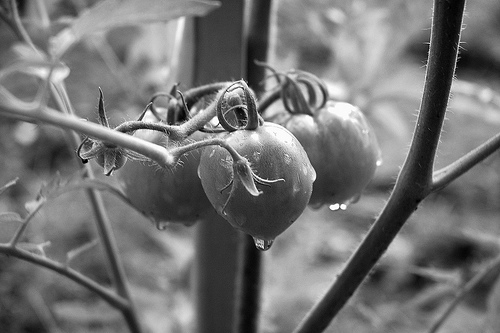
Growth
fun in threes, sometimes fours
food and cooking
Despite the ravaging neighborhood creatures, we managing to grow things. Our plot behind the house is struggling a bit,
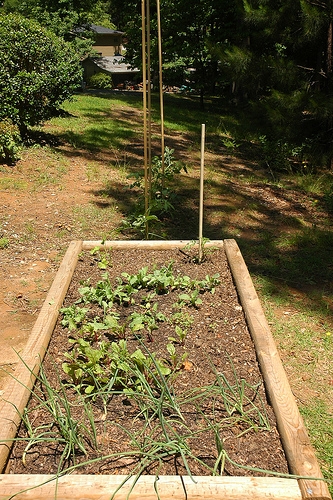
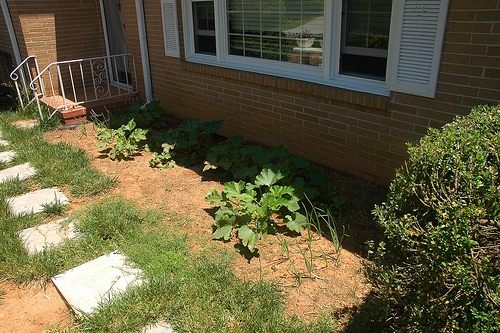
but our squash, zucchini, melons, and onions in front of the house are doing very well.
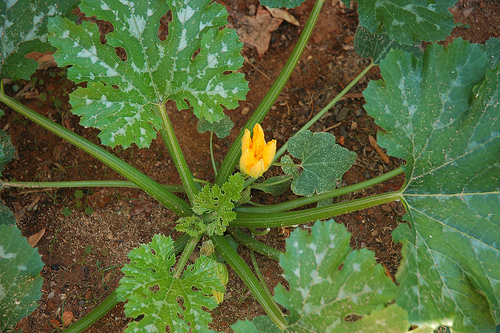
Some are even flowering.
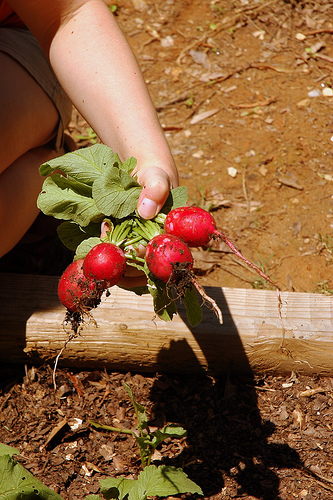
In fact, we've kept one thing in the ground long enough to have a harvest: radishes. A few are almost as big as a ping pong ball, and K explains that we have to pick those now, else they'll be no good. "They don't taste as good when they're bigger." Not knowing the first thing about growing radishes, I nod my head in approval.
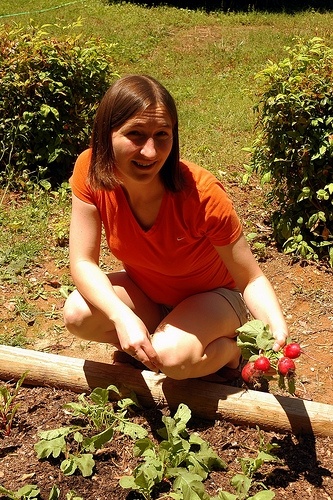
Radishes are a like dill for me: they make me think of summer in Poland.
We use the radishes to make a creamy cheese spread: diced radish mixed in with farmer's cheese. A simple thing, but then, many of the tastiest foods are "simple things."
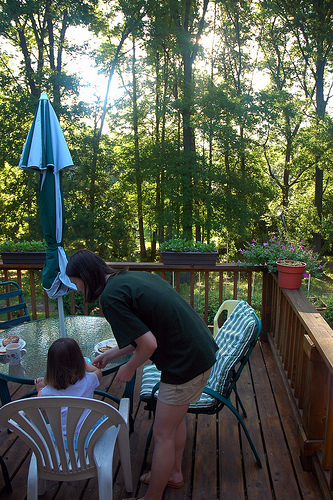
The cheese is a highligh of our Sunday-morning breakfast. The Girl as her usual: French toast and Maple syrup.
Then we notice our back bed has been visited again.
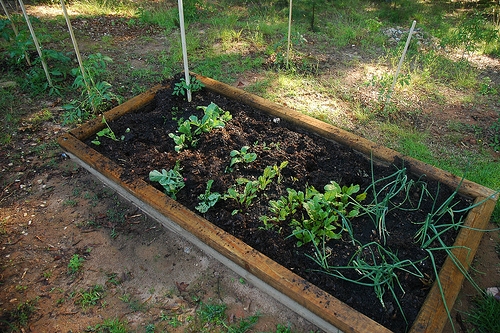
Enormous holes, spread through the bed. "It's the worst it's ever been," K sighs.
Our raccoon neighbor? Dogs?
It's hard not to take it personally. "What did we ever do to you?" A useless thought -- best to start planning how to keep out of our garden dogs, chickens, raccoons, squirrels, bears, elephants, and whatever else might be lurking in the neighborhood.
Growing up, I drank milk my mother purchased from a small farm about fifteen miles from our home in Virginia. When I went with my mother, I often got a “tour” from Mrs. Campbell. Chickens, cows, a horse or two. The cows wandered about the pasture, grazing and lazing all day long. They moved slowly and seemed totally relaxed.
For a suburbanite like me, it was heaven.
Then there was the milk: always thick and delicious. Vigorous shaking was prerequisite to pouring. And a taste that was radically different from the nonsense I drank in school.
When we stopped our milk runs and turned to store-bought milk, I was initially disappointed with the taste but eventually grew used to it. Trying to remember that taste was like trying to remember an odor: it lingered in the mind just long enough to taunt me with the realization that I can’t truly remember it at all.
I’ve had the opportunity to taste that milk again, here.
It turns out, there’s a local dairy farm and creamery that runs on the same principles: no hormones or antibiotics; free-range grazing; stress-free, healthy living.
Further, it turns out they give tours.
We arrived just after twelve, stepped out of our car and suddenly felt we were back in K’s home village. The odor of a farm is international, and strangely warm and heartening.
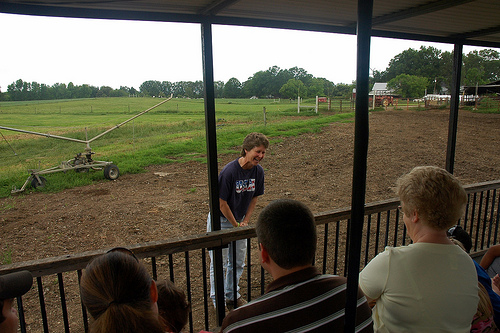
The farm is Trantham’s Twelve Aprils, and the tour convinced me of one thing: buy their milk or no one else’s. No growth hormones, no antibiotics, no stress, grass-fed — pretty much what I grew up on.
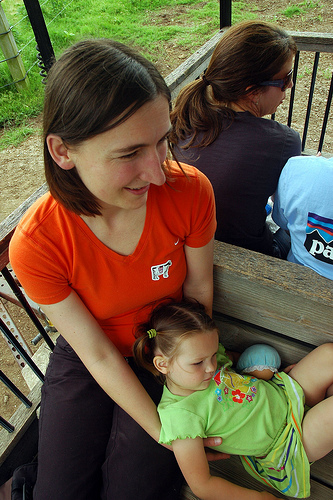
K had heard about the tours, so she arranged a few families to get together for a tour and some strawberry picking afterward.

Sitting in a trailer behind a tractor being dragged all around a farm doesn’t seem like it would be terribly enjoyable, but learning about simple but revolutionary grazing techniques and the resulting product was, in fact, almost a blast. L was entertained by the simple fact of being pulled by a tractor. Having a farm coloring book helped as well.

The milk is available only in South Carolina, but given the small size of the operation (they have, if memory serves, eighty milking cows right now) relative to the size of the output is fairly stunning.
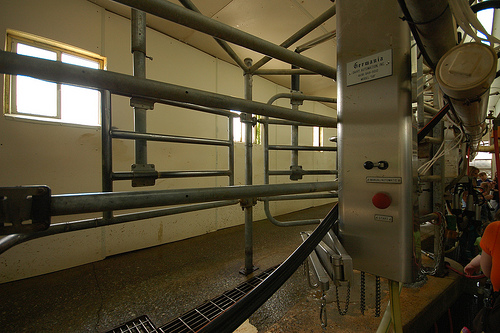
After the tour, we got a chance to sample the milk. They have three products: buttermilk, regular, whole milk, and chocolate milk. I’ve never, in my life, been a fan of buttermilk, but theirs was delicious.
“Mega-dairies add things to their buttermilk to sour it,” the guide/farmer explained. “The result is a strongly acidic taste. Ours doesn’t have that.”
She was certainly right.
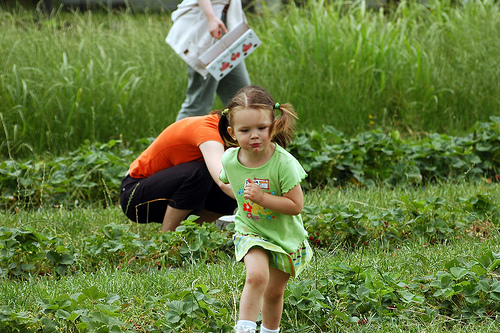
Finally, it was time for strawberry picking. “You might not find much after the school kids we had coming through here this week,” the owner’s daughter said.
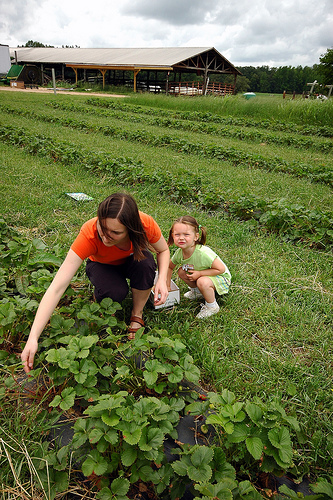
L helped by serving as a quality assurance specialist and general run-around-the-farm-laughing consultant.
Just before packing up, we were able to see the pregnant cows. “We’ve got fifteen due in July,” the guide/farmer said. “It’ll be a busy time.”
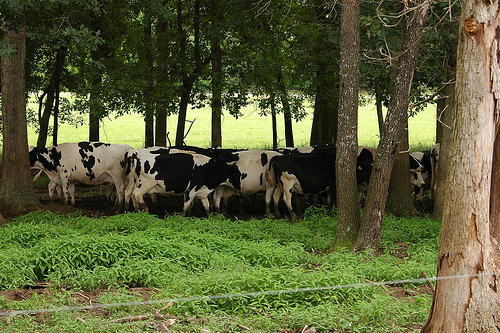
As always, L stood, fascinated with the animals. Last summer in Poland, “I want to see the cows” was a common refrain.

The fascination hasn’t waned in the intervening year.
For dessert today, we had that Polish favorite, shredded carrots and apples topped with chocolate. Chocolate and carrots are a popular culinary combination in Poland, though cabbage and chocolate is a little more classy and the all-time spring favorite is chocolate covered radishes.
Ah, the things we do to try to ween the Girl from this and that...
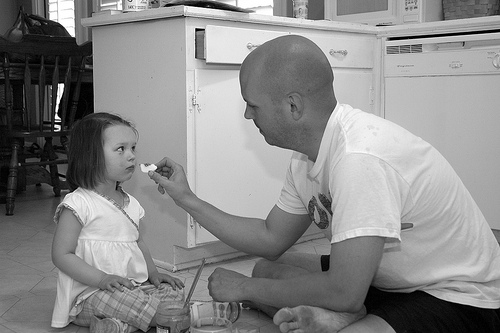
Often, when L and I arrive home, we take a snack together. An eternal favorite is apple slices with a light spread of peanut butter and a shared glass of milk.
I don't know how we began sitting on the floor, but we do now consistently -- even when it's a Saturday afternoon snack.
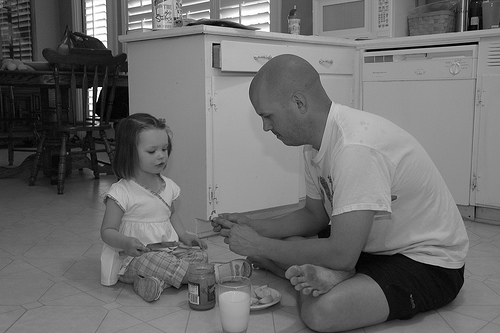
I hold the apple; L spreads the peanut butter. The cooperation is a blessing: she often insists on doing everything herself, and that can lead to frustration.
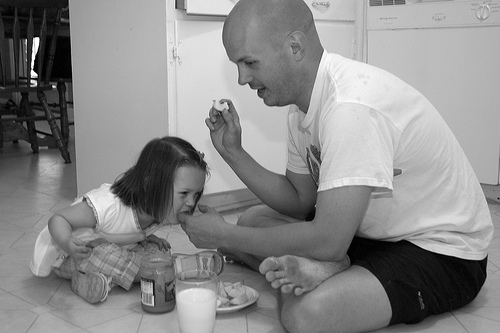
She also cleans up messes. Occasionally, the mess is bigger after she completes the task, but in the case of peanut butter on a finger, she does a thorough job.
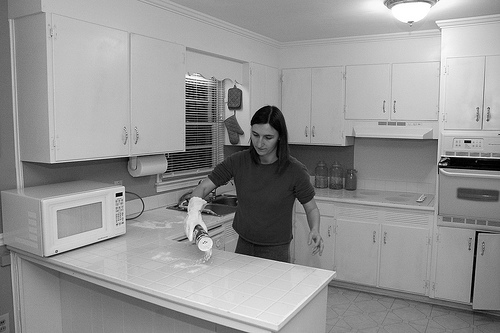
Christmas is nearing -- in a Polish household, that means cleaning.
For us, it also means smoking. Sure, it is a redneck-looking smoker, but the elegance of the pepper-corn-encrusted tenderloin I have in there now will make up for it, I'm sure.
4
In America, if a beer has "more than three and two-tenths percent of alcohol by weight," it's called "malt liquor." And "malt liquor" has certain connotations.
The alcohol-by-weight for taxation purposes versus alcohol-by-volume for all other purposes is yet another example of America's love affair with mixed measure standards. At L's last check-up, for instance, I noticed that weight was calculated in the English system while head circumference was measured metrically. And surveying, because of software limitations, uses not inches but tenths of feet -- the American metric system.
Wikipedia -- that bastion of objectivity -- writes, "Malt liquor is distinguished from other beers of high alcohol content in that the brewing process is seen by many as targeting high alcohol content and economy rather than quality." Translation: it's a seen in American culture today as something of a party and/or ghetto drink. It's for people who don't know better, can't afford better, or just don't care.
In Poland, there's just beer. Some beer is called "Mocne" ("powerful" or "strong") but it's just called "beer".
Generally speaking, I don't like Polish "strong" beers. To get their strength, they add a lot of malt (hence, "malt" liquor) and it produces a sweeter beer than I generally like.

There are some exceptions. Okocim Mocne is drinkable, but still too sweet. Debowe Mocne is less sweet, but there's just something I don't care for. My favorite is Tatra Mocne. A review is available here.
I've never seen any of these in the States except the Okocim, though I really haven't looked -- just happened to find it at a Russian food store in Asheville.
In four days, though, I won't have to look far.
Gautama Siddharta said,
Let yourself be open and life will be easier. A spoon of salt in a glass of water makes the water undrinkable. A spoon of salt in a lake is almost unnoticed.
Salt. Salt is the key to good smoking, and Siddharta could have just as easily framed his analogy in terms of the salt bath for smoked meats (though it probably wouldn't have read as well).
We added what we thought was enough salt. We did a taste-test of the water, and it seemed to be about as briny as the first time, when Dziadek, the smoking expert, was still here.
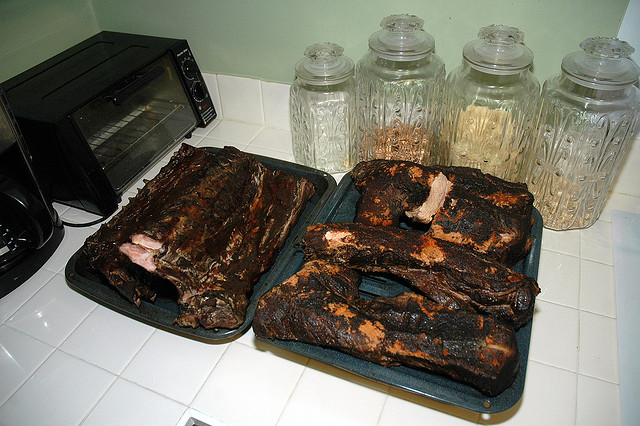
Apparently we got it wrong, for while the second batch looks good, the taste just wasn't there.
Can that which is unsavory be eaten without salt?
or is there any taste in the white of an egg?
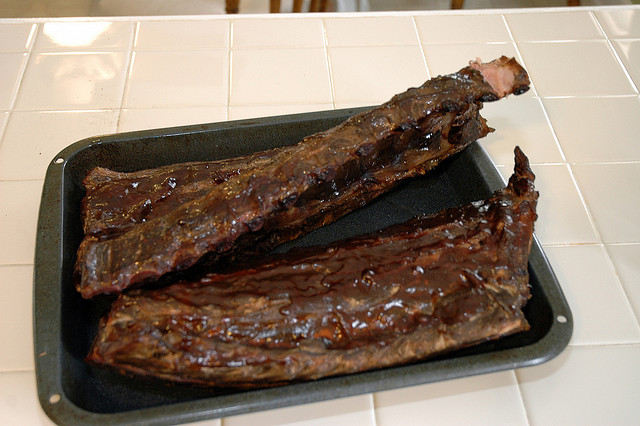
Apparently not.
We bought an entire pork loin for Saturday smoking. When you buy it in this quantity, the price is almost absurd.
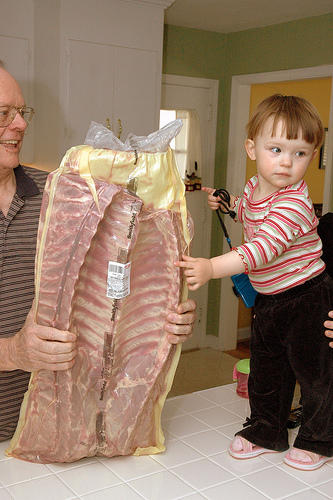
Twenty-five pounds of meat for less than $60. "If I broke this apart for you," the butcher said, "It would cost you three times as much."
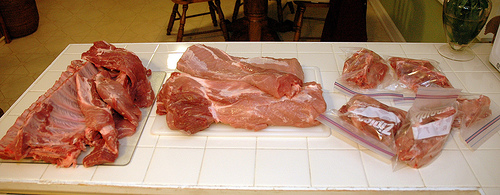
An hour of cutting gave us two whole deboned loins (I don't know what you'd call that), two baby back ribs, and six ZipLock bags of soup bones and left-overs (only five shown below).
Saturday morning, I'm hoping to have a more successful smoking session than our first. While the end product was good, the smoke was too hot, producing less-than-perfect meat. Since I only have oak for smoking, and it burns really hot, I'll be soaking some planks in water to add some smoke and to cool it down a bit.