family

Manners

The room was dark; L and I were in the rocking chair, just moments before she went to bed. A time to calm down, this time of day often brings out stories about how L’s school day went.

L began telling me about the order they sit in during circle time.  She’s in a new group, and most of the children in there are new friends, so there were lots of new names floating about. She hardly finished one name when she started another. Then a pause.

“And beside Alex…” her voice tapered off.

“Who’s beside Alex?”

“I don’t know.” We rocked for a few moments, then she amended it. “I don’t know her name.”

“Why don’t you ask her.”

“No,” said L in a quick, clipped voice: it’s how she’s shortened “I don’t know” for many months.

“You just have to introduce yourself. Walk up to her and say, ‘Hi. My name’s L. What’s your name?'” A few more rocks, then I suggested we practice.

Within a few moments, she began improvising — “What’s your name? My name’s L.” — and adding a handshake with, “Nice to meet you.”

The following night, I asked her how it went. “Did you meet that girl from your circle time?”

“No,” she replied, and then gave a meandering explanation that only a toddler could come up with. Still, we practiced again.
Miss Hyde

“She’s so easy-going!” I’ve heard several people at L’s school mention this, and I’m certainly pleased about it. When I hear this, I’m also a little confounded about the Miss Hyde that appears on a daily basis at our house. “Easy-going” is not how I’d describe her distressingly often; “high-maintenance” and “tiring” are the words I’d choose.

Familiarity, in this case, truly leads to a sort of contempt (though that really is much too strong a word). She’s lately taken to behavior that, while I knew was possible irrespective of the quality of parenting, I never really believed would appear. Not being clairvoyants, we are unable to peer, or even peek, inside her head to find out what’s causing this. Exhaustion is certainly part of it, as she’s not getting enough sleep; stress is definitely a component, for she’s moved into a new group at her preschool and all that was known and comfortable has disappeared. But there must be more to it than that, and, as with the classroom, we’re left wondering whether we’re doing everything we can.

The Wisdom of Seuss

An occasional selection for my nightly bedtime reading with L is One Fish, Two Fish, Red Fish, Blue Fish. She sits on my lap, commenting on pictures, asking with every pause, “Turn the page?” We make our way slowly through the book — it’s not one we read often and she can’t recite any passages from rote as I read, like she can with Fox in Socks or Green Eggs and Ham.

I’m always taken aback at the appropriateness of the ending:

Today is done.
Today was fun.
Tomorrow is another one. …

If we could only keep that in mind daily.

Hit or Miss Language

At school, everyone is “Miss.” Miss Karen. Miss Cathy. Miss Deborah. Miss Brenda.

Miss Cathy — L’s favorite — works in Toddler I. L no longer sees her on a daily basis, but her eyes light up when she sees Miss Cathy coming.

Miss Karen, Miss Deborah, and Miss Brenda work in Toddler II, where L spends her days now.

I wondered whether L thinks “Miss” is just part of their name, but it’s become obvious that L has separated the “Miss” from the name. She understands it as a prefix, but she still doesn’t understand its significance. It’s a term she uses with individuals she really likes.

Hence, I am often “Miss Tata” now. K is “Miss Mama.” Our cat, “Miss Bida.”

No!

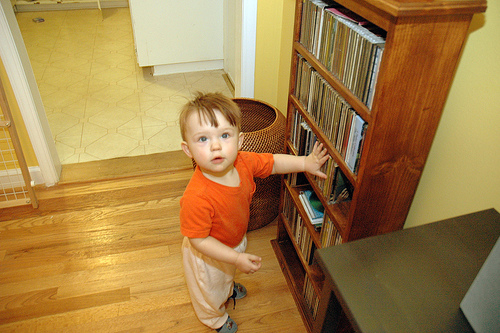
Power outlets, books, and CDs are the only things we really say “No!” to with the girl. Oh, and plants and hot things and climbing on the stairs and so on. And the cat, when we had a cat. (He ran away some weeks ago. Some say he’s supposed to come back any day now.)

No!

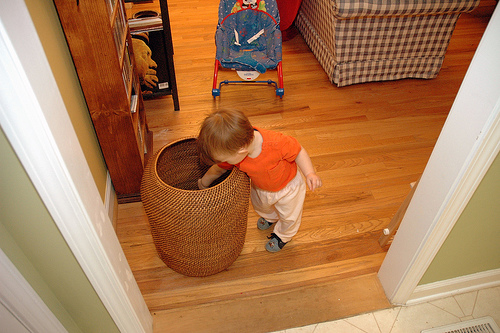
Still, it’s the forbidden that’s attractive.

(I’m sure it didn’t help to send mixed messages by saying “No!” and taking the picture. But I just happened to have the camera and couldn’t resist.)

Fortunately, there are plenty of things in the house to hold her attention.

Curious

Landmines

When the Girl is being put to sleep, she sometimes gets angry. Scratch that — furious. She can howl and scream and whimper endlessly when I’m the one trying to put her to sleep instead of K.

I usually just wait her out. She’ll literally scream and push and wiggle and cry until she literally passes out. While she’s doing this, I simply walk around the apartment, holding her close, and whispering sweetly (or as sweetly as I can manage while every last nerve in my body is being assailed simultaneously). There comes a time when she’s crying, then whimpering, then crying, then tumbling quietly toward sleep — until something disturbs her and reminds her, “Oh, yes, I am indeed irritated.”

That’s when toys can become landmines.

DSC_8934There are two beeping, flashing, musical toys that are particularly deadly. In one of them (a caterpillar that plays about four songs and flashes lights where one wouldn’t think caterpillars would have lights) has expired: the batteries are dead, and gosh darn it, I just can’t seem to remember to replace them. Touch it and it begins a loud, loud, loud symphony.

The porcupine is not much better. Give it a kick (as I did last night) and it begins talking to you. Nothing too intelligent, but you wouldn’t expect physics from a porcupine.

Last night, I kicked it dead center. I’m not sure which woke L: my sudden, frustrated gasp, or the porcupine.

Swimming, Redux

The video is fixed — don’t know why it wasn’t playing, but I just re-“compiled” it and it seems fine.

Update: Some folks tell me the video stops halfway through. I give up on this one…

Swimming II

We’ve been taking L to swimming lessons at the local YWCA. Within a few weeks, we’ve gone from calmly moving her about the pool (“Dig, dig, dig! Kick, kick, kick!”) to dunking her under water after blowing in her face. She doesn’t much like the former, and the latter sets her to screaming more often than not. The instructor suggests that it’s the water running down her face when we pull her back up that upsets her.

Still, we take her regularly and follow the instructor’s advice, on the hopes that it’s the unfamiliarity of it all that is bothering L.

There’s a progress report at YouTube.

Potty Training

Few things in life are more of a milestone for a child than to learn how to use the toilet. There’s tons of advice about when and how to begin. “Most children show signs of readiness to begin using the toilet as toddlers, usually between 18 months and 3 years of age,” writes one site. It continues,

These signs include staying dry for at least 2 hours at a time, having regular bowel movements, being able to follow simple instructions, being uncomfortable with dirty diapers and wanting them to be changed, asking to use the potty chair, or asking to wear regular underwear. You should also be able to tell when your child is about to urinate or have a bowel movement by his facial expressions, posture or by what he says. If your child has begun to tell you about having a dirty diaper you should praise him for telling you and encourage him to tell you in advance next time.

Well, L can’t communicate yet, and in fact she’s just learned how to sit up on her own. That doesn’t mean she can’t use a potty chair already. How do we know? Because she’s successfully used the chair several times.

Is this real “potty training”? I do indeed think so — we’re giving her an alternative to dirty diapers from an early age, and we’re showing her how “grownups” do it.

The key is knowing when she usually relieves herself. BMs are the easiest, because she announces it clearly and well in advance. But at least two times, we’ve sat her on the potty chair after eating when she wasn’t showing any signs, and within a few moments, she made use of the chair.

Our hope is that this will make “real” potty training more manageable. We’ll see in a few months…

Limits and Liquids

We went to visit family yesterday. This meant a lot of time in the car, which meant, for L, a lot of time in the car seat.

We discovered, much to our surprise, that L doesn’t really like the car seat as much as tolerate it. Imagine — she doesn’t like being strapped into a virtually immovable position for hours on end.

We think liquids might help, because she seemed to cry much less violently during that last hour when she was working on a bottle of tea.

In Poland, in summer, potatoes — those ever-present tenants of the Polish table — are always served with fresh dill. All told, I had to scrape of pounds of it during my years there, and no one could understand that I just don’t like the stuff.

“Tea!? You give your 5-month-old tea?” I can just hear the voices now. Well, to call it “tea” is really a stretch. It’s a special granulated herbal concoction J brought from Poland with her. It’s made specially for infants, and it’s made from dill and aniseed. To my nose, it stinks like the dickens, because I don’t like either one. But the girl likes it, and it eases her stomach, and it will undoubtedly ease time in the car.

After all, K and I buy green teas for the road. Why shouldn’t she have something to drink to?

Maybe it’s just one of those paradigms you slip into when your baby is breastfed. Additional drink is like additional food — unnecessary. What we’re learning is that that is only true — duh — for the first four or five months.

Subtle

When I was in Poland, I eventually reached a point in my linguistic development at which I understood everything going on around me. It wasn’t fluency, because in any given sentence there might be one or even two words I didn’t know, or couldn’t immediately place, but I learned that understanding 100% of the language doesn’t mean understanding 100% of the words spoken.

Once I reached that linguistic milestone, it felt I’d always been at that point. It felt like I’d always been able to understand everything, even though I knew it wasn’t the case. Like swimming and reading, understanding Polish was something I couldn’t remember what it was like not to be able to do. (What an awful example as a teacher I’m setting with that sentence! And this one…)

Today, we went to see my cousin and her recently-adopted baby. The little girl — S — is six weeks. She’s about a pound heavier than L when she was born. And I looked at that little girl, her eyes still mostly closed, and I couldn’t imagine L being that size. I know she was. We have the pictures to prove it. But, as with the language, I just feel she’s always been this size; that she’s always been able to hold her head up; that she’s always been able to look around, to smile, to cry from boredom, to giggle, to coo.

And then, a little voice: “That is how you’ll wake up one morning and realize she’s going off to college and for a brief moment, feel complete unprepared for it, and feel she’s completely unprepared for it.”

It’s not quite synonymous with “taking for granted,” but it’s awfully close.

And I think that’s one reason why I’m trying so hard to write in this silly blog so often. To mark the lines of development; to make a record for later — to make an online baby book.

Besides, what else am I going to write about in my newly realigned universe?

Cut!

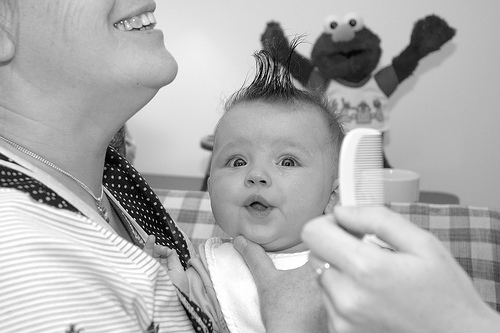
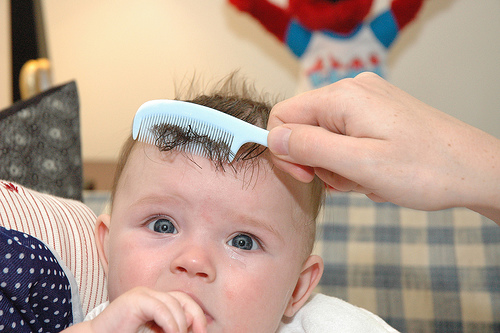
L’s had a lot of hair since she was born. Recently, we decided that it had grown too long — at least the little lock that was swooping down into her eyes.

First step: wet the hair and get it standing up — as Elmo looks on…

DSC_7040

Next: cut it. Given L’s propensity to jerk suddenly when a flash fires, I didn’t actually get a shot of that.

Finally, comb it.

DSC_7045

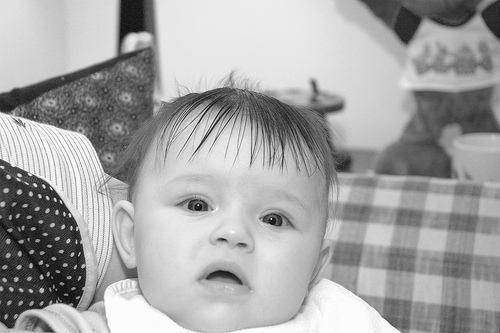
And in the end, she looks like one of those wet-hair-look Euro-trash boys (and I say that with tongue firmly in cheek).

DSC_7046

All she needs now is a tracksuit and she’d fit in perfectly at any Polish soccer match…

Note To Future Parents

When playing with your child, some common sense is in order. After eating, for example, is not the best time for bouncy play.

That’s fairly logical, but there’s a derivative from this: after eating (up to, say, an hour after), avoid any play that places the child’s head directly above your head.

As a newly washed car is to a bird, so your face, with it’s stupid, wide-open-mouth smile, is to your child…

Turning Heads

I’m constantly amazed at all the things L has to learn, and how quickly she learns them. She learned those things waving around in front of her face were hers, and then she learned to control them. She’s figured out that those growths from her lower body are hers, too, and she’s learning to control them too.

Both those examples are very concrete.

Lately she’s been getting into the abstract.

We noticed last night, for instance, that she’s figured out a major fact about the world around her: it generally stays in the same place, and it’s she that moves. She was watching K load the dishwasher, and I turn around 180 degrees. She quickly turned her head and continued watching. And it took me just a couple of seconds to realize the significance of what she’d done. I turned back around again; she turned her head again, and giggled when K kissed her cheek.

Sort of…

Sitting IThere’s a definite developmental order almost all infants follow. Sitting comes before standing. Crawling comes before walking. Babbling comes before talking. Liquids come before solids. It’s all very regimented in the child’s development.

Or so I thought.

L has been challenging that preconception, though. Now, the Girl absolutely and very resolutely does not want to sit. She wants to stand. Sort of. We’ve been burping her simply by setting her on bottom and letting the pressure that exerts on her belly (when she leans over slightly) force out all the offending air. Now, she simply extends her feet when we move her from a horizontal to vertical position, and it’s virtually impossible to get her simply to sit.

Sitting is one thing. This is quite another.

Update I somehow didn’t provide the link to the video. That’s been corrected.

In the Dark

For the first time in ages, K and I slept in the dark last night.

No, not the “first time in ages.” The first time in almost four months.

Since L’s birth, we’ve kept a small red light on beside the bed. You never know when the girl’s going to wake up in a pacifier panic, or spit up and need emergency cleaning, or any number of other horrid, life-threatening things.

But  last night, K thought we should do an experiment — open the blind to the window on her side of the bed and see if that provides enough light. And it did.

And so for the first time in weeks and weeks, I lay there in the dark, no red light filling the room with an oddly calm-yet-angry glow (red light is just really not all that pleasant at all), and it honestly felt as if it was the firs time in my life that I’d slept in the dark. It felt like going to bed without brushing my teeth, or coming home without hugging, kissing, and playing with the girl, or eating cereal with skim milk — it just felt unnatural.

Next step — get the girl to stay in her crib all night, even in the midst of needing a 1:00 a.m. feeding…

Sick

The Girl has been sick-ish. Lots of saline nose drops and bulb syringe work as a result. Lots of crying. And least significantly: a beautiful weekend spent inside.

L is at the age now where she’s starting to recognize things — including bulb syringes. Which means she sometimes starts before the whole process starts. Then, the degree of difficulty increases significantly as she jerks her head from side to side, crying, snorting, and being generally miserable.

And so now that we’re at the point of L’s life we were all sort of looking forward to (the time when she’s not so fragile as when she was first born), we’re looking forward to when she’s able to communicate her needs, and, more importantly, we’re able to communicate with her.

“I know this hurts, but I need to do it so you’ll be able to breathe better.”

Tumble Calm

I have a friend who once put her cat in the drier — by accident, she claims. She just closed the drier door and it started up. From the inside came howls and screeches and the odd sound of scamper, scamper, scamper thud. My friend was laughing and crying so hard, she said later, that it took her just a moment to get the door opened. Off the cat bolted, disappearing for a good long time, emotionally scarred for life.

All that is just to point out that driers can be used for things other than drying clothes.

Take calming babies, for example.

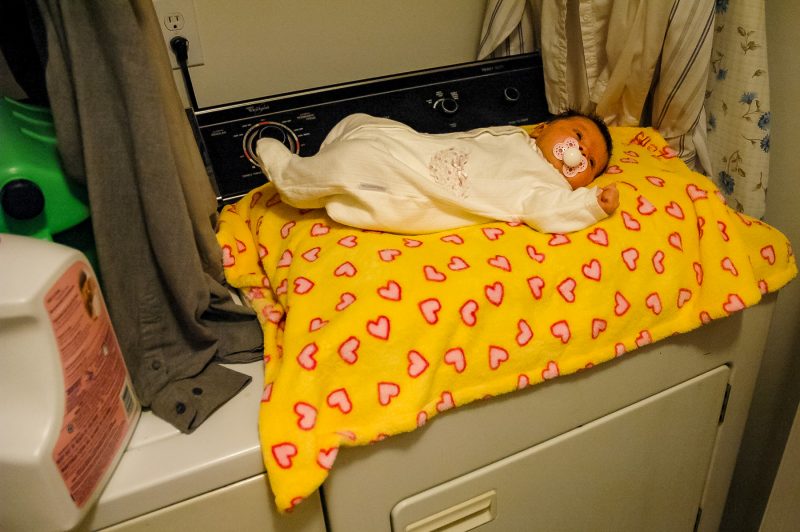
K and I had heard several couples say that the only thing that would calm their child was to put him on the drier and turn it on. Apparently the combination of motion, noise, and warmth was somehow soothing.

The other night, L in full panic mode, we decided to try it. And it worked. I put her on the pillow and blanket we’d set on the drier and she stopped instantly. It didn’t work for a long time, as evidenced by the picture: eventually she wanted her pacifier as well. But it’s good to know that, when all else fails, Maytag can save the day minute.

Enter: LMS, Part V :: Birth

One two, one two — chop chop! There’s a sense of urgency to the arrival at the hospital that I’ve never experienced before. Yet, strangely calm urgency.

We get to the emergency room and the attendant grabs a wheelchair for K and I head back out to park the car. By the time I come virtually sprinting into the birthing room, K is on the bed, a nurse is getting a vast array of implements ready, and we’re all wondering when the midwife is going to arrive.

The nurse hooks up the two belts around K’s belly that measure the contractions and L’s heartbeat. She goes over some paperwork with K (“Would you refuse any particular type of medical intervention on religious grounds?” and the like) and then the midwife comes in. This is something like her 1,600th birth — she’s calm, calm, calm.

Contractions continue. Questions continue. More nurses come in and prepare a tray covered with various “sharps” — scissors, scalpels, needles, and a few things that look more Inquisitorial than medical.

Paperwork complete and sharps in place, it’s time to get K to the tub. I glance at my watch — it’s something like 6:40 am. We’ve only been there a little over forty minutes. Things are going so fast that it’s difficult for me to keep everything in perspective.

Once K’s in the, everything calms. K relaxes so much — and is so exhausted — that she actually begins falling asleep between contractions, which are coming with more frequency and lasting longer. I begin thinking, “Forget this hours in labor stuff — we’re having this baby within a few minutes.”

Close.

LMS

Through this all, K’s constant question: “When will I know to push?” The midwife, the nurses, everyone (except the only man in the room) respond with a reassuring laugh: “Oh, you’ll know.” One compared it to the feeling you get when you absolutely have to have a BM and there’s no toilet around. Nothing like a metaphor even the man can understand.

Sure enough, within a few minutes, K says, “I think I need to push.” And push she does, probably a total of less than ten times.

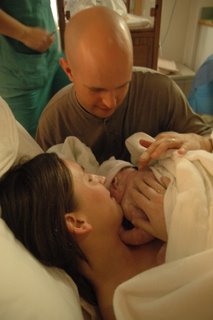
At 8:05, L makes her appearance, covered in cheesy Vernix caseosa, which the midwife advises K to use as lotion around her eyes. Her eyes, not L’s. “It’s the best moisturizer in nature,” she explained.

Within minutes, K’s in the bed, with L lying on her chest, and G standing around in a daze…