matching tracksuits

fun in threes, sometimes fours

education and teaching

Snow Day

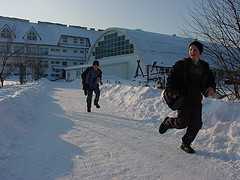
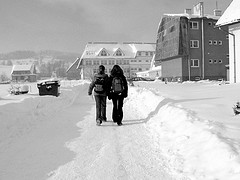
Snow Day? You must be kidding? I woke up this morning to a fiery throat, thinking immediately, "Maybe I'll come home early -- as in, shortly after arrival -- if we're not terribly short-staffed." Much to my delight, I looked outside and saw a powered sugar dusting on everything and thought, "No school, I'm sure." And sure enough, no school. There's less than an inch of snow on the ground, but no school.Returning home from school

I think back to the years I spent in Poland, buried in snow from December (sometimes November) to March. I believe we missed one day because of weather. If I recall correctly, students are not legally obliged to come to school if it's colder than minus 18 Celsius (0 Fahrenheit), but many come anyway.

K laughs at the reaction here to the slightest bit of snow. There are two reasons, I explained to K. First, most places don't have the equipment to remove snow city-wide. And given the fact that so few people have experience driving in snow, the slightest bit makes them nervous.

dsc00048A colleague at work provided the second explanation: that there's a certain phobia with local school boards about lawsuits, and so they cancel school at the slightest hint of bad weather.

Both reasons are completely foreign to K.

Many roads in Poland are literally packed with ice through most of the winter, so the thought of being spooked by a couple of centimeters of snow is absurd to her.

And the fear of lawsuits?

Only in America, she smiles.

Update

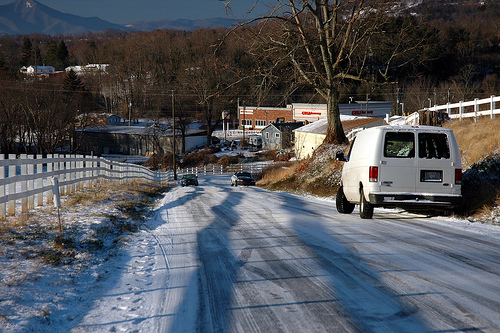
I went out for a walk at about eight. Suddenly, it was fairly clear why school was closed.

Slip Slidin' Away

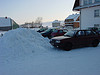
Just a few feet apart, three cars that slid off the road.

For the Want of Punctuation, Calm Was Lost

We'll call him Doug. He's one of the young men I work with -- a young man who's made a lot of progress in the last few weeks. An exchange with him a few weeks ago taught me -- again -- the importance of speaking judiciously, and it suggested something of this young man's past.

We were writing up reports from a short experiment we'd done, and I thought I'd use the chance to teach the boys something about spreadsheet software. We were beginning to enter all the data into a spreadsheet, and I suggested to Doug that he add a title.

"What do I call it?" he asked, his voice a bit edgy.

With Doug, I've noticed that confusion leads quickly to frustration, and frustration can lead to crisis. When I hear the edge in his voice that suggests all is not well, I slow down, and I also mention to Doug that I've noticed he's getting frustrated, and I encourage him to keep his cool "like I know you can."

To answer his question, I suggested he think back to the topic we'd been learning about in the previous lesson (namely: friction). He couldn't remember, and he was clearly not entering a "teachable moment."

I continued trying to jar his memory, asking him some fairly basic questions that were similar to ones we'd worked on in class. One of them, I recall, was, "Well, Doug, what happens when you try to walk on ice?"

He looked at me as if I were a complete idiot. When he didn't answer, I asked him to hazard a guess.

He exploded.

Man, you know what happens when you try to walk on ice! I know what happens when you try to walk on ice! Everybody knows what happens when you walk on ice! Why are you asking me that?! What are you talking about. I just want to get some help and you go off asking me stupid questions!

His voice had gone from being merely edgy to being positively aggressive. Everything in his body language screamed, "You're an idiot!"

Since instruction in social skills trumps academics, I stepped out of my role as science teacher and explained what had just happened.

When you say those things in that tone, with that facial expression, your words are telling me one thing, but your body is saying something else. It's saying to me, "You're stupid."

It's just a small step from, "It's saying to me, 'You're stupid.'" to "You're saying to me [that] you're stupid."

Doug heard the latter; I intended the former.

Instant crisis.

"Man, don't you fucking call me stupid!" -- and several variations of that same sentiment before I could calm him down.

At first, I was completely taken aback. I had foreseen the misunderstanding and thought I'd chosen my words with sufficient care. My gut instinct was something I'm a little ashamed to admit now: "You just hear what you want to hear! You're just looking for an excuse to act out!"

Writing about it in my journal that night, I realized my error. You can't verbally indicate those quotation marks (or inverted commas, if you prefer) with perfect clarity. When I wrote the sentence, I saw how easily it could have been misconstrued.

Better would have been, "It's like you're telling me that I'm stupid."

All that aside, I can't help but wonder if there was much more going on. Most of the kids I work with come from environments that are so far from the norm -- let alone the ideal -- that it's shocking. For all I know, almost every time Doug has heard the word "stupid" coming from an adult's mouth, it was directed at him.

Once I calmed Doug down and explained what I really meant, I realized I did have a teachable moment then.

See, Doug, when you thought I called you stupid, you really didn't like it, right? And you really didn't want to be in my presence, let alone have me help you. When you let your body language accidentally tell people that they're stupid, they don't like it, and they'll be less inclined to help you. Understand?

Doug screwed up his mouth while he thought about it, then mumbled "Yeah." And though I might be imagining things, I could have sworn that for the rest of the lesson, Doug was doing his best to stay aware of his body language.

As often happens in jobs like mine, its those little moments that make all the less-than-ideal on-job experiences worthwhile.

The Process of Education?

Via Autism Vox, I found this post: “The Process of Education.” In part, it reads,

shouldn’t the people who fail school be kicked out? I mean, if someone fails a class and makes no effort to regain good grades, that person is assuredly not going to contribute to society. It really would save a lot of money and time if those people were just simply expelled; they obviously do not care about their well-being and education. it’s a waste of money for us all, and morons like that tend to annoy me, anyways. And the same goes for mentally challenged children. Just let them die. We, in this world, cannot waste any more money educating these worthless brats. And I’m not talking about ADD or ADHD. Those things can be channeled by a person and used for their advantage. What I’m talking about are the more serious illness. Autism, for one. People with autism shouldn’t even be educated, and if I was a parent of an autistic child, I would really be ashamed. We don’t need to waste any more precious money educating people who won’t learn (Process of Education)

Dr. Chew deals with the uneducated absurdity of this comment here, but I wanted to touch on something a commenter said in reply:

It’s high school, it’s more a social experience than anything. High school builds character and knowledge where you manage to grasp it.

A lot of fluff was in my high school days and I’d like to think (I say like because someone has to pay for that shit to keep going) that whatever class you’re going into has a small impact on your overall character and in some way you’ll expand yourself. I was in all sorts of fine arts classes from art itself to woodworking, computers, ceramics, to auto body, and from my standpoint right now I’m glad I went through those classes so I at least have some knowledge in a different area of life. I understand that I may never again have the need to wedge an aerated piece of clay air tight again but at least I know what it is. (Source)

High school is a social experience? Sadly, I agree. And this individual (one “shaharazhad”) even touches on part of the problem: a completely fracture curriculum. In the name of diversity, we’ve spread our education so broadly that it’s almost paper thin.

Now, thanks to No Child Left Behind (NCLB in all in-school communications), we’re reaching over to the opposite extreme, at least in primary school. We’re focusing so much on math and reading that we’re neglecting a lot of other subjects that might be called “fundamental.” NCLB tries to solve the problem of low achievement through testing and conditional funding. What about lengthening the school day and increasing the number of days children spend in school?

Suspension

The typical suspension length at my high school was three days. I'd heard of year-long, but I never actually heard of anyone getting it. It was always out-of-school suspension as well. To my recollection, there was no such thing as in-school suspension at my high school.

There is certainly a move away from out-of-school suspension, for a variety of reasons.

The unappealing idea of students serving out-of-school suspensions roaming their communities during the day, possibly getting into more trouble, prompted some schools to create or expand their in-school suspension programs. In Louisiana, state officials became so concerned about suspended students missing instructional time that the legislature began funding in-school suspension programs.

The Kentucky Department of Education encourages school districts to develop policies that include well-rounded academic offerings for those students who stay in school during suspension. (Education World)

But it still exists. If it didn't, I wouldn't have a job, for a majority of the clients in our program are there because of year-long, out-of-school suspension.

Out-of-school suspension (for simplicity, just "suspension" hereafter) is the lazy way out, though. It puts the burden of educating the most troubled students on someone else. In our organization's case, that "someone else" receives most of funding through "professional begging" -- that's what the organization's director likes to call his continual grant writing.

Suspension addresses only the behavior; it does nothing to correct the causes of the behavior. To be sure, those causes are myriad and most of them out of the effective reach of a public school system. If a child has been suspended for the remainder of a school year, the situation has reached a point at which therapists are probably necessary. Short of dealing with the causes, school systems are simply putting off the inevitable: a sense of failure so deeply ingrained and reinforced that the child gives up on doing anything other than fulfilling everyone's expectations.

An old saying comes to mind: "If you think you're going to succeed, you're probably right; if you think you're going to fail, you're still probably right." School systems that kick the tough kids out of school are feeding into the latter. Then organizations like ours have one more shell to break through before we can start reinforcing the former.

Perspective

In the switch from science to social studies at the day treatment program with teach in, I’ve gone from trying to follow the appropriate grade-level curriculum in science to allowing the kids (and myself) a bit of freedom in what we’re covering now in social studies. (We switch subjects every six-week grading period.) On talking to the lead teacher, I realized that it’s not as critical that we follow the curriculum because there’s such a mix of kids.

M-Jezzy, of science fame, has been asking about slavery. How did it begin? Who started it? How’d they get the slaves?

In explaining that we’d be looking at slavery next week, I got a response I’d been thinking I might hear, but had hoped to avoid nonetheless. Basically, a young man asked, “What can a white guy teach black people about slavery?” Now, to his credit, it was very polite — surprisingly maturely and subtly phrased, in fact. It was more like, “I don’t mean any offense or anything, but, you know, I’d rather hear about slavery from someone who’s experienced it, someone whose people experienced it.”

“That’s a very good point,” I said, thinking, “Am I glad I did some research before mentioning this,” for that’s exactly what I found:

In the 1930s, the Works Progress Administration (WPA) sponsored a federal project dedicated to chronicling the experience of slavery as remembered by former slaves and their descendants. Their stories were recorded and transcribed, and this site presents dozens of select sound recordings and hundreds of transcriptions from the interviews. Beyond the content of the interviews, little to no biographical information is available on the individuals whose interviews appear here.

These interviews are available at PBS’s site for their series Slavery and the Making of America.

An Agenda

Yesterday, one of the boys in our program asked if he could use the computer for a little while. “No problem,” I said. He’s had a great week, and it was a slow morning.

The week was much improved over the past. We were both frustrated about how things were going in my class — he much more than I. At the end of the last six weeks, when we were working on science (now we’ve switched to social studies for the second six weeks), M-Jezzy (his nom de plume at our program’s blog) was trying to make up some missed work, and getting very frustrated about it.

“Man, I just hate science,” he exclaimed.

“That’s fine,” I said. “Not everyone likes science. What we can do, though, is use that as a way to make up some of your work.” I instructed him to log into our blog, akacoolpeople.com, and write about science and why he hates it. “Explain three reasons you don’t like it, and we’ll count that as one of your missed assignments.”

He wrote,

I do not like science at all. And i,ve got three reasons why. One reason is because it is so confusing. likewhe gives the homework out. I dont know what he is talking about beause. They would be so many things that he is talking about. An the other reason iswhen he gives the i want know what to do because. It will be so many things that you would have to look for an you would have to do so much research. And the last reason is the things that he teaches in class i dont know wat in the world that hebe talking about. Likewe was talking about an atom an what i have to study about it is so hard because. The atom has so many things in it. And you will get mixed up with all the parts of an atom. Beceause you will not know how to put them in oder. An if you get this and you are really feeling wat i am saying to you then mail me back M-JEZZY out. I hate science so bad i wish i did not have it at all. (science)

I read it and thought, “What an indictment of me. I obviously don’t explain things for him, and I can’t even make myself clear when assigning homework.”

Depressing.

But fixable.

I talked to the head teacher about it; I talked to the program director about it; I talked to the head counselor about it. The consensus: M-Jezzy does not deal with ambiguity well (as if anyone really does). Like most people, he wants to know where he’s going and what he’s going to have to do to get there.

Starting this week, I began something new. Something obvious. Something basic. Something I should have been doing all along. I blocked off a portion of the white-board and wrote an outline of what we’d be doing, including information about what kind of activity it would be.

Next class, M-Jeezy was like a different young man — much more attentive, much more focused, much more involved. He asked penetrating questions, and he didn’t giggle too much.

A success, I thought.

Back to yesterday morning. M-Jezzy sits down at the computer and logs into “aka cool people,” and starts typing. This is what he writes:

now sence my teacher was started to put the agenda on the board i am starting to learn more in class and i know no wat to do.And i am not getting confused write me (Agenda)

I can’t remember the last time I felt so good.

Yet it was not what M-Jezzy wrote that made my day — it was that he did it spontaneously.

Fighting Back the Smile

Sometimes, the kids say things that are humorous, but not necessarily because they're trying.

Yesterday, I was talking to a young man about an altercation we'd had. I was trying to get him to see that he was arguing with me.

"I wasn't arguing with you!" he exclaimed, offended.

"Well, be that as it may, you're arguing with me now."

His eyes got really big -- wide with disbelief. "I am not arguing with you," he exclaimed as if he were shocked that I'd even suggest such a thing.

Please Don’t Give Us Homework!

There’s a “movement” to abolish homework, according to the San Francisco Chronicle.

Vigorous scrutiny of the research, they argue, fails to demonstrate tangible benefits of homework, particularly for elementary students. What it does instead, they contend, is rob children of childhood, play havoc with family life and asphyxiate their natural curiosity. Learning becomes a mind-numbing grind rather than an engaging adventure.

Who said all homework was mind-numbing? Perhaps these teachers should be thinking of more original alternatives than photocopied worksheets and such.

Who said homework has to impact family life? Here’s an idea — the parents become more involved in their children’s education and work with them.

Is this more of the no-wrong-answer-fuzzy-math theory of education?

In an era of more rigorous academic standards and vertebrae-straining backpacks, most American schools seem to be assigning more homework in earlier grades. For two decades, experts have propelled this trend with dire warnings that students in nations such as Japan are besting Americans because they diligently do more homework.

The problem is not the amount of homework we are or aren’t giving our students. It’s the time spent in actual instruction, particularly at the high school level.

  • The Japanese school year starts in April and consists of three terms, separated by short holidays in spring and winter, and a one month long summer break. (Source)
  • Japanese students spend 240 days a year at school, 60 days more then their American counterparts. Although many of those days are spent preparing for annual school festivals and events such as Culture Day, Sports Day, and school excursions, Japanese students still spend considerably more time in class than American students. (Source)

So it’s not just the amount of homework. Imagine that…

Take Five

With Take Five, the Dave Brubeck Quartet proved you could play jazz in 5/4 time | JAZZ.FM91

One of my favorite albums is Dave Brubeck's 1959 classic Time Out, with probably his most famous piece, "Take Five." The quintuple time signature (5/4) could give it a somewhat jerky feel, but Dave's light touch smooths the piece and provides minimalistic base for Paul Desmond's now-timeless melody.

Playing in 5/4, I would imagine, is all about self-awareness. It's such an odd time signature and so rarely played that I would think it takes a conscious effort to stay in time.

It's almost as if Brubeck and Desmond were writing a soundtrack for events forty-seven years in the future, a commentary on some of the difficulties the kids I work with have, and how they deal with it.

"Why don't you just take five?" A question that comes from my lips almost daily. "Take five" means, in our program, getting up and walking to the front foyer and taking a break from a situation that is in some way upsetting. Staff can tell the kids to take five if the staff member feels things are getting out of control, and the kids can simply say, "I need to take five."

I imagine that the circumstances leading up to those "take-five" moments feel a bit like the 5/4 time signature played badly: jerky, unpredictable, out of control.

From the outside, it often seems like the smallest thing has set a kid off.

  • Sometimes, I have to ask a kid to stop talking so I can finish explaining something, and boom. "Why are you always on my back?!"
  • Occasionally, a couple of kids are talking, so I stop talking and just wait for them to finish. And then wait for there to be silence so I can continue. "Man, why you just standin' there?! I wanna get this class over with." Usually, the one who says this is one who was talking.
  • Every now and then, insisting that a kid correct his work -- providing negative feedback, in other words -- upsets him to the point of distraction, even if I'm sitting there working with him. Indeed, this can make it worse.

In all these situations, and many others, I find myself thinking, "What's going on here? Why is this simple request to be quiet or to correct a wrong answer so upsetting?"

Such moments are harsh reminders of the simple fact that I see only a small portion of their lives -- almost incalculably small. These behaviors didn't appear instantaneously, and they were reinforced by events that I'll never know about and could do nothing about even if I did.

Bottom line, the reaction doesn't make sense, and the reason why they're occasionally reacting in such ways is the same reason they're in our program and not still in school.