education and teaching
Rainy Sunday
It's supposed to rain all day today, and it doesn't disappoint: from the morning, we know that there'll be no scooters, no jumping rope, no swinging.

It's just a day to stay inside, perhaps stay in our PJs for as long as possible.

We watch cartoons, make wish lists for Santa,

drink lots of tea and coffee,

and I grade a mountain of papers before tomorrow's mid-term grading deadline.
And so now it's almost eleven, and the only thing I really want to do is sleep.
Needs
Dear Terrence,
I was reading tonight, and I came across a passage that got me thinking about you again:
Most people, too, recognize the need for some immaterial moral principles as well: justice, fairness, freedom, love, compassion, solidarity, and so on. These are abstractions, manifested in concrete events, but not exhausted by those events. We measure the material manifestations against the abstract ideal we hold in our minds.
Music and art, too, move us from the sensory to the abstract. Most people who listen to a Mozart composition will conclude that its thousands of variations in pitch add up to something, evoke something, stand for something greater.The sounds of Mozart move us from the sensible to the abstract, the sensible to the insensible. Aesthetic experiences are not important to everyone, but they can be a profound mystery to an unbeliever who is open to their power, a spiritual foot in the materialist’s door.
I found myself wondering, again, if you’d ever been struck dumb by beauty, if something had moved you so deeply that you stopped in your tracks. And I thought back to all the things you told me today, all the facets of your reality that I find completely incomprehensible because I can’t imagine one stranger treating another like that, let alone one’s parent — I thought about all these things and realized it’s impossible for you to have experienced this. No, it’s not the usual rant I have about kids and classical music today, about your short attention spans and inability to keep multiple thoughts going in your head. It’s much more basic than that:
It’s Maslow’s Hierarchy of Needs, that triangle all teachers see again and again in all the various psychology courses we have to take as undergraduates (and even graduate students). The premise is basic: the needs on the bottom must be fulfilled before those above them can be fulfilled. One cannot worry about employment if one cannot breath without great difficulty. One cannot worry about friendship if one doesn’t feel safe. One cannot worry about self-esteem if one’s familial needs are not met. And one cannot worry about self-actualization until all the other needs are met. I’m not sure I totally agree with all of this: morality as being a top-level need strikes me as being unnecessarily postmodern. Still, for your situation, it resonates: how can you worry about beauty when you have to spend your time going out and looking for your father, who disappears only to reappear months later to inform you that he’ll likely be going to prison shortly? How can you worry about beauty when your mother and her boyfriend have knock-down fights and then blame them on you? How can you be concerned about aesthetics when the relative you stay with quit often is falling-down drunk? The only needs you seem to be having met are the physiological ones, and those just barely.
Once again, though, as you spoke, I felt like more of a part of the problem than the solution. I’ve been hard on you in class: I’ve taken things personally that I really had no business taking personally. I’ve responded like a caged animal at times though
What’s almost as tragic as your home situation is your school situation, then. How can we as teachers expect you to focus on higher-order thinking and fulfilling higher needs when your most basic go unmet? How can we hold you entirely and unquestionably responsible for behaviors that are defense mechanisms? How can we call ourselves teachers if we don’t work to figure out what’s going on with you, to stop taking your behaviors personally and start acting like an adult, unlike your guardians?
And how can the school system expect of you these things? Test you on these things and declare you’re, in one form or another, a failure because you don’t meet these standards? How can the school system expect us teachers to be truly successful with you when we’re like everyone else, ignoring all your basic needs in order to meet a score quota? How can the school system not realize that with some children, the academics are of secondary, tertiary, or even quaternary or quinary?
I can’t answer these questions, unfortunately. But perhaps, with the honesty we shared today, we can figure out some answers that work for us.
With apologies,
Your Teacher
Brains and Bones
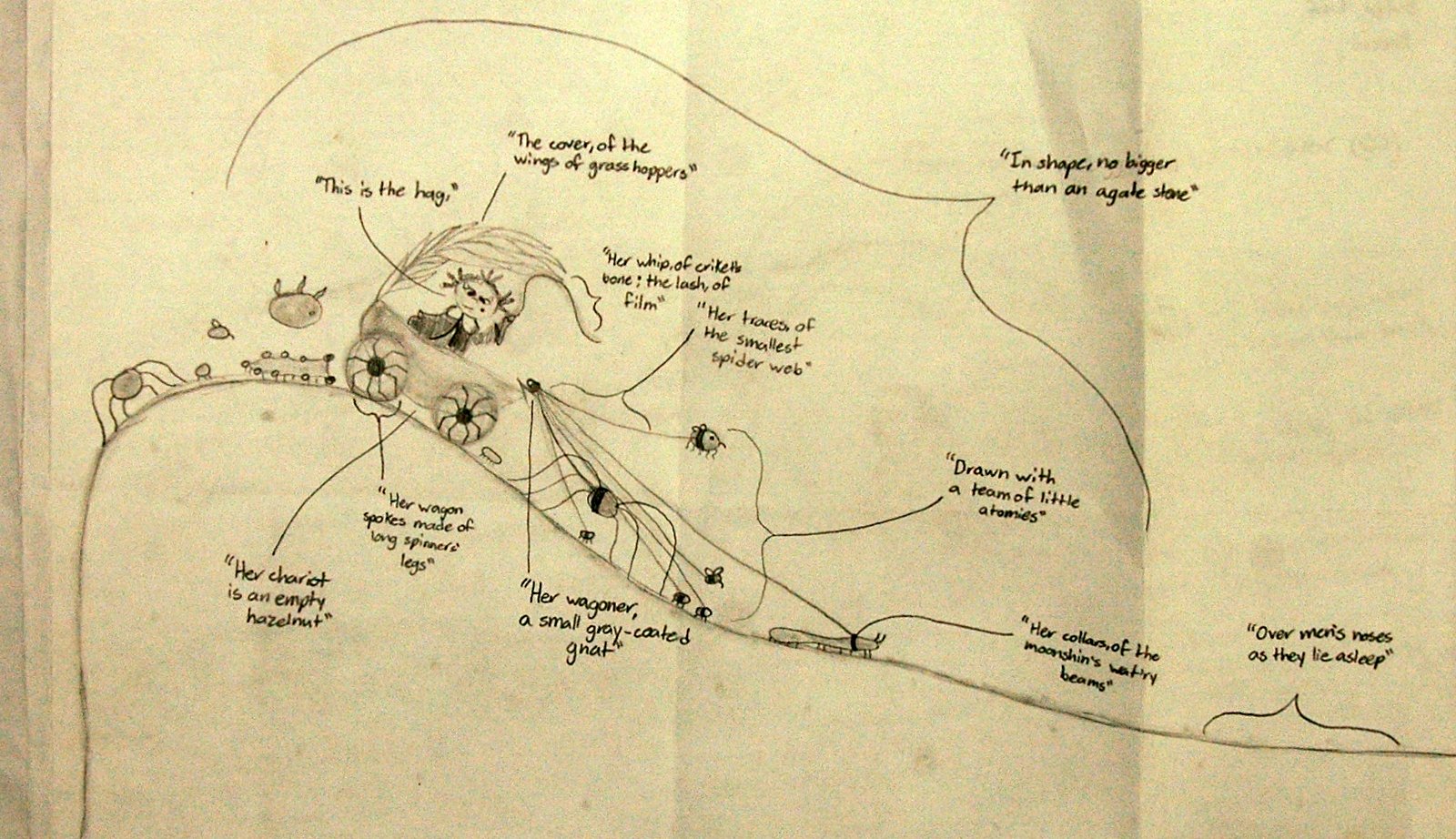
In the English I Honors classes I teach, I work with some really bright, really thoughtful kids, and I get to do some really fun things with them, like introduce them to Shakespeare with Romeo and Juliet. One of the most confusing passages for readers is Mercutio's long Queen Mab speech, which begins:
O, then, I see Queen Mab hath been with you.
She is the fairies’ midwife, and she comes
In shape no bigger than an agate-stone
On the fore-finger of an alderman,
Drawn with a team of little atomies
Athwart men’s noses as they lie asleep;
Her wagon-spokes made of long spiders’ legs,
The cover of the wings of grasshoppers,
The traces of the smallest spider’s web,
The collars of the moonshine’s watery beams,
Her whip of cricket’s bone, the lash of film,
Her wagoner a small grey-coated gnat,
Not so big as a round little worm
Prick’d from the lazy finger of a maid;
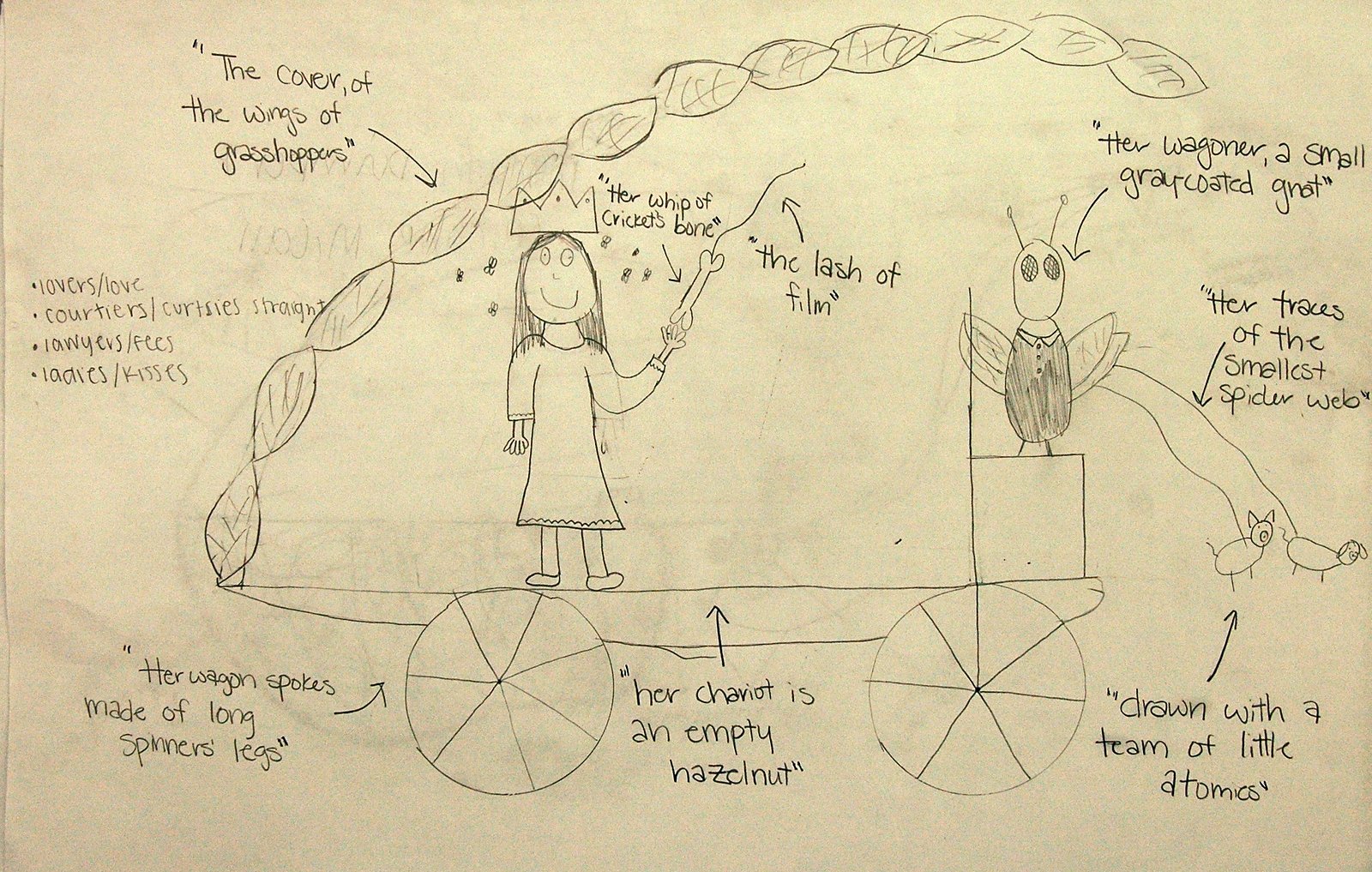
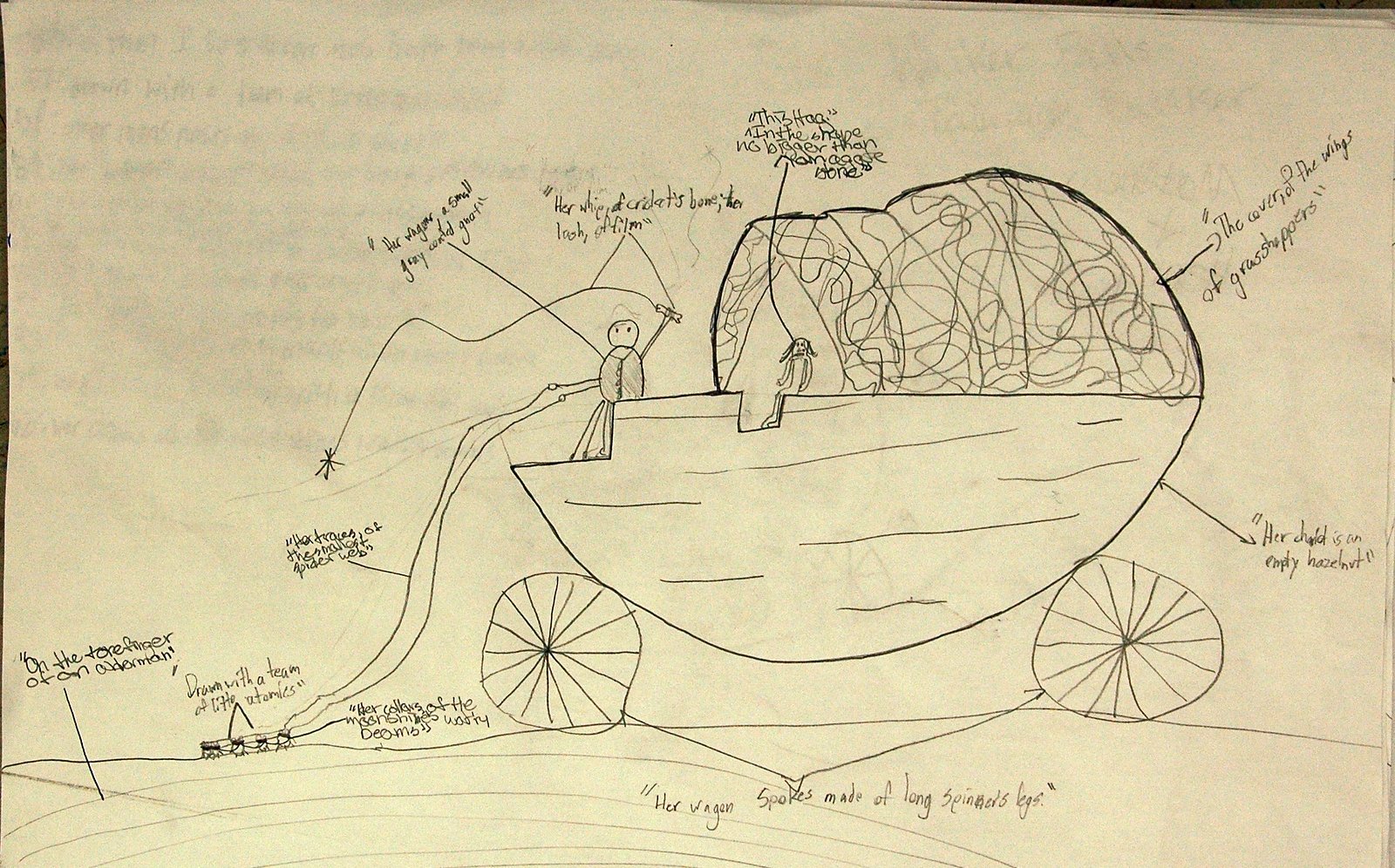
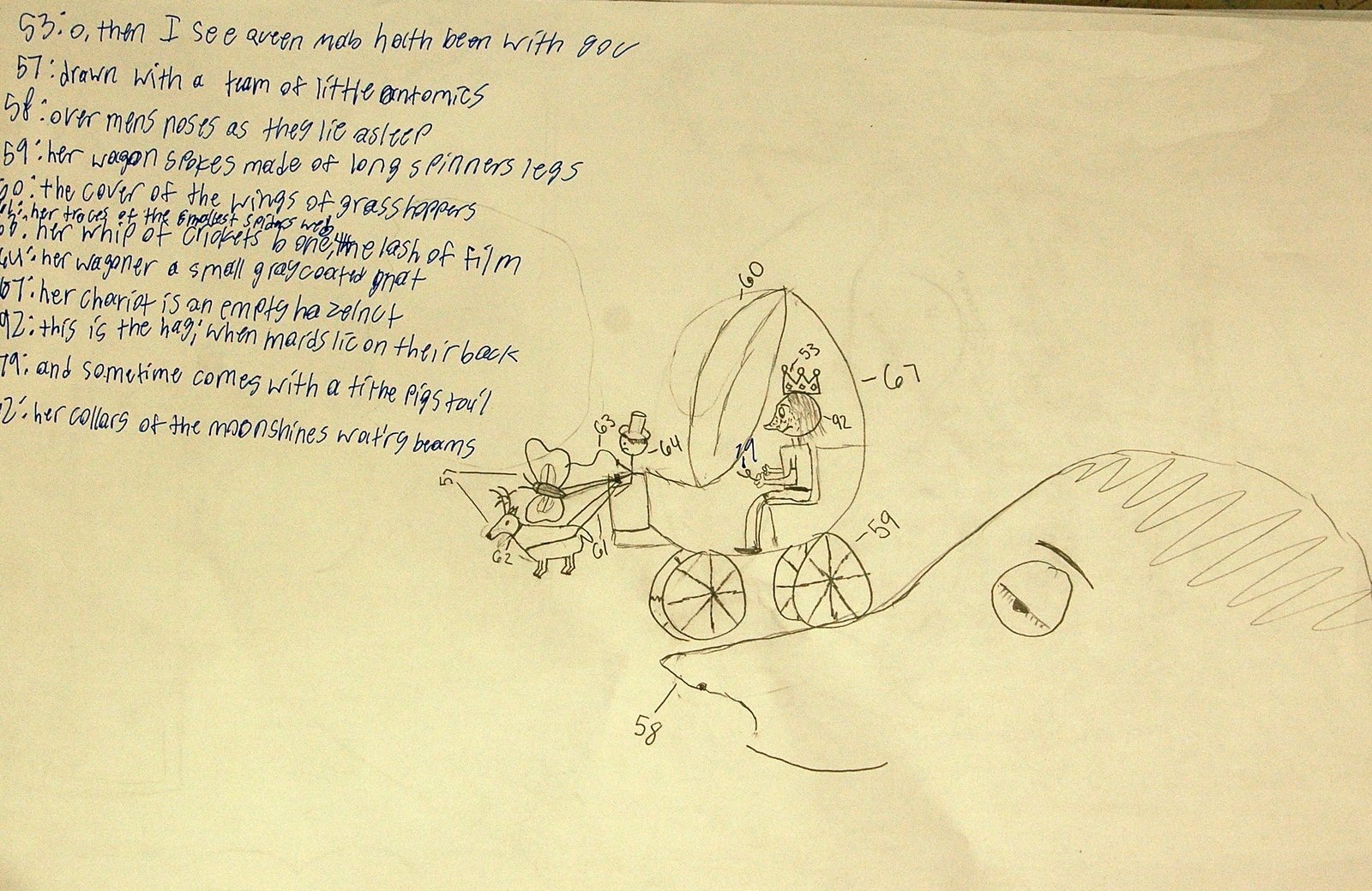
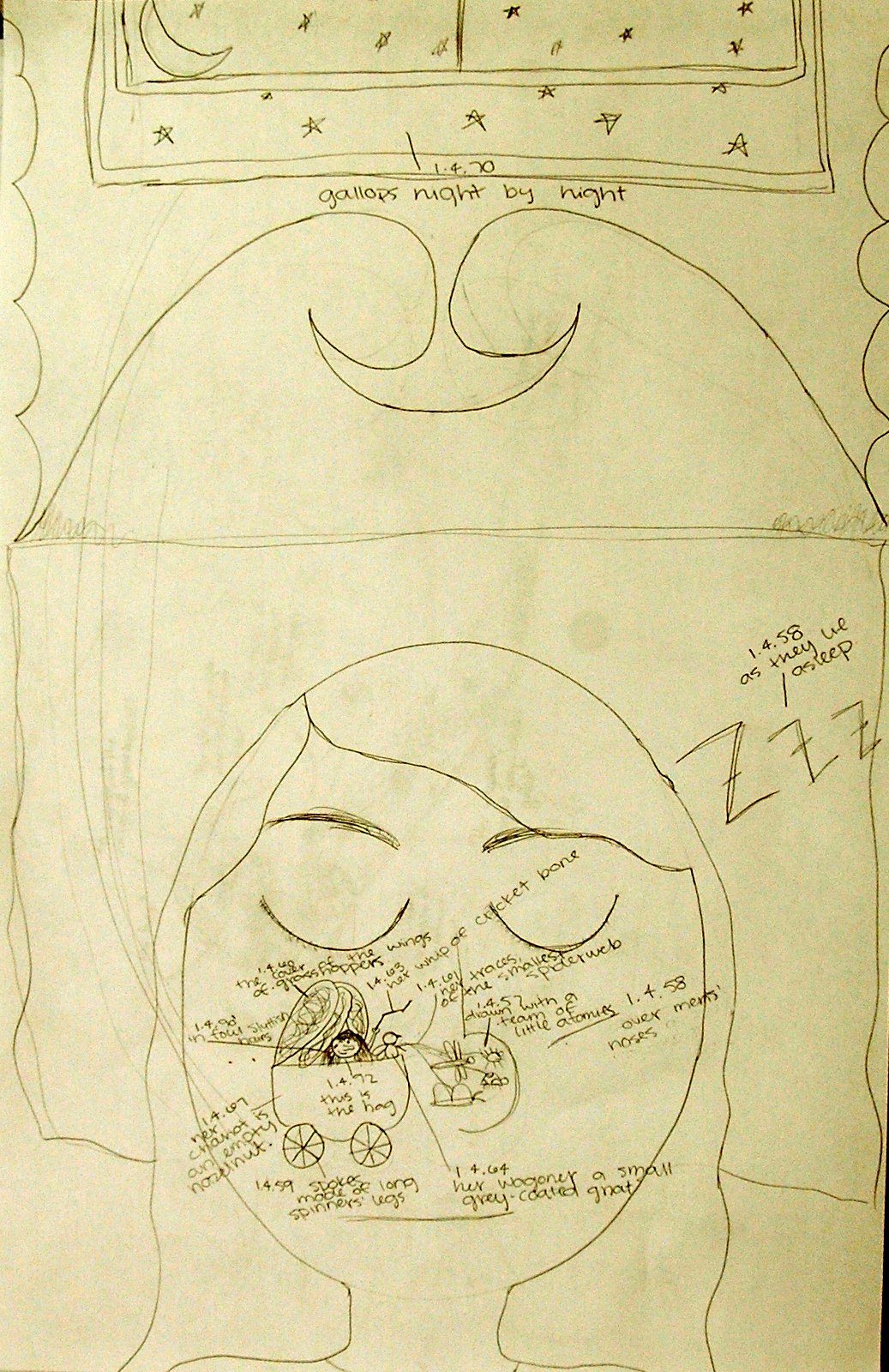
To help with their understanding by forcing them to read it line by line, I have them draw a picture of Queen Mab. In the past, they've come up with some striking examples.


This year, one young man was particularly persistent on one small detail: "Mr. Scott," he began, "how can she have a whip made of a cricket's bone? Crickets don't have bones; they have exoskeletons."
Smart aleck...
Oldest Trick in the Book
“Can I just call you Pete?” I ask. I often ask students if I can call them random names. Just something silly I do.
“Um, sure.”
Then I remember an old joke.
“You and Repeat were sitting on a log. You fell off. Who was left?”
“Repeat.”
“You and Repeat were sitting on a log. You fell off. Who was left?”
“Repeat?”
“You and Repeat were sitting on a log. You fell off. Who was left?”
“Oh, I get it.”
Three Picture Evening
First there was the tea party. The prototypical cliche little girl game, the tea party has never really been a frequent occurrence in our house. I'm not sure why it made an appearance today. But there they were, all sipping tea.

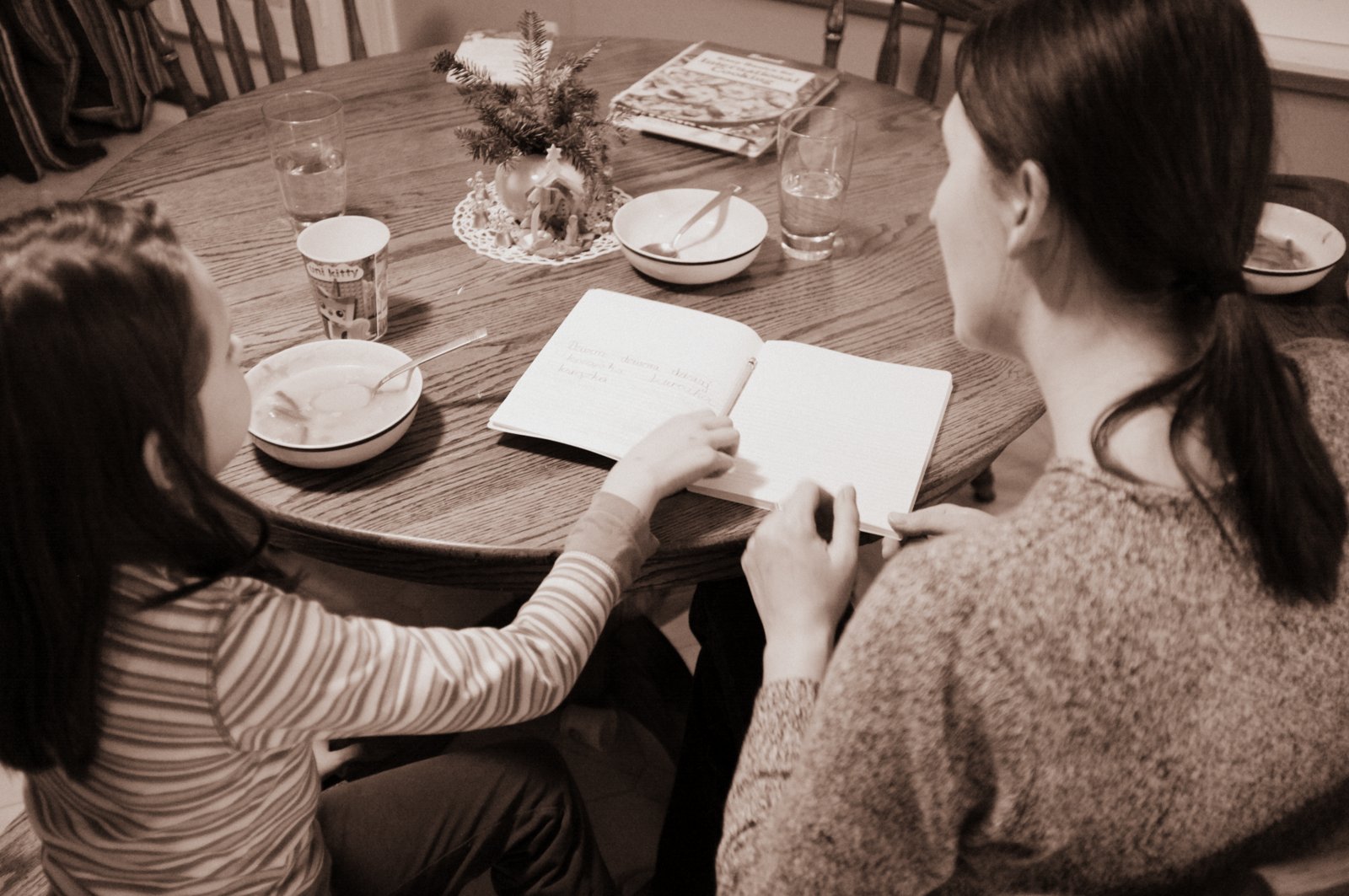
Then there was the homework. Reading comprehension. "Go back to the text," I reminded L time and time again. "Go back to the text. Don't try to answer the question from memory." And so as the Girl progresses through school, the things I say in the classroom start popping up during the homework sessions.

Finally, the kids in bed, K and I turn to cooking. "We haven't had rosół in a while," K said some time ago, and so tonight we cook that Polish favorite that's really an international soup. After all, what is pho in essence but chicken noodle soup, which is exactly what rosół is. Sort of.

Forward and Backward
There is no corner to turn. To admit that to myself, to get myself to see that clearly and accept the implications of it as a teacher -- that was the trick. One good day does not a corner make; one week of good days do not a corner make. When dealing with a class filled with troubled kids, there's no six steps forward; there's no question of three steps forward. Ever bit of forward momentum comes with drag. The drag of habit. The drag of need. The drag of peers.

And so just because one day is almost blindingly good, with 96% of recorded behaviors being positive, doesn't mean that the next day can't be a dismal failure, relatively speaking.

That only makes coming home all the sweeter. Though we take steps forward and stumble backward occasionally, I know there's someone standing behind to catch the stumbles, to encourage, to accept. When the Boy has several accidents in daycare, the family is there to encourage him to do better.


When he comes home wearing the same thing he wore as he walked out the door that morning, it a cause for celebration, and we celebrate.


That's not to say that my students at school don't have support somewhere. It's not to say their parents are somehow inferior. But the facts remain: some of the at-risk students I teach experience a daily school life that is so different from that of our daughter's that it's positively foreign.

What explanation fits? There are those with horrible parents who don't support them, but I haven't met many. No, scratch that. I haven't met any, because they don't come to the school. Most of the parents, though, seem caring, seem supportive. Who am I to judge, to suggest that their behavior is somehow different in private?

It's the wrong question, though, because the cause, whatever it is, is something outside my control. What is in my control is how I treat them. And more importantly, what is in my control is how I treat my family.
Positive Reinforcement
It’s a struggle, working with a class of students that are such a mixed bag as some of my periods. Some have never really had much success in school, and they show it with their behavior. Some have never really learned basic social skills, and they show it with their behavior. Some desperately want to learn but struggle, and they show it with their behavior.
Many times, I’ve thought (and a few times even said) that I wish students could see them as I see them, to see their behavior issues as the problems they are, to see their future as I fear I see it unless they change. How to do that though?
“I’d give a whole month’s pay” begins one such little fantasy. Let them sit in my head, as in Being John Malkovich, but see what I see as I see it. But how to do that? It is of course impossible. The closest we could come would be a numerical representation of behaviors: you do this x times per lesson; you do that y times per lesson. Data, in other words. Yet how to get that data?
Enter: a perfect solution. A silly web site and app that are not so silly after all. I’d heard of classdojo.com before, but I’d only heard of it? Why hadn’t I simply loaded it into a browser, for when I did, I immediately saw the potential.
Numbers don’t lie. I might not catch all positive actions (and that’s what I really need to focus on for this to work), but I catch enough to make it meaningful. To make it count — literally now.
Slouching Towards Bethlehem
I was recently asked to view this TED talk and provide some feedback. Here's the talk.
Here are my thoughts in virtually un-edited form:
To begin with, a few seemingly-random facts: Sir Ken Robinson has a PhD from the University of London. He's speaking as part of the TED program, which was implemented by Chris Anderson, an Oxford graduate, and his Sapling Foundation. This video was delivered on the World Wide Web, which, despite Al Gore's protests to the contrary, was the creation of Sir Timothy John Berners-Lee, who studied at Queen's College at Oxford. All of this is computer based, and many attribute the creation of the computer largely to John von Neumann, a classically trained Hungarian mathematician and physicist who, in an effort to bring himself some peace on his deathbed, quoted from memory large swaths of classical poetry in their original Greek and Latin. I am currently writing this on a computer in my home that uses Linux, an operating system (i.e., Windows and Apple's OS X) created by Linus Torvald while he studied at University of Helsinki. While many might never have heard of it, Linux is the most used operating system in the world, running on 80% of the world's super-computers and probably closer to 95% of the servers that make up the Internet. Finally, I am writing this in a country that in the history of the world is and has always been quite unique for its constitutional freedoms, a country that was created by a group of men that experience classical education in its truest meaning.
So it's deeply ironic that Robinson and all of the individuals who created the technology to view his speech were products of this very education system that Robinson suggests needs reforming. Robinson suggests that we're stifling innovation and thus we need to have a revolution in education but he says so on a platform made possible by this age of unprecedented innovation, an age that is the product almost exclusively of classical education and its modern kissing cousins.
Robinson suggests that modern education is killing creativity. Yet to be creative, one must have something to be creative with. Otherwise, creativity consists of only the basest instincts, as we have seen here at Hughes on the eighth-grade hall with the recent behavior of two of our students. Their hideous act (and if you don't know what it was, it's best not to ask), in their eyes, was brilliantly creative. But as the saying goes, garbage in, garbage out. If we start with nothing to be creative with, we will be creative with our basest instincts.
We traditionalists often suggest that we need to have a wide liberal arts education before the specialization of college in order to ensure the continuation of culture, but it is less esoteric than that. Creativity comes from having something to create with, and all great creative endeavors have stood on the shoulders of the creativity of others–I know I'm mixing my metaphors here, but I'm only intending a first draft of this, so bear with me. Picasso, for example, did not start with Cubism; he learned all the rules, then he decided how he wanted to break them. Faulkner did not begin by writing run-on sentences; he mastered his craft and then learned how and when to break the rules for effect. Linus Torvalds did not create the Linux operating system in a vacuum, and Jef Raskin, Bill Atkinson, Burrell Smith, and Steve Jobs did not create Apple's operating system from nothing: they both used UNIX, an older, very stable system, as a starting point. So when we start pushing this individualization, this specialization from graduate school to college to high school to middle school, we decrease the amount of raw materials we provide students to be creative with. Despite Robinson's contention to the contrary, it is based on “the idea of linearity.”
The truth of the matter is that education is linear: one has to learn addition before algebra, and one has to learn algebra before calculus. One has to learn to read music before embarking on a Chopin Ballade. One has to learn basic coding before attempting to create an operating system. There is a hierarchy of knowledge in any discipline, and one must learn things in that hierarchical order or else it's simply chaos.
I understand Robinson would not dispute that. He's not suggesting we let students begin wherever they want. He's talking about an organic model that allows students to follow their own interests wherever they lead them. To do otherwise, he suggests, is soul-killing: We “have sold ourselves into a fast food model of education, and it's impoverishing our spirit and our energies as much as fast food is depleting our physical bodies,” says the man who quotes Yeats, a product of this very education, an education that, in Yeats's time, was much more linear than anything we have today. My point is that, as with creativity, to be organic, you have to start with something: life, art, technology, or even existence does not start from nothing.
But there's more to it than that when we consider the fact that we live in a democratic republic like America. Robinson suggests that students should be able to create learn “with external support based on a personalized curriculum.” This is going to result in a highly fragmented society, with very little common knowledge–i.e., cultural literacy–to share. It is nothing short of Balkanization. E. D. Hirsh, Jr. writes in Cultural Literacy: What Every American Needs to Know about the impact of highly-specialized knowledge on democracy:
No modern society can hope to become a just society without a high level of universal literacy. Putting aside for the moment the practical argument about the economic uses of literacy, we can contemplate the even more basic principle that underlies our national system of education in the first place–that people in a democracy can be entrusted to decide all important matters for themselves because they can deliberate and communicate with one another. (12)
In other words, for democracy to work, everyone must be informed about the basic issues and be conversant about them. That this is not the case in America today is painfully obvious when watching the gotcha viral videos that show people struggling to name one single American senator, to find a given country on the map, and other ridiculous ignorance. Should we create a completely personalize curriculum, many of our students would study video gaming and rap music, leaving very few who are interested in the functions and institutions of our government. It's easy to see that this becomes an oligarchy quite quickly.
So Robinson can't possibly be suggesting complete topical freedom for students. He would have to accept the fact that there are some basic things that everyone needs to know in order to function in a modern Western democratic society, but the instant he does that, he's undermined his own argument. What we have them is not the revolution Robinson is claiming but a bit of feel-good tinkering around the edges. Or complete chaos.
What then is the problem? Why does our education system not work anymore? I suggest that it's not the education system that's broken: after all, as I pointed out, it has created all we see around us today. It's culture that's broken. Why does the same educational system of the early 20th century no longer work? Because it doesn't mesh with the 21st century culture, which demands instant gratification, complete and blissful entertainment, and absolutely no hard work.
Furthermore, education doesn't kill creativity; our modern culture kills creativity. We turn on and tune out with our huge televisions, mobile devices, and gaming systems, then wonder why we aren't as creative as we used to be. We serve up to our children mindless entertainment that requires no imagination, then wonder why they don't have imagination. And like always, we blame it on our education system, the system that created Mark Zuckerberg and Sean Parker, Sergey Brin and Larry Page, Bill Gates and Steve Jobs. And what do most people use these men's amazing inventions to do? Foster creativity? Hardly.
So can this proposed Robinsonian revolution solve the problem? Well, I don't think as Robinson presents it, it really is much of a revolution. A total revolution would look like this: the dissolution of the grade-level system in exchange for a mastery-learning program with a basic curriculum that fosters general civic, mathematical, linguistic, scientific, and technological literacy. This program would let students learn these basics at their own pace, but it would require mastery before moving on. If takes a student three years for one topic in math, then it takes that student three years and she stays there until she shows mastery; if it takes another student three months, that student moves on in three months. Once students master these basics–what used to be about an eighth-grade education but now is probably more like a twelfth-grade education–students can move on in a similar setting to explore any interest he or she wants. And if that means a student stops his education then and gets a job in construction, then that's his choice. But that is too radical a reform, and still more important to policy makers, the fiscal cost of such an education would be relatively staggering.
Yet that wouldn't solve the underlying cultural problem. That, I'm afraid, is out of the purview of public education. It's a pessimistic view, I understand, and I'm sure some might wonder how I could be a teacher with such a bleak outlook.
And so in final response to Robinson and to more succinctly and beautifully sum up my thoughts, I too turn to Yeats:
Turning and turning in the widening gyre
The falcon cannot hear the falconer;
Things fall apart; the centre cannot hold;
Mere anarchy is loosed upon the world,
The blood-dimmed tide is loosed, and everywhere
The ceremony of innocence is drowned;
The best lack all conviction, while the worst
Are full of passionate intensity.Surely some revelation is at hand;
Surely the Second Coming is at hand.
The Second Coming! Hardly are those words out
When a vast image out of Spiritus Mundi
Troubles my sight: somewhere in sands of the desert
A shape with lion body and the head of a man,
A gaze blank and pitiless as the sun,
Is moving its slow thighs, while all about it
Reel shadows of the indignant desert birds.
The darkness drops again; but now I know
That twenty centuries of stony sleep
Were vexed to nightmare by a rocking cradle,
And what rough beast, its hour come round at last,
Slouches towards Bethlehem to be born?
Peace

I often wonder just how much peace my students experience at home. It seems to be an inverse relationship: the more troubled the behavior, the less peaceful the home. A colleague tells of a home visit that sounds absolutely horrifying: two loud televisions in one room, one with sports and the other with some movie, a loud boom box in a nearby room, someone sticking his head in to yell "When's dinner?!", and all the while, the conversation continues about the student's performance and not once does an adult offer to turn down any of the noise.

"They're surrounded by noise, by motion, by stimulation," another colleague mentions during lunch. "It's no wonder they can't sit still, can't focus."
Not to mention what they consume in the name of food.

I have a rough class before lunch, and when we return from lunch, twenty minutes remain until the next class change. I work on social skills with them; I let them relax a while if they've worked well during class time; but most often, I try to give them peace. I turn the lights off, instruct them to put their heads down -- why is it they won't put their heads down when told but at least one every day wants to put her head down during class time? -- and simply stop. Stop moving, stop talking, stop shaking a leg or beating a finger on the desk. Just stop. Take a moment to collect themselves.

Most of them can't do it.
I try to play soft music for them, but I wonder if, obsessed as they are with rap "music," the classical music I play for them might be exhausting. They might not even know what a melody is, and if that's the case, they can't find much pleasure in classical music. Add to it their painfully short attention spans and it becomes rather obvious that they can't trace out the development of a musical theme, let alone notice when it repeats and begins morphing as it does in Romantic and Classical (as in the period, not the genre) music. I find Haydn works best, better than just about anything else.

Fast forward a couple of hours. K, E, and I have dinner together. What a blessing just to have dinner together. What a blessing that the Boy loves veggies. What a blessing that we had an entire zucchini to feed him.

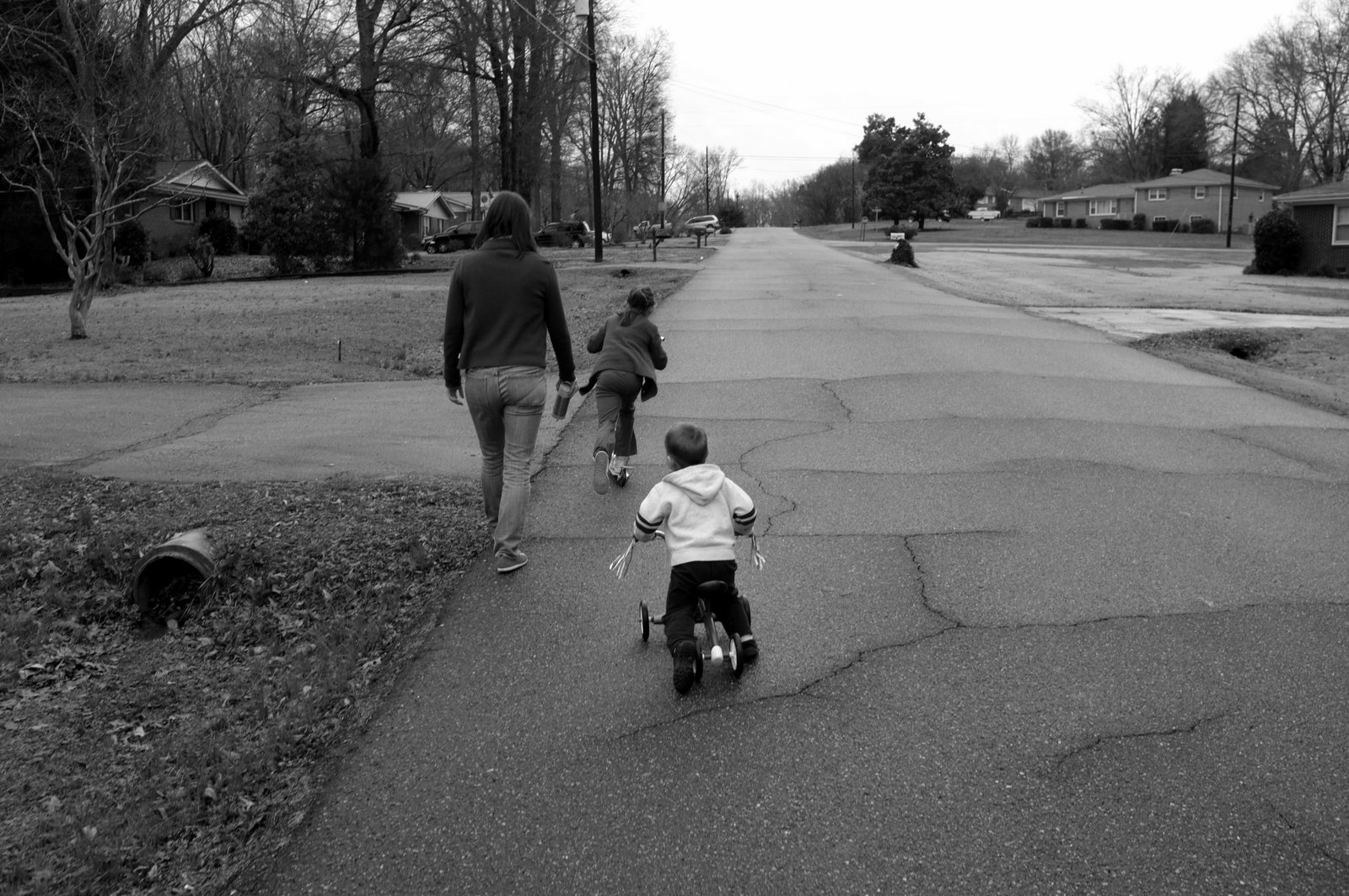
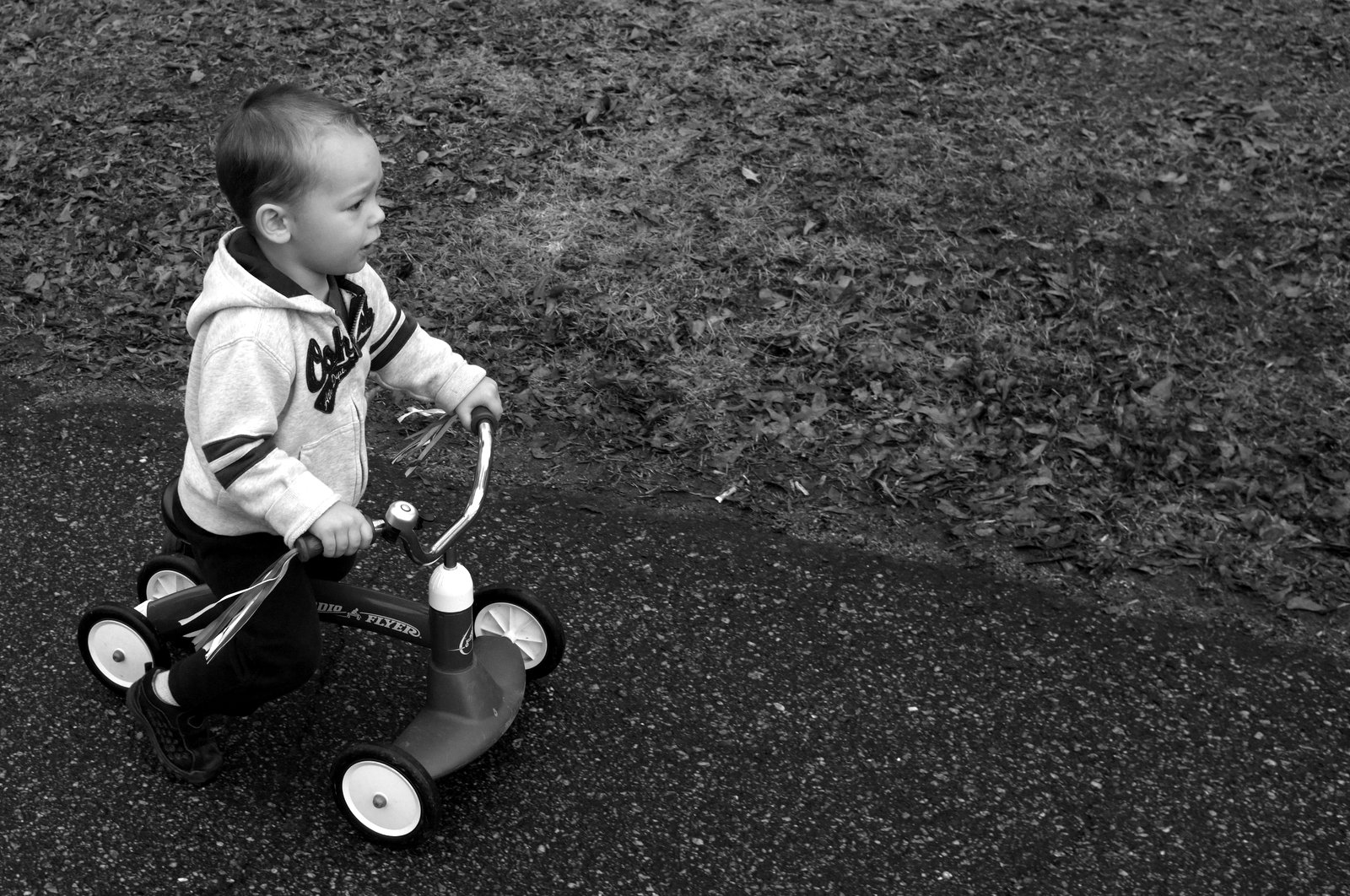
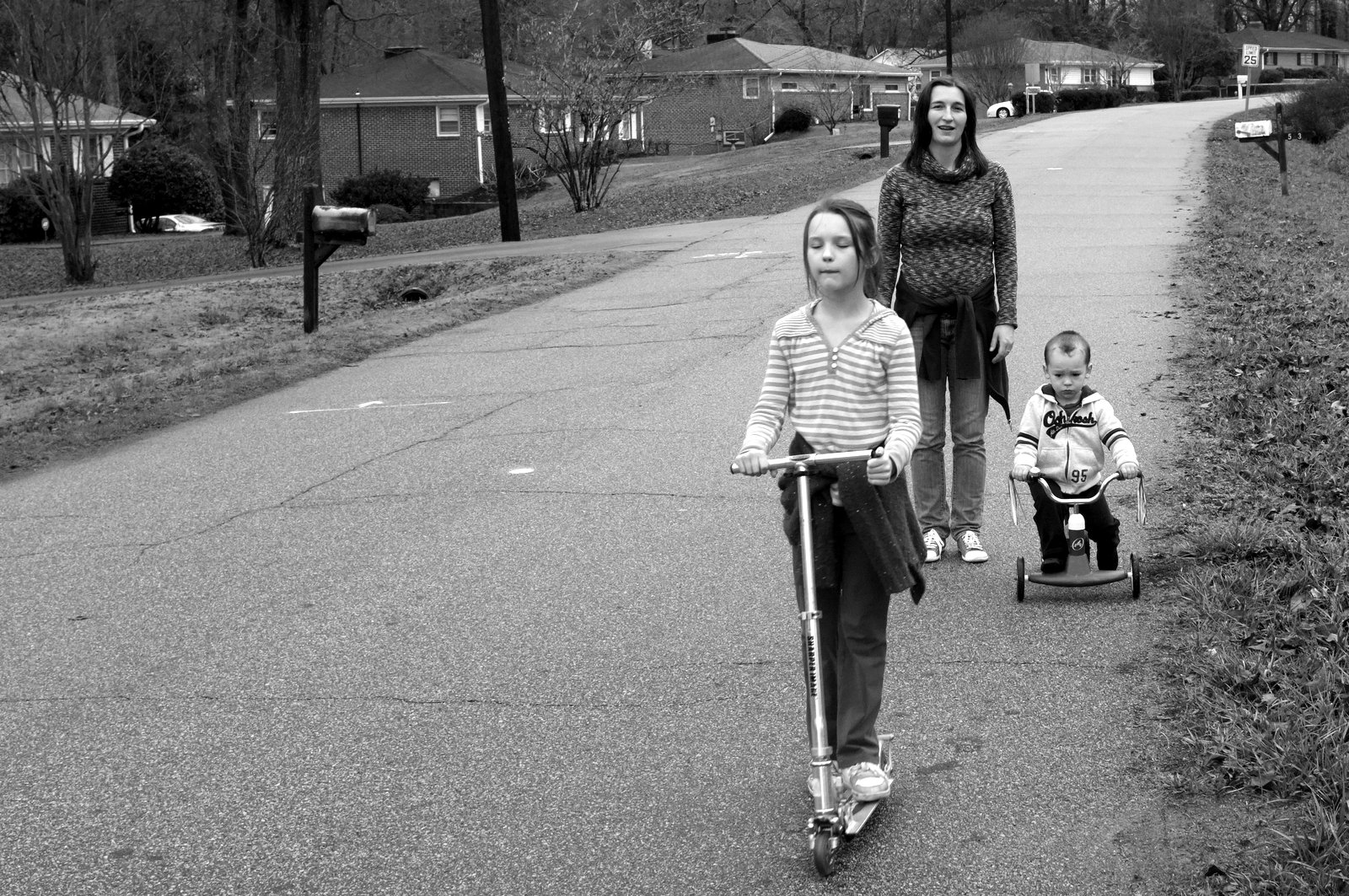
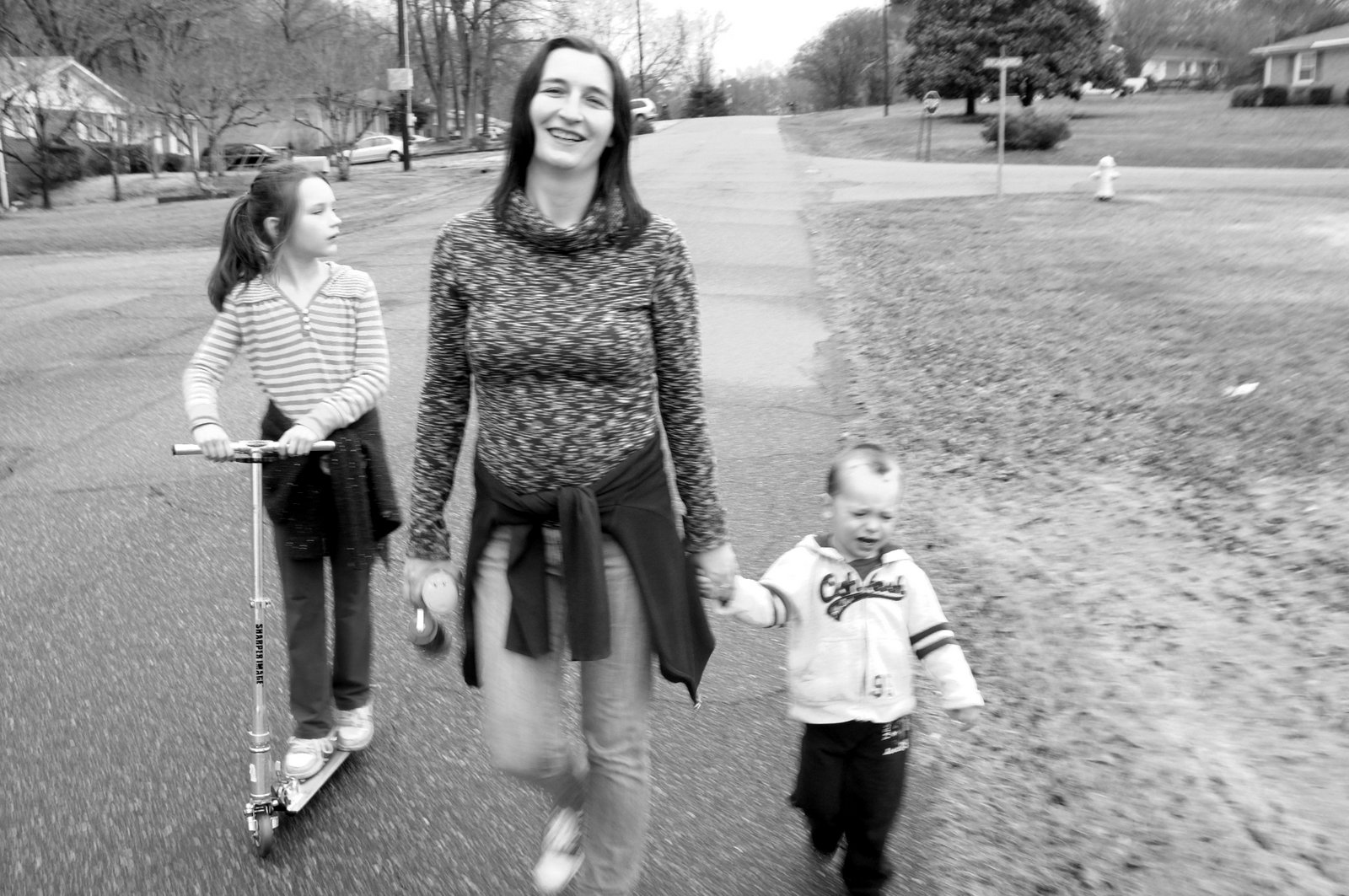
After dinner, we go to the newly-paved street across from our house. K rides the scooter; the Boy coasts around on his whatever-it's-called. They bump each other, chase each other, goof around. I take the pictures.
After riding, Nana and Papa bring the Girl back and everyone sits a while and talks, rides bikes, fusses, cries, laughs.
After bath, after snacks, the kids lie on the bed with K who reads a new book from the library, translating the English to Polish to provide the kids with more exposure to the language.

"Co to jest 'snooty'?"
"Go with snobby," I say.
What do all these vignettes have in common? A peace that comes with a family spending time as a family. A peace that I'm not sure some of my students can even imagine.