Homework

education and teaching

My daily update for today:
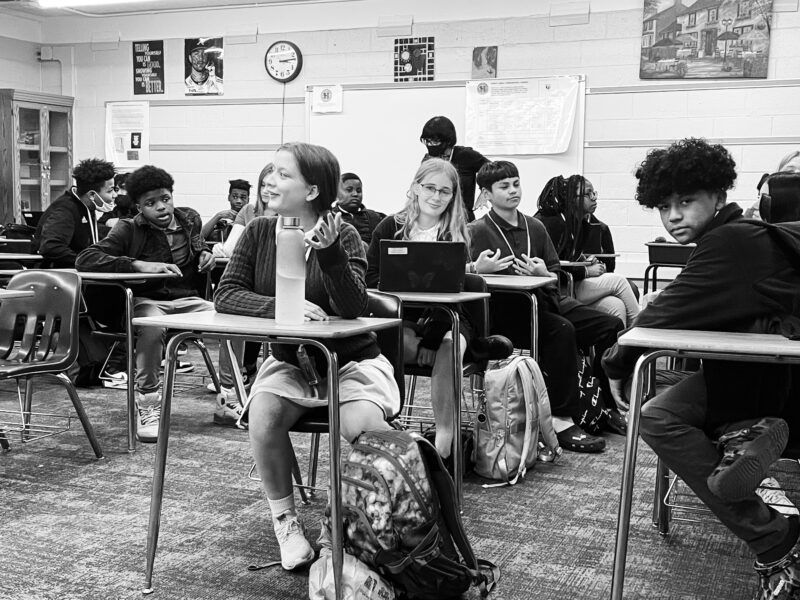
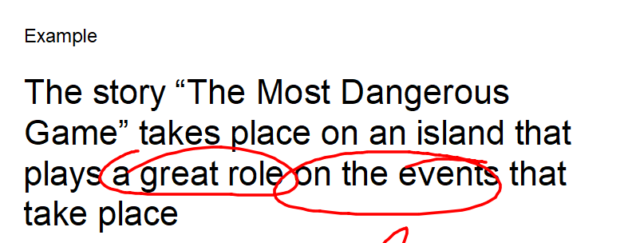
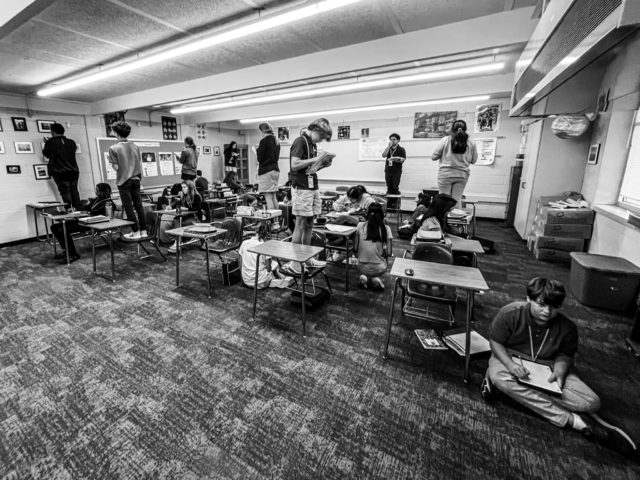
Students today worked on clearing up some final confusion over our first analytic Schaffer paragraph before beginning our second cycle. For example, the excerpt below has the problem of a very general topic sentence. Once it begins so generally, a paragraph will only go downhill from there.

Afterward, we began working on our second cycle of stories that we will use for our next analytic Schaffer paragraph. We'll be focusing on the narrator's point of view and the effect that has on the narrative.

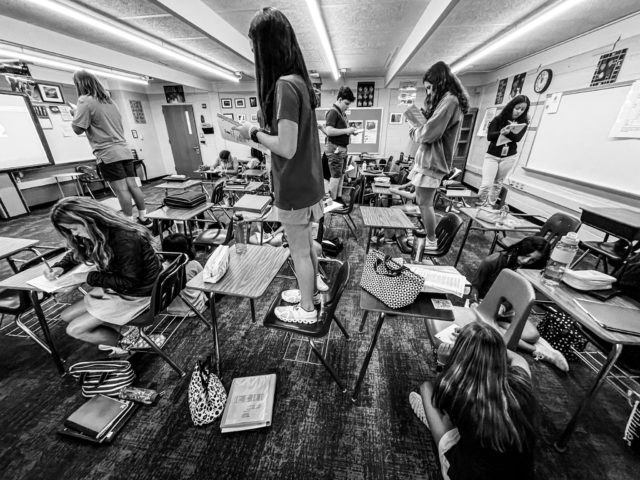
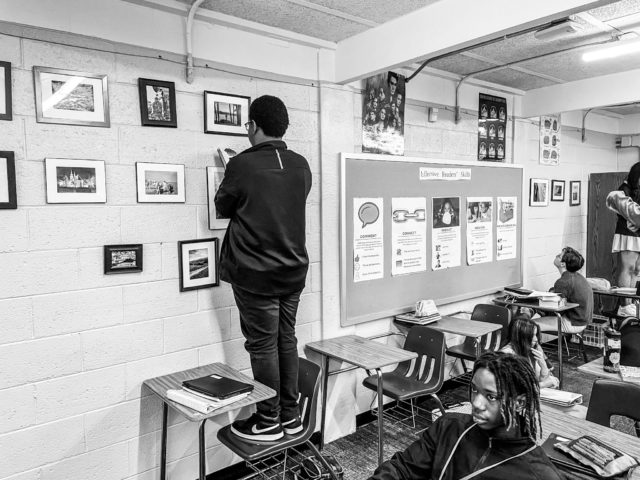
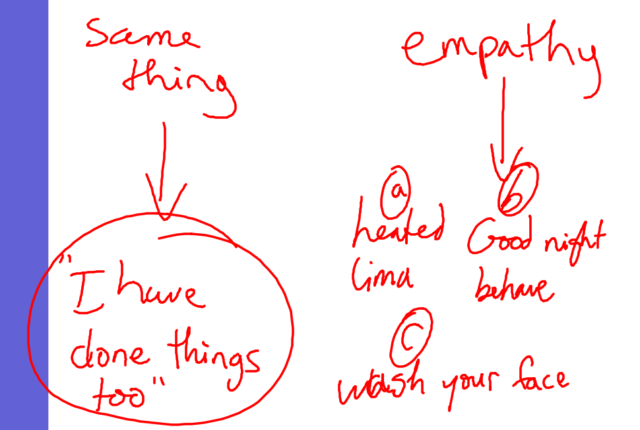
We began with some unusual writing to illustrate the simple fact that what we see, figurative and in this case literally, depends on where we stand.

The "where we stand" element has to do with everything from past experience to religious views, from political views to personal food taste, and everything in between.

Then we read an intriguing story, "In the Family" by Maria Elena Llano (on Moodle). We'll be using this tomorrow to examine how we can use the point of view of the narrator as an analytic framework and then plan a Schaffer paragraph around it.
Students in sixth period finished their second Schaffer paragraph, the one that's truly a beast: using quotes from a text as the basis for the concrete details.

We picked up where we left off Friday and worked on our concrete details.

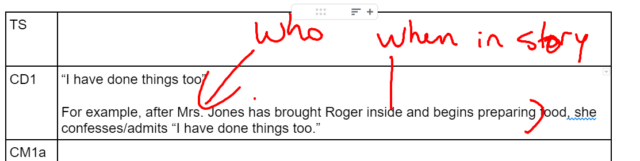
They key to using quotes in concrete details, they discovered, is to mix your words with the writer's words: the student needs to include information about the context of the quote (the who and when in the story) and then try to slide the quote into the sentence naturally so as to avoid saying things like "For example, the text says..."
Some of the excellent examples they:
created include:
Students in the final period completed their first real Schaffer paragraphs after examining three example paragraphs in various states of disrepair. They had several options to choose from for each paragraph:
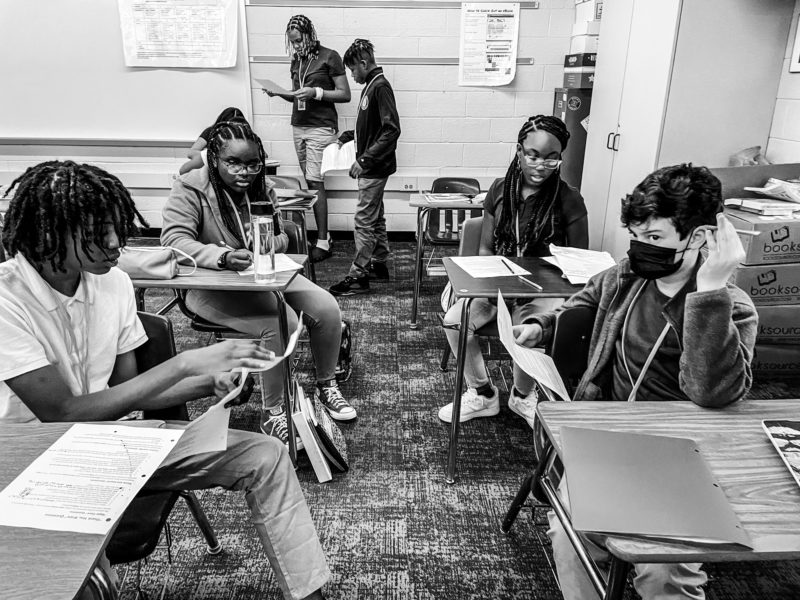
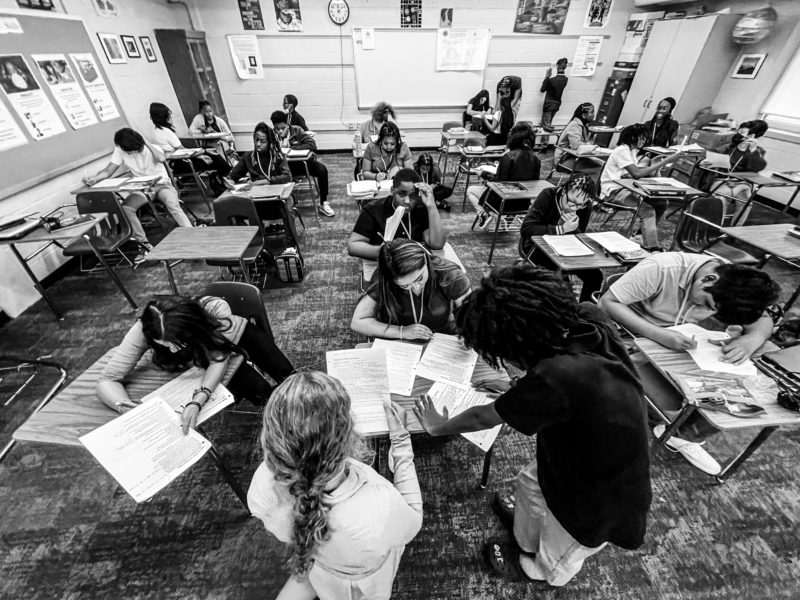
Students evaluated the paragraphs first in groups and then alone.
Afterward, we worked on our first Schaffer paragraphs:

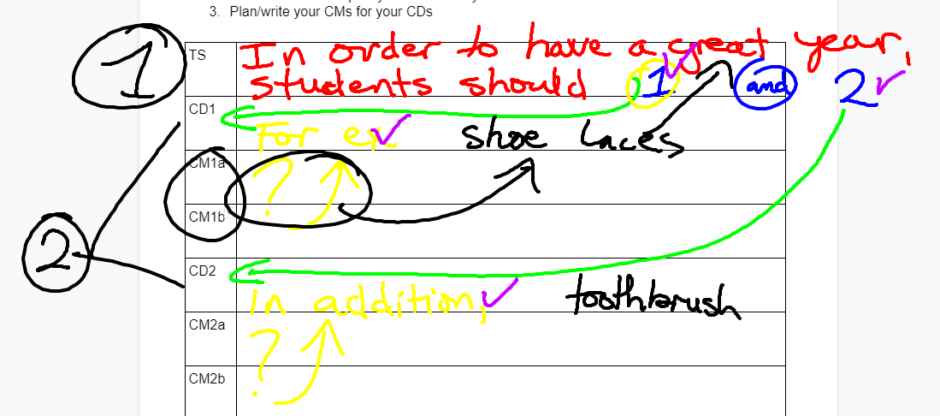
Every student had a topic sentence they'd created in groups: "In order to have a great year, students should (1) and (2)." The numbers represented their two best ideas from the list they'd brainstormed. Afterward, on Friday, we made sure that the two ideas from the TS made it to CDs. And today, we worked on completing the two CMs for each CD, thus completing our first Schaffer paragraph.
We're only two full weeks into the school year, and one of my on-level classes is about 1.5 days ahead of the other on-level class. It leaves me wondering what to do: slow down one class to let the other catch up, or skip some things with the slower class to help speed up the pace.
Neither is a good option. Time for enrichment lessons...
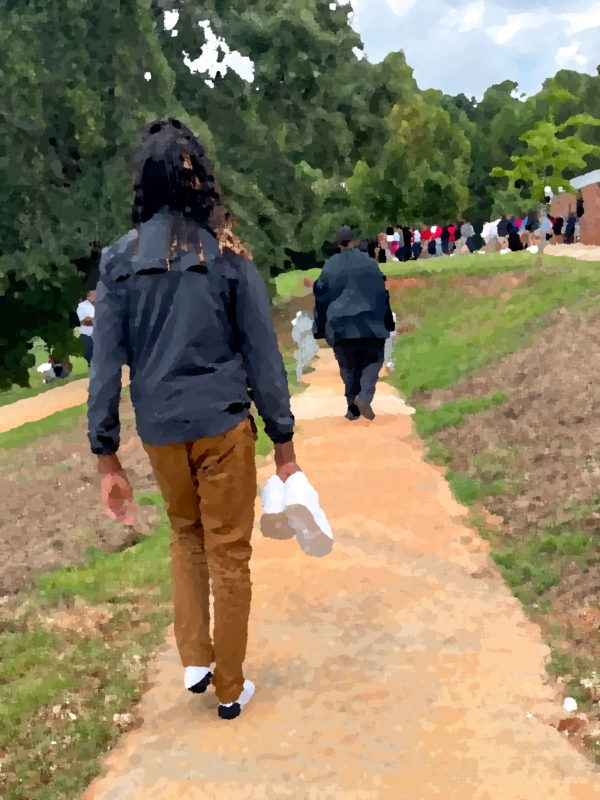
It's always seemed to me that shoes are especially important when you're outside and will soon be walking through wet grass. The option of taking one's shoes off and getting one's socks wet doesn't seem incredibly pleasant to me, especially when it's just the second period of the day and the socks would remain wet for hours afterward.

But spotless, white shoes are more important than comfort, I suppose.
The first week is about to enter the books -- one week down, thirty-five to go. Some might view it that way, and some years it's tempting for me: when in the first week of school students are already being disrespectful and incorrigible, it's difficult not to think wistfully about the far-in-the-future summer. "It's going to be a long year," becomes the common thought.

But this year's first week is not like that at all. The Terrences and Teresas haven't appeared, haven't even shown a glimmer of appearing.

Kids staying focused, working together effectively, showing each other respect...
I know it's still the honeymoon period, but I can't help but be hopeful about this year.
The Boy had a rough day of it: he's been in a multi-age classroom for four years, meaning he's been with the same group of people (mostly) for those four years. Fifth grade, though, doesn't have a multi-age program, so he's back out in the general population -- and none too thrilled about it. All his closest friends from the last four years -- all of them -- ended up in different classes. A few of them got grouped together, but none of them are in E's class. Which makes him less than thrilled about school after this first day.
We tried to help the Boy see things from a different perspective, but for the longest time, he just wasn't interested. It was going to be a disastrous year, he was sure of it. There was no way it could get better -- he was convinced. He might as well just switch to homeschool.
After some time in the pool and a lot of reassurance, he informed us on the way home that "all of Mama's speeches" had made him a little more excited about tomorrow.
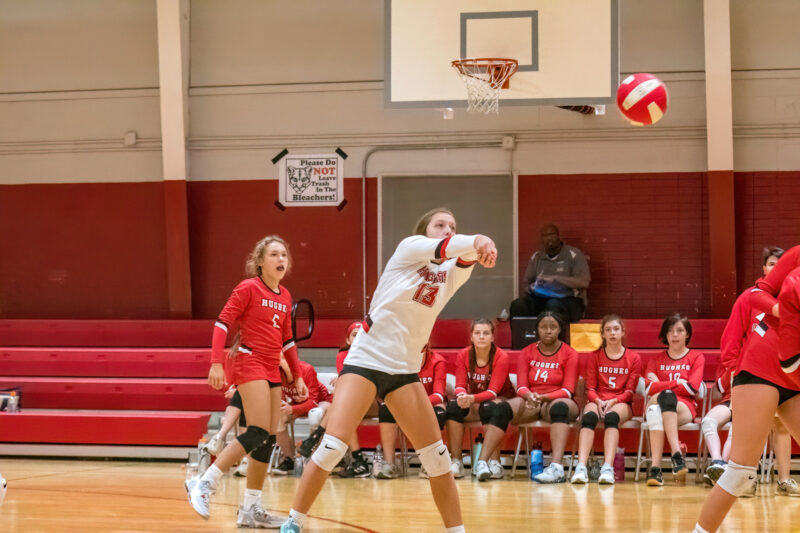
As for the Girl, she sat down in the car after volleyball practice, looked at me, and said, "Guess what we have in English class?" I raised my eyebrows in anticipation. "Articles of the week!"
I've been giving my students an article of the week for almost ten years now. It's one of the most effective tools I use.
"Do you know what this is?" one of the Girl's friends asked her.
"Yes," she whispered back. "I've been grading them for years." Which is dramatic sounding, and it probably got a laugh, but it's not quite true. I've had her checking multiple choice questions, adding up the points, and using my scale to determine and write the grade on the paper, but that's not really grading them.
"Same difference!" L playfully huffed when I pointed this out.
We had our first day back at school today -- teachers have a week of preparation before the kids come back. To be honest, a lot of it is less preparation and more endless meetings: three hours this morning; meetings in both the morning and afternoon tomorrow.

In the afternoon, returning home, I discovered that the Boy had painted the ramp into Papa's room (always it will be Papa's room) in the morning. After dinner, he applied a quick second coat and now we have a lovely, freshly-painted ramp.

Today was an annual festival here in Jablonka -- the thirtieth year in a row. That means they began having the festival just a few years before I first arrived. When we're in Poland, we usually get at least to drop in on this festival.
This year, I saw several former students from those early days. Except for one, I didn't recognize any of them immediately. I had to ask their name. When a bearded man in his mid-thirties approaches you, you'll be forgiven if you don't recognize him as the former student you last saw at age eighteen.


Today was the final day of school for me. The kids didn't have school, but teachers have to go in for at least one more day to get things squared away for the summer: materials returned, documents completed, papers signed, report cards mailed. During my first year at Hughes, I was overwhelmed with the amount of stuff we had to do. Since then, teachers' "To Do" list has been drastically simplified. One whole task, which often took hours, has been assigned to others. I use the passive voice there because, quite honestly, I don't know who made that change, but I am grateful nonetheless.
Getting this last day out of the way is such a relief because I reach a point where I can finally stop thinking about school for a while -- I'm not even planning on doing any prep work this summer. For one thing, I have too much to do this summer:
Then there's all the travel:
Still, this is a fairly short list for the summer, but this is all in the next three weeks, for in just 23 days, we'll be heading to Poland as a family of four for the first time since 2017. Five years. Five years. It's the longest period of time I've not visited Poland since I first went in 1996. K and E went last summer; L went on her own in the summer of 2019. (Or was it 2018?) But it's been five long years since we all went.
That means L was E's age the last time we were there. And L has gone from being a pre-teen to an almost-licensed (driver-permitted?) employed teen with all that entails.

The Boy has one from a little five-year-old thrilled with everything new to an increasingly cynical (but still fascinated by many things) ten-year-old.

We'll probably take the same walk we always do on the day we arrive, and we'll definitely enjoy Babcia's rosรณล the day we arrive, but everything will be just a little different. And that's probably good.
It's the end of the school year, and that can only mean one thing for my English I students: letters to next year's students.
"Make a little nervous," say to them with a smile. "Impress them with your writing, and don't lie -- but scare them just a bit, too."
Here are some of my favorite quotes from this year's letters: