matching tracksuits

fun in threes, sometimes fours

education and teaching

Are you our sub?

A first-time experience and I keep quiet -- that can’t have happened too very often. But the details about the events of yesterday, fascinating though they were, will remain distanced from any comments I might make here about it. The experience: I was a sub. First time.

In an effort to gain a face in the local school system, I am trying substitute teaching, and I got my first call yesterday morning.

“Substitute teaching.” That in itself seems to be an oxymoron. Teaching is a profession requiring such intimate knowledge -- not the least of which, the kids’ names -- that "substitute teacher" has all the ring of “substitute shrink.”

“Yes, I know you’d rather be talking to Dr. White, but he’s away on urgent business and his office asked me to come down and fill in for him. Now then, what seems to be the problem?”

It just doesn’t seem like it would work.

Yet at an orientation session for new substitute teachers last week, I and other new subs learned that “subbing isn’t the glorified babysitting it used to be” and that subs are expected to continue on instruction. In other words, be a substitute teacher and not just a substitute authority figure. I'm not sure it was ever anything else, but I do think that there was less expectation of what subs would accomplish in the classroom, say, twenty years ago.

The Day

Seven years of teaching has taught me one invaluable thing about the profession -- take nothing they do personally. Any silly, probing, "let's-see-what- he-does-now" behavior is directed at my role, not my person. That realization will be key to being an effective sub.

I survived. Not only that, but I enjoyed it. It felt good to be in a classroom again. With the beginning of the school year here (and approaching in Poland -- 1 September), it was difficult to keep from feeling a tinge of sadness at the thought of not teaching this year. The call Friday morning helped alleviate that.

I spent the afternoon with a group of seventh graders, the first time I’ve worked with that age group in many years.

Six weeks of my student teaching was in a seventh grade classroom, and those kids, according to my reckoning, have just finished college, so it’s been a while.

Seventh grade -- an interesting age group, for they’re right on that border between “child” and “young adult,” beginning to realize that they’re not kids anymore but not quite sure how to handle that.

Farewell Party

Final Days of School

Survival Mode

And out of the blue yesterday, a tolerable lesson with The Class. What makes them tick? I have no idea. Such a strange group of kids. Monday was living hell; yesterday was survivable, even decent. But still, the same old folks were up to the same old game – gap speaking activity turned into a copy-your-partner’s-worksheet activity. And of course the usual suspects didn’t come to class with anymaterials whatsoever, then use that as an excuse to sit and draw all lesson.

I’ve finally realized with that class that I simply can’t make them learn, and so I concentrate now on the five to seven students (depending on their moods) who want to learn, with the four hardest-working students (and therefore, best behaved) at the front of the room. I talk to them, and glance at the others from time to time, in case someone there gives a crap. Most of them don’t, it seems.

The other day, I all but told them this. I said that I really didn’t care whether they care anymore, and that I’m going to put all my attention on those who in turn pay attention. “Tak jest,” said the best student – a young man who has, I believe, one B (a 4 in the Polish system) this semester.

I worry this might be self-defeating in the long run, and not a very good classroom management method. Still, I’ve got about three weeks of school left, and I’m just in survival mode with them now.

-ation

I did a lesson on word formation with a group of juniors today. We worked on turning nouns to adjectives (i.e., beauty to beautify) verbs to nouns (i.e., improve to improvement), and then I stunned them with the news that they were going to learn more than a thousand new words during the lesson.

It's an easy lingustic trick, really. Words that end in "-ation" in English usually are virtually identical in Polish, only with an "-acja" (pronounced "aat-see-ya") suffix, or a variation.

  • "revolution" is "rewolucja"
  • "inflation" is "inflacja"
  • "distribution" is "dystrybucja"

I don't think I need to elaborate on what word young Rafał blurted out in class...

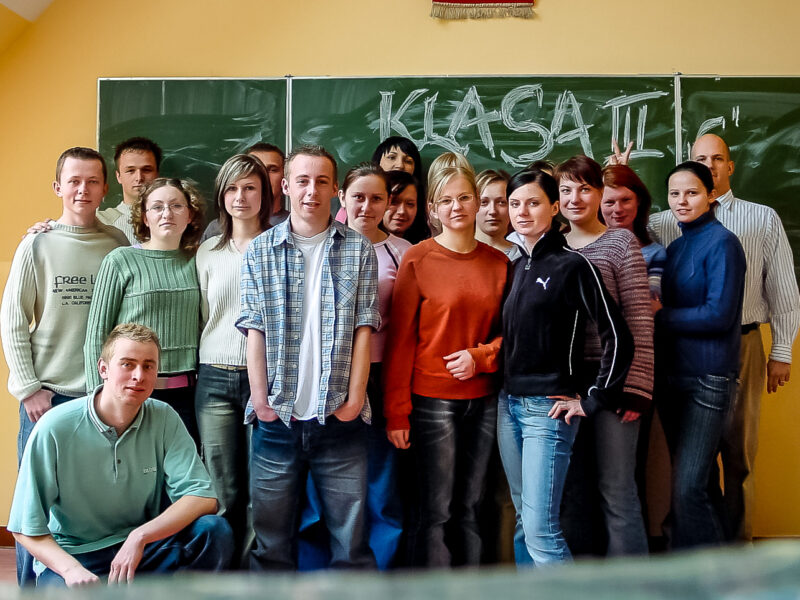
Class 2d

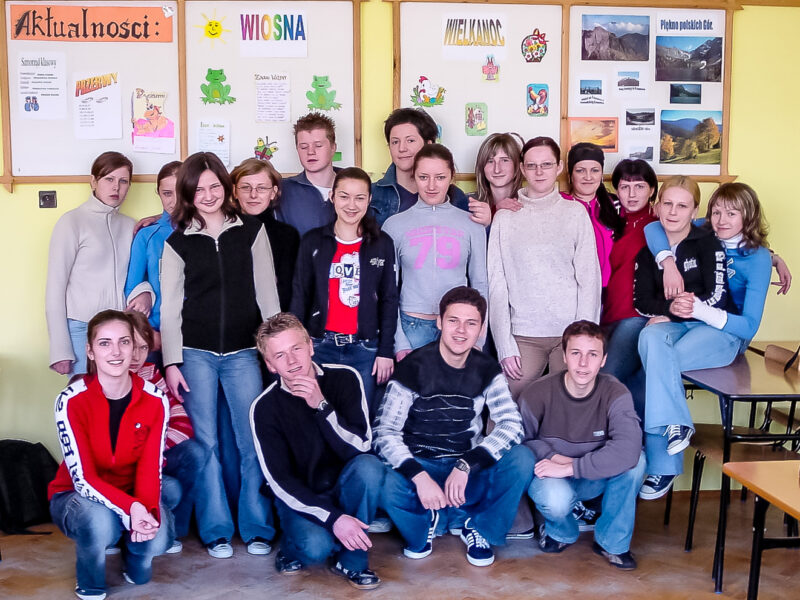
Not supposed to have favorites, but I'm not going to lie -- this was one of my favorite classes.

Matura

Here in Poland, the bane of high school students’ existence has just begun: the matura. This year is exceptional because it's the first time in many years that the matura has been significantly revised.

The old matura was hell. The new matura -- well, we'll see.

This year the order is reversed: first the oral exams (in both Polish and a foreign language), then written exams (in Polish, a foreign language, and a third, student-chosen subject).

It is also, in my opinion, much easier. The foreign language exams, at least the basic level exam (there's also a possibility to take an "extended" exam), depends more on students' ability to communicate than on grammatical knowledge.

The English Matura

The English exam has four parts: three situations/dialogues, and a picture. The situations have three sub-points that students have to complete in order to get the full credit. Usually the situations are something like, "You are on vacation in England and you read an advertisement about excursions to Scotland. Call the given number and find out," with the three sub-points being something like:

  • cost of the trip;
  • what's included in the price;
  • when and where the departure will be.

Pretty basic stuff, and most of the kids who'd put forth any effort whatsoever during the last three years will have no problem with it at all.

The picture is always of one or more people, doing some obvious, clear activity. Students have to describe the picture, than answer two questions about it.

Again, pretty basic stuff.

Still, a lot of the students are scared silly. Many of them have no cause to be frightened -- they'll pass despite their jitters. But a few have reason to be nervous.

I too am a little worried about it. It's at least a partial reflection of my teaching ability. It shows, I think, students' communicative skills (or lack thereof) much more so than my teaching, but still...

Teaching

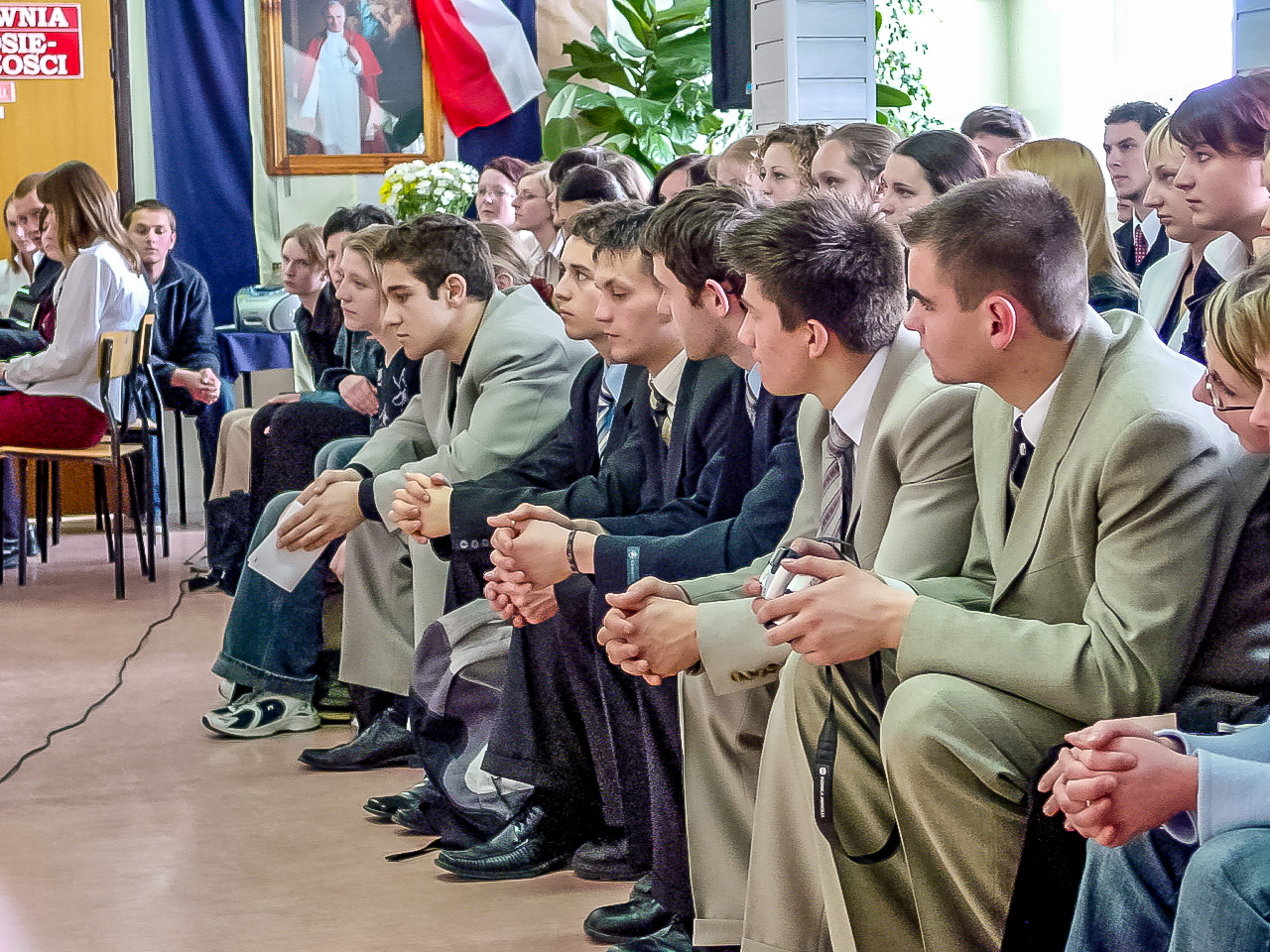
The end of the school year for seniors – today was the last time they’ll all be together, and as of this afternoon, they are officially graduates, with only the matura (exit exam) awaiting them. There was of course something like a graduation ceremony, complete with a series of skits and songs performed by juniors, as per tradition. Naturally, among the songs was that school classic, “Ale to już było / I nie wróci więcej”

(“But that has already been, and won’t return again”).

I sat there, facing the seniors, watching some of the girls get teary-eyed and sing along, and I couldn’t help but smile. I wasn’t happy because of their obvious sadness, but because of the privilege I was experiencing – to be that close to so many young people that are of no relation to me at all. I see their joys and troubles, and sometimes have to put up with their troubles jointly when they come pouting to class. When I’m extremely fortunate, I’m even part of the cause some of their joy; and unfortunately, I’m certainly the cause of their troubles too often. But young skin, hearts, and bones mend quickly, I tell myself.

I’ve taught these seniors for three years – their entire high school career. I’ve seen some of them go from being complete beginners to relatively eloquent English speakers.

I’ve seen some of them come in and leave with the same level. Most have improved, as evidenced by letters that I had them write to themselves at the end of their first year in high school and then gave back this week. What a feeling, watching them read and hearing them laugh at their own silly mistakes, and what a sense of accomplishment for them that they can now see those mistakes.

But it’s not only been their English that has improved. Girls have become young ladies, in appearance and behavior. Little boys in teenagers’ bodies have become responsible young men. Nerdy outcasts have improved their social skills and have even become semi-popular. Boys learned how to comb their hair and became young men, and awkward young girls became attractive young women.

That’s the best thing about having taught in the same place for a while – you see the kids grow up. It’s like parenting, without as many of the worries.

Class 3

It’s not often

that I get to make a student's day, but I think I did just that this morning.

I handed back tests to a class of first year students, by far my favorites. I love teaching beginners because it's really a kick to end a year talking to a group of kids in English that didn't know a single word a few months earlier. This group in particular is wonderful. There's a very positive dynamic in the class: they're very enthusiastic, but easily controlled.

Grazyna (not her real name) has been having problems since the beginning of the school year, and has to struggle to pass. I think she's one of those of us who have little talent for languages.

Today, I gave her back her test. She made a "three" on it, the equivalent of a "C" in the States.

It was her highest grade ever for a major test in English.

She literally screamed, and her face glowed with the loveliest smile I've seen in a long time.

Those are the moments that make teaching my dream job.