matching tracksuits

fun in threes, sometimes fours

education and teaching

Media on January 7

As an English teacher, there are times that demand I drop what we’re doing in class and talk about what’s going on. Or as Kelly Gallagher put it,

Sometimes when history unfolds, it immediately supersedes tomorrow’s lesson plan. Today is one of those days. Students will need to read, write, and talk about this.

I took his thoughts (and one of his ideas) to heart and took the opportunity to do a short media studies lesson. We looked at seven screenshots of seven media outlets and asked a few questions about them:

  • What is said?
  • What is not said?
  • How is it said?
  • What images were selected?
  • What images were not selected?
  • Why this order of links?
  • Why the selected font sizes?
  • Who is the intended audience?
  • What is the intended purpose?
  • What inferences can we draw about the source?

As best I could, I scrubbed all indications of the source from the screenshot. I missed a bit from the CNN shot, observant students probably noticed the “South Carolina Public Radio” media player on the NPR shot, and I accidentally left in image attribution for The Washington Times but otherwise, I kept them a mystery. (The first time I went through the lesson, I told the students which images came from which sources. Because of the reaction, I decided not to do that in subsequent lessons.)

Here are a few things the students noted.

Screenshot 1: NPR
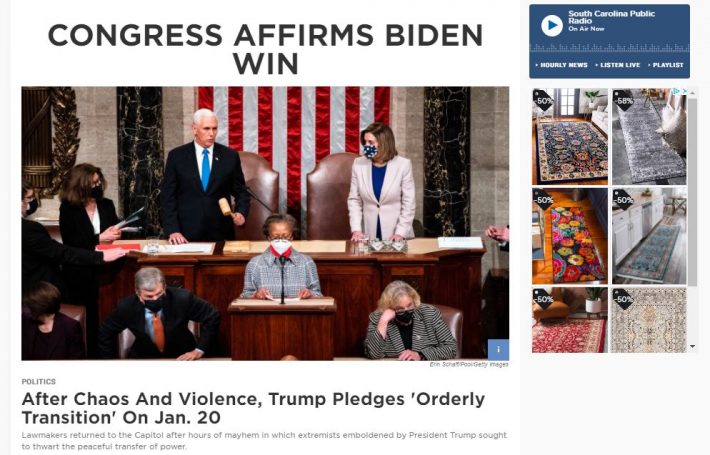
Of the two big stories from January 6, this source focused on the positive (for the survival of our democracy, that is) story. The attack on the capital was referred to only as “chaos and violence.”

Screenshot 2: The Washington Times
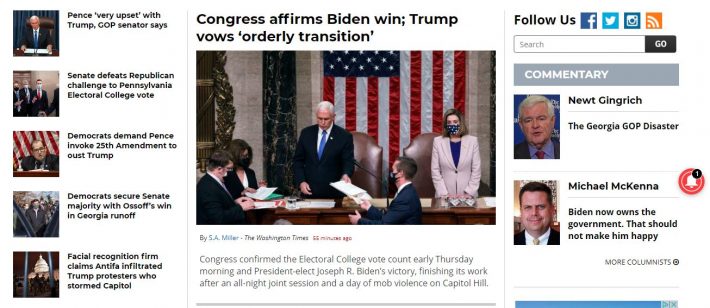
Students, after I explained who Newt Gingrich is and what “GOP” refers to, decided this was definitely targeting a right-leaning audience. I was surprised that not a single student knew what GOP meant.

“Why did Republicans get that nickname?” they all asked.

“I don’t know.”

“Do Democrats have an equivalent nickname?”

“Not that I know of.”

Screenshot 3: CNN
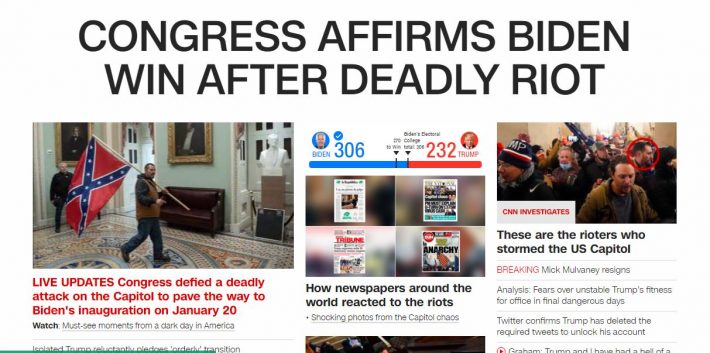
Students immediately commented on the amount of screen real estate the headline takes up. They also commented on the vote count graphic.

“I’ve only ever seen this on election day,” I pointed out.

We discussed the use of the term “rioter.”

“What else could we call the people who participated in that event?” I probed.

They came up with a list:

  • protesters
  • gang
  • terrorists
  • attackers
  • mob

I added one more: insurrectionists.

We put the words on a continuum, and they decided that the most benevolent was “protesters.”

“Using that term would suggest they support them,” one student succinctly observed.

At the far end: insurrectionists. All that being said, they felt that “rioters” was the most objective.

Screenshot 4: The New York Post

Students immediately noticed that, with source 4, we could win a beach house vacation! In other words, they realized quickly that this site relies heavily on ad revenue.

“Maybe it’s a blog,” someone ventured.

As to the content, they thought it was striking that the lead story was about the rioter who was shot, but they also thought it was significant that the headline left so much out.

“In the Capitol — it sounds like something happened to a tourist or something.”

Screenshot 5: The New York Times
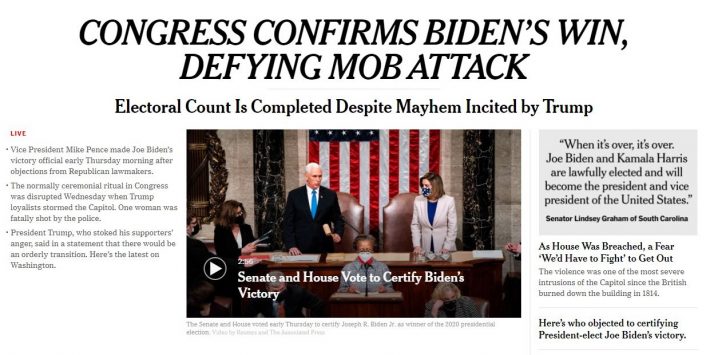
This source included a video, which suggests that the images in the other articles are screen grabs from this video.

There’s also the word choice: mob and mayhem.

“What’s ‘incited, Mr. Scott?” they asked. “Isn’t it like ‘encouraged’?”

Screenshot 6: Fox News
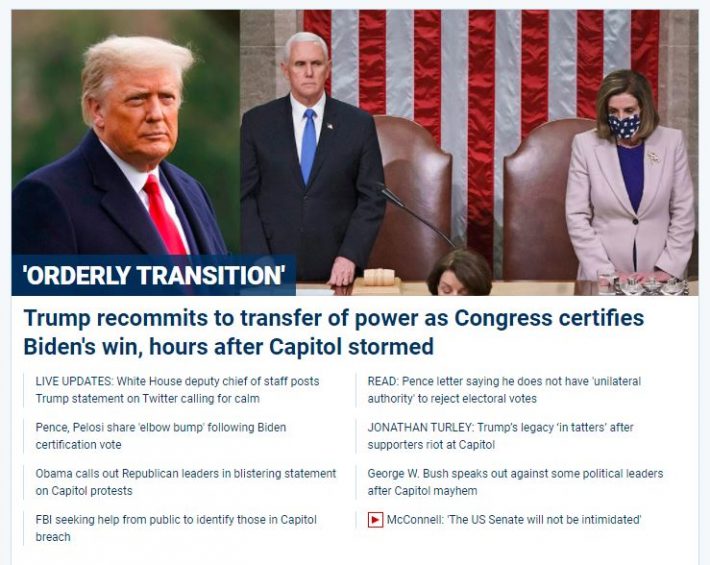
The immediate thing students noticed was “Orderly Transition” is the headline. It’s in all-caps, so it somewhat dominates the second headline below it.

Also, in the picture, Pelosi looks a little weak: she’s a little slouched over with downcast eyes. If this was from a video, it could have been a conscious choice, which would indicate a bias. Additionally, with the placement of Trump’s picture, it seems to highlight the distance between the two parties.

Screenshot 7: The Washington Post
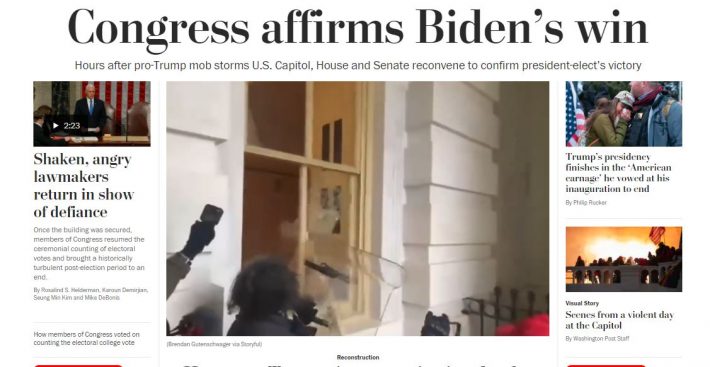
The final shot came from The Washington Post. It seemed, the kids noted, to balance between both: the headline was about Biden; the image was from the assault.

“If you look at the area just below it,” I pointed out, “you’ll see what looks like the tops of letters. That was the headline for the second story, which was about the assault.”

Once we were all through, I reminded kids that the purpose of the lesson was not to teach them what to think but rather how to think. “An informed citizenry is critical to the success of any democracy,” I said.

Oh, the things we (rightly) leave unsaid in the classroom when talking about such matters, though…

Working in the Evening

The Boy sometimes has trouble getting work done in class. I say “sometimes” but in fact, it’s more like “most of the time.” He’s easily distracted; he takes his time sometimes; he gets off task. The end result is a fairly common occurrence: we spend some time during the evening getting caught up with his work.

We worry about his ability to keep up with things return to “normal” (whatever that might be) and teachers are no longer so very forgiving. We worry that we might hear suggestions of “ADHD” and, more ominously, “medication” from well-meaning, concerned teachers.

I don’t recall ever having any significant issues like this growing up, but I also wasn’t surrounded by electronics and instant gratification. It must put a strain on the attention unlike anything we ever experienced growing up.

Various Visions

Today, we looked at six performances of various parts of the famous so-called balcony scene. I’d just discovered a new one:

This calm, nuanced performance has become my favorite.

Opłatek 2020

It’s always the highlight of the school year for me, introducing American students to the lovely tradition of sharing the opłatek wafer. The kids love it; the administrators and counselors I invite in love it; I love it.

And I thought that we wouldn’t be able to do it this year. But I’m not one to give up easily when I think it’s something valuable for my kids, so I came up with an alternate plan.

Instead of sharing food, I had kids bring in their own snacks.

“What are we doing, Mr. S?” they asked.

“You’ll see.”

It’s important that they have a bite to eat during the process because that’s what the tradition is all about: breaking bread together.

So the kids divided into two groups, with the inner group rotating in sync, always maintaining social distance, and never touching any other seat.

I showed them pictures from previous years.

“That looks really fun,” one girl said.

Well, it is more fun than what we did today, but perhaps they got a little glimpse of the perfection that is the sharing of the opłatek.

The Letter

We just started Romeo and Juliet, and a lot of the kids are quite excited about that.

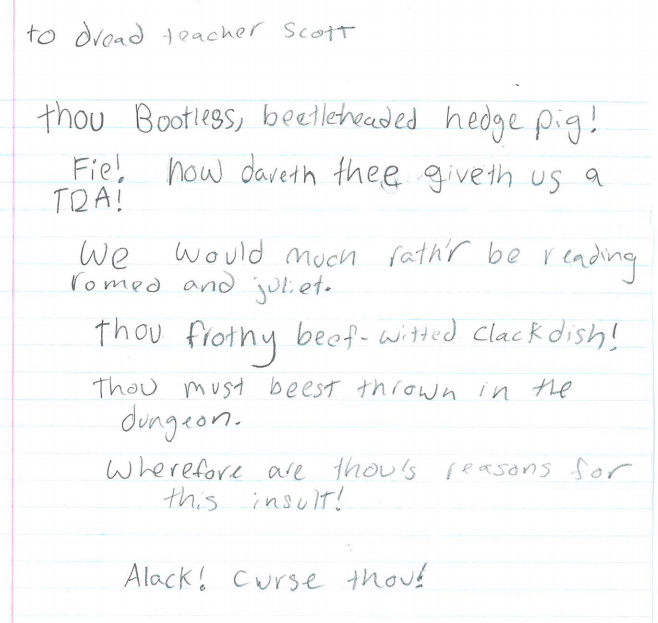
I found this waiting on my desk at the end of the day. (“TDA” is a “text-dependent analysis” — the district requires us to give a couple of practice TDAs in preparation for the state-mandated one at the end of the year. No one really likes them…)

Growing and Writing

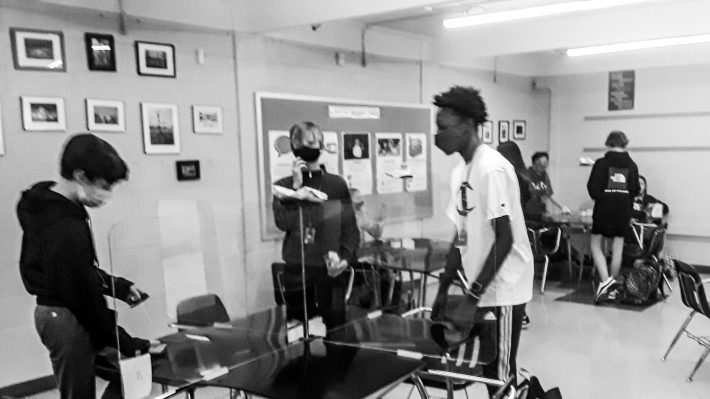
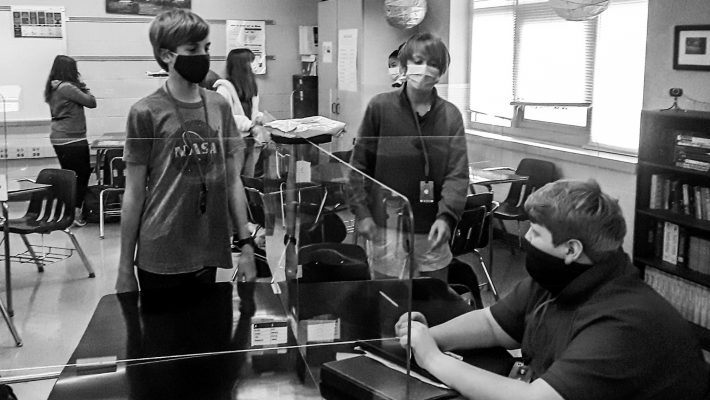
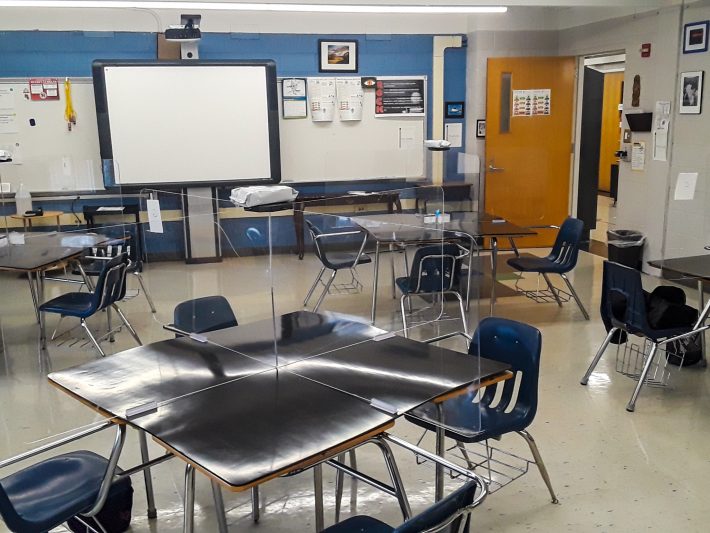
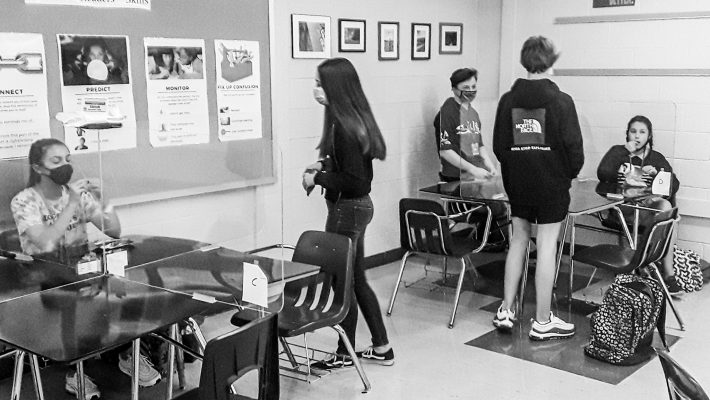
My classes are growing. More specifically, they grew today — doubled, in fact. Today was the first day we had all students back at the same time. Sixth grade has been doing it for a couple of weeks now; seventh grade began last week; this week was eighth grade’s turn. So each class had 18-24 students in plexiglass-enclosed quad-desks, each six feet apart. “Remember,” I said countless times, “these plexiglass shields only serve as protection for you and your neighbor if you have your masks on.” This mean that it was the first day for everyone wearing masks all day.

How long will we stay like this? What effect will the Thanksgiving surge, now in full swing, have on it? I really don’t know.

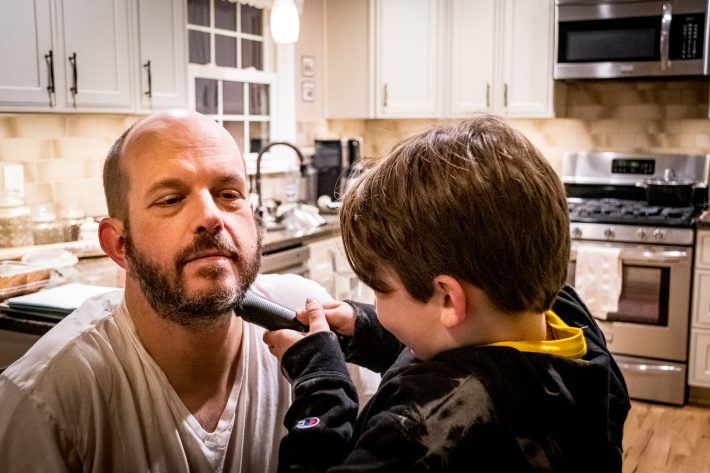
As part of my promise to K about my beard (“I’ll get rid of it when we’re back in school 100%.”), I had the Boy shave me last night.

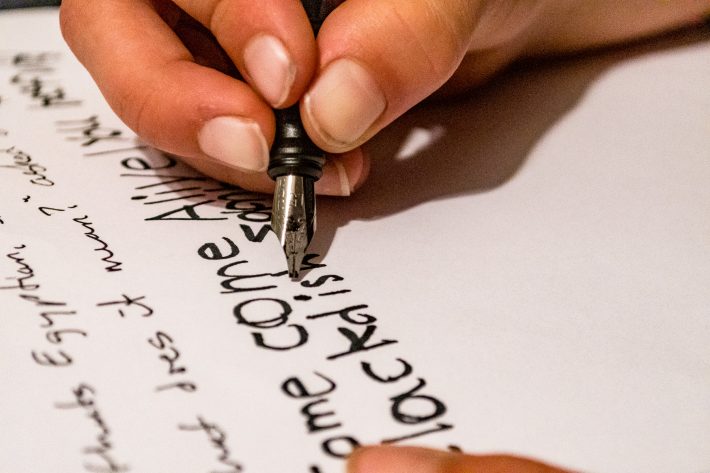
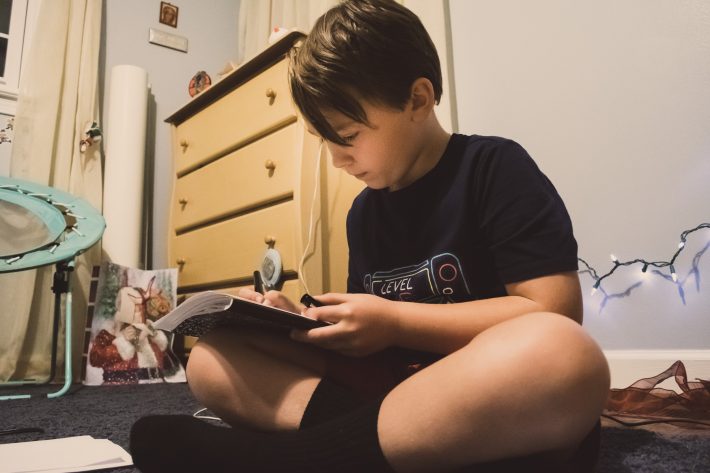
That was how we had some of our Daddy-E time. Tonight, it was writing: the Boy has discovered fountain pens,

and that discovery has inspired him to write short stories. We’re working on a tag-team zombie story now.

First Impressions

“They actually kind of make me dizzy.”

It wasn’t what I was expecting when  I asked Ms. Butler about how things were going in her newly-podded classroom with each student seated in a little box of plexiglass. Perhaps I was expecting something more like, “It’s even more difficult to hear students,” or “It’s weird seeing students through so many layers of plexiglass,” or even, “It’s just weird.” But not dizziness.

“What do you mean,” I asked.

“Well, with all these panels of reflective plastic,” she began, feeling her way through the explanation carefully as if she hadn’t really hadn’t tried to put it into words before. “There’s just all these weird reflections that shift and move as you move around the room.”

“That sounds awful.” I get dizzy easily, and it had me a little concerned about how I might react to it myself.

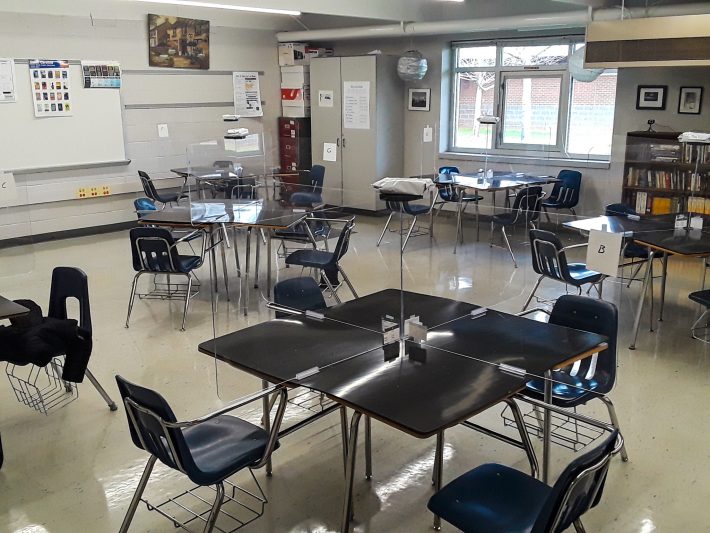
When I got into the classroom this morning and started placing name tags on everyone’s seat, I saw immediately what she meant. The clear plexiglass that divides students into little almost-self-contained cubes reflected images from around the room. These reflections were, in turn, reflected off the black plexiglass bases on which the whole dividers sat, and the play between these reflections and reflections of reflections had me feeling a little woozy within seconds. It was as if everything were somehow in the matrix film, with solid reality turning into liquid, flowing reflections of reality. What’s worse, the whole broad clear barriers reflected again their own reflections from the black bases and also refracted the images of other tables so that we had reflections of reflections of reflections, all moving and shimmering at different speeds and frequencies.

I felt like I was in a hall of mirrors, a corridor of reflections that caved in on themselves, like waves riding on waves that then crash into other ripples, transforming all of reality into a dancing mirage, a dizzying visual cacophony.

“Dear God, what if it’s always like this?”

As I walked around the room affixing the place holders to their right locations, I realized it wasn’t an issue if I didn’t pay attention to it or even think about it. Like baffles in a large gas tank, I thought that perhaps having people in those seats might draw more attention than the reflections themselves.

As the first period with students began, I apologized for some of the changes the new format necessitates -- no real...

Written in creative nonfiction class as students worked on their own accounts of the first days in the new pods.

The Challenge

I texted a picture to K this morning: “This is what my classroom looks like now,” I said.

“Wow — no more rearranging rooms, I guess,” she replied.

I know a lot of teachers are concerned about the impact this will have on their teaching style, on the types of lessons they can do. I for one am not terribly worried about that because this year I’m teaching only honors classes, and most honors students are relatively mature and somewhat adaptable. There are some things that will take getting used to — not as much motion, more teacher-based lessons, etc. — but overall, I think they’ll do fine.

When I got home, I noticed a little paper with Shakespearean insults on the table. Remembering that L’s class has just started Romeo and Juliet, I thought it might have been from her, but the Boy filled me in when he got home from swimming lessons: “The kids in challenge today were working on Shakespearean insults,” he said. He told me about how funny it was when his friends who went to challenge shared it with him, and I’m assuming he got K to help him find a list of insults on the internet and print them out.

It was only then that I realized: E didn’t get an invitation to join challenge when he started this year. The invitations are based on standardized test scores from second grade, and I immediately thought that the Boy must feel a little left out, a little, well, stupid compared to the others.

K had the same concerns, and we talked about it in the evening when the Boy was sound asleep. “He wanted to know if we could sign him up,” she said forlornly, “and I had to tell him you don’t sign up for it; you get an invitation.”

I remember seeing the challenge kids leave — our district was a little worse in their naming: it was the “gifted and talented” group, which makes everyone else feel less gifted, less talented, and that’s exactly how I felt. I watched them troop out of the classroom in elementary school, wondering what they do there, wondering why I wasn’t a part of it.

I got an invitation at the end of fifth grade and spent sixth grade with the GT kids who’d been doing it for several years by that time. I didn’t feel any different, really, and I don’t really recall doing anything all that spectacular. Of course, that was over 35 years ago, so I can justifiably be a little fuzzy on the details, I’m sure.

Throughout high school, I was most decidedly average. I was in the “advanced” classes only insofar as I was not in remedial English or remedial math. I didn’t take algebra until ninth grade; I never took a single AP course; I had no “Honors” affixed to my class names; I didn’t graduate anywhere near the top 10, and I highly doubt I was even in the top 10%. And yet for high school superlatives (how I loath to this day that idea), my peers voted me “Most Intellectual.” (I was tempted to refuse the award during the senior luncheon, but my mother convinced me it would be rude to do so.) So the recognition for my academic achievement was a mixed bag — conflicting signals. In the end, I just didn’t put much stock into what people thought of my intellectual abilities.

But somehow, when it comes to my kids, I feel a little differently. I want them to be geniuses, above and beyond even those who are above and beyond. What parent doesn’t?

The Boy is starting to realize some people work faster than he does, maybe a little more accurately, K and I concluded. And that’s fine. We’re all different. We all have different gifts. But still, I felt the Boy’s sting just a bit, so I went back to his bedroom and cuddled with him a little more.

“You’re very gifted in many ways,” I told him.

“How?”

“You’re a very good reader. You’re an excellent drawer. And you’re very kind and sensitive to other people’s needs and emotions.”

A pause. “Thank you.” He snuggled in a little closer and went to sleep.

Treble Clef

Today the Boy had music for his related art class in school. They're working on the treble clef.

"I took the after-lesson quiz," he explained, "and I got 3 out of 20 right! I took it again and only got 4 out of 20 correct!" His frustration was mounting to the level I'm sure it achieved when he was struggling with the material in class.

Checking school lunch. "Daddy, this is what I'm having tomorrow! It's delicious!"

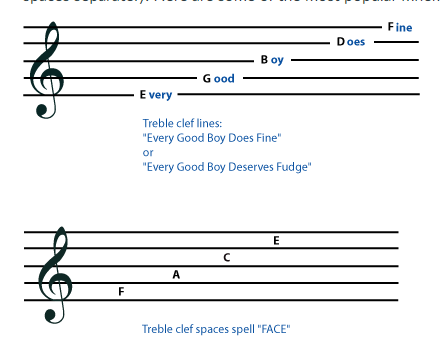
After dinner, I printed out the old methods of memorizing the treble clef: "Every Good Boy Deserves Fudge" and "FACE."

We went through his work together, and he made a perfect score. "That was easy," he decided.

He noticed, though, that there are two D notes on the treble clef: one just beside middle C, and one almost up at the top of the clef.

"Two Ds?!"

So we went to the piano and started poking around. We talked about the patterns of the black keys and used that as a way to show which keys corresponded to which note.

"This is D," I said. "See how it's between the two black keys? Now show me another D."

Testing, Again

I guess it could be worse. Shoot, it was worse just a few years ago. We had MAP testing and Iowa Basic Skills testing and some other test that I can’t remember, all piled up in the first half of the year, with the MAP test repeated in the spring along with state-mandated testing. Now we’ve lost the MAP testing (the only really useful test for me) and the Iowa Basic Skills (Is that what it was called? I could look it up, but I don’t care enough about it to check), but in their place, we have district-mandated benchmark testing every quarter and two practice TDA tests.

What is a TDA test, you might ask? Text Dependent Analysis. An essay question based on a text, in other words. That’s how we spent today, working on this essay question:

“Inventor Martha Coston” focuses on Martha Coston’s night signal invention. The author claims that it was Coston’s “desire to provide for her family and her determination to succeed [that] made the Coston night signals a great success.” Write an essay analyzing how the author develops and supports the claim. Use evidence from the text to support your response.

If you read that carefully, you’ll see that it’s really just asking students to summarize the argument in the piece. Today, I helped students see that; I’ll do the same tomorrow, as I have to do this in person, and we’re only meeting a given student every other day. Is that teaching to the test? Or rather teaching the test? I don’t know. I don’t care. But I wasn’t about to just toss the test at them and say, “Here, do this.” And I was also not about to let the know, through implication, that I really didn’t want to spend time with this test. “Now, as you look at this district-mandated test…” “If you look at the prompt for the district-mandated test…” “Do you have any questions about the district-mandated test?”