fun in threes, sometimes fours


Why am I no longer interested in studying literature? Is it simply that I don’t understand most of it, particularly contemporary poetry? Perhaps, but regardless of whether I understand it or not, it all feels so fake to me, so much like a game. The rules of the game are simple: Make nice flowery language that doesn’t necessarily mean anything in particular; make nice vague language that sounds nice but doesn’t necessarily many anything. It’s as if poets are not writing for people but for other poets. Even the criticism and analysis of poetry seems as if it’s coded for poets. I read descriptions of poetry and it tells me nothing. I understand what the words mean, but I don’t see how you can possibly describe poetry in that way and it mean anything. In that way, poetry critism is its own form of creative writing. No one simply says, “This is what the poet is getting at,” but the critic must turn her essay into a prose-poem itself.
Take for example Christian Wiman’s essay in the January 1997 issue of Poetry. He says of Heaney’s “The Harvest Bow,” “The poem has an equable, utterly accomplished feel to it, a pleasing sense of formal fulfillment and completed experience.” Or comparing Heaney’s work to Ruskin’s “sacred laws”: “Both are as yet unrealized, but they are not merely illusory expectations; the promised revelation is implicit in the work at hand.” Of course I am taking these quotes completely out of their context and not even supplying the poems about which Wiman is writing. All the same, while I understand what each word means, the sentences themselves tell me nothing about the poems. In what sense are they “unrealized?” How would an “utterly accomplished feel” differ from a “partially accomplished feel?” Indeed, what would be the opposite of “an utterly accomplished feel?” The words sound nice; they sound academic and deep; but they don’t tell me anything.
The Vintage Book of Contemporary American Poetry is filled with examples of empty and meaningless description. J. D. McClatchy, the editor, writes a brief biographical introduction to each poet, but when he sets about describing the poetry, he often loses me. He introduces Mora Van Duyn by saying, “Her intellectual balance, as well as her preferred narrative and formal strategies, serve to heighten the ordinary (what she calls the ‘motley and manifold’), and control the bizarre.” What exactly does he mean by “intellectual balance” and how does this manifest itself in Van Duyn’s poetry? He describes Robert Penn Warren’s later poetry as “craggy.” This tells me nothing.
Some of McClatchy’s description makes sense, but seems to be more than a little overstated. Concerning J. V. Cunningham, he says, “Though small in bulk and scope, Cunningham’s work is honed to a mordant precision of style and feeling.” I read this, and I have no idea what he’s talking about. Even after I read Cunningham’s poetry, I think, “How does McClatchy mean this is ‘honed to a mordant precision?’” Not all of Cunningham’s work is filled with the biting sarcasm implied in “mordant precision.” And once again, what would the opposite be?
It is not as if McClatchy writes entirely like this. About May Swenson’s work he says that she “relies on wordplay, odd viewpoints, unexpected juxtapositions, and puzzling riddles.” That tells me something; it gives me an idea about what to expect concerning her poetry. He describes Richard Wilbur’s work as being “grounded in a detailed observation of the natural world.” I read that I come to anticipate many physical details in his poetry.
I believe this style comes directly from the forms used by poets when they write about other poets. Robert Lowell wrote to Theodore Roetke and said, “One of the things I marvel at in your poems is the impression they give of having been worked on an extra half day.” What does that tell me about Roethke’s poetry? About Anne Sexton Lowell wrote, “Her gift was to grip, to give words to the drama of her personality.” The latter half I understand, but what does he mean, “to grip?” To grip what?
It’s the day before Christmas and all through the house, I’m bored senseless. I really have no idea what I’m going to do to pass the remainder of this holiday. I should go somewhere — rather, I should have gone somewhere, for it’s a little late now. But the question is always, “Where?” And the related, “With whom?” So I plan on sitting in my apartment, passing the time somehow, doing something — alone.
Last night Kamil and I went out for a beer. We talked about the possibility of having a party at my place New Year’s Eve, but I don’t know that that’s going to work out. We don’t know who can come, and the biggest problem couched within that dilemma is, “What about women!?” We have no idea if we can get any women to come to this and if not, it could be decidedly boring. If this doesn’t work out, I don’t know what I’ll do. The thought that I might spend New Year’s Eve alone, holed up in my apartment, looms with a gloomy certainty which I’d rather not think about.
I have spent an incredible amount of time alone in the past eighteen months. In a sense it has been very nice, but enough is enough, really. I’m tired of being alone all the time. It really does get old after a while. Yet I see no alternatives. I don’t want to go hang out with drunks in the bars, and that seems to be my only option. I could invite people over, but whom would I ask? It’s the same problem I’ve been mulling over ever since I first arrived in Lipnica. There’s just not a hell of a lot to do in this place.
What will it be like when Chhavi is here? I’ve a feeling we’ll get into a few arguments because she’ll want to be doing something and I’ve gotten accustomed to doing nothing. I do want to travel on the weekends, but not every weekend — we couldn’t afford it to begin with. I really don’t know. I think she realizes the potential boredom and that’s why she wants to get a job in Warszawa or Kraków. Yet what’s the point of staying in Poland if I go somewhere else to teach? The only reason I want to stay here rather than trying to get some kind of job back in the States is that I want to work with my students for another year. I’ve pointed this out a thousand times, both to myself and to her — we both realize and understand it.
My apartment is ridiculously messy — I’m going to clean.
My anal-ity about writing in this every night has certainly disappeared. I really have nothing on my mind to write about tonight, but I thought I’d jot down a few things before going to bed.
I finally sent Jarek the stuff from my presentation next week. It’s good to be done with all of that, but I’m still plagued by those thoughts of, “Do I have enough material to last me forty-five minutes?” It’s just like the worries I have every night as I prepare my lessons, but here it’s a little different: I cannot just fake it without everyone knowing it. I’ll spend some time Sunday (probably more than I anticipate) preparing a little something extra. I’ve been thinking about having an open discussion about lesson planning in general, but to what ends? I can’t really think of where I’d want to lead the discussion, so what’s the point? I’ll do some more thinking on that as well.
Today we had the presentations in IB and they went rather well, I thought. Their projects aren’t quite as elaborate as IA’s or IC’s but they’re good all the same. Their presentations were much more effective because we had each person teach the class two or three new words from their projects and then had a bit of a review after every group had gone.
I think on a whole the projects were very successful. I think the students enjoyed doing them and probably thought it was an original assignment, coming from English teachers. The other teachers have all commented on the projects. (We’re keeping them in the teachers’ room while we grade them.) Everyone says they look nice and that it’s a good idea which should promote learning. I’m really pleased with how everything went. It gave me a nice feeling this afternoon looking at all those projects and think, “Hey – that was my idea.” I came up with a highly effective and educational learning project. Certainly it’s not original, but I thought of it myself with no outside help. I’m quite proud of myself. Ha.
This week has gone by so quickly. The time is just flying. November seems like it just began and it’s almost two-thirds over. Next week will go by rather quickly because I only have two days (because of the IST). Then we have three weeks until Christmas break begins. And then we’ll have just a few weeks before winter break. It’s really going to go by quickly now. And in some ways it can’t go by quickly enough. I have trouble going to sleep sometimes because I keep thinking about my homecoming, and that is happening more and more frequently. Two years stretched before me endlessly – now I’m down to a little over seven months. It’s almost three-fourths over . . .
It’s amazing how quickly plums can roll. You would think that since they’re not really round but more oblong—more like a small American football than a soccer ball—that they wouldn’t roll as much as they would wobble, doing a strange dance which could look like a drunken lame man hobbling down the street. But they did scoot through the bus with amazing speed.

When the bag full of plums sitting in the aisle tipped over, I didn’t imagine the comedy of the ensuing scene. Its owner, a drunken Polish man in dire need of a belt, was completely obvious to the fact that his plums were making their way throughout the bus, rolling down the aisle and under people’s feet. Finally, whether by intuition or chance, he realized what was happening and with a groggy grunt he turned around, bent over and began picking up the plums. First, he had to put the bag back up, and this resulted in an immediate and new deluge of plums.
Containing my own amusement—for it’s not a good idea to laugh at a drunk man who’s losing all his plums—I helped him put the bag back up and then grabbed a few of the plums and plunked them back into his bag.
After he replaced the fruit in his immediate reach, he began moving people’s legs aside with a gruff “Przepraszam” as he lurched for the plums which had rolled under passengers’ chairs. Pleased with the unexpected entertainment, we sober riders which him, glancing up occasionally to smile at each other as if to say, “If only this poor guy knew how stupid he looks.”
Finally he retrieved all the fruit that was within a few feet of him, but then he revealed just how tenacious he could be. Swaying with the bus which, combined with the high level of alcohol coursing through his veins, seemed to make him look a shade of nauseous green which is not healthy even for folks with the strongest stomachs, he stood up and stumbled toward the front of the bus, grasping the chairs for balance.
His destination: a small trove of plums which had rolled all the way to the front of the bus.
He brought back three or four, dropped them in his bag which he carefully rearranged to prevent the catastrophe from happening again, then slumped down into the floor—there were no empty seats—and leaned over in a drunken stupor. A lone plum, which had somehow eluded the man, sat balanced in the middle of the isle. Though the bus was swaying back and forth fiercely and though his comrades had set an amusing president, the plum did not roll at all but sat still, content to be alone and free.
And that was what kept me amused for the rest of the bus ride from Kraków.
I got journals from IIB and IIIA today. I’ve already graded the journals from IIIA but I really dread starting on the big stack from IIB. It takes such a long time to grade those things because I always want to be fair. I don’t know if it’s possible in such a subjective thing as journals, but I try nonetheless. In some ways I wonder if they’re more trouble than they’re worth. That’s really a stupid thing to think because it does a great deal of good for the students—it provides an opportunity for them to write without worrying about mistakes or the eventual grade (for correctness, that is). The question is not whether or not to continue the assignment, but how to grade it more quickly and effectively.

I just noticed a drawback to the new grading system I’m using this year. I can’t get any kind of grade whatsoever until I have at least one grade in each area (test, journal, projects, etc). That will mean that we have to give a lot of assignments to each class. That won’t be too difficult, but it will be terribly time consuming to grade all those things and then put the grades in the computer.
One thing is certain: I am not doing all the grading like I did last year. I did it because I had so much more free time than Danuta did, but this year I’m going to get her to grade a few things. Of course that wasn’t the only reason: I was also worried that she would grade them too harshly. I always thought of those tests she gave IIB last year—some students received no credit whatsoever. I could never convince her that giving no credit for a test item is a bad idea. Perhaps this year I can talk her into it—but she is so stubborn at times.
I survived the first of many Wednesdays, all of which will certainly be hellish. Eight lessons without a break is tough. But I will admit that it wasn’t as tough as I was expecting. I rather enjoyed each class, most of which are with the first class (group A, B, or C). I have IIIA to begin with, and then I have only first year students. And just as I did last year, I’m finding that I really like the first class. They’re all great, and even though I thought I had a good start with the first classes last year, I think I’m doing much better this year. I’m really connecting with them more effectively than I did last year.
I’m trying to learn students’ names of course, and there are already a few who stand out. In IA there’s a girl named Alina who has really marvelous English and seems eager and willing to use it. (I was surprised by the willingness of the whole class to use English, to be honest.) Rafał in IB reminds me of someone with his good-hearted mischievousness, but I cannot remember who. (Dominik during practicum in Radom?) In IC there’s Ba ka who reminds me of Żaneta from IIA. They even look similar.
I find now that the despression of Sunday night seems so very far away. I’ve no idea how I could have felt so bad. I look around and I think of how I’ll miss this place, even during next summer while I’m back in America. I’ll miss speaking Polish and teaching English. And I’ll even miss the smallness of this place, that which can cause such boredom if I’m not careful.
Today I got both class IB and IC to speak a little English. It was so simple, but it sounded so wonderful. They were only saying things like, “This is Bob,” or “What’s his name?” But to hear that from someone who has never before put together that many words in English was almost magical. I had forgotten how good I felt last year when IIB was beginning to say a little bit in English. It is that which makes me prefer first year classes in some way. To begin with, their easier to prepare for. But more importantly, I get a much greater sense of accomplishment from working with them.
We had the opportunity to meet two of the three first classes today—IA and IC. It turns out that there are not as many students from class VIII that I taught last year as I thought there would. I recognized a few faces, but not many. Strangely enough there are almost as many boys as there are girls in that class. That’s a shock for Lipnica, especially when one considers both second classes and third class. I began talking to them in English and then Danuta gave a few rules and regulations in Polish. I think it will be a good class, but Danuta said it would be a difficult class. “Why?” I asked. “Because they responded much like IIIB always does,” she answered. I pointed out that it’s impossible to judge them from only one short class which had almost no interaction at all.
Class IC is a different story altogether. There are twenty-eight students in that class, and not a single boy. I walked in and said, “Hello girls and girls!” I talked to them in Polish at first to show them that my Polish is not perfect but it is understandable. I made the point that I don’t really worry about my mistakes because if I did, I would never be able to say anything. I said also that they will speak English much like I was speaking Polish. “We’ll speak like children and make a lot of mistakes, but it’s not a bad thing. We [Danuta and I] will never say you’re a bad student because you make mistakes.” I tried to encourage them and show them that making stupid mistakes—even funny mistakes—is to be expected. They were fairly quiet, but I think it was simply from nerves and not really from anything else. I now have the experience of IB last year to remind me that classes that begin with such difficulty often turn out to be the most rewarding.
I had IIIA play “Taboo” today and they were really speaking a lot. I heard more English in those forty-five minutes than I’ve heard in a very long time. I was thrilled, and it seemed that they were actually enjoying it. I really don’t know what I’ll do tomorrow, but I’m not as worried about it now. I realize that they are willing to speak English if they have such tasks that allow them to make their own constructions as they need to.
Part of the problem is loneliness. I haven’t seen anyone today and I don’t know that I will. I’m thinking about going across the street, but what prevents me from doing that is the simple understanding that I still haven’t finished planning for tomorrow. I could say to myself, “You don’t have class until 9:50 tomorrow morning. You can wait and throw something together then.” But that’s exactly what I did last year and where did it get me? What did I accomplish? What did the students learn? How as my sanity? So I want to try to finish writing a lesson plan for tomorrow. But I know (or rather, “I expect”) that when I go back and sit down with a fresh outlook (as fresh as I can manage at this point), I’ll run into the same brick wall. “What the hell am I going to do tomorrow?”
That was a nightly battle last year and I assume that it’s going to be the same way this year. Every evening I struggled to come up with a lesson, forty-five minutes of business and productivity. When I finally came up with something and finished all the planning, I thought, “Whew—did it again. But I’ve no idea where I’ll get another activity from.” Yet somehow, I always managed to come up with something. It’s just that toward the end of the year, my “somethings” were turning out to be rather boring and ineffective. The students didn’t respond well at all and I was left wondering what the hell I could do differently. Part of my trouble now is that the same thing is happening at the beginning of the year. I think, “Well, I survived about four or five weeks of that last year, but I can’t do nine or ten months of it this year.”
I just don’t know what the problem is. Is it that I’m not doing enough planning? Am I leaving to much up to chance? Am I too often saying, “Okay, that’s a good idea but I’ll improvise the finer details tomorrow during the lesson”? Am I planning with the wrong objective? What is my objective? I guess if I’m honest, I’m still running on last year’s fourth-quarter improvisational objective: “Let’s fill these forty-five minutes.” I need to shift my priorities and not worry so much about filling the time as teaching them English and giving them opportunities to use the language authentically. […]
Part of the problem I have is with providing structure within the lesson. I come up with fairly good ideas for activities, but I then expect (today’s magic word) the students do come up with too much stuff on their own. I provide only the barest frame and then expect them to go out and buy the paint and canvas, think of a proper subject, and finish the piece of art. Take my last lesson with IIIA for example. I told them that since we weren’t going to be using books this year, we must decide on what we want to study and how. Now that was entirely too broad of a topic. They really don’t know what the possibilities are (both in subject matter and methodology) and so to expect them to discuss that (even with the gimick of “alter egoes”) was asking entirely too much.
I also don’t have enough of a long-term plan. I told IIIA that I hope to give them a syllabus at some point which gives them at least a rough idea of what we will be doing in the coming weeks. I need also to establish a routine, a weekly schedule so that I have some idea of where I need to go with the lesson before I even start planning it. And yet I’m really not sure how to go about doing that.
Once again, I know what I need (more structure; more long-term planning; more control over the class; more enthusiasm from my students), but I’ve no idea how to go about achieving these things. It’s the seemingly unbridgeable gap between theory and praxis. Even with a year’s experience, I don’t know how to overcome these problems.
I’ve no idea.
I’ve no ideas.
I’ve no ideal.
I rode to Jabłonka this afternoon to meet the new volunteer. I went yesterday but no one was home. I thought I’d seen him Friday night when I was going to Nowy Targ and when I knocked on his door—his name, for the sake of simplicity, is Evan—I was surprised to see an older man and behind him a tall, young man.
I asked, “Are you the new volunteer?”
And for a moment I thought I’d just made a fool of myself, for he looked at me with the strangest expression on his face. My mind switched immediately to Polish so that I could explain what happened, but he responded in time. I can’t remember exactly what I said—something like, “I just thought I’d drop by and introduce myself.”
He responded haltingly, “Well, you’ve kind of come at a strange time.” My first thought was that he was going to go out with the older gentleman—his counterpart, I assumed. But he continued, “Because I’m ET-ing.”
“Perhaps there’s been a family emergency or something,” I thought.
However, I was wrong. He just didn’t like teaching—didn’t feel at all prepared, he said. I stayed and we talked for a few minutes, but that was about all I got out of him. I wasn’t really prying, for it is certainly none of my business. He’s going back to go to grad school.
In some ways the judgmental part of me screams, “What a wimp! He didn’t even last a week!” Yet I’ve no idea what was going on in his head and what kind of person he was. I just thought that it could have been one of those ET placements, like with that older lady in our group (whose name I can’t remember). Another part of me feels genuine sympathy for the kids in Jabłonka and the remaining teacher. When he was telling me why he was going, saying things like, “I just asked myself, ‘Where are you going to be happier in two years? In a year? In a month?’” I will admit that I was thinking, “Well, you might be happier, but what about the kids here? What will be best for them?”
Has a PCV made a commitment when he has gone to site? I think so, at least an implied commitment. I don’t think the PC administration tells potential schools during the initial interviews, “This is just a potential English teacher. S/he will come here and take a look around, and maybe s/he’ll stay, maybe not.” Of course I could be completely wrong. They could tell the schools something very similar to that—don’t get your hopes up, I guess.
All the same, I compare this to my own experience and mindset and I feel like he’s giving up entirely too soon. Of course it’s tough at first, but how can you judge an experience after only three days? If he had such serious doubts, wouldn’t they have shown themselves earlier? During training? Yet how can I judge such a thing? I’m only projecting—nothing constructive at all. One fact that I really haven’t considered that much is Evan’s counterpart, who was a little strange. I guess I might have had an entirely different experience if Danuta was a freak.
I got to see the Polish pope in Poland. It's not a thing I ever thought I'd be writing. But I did indeed get to see the pope in Ludzmiez on June 7, 1997. (I'm not sure of that spelling, but it will have to do for now.) Not only that, but I went dressed in traditional, góralski clothes. This means itchy woolen pants, knee-high boots, a light cotton shirt, and a heavy woolen vest.
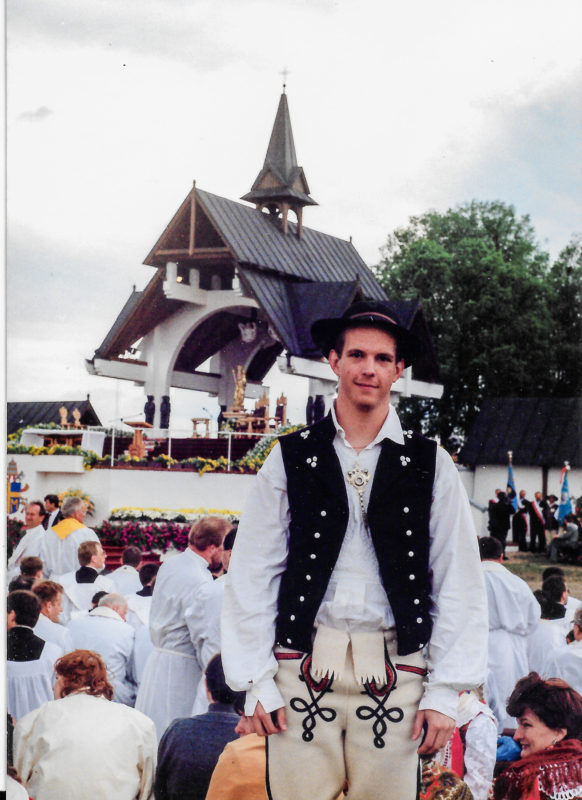
I went with the mayor, his wife, and his daughter (my student). And the mayor being just that – the major – we had great tickets. We were able to park within sight of the church (as opposed to several kilometers away) and we sat in the front, right section. Actually, my ticket was for section A1, but the mayor flashed the tickets together with his on top and we went in with no trouble. We were no more than thirty-five meters away from the podium and altar.

The whole ceremony was outside. There was a large pavilion for the pope and priests and then the people were stretched for several hundred meters along the Czarny Dunejec river. Many people held up banners (including a few in English), and almost everyone had a little yellow and white flag which they waved frantically at certain points.
First, there was a great ceremony at which a high-ranking priest (possibly the current archbishop of Kraków) spoke and the Queen of Podhale icon was brought in and placed on a pedestal in the middle of the pavilion. Four men in góralski clothes brought in the golden statue of Mary holding Jesus as an infant. In her right hand was a scepter. My friend Charles told me that when Karol Wojtyla was still the archbishop of Kraków he made a visit to Ludzmiez and was part of the processional carrying in the Queen of Podhale when suddenly the scepter fell out of her hand and he caught it before it hit the ground. People took this as a sign that he was going to be pope. Of course it's easy to say that after the fact.
Next, there was a mass, so that meant a lot of standing, kneeling, sitting, kneeling, standing. I sat beside Agnieszka and she told me what to do. The front few rows were reserved for priests, and when it came time to share the host, they took their little urns of saltines and gave them to whomever in the audience wanted to partake. There was a lot of chanting and prayer as usual, but it was interspersed with singing and music.
The pope arrived about fifteen minutes late. Wearing his customary white dress, he entered in his customary bullet-proof glass-enclosed car, waving at those who could see him. First he went into a small house that was for those who made pilgrimages to see the Queen of Podhale. Afterward he got back into his protected car and was driven out of sight. Within minutes he appeared on the pavilion. I must say that the people didn't go as crazy as I was expecting, but there was a great deal of applause and almost everyone was chanting, "Ty jestes Piotrem! Ty jestes Piotrem!" He waved and made a few signs of the cross, then went and bowed before the Queen of Podhale with two other priests flanking him. Someone came and put a red cape over him as he prayed silently, then he began the Hail Mary.
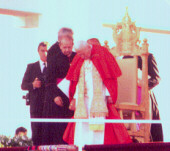
I was surprised when I heard the pope speak. He mumbled almost incoherently. Of course I don't know Latin and my Polish is still weak, but I couldn't discern one word from the other. He sounded so tired as if it was all he could do to move his mouth and tongue in order to speak. He seemed to gain some energy as he went along – at least he began speaking more clearly.
After about thirty minutes of doing Hail Marys, the pope spoke for about ten minutes. I couldn't understand much of what he said at all. I caught a word here and there, but not enough to piece the speech together. I did catch something like, "The world doesn't know. The world doesn't understand. But the world needs . . ." and I lost it there. I guess he went on to say that the world needs God, but he didn't use any vocabulary familiar to me. At this point he went and sat in a huge chair while several people came in pairs and bowed before him, giving him gifts while he blessed them.
Then he stood and left. That was it. He got back into his protected car and rode back to the pilgrims' house, then back out to his helicopter and he was gone. We were there from a little after two until about eight, but it didn't seem that long at all. And the actual presence of the pope seemed incredibly short.
The whole thing was a bit like a concert. There were officials making sure that everyone went to the correct sections. There was the pre-performance energy. There was an opening act. There was the post-performance chaos. And ridiculously priced souvenirs. Is nothing sacred anymore?!
I made it out Friday to catch the bus at six. Almost all the students were there, but no bus. We stood, waiting, and I began sitting, "I don't know how many times I've told these people in Vienna and Strasbourg, 'I can assure you that we will be there,' and what if the bus doesn't show up? What if they make a liar out of me?" I remembered that the bus company wanted full payment before the trip. "What if they decide not to send the bus, citing this as a reason?" It finally showed up, thirty or forty minutes late -- I can't remember exactly. We loaded everything on and we were off. We made it through the first border without much trouble, and we were whizzing through Slovakia. It was here that the first change occurred. Bogdan told me the problem: "The drivers can only drive eight hours each -- sixteen hours total. If we go to Budapest, it will be too far for them to drive to Vienna, so we're just going to Vienna first." Fine by me, I thought. We slowed down our pace a little and arrived around seven thirty.
Somewhere in the middle of Slovakia -- a beautiful country with mountains which shoot up to sharp peaks suddenly -- Bogdan told me, "If you don't have enough money for the accommodations, you can use some of the money Wojtek got from the students." It was like he slapped me. "What is that money for, if not for the accommodations?" I asked him. "For museums and such," he responded. Suddenly the money trouble returned. I got out the information concerning our bank payments, hoping that Janusz had indeed paid the whole sum. At first I thought he had -- the amount was correct. Then I noticed it was in shillings. "We're in deep *&$#," I thought to myself. Before continuing, I'll explain how I arrived at the stupid assumption that this money was for accommodation: Talking to the mayor, I told him how much it would cost and he responded, "Wojtek has 100 zloty from each student," he said. Therefore, as we had been talking about the cost of the hostels, I assumed -- first mistake but not the first time -- that this money was that.
We arrived, and the decisive moment approached with nauseating speed. I began talking to the receptionist, hoping that we could talk her into letting us pay by bank deposit. "So you want to leave without paying and without giving any security that you will pay," she said ever so sweetly. I offered my credit card as security. She smiled and virtually whispered, "We don't take credit cards." Of course not. I went back and told Bogdan and Wojtek. "And that's for one night, right?" asked Wojtek. "What?" "We're just staying here tonight, right?" "No, tonight and tomorrow night." It turned out that the mayor told Wojtek that we could sleep on the bus the second night while we drove to Strasbourg. He only told me, "You'll be in Vienna 31 May and 1 June, so you'll need rooms there too . . ." I talked to the receptionist on Wojtek's urging. "Maybe we can cancel tomorrow's reservations -- and that would mean we need less money." I thought, "Yeah, they'll love that." They would have -- we simply would have had to pay the full sum regardless of whether we stayed or not. What else would you expect? It was what I expected, but I was hoping for some miracle. Finally, we just coughed up the money and that was that. For the time being.
Vienna is a great city, but tremendously expensive. I had dinner with Astrid that first night and a simple meal -- pasta and a beer -- cost 240 shillings. That would have been about 70 złoty if she hadn't graciously paid. A hot dog cost me 10 złoty. It was beyond outrageous. Astrid told me before I came, "I warn you, Vienna is very expensive." I had no idea she how expensive she meant.
The next day we visited a couple of places in Vienna. First, we went to a historic Polish church in Vienna so everyone could go to mass, then we went to the emperor's summer palace. Of course, the emperor had to have two -- a summer and a winter palace. I wonder why not waste more money on spring and fall palaces, as well as one for those hot Indian summers and another for the unexpected return of winter that comes every few Aprils. After all, how can one expect an emperor to live in only two palaces? Surely there were more people who could have gone hungry to provide him with three or four more palaces. Whatever the reason, the poor emperor had only two palaces in Vienna and we visited his humble summer one. We walked around the grounds (didn't actually go in -- that was too expensive). Afterward, we were going to walk to the center of town, but some of the teachers and students felt it was too far and decided to go back to the hostel. Those of us who went had a nice enough time, but I can't speak for those who went back to the hostel.
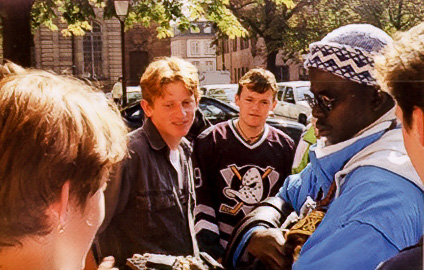
The next morning we headed to Strasbourg and made it about two hours before we stopped. I thought it was a toilet stop. "The bus broke down again," I heard one teacher tell another. The drivers had worked on it a little while we were in Vienna, but obviously hadn't fixed the problem. So we spent five hours in a parking lot somewhere in Austria waiting for the drivers to fix the problem. I called Strasbourg and told them that we might not get there until early in the morning. I read, wrote, read, rested, walked, talked, read, wrote. It was hellish.
On a side note, I think the Kiss tour buses parked beside us for a little while. I saw a bunch of guys milling around and several of them had key chains with Kiss ID cards, the sort that one wears to have unrestricted freedom backstage. I didn't see any of the actual band members, nor did I try. I think they're a bit silly, though I didn't always. I once got in trouble for listening to my neighbor's Kiss record -- forbidden music when you're six. There were all those stories that "Kiss" was an acronym for "Knights In Satan's Service" and that listening to them would melt your brain or something along those lines.
We finally made it to Strasbourg around 3:00 a.m. and got everyone checked in and in their rooms by 4:00. Then we got up at 8:30 for breakfast and the big event: the Council of Europe. After breakfast we got our lazy selves on the road and walked to the center of town, arriving at 12:45. We decided to leave for the Council of Europe at 1:45, giving us forty-five minutes to walk there. We met at 1:45 and got underway at 2:05. After walking for eternity we made it to the Council of Europe compound itself. I was in the front so I headed straight to the visitors' center. Wojtek took most of the group to the place they'd gone last year. After we went off to find them, we were ten minutes late. I was concerned that the discussion itself began at 3:00 and that by being late we would be interrupting. That concern was for naught. As was my concern about dressing nicely. Before leaving I asked all the students to bring something nice to wear for that day. When Bogdan heard this, he laughed. "We didn't last year, and it was no problem." I explained that it was a major international governing body that we were going to observe, not a carnival. "We need to look nice," I said. When we got there, I noticed that no other groups were dressed up -- nothing to worry about. Still, we looked sharp, except for a few (notably Wojtek and his running pants).
We watched a video about the Council of Europe, then headed up to the debating chamber to observe. I must admit that I was terribly excited about it all. We were about to watch a cooperative of over forty countries working together to solve problems of mutual concern. I knew we wouldn't watch any ground-breaking decisions -- such things take months or even years to accomplish. Still, I was eager to watch it all. Then one of the students asked me, "How long do we have to stay here?" and another said, "This is so boring." Of course. I had forgotten what I would have been like at that age. "Do we have to stay here long? This is so boring!"
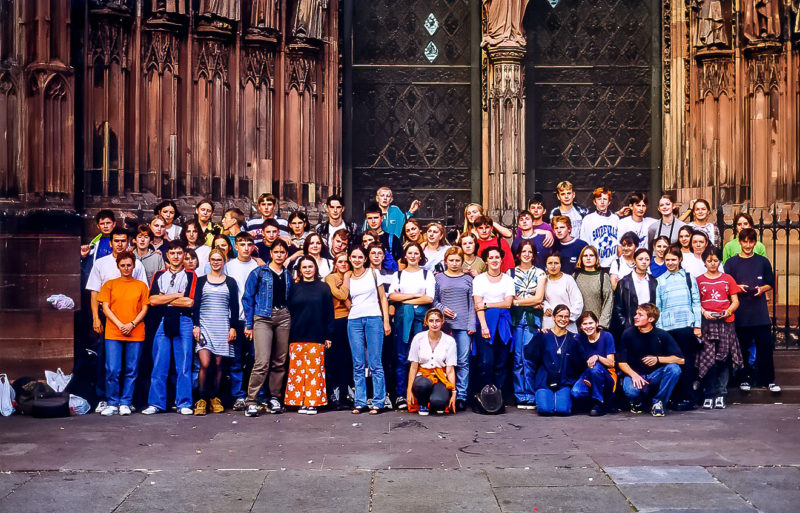
The debating chamber was circular, very similar to the interior of the United Nations in New York. There were joined desks arranged in arcs with the main table and podium at the top of the circle. Around the outside of the room were the translators' booths, eight of them in all: English, French, German, Italian, Russian, Norwegian, Turkish, and Greek. Of course, I put on my headphones and turned the dial directly to the languages I'd never heard before, then turned it to English so as to actually understand what was going on.
We watched a session of the Congress of Local and Regional Authorities, of which our mayor is a member. The topic under consideration dealt with locally elected officials being removed from office in Turkey without due judiciary process. We were there long enough to hear a summary of a report about the problem and a representative from Turkey speak about the issue.
So how long did we stay there? I had worked frantically for four weeks to plan this, and the local government was paying several thousand zlłoty for this trip. I worried about it constantly for those four weeks and got absolutely no sleep the night before we left because of all the things I was fretting about. I thought we would stay for longer than twenty minutes, but that was it. I must admit that I was both disappointed and un-astonished. Not even the teachers were interested in it. In fact, just as one student had asked me how long we were going to be there, one teacher asked if we were going to be long. (Later that evening I saw her showing to a couple of other teachers some of the things she'd bought. It was a shopping excursion for her.)
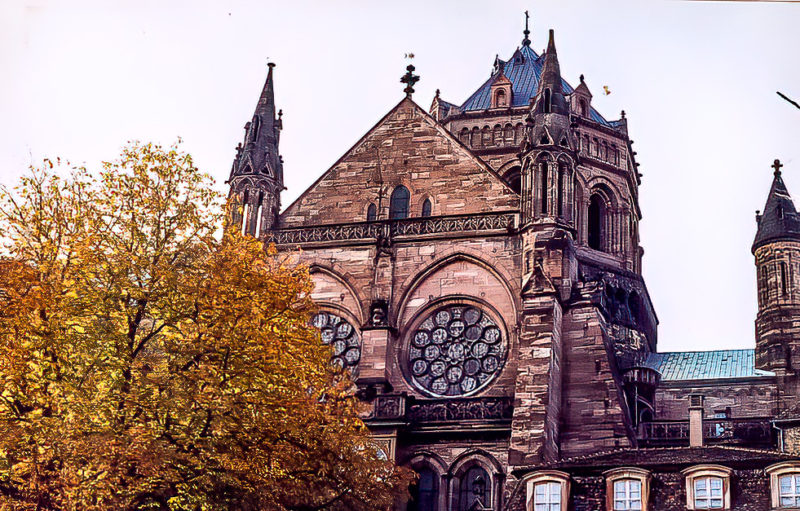
After the Council meeting, we took the kids out to eat and then for a guided boat tour of the city. As we sat on the boat, I realized that the English portion of the tour was difficult enough that most students wouldn't understand it but simple enough that I could translate it. So I began giving a rough translation. And then it suddenly got more difficult. I struggled for a few minutes, then got one of the best students and just told him in very simplified English what the guide said and he told the rest of the students in Polish. Such was my one and only attempt at translating.
The return trip was blissfully uneventful. We left at 12:00 p.m. Wednesday and arrived home in Lipnica 9:00 a.m. Thursday. We stopped in Germany to look at a famous church which I'd never heard of. It was very small, more like a chapel, and the outside and inside walls were covered with small paintings depicting the history of the world (from a German perspective, I assume). Each picture had a black angel with a very dark halo. What I found amazing was not the paintings themselves, but the fact that the ones on the outside were still intact, free from the slightest bit of vandalism. I do not know if they post a guard there in the evenings, but I saw nothing suggesting that.
Looking back on it now, I'm not sure whether I think the trip was a success or not. I guess the fact that we made it there and back without losing anyone or anything makes it somewhat of a success. Still, the lack of organization (which several students noticed and mentioned to me) made the whole thing rather stressful and chaotic -- we wasted a lot of time. I've learned a lot in the past five weeks, and I think next year's trip (if it does indeed occur) will be much better. Thankfully, that's at least a year away . . .
It looked like perfectly harmless soup. I could see a bit of carrot and potato, and a sip of the broth revealed a nice, rich flavor. Then I saw it: A bit of bumpy white mystery that was vaguely meat-like. I moved it around a little with my spoon and thought to myself, "Oh, please don't let this be flaki." I took a bite. It was rubbery and had a very pungent flavor. I swallowed and it was at that point that my host brother asked, "You know what that is?" Before I could say, "Wait--don't tell me. I don't want to know," he informed me, "Flaki!" He smaked his lips and rubbed his belly. "Ummmm," he said with a sly smile. "Go ahead," he prodded, "It's great!" I tried to eat more, but I simply couldn't. After all, how much intestine soup could you handle? Yep, flaki is basically soup made from cow guts. While the broth can be tasty, the meat itself isn't, and the while it cooks it positively stinks.
This was only one of my culinary adventures during the 1996 Christmas holidays. I returned to Radom to spend Christmas with my host family and I was introduced to the wonders of the Christmas feast. On Christmas Eve there is a huge meal with anywhere from nine to fifteen dishes, none of which have meat (unless you count fish, which the Poles don't). There were a couple of geletin dishes with bits of veggies and fish suspended in a suspect looking gel and sledz (herring).
The highlight of the dinner is the carp. Traditionally it is kept alive in the bathtub until the day of Christmas Eve when the grandfather bludgeons the poor thing to death and then it becomes the central entree of the Christmas Eve banquet. I'd never eaten carp, and if you haven't, I wouldn't advise it. Fishermen throw it back for a reason! It is basically a bone with some skin and a little meat trapped in between. Breaded and fried, the carp I had was rather difficult to finish. When I finished the pile of bones was somehow bigger than the actual piece of fish was.
Christmas day is a day of meat. While none of the Christmas Eve dishes had meat, almost every single Christmas day dish had meat. This was when the flaki made its appearance. I was somewhat surprised to find that the desert had no meat in it. I thought, "Why not a mincemeat pie? Perhaps some chicken ice cream? Or even a pork cake?" but I kept it to myself.
As a general rule, though, Polish fare is quite good. It's a bit on the starchy side, but tasty. Potatoes are served with almost every meal to which I've been privy, cabbage appears on the table frequently, and pork is the meat of choice. Beets are rather common (in soup--barszcz--and as a side dish), and every meal is washed down with warm kompot which is an incredibly sweet drink made from various fruit (apple and pear seem to be the most common in Lipnica). Occasionally chicken will show up (though most often in soup) and I've even had rabbit on once. While I ate, Elmer Fudd kept singing, "Kill da wabbit, kill da wabbit . . ." and I felt a little guilty, but I have to admit that wabbit is wader wonderful. No wonder Elmer's so intent on bagging Bugs.
I went to Jabłonka this morning to the targ. I wanted to buy a zoom lens. I had talked to the camera guy there a few weeks ago, and he said that he’d have one for me. Well, he couldn’t find one. So I started back to the bus stop empty handed. It was a little before nine. I was thinking there was a bus at nine — no, the next one wasn’t until ten. I was irritated because like an ass I had forgotten to bring anything to read. (Rule of thumb when traveling in Poland: Always have something to read, for you’ll do a lot of waiting.) I was so irritated at the prospect of losing a whole hour that I paid 12 z to take a taxi back home. That’s exactly ten times what it would have cost by bus. Well, ten times, and an hour less. I’m coming to realize that time is much more valuable than money. The fool who said “Time is money,” got it backwards.
I had him stop just before getting to my apartment because I didn’t want anyone to see me getting out of a taxi. Someone in the gmina saw me with my computer and made a comment, “Jesteś bogaty,” (“You’re rich!” of course), so I didn’t want anyone seeing me pay ten times what I could have paid if I’d simply waiting for the bus. I guess it’s a bit silly to go around worrying what other people think, but I don’t want them to resent me for waltzing into the village and making more money than the average person here (which I do, though not by much).
4:36 p.m.
I finished checking the journals today. There are still a few who have not turned them in, though. I was both relieved and disturbed to find that Iwona also copied some stuff out of a book for journal entries. It relieves me because now I don’t have to face Tom alone. He can be belligerent and I was expecting to take hell from him for “reading” the journal. Now I can address the whole class about the problem (without mentioning names, of course). The down side of this is that I would not have expected Iwona, of all people, to have done such a thing. I’m sure she only did it because she felt she couldn’t write that much on her own; I don’t think it was pure laziness as much as a lack of self-confidence. The funny thing is, Iwona copied her stuff straight out of the book (including the bit about Paul Newman).
What will I do about it? I will talk to the class and present my idea (although it will not be up for vote, like that made it sound): I hereby reserve the right to read any suspicious looking journal entry to determine whether or not the student in question actually wrote the entry him/herself. I will not read the journals for pleasure, but I feel that it is necessary to make this small adjustment. I think I might say that if I determine that anything has been copied from a book without proper acknowledgement (in other words, plagarized), that person will get a zero for that particular journal grade. It’s harsh, and it’s demanding, but I don’t want any slacking on this. Plagiarism is a serious issue, even in a seemingly minor case like this.