matching tracksuits

fun in threes, sometimes fours

Znalazłes?

It’s amazing how much one can implicitly communicate through one’s choice of words. “Znalazłes›?” asked the woman in the big store as I was looking for szpilki. My first thought was, “Znalazłes›? Don’t you mean, ‘Czy Pan znalazł?’” The lady in the small flower shop had used the formal, polite “Pan” with me just moments before, but this woman chose the familiar form – something that would be positively rude to do to unknown Pole. Given the fact that adults use the familiar form with children, I couldn’t help but feel a little insulted at this perceived slight. Putting the foreigner in his place, so to say.

I’m curious how other Poles would interpret this.

A Walk in the Fields

NT Cemetery, Fall

School Performance

NT Pictures

All Souls’ Day 2001

Zakopane, Autumn

All Saints’ Day 2001

In Ochonica

First All Saints

There’s something about waking up in a house when it’s a holiday that has a similar feel no matter where you are. Waking up this morning and realizing a) I didn’t have to go to school and b) it wasn’t the weekend made me suddenly feel as if I could be at home (whatever those two words mean for me now) on Thanksgiving morning. Or at least in Nashville, waking up in a place that isn’t “home” but at the same time is familiar and rather comfortable.

Speaking of “home,” I guess I’ve come to realize that I don’t really have any place that I think of like that. I feel like I’m visiting when I go to my parents’ house, because even though I’ve been there several times now, I still feel like it’s not really “home.” It’s familiar, but not like 106 Lamont Road was. And of course if I went there now it would feel completely alien.

I read some reviews of Hitler’s Willing Executioners and I have to say that a lot of the things I read had a familiar feel — that feeling of reading something that you’ve felt but not been able to put into words. For example one reviewer (I’m not sure who — I just copied this from the internet and I didn’t collect any information for an individual review other than what was on the actual page itself) wrote, “Goldhagen’s book has been aptly described as ‘angry.’ He writes like a lawyer rather than like an historian.” This lack of a historian’s voice came up again in the review several pages later:

In this fashion, Goldhagen systematically discounts all statements indicative of normal human emotion by the perpetrators. However, at several places in his narrative he is quite willing to casually throw empiricism to the winds and to liberally conjure up fantasies to bolster his portrait of collective German brutality! For example, on p. 339 he muses about what went through the minds of the soldiers as they “. . . made love in barracks next to enormous privation and incessant cruelty. What did they talk about when their heads rested quietly on their pillows, when they were smoking their cigarettes in those relaxing moments after their physical needs had been met? Did one relate to another accounts of a particularly amusing beating that she or he had administered or observed, of the rush of power that engulfed her when the righteous adrenaline of Jew-beating caused her body to pulse with energy.” One can legitimately ask whether Goldhagen is writing history at such points, or creating a short story.

I remember thinking as I read that very passage, “This really doesn’t read like history. It reads more like a novel or something.” I think I might have even assumed that it wasn’t in the original dissertation but was added when it was edited with a mass-market in mind.

And the whole time I read it, I thought, “Nothing counts against this guy’s thesis. He can dismiss almost everything in some fashion or another.” Somewhat similar to how Armstrongians will accept nothing that comes from a non-Armstrongian source. Once people get something into their heads, it seems it’s all but impossible to get it back out.

Cleaning Graves

In preparation for All Saints' Day, Poles clean graves.

The Beer that Changed My World

A Walk in the Fields

A Classroom

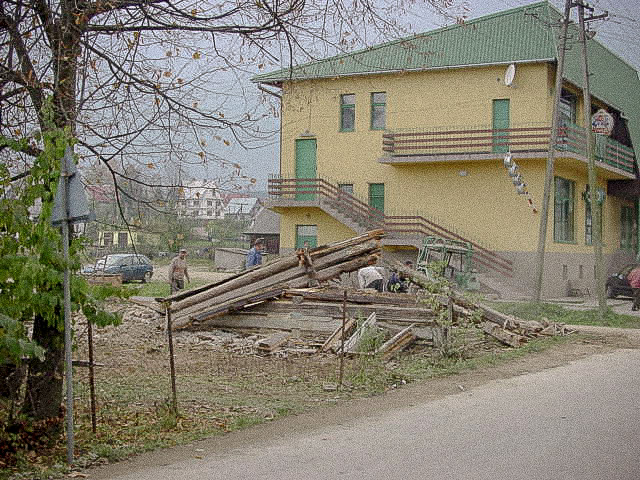
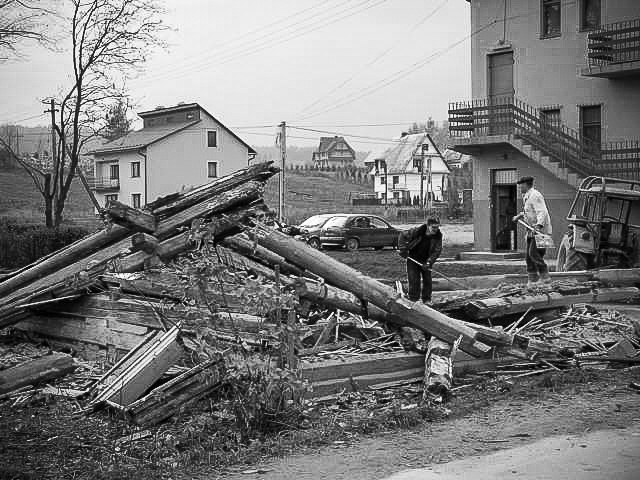
Tearing Down History

DSC00159

It's almost a crime, happening in front of everyone: a home over a century old, torn down for firewood.

XCG Thoughts

To begin with, Lee Clark has been having “visions” and “messages”1 that this fits into nicely. Of course all his ranting and raving about the “chem-trails” he’s been seeing above Las Vegas doesn’t really fit in well, because he thought the attack on America would come from the United Nations.

On the other hand, Garner Ted Armstrong is following in his father’s footsteps nicely — poor writing, an overwhelming sense of self-importance, and totally belittling treatment of anyone with a different opinion.

To begin with, Armstrong doesn’t really have a firm grasp of basic English grammar, including parts of speech: “Adjectives cannot describe what I saw; what I felt. Outrage. Anger. Rage. Shock. Pity.” It’s funny that there’s not a single adjective in his list. It’s not that he started out with a list of adjectives and accidentally switched to nouns. He used nouns from the beginning and called them by another name.

I won’t provide documentation for Armstrong’s sense of self-importance because it’s in abundance at his website (http://www.gtaea.org) and I just don’t want to wade through his inept writing to find it all again.

Finally, in discussing international reaction to America’s bombing campaign, he refers to an “empty-headed young lady” and later refers generally to “thick-headed” people. Sounds like Herbert.

Finally, there was this proposed solution to the problem of America setting up a “puppet government” in Afghanistan when it’s all over (a claim he provided from one of the “thick-headed” folks protesting the attacks, not his own):

What should be done is this: Say to the neighbors surrounding the forbidding mountain wastes of Afghanistan that each of them are hereby offered a share of the pie. Say to the Iranians, Turkmenis, Tadzhikis, Uzbekis and Pakistanis that each can occupy a portion of what was Afghanistan in return for the following quid pro quo:

(1) They will immediately cease all research and development of weapons of mass destruction, and sign a 100-year pact agreeing never to seek such weapons, including permission for open inspections by the international community.

(2) Iran and Pakistan will dismantle and destroy any nuclear facilities, and destroy all stockpiles of chemical or biological agents.

(3) Each country will declare war against terrorism; will arrest and hold for trial any and all terrorists or their supporters.

(4) Each country will guarantee human rights, free access to education, free speech, free expression of religion, and will grant to women the right to vote, and, horror of all horrors, even to walk about in public with their faces showing.

(5) Each country will sign a peace treaty with Israel, and guarantee Israel’s right to exist.

Following the dismantlement of the Ottoman Turkish empire after World War 1, many "nations" were created in the Middle East. Following the gradual disintegration of the world’s major colonial empires of Britain, France, Germany, Holland, Spain and Portugal, many other nations were created. Nations such as the "Anglo-Egyptian Sudan" became Sudan; "Trans-Jordan" became the "Hashemite Kingdom of Jordan;" Yugoslavia was pieced together from a collection of several ethnic groups, as were nations in the rest of the Balkans. Czechoslovakia was pieced together from the Austro-Hungarian empire, and has since divided into the Czech Republic and Slovenia. There is plenty of precedent for big powers to partition, absorb, or divide up conquered territories. It has taken place virtually from the beginning of time. Clearly, the beleaguered, war-weary, exploited peoples of Afghanistan deserve something better than the governments which have suppressed them for the past many decades.

He’s basically suggesting a partition of Afghanistan. “It’s been done before!” was his justification. Yes, and it always works wonders.

This, though, is a perfect example of the ethnocentrism, racism, and imperial/colonial apology/worship that seems to run in the Armstrong family. One can clearly see, for example, what happened to all the nations of Africa once they got their independence from the “oppressive” rule of Great Britain — so goes their argument. And here it is again — whatever the great Anglo-Israelite American government decides would ultimately be best for Afghanistan, no matter what they think. See, backward races like that simply don’t know what’s good for them. They don’t know how good they in fact have it. Such racist ignorance.

Armstrong also appropriates this as proof of his prophetic acumen. He doesn’t say that he predicted this or any such nonsense, but simply he knew something catastrophic was going to happen. “All of you who are a part of this work of the Watchman, are most probably, just like me, shocked at this — but you are not surprised!”

Giving credit where it is due, he did say something similar about a month earlier (or so he claims).

Something has just been brought to my attention.  On the 18th of August I was speaking before a group in Lexington, Kentucky.  At one point I was recounting the time Jesus was talking to the disciples about the temple and how "the days will come, in the which there shall not be left one stone upon another, that shall not be thrown down (Luke 21:6, Mat. 24:2, Mark 13:2)." I then went on to describe what this would be like for us in the "here and now".  I then stated. . .

"That would be tatamount [sic] to saying; driving down Wall Street in New York, you are going to see the day when it is a pile of rubble. There will not be the Twin Trade Towers, there will not be the Chrysler building; there will not be the Empire State Building. . .. . .. . ..it will be ground level."

An astounding analogy, given the events of the past week!

The only problem with that is that this was an analogy to what was to happen in Jerusalem, not a prophecy of what was going to happen in New York. And amazingly he even comes close to admitting that, saying it was “an astounding analogy.” And giving himself a nice pat on the back at the same time.

Finally, Armstrong has an article entitled, “50 Years of Warning!” in which he praises his tireless efforts over the last forty-two years2 to warn the world. No mention of the fact that there has always been a tendency to say, “It’s coming in the next x to y years!” and then when the given date comes and goes, it’s just reformulated. Silly men.

1 I think indicates that he’s in some serious need for some psychiatric help. We often say, “This guy needs help,” but don’t really mean it. This time, I honestly do believe he needs some time with a psychologist or psychiatrist. He’s hearing voices, which of course he’s interpreting as being from God, and he’s having rather “vivid” dreams, which naturally is also from God, but probably is probably just the effects of his hyper-imagination. The voices, though, I don’t believe would be the product of such an overactive imagination.

2 Strangely he begins the article, “For 42 years, I have continually warned.” I guess he decided to round up because “50 Years of Warning” sounds better than both “40 Years of Warning” and “42 Years of Warning”