matching tracksuits

fun in threes, sometimes fours

Letters Between a Catholic and an Evangelical

I’m reading a book D sent me called Letters Between a Catholic and an Evangelical. It’s interesting, but the two guys seem to be talking at each other at times.

Much of it seems to reduce down to a question of whether or not to interpret a passage literally. When Jesus says, “Call no man ‘Father,’” McCarthy, the evangelical, wants to take that at face value (i.e., literally) and Waiss, the priest, offers possible explanations (99). Hyperbole, he says, citing Jesus’ eye-plucking-out comment. Another possible interpretation deals with whom we regard as the source of our faith. But why the Catholic Church doesn’t apply the same rigorous interpretation as it does to John 6 is a notable inconsistency.

This cuts both ways—McCarthy wants to interpret this literally, but not John 6; Waiss wants to interpret this figuratively (even as hyperbole) but not John 6. Literal and figurative—take your pick.

Regarding this broader question of interpretation, Wais argues,

We carry all sorts of historical, cultural baggage that affects our interpretation. Tradition allows us to transcend our particular cultural and historical situation to understand God’s Word in the context in which it was written and first interpreted (65).

Fine and good. But Catholic, capital “T” Tradition doesn’t stop in the first century when the apostles and disciples lived. So he’s right when he says that trust in Tradition is a question of faith. He argues it’s a question of faith in the Holy Spirit; I think McCarthy more correctly argues it’s a faith in fellow man.

Earlier, McCarthy states that the burden of proof is on Waiss:

Now, in a court of law, the burden of proof lies with the one who asserts a particular point, not the one who denies it. It appears, then, that it is you who must prove the claim for Tradition, rather than I who mush show that Scripture is the sole rule of faith, as you have insisted in your letters (44).

Is McCarthy blind here?! Doesn’t he realize that he’s “assert[ing] a particular position?!” Further, given the fact that the Catholic Church existed long before the Protestant movement, it seems that the burden of proof lies on the Protestant side.

Discussing the hierarchy of the Catholic Church, McCarthy makes a terrible logical blunder, which Waiss makes little use of: the argument from silence. McCarthy says that because “Pope” doesn’t appear in the Bible, it’s not Christian. Three words: Trinity, Christmas, and Easter.

Concerning Tradition, McCarthy writes,

What then prevents the gradual introduction of new doctrines? Could not a pious comment by a Pope in one century—say about Mary of the power of the papacy—spread and become widely known in the next century, a generally held belief in the third, and a dogma in the fourth or fifth? With no written record of what is contained in Tradition, who’s to say what’s in and what’s not (69)?

He goes on to point out that this is exactly what happened with the Catholic doctrines of the Immaculate Conception (proclaimed by Pius IV in 1859) and the Assumption of Mary (Pius XII, 1950). He ends this asking, “Today an international campaign is being waged to petition the Pope to proclaim as dogma that Mary is the Co-Redeemer of the human race. Whether it is successful or not, I still must ask: What’s next” (69)?

There seem to be indeed no check on the Pope in that regard. Of course, Popes have only formally invoked Papal Infallibility a couple of times (or maybe even once) to date. But what’s to stop them from making, say, Paul a Co-Redeemer? Or Peter?

Protestants like to quote 2 Timothy 3.15-17 as proof of sola scriptura, and McCarthy doesn’t let us down:

and how from childhood you have known the sacred writings that are able to instruct you for salvation through faith in Christ Jesus. All scripture is inspired by God and is useful for teaching, for reproof, for correction, and for training in righteousness, so that everyone who belongs to God may be proficient, equipped for every good work.

Something I never realized until now, though, concerns the question of what these “scared writings” might be. Why, none other than the Old Testament. The New Testament didn’t exist yet, obviously enough. So sola scriptura should be more like one of the early heresies: sola Old Testament.


Sola Scriptura

Having been raised a Protestant and now marrying a Catholic, I've been thinking about the nothing of "sola scriptura."

The facts about sola scriptura as I see them:

  1. The Gospels were probably written by and large after Paul’s epistles. Paul no where makes mention of the Gospels. Therefore, any of Paul’s passages that are taken as proof of sola scriptura cannot be referring to the Gospels.
  2. Paul’s letters were not collected into anything canonical during his lifetime, nor were the other epistles. They were circulated from church to church. Therefore, any of Paul’s passages that are used to prove sola scriptura also cannot be referring to any of the pastoral epistles.
  3. The Gospels are purportedly reporting what Jesus said — in theory (and in faith), they report what happened before either Paul’s epistles or the Gospels were written. Therefore, anything in the Gospels taken as proof of sola scriptura cannot be applied to the New Testament.
  4. The recognition for the need of an authorized list of New Testament books (i.e., canonization) did not emerge until the middle of the second century. The Old Testament canon, however, was handed down from Judaism. That, combined with the above points, means any reference in the New Testament to “Scripture” is a reference to the Old Testament.
  5. Because of lack of canonized testimony about Jesus, early Christians based their faith primarily on oral traditions and the Old Testament.

Does this justify the Roman Catholic position on tradition? Certainly not. But it does make headway in showing the Protestant notion of sola scriptura is not Biblically based, nor logical.
Sola scriptura is even more troubling when we think about all the extra-Biblical beliefs and practices that Protestants engage in:

  1. Christmas
  2. Easter
  3. Sunday worship
  4. The Trinity
  5. Prohibition of polygamy
  6. The use of the cross as a Christian symbol
  7. Rejection of the Jewish festivals

The Trinity is a special case, because Protestants argue that the Bible does teach that there is a Trinity, it just doesn’t use that term. But Armstrongism, Mormonism, and the Jehovah’s Witnesses show that such a conclusion doesn’t necessarily have to follow — not to mention all the early heresies.

Chapels

Poland is a Catholic country — in spades. Some ninety-seven percent of the population claims Roman Catholicism as their religion, though estimates of practicing Catholics is around seventy percent.

Of this seventy percent, I'm not sure how much of it is from habit and from true faith. I've had many a discussion about this with friends here about it. It calls to mind a college professor who'd "accepted Christ" at age five, which seems more from environment than from inner conviction. Regardless, the vast majority of Poles go through the motions, anyway. And certainly, many of them are devout and sincere.

There are quite a few who go to daily mass. It's mainly elderly women, judging from the small stream of people I see leaving the church. This raises a question: how does one draw the line between sincerity and habit? And what if it seems only to be habit despite the individual's protests that it's not? Pious until proven habitual? Or maybe I'm begging the question of them being mutually exclusive.
This Catholic piety spills over into every facet of life here, something striking to someone coming from a relatively irreligious country like the States. Separation of church and state — a completely foreign concept here.

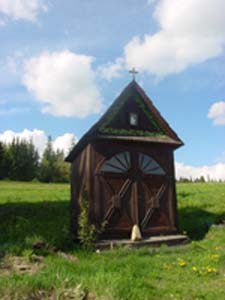
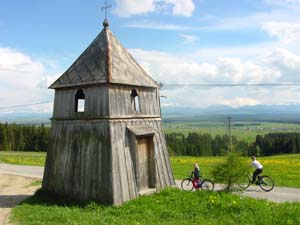
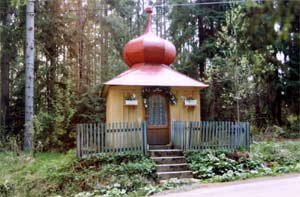
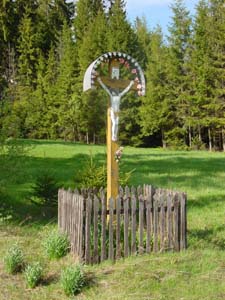
One of the many results of this piety is the proliferation of chapels —roadside chapels, yard chapels, even gable chapels.

Roadside Chapels

Belltower in Jablonka

Roadside chapel just outside of KiczoryRoadside chapels are everywhere in Poland. They're by highways (or the Polish approximation of "highways") and roads you think are probably traveled once a year.

And they're all different: from small, simple, covered crucifixes to elaborate buildings.

I've rarely seen people there praying, but it does happen occasionally. It seems to be most common around high holidays in the spring and summer when the weather is conducive to spending all that time outside praying. And in many ways, it's quite admirable, that kind of religious dedication.

Some Protestants might suggest that building chapels like this is not necessary, that no building contains God.

Theological differences aside, it's still a pleasant idea for me, even as a non-believer.

Pre-Wedding Seminar

So we survived this Catholic church’s inability to treat its believers like responsible adults—i.e., we survived the pre-wedding, weekend-long marriage class. I would say “seminar,” but “seminar” implies more interaction than actually took place. The first half of the first day especially was nothing more than a long lecture.

Kinga and I decided that the people who really need such a thing don’t benefit at all from it, because they don’t really pay attention to it; and the people who don’t need it obviously don’t benefit from it all that much. The price was not worth the benefit in our case, I would say. It didn’t really cover anything Kinga and I hadn’t heard/thought/realized before.

What was especially frustrating was the repetition of the Catholic birth control talk. It began with an attempt at justifying it logically (and of course theologically, and even thought “logical” is in the word “theological,” it often isn’t). The presenter hung up a poster of Van Gogh’s Sunflowers and asked us to imagine we’d painted it. In comes a friend who rips the painting and she had us brainstorm what we would feel toward that friend: anger, surprise, hatred, desire for revenge, etc. were the words that came to people’s minds. She then pointed out that we weren’t physically harmed by our “friend’s” action, but that our creation was. “Ah,” I began thinking, “That’s how they’re going to try to justify the church’s absurd position on birth control.” And sure enough, she pointed out that we’re God’s creation, and that according to the Genesis account (which apparently we’re to interpret literally), we were created with four critical aspects/commands. One of them was our fertility and the command “be fruitful.” So the reasoning went, that when we’re tampering with our fertility, we’re tampering with God’s creation, and so on and so on.

She then went on to frame it as a question of faith, and I believe that was a great mistake. “Checkmate,” I thought, recalling my upbringing. In short, I wanted to talk to her about this and say the things I’m about to write, but I didn’t. If it’s a question of faith in God’s almighty power, then going to the doctor is just as much a questioning of that faith as using birth control. It’s one and the same. Catholics pray to God for healing—and then use medicine. If it’s an act of anti-faith (for lack of a better term) to use birth control, it’s just as much to use birth control.

Another one of the critical aspects of the Genesis account that they brought out was the control over creation that God supposedly gave Adam and Eve. So we’re supposed to “panować” all of creation except our fertility…

The church’s position is an antiquated position based on a time when infant mortality was much higher than now, and global overpopulation was an unthinkable concept. “Be fruitful” makes a lot of sense when perhaps half of the children you bring into the world live to be adults. In today’s society, it just makes no sense whatsoever. So the church is left scrambling to explain a first century (and earlier) tradition in a twenty-first century reality.

Interesting that the woman presenting said that the church’s position was not a question of the church wanting to have as many Catholics as possible—having babies for the church, in other words. And yet, just the day before, the priest said just that. That children were a blessing, and that by having many of them (he suggested three!) we would help our “fatherland” and the church.

The whole weekend wasn’t a waste. There were some interesting moments, but it could have been done in an afternoon as opposed to two full days. And the fact that it was required was ridiculous. Of course those conducting it had nothing to do with that, as they pointed out at the beginning when they said that no one would be excuse for any reason, we had to sit there throughout the whole thing. And then actually said bottom line themselves: “Ci który mają świadecwy mają władca.” “Those who have the certificates have the power.” It was meant as a joke, but I didn’t find it terribly amusing.

July 4 Nowy Targ

Delivering Invitations

Part of the tradition of the Polish wedding is the delivery of the invitations. In short, if you can drive there in a reasonable amount of time, you’re expected to hand-deliver the invitations. That means a lot of driving before the wedding.

2-DSC00008

In places you might not usually drive.

1-DSC00004

With views typical of the region.

Soccer Religion

After having written a short review of Dan Brown's The Da Vinci Code (Okay, I admit it – I have to stoop to some pretty low levels in my English reading while in Poland), I recently received the oddest letter from a complete stranger. The subject line: The DaVinci [sic] Code and The DA Revelation of Avatar Adi Da Love-Ananda Samraj

Dear Gary,

My name is John Forth from Melbourne Australia. I got your e-address from Amazon reviews.

The DaVinci [sic] Code is an interesting book on an important theme: namely the suppression [sic] of the gnostic [sic] strain in Christianity. A suppresion [sic] which has turned out to be a disaster for ALL beings on this planet.

With that in mind please check out The Divine Revelation of Avatar Adi Da Love-Ananda Samraj at:

1. www.adidam.org

2. www.adi-da-samraj.org

A Prophetic Criticism of the "Great" Religions (essays on how non-gnostic [sic] essentially materialist Christianity took over) at:

3. http://www.dabase.net/proofch6.htm

Grace Shines

John Forth

My response, after checking out the links he'd provided, was short: "What exactly does The Da Vinci Code – which is a horrid book filled with historical errors – have to do with a New Age cult?" Of course I knew such a reply was antagonistic enough to get another response out of him. In other words, I realized I was childishly provoking him, but I couldn't help it. After all, it's not every day that you get to speak to a cult apologist.

Mr. Forth replied:

Dear Gary,

Thankyou [sic] for your response.

IF you do your hope work you will discover that Adidam or The Way of the Heart created by Adi Da Samraj is not a "new age" cult. Christianity is a cult. Every body belongs to numerous cults. A cult being a group of people from the very small or in the billions fascinated by some object of desire or fascination.

Please check out "Beyond The Cultic Tendency in Religion----" at: http://www.dabase.org/cultic.htm

You could say that the fascination with the Davinci [sic] Code is a cultish [sic] phenomenon [sic]. AS are the cults associated with The Lord of the Rings, the Matrix films, Star Trek etc etc [sic] Perhaps the relevance to Adidam is that Adi Da addresses in a very real way some of the themes, especially the repressed gnostic [sic] elements of early christianity [sic], mentioned in the Davinci [sic] Code.

Grace Shines

John Forth

Leaving aside the question of what "home work" Mr. Forth thought I was supposed to have done, I took him up on his offer and read – or rather, scanned – the piece Mr. Forth recommended, written by none other than the guru himself: Avatar Adi Da Samraj.

It was full of Things Not Normally Capitalized which were written in Capital Letters to express Their Importance (though he did restrain from some cult/sect writers' typographical IDOCYCRIES), and basically filled with nonsensical Eastern guru babble. (I'm not suggesting that Eastern wisdom is just "babble," just this particular "wisdom.") Some choice quotes:

  • The relationship to Me that is Described (by Me) in the Ruchira Avatara Gita is not an exoteric cultic matter. It is a profound esoteric discipline, necessarily associated with real and serious and mature practice of the "radical" Way (or root-Process) of Realizing Real God, Which Is Reality and Truth. Therefore, in the Ruchira Avatara Gita, I am critical of the ego-based (or self-saving, and self-"guruing", rather than self-surrendering, self-forgetting, self-transcending, and Divine-Guru-Oriented) practices of childish, and, otherwise, adolescent, and, altogether, merely exoteric cultism.
  • Just so, the cult of religious and Spiritual fascination tends to be equally righteous about maintaining fascinated faith (or indiscriminate, and even aggressive, belief) in the merely Parent-like "Divine" Status of one or another historical individual, "God"-Idea, religious or Spiritual doctrine, inherited tradition, or force of cosmic Nature.

The piece mainly dealt with the issue of "cultism," which Adi Da claims is endemic in all religions – except his own, of course. His is the antidote to cults. Clever move: take critics' charges and aim the back at them.

Next step, I decided to do my "homework" that Mr. Forth took me to task for not having done – particularly easy with Google. Soon I was flooded with information about Adi Da, Daism, and assorted goodies.

The Guru

I was initially not sure whether to call this charlatan "Franklin Jones" or "Adi Da." Indeed, Jones himself cannot seem to make up his mind as far as names go. (names.adida.org) Continually referring to him as Jones makes his claims seem particularly absurd, but since they are currently published under the name, it seems to make contextual sense to call him "Adi Da." In the end, I just oscillated back and forth.

I found out that – surprise, surprise – "Adi Da" is in fact Franklin Jones, a sixty-something Long Island born "guru" who has been holed up for over twenty years in Fiji , where he dispenses his Eastern-tinged "Crazy Wisdom" (his term, not mine) selflessly. I scanned a bit of his stuff and it was quickly evident that the guy is a fraud.

Jones' religion, his "Crazy Wisdom," is not a Siddhartha-type Western understanding of Buddhism, something which might raise the eyebrows a bit of a true Eastern master but cause no real consternation. In other words, it's not some new meditation method, some slightly commercialized take on yoga (i.e., twelve positions for the supermarket checkout counter). Nothing so insignificant as that.

The claim that Jones make – the heart of his religion – is that he is an Avatar. A human manifestation of God. To frame it in Western terms, Jones makes the same claim Jesus did: that he is God incarnate. As he explains it:

I Am the Divine Heart-Master of every one, and of all, and of the All of all. Therefore, I Call upon every one (and all) to rightly and positively understand My Divine Self-Revelation. And I Call upon every one (and all) to truly devotionally recognize Me, and to responsively demonstrate that devotional recognition of Me in the
context of, and by Means of, the right, true, full, and fully devotional, and really counter-egoic, practice of the only-by-Me Revealed and Given Way of Adidam (www.dabase.org)
.

He is the Set Apart Guide (I can't help lapsing into some Jones-esque capitalization) for All those Who want to Know the Way. The Way, coincidentally, is Jones himself, so his teaching amounts to how to recognize he is God. Indeed, followers are given instructions that the best way to forget about ego is to meditate on Jones, and since he's living it up in Fiji and not physically available to all his followers, they're provided with a photo album to help with the visualization!

Salvation, it seems, is based on fantasizing about a fat, bald, literally slimey-looking (just scroll down a bit) New Yorker with glaucoma.

The only Liberating discovery is that My Avataric Divine Spiritual Presence is Real, able to be tangibly experienced under any and all circumstances. It is not about imagining My Spiritual Presence or manipulating yourself. None of that is satisfying, in any case. To searchlessly [sic] Behold Me and, in the midst of it, to notice My Spiritual Presence tangibly moving upon you in your real experience–this is the great and Liberating discovery, the only Satisfaction. Ultimately, it is the only Satisfaction in life. Everything else is temporary, conditional, ego-based, and disheartening. Only the discovery of the tangible Reality of That Which Is Divine is heartening and Liberating and Satisfactory (adidam.org).

The practice is searchless, ego-forgetting, altogether to-Me-turned Beholding of Me in My bodily (human) Divine Form. When you are not in My physical Company, you can recollect My bodily (human) Divine Form. You can use My Murti-Form, My Padukas, and so on. Persisting in this practice, there is the potential of moving Me to Bless you further. [March 24, 2003] (adidam.org)

I closed my eyes and pictured him for a few moments and the only result I got was a chill running down my back and a brief
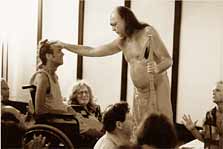
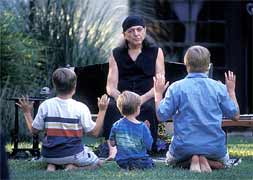
paranoia that, like the catchy melody of the latest pop trash hit, the image would keep popping back into my head unwanted.The Suckers and VictimsThe case of Franklin Jones and his AdidDaSes (the name "Adi Da" supposed just came to him; perhaps he just glanced down at someone's athletic shoes) would be more comic than anything if it weren't for the people that follow him. The difference between a cult leader and a raving schizophrenic homeless man in a subway station is that someone has taken the former seriously, and that's a frightening thought. What makes a cult tragic is of course the devoted, mindless followers.Jones' website speaks of "turning to him," of "recognizing him," of "loving him." It's scary stuff. But the words are not half as scary as the pictures – images from the inside workings of a cultic compound. Imagine David Koresh made pictures available of what went on in Waco. It might look something like this:And what's worse is the fact that there are children being raised on this bullshit. Children of followers living on Jones' Fiji island paradise are taught from birth (i.e., primarily socialization) that this snake-oil salesman is God. It's difficult enough to deprogram adults who have surrendered (voluntarily or not) their grip on reality, but these poor kids will never have had a firm understanding of reality to begin with, and they're going to be warped for life. It's nothing short of child abuse, but unfortunately, such child abuse is legal.Thus armed, I dashed off a quick reply to Mr. Forth:

I read the piece to which you sent me the link, and I found this passage:

All cults, whether sacred or secular, thrive on indulgence in the psychology (and the emotional rituals) of hope, rather than on actual demonstration of counter-egoic and really ego-transcending action.

What is the difference between this "indulgence in the psychology [. . .] of hope" and what Adi Da offers? His form of TM simply offers the hope of getting in touch with true reality.

I suppose, to some degree, as an atheist I would agree. Any time we seek from a religion something beyond what we experience in our senses, quantitatively confirmable through science, we are indulging in "the psychology [. . .] of hope."

Further, I would go so far as to say that Da is exploiting this "psychology [. . .] of hope" to build up his own cult. And for the record, I am using "cult" in the sociological sense of the term. Like Jim Jones (though I don't know that Da will go so far), he has holed himself up in a remote corner of the world and refuses contact with outsiders.

Concerning this, Ken Wilber asks,

[Da's] claim, of course, is that he is the most enlightened person in the history of the planet. Just for argument, let us agree. But then what would the most  enlightened World Teacher in history actually do in the world? Hide? Avoid? Run? Or would that teacher engage the world, step into the arena of dialogue, meet with other religious teachers and adepts, attempt to start a universal dialogue that would test his truths in the fire of the circle of those who could usefully challenge  him. At the very least, a person who claims to be the World Teacher needs to get out in the world, no? (www.beezone.com)

Indeed, what does the Dali Lama think of Da? How is he received in, say, India? Yes, yes, I know that some notables (most disturbing, Allan Watts) have given credence to Da's claim, but as far as I know, true spiritual leaders don't have much to do with him.

When I wrote this, I was still unaware of the extent of Jones' claims to be God. As such, it's a little flawed, for there does indeed exist a Gnostic element in Daism – the knowledge that a fat New Yorker is God.

Now, as far as this and some connection to that horrid The Da Vinci Code, I still fail to see the  connection. Gnosticism was not about mystical meditation but instead knowledge. "Gnosis" means "knowledge," not meditation. The Da Vinci Code attempts to rehabilitate the idea of the sacred feminine – goddess worship, in other words – and not Christian mysticism. If that's what Brown were trying to do in writing "DC" he would have written about, say, Father Pio. Instead, he wrote about Mary Magdalene, the "proper" object of veneration in Christianity as it was originally formulated.

In closing, I'd like to thank you for your emails, and encourage you, if you are involved in Adi Da's cult, to get yourself out as fast as possible.

I never heard from Mr. Forth again. I suppose he realized that time trying to convert me was not time well spent, and I imagine he's off emailing other people who submitted reviews of The Da Vinci Code to Amazon.com.The Ultimate Sell: YourselfOne question remains: to what degree does Franklin Jones believe his own nonsense? There are two equally disturbing possibilities. The first is that he simply knows that he's a charlatan and realizes it's all a big scam. This seems unlikely, for a conscious con-man, no matter how good he is, eventually slips up.The second possibility is that he thinks he is God. This simply means he belongs in an asylum. Indeed, the only difference between Franklin Jones and the probably uncountable number of Jesuses, Buddhas, Thors, and Jehovahs sitting around in state hospitals is that  Jones hasn't been locked away. You can almost imagine a large nurse reassuring a pajama-clad Jones, "Yes, Mr. Jones, I know that my salvation rests on perfect contemplation of you. Now be a sweetie and take your medicine . . ."

Sunset

Johnny

Maturas

Playing Upwords

Around Jablonka

Looking

Looking for a verse for our wedding.

Libation

There are several drinks one associates with Poland. Surprisingly, tea is one of them. I say "suprisingly" because tea is too English to fit into Polish society, but fit it does.

But who wants to read about tea?

Coffee is another story altogether. In Poland they drink their coffee Turkish style. They simply put coffee grounds in a cup and add water.  No filter, so there's a sludge (not to be confused with sledz) in the bottom of the cup. My friend's uncle does strange things with his coffee grounds: He eats them.  He puts eight or nine teaspoons of sugar in his coffee (or rather, he pours a little water of his sugar and coffee ground mixture), then eats the stuff at the bottom of the glass.

"Glass?  Don't you mean, 'cup?'" you might be asking yourselves. No, I mean glass. Most often coffee is served in a glass, much like we would drink soda from in the States. In other words, there's no handle. I think it is actually rather dangerous, because it's very easy to burn my tender hands holding a glassful of hot coffee. But most Poles just grab the glass, and don't wince at all.

Vodka

I'm not sure I'd ever drunk vodka straight before I came to Poland. Since coming to Poland, I've drunk a fair amount of it (comparatively speaking), but I still don't like it.

Vodka accounts for many of the little surprises I've noticed around here — missing fingers, for instance. Many men in Lipnica have part or all of one or more fingers missing. I knew fairly early on that this would be a result of carelessness in one of the many sawmills in the village, but I thought, "Come on, simple carelessness doesn't account for it." Then I saw a man covered with wood chips and sawdust come into a shop and buy a half-liter of vodka.

As far as straight drinking goes, though, Poles, while they out-drink Americans to a lip-numbing degree, are teetotalers in comparison to Russians. I once saw a documentery in Poland, called Z?ota Ryba ("The Golden Fish"), about vodka in Russia. It showed a home distillary that produced 140 proof (i.e., 70% alcohol) vodka that even Grandma was tossing back by the full glass (Not a shot glass, mind you, but the size Poles use for coffee and tea.), without a chaser.

Poles make their own vodka too — to a degree. It's a tradition to use pure spirits to make wedding vodka. (Kinga's father and I made it for ours.)

Still, buying spirits and dilluting them is one thing; making your own spirits is quite another.

The Linguistics of Vodka

Vodka in Polish is "wódka." A perfectly normal word, but its derivation is strange.

First, a bit about diminutives. A grammatical "diminutive," for those who don't know what it is and don't want to look it up, is used to denote the smallness of or fondness towards a particular thing.

In English, we don't really have them. We might preface some noun with "little" (as in, that's a nice little dog), or even use "little" in conjunction with "cute" or "sweet."

In Polish, though, you actually change the word, usually adding "ek," "ka," or "ko" to masculine, feminine, and neuter nouns respectively. In the example above, a Pole might say "piesek" as the diminutive form of "pies."

Poles have diminutive forms of first names as well. You seldom call a friend named Piotr by that name, but instead use "Piotrek," or if you're his mother, "Piotru?." It's similar to the change from "Thomas" to "Tommy," I suppose.

Now, back to "wódka." If you notice, it ends in "ka," meaning it is, in fact, the diminutive of some feminine noun. What word could that be? Why, it's none other than "woda," or "water."

Beer

I'll never forget the first time I saw it: standing in a shop at seven in the morning, waiting to buy something for breakfast, I watch a man come in, buy a beer, down it in one long gulp (for lack of a better word), put the bottle on the counter and walk out. Seven in the morning.

It's safe to say that beer is viewed somewhat differently in Poland than in the States. In fact, when someone in Poland says, "I haven't drunk in two days!" I take that to exclude beer. "I haven't drunk vodka in two days," is what he probably means.

Fields