matching tracksuits

fun in threes, sometimes fours

EFL Materials

Ever wonder what an EFL (English as a Foreign Language) textbook looks like? I certainly did as I was preparing to come to Poland for the first time back in 1996. After all, how often do you get to see a textbook teaching something you already know fluently? Naturally, after four and a half years' experience, I've seen and used more textbooks than I care to remember. I thought I'd share a little about the books I've been using.
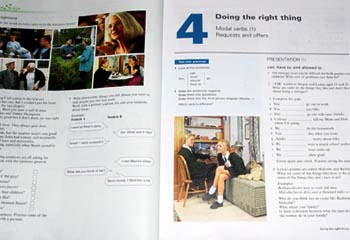
Most units tend to be thematic. For example, for practicing modal verbs such as "should," "must," and "have to" (among others), this particular book (and many others) use the idea of advice and "Doing the right thing."
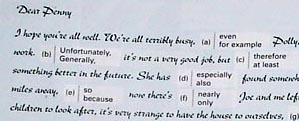
There are certain groups of easily-confused words, and some activities are aimed at improving students' ability to choose the correct word from a similar pair. This particular book is written specifically for Polish students, and so that influenced the word choice (in other words, they might not seem like similar words in English, but they are in Polish translation, so . . .).
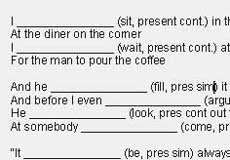
There are three tenses in Polish; there are twelve in English. When to use which tense can be somewhat confusing for students. Even remembering how to make them all can be difficult, so sometimes we have "easy" lessons that just make students think about how to make the tenses. (This particular exercise uses Suzanne Vega's "Tom's Diner," a rather popular song in Poland, making this one of the most popular lessons I've ever taught.)
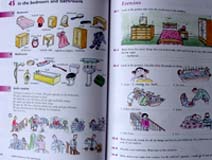
Obviously, the most basic element needed to be able to use a foreign language is an adequate vocabulary.

Teaching English in Poland presented some special challenges. For instance, articles: when to use "a," when to use "an," and when to use "the." Polish doesn't have articles, so the sentence "Id? do sklepu" could be translated "I'm going to a shop" or "I'm going to the shop." Teaching students when to use which was initially very difficult.

The most difficult part, though, would be orthography: getting kids to remember that the dark part of a 24-hour period is "night" and a medieval soldier is a "knight" and they're both pronounced the same.

Irritation Squared

Today I went with Kinga (my wife, for the uninformed) and my father-in-law to Kinga’s brother’s house, which is being built just outside of Krakow. Kinga’s brother is now out of the country, so my father-in-law is taking care of the building process while he’s gone.

The house is “standing raw,” to translate directly from Polish. This means that the walls are done, the roof is done, and it’s ready for the interior finishing.

Houses here are built out of blocks and concrete, not the tooth-pick contracting familiar in America. My friend who spent some time in American working in construction said, “A house like that wouldn’t last a week here. The father would come home drunk one night and destroy the whole thing!"

Recently, the concrete for the floors was poured. There was to be five centimeters of concrete on each floor, poured over ten centimeters of Styrofoam insulation. We went to check that that was done.

“You can’t trust anyone here!” says my father-in-law. When he really gets ranting, he likes to say,

“This country has no right to exist!” and “Poland must be the richest country in the world, because everybody’s stealing and cheating, and yet there’s still something left to steal.”

So Kinga and I measured the area of all the floors while her father drilled random holes in the concrete to check its thickness. The upstairs was fine, but the downstairs floors were one centimeter too thin.

“It’s ridiculous we have to do this,” I muttered as we went throughout the whole house and measured everything. I was talking to my father-in-law about this, and he said, “Oh, it’s surely the same thing happens all over the world.”

And suddenly, we litigation-happy Americans looked pretty good, because, as I said to him, “At least in the States, you could take this guy to court for not fulfilling the contract. What can you do here?” I asked.

“Not much. We’ve already paid.” The point of all the measuring was this: the same company is supposed to come and finish the walls as well, and the hope of negotiation is what motivated the day’s measuring.

But what struck me was the fact that no contractor here has a reputation for being honest.

As my father-in-law said, “You can’t trust anyone here.”

Why they do it

Michele asks in a comment if it’s “not MORE difficult to cheat in the field of English because of the essay style answers that are required?” Perhaps in theory, but remember: essays require vocabulary, which is conducive to cheating.

Explaining how students in Poland cheat leads naturally to explanations as to why they do it.

One of the reasons, I think, is the sheer number of courses they take every year. Here’s a list of courses for one third-year (senior) class:

  1. Polish
  2. History
  3. Mathematics
  4. Biology
  5. Chemistry
  6. Physics
  7. English
  8. German
  9. Computer science
  10. Geography
  11. PE
  12. Social studies
  13. Religion

That’s not possible courses — that’s the required course work. As opposed to the American system, where you have physics only your final year, with chemistry your junior year and biology as a sophomore, they have all three sciences throughout high school. Of course they don’t have each course every day. For example, senior students have four hours of English a week, and so they meet Monday, Wednesday, Thursday and Friday — like the university scheduling system in the States. Still, that’s an insane amount of studying every week.

A second cause, put forth by a teacher, was historical. “Teachers during communism were seen as the Establishment, and so it was a way to fight the establishment.” Sounds weak. I don’t buy it.

Option three: the rote memory required by many teachers necessitates it. This might have some merit. I know teachers here sometimes simply dictate from a book and the students just write down everything and vomit it back up the next lesson. Admittedly, I do something similar when I give vocabulary quizzes — and I give an obscene number of such quizzes. “Without words, all the grammar in the world won’t help you!” tell the kids.

Choice four, which is the most logical now: as a fellow English teacher put it, “We let them.” Pure and simple. I do my damnedest to stop them from cheating, and I sometimes fail them for even a glance to the side (and that’s no exaggeration — I do it early in the year with first-year students, usually with a not-so-important grade, to set a precedent), and I take no excuses. And yet they still cheat.

The cheating won’t disappear soon, I’m afraid. I always use as an example the cultural attitude in the States towards cheating, but I know that that is slowing being eroded and that more and more students are cheating in the States.

Dude, what’s number three?!

I am a high school English teacher in a small village in southern Poland. One of the things that still amazes and annoys me, after more than six years of teaching here in Poland, is the culturally engrained habit of cheating. Simply put, the majority of students here will cheat in any and all perceived opportunities.

  • They whisper to each other.
  • They attempt to peak in their books.
  • They write on desks before a test.
  • They hide cheat-sheets in more places than you can possibly imagine.
  • They write on their hands, arms, and legs.
  • They copy their homework from each other.

And that’s just the stuff I’ve caught them doing.

It’s not that they’re morally degenerate, though. Rather, it’s a full-fledged, much-loved cultural difference. For us Americans, cheating is something of an embarrassment. I cheated once in sixth grade, and got caught doing it. My parents were called in for a conference, and I was quite ashamed of the whole situation. (I did cheat once in junior high, but that was merely because the teacher was on his own planet and my friends and I wanted to see how blatantly we could cheat.)

Poles don’t even see it as cheating, but more as “helping.” Intellectual honesty is, in my experience here, hard to come by. Cheating begins in elementary school and continues through university and into the workplace.

Two examples show the tolerance Poles seem to have for cheating:

  • A friend was working on a development project in the north of Poland some years ago. Individual cities wishing to participate in the project had to submit budget proposals. One town copied another’s proposal.
  • A high-ranking minister (I believe in the Ministry of Education, if memory serves) admitted to having plagiarized his doctoral dissertation some years earlier. It was deemed “excessive” punishment to revoke his doctoral degree, though I can’t remember what ultimate punishment was.

It’s no wonder, then, that students cheat. It seems to be in the blood.

But how do they do it?

To begin with, they talk. Literally, if I turn my back for one moment a murmur spreads across the classroom. But I usually watch them like a cliché hawk (no reading books while they’re taking a test here . . .), so they have to resort to written methods.

The most common method (aside from writing on hands) is to make cheat sheets that are then hidden in shirt sleeves, taped to the knee (if it’s a girl wearing a skirt), taped to the inside of clothing, or numerous other places.

All this cheating makes the instances of intellectual honesty all the more poignant. I once had a student — one of the hardest working in the school — copy entries for the journal that I was requiring her class to keep. She explained later that she simply didn’t know. She’d never cheated, and she was a model student, but I knew I had to fail her for the assignment. I told her I would think about it. She came to me the next day and said, “It’s not fair that I don’t get a failing mark. I should have known better. Please give me the ‘1’.” I did, but made sure it didn’t affect her overall grade.

Another place students like to use these little “aids” is in conjunction with a pen. There are two methods: the cruder form is simply to take the small, virtually illegible sheet on the outside of a pen. The more sophisticated way is to put it inside a pen with a clear casing. Whenever I happen to find these, I keep them – so there’s at least a minimal consequence to cheating: loss of a złoty.

Despite my best efforts, I can’t seem to stop this. I might have better luck trying to get my friends to give up smoking and drinking. It doesn’t matter than I have a zero-toleration policy, that I remind students of before every test or quiz. Students know that there’s no questions asked, no arguing tolerated, and begging is ignored – they cheat in any form and I fail them for the assignment, regardless of the weight of the grade.

I even fail them if the appear to be cheating! I’ve told them, “If your lips move, you get a ‘1,’ because am I to know what you’re saying?” It’s excessive, in a sense, and even unfair, but I know if I’m not this strict, they’ll say, “I wasn’t cheating! I was asking for a pencil/tissue/eraser/whatever.”
And still they cheat. And some of them, after being caught, do it again!

Usually I’m remorseless about failing them. After all, I’ve warned them repeatedly. But sometimes a usually hard-working, generally honest student (in other words, someone I really like) cheats. And that’s when it’s difficult to fail them. But I do, explaining my desire not to show favoritism and be fair at all costs.

For any casual readers from the States, I have a question: Did you ever cheat in school? How did you feel? Did anyone every find out? What was their reaction?

Vindictive Voting II

Quite a response I’ve gotten here. To be honest, I don’t put much stock in what people think of many anyway. Yeah, whatever.

It seems I’ve been VR’ed (trying to coin a new cyber term here) again by two more who I gave low scores. I’ll try to get some traffic their way now:

I gave them “one’s” for design alone. But with one, I couldn’t leave a comment to explain why, because there’s a limit on the number of comments you can leave in the first place.

Not good.

My initial impression of BE is steadily going downhill.

For now, BE has a lot of work to do, I think.

But as “Sunshine put it,

Regardless of how it started, the intended result–reading another’s blog–was successful, no?

Who can argue with that?!

Vindictive Voting

I joined Blogexplosion from sheer curiosity as to what this would do for this stupid site of mine. Thud mentioned it once and I though, “Why not give it a try.”

I got an account, looked through some blogs, and that’s about it. I don’t know if my traffic went up or not. To some degree I guess it did.

One of the things you can do with BE is you can rate other people’s work. And you can see who rated you, and more importantly (for some I guess), what rating they gave you.

Which gives rise to vindictive voting. For example, I gave this blog by one Lewis Moten a low rating. A one, in fact. Perhaps a bit of an exaggeration. It wasn’t that bad. But the content and the design annoyed me.

The first thing I saw was this entry about the Star Wars trailer, which includes nothing but a screen shot and the comment,

I just watched the trailer to Star Wars Episode III — Revent [sic] of the Sith. Pretty cool, and I didn’t have to buy a Hyperspace account to see it.

Fairly lame, I thought.

Worse, the design is a little annoying, with all those frames and scroll bars. As I commented (admittedly later):

The embedded frames with the off-color scroll bars makes it visually unattractive. The floating link list on the right adds a distracting element, and partially obscures the site title.

So I gave it a low mark and moved on.

Well, it appears that Lewis, angered by my low rating, decided to give me a low rating.

Ah, the joys and pains of the cyber experience…

Chewing Gum in Singapore

Everyone knows of the "notorious" ban on gum in Singapore. It seems that liberalization is coming. You can chew gum now! That is, if you're registered to do so.

I was doing a search on this because there's a listening activity on the history of chewing gum in the intermediate English textbook I use. I was shocked and thrilled to find out that freedom of chew is slowly coming to Singapore.

And America is helping bring it!

The gum became a sticking point in the trade talks when Philip Crane, a US congressman from Illinois, called for Singapore to lift the ban on all gum. Mr Crane represents Chicago, the home of chewing gum giant Wrigley (BBC Article).

I guess Singapore better brace for an attack if these restrictions aren't lifted . . .

Party Across the Hall

1-01

When your apartment is across the hall from a small office, and you know most of the people who work in the office, and they have an after-work party, you’ll probably end up there as well.

Calling the Kettle Black

Using The Cloak I can now look at W's web site. He writes,

Kerry politicized the Osama bin Laden tape by using it to attack the President and now his campaign surrogates are taking those attacks to a new low.

I seem to recall a scene of Bush getting off of Air Force One and saying something about bin Laden and the need for a safe America...

Apparently what's good for the goose is not good for the mule. (Wait, I think I got my metaphors mixed up a little.)

Further, one Steve Schmidt says:

For John Kerry's surrogates to suggest that Osama bin Laden supports President Bush's reelection is disgusting. John Kerry politicized the tape by using it to attack the President and now his campaign surrogates are taking those attacks to a new low, even as Kerry hypocritically says it would be 'wrong' to politicize the tape. This just demonstrates once again that for John Kerry the War on Terror is about political opportunity, not victory.

But it's okay for Bush's surrogates to suggest that bin Laden would rather Kerry win because it'll make U.S. security weaker?!

The article quotes Gov. Ed Rendell (D-PA) as saying, "Bin Laden is trying to help George Bush because George Bush is the best  recruiter that Al Qaeda has." I'm not sure why this is so inflamatory, because in a sense, it's true. It's just that Bush and his handlers aren't good at interpreting subtlities, as the uproar of Kerry's "irritation" comment regarding terrorism.

John Paul II is a Liberal

Just when you think the Catholic Church is bad, along comes someone who proves that it really could be worse.

According to Earl Pulvermacher, John Paul II is an Anti-Pope, which I suppose is almost as bad as being an anti-Christ. He in fact is the true pope.

After 40 years of the Holy See being vacant, the Catholic Church has, on October 24, 1998 elected Pope Pius XIII as the Vicar of Christ on Earth. The details of his election and papacy can be found on the Papal Homepage.

JPII is a heretic. Among JPII’s alleged heresies (our hero lists 101 of them – perhaps he was watching a Disney film as he typed them up?) are all the pronouncements that put a human, tolerant face on the Catholic faith.

There are two columns in list: JP2’s alleged heresies, and “Truth of Divine and Catholic Faith.” Under the latter heading of we find:

  • Only Catholics have the right to religious liberty.
  • Equal rights for all men is senseless.
  • The State must forbid non-Catholic religions.
  • False religions worship the Devil.
  • Apostate Jews do not worship the One True God.
  • No one can be saved who is not in the Church.
  • John Paul II worshiped the Devil.
  • Buddhism is a religion of damnation

When I look at the list and think of the possibilities, I am all the more thankful that Karol Wojtyla was elected pope and not some more “traditional” Catholic.

Us and Babia

Riding Round Babia
Slovakian view of Babia Gora

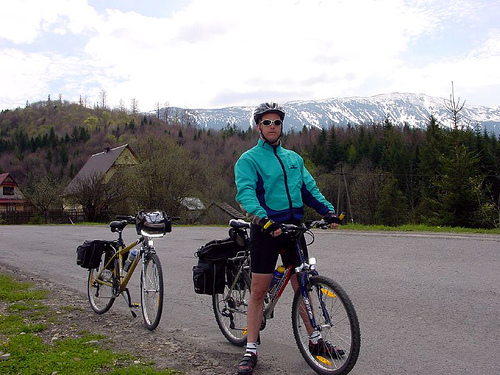
Last Saturday, Kinga and I went for a bike ride through Slovakia, around to the back side of Babia Gora. It'll probably turn out to be the last bike ride of the season, because the Indian Summer we'd been enjoying (called in Polish "lady's summer") came to an abrupt end recently. So no more pictures like the one at right . . .

Inexplicable stupidity

Sorry, but I had to bump this up to the top. Come on people — this is utterly ridiculous. I’m making a big deal out of a mole hill and nothing?

I live outside the US — Poland, to be exact. Surfing the net, I found a claim that people outside the US couldn’t access Bush’s official web site.

So I tried it.

I get the “Permission to view this website is forbidden for this server” message.

Just what is Bush doing? There is no justification for this, and no logical reason for it either.

Here are some articles about it:

According to the Expatia article,

Scott Stanzel, a spokesman for the Bush-Cheney campaign, was reported by the BBC on Thursday as saying: “The measure was taken for secruity [sic] reasons.” He declined to elaborate.

Security reasons?! Does al Q have the capacity to strike through IE? First Homeland Security is raiding toy stores (thanks to Thud for this info), and now Bush is shutting down his website for non-Americans? What kind of “security” is this?

There is just no logical reason for this blockage. If Bush’s team can’t “defend” his web site, what makes people think Bush and his gang can defend the country? Setting up a firewall is a lot easier than keeping out terrorists, I would imagine.

There was, in the Expatia article, some speculation as to why this was done:

Mike Prettejohn, president of Netcraft, speculated to the BBC that the decision to block usage was made to cut traffic to the site in the run-up to the 2 November poll and make sure the site remains active.

Google doesn’t seem to have this problem, and I would wager they see _a lot more traffic_ than Bush’s site. If this is really a concern, I would suggest to Bush’s technologically savvy web team that they look for a better host.

From the BBC article, further speculation, which puts the previous quote in context:

On 21 October, the George W Bush website began using the services of a company called Akamai to ensure that the pages, videos and other content on its site reaches visitors.

Mike Prettejohn, president of Netcraft, speculated that the blocking decision might have been taken to cut costs, and traffic, in the run-up to the election on 2 November.

This just doesn’t wash either. How much could this possibly cost? Besides, in addition to campaign funds, Bush has a sizable bank account himself — he could pay for this out of his own petty cash, I’m sure.

Is it a conspiracy to keep non-Americans from viewing the site? I doubt it. Expatica claims that there are ways to get to the site:

However, keen net users have shown that the site can be found at other addresses, including: https://georgewbush.com; http://65.172.163.222 and http://origin.georgewbush.com.

However, none of them worked for me.

They all produced 404 errors.

A Poll of Poles

Polish news agencies reported yesterday that according to a poll (no pun intended), 41% of Poles would vote for Bush and 31% for Kerry.

In the rest of the EU, the numbers were decidedly more, well, decided: 61% of respondents said they would vote for Kerry; 9.8% for Bush.

“Damn liberal Europeans! Kerry probably bought them with money from the oil for food program!”

Tolstoy and Tahiti

I’ve been reading Anna Karenina intermittently for a couple of weeks now, and I find it somewhat difficult to sympathize with such characters who are so clearly in an entirely different social world than I. They talk of Society (with the ever-important “S”) and take off abroad on a whim. Hard work for the men is listening to petitioners in their civil service job or riding around their estate to make sure all the serfs are working as directed (maybe occasionally working with them!); had work for the women is dealing with servants’ incompetence. It’s not difficult to see why Marxist ideology took root there as it did, and it’s strikingly evident already in Tolstoy’s mid—19th century Russia. One character even semi-accurately predicts that Marxism will be the new theology, sweeping Christianity off to one side.

And just when you think none of the characters is going to address any of this, Oblonsky, Levin, and Veslovsky head off into the marshes for a couple of days of shooting. Sitting in a peasant’s hut, enjoying his hospitality, they begin talking about the justness of social system when their host must step outside for a while.

“Why do we eat and drink, go shooting and do no work, while he is always, always working?” said Vasenka Veslovsky, evidently for the first time in his life thinking of this, and therefore speaking quite genuinely (582).

Why indeed? Because you can afford it.

The conversation ends with an exchange between Oblonsky and Levin, in which the former admits the inherent injustice in the system, but encourages Levin to accept them nonetheless.

“One of two things: either you confess that the existing order of Society is just, and then uphold your rights; or else own that you are enjoying unfair privileges, as I do, and take them with pleasure.”

“No! If it were unjust, you could not use such advantages with pleasure; at any rate I could not. The chief thing for me is, not to feel guilty” (583).

It reminds me of a similar emotion I experienced a few years ago in Berlin viewing an exhibition of Gauguin’s work:

While at the new National Gallery I was struck with a terrible sense of the stupid futility of all that I was seeing around me. Here we were, the privileged ten or fifteen percent of the world’s population, paying fifteen marks to look at some paintings (created by someone who was, by his own admission, trying to escape reality) while the remaining eighty-five percent of the world’s population is fighting for survival. We spend so much of our time trying to inject some kind of meaning in our lives while they simply try to live. The significance of the Expressionist movement or the impact of Bach’s music on his contemporaries seems pitifully  insignificant when others go to bed hungry every night. Their suffering robbed me of any pleasure I might otherwise have experienced at the gallery. And then I turned this critical light on my own aspirations and once again felt that I would be wasting my life by devoting my time and energy to studying and teaching religion and philosophy. What does it matter whether Berkley is right or wrong about the relationship between perception and existence when people are starving and disease ridden? It’s a simply matter of Maslow’s hierarchy of needs — most people don’t get the most basic needs fulfilled while we in the western world scurry about trying to find meaning in paintings and music.

Perhaps Gauguin just doesn’t appeal to me . . .

Reading Ann Coulter

Why? Because I like to read what “the other side” has to say. I don’t know many conservatives who will sit down and read a liberal column, but that’s just my limited experience. In her latest piece, Ms. Coulter writes,

Among his other pointless carping about the war in Iraq, Kerry keeps claiming the military is overextended. His supporters claim Bush has a secret plan to bring back the draft. Whatever happened to all those gays who wanted to join the military? We haven’t heard a peep out of them lately. How about rounding up a “Coalition of the Fabulous,” Sen. Kerry? And what does his good pal Mary Cheney tell him about that?

Is it just me, or does there seem to be some rather rabid homophobia in that? The implied benefits are:

  1. “Those gays” will finally shut up about being able to join the military.
  2. A lot of them will get killed in the war — dead gays are always a good thing.
  3. All gays speak with a lisp and say everything is “fabulous.”

Perhaps I’m missing an insinuation.