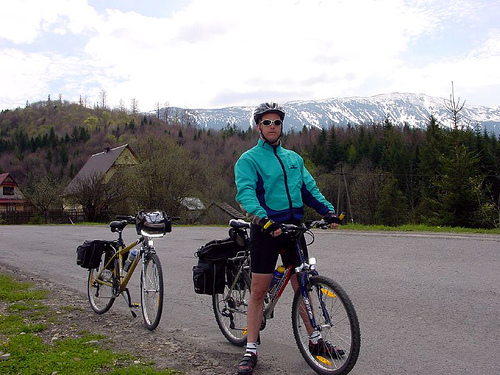
matching tracksuits

fun in threes, sometimes fours

Vindictive Voting II

Quite a response I’ve gotten here. To be honest, I don’t put much stock in what people think of many anyway. Yeah, whatever.

It seems I’ve been VR’ed (trying to coin a new cyber term here) again by two more who I gave low scores. I’ll try to get some traffic their way now:

I gave them “one’s” for design alone. But with one, I couldn’t leave a comment to explain why, because there’s a limit on the number of comments you can leave in the first place.

Not good.

My initial impression of BE is steadily going downhill.

For now, BE has a lot of work to do, I think.

But as “Sunshine put it,

Regardless of how it started, the intended result–reading another’s blog–was successful, no?

Who can argue with that?!
Vindictive Voting

I joined Blogexplosion from sheer curiosity as to what this would do for this stupid site of mine. Thud mentioned it once and I though, “Why not give it a try.”

I got an account, looked through some blogs, and that’s about it. I don’t know if my traffic went up or not. To some degree I guess it did.

One of the things you can do with BE is you can rate other people’s work. And you can see who rated you, and more importantly (for some I guess), what rating they gave you.

Which gives rise to vindictive voting. For example, I gave this blog by one Lewis Moten a low rating. A one, in fact. Perhaps a bit of an exaggeration. It wasn’t that bad. But the content and the design annoyed me.

The first thing I saw was this entry about the Star Wars trailer, which includes nothing but a screen shot and the comment,

I just watched the trailer to Star Wars Episode III — Revent [sic] of the Sith. Pretty cool, and I didn’t have to buy a Hyperspace account to see it.

Fairly lame, I thought.

Worse, the design is a little annoying, with all those frames and scroll bars. As I commented (admittedly later):

The embedded frames with the off-color scroll bars makes it visually unattractive. The floating link list on the right adds a distracting element, and partially obscures the site title.

So I gave it a low mark and moved on.

Well, it appears that Lewis, angered by my low rating, decided to give me a low rating.

Ah, the joys and pains of the cyber experience…

Chewing Gum in Singapore

Everyone knows of the "notorious" ban on gum in Singapore. It seems that liberalization is coming. You can chew gum now! That is, if you're registered to do so.

I was doing a search on this because there's a listening activity on the history of chewing gum in the intermediate English textbook I use. I was shocked and thrilled to find out that freedom of chew is slowly coming to Singapore.

And America is helping bring it!

The gum became a sticking point in the trade talks when Philip Crane, a US congressman from Illinois, called for Singapore to lift the ban on all gum. Mr Crane represents Chicago, the home of chewing gum giant Wrigley (BBC Article).

I guess Singapore better brace for an attack if these restrictions aren't lifted . . .

Party Across the Hall

1-01

When your apartment is across the hall from a small office, and you know most of the people who work in the office, and they have an after-work party, you’ll probably end up there as well.

Calling the Kettle Black

Using The Cloak I can now look at W's web site. He writes,

Kerry politicized the Osama bin Laden tape by using it to attack the President and now his campaign surrogates are taking those attacks to a new low.

I seem to recall a scene of Bush getting off of Air Force One and saying something about bin Laden and the need for a safe America...

Apparently what's good for the goose is not good for the mule. (Wait, I think I got my metaphors mixed up a little.)

Further, one Steve Schmidt says:

For John Kerry's surrogates to suggest that Osama bin Laden supports President Bush's reelection is disgusting. John Kerry politicized the tape by using it to attack the President and now his campaign surrogates are taking those attacks to a new low, even as Kerry hypocritically says it would be 'wrong' to politicize the tape. This just demonstrates once again that for John Kerry the War on Terror is about political opportunity, not victory.

But it's okay for Bush's surrogates to suggest that bin Laden would rather Kerry win because it'll make U.S. security weaker?!

The article quotes Gov. Ed Rendell (D-PA) as saying, "Bin Laden is trying to help George Bush because George Bush is the best  recruiter that Al Qaeda has." I'm not sure why this is so inflamatory, because in a sense, it's true. It's just that Bush and his handlers aren't good at interpreting subtlities, as the uproar of Kerry's "irritation" comment regarding terrorism.

John Paul II is a Liberal

Just when you think the Catholic Church is bad, along comes someone who proves that it really could be worse.

According to Earl Pulvermacher, John Paul II is an Anti-Pope, which I suppose is almost as bad as being an anti-Christ. He in fact is the true pope.

After 40 years of the Holy See being vacant, the Catholic Church has, on October 24, 1998 elected Pope Pius XIII as the Vicar of Christ on Earth. The details of his election and papacy can be found on the Papal Homepage.

JPII is a heretic. Among JPII’s alleged heresies (our hero lists 101 of them – perhaps he was watching a Disney film as he typed them up?) are all the pronouncements that put a human, tolerant face on the Catholic faith.

There are two columns in list: JP2’s alleged heresies, and “Truth of Divine and Catholic Faith.” Under the latter heading of we find:

  • Only Catholics have the right to religious liberty.
  • Equal rights for all men is senseless.
  • The State must forbid non-Catholic religions.
  • False religions worship the Devil.
  • Apostate Jews do not worship the One True God.
  • No one can be saved who is not in the Church.
  • John Paul II worshiped the Devil.
  • Buddhism is a religion of damnation

When I look at the list and think of the possibilities, I am all the more thankful that Karol Wojtyla was elected pope and not some more “traditional” Catholic.

Us and Babia

Riding Round Babia
Slovakian view of Babia Gora

Last Saturday, Kinga and I went for a bike ride through Slovakia, around to the back side of Babia Gora. It'll probably turn out to be the last bike ride of the season, because the Indian Summer we'd been enjoying (called in Polish "lady's summer") came to an abrupt end recently. So no more pictures like the one at right . . .

Inexplicable stupidity

Sorry, but I had to bump this up to the top. Come on people — this is utterly ridiculous. I’m making a big deal out of a mole hill and nothing?

I live outside the US — Poland, to be exact. Surfing the net, I found a claim that people outside the US couldn’t access Bush’s official web site.

So I tried it.

I get the “Permission to view this website is forbidden for this server” message.

Just what is Bush doing? There is no justification for this, and no logical reason for it either.

Here are some articles about it:

According to the Expatia article,

Scott Stanzel, a spokesman for the Bush-Cheney campaign, was reported by the BBC on Thursday as saying: “The measure was taken for secruity [sic] reasons.” He declined to elaborate.

Security reasons?! Does al Q have the capacity to strike through IE? First Homeland Security is raiding toy stores (thanks to Thud for this info), and now Bush is shutting down his website for non-Americans? What kind of “security” is this?

There is just no logical reason for this blockage. If Bush’s team can’t “defend” his web site, what makes people think Bush and his gang can defend the country? Setting up a firewall is a lot easier than keeping out terrorists, I would imagine.

There was, in the Expatia article, some speculation as to why this was done:

Mike Prettejohn, president of Netcraft, speculated to the BBC that the decision to block usage was made to cut traffic to the site in the run-up to the 2 November poll and make sure the site remains active.

Google doesn’t seem to have this problem, and I would wager they see _a lot more traffic_ than Bush’s site. If this is really a concern, I would suggest to Bush’s technologically savvy web team that they look for a better host.

From the BBC article, further speculation, which puts the previous quote in context:

On 21 October, the George W Bush website began using the services of a company called Akamai to ensure that the pages, videos and other content on its site reaches visitors.

Mike Prettejohn, president of Netcraft, speculated that the blocking decision might have been taken to cut costs, and traffic, in the run-up to the election on 2 November.

This just doesn’t wash either. How much could this possibly cost? Besides, in addition to campaign funds, Bush has a sizable bank account himself — he could pay for this out of his own petty cash, I’m sure.

Is it a conspiracy to keep non-Americans from viewing the site? I doubt it. Expatica claims that there are ways to get to the site:

However, keen net users have shown that the site can be found at other addresses, including: https://georgewbush.com; http://65.172.163.222 and http://origin.georgewbush.com.

However, none of them worked for me.

They all produced 404 errors.

A Poll of Poles

Polish news agencies reported yesterday that according to a poll (no pun intended), 41% of Poles would vote for Bush and 31% for Kerry.

In the rest of the EU, the numbers were decidedly more, well, decided: 61% of respondents said they would vote for Kerry; 9.8% for Bush.

“Damn liberal Europeans! Kerry probably bought them with money from the oil for food program!”

Tolstoy and Tahiti

I’ve been reading Anna Karenina intermittently for a couple of weeks now, and I find it somewhat difficult to sympathize with such characters who are so clearly in an entirely different social world than I. They talk of Society (with the ever-important “S”) and take off abroad on a whim. Hard work for the men is listening to petitioners in their civil service job or riding around their estate to make sure all the serfs are working as directed (maybe occasionally working with them!); had work for the women is dealing with servants’ incompetence. It’s not difficult to see why Marxist ideology took root there as it did, and it’s strikingly evident already in Tolstoy’s mid—19th century Russia. One character even semi-accurately predicts that Marxism will be the new theology, sweeping Christianity off to one side.

And just when you think none of the characters is going to address any of this, Oblonsky, Levin, and Veslovsky head off into the marshes for a couple of days of shooting. Sitting in a peasant’s hut, enjoying his hospitality, they begin talking about the justness of social system when their host must step outside for a while.

“Why do we eat and drink, go shooting and do no work, while he is always, always working?” said Vasenka Veslovsky, evidently for the first time in his life thinking of this, and therefore speaking quite genuinely (582).

Why indeed? Because you can afford it.

The conversation ends with an exchange between Oblonsky and Levin, in which the former admits the inherent injustice in the system, but encourages Levin to accept them nonetheless.

“One of two things: either you confess that the existing order of Society is just, and then uphold your rights; or else own that you are enjoying unfair privileges, as I do, and take them with pleasure.”

“No! If it were unjust, you could not use such advantages with pleasure; at any rate I could not. The chief thing for me is, not to feel guilty” (583).

It reminds me of a similar emotion I experienced a few years ago in Berlin viewing an exhibition of Gauguin’s work:

While at the new National Gallery I was struck with a terrible sense of the stupid futility of all that I was seeing around me. Here we were, the privileged ten or fifteen percent of the world’s population, paying fifteen marks to look at some paintings (created by someone who was, by his own admission, trying to escape reality) while the remaining eighty-five percent of the world’s population is fighting for survival. We spend so much of our time trying to inject some kind of meaning in our lives while they simply try to live. The significance of the Expressionist movement or the impact of Bach’s music on his contemporaries seems pitifully  insignificant when others go to bed hungry every night. Their suffering robbed me of any pleasure I might otherwise have experienced at the gallery. And then I turned this critical light on my own aspirations and once again felt that I would be wasting my life by devoting my time and energy to studying and teaching religion and philosophy. What does it matter whether Berkley is right or wrong about the relationship between perception and existence when people are starving and disease ridden? It’s a simply matter of Maslow’s hierarchy of needs — most people don’t get the most basic needs fulfilled while we in the western world scurry about trying to find meaning in paintings and music.

Perhaps Gauguin just doesn’t appeal to me . . .

Reading Ann Coulter

Why? Because I like to read what “the other side” has to say. I don’t know many conservatives who will sit down and read a liberal column, but that’s just my limited experience. In her latest piece, Ms. Coulter writes,

Among his other pointless carping about the war in Iraq, Kerry keeps claiming the military is overextended. His supporters claim Bush has a secret plan to bring back the draft. Whatever happened to all those gays who wanted to join the military? We haven’t heard a peep out of them lately. How about rounding up a “Coalition of the Fabulous,” Sen. Kerry? And what does his good pal Mary Cheney tell him about that?

Is it just me, or does there seem to be some rather rabid homophobia in that? The implied benefits are:

  1. “Those gays” will finally shut up about being able to join the military.
  2. A lot of them will get killed in the war — dead gays are always a good thing.
  3. All gays speak with a lisp and say everything is “fabulous.”

Perhaps I’m missing an insinuation.

Gombrowicz the Artist

I’m reading intermittently ’s Diary, which was part of a wedding gift that consisted of several Polish classics. I’ve been wading through it for about two months now. I read a day here, a day there, an entry or two in a single day, then nothing for a couple of weeks.

It’s hard going because there’s only so much self-congratulatory discussion on Art (and that capital “A” is critical) that I can handle in one sitting. Gombrowicz was a self-exiled Polish writer who seemed constantly to be growling and grumbling against “timid Polish Art” and such. He’s an Artist with the Capital A because he regards Art (again, that “A” must be there) as something as critical as Air (an equally important “A”), and thinks Disastrous Art will lead to the Downfall of Civilization as surely as bad monetary policy. He does admit once that Art (or even lowly art) is a luxury, but only in a fever of humility that quickly passes.

It reminds me of what Lawrence Ferlinghetti writes in #15 from A Coney Island of the Mind of the adventures, difficulties, and responsibilities of a poet. It’s the ever-popular poem about poetry, in other words. It seems to be a bit of self-flattery, the knight looking at himself in a mirror, admiring his own armor and coming heroism. And taking himself entirely too seriously, the

super realist
who must perforce perceive
taut
truth
before the taking of each stance or step

As if the right words will save the world, and the wrong ones, destroy. The whole poem, for those interested (without F’s beat-poet line indentions):

the
poet like acrobat
climbs on rime
to a high wire of his own making
and balancing on eyebeams
above a

of his audience
sea of faces
paces his way
to the other side of day
performing entrechats
and slight-of-foot

above the heads
tricks
and other high theatrics
all without mistaking
any thing
for what might not be.
For he’s

whenever he performs
the super realist
who must perforce perceive
taut truth

Constantly risking absurdity
start her death-defying leap
And he
a little charliechaplin man
who may or may not catch
her fair

with gravity to in
eternal form
spreadeagled in the empty air
of existence

before the taking of each stance or step
and death
his supposed advance
toward that still higher perch
where Beauty stands and waits

I don’t know why it annoys me so much for an Artist to think of himself so seriously. He spends quite a bit talking about how no one understands him, how no one can comprehend what he’s been doing in his various novels that might appear to be unreadable, but in fact are only difficult because we’re not accustomed to such radically different Art.

“What I’m trying to do . . .”

Tom Wolfe commented on this thirty years ago:

Then and there I experienced a flash known as the Aha! Phenomenon, and the buried life of contemporary art was revealed for me for the first time. All these years I, like so many others, had stood in front of a thousand, two thousand, God-knows-how-many-thousand Pollacks, de Koonings, Newmans, Nolands, Rothkos, Rauschenbergs, Judds, Johnses, Olitskis, Louises, Stills, Franz Klines, Frankenthalers, Kellys, and Frank Stellas, now squinting, now popping the eye sockets open, now drawing back, now moving closer — waiting, waiting, forever waiting for … it … for it to come into focus, namely, the visual reward (for so much effort) which must be there, which everyone (tout le monde) knew to be there — waiting for something to radiate directly from the paintings on these invariably pure white walls, in this room, in this moment, into my own optic chiasma. All these years, in short, I had assumed that in art, if nowhere else, seeing is believing. Well — how very shortsighted! Now, at last, on April 28, 1974, I could see. I had gotten it backward all along. Not “seeing is believing,” you ninny, but “believing is seeing,” for Modern Art has become completely literary: the paintings and other words exist only to illustrate the text (quoted in Steven Pinker’s The Blank Slate).

We have to have it explained to us. And what exactly are they explaining? Back to Pinker:

The political messages of most postmodernist pieces are utterly banal, like “racism is bad.” But they are stated so obliquely that viewers are made to feel morally superior for being able to figure them out.

This is true not only by the artists, but by the critics as well. Try reading a college textbook on film criticism. You’ll find yourself wondering how someone could write something so contorted, so warped — how someone could use so many words to say so comparatively little.

And so where does it leave us in this blog-invested world, where now everyone is an artist and everyone is trying to say something?

He writes with a grin.

Photo by 50 Watts

Get Yourself Registered

How long do you think it would take to register a new car? How much time off of work do you think you'd have to take? A couple of hours after work? If only.

A friend recently registered his new car here in Poland. He took two days off of work to do it. Two days.

Two days

He went to the office to get in line at 4:00 a.m. No, I'm not making this up -- he went to stand in the line at four in the morning, and finally got into someone's office at twelve! And here's the kicker -- when he arrived, there were already people waiting!!! Once he got into an office to see someone, it took my friend forty minutes to fill in all the paper work.

The absurdity of this is astounding.

Chester, Oscar, and the Problem of Evil

Last night I began reading Oskar i Pani Róza, which is originally Oscar et la dame rose (Amazon.com) and in English would be Oscar and Ms. Rose. It’s about a ten-year-old dying of cancer and a volunteer he makes friends with, named Ms. Rose. When Ms. Rose suggests that Oskar write to God, he replies that he doesn’t believe in God. She suggests that perhaps he should write anyway:

“Maybe you would feel less lonely?”
“Less lonely with someone who doesn’t exist?”
“Why not check if he exists?”
She bent down close to me and said, “Every time you believe in him, he’ll exist a little more” (15, my translation).

Believing in something makes it more real? Is that what she’s saying? Of course, it is, and of course, it’s true. Does that mean that God exists only in our heads, that we create him by believing in him? Not quite, I think, but strangely enough, taking a leap of faith and just believing seems to make it more believable.

Czeslaw Milosz wrote in The Captive Mind (Amazon.com),

The Catholic Church wisely recognized that faith is more a matter of collective suggestion than of individual conviction. Collective religious ceremonies induce a state of belief. Folding one’s hands in prayer, kneeling, singing hymns precede faith, for faith is a psycho-physical and not simply a psychological phenomenon.

Doing leads to believing. Believing is, in a sense, encapsulated in this “doing,” and so paradoxically, as Ms. Rose seems to be saying, believing leads to believing.

This is also the question in Life of Pi, though much more directly than in Oskar. I remember the quote, something like “If you stumble at believability, what is there left to live for?” Or something like that.

I was making a sandwich or something last night – perhaps pouring a brandy, I can’t remember – and I thought, “It would indeed be nice to believe in something out there, something bigger than us that we can count on to help us when we need it.”

The trouble with that is simply that I don’t see help where help is most needed – in the suffering of a child: the painful and incomprehensible suffering that child might have to endure before dying, and that’s the “problem of evil” as I frame it. Not just any evil – incomprehensible evil.

All evil can be understood on some level by adults.

Incomprehensible evil is that which attacks children, like children in Rwanda who were hacked to death with a machete because of their ethnicity when the notion of “ethnicity” is so foreign to them that it would be difficult to explain it to them.

Sunrise

I woke up the other morning and saw the most amazing sunrise.

Sunrise

Such beautiful beginnings here are often omens for a horrid afternoon: it starts out lovely, then clouds over completely. On the other hand, waking up to a foggy morning means a cloudless afternoon.

“Don’t like the weather? Wait five minutes.” So goes the saying.