I recently wrote about Polish plurals and the strange fact that there are two forms.
That was only the tip of the iceberg. The easy part of the language. Today -- how to make a Polish sentence meaningful. Or "how to make sure you say 'The dog bit John' rather than 'John bit the dog.'"
In English, word order is an essential grammatical element. We know in the sentence "The dog bit John" that the dog did the biting, and not John, from the position of "The dog" in the sentence.
Polish, however, is an inflected language and that means that word order has no effect on the meaning of the sentence. In Polish, you could just as easily order the words, "John bit the dog" without any change in meaning. For that matter, "Bit John the dog" and "The dog John bit" are possible as well.
So how are they differentiated? By their ending. In Polish (in all highly inflected languages) you indicate a word as a direct object, an indirect object, a subject, or whatever by adding a suffix according to a given pattern.
An example may help. Imagine in English that subjects ended in "-doj" and direct objects ended in "-aldi." Our sentence would then look like this: "The dogdoj bit Johnaldi." In that case, "Bit Johnaldi the dogdoj" would have the same meaning, as would the following:
- "Johnaldi bit the dogdoj."
- "Johnaldi the dogdoj bit."
- "The dogdoj Johnaldi bit."
English does indeed have a bit of declension. Some examples:
- "-ed" to a verb to make it past tense
- "-s" to make a noun plural
- "-ing" to make a verb a gerund (i.e., "Swimming is a healthy activity.")
- "-er" and "-est" in the comparative and superlative forms
- "-'s" to denote possession (i.e., "Samantha's mother left for Switzerland.")
By and large, though, English is not an inflected language. "The dog bit John" and "John bit the dog" are very different sentences as a result.
Thanks to Oliver for the correction. Originally I'd mistakenly claimed that German has five cases.
An inflected language uses cases to differentiate functions and forms. Greek and German have four cases.
Polish has seven:
- Nominative case -- The subject of a sentence
- Accusative case -- The direct object of a positive sentence
- Genitive case -- To denote possession (i.e., "That's George's bag.")
- The direct object of a positive sentence for some verbs
- The direct object of a negative sentence
- For quantities of five and above.
- Locative case -- To specify location after certain prepositions
- Instrumental case -- To denote the method or tool used to do something
- Dative case -- The indirect object of a sentence
- Vocative case -- Used in addressing people (i.e., Did you take it, George?)
These changes even occur to names, providing a clear example of the complexities of Polish grammar. We'll use "Bill Clinton" as a direct object, indirect object, object of a preposition, etc, and see just how insane Polish is:
| Case | Example |
|---|---|
| Nominative case | To jest Bill Clinton. (This is Bill Clinton.) |
| Accusative case | Lubię Billa Clintona. (I like Bill Clinton.) |
| Genitive case | Szukam Billa Clintona. (I'm looking for Bill Clinton.) |
| Locative case | Myślę o Billu Clintonie. (I'm thinking about Bill Clinton.) |
| Instrumental case | Rozmawiam z Billem Clintonem. (I'm talking with Bill Clinton.) |
| Dative case | Dałem Billowi Clintonowi. (I gave Bill Clinton... s'thing.) |
| Vocative case | Wzia…łes›, Billu? (Did you take it, Bill?) |
Because of declension, the word order doesn't make any difference. For example, if you want to stress that you gave it to Bill as opposed to George, you could say, with the proper vocal inflection to stress it, "Billowi dałem."
But learning Polish grammar is not simply a matter of remembering some endings, for all nouns in Polish have a gender (as in German, French, Spanish, etc.), so you have to learn a hell of a lot of endings.
- Three genders
- Seven cases
- Singular and plural
So when you utter a Polish noun, there are forty-two possible endings, depending on whether it's singular or plural, masculine, feminine or neuter, and whichever case is necessary.
And the exceptions, for some forms are exactly the same except in given cases.
- The accusative plural and the nominative plural of neuter nouns are identical, but feminine and masculine nouns are different.
- The female genitive and locative cases are the same for singular nouns but not for plural nouns.
Aside from that nonsense, there are various considerations for exceptions. Is it a masculine alive noun? Does it end in "a"?


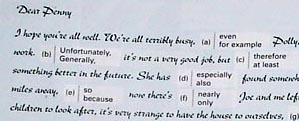
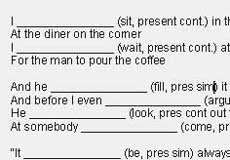
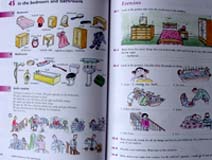
 Ever wonder what an EFL (English as a Foreign Language) textbook looks like? I certainly did as I was preparing to come to Poland for the first time back in 1996. After all, how often do you get to see a textbook teaching something you already know fluently? Naturally, after four and a half years' experience, I've seen and used more textbooks than I care to remember. I thought I'd share a little about the books I've been using.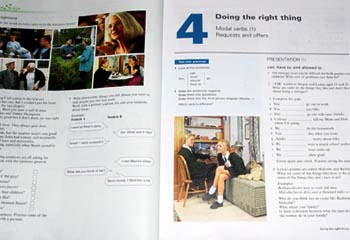
 I am a high school English teacher in a small village in southern Poland. One of the things that still amazes and annoys me, after more than six years of teaching here in Poland, is the culturally engrained habit of cheating. Simply put, the majority of students here will cheat in any and all perceived opportunities.
 Two examples show the tolerance Poles seem to have for cheating:
 But how do they do it?
 I even fail them if the appear to be cheating! I’ve told them, “If your lips move, you get a ‘1,’ because am I to know what you’re saying?” It’s excessive, in a sense, and even unfair, but I know if I’m not this strict, they’ll say, “I wasn’t cheating! I was asking for a pencil/tissue/eraser/whatever.”