When I photograph L, I try to avoid using a flash -- for somewhat obvious reasons.

fun in threes, sometimes fours
When I photograph L, I try to avoid using a flash -- for somewhat obvious reasons.

It seems to be as ubiquitous in rural Poland as the headscarf. Walk into a Polish home and you're likely to see the matriarch in an apron. Whether cooking or not; whether cleaning or not; the only thing that matters is whether or not you're out of bed.
And if you're going to visit family for an extended period of time, you take them with you.
My mother-in-law wears aprons all the time. As I write this, I can look over and see her working crossword puzzles, wearing the apron she was wearing when she emerged from her room at 6:30 this morning.
It makes me smile.
I'd finished burping the girl; something was holding her attention; K had the camera:
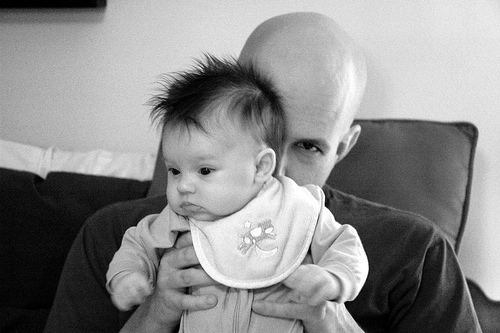
Things went well for a few moments, and then L got testy.
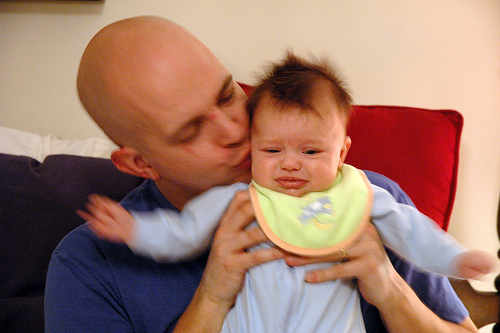
But she's still gorgeous when she's positively wailing.
For many of the young people in the program where I work, one of the formal goals that forms part of the forest of paperwork about them is "Learn to say "Okay.'" What that means in practical terms is fairly simple: many of them are unable to accept criticism -- broadly defined as anything even apparently critical of them or their actions -- of any kind from adults.
A scenario from not so long ago illustrates how many things are going on that can make it difficult for someone just to say, "Okay."
Two boys, in class, are doing something disruptive. Fidgeting with something, throwing it back and forth (maybe a jacket?) or something. I couldn't see clearly what it was, but it caught my attention and I deemed it a distraction.
"Hey, guys, stop doing that, please."
"Doing what?" one asks simultaneously with the other's plea of innocence: "I wasn't doin' nothin'!"
Now it really doesn't matter what they were doing. It really doesn't matter if they were doing anything at all. The best response to bring the whole exchange to an end, to prevent it from escalating into something more serious, to ensure not getting into trouble, is to say, "Okay."
"If you have a problem with that," we tell them, "you can talk to the teacher afterward. If you don't know exactly what the teacher is asking you to do, you can ask for clarification after saying "Okay.' But getting defensive, taking it personally, exaggerating it into a personal affront will only make the situation worse."
And so going back to the above scenario, I reminding the boys that one of the skills they're working on is simply saying "Okay" and moving on.
"I ain't sayin' "Okay' to something I didn't do!" one replied indignantly.
"Why not?" I asked. "In saying "okay' you're not admitting to guilt. You're not doing anything other than acknowledging that you heard and understood what the person in authority -- be it a teacher or not -- is saying."
"But I didn't do nothin'!" he protested.
"But that doesn't matter." I responded. "In protesting it, particularly in the manner you're doing now, you're not doing anything to help your situation."
"Are you telling me that if someone accused you of doing something..."
"Whoa, wait -- I'm not accusing you of doing anything. I simply asked you both to stop. If you weren't doing anything, then clearly I wasn't talking to you. Even if I was addressing you alone and said "Stop doing that" and you were behaving perfectly, the best response is to say, "Okay' and move on."
"Move on?! You're the one making an issue of this" he said, voice pitching upward into a virtual screech, eyebrows raised just enough to say -- inadvertently or purposely -- "You're an idiot for saying that."
"No, I'm using this moment to remind you of a skill you're working on and to try to get you to practice it."
The boy couldn't accept that saying "Okay" even if you're completely innocent is anything more than an admission of guilt. And to prove his point, he brings up a most fascinating example: "So you're sayin' that if you walking down a street and cops come up to you and say, "You look like this guy who just robbed a bank,' and arrested you, that you'd just say, "'Okay.'"
The discussion is starting to get less and less productive as we range farther and farther off topic. Or are we off topic? Is this how the boy equates all these things? I decide to play along.
"Yes, I would. Or at least I hope I'd have a cool enough head to say that."
"But you didn't do it. Are you saying that if they said, "You robbed this bank,' that you'd just say nothing, that you wouldn't tell them you're innocent? They'll take you to jail and what -- you'll end up spending ten years in jail for something you didn't do?!"
Right here, though I suspected it moments earlier, I realize the young man didn't have a firm grasp on the workings of our criminal justice system. And another thing begins dawning -- we're really getting off track. Does this help the young man understand the situation? Is he just trying, like so many of the boys do, to get me so wrapped up in a discussion argument exchange that it's just a matter of whoosh! blink! and the whole class is over? I decide, somewhat against my better judgment, to continue.
"Just because they arrest me doesn't mean I'll be spending ten years in jail. There's a trial first, and in the meantime, I can be released on bail. But think of what they say, what you hear on TV, every time they arrest someone." Almost together we recite the Miranda warning. Then I continue, "Now if I'm an idiot, I'll start blathering on about how I'm innocent and how I didn't do anything and then, in court, that will be used against me, because the irony is, it makes me look guilty. If I'm smart, I'll shut my trap completely until I can get a lawyer."
"But if you didn't do nothin'""
"Especially if I hadn't done anything," I replied.
Finally things are winding down, and a boy enters from the other group.
"Hey, Mr. S, let's ask him if he'd just say "okay.' 'Eric, if someone framed you.'"
And now everything is mixed up. Nothing is as it started. We're no longer talking about whether or not saying "okay" helps you in a situation even if the request is relatively arbitrary; we're no longer talking about whether or not saying "okay" is an admission of guilt -- we've moved off into the netherworlds of arbitrary, six-sixty-degrees-of-separation tangents that suck up time and accomplish nothing.
Or is it simply that he doesn't understand what I mean? Are all these scenarios that we've been bouncing off of each other identical to him?
In the end, he simply says, "Well, if that's a skill, I guess it's a skill I won't use."
And I think, "Okay -- we'll try again tomorrow."
Listening to NPR coming home a couple of days ago, I heard the most curious thing. Regarding the House debate on Iraq, a Republican representative then name escapes me, but it’s a virtual party-wide sentiment said that in this debate “the terrorists are dividing us.”
Huh?
Did bin Laden get on the House floor and propose this debate? Have Hezbollah members been elected and hijacked the House agenda? No, what happened was exactly what those folks don’t want to happen: debate. It’s the ultimate indication of a truly free society.
“We’re sending a message to the terrorists that we’re weak!” war hawks cry. No -- we’re sending a message that we’re strong, that unlike the Islamic world theocracy they would like to enact, our state can handle political disagreement.
“We’re sending the wrong message to our troops.” Well, I’m not a soldier on the front, and neither was the representative who made this statement. However, it needs to be stated that the nonbinding resolution deals with the President’s performance in regard to Iraq, not the soldiers’.
What’s most astounding about some Republican’s disgust at the notion of having a public debate about how things are going in Iraq is the simple fact that this is the first time it’s happened since the war began. This is not a continually occurring thing. “Oh no, here those Democrats go again! Didn’t we do this last session?” Instead, while in the majority, the Republicans tried to stifle all such debate.
Which is odd, because I thought that was one of the things that made our country a pretty good place to be.
We took J out to the local university's botanical gardens Sunday. We knew that, being a gardener herself, J would be fascinated by all the various species that might not necessarily be unique to this area but certainly don't grow in Poland.

What was most amazing for her was the number of deciduous trees, Poland being mostly forested with coniferous varieties. Of course, with the leaves off the trees, said deciduous trees aren't nearly as lovely as they'll be in spring -- and of course autumn, but by then, J will be long gone.

However, she will be here in spring, and so visits to all the various parks and gardens in the area are already in the works.
(More images from Sunday at Flickr.)
An interesting story from the NYT yesterday:
There is nothing much unusual about the 197-page dissertation Marcus R. Ross submitted in December to complete his doctoral degree in geosciences here at theUniversity of Rhode Island.
His subject was the abundance and spread of mosasaurs, marine reptiles that, as he wrote, vanished at the end of the Cretaceous era about 65 million years ago.
But Dr. Ross is hardly a conventional paleontologist. He is a “young earth creationist” -- he believes that the Bible is a literally true account of the creation of the universe, and that the earth is at most 10,000 years old.
There are lots of issues in the article, a couple of them worth touching on.
First, there’s the question of whether graduate schools should reject applicants who hold to creationism. “It’s not a matter of religion,” say the proponents, “But of science.”
In this case, Ross’ work is impeccable, from a scientific point of view. That he doesn’t actually believe what he discusses in his dissertation is a philosophical oddity, which Ross explains by saying he’s working in a different paradigm: Just as a Marxist could do the work in an economics department with a free-market bent, he explains, so he as a creationist could work in a department that teaches the scientifically standard position of evolution.
But the issue is larger than that, and feeds into the second concern I have:
While still a graduate student, [Ross] appeared on a DVD arguing that intelligent design, an ideological cousin of creationism, is a better explanation than evolution for the Cambrian explosion, a rapid diversification of animal life that occurred about 500 million years ago.
Online information about the DVD identifies Dr. Ross as “pursuing a Ph.D. in geosciences” at the University of Rhode Island. It is this use of a secular credential to support creationist views that worries many scientists.
Eugenie C. Scott, executive director of the National Center for Science Education, a private group on the front line of the battle for the teaching of evolution, said fundamentalists who capitalized on secular credentials “to miseducate the public” were doing a disservice. (Link)
This would put a university geology department in the odd position of asking applicants about the motivation and eventual use of their degree, and the morally questionable position of using that to make decisions about admission.
But the larger issue for me is the phrase “to miseducate the public.” Here, creationists have an advantage, because they generally get their worldview confirmed on a weekly basis, in church. Educating the public about evolution, however, is a bit tricker, for not only is it culturally competing with creationism, but the amount of time it’s presented is significantly less than creationism. Unless an individual majors in science, his exposure to systematic education about evolution is limited only to a few years in school. Creationism, however, puts forward its case on a weekly basis.
There's nothing like a party to make you feel loved...


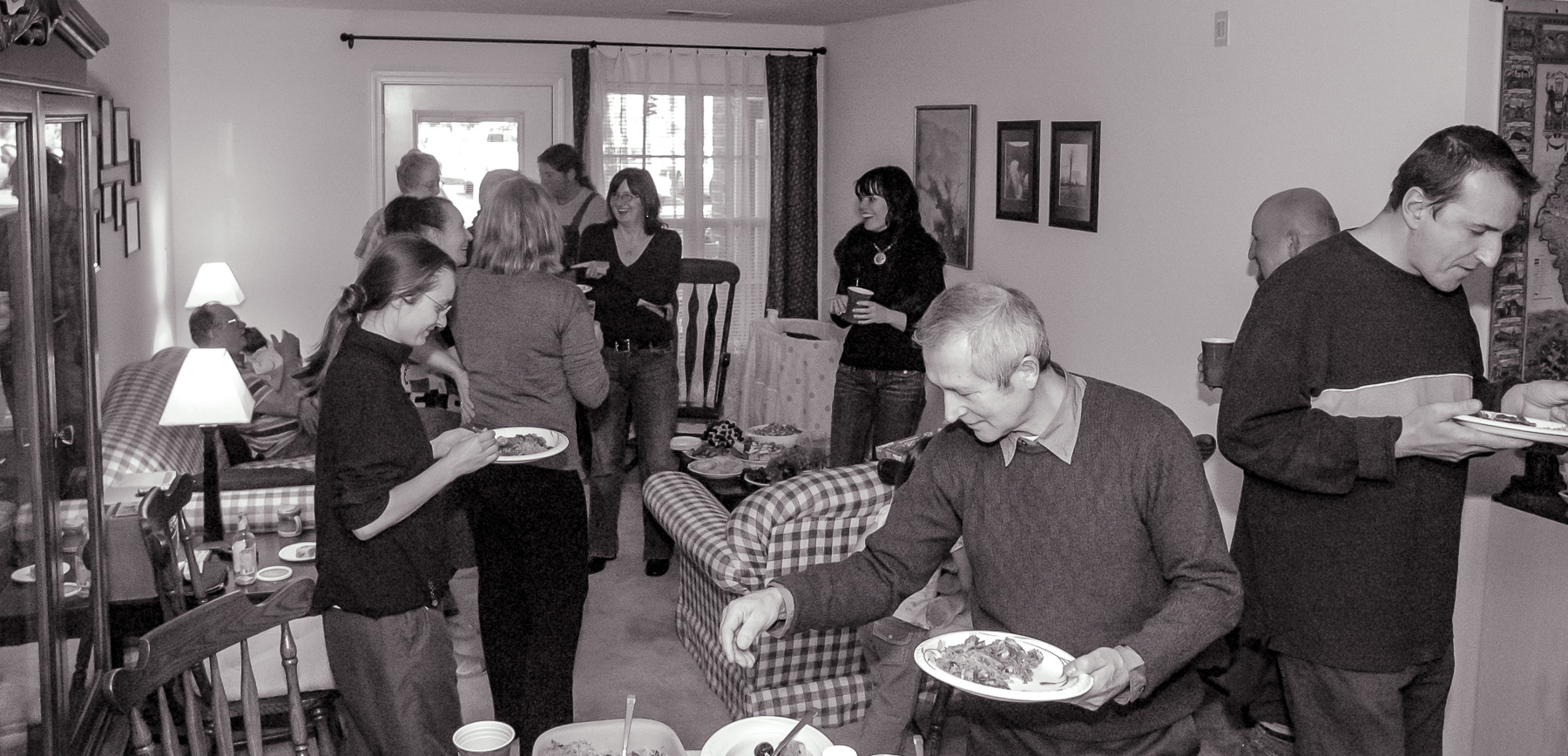

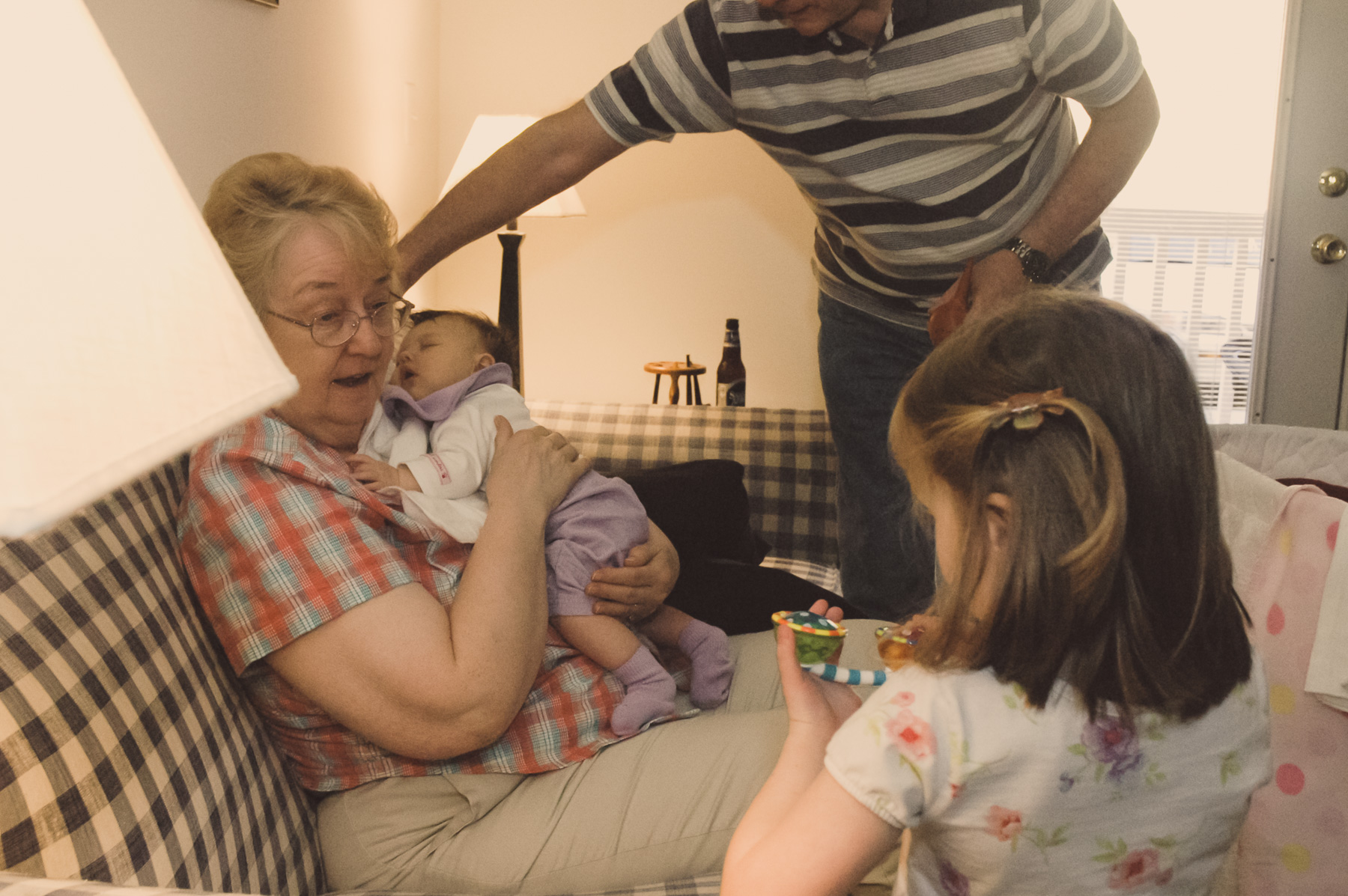
When we lived in Poland, K and I had parties fairly frequently. Nothing huge: a few friends, some drinks, a bit of food -- that's all it took. No huge planning. No date-setting far out into the future. "Why don't you all come over Saturday night?" is how if often started.
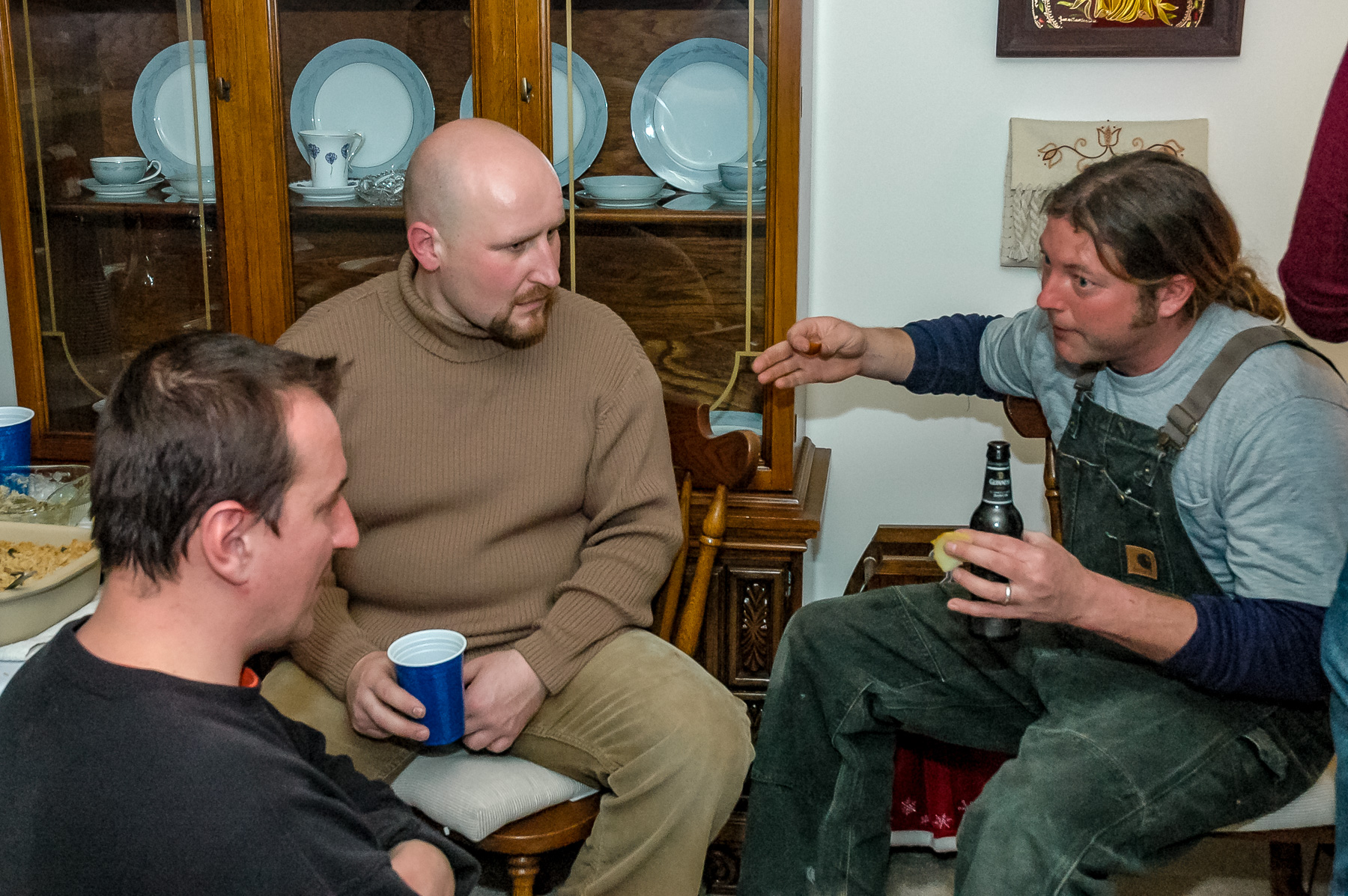
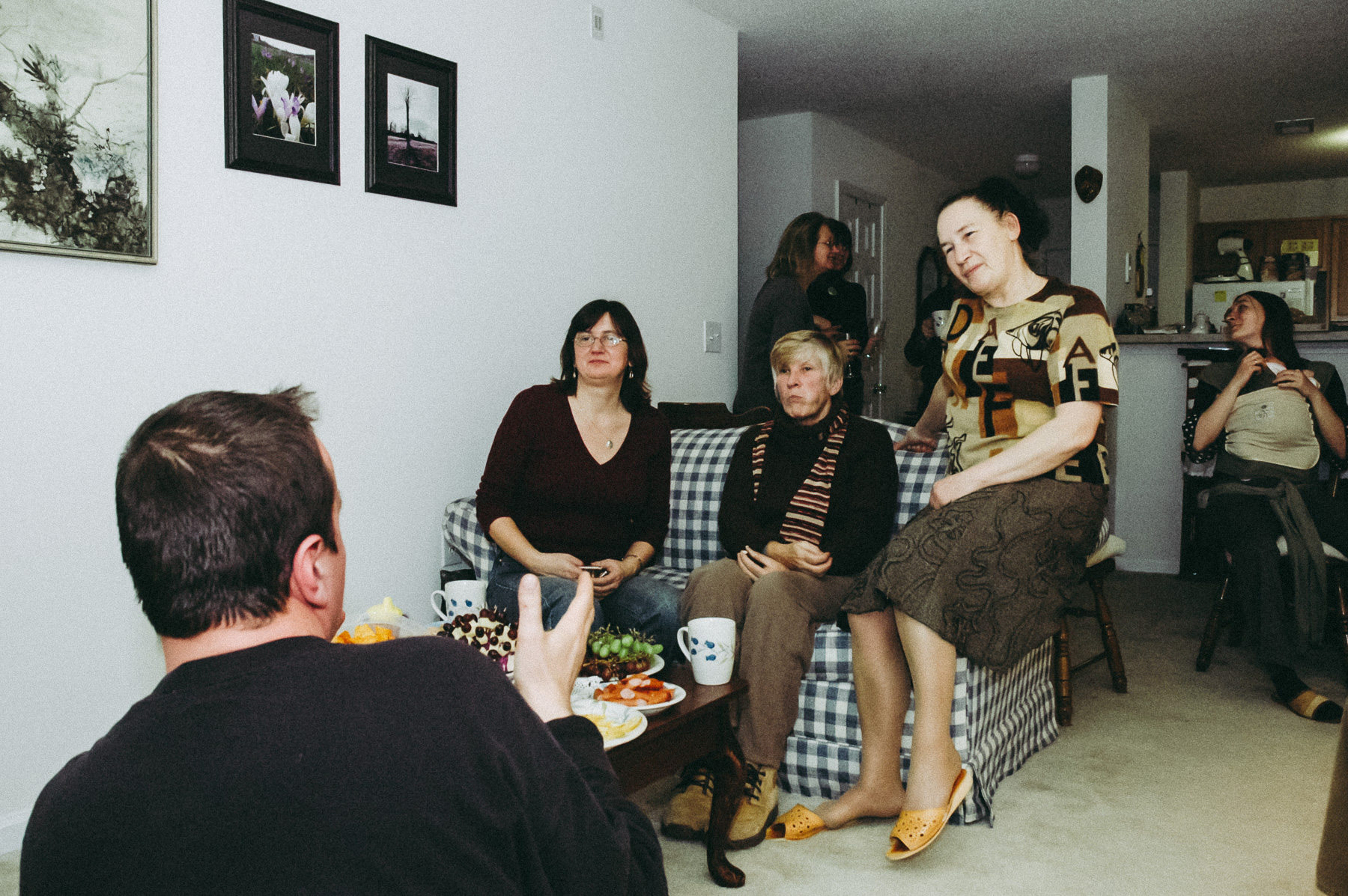
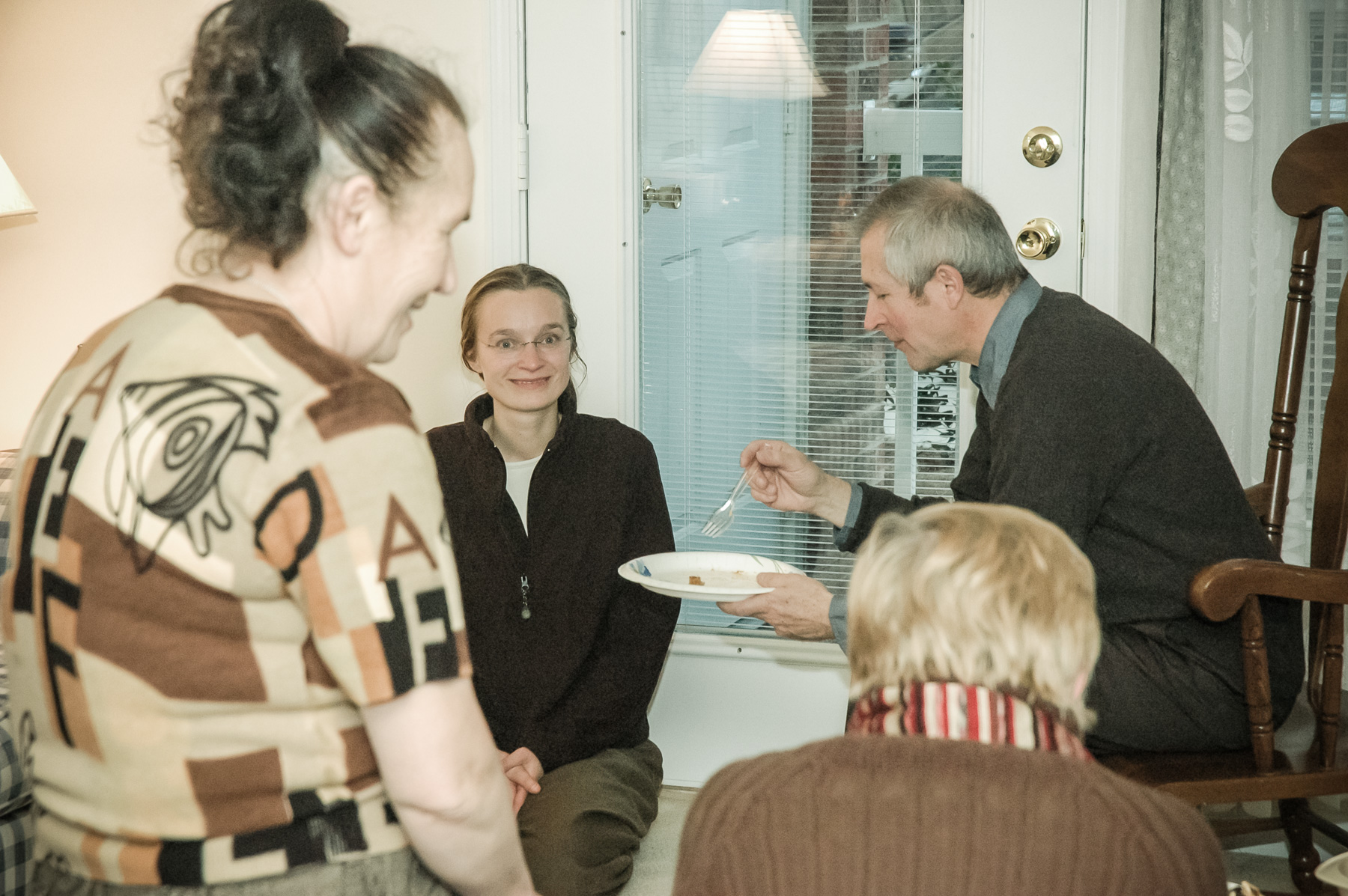
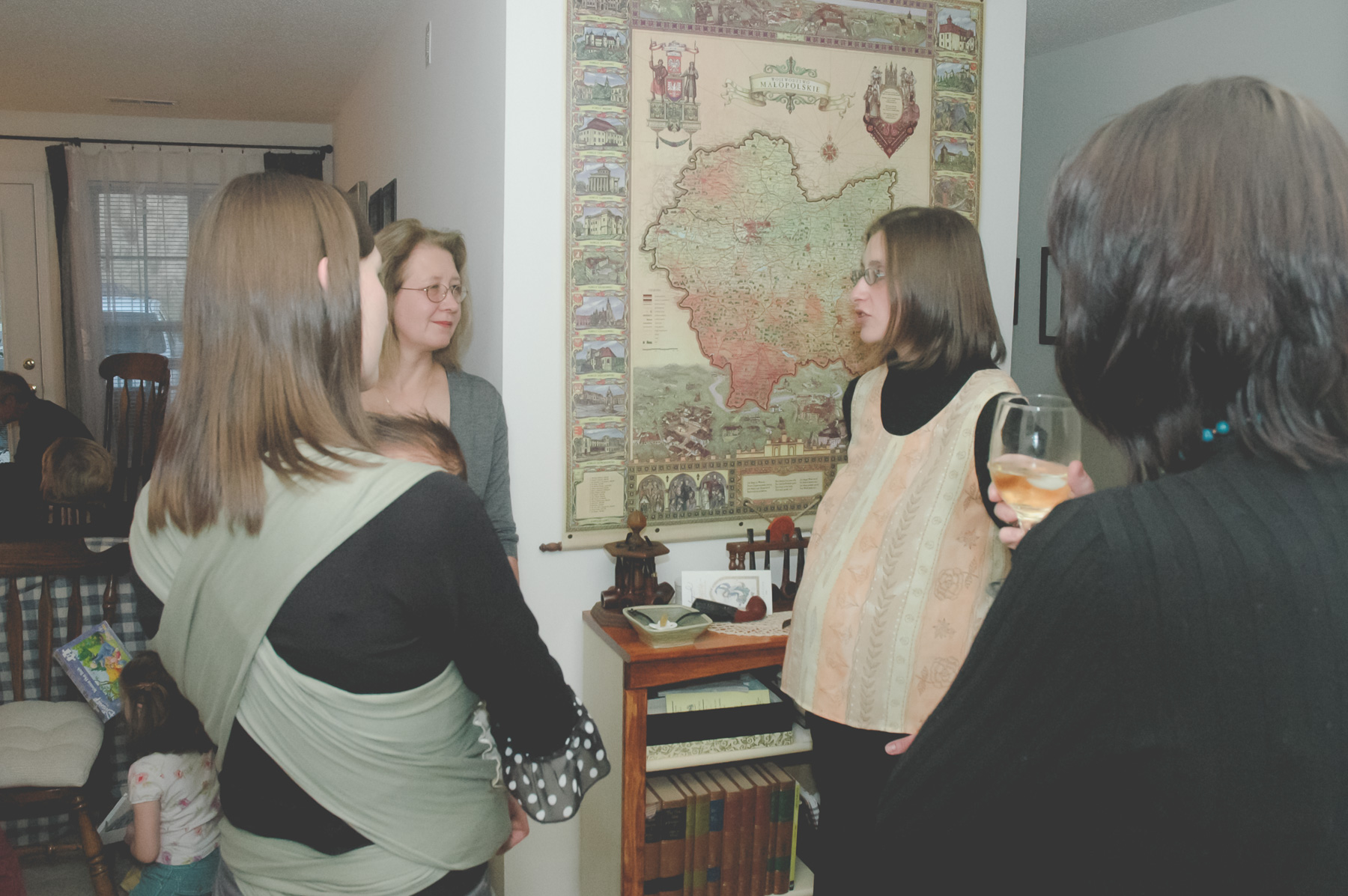
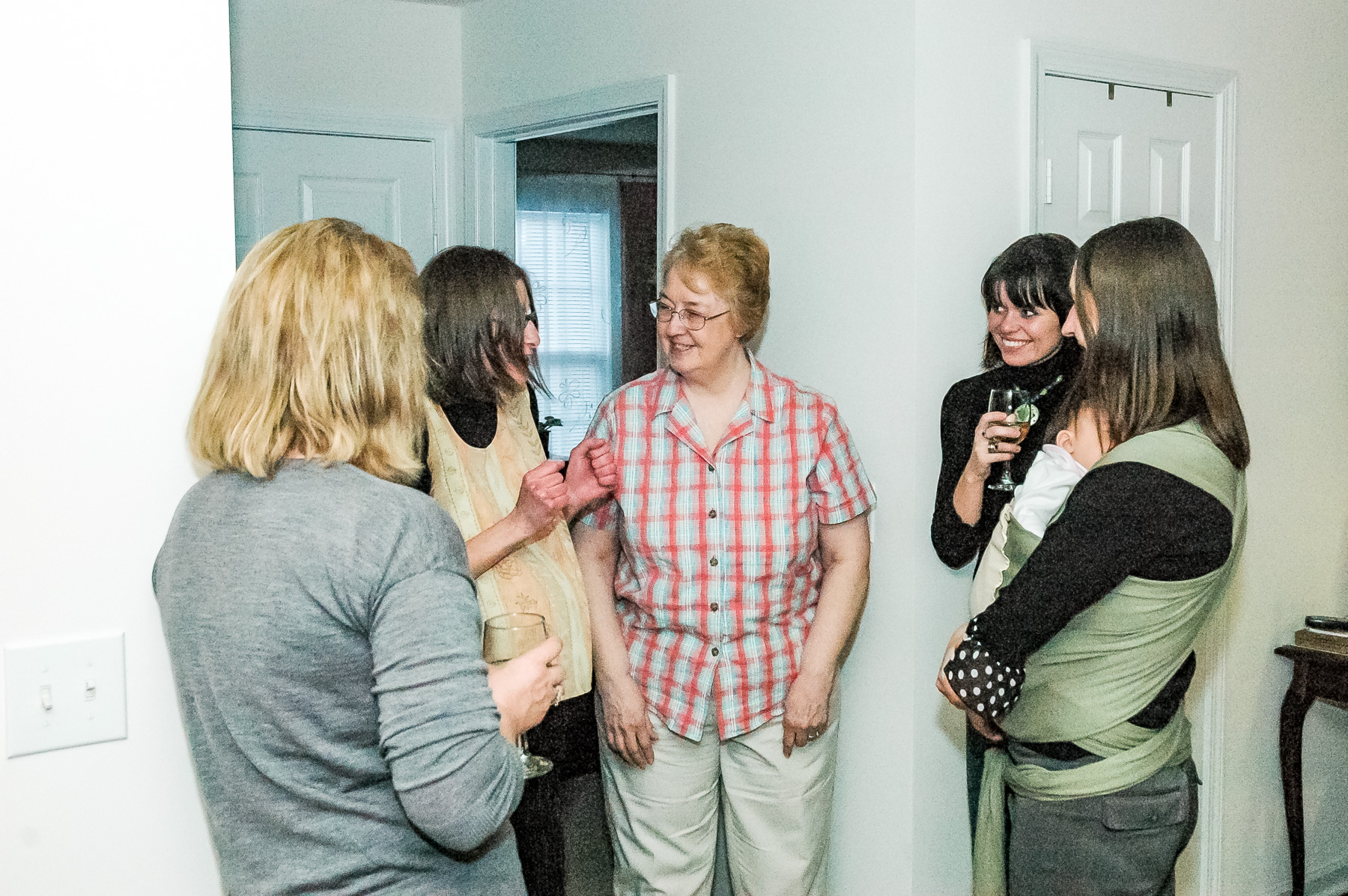

Here, with everyone's busy schedule, it takes a little more planning.
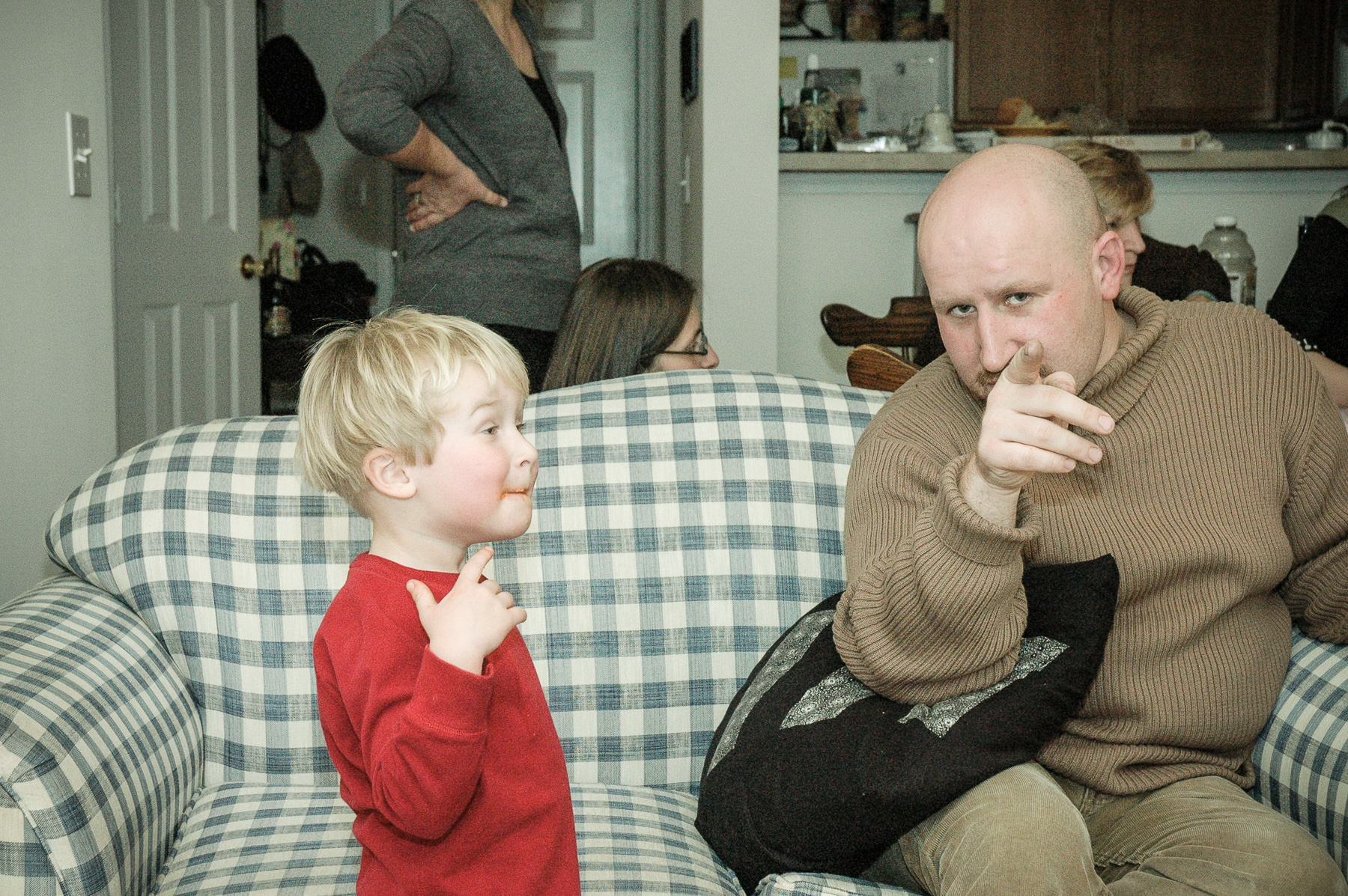
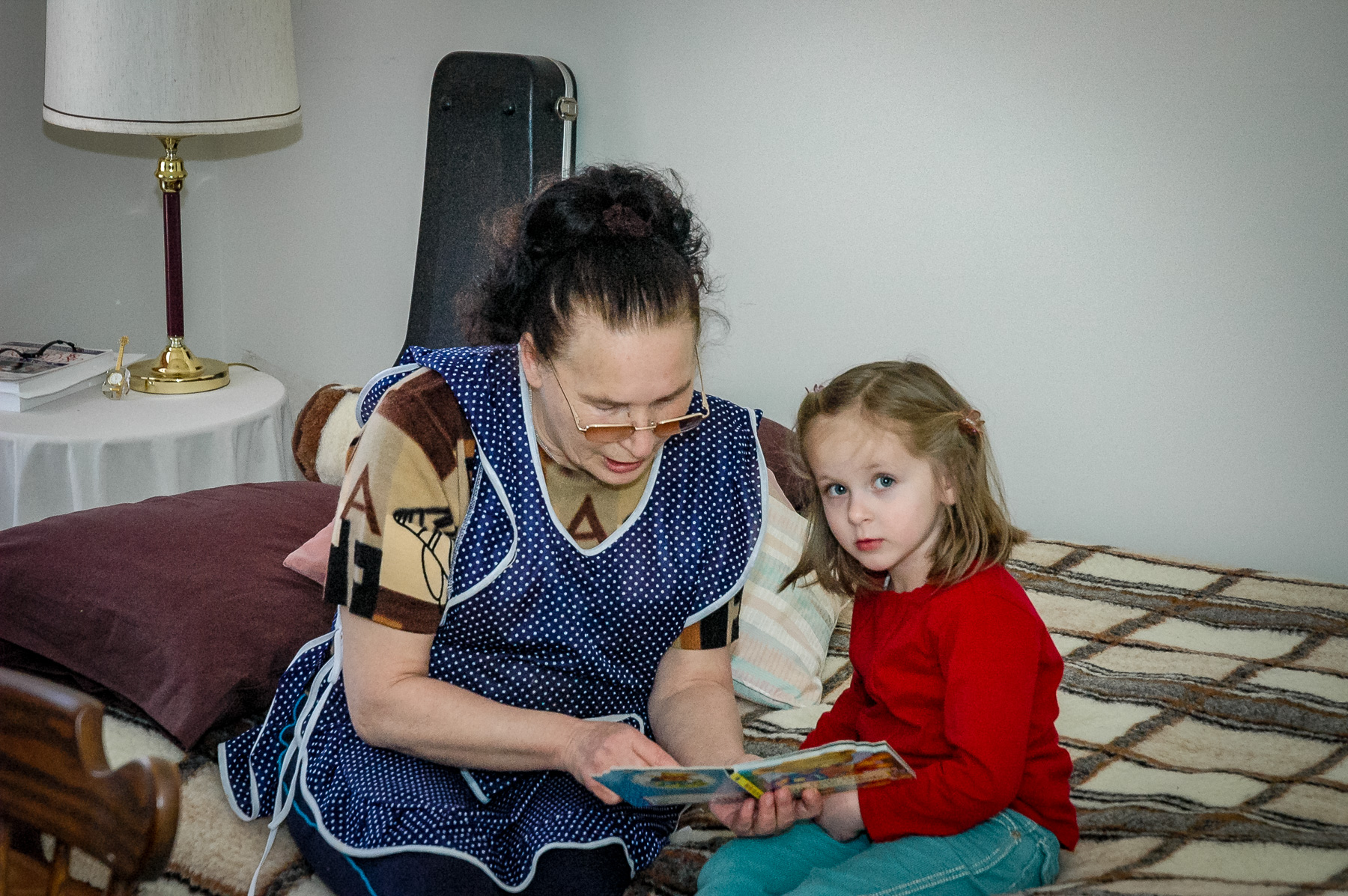
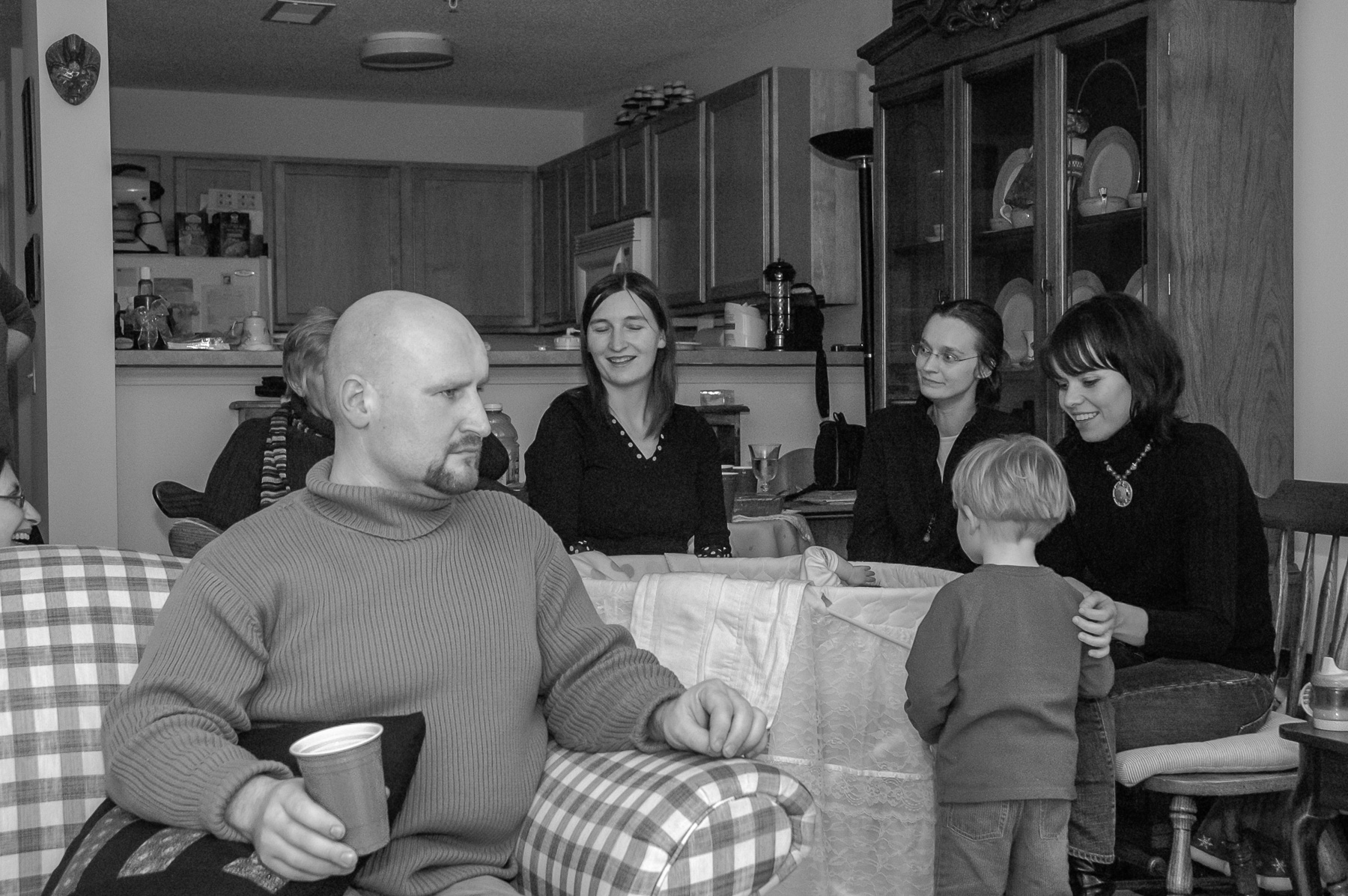
One thing that is certainly different: the amount of drinking. J brought with her a bottle of the loveliest plum vodka. In Polska, my father-in-law and I could polish off a bottle in an evening. Last night, even with twenty people, we didn't finish it off, despite my prodding. Perhaps it's safer that way.

Does it count?
A week into J's visit (J being K's mother) and she finally went out shopping. I took her on our weekly grocery rounds yesterday afternoon, wondering what she'd think of the wonders of American consumer choice, which plays itself out practically in a grocery store that has an entire row of paper towels.
This is not the first time J has been to America. She came for a visit almost ten years ago, but I think she stayed fairly exclusively in the safely Polish sections of Chicago.
When I returned to America after a couple of years in Poland, it was that choice over-kill that shocked me. I'd grown used to little corner stores where I stood on one side of the counter and the food and grocer were on the other, and I had to as for everything by name (which does wonders for language learning). She didn't comment on the paper towels though.
I kept an eye on J, hoping to see what might catch her eye. It was finally in Ingles that she showed some real excitement. We passed an isle display of a particularly southern snack and her eyes light up and she began, "Oh, these are those, those, those," searching for what in the heck you'd call fried pork rinds in Polish.
Thinking she couldn't possibly realize what these things were, I said "the skin of" and she found her word. The best word for something as untranslatable as "pork rinds."ï
"Pig chips!" she cried. "Oh, we loved these. We ate them all the time!"
She had me translate each flavor for her so she could pick the one she wanted: cheddar.
"Of all the things for her to get excited about," I thought, putting a bag of fried pork skin into my shopping cart for the first time in my life.
A post and two comments have suddenly disappeared. How is that possible? The only thing I can think of is that there was some kind of issue at my web host and they had to reload from an earlier tape backup that was made before I wrote the post in question.
The fact that an old version of the post exists in draft form seems to support this notion.
Curious…
Worst is, it broke my posting streak. Well, I shan’t be defeated. I’m simply going to repost it and backdate it.
Still, it gives me yet another reason to switch hosts…
French photographer Henri Cartier-Bresson (Wikipedia) was a purist. He claimed that he didn't even crop any of his photos, let alone indulge in the darkroom magic of dodging and burning. Had airbrushing been available to HCB, I very much doubt he would have done much more than laugh at it.
In this digital age, it's difficult to be such a purist. Yet there must be some limits, some standard.
How much digital manipulation can you do before it's no longer a "true" image?
Wandering around Flickr, I've noticed a preponderance of heavily manipulated images -- Photoshopped to an inch of the digital existence. The results are striking, but somehow false. I get the feeling that I'm looking at an advertisement of some sort.
Examples include:
I'm not discounting the quality of the composition, nor the impact of image, but it just seems to be a little too much.
When I do digital manipulation (and I rarely use Photoshop for that anymore), my goal is simply to make the image look as it did when I took the picture.
We recently bought a notebook computer and that inspired me to do the logical: buy a router and set up a little handy-dandy home network. Because we bought an older, cheaper notebook (essentially for word processing and internet access), it didn't come with built-in wireless capacity, we also had to buy a USB wireless adapter.
First stop: Google's Froogle service. I found a nice deal: less than $60 for both the adapter and router. At that price, probably not the best quality in the world, but I wasn't trying to set up an industrial-strength wireless network here. It turns out, they applied BMG Music's business model: sell things (at least initially, in BMG's case) at less-than-market price, but make up for the losses by charging inflated shipping and handling costs.
In this case, ridiculously inflated costs. Shipping from California, the retailer's cheapest shipping option: FedEx, at $41. UPS Ground cost a mind-blowing $71! Overnight service was $278!!
According to the Washington Post:
Ryan O'Neal says his weekend arrest came after he fired a gun in self-defense to prevent his son from w him with a fireplace . [...]
O'Neal's son Griffin, 42, who has a history of alcohol and problems, was visiting. O'Neal said Griffin grabbed a fireplace , started swinging it and grazed him four or five times. (Source)
He ripped an entire fireplace out of the wall and swung it at his father? That's some strength.
In all seriousness, I've noticed quite a few such mistakes in the Post lately. In all fairness, this is an AP story, but still...