matching tracksuits

fun in threes, sometimes fours

Krakow

7

For many Poles (particularly in the south), Krakow is emotional capital of Poland: the resting place of kings and the location many cultural and academic treasures.

The first time I went to Krakow I was dazzled, as many initial visitors are.
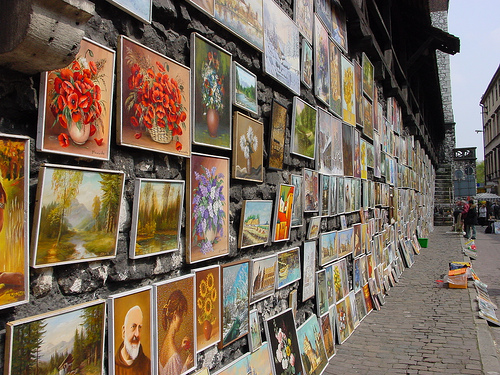
Krakow Art Sale III
The ancient city wall at the end of ulica Florianska.

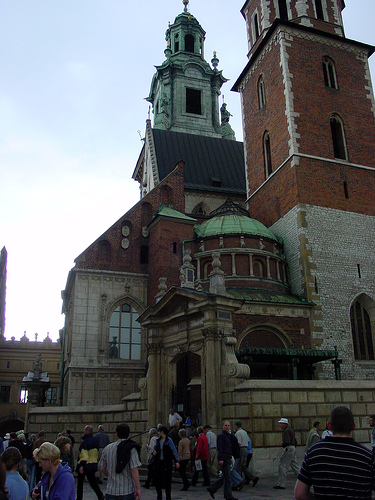
There's a lot to wow: narrow, cobblestone alleys lined with buildings older than our nation; the vast market square, with St. Mary's at the corner; the royal Wawel castle.
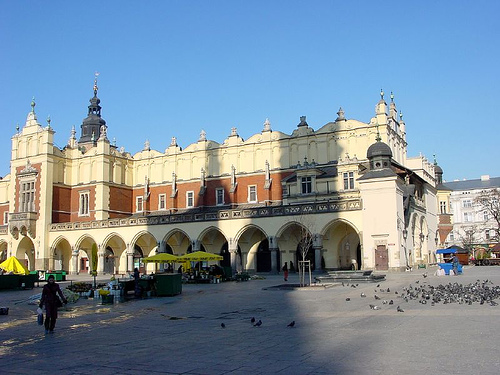
Krakow Rynek, Morning I
The market square, early morning
DSC00006
Wawel Cathedral

I had a mixed relationship with the city. Because of my civil status, I had to go several times to Krakow to arrange this or that document. Those were long, trying days that began with a two-hour, 5:00 a.m. bus ride to Krakow with a sprint to the appropriate office, often to find a line already formed halfway down the building. As a result, I'm somewhat embarrassed to say that I reached a point that instead of thinking, "Tomorrow I get to go to Krakow!" I began thinking, "Oh, God, tomorrow I have to go to Krakow."

How sad that such a lovely city could become a chore.

We will be spending two days in Krakow, at the end of our time in Poland, meeting friends (K studied in Krakow) and some family, and just re-aquainting ourselves with this lovely city.

Our Daughter

Wide-Angle Photos

8

We got a bit of new equipment yesterday: a Sigma 10-20mm wide-angle zoom.

Thinking of what's possible with this lens in, say, Zab, overlooking Zakopane and the Tatra mountains -- almost makes us (well, me) giddy.

Backyard sapplings
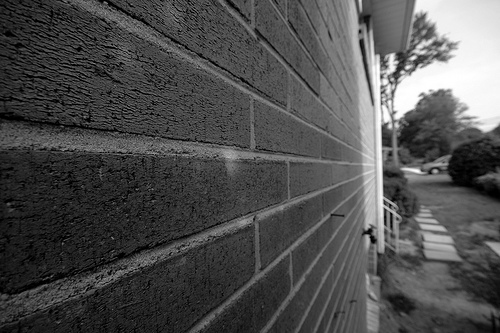
Front wall
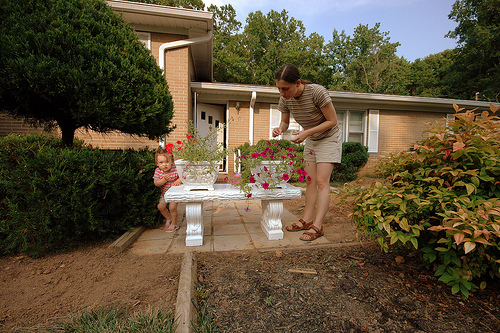
K and the flowers
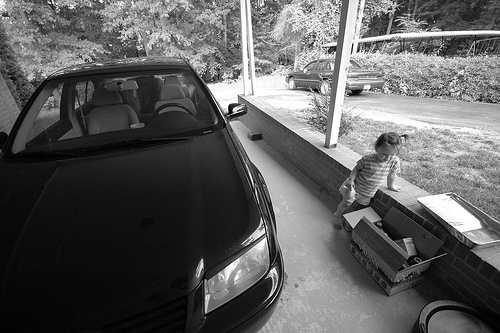
The Girl, our car, and Papa's car

Really -- in Zab it's going to be spectacular. Not to mention ulica Florianska...

Cool Evenings

9

One of the most refreshing aspects of Polish summers are the cool evenings. Long pants and even a jacket are necessary, and it makes bonfires — a favorite Polish summer tradition — all the more enjoyable: it’s not just the atmosphere you’re after, but the warmth as well.

Nine days to go until we have evenings in the 50s.

BoM 9: First Book of Nephi, Chapters 5, 6

hen the boys return, with Laban’s servent Zoram, they find that Sariah, their mother, has been complaining about Lehi’s decision to drop everything and run to the wilderness. But what the description is odd:

For [Sariah] had supposed that we had perished in the wilderness; and she also had complained against my father, telling him that he was a visionary man; saying: “Behold thou hast led us forth from the land of our inheritance, and my sons are no more, and we perish in the wilderness.”

“Visionary” today means far-seeing; it’s hardly derogatory. I’m assuming that it meant something different in Smith’s day.

There is some textual help, though: a cross reference in the on-line version of the Book of Mormon. It refers to Genesis 37.19: “And they said one to another, Behold, this dreamer cometh.”

Slick. Really, a good con — this gives the indication that the Book of Mormon was a translation, and that the term used in 1 Nephi 5.2 is the same Hebrew word in Genesis 37.19. But it doesn’t all add up. To begin with, we have no way to determine what term was used in the original BoM because we don’t have the original text; all we have is a purported translation.

Not only that, but Mormon apologists can’t even agree on the original language used for the plates:

Latter-day Saint scholars have long been divided on the issue of the language in which the Book of Mormon is written. Some have proposed that the Nephite record was simply written in Egyptian, while others have suggested that the Nephite scribes used Egyptian script to write Hebrew text. While either of these is possible, this present study will elicit evidence for the latter.

Non-Latter-day Saint scholars and others have long scoffed at the idea that an Israelite group from Jerusalem should have written in Egyptian and mocked the term “reformed Egyptian” as nonsense. Since Joseph Smith’s time, we have learned a great deal about Egyptian and Israelite records and realize that the Book of Mormon was correct in all respects.

The ancient Egyptians used three types of writing systems. The most well known, the hieroglyphs (Greek for “sacred symbols”), comprised nearly 400 picture characters depicting things found in real life. A cursive script called hieratic (Greek for “sacred”) was also used, principally on papyrus. Around 700 B.C., the Egyptians developed an even more cursive script that we call demotic (Greek for “popular”), which bore little resemblance to the hieroglyphs. Both hieratic and demotic were in use in Lehi’s time and can properly be termed “reformed Egyptian.” From the account in Mormon 9:32, it seems likely that the Nephites further reformed the characters.

While it is clear that the Book of Mormon was written in Egyptian characters, scholars are divided on whether the underlying language was Egyptian or Hebrew. (Source)

There’s a lot in this passage, and not just the admission that there’s no consensus. Most striking is this statement: “Both hieratic and demotic were in use in Lehi’s time and can properly be termed ‘reformed Egyptian.'” I think this is called begging the question. The issue is whether or not there’s something called “reformed Egyptian,” and the authors of the paper simply assume it blithly.

Getting back to Nephi’s first book, the story continues with mother being comforted, everyone offering sacrifices of gratitude, and Lehi finally looking at the critical tablets brought back from Laban. They contain the books of Moses as well as Lehi’s fathers’ geneology, enabling Lehi to trace his lineage back to to the patriarch Jacob.

This should not be surprising, given the fact that Lehi and everyone are Jews.

Lehi gets excited — “filled with the Spirit” — and declares that all nations, all humans, in all times, should see these documents.

Chapter five sets up some heavy expectations: after all, Lehi himself said “Let everyone know.” But chapter six is a disappointment. It reads, in its entirety:

And now I, Nephi, do not give the genealogy of my fathers in this part of my record; neither at any time shall I give it after upon these plates which I am cwriting; for it is given in the record which has been kept by my father; wherefore, I do not write it in this work. For it sufficeth me to say that we are descendants of Joseph.And it mattereth not to me that I am particular to give a full account of all the things of my father, for they cannot be written upon these plates, for I desire the room that I may write of the things of God. For the fulness of mine intent is that I may apersuade men to bcome unto the God of Abraham, and the God of Isaac, and the God of Jacob, and be saved. Wherefore, the things which are pleasing unto the world I do not write, but the things which are pleasing unto God and unto those who are not of the world. Wherefore, I shall give commandment unto my seed, that they shall not occupy these plates with things which are not of worth unto the children of men.

It’s growing increasingly difficult to take this book seriously.

Photo by Internet Archive Book Images

Pattern Recognition

10

Obviously one of the things K and I both are looking forward to is introducing everyone to L.

We left three years ago as a pair; we return as a family.

Walks to the River

11

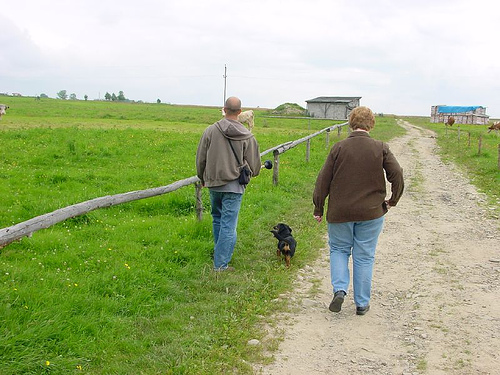
There's a river just about a mile away from K's parents' home. A dirt road leads though the fields to the river.

Summer, winter, spring, and fall -- a good walk.

Jablonka
Walking to the river in August 2004

When Nana and Papa came for our 2004 wedding -- obviously not "Nana" and "Papa" at that time -- we headed to the river.

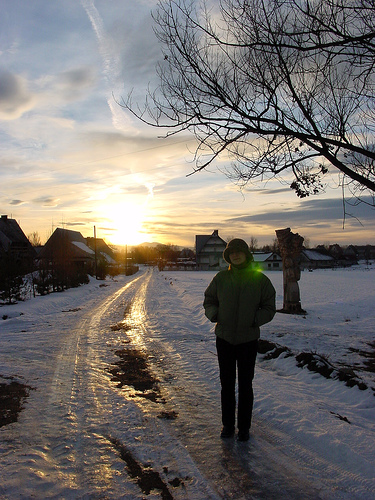
Winter Sunset II
Returning during winter

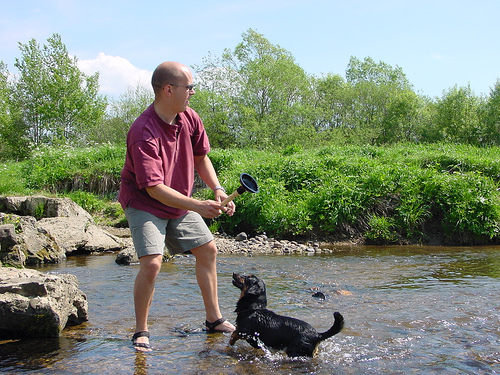
Once with Kajtek at the river, we decided to see if he'd charge into the water for his beloved "Daj". He did.

DSC00018
At the river with Kajteck (4 June 2005)

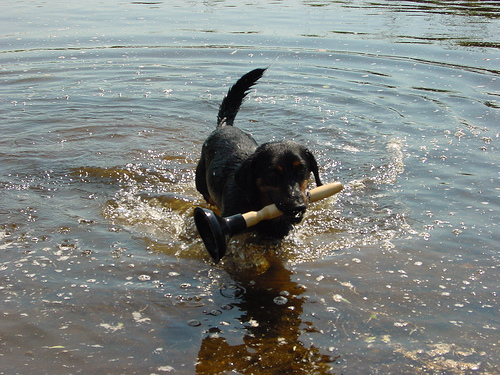
And brought it back with joy.

DSC00015
"Daj, Kajtus!"

We'll take our first walk to the river in eleven days.

50mm f/1.8

I took an old Nikkor 50mm f/1.8 manual focus lens and put it on our digital camera. That’s one reason to go with Nikon: they’ve never changed their lens mount.

DSC_6024

Oscypek

12

What would a list of things we're looking forward to in Polska be without oscypek -- that smoky, dry, chewy sheep milk cheese that brought the European Union to its knees?

Photo by edwinek

Sheep milk cheese? It does at first sound a little questionable, and the idea of milking sheep seems a little daft. But urban ignorance aside (after all, the "King of Cheese," Roquefort, is made from sheep milk), it's a wonderful tradition, which was the catalyst for much heated debate when Poland entered the EU.

Wikipedia gives the following regarding this Polish wonder, shedding a little light on why the EU had concerns:

Oscypek is made using exclusively salted sheep's milk. Addition of cow's milk is strictly regulated by protected trade name recipe. Unpasteurized salted sheep's milk is first turned into cottage cheese. This is then repeatedly rinsed with boiling water and squeezed. After this, the mass is pressed into wooden, spindle-shaped forms in decorative shapes. The forms are then placed in a brine-filled barrel for a night or two, after which they are placed close to the roof in a special wooden hut and cured in hot smoke for up to 14 days.

The whole process traditionally takes place in a bacowka -- a wooden hut where shepherds sleep and make their cheese. It is, in a word, dirty. So said the EU.

Additionally, it's sold at open air booths (see example at Flickr), unwrapped. A vacuum-packed, sterlized version is available, but it's relatively tasteless.

In twelve days, we'll be on our way to piles of oscypek.

In the Park

Polish Busses

13

"What are you looking forward to?" I asked K.

"Riding in a bus," she said with a smile.

While we lived in Polska, we often dreaded a bus ride. Bumpy, crowded, cold or hot depending on the season, a bus ride could be torture. And it could be real torture.

One winter evening, coming back from Krakow on the now-obsolete 6:35 public bus to Lipnica Wielka, I was sure my toes had completely frozen; I was fully expecting to have frost bite. I pulled my boots off and sat Indian style -- or "criss-cross apple sauce" as it's called now -- in the hopes of warming my feet under my folded knees.

One summer afternoon, on a bus to Kielce, I was sure I would melt. No one directly in front of me saw fit to open a window, and I was suffocating in body odor and heat.

But when you haven't had one in three years, nostalgia sets in.

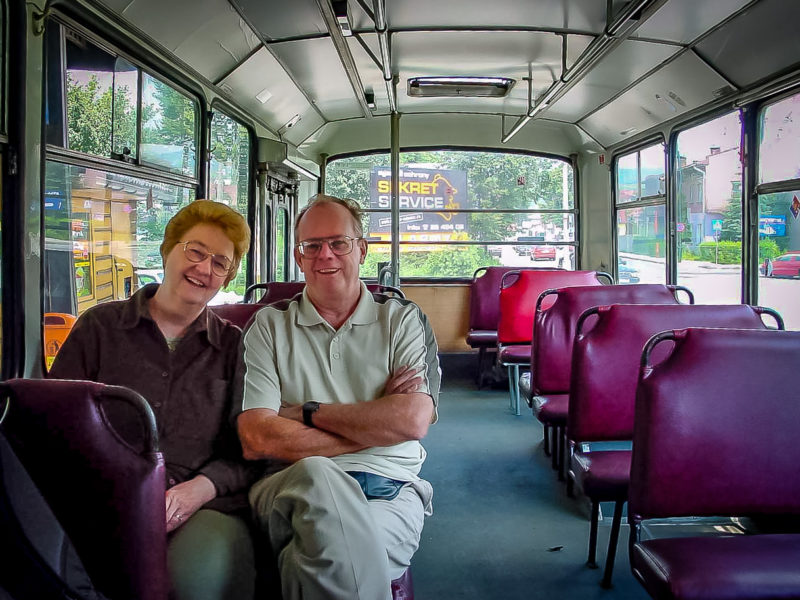
Papa and Nana on a Polish bus in August 2004

Bus ticket prices are a sure indicator of inflation. When I first moved to Lipnica, the ticket to Nowy Targ, about 35 km away, cost less than four zloty. Three twenty, I believe. When we left in 2005, a ticket cost an even five zloty. Three years later I'm sure it's up to six.

We'll find out in thirteen days.

Weekend in the Mountains

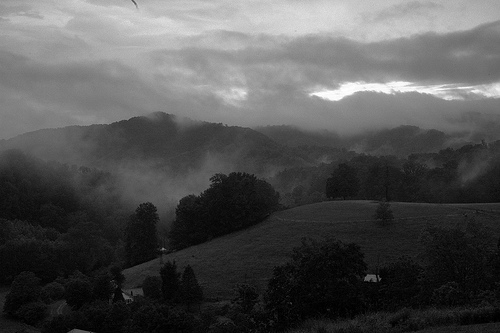
Saturday evening, as the sun was setting and the fog was settling in, this is what K and I saw:

DSC_5764-1
Sunset in Madison County

Getting to that moment was just as enjoyable as the moment itself, though.

We set off Saturday morning -- after my Praxis test -- on a trip to the mountains: Asheville. Hippy-ville, land of the sky, where the patchouli flows like water.

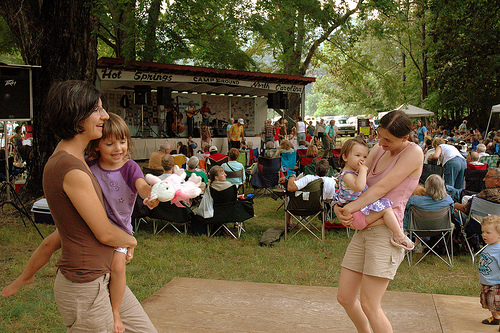
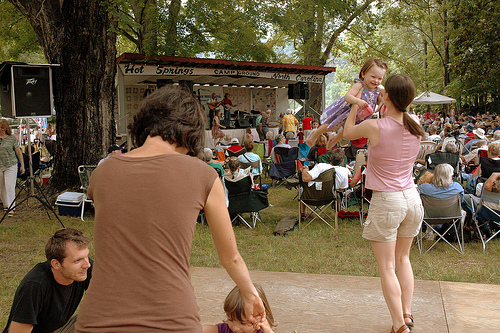
Our first stop was actually a good bit north of Asheville, in Hot Springs, at the annual Bluff Mountain Festival. Bluegrass, old-time music, clogging -- a fine festival.

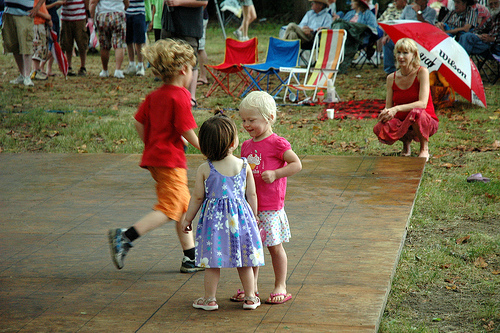
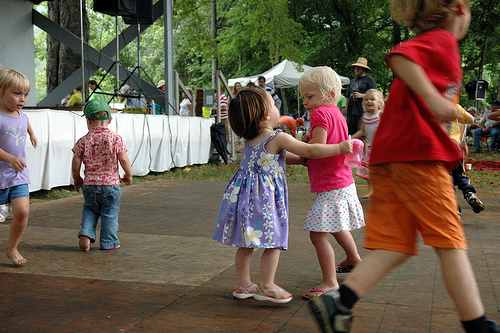
K and L danced and twirled

Dancing at the Festival I
Dancing at the Bluff Mountain Festival
Dancing at the Festival II
Dancing at the Bluff Mountain Festival

L made a new friend,

New Friend I
New friend

only to discover that the new friend was not wild about hugs.

New Friend II
New friend, who doesn't like hugs

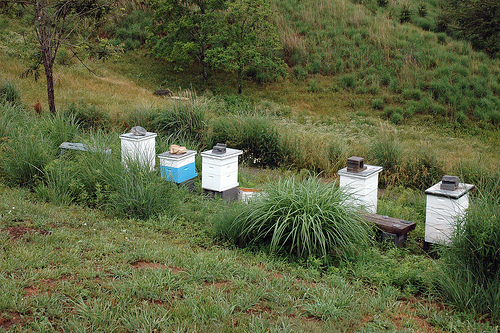
After the rain finally chased us away, we went to stay with friends in Madison county -- friends who live on the top of a mountain and keep bees:

Hives I
Hives

We spent the evening as all evenings should be spent: on the deck, surrounded by nature and friends, without a mosquito to be found.

I took the time to talk with someone knowledgeable about bees about what's going on with the bee population in the States. It's fairly frightening. One word: monoculture:

Many worry that what's shaping up to be a honeybee catastrophe will disrupt the food supply. While staple crops like wheat and corn are pollinated by wind, some 90 cultivated flowering crops - from almonds and apples to cranberries and watermelons - rely heavily on honeybees trucked in for pollinization. [...]

For many entomologists, the bee crisis is a wake-up call. By relying on a single species for pollination, US agriculture has put itself in a precarious position, they say. A resilient agricultural system requires diverse pollinators. This speaks to a larger conservation issue. Some evidence indicates a decline in the estimated 4,500 potential alternate pollinators - native species of butterflies, wasps. and other bees. The blame for that sits squarely on human activity - habitat loss, pesticide use, and imported disease - but much of this could be offset by different land-use practices.

Moving away from monoculture, say scientists, and having something always flowering within bee-distance, would help natural pollinators. This would make crops less dependent on trucked-in bees, which have proved to be vulnerable to die-offs. (Christian Science Monitor)

Once the ladies came out to the porch, though, we changed to less depressing topics, but not for long: "Who knows when the Girl will wake us" we said, trotting off to bed around eleven.

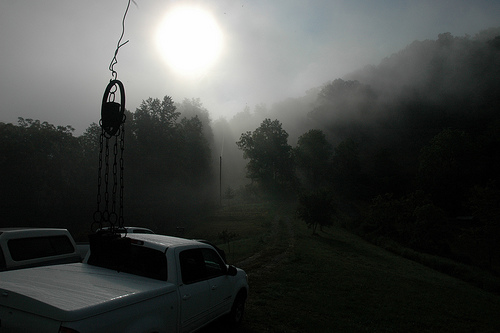
L woke us up at her usual hour, which meant we got to see a mountain sunrise:

DSC_5818
Sunrise in Madison County

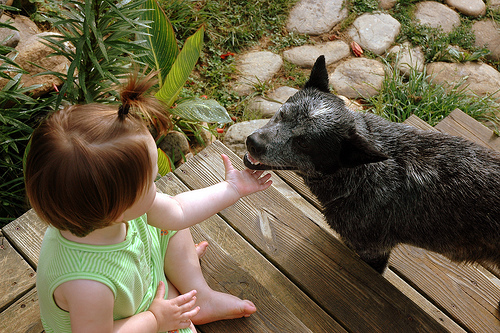
L played with the dogs for a while. Our friends have four dogs, but only three of them were interested in L.

DSC_5873

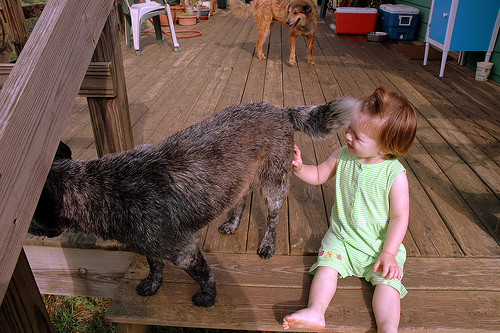
She got a face-full of tail a couple of times but took it like a trooper and insisted on staying with the dogs.

It was wonderful seeing how the dogs sensed L's fragility and were so gentle with her. They didn't attempt to jump on her and would gently approach to lick her in the face -- which she loved and showed the baby sign for "more" again and again.

DSC_5874

After breakfast, we drove back down to Asheville, to visit other friends, who also have a dog.

DSC_5921

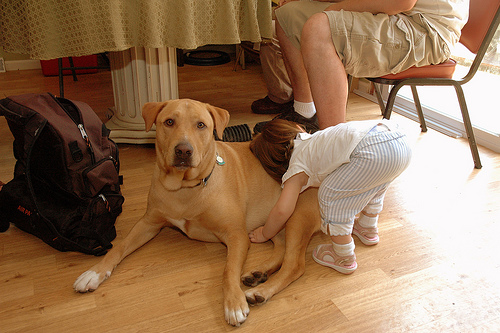
We were pleasantly surprised at how patient all the dogs were with L. She's so obsessed with hugging animals that she's got an arm-full of scratch marks from where she shares the love with our cat a little too forcefully.

Finally, we met still more friends at the NC Arboretum for walk.

DSC_5966
NC Arboretum
14

It was a busy weekend, undoubtedly a foretaste of what's our trip to Polska is going to be like -- a trip that is rapidly approaching.

Too rapidly, in some respects.

We leave in two weeks.

(More pictures available at Flickr.)

Daj!

15

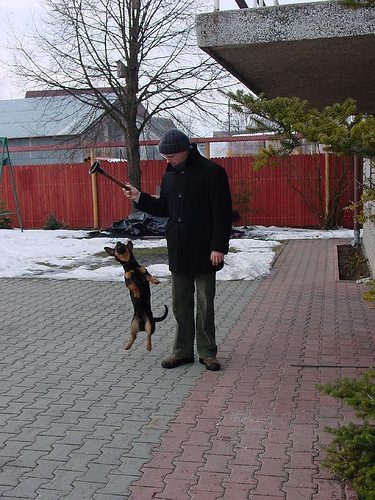
We'll wander down to the river that runs through the edge of Jablonka, toilet plunger in hand, ready for the first game of fetch with Kajtek, the family dog.

Kajtek has always loved toilet plungers. He has his own, in fact, to keep him from stealing them from the bathroom.

"Daj" is the imperative of "give" in Polish, and is pronounced like the English word "die."

Give a plunger a toss and off he goes: through snow, tall grass, mud -- it doesn't matter.

It came to be know as "daj" because, well, we all said "Kajtek, daj!" and he knew what we meant: off he'd go, searching for his toilet plunger, inevitably bringing it back with more excitement than would seem possible.

Favorite Toy II
Kajtek and his toy, March 14, 2004

Shortly, we'll be introducing L to the joys of the daj.

Fields and Cows

16

Greenville doesn't have enough fields. And it certainly doesn't have enough cows.

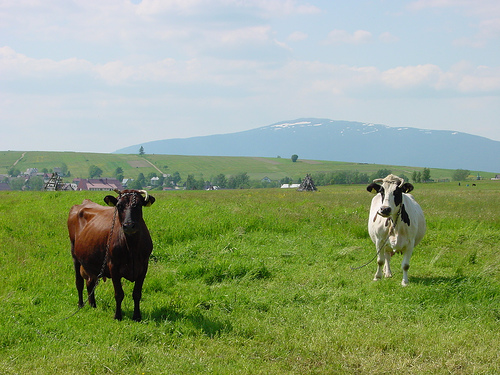
Soon, we'll be wandering among the fields and cows of Jablonka -- "Little Apple Tree."

Cows of Jablonka, with Babia Gora in the background

Bread

17

Americans don’t eat bread. By that I mean it’s not a staple. We don’t buy bread daily.

We don’t eat bread daily. And what we eat really doesn’t deserve to be called bread. Most stores sell gummy, soft, baked masses called bread, but it is to real bread what Nescafe is to real coffee.

Real bread is dense and dark. It goes bad in a few days and can be bought still warm if one gets to the corner store quickly enough.

In seventeen days, we will eat bread.