matching tracksuits

fun in threes, sometimes fours

Party Preparation

Later today, L will celebrate her second birthday party. Her birthday is not until Tuesday, but one doesn't have parties on Tuesdays. We've been practicing: thank you, happy birthday to you (which comes out "happy to you"), dziekuje, sto lat, blowing out candles, and so on.

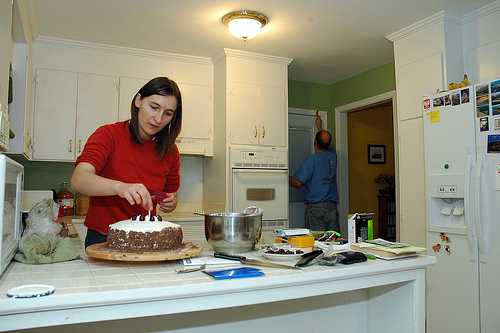
Last night, K baked a cake, as I did some touch-up work on our new door.
DSC_2572

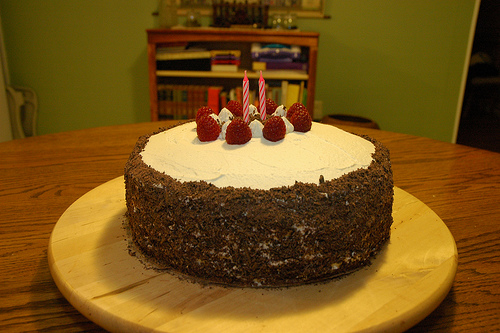
The cake, when finished, was quite a masterpiece:
DSC_2573

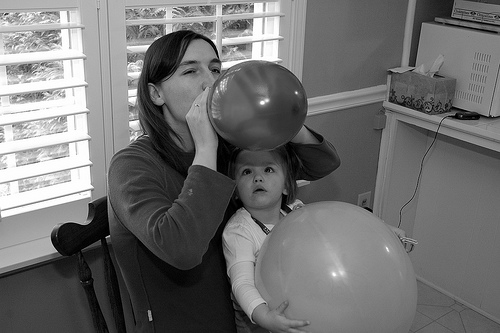
Today, we tried blowing up some balloons, but L was a bit wary:
DSC_2587

Right now, she's asleep. "When you wake up," I told her, "It'll be time for 'Happy to you!'"

I'm surprised she even managed to go to sleep.
Religious License

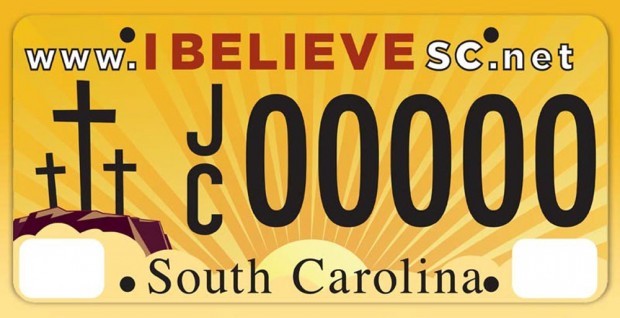
Here in South Carolina, the Department of Transportation began issuing religious-themed license plates. They have stained glass, a cross, and the words “I believe.”

I Believe' license plate back in S.C., 2 years after ruling | Religion | missoulian.com

One guess as to what happened:

A federal judge says South Carolina must stop marketing and making license plates that feature the image of a cross and the words “I Believe.”

A federal judge issued a temporary injunction during a court hearing Thursday after opponents said the plates violate the separation of church and state.

U.S. District Judge Cameron McGowan Currie said the case needs to be heard in court. In the meantime, the judge said the Department of Motor Vehicles cannot take any more orders for the plates.

Department spokeswoman Beth Parks said the agency stopped taking orders more than a month ago, after it collected the 400 needed to cover the cost of making the plates. She said they are in production, and none has shipped. (AP)

I’m sure there are many in the state who are appalled by this. Just another example of those damn goddless bastards trying to destroy religion in America. That’s what the Andre Bauer, the Lt. Governor, says:

For those who say this violates the Constitution by giving preference to Christianity, I think this lawsuit clearly discriminates against persons of faith,” Bauer said in a statement. “I expect the state attorney general to vigorously defend this, and it is time that people stand up for their beliefs. Enough is enough.” (Harold Online, cached at Google)

plate2Yet how could anyone argue that it doesn’t give preference Christianity? There are no other freaking choices! I’d have gone for a FSM plate myself, but I don’t think my wife would have appreciated it.


Nate, at Shots from the Battery, really hits on the important issue, though:

I really wish we could sue the fundegelical state lawmakers who are forcing us taxpayers to bear the burden of the litigation they knew they were inviting. It’s a waste of $$ that the state taxpayers cannot afford. (SFTB)

Every morning going to work, it seems like I hear about the state making more and more budget cuts because of the falling tax revenue. South Carolina is predicted to have a stunning 14% unemployment rate by the spring, and these nitwits are out trying to make a mindless religious point.

Bilingual Breakthrough

We’re getting ready to go to the zoo — just L and I, a newly forming bi-Sunday tradition. L is excited: she’s chattering on and on in her own way: 10% Polish, 20% English, 70% L-ese. (One of the problems with raising a bilingual baby is that you never know whether she’s trying a new Polish word, a new English word, or just making up something in her own language.)

In the midst of the babbling, L suddenly says, “Mamma, afant.”

“Afant? I don’t know what that is,” K responds, as always, in Polish.

“Afant!” declares L.

“Honey, I don’t know…” K begins, then L switches languages.

“Slonik!” translates L.

“Oh! ‘Elephant!'”

Marriage and Divorce

One of the blogs tumbling into my Blog Lines account on daily basis is the New York Times' "Freakonomics." Justin Wolfers posted "Assessing Your Divorce Risk" and provided a link to Divorce 360. I was immediately intrigued, for how can one quantify something as personal and diverse as divorce?

This site provides people with information and support for all stages of divorce. I'm not thinking about a divorce -- or even close to it -- but I was fascinated with the idea of the "Marriage Calculator" widget. When I filled out the necessary fields, I learned the following:

People with similar backgrounds who are already divorced: 4%
People with similar backgrounds who will be divorced over the next five years: 7%

It sounds like the wife and I have little to no chance for divorce, according to this widget. However, it includes the caveat/explanation that "In general for the five-year divorce prediction rates, those with less than 3 percent are at lower risk, 3 - 7 percent are of average risk and more than 7 percent are at higher risk."

So we're at average risk for a divorce.

What would go into calculating this rate? As the page loaded and I clicked across to another tab, I gave it a little thought. Surely age at marriage will count. Length of time we've been married would also be important, I reasoned. But beyond that, I couldn't think of anything that might really give any sort of indication regarding divorce.

Fiscal strains present in the marriage? Nah -- thousands of marriages survived the Depression and few people in the States are suffering at a level anywhere near that.

What about how long we'd known each other before getting married? A spur-of-the-moment (relatively or literally speaking) decision might be at a higher risk than those who'd taken their time in getting to know each other. At the same time, how would you quantify that for such a survey?

What they ask for, though, is simple: gender, education level, age when married, years married, and period of time when the respondent got married.

Wolfers points out how many just assume "the risk is zero," and I'll admit, I still feel that way, even after having taken the survey.

It makes me wonder about the legitimacy of the survey, though. Certainly there are indicators for a higher risk for divorce, but how can anyone determine an "average" risk?

Truth is, I can't imagine a scenario that might put so many strains our my marriage that we might talk about divorcing: the death of a child can lead to divorce, I believe. Yet there have to be other factors, for not everyone who suffers the loss of a child divorces.

If two people are determined to stay together, to make a relationship work even in the face of a tragedy that tears some couples apart, then statistical analysis is useless. The risk for them is zero, because they've both said as much. If two people are determined to make a marriage work, and the success and happiness of their marriage is a major goal in their life and not just something that's bumping along for the ride, with the mortgage and insurance payments, then it seems to me that all other numbers are useless.

Those other factors that lead me to believe that this is basically worthless. All it says is that you fit into this or that demographic stastic; that's not the same as risk.

Stories from L

Part of learning to talk is learning to tell stories, to string together a group of sentences in a coherent, meaningful way. Yet we’re learning that there are many different levels of coherence and meaningfulness.

Take, for example, this story L told me yesterday: “i whee i boom i cry!” (She’s saying Polish “i” — and, pronounced “ee” — and not the English first person singular personal pronoun.) Facial expressions and hand gestures accompanied this lovely story, which I would translate thus: “I was sliding down the slide! I was having a great time when I fell down. It hurt, and I cried.”

When K came home a few days ago, L told her the following story: “i Bida i no no i time out!” Translation: “I was playing and decided to pick up Bida[, our cat,] which is a no-no. Dad sent me to time out.”

Stories with three episodes. We are in the midst of what Stephen Pinker joking referred to as the “All-hell-breaks-loose” stage of language learning.

Calling All Pakistanis – NYT

From the New York Times:

On Feb. 6, 2006, three Pakistanis died in Peshawar and Lahore during violent street protests against Danish cartoons that had satirized the Prophet Muhammad. More such mass protests followed weeks later. When Pakistanis and other Muslims are willing to take to the streets, even suffer death, to protest an insulting cartoon published in Denmark, is it fair to ask: Who in the Muslim world, who in Pakistan, is ready to take to the streets to protest the mass murders of real people, not cartoon characters, right next door in Mumbai?

NYT

GuidoWorld » The Last Christmas?

Just how bad is the current situation? How long will it last? Guido offers some stark analysis:

All previous down markets have lasted three eighths as long as the preceding up phase. This would mean the stock market will be going down till 2016 – 2017. Since stock markets usually rebound before the economy, one can assume the economy will remain weak and contract at least through 2016.

This all leads me to the title of this post. Is this the last Christmas of post WWII over consumption? Or is this a lost Christmas, and last year was the final hurrah? (GuidoWorld » The Last Christmas?)

L Near Ice

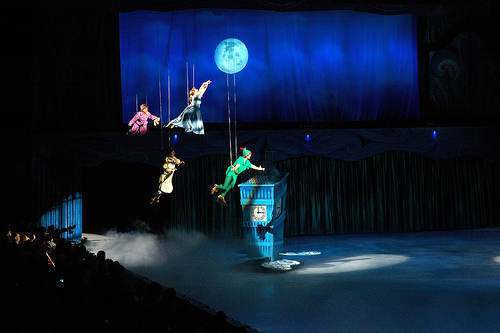
In the first of many such adventures, we took L to see the latest incarnation of Disney on Ice this weekend.

DSC_2308

She sat calmly before the show began. She sat calmly during the show. The only time she showed much emotion -- other than clapping -- was when someone skated behind the curtain, disappear forever, she was sure.

DSC_2326
Does she close her eyes when being thrown around like this?

It was a fairly good production, with a little something for everyone. They stayed with the later Disney films: Lion King, Little Mermaid, and Lilo and Stitch. During the second half they went a little deeper into the Disney catalog, with a fairly long Peter Pan scene.

DSC_2366

DSC_2367

Unfortunately, they didn't do any of L's favorites. Without a doubt, her absolute favorite -- thanks to Nana and Papa's extensive collection -- is Dumbo, but no proboscidean adventures were included.

Awake

Writers often keep a pen and pad on their nightstand in case inspiration strikes in the haze of near sleep. Poet Luci Shaw, visiting my college years ago, explained that she can never remember it the next morning, and to prevent that thought from being lost, she keeps writing materials by her bed. Some even keep illuminated pens and tablets, thereby saving their sleep by not having to turn on the light.

Inspiration can even jolt some writers out of a deep sleep, I've heard.

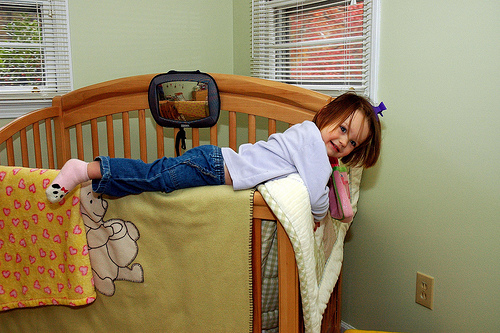
Twice in last few weeks, I've been jolted out of a deep sleep, but not by anything so pleasant as inspiration. I sit upright in bed suddenly, and there's not a sound in the house, but within moments, I hear L crying. I rush to her bedroom and find her out of her crib, on the floor, stunned to be there, still half asleep herself. What woke me, K, and even L was the thump of her falling to the floor.

Crib
The heights

"It's time we buy the foot board to turn the crib into a day bed," we both say the morning after.

That night, though, it's all about calming a confused, half-asleep girl, there is only one question: how in the world did she fall out of bed?

The next morning, she shows us. Pointing to the top of the crib, she explains, "I boom!" (She pronounces "I" as the Polish i, which means "and" and is pronounced like our letter "e". So in fact, she was not saying "I boom" but "and boom.")

DSC_2299
Re-enactment

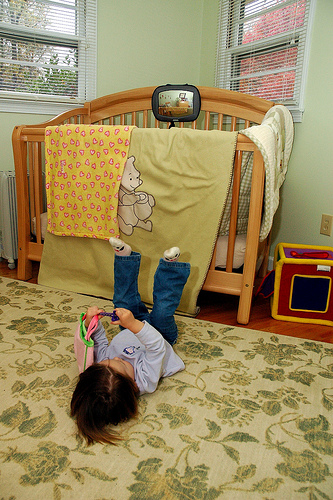
Afterward, she points to the floor, adding another "i boom" for good measure. She willingly shows us as well.

DSC_2303
"i boom!"

Thanksgiving Games

In the old days, my family and I went to visit Aunt L and Uncle N for Thanksgiving. It was always a traditional feast, with copious amounts of gibblet gravey poured over sliced turkey, with desserts and snacks through the rest of the afternoon and evening.

The guys might fall asleep in front of a football game sometime in the middle of the afternoon, but by five or six, everyone was sitting at the table, playing games. Dominoes, Uno, board games -- you name it. It was a time of family enjoying each other's company.

This Thanksgiving, we visited long-lost family. The difference was striking. The men set up a television in one room and watched football for the two or so hours they were there while the women watched a dog show.

When dinner was served, everyone loaded up their plates and sequestered themselves anew. After a couple of hours, the guests loaded up and took off, heading to the mountains for a vacation.

Untangling credit default swaps

In Line

I fancy I can tell a lot about someone from their shopping cart's contents. Lots of frozen foods or processed packaged foods means little time for and/or interest in cooking. Lots of power tools means new homeowner or generous present. A collection of books on the MLA format means a son or daughter working on a research paper.

Generalizations, certainly, but they're probably accurate at least occasionally. I look in our cart and I can tell quite a bit. Of course, I have the Cliff Notes to my own life, so there's not much guess work there.

More revealing, though, can be the conversations in the line. One of the reasons I prefer to Polish in public is the privacy it provides. I certainly wouldn't want those around me to hear an exchange between L and me like the one I overheard yesterday.

A mother and her two children were piling up frozen foods at the checkout when the oldest daughter -- probably around fourteen or fifteen -- pulled a copy of Twilight from under a bag of frozen fries and asked, "Do I have to put it back?"

Mother's response was stunning: "You won't read it! I've never seen you sit and read anything."

The girl turned the book over in her hands a couple of times, and with a sigh, trudged off to replace the book on the shelf.

The temptations: "Has she ever seen you sit and read anything?" "Wonderful job of encouraging your daughter to read." The greatest, though, was the most dangerous: as the girl passes me, "Here -- I'll buy it for you."

Instead, I whispered to L, in Polish for added security, "I'll buy you all the books you want."

Shopping cart photo by Dan4th.

Woman Fired For Eating ‘Unclean’ Meat

Has anyone heard about this? It happened back in 2004.

A Central Florida woman was fired from her job after eating "unclean" meat and violating a reported company policy that pork and pork products are not permissible on company premises, according to Local 6 News.

Lina Morales was hired as an administrative assistant at Rising Star -- a Central Florida telecommunications company with strong Muslim ties, Local 6 News reported.

Woman Fired For Eating 'Unclean' Meat - Money News Story - WKMG Orlando.

The Mountain

This is something I wrote as a quick example for students. The topic was:

Comment on one of the following quotes and how it applies to your life:

  • "A pessimist sees the difficulty in every opportunity; an optimist sees the opportunity in every difficulty." - Winston Churchill
  • "Success is a journey, not a destination." - Ben Sweetland
  • "Success is knowing what your values are and living in a way consistent with your values." - Danny Cox

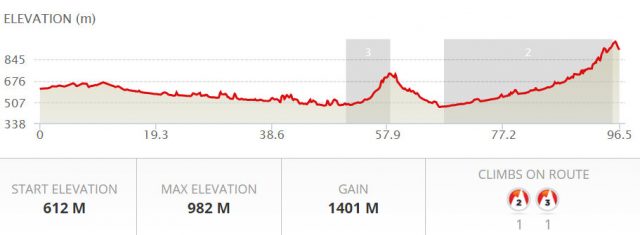
It seemed we would never reach the top. The winding mountain road in central Slovakia would pose no problem to a motorized vehicle, but after seventy miles on a bike, I was wondering whether we could make it. My wife -- then only my girlfriend -- probably felt the same way. The journey, even if we made it to the top, couldn't be considered a success; it was a question of brute survival.

We'd started off in the morning in Poland. The plan was to ride through Slovakia, into Hungary, and spend several days in Budapest. We were a little behind schedule due to rain and an unexpected break as we waited out the cloud burst. For most of the day, though, the road had been easy going: fairly flat, some downhill portions, a climb or two. Nothing serious.

That was before we hit the mountain. It sneaked up on us, really: we felt a gradually increasing incline, and like two frogs in boiling water, we were in danger before we realized danger was approaching.

On two packed bikes, we were struggling fairly quickly after the realization that we were riding up a mountain, not a hill. Each pedal stroke became a battle, and the veins in our temples bulged and quivered as they tried to carry our blood at the furious pace our heart was beating. Our lungs began to burn, then simply went numb as the heavy, post-rain, damp air practically strangled us. Our legs followed suit: first a tingle, then a burn, followed by flames and complete numbness.

With every switch-back, we were sure it had to be the last; time and time again, we were almost knocked off our bikes by the sight of another uphill stretch concluding with another switch-back. "Maybe that one is the last one," I said to my girlfriend. When it wasn't, I'd repeat the speculation on the next one, often following it with a skeptical laugh.

What we both knew we couldn't do was stop. It wasn't some kind of macho, push through the pain nonsense. No -- the simple truth of the matter is that stopping only makes it worse. Muscles cool down and the pedaling becomes more painful after the break. There's only one thing to do: be macho and push through the pain.

After a while, though, cyclists climbing seemingly endless inclines stop thinking about reaching the top. Goals become short term: "Just make it to that twig that's lying in the road twenty-five meters in front of me." The instant disappearance of pain when stopping is tempting, but one makes an honest effort to go a little further: "Before I can possibly consider stopping, I have to make it to that tree." And once the goal is accomplished, one thinks, "well, perhaps a little further."

1-fullscreen-capture-11202016-123118-am

At that point, a strange thing happens: the pain becomes enjoyable. There are all kinds of physiological explanations for the euphoria athletes feel when the pain becomes pleasure, but at least part of it is mental. The surety of completing short-term goals and the realization of how many such goals have already been reached transforms the pain into a sure sign -- symbol, if one wants to get metaphysical -- of one's ability and a confirmation that one's self-confidence is not misplaced.

It's something we can apply to life: a series of short-term goals adds up to a large accomplishment. Focusing on the here and now, concentrating on getting through the present pain, we find ourselves enjoying even pain.

We finally made it to the top, and just to the right was a hotel. "We're staying here," I said, knowing we were still fifteen miles from our planned stopping point. "I know," said a voice behind me.

If you'd asked me that night, I would have said that success is indeed a destination. Success is finally lying down on a bed after climbing a seemingly endless mountain. Two days after that, I would have said that success is finally walking down a street in Budapest, looking for a cheap restaurant.

But when I recall the whole trip, I think back to that mountain, and how some part of me wanted it never to end.

Haircut

It was not her first haircut, but what a difference it made. A bit off the back and she goes from looking like a baby

DSC_2133

to looking like a little girl

DSC_2155

"I try to hold on to these moments as they pass", sings Adam Duritz, and it's become my mantra. I have to cherish the rare moments that will become ever rarer. When K is vacuuming and L panics, running to me and screaming for me to pick her up, I hold her close; she clings so tightly to my neck that it's almost difficult to breath.

"Were you scared?" I ask.

"Tak," she says, relaxing her grip and simply putting her head on my shoulder.

I'll always want to hold her when she's scared; I'll only be able to for a few more years.