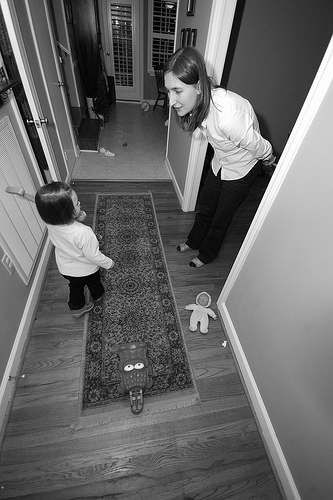
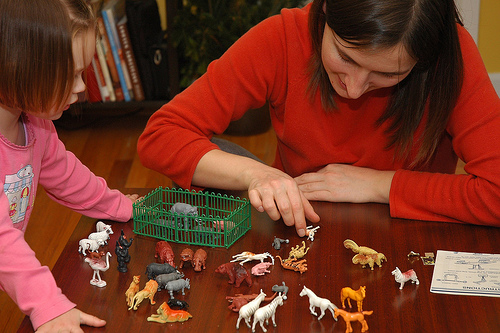
matching tracksuits

fun in threes, sometimes fours

“I Think He Has”

I have a little jar of olive oil mixed with grapefruit seed extract that I keep in a plastic bag in the bottom of a desk draw at school. It was from a long time ago, for an irritating spot of skin on my hand that I didn't want to go see a specialist about. The wise Internet suggested this as a homeopathic remedy.

Today, a young man caught a glimpse of that little bottle when I was pulling something from my desk draw. Or at least I guess he did -- the alternative is that he was rummaging through the drawer when I wasn't looking, something I don't want to imagine he did. At any rate, he went to Ms. W, the eighth-grade administrator and my immediate supervisor, with a concern shortly after that.

"I think Mr. Scott has a little jar of urine in his desk drawer."

Ms. W told me shortly afterwards that it was very hard to keep a straight face with that concerned young man. "I can assure you, Terrence, that that was not what it was, and that there is a logical explanation for what you think you saw."

Oh, but the fun I could have with that misconception tomorrow in class...

Nomad

Our cat, the youngest, likes to drag her bed here and there.

1-DSCF2249

Making Tracks

The Boy is a big train fan. Well, he’s a fan of just about anything that rolls, crawls, lifts, shovels, moves — machines. But trains are special, as they should be.

1-DSCF2290

Every now and then, though, I get a little carried away when designing tracks.

Yesterday, During the Game…

1-DSCF2284

Mushrooms

1-DSCF2268

Experiment

When I was a kid, I wanted to be an inventor. Who doesn’t, I guess. I mixed this and that, sometimes with permission, sometimes surreptitiously. At one point, I even determined that I could certainly make my own alcohol, so set some potato peelings to ferment, and not knowing really about the distillation process, created what could only be called later a foul mess.

1-DSCF2257

Today, L was less ambitious. She wanted, appropriately enough for her interests and gifts, to create paint. She mixed various food colorings together, taking careful notes about proportions.

1-DSCF2258

In the end, they all wound up in the sink, I believe. She couldn’t figure out a way to thicken the mixture into a paint that didn’t involve some idea like mixing yogurt into it. We’re more than happy to let her play, let her experiment, let her explore, but everything has a certain limit.

Dance The Night Away

Few things remind me of how glad I am to be an adult as well as chaperoning a middle school dance.

Playing with Papa Again

DSCF2243

Teaching to the Test

I've heard about it from three different sources now: our principal, our department chair, and a colleague. We've all in the English department heard about it, and we're all more than a bit nervous about the new test students will be taking in late April. It's meant to replace a state-created test that measures progress for No Child Left Behind (still haunting us), but it even has the kids running scared. Even the most apathetic students responded the same as the teachers: "Are you kidding?"

The test -- the ACT-Aspire, created by the same company that makes the ACT -- porports to measure students' ability to create an essay, and all the various elements of that process: generating ideas, developing ideas, organizing ideas, and proofreading said ideas. My students, eighth graders, will be be required to write a persuasive/argumentative essay, and they will be judged on four things: the argument, the development, the organization, and the language use. For a perfect score in the argument strand of the rubric, they are to accomplish the following:

The response critically engages with the task, and presents a skillful argument driven by insightful reasons. The response critically addresses implications, complications, and/or counterarguments. There is skillful movement between specific and generalized ideas.

This is all fine and well: I have plenty of students who could write a paper that addresses the implications, complications, and counterarguments in an insightful way. Not a big big deal.

For development, a perfect paper would look like this:

Ideas are effectively explained and supported, with skillful use of reasoning and/or detailed examples. The writer’s claims and specific support are well integrated.

Again, not that big of a deal. Certainly a challenge for some less-accomplished students, but again, this is for the absolute top score.

Organization looks like this:

The response exhibits a skillful organizational strategy. A logical progression of ideas increases the effectiveness of the writer’s argument. Transitions between and within paragraphs strengthen the relationships among ideas.

Good organization is difficult for fourteen-year-olds, and in some ways I'm most worried about this one. Organization takes time, takes thought, and fourteen-year-olds tend to be a bit impulsive. But its a solvable problem.

Finally, there's language use:

The response demonstrates the ability to effectively convey meaning with clarity. Word choice is precise. Sentence structures are varied and clear. Voice and tone are appropriate for the persuasive purpose and are maintained throughout the response. While a few errors in grammar, usage, and mechanics may be present, they do not impede understanding.

For some of my students, I'm not even tackling the voice and tone issue. Not many fourteen-year-olds have a firm understanding of voice even with a lot of direct instruction. A lot of adults don't.

All in all, a decent but challenging rubric. Until you consider one thing I've left out: its a timed test. And the time limit for this? What do the test creators consider a reasonable amount of time for students (and the time is universal for all grades) to create an essay on which so much depends? Two hours? Three? Ninety minutes? How about thirty minutes.

That's right: one half hour to conceive, plan, organize, write, and proof an essay.

"Are they crazy?" we teachers all said almost on cue.

"Are they crazy?" all the students replied.

I have plenty of students for whom this would be a tremendous challenge if give two hours to accomplish, but thirty minutes seems laughable. It sounds as if all the decision-makers in the fine organization that creates the test got high on every possible drug and then decided on the time limit.

"I got it! I've got it" laughs a young executive who's just sniffed three lines of coke, shot up some heroin, taken a few Vicodin, smoked an enormous joint, and done an Irish Car Bomb. "I've got it! Just for the fun of it, just for kicks and giggles," and breaks into fifteen minutes of giggles before continuing, "Let's give them half an hour!"

Howls in the boardroom.

Howls in the classroom.

Not the same howls. Not even close.

I'm not even sure what such a ridiculously short time limit is supposed to accomplish. Raise the stress level of students? Ensure as many short essays that are so bad that they're easily gradable as possible?

I've a feeling when the state results are published, the howls won't just be in the boardroom and the classroom anymore.