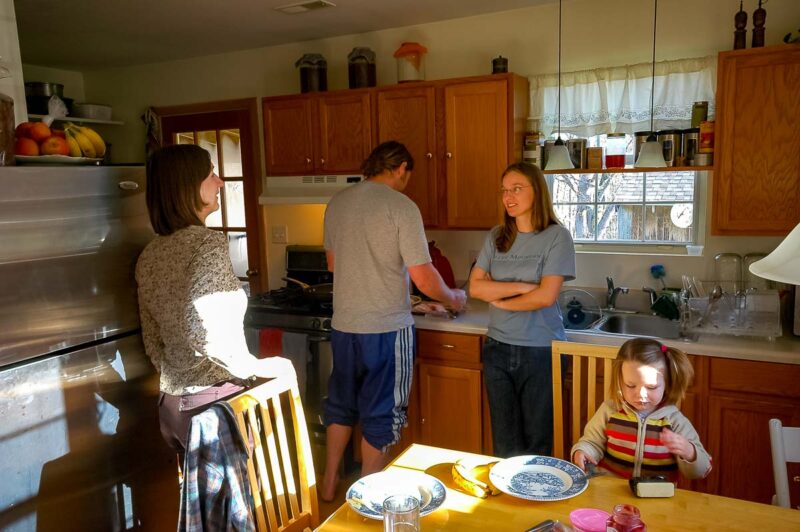
matching tracksuits

fun in threes, sometimes fours

Egg Party

For a few years now, we've been having people over one evening as Easter appears to have an Easter egg painting party. We were squeezed for time this year; we weren't sure whether or not we'd get everything together.

Then friends saved the day by beating us to the punch. The only thing we had to do: bring eggs.
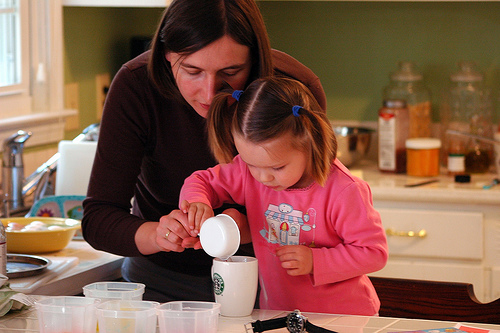
As might be expected, L greatly enjoyed preparing the egg dye. It was, in fact, the first time we used store-bought dye. K usually boils the eggs with onions skins, turning the eggs a rich reddish-brown.

This was the first year L was old enough to paint, and she took to it like a natural. She was unfazed when her egg tumbled from the high kitchen counter where everyone was working. Once she had it back in her hands, she continued as if nothing happened.
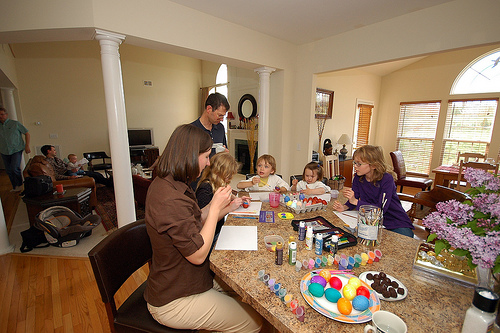
It was the first year I didn't paint an egg, though. Not the first time in my life, for I grew up not celebrating Easter.

When I got back home, I saw a message on a social networking site from a friend who was "spring cleaning/deleavening today!" Someone else who doesn't celebrate Easter but instead, the Jewish Old Testament festivals.

Deleavening -- cleaning the house to get literally every single crumb from the house, for leaven is a symbol of sin -- seems much less enjoyable than what we were doing. I haven't been involved in deleavening in many, many years now, and I must say: Easter egg painting is a much more rewarding spring tradition.

And you can't exactly invite your friends over for an afternoon of deleavening.

Well, you could, but first you'd have to explain what it is. It can be, in its own way, a very spiritual activity:

I always pray for deleavening/unleavening because there are no voids in the universe. There is no "empty." If something is taken away, it is replaced with something else (e.g., when water is removed from a glass, it is replaced with air).

Deleavening requires God's help. Just as my house can't deleaven itself (I have to do it), I can't deleaven myself (God has to do it). I, though, choose to cooperate or resist and I am responsible for the choices I make. As I'm deleavened, those empty places need to be filled with unleavenedness, and God also has to do to do that (just as I make or buy unleavened bread and bring it into my house each year - I do wish sometimes it would materialize all by itself since my personality doesn't lend itself to enjoying the precise formulation of baking). Again, I choose to cooperate or resist the unleavening part of the process. (All the Strange Hours)

One cannot wax theological about Easter egg painting.

Well, an egg is a symbol of life, but beyond that?

Really, it's not important. There doesn't have to be theological meaning behind everything in life. Sometimes, it's just about the painting.
Eviction Notice

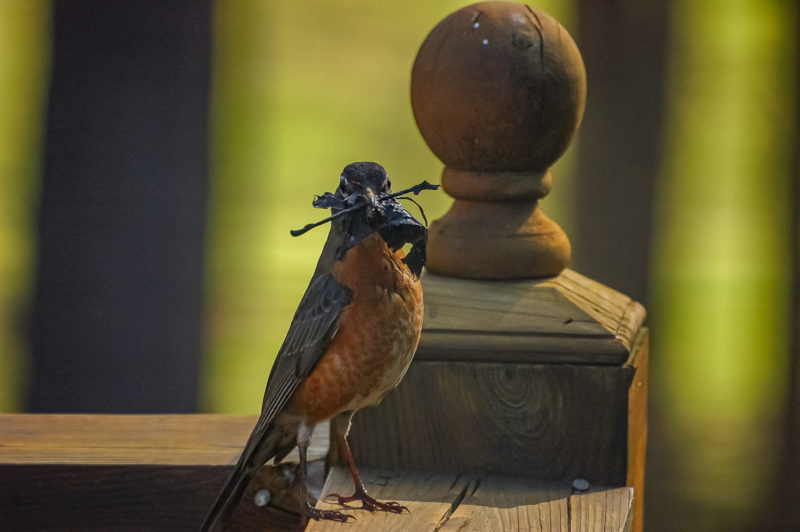
He flew in with a beak filled with building materials, landing on our back deck banister. L saw him first.

"Tata! Look! A bird!"

We'll have to begin playing "I spy" soon.

The bird sat for a while on the railing, then flew into one of the juniper trees in our backyard. The ones which I'll drastically cut back at some point this spring, thus disturbing the bird, possibly spoiling a nest (though I'll do my best not to).

If only I could have reasoned with him: demolition work ahead. Best build elsewhere.

Planting

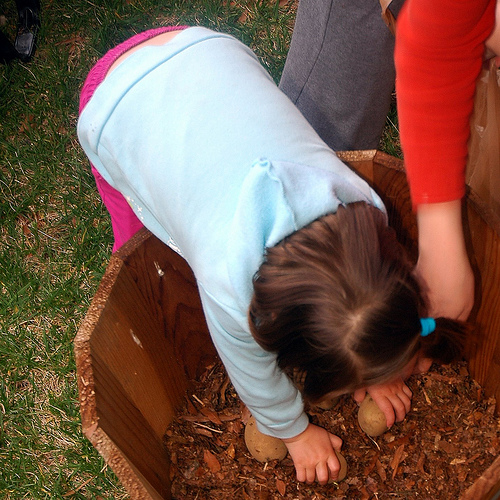
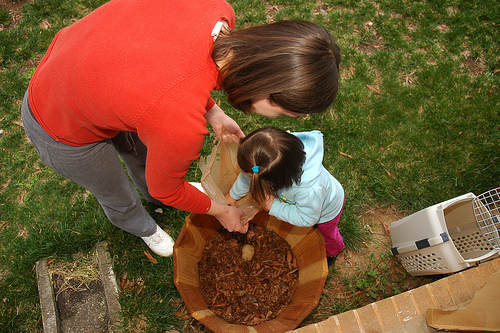
We planted our potatoes this week. I was worried because we didn't use "seed" potatoes. K insisted that organic potatoes would do just fine. Of course she's right: who's going to argue potatoes with a Pole?

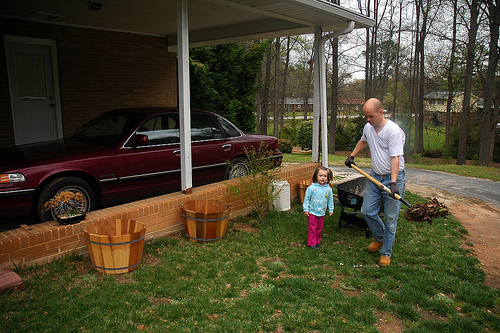
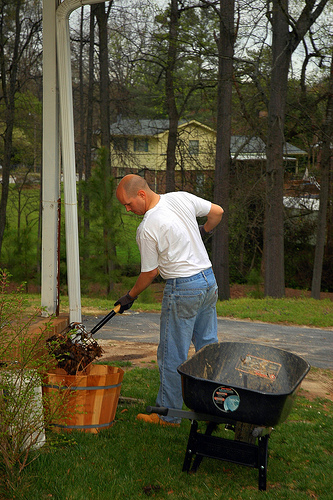
We're growing them in large gardening buckets, with little to no soil. We're using mulch from leaves, compost, and more mulch/leaves on top. Will it work? We'll find out shortly.

L insisted on helping. "I do it!" is her motto of late, and we're certainly encouraging that helpful nature. Earlier this week, she helped make a salad, mixing the ingredients for the sauce ever-so-carefully.

Yet there are some things she'll be too small to do for quite some time.

By the time she's big enough to do this kind of work, she'll have her own list of chores.

How will we ever get her to do chores? Choice seems to be promising: like most people, L responds best to requests when given a choice. It's something that works wonders in the classroom as well.

The Concert

We've been wanting to get the Girl singing captured on video. We managed to do that last night, but we weren't expecting this kind of concert:

Fred Sanford, Where Are You?

South Carolina would probably be in better hands if governor Mark Sanford handed the reins to another Sanford. They both seem to know about as much about education:

The dispute between Gov. Mark Sanford and state lawmakers over the use of $700 million in economic stimulus money from Washington threatens to become a "constitutional standoff" that can only be resolved in the courts, according to a legal analysis released today by state Attorney General Henry McMaster.

The $700 million is a portion of about $3 billion in cash that various entities in South Carolina, including the state government, are expected to receive under President Obama’s $787 billion economic stimulus program.

Sanford has threatened to reject the money unless it can be used to pay down state debt, but legislative leaders prefer to use the funds as Washington intended, mostly to maintain education spending. (Greenville Times)

Paying down the state debt is a great idea -- I'd love to pay down our mortgage debt. However, I wouldn't sacrifice L's education to accomplish that, which is exactly what Sanford wants to do.

Sanford says this notion is nonsense, that there would be adequate funding under his budget. Perhaps he's right. But the worrying thing is that he's not accepting stimulus money earmarked (I hesitate to use that term, but that's just what it is) for education. Refuse to accept some other portion of the stimulus money.

Flustered Enraged upon hearing this, I wrote a letter to the governor:

It troubles me that, in this era of waning American international influence, you would consider such drastic cuts in education as would occur if you continue to refuse to use the stimulus money intended for education funding. Our classrooms our crowded; our educational infrastructure is woefully inadequate; our teachers are under-paid -- yet you want to force school systems to cut even deeper: up to 480 positions in Greenville County.

The rest of the Western world has surpassed America in the quality of its education: "average" eleventh-grade students study mathematics topics in America that are taught in the fifth grade in Poland, for instance. A six year lag. (How do I know this? I've been a substitute teacher in an American mathematics classroom and I lived in Poland for seven years -- it's first-hand knowledge.)

What you're proposing would only increase that difference.

Please reconsider. The state unemployment rate is significant enough without adding teachers to the fold, and more importantly, our kids can't afford it.

It seems that South Carolinians are not the only ones concerned, though.

A White House official said Wednesday that only Gov. Mark Sanford can apply for nearly $700 million available in federal stimulus funds, but U.S. Education Secretary Arne Duncan said that even if Sanford turns down the money he still plans to seek funding for the state because of the poor condition of South Carolina education.

"To stand on the sideline and say that the status quo is OK there and that the children are well served, it simply defies logic and is not reality," Duncan told reporters.

Asked if he was developing a plan to send the money to the state in the event Sanford didn’t ask for it, Duncan replied he was, then rattled off several facts about education in the state that bothered him.

Duncan said that only 15 percent of African-American children in the state are proficient at math and 12 percent at reading. He said the state has the nation’s fourth worst graduate rate for freshman.

"Those are heartbreaking results," he said. "Those are children that if we don’t do something dramatically different for them will never have a chance to compete in today’s economy." (Greenville Times)

A Greenville Times editorial summed it up succinctly:

Most Republicans in Congress opposed the excessive stimulus bill that greatly expands the reach of the federal government. So did this newspaper in several editorials. But the bill was passed, the fiscally conservative argument did not prevail, and every penny of those hundreds of billions of borrowed money will be spent.

So, as U.S. Sen. Lindsey Graham was quoted as saying, the "question is do we use it or lose it?" (Greenville Times)

This leaves us wondering why Sanford is so staunch in his refusal. His name was bantered about as a potential running mate for McCain in 2008; there have been rumors of a planned presidential campaign in 2012. Could this be political posturing? Could this be Sanford's no-thank-you-to-a-bridge-to-nowhere?

Zupa

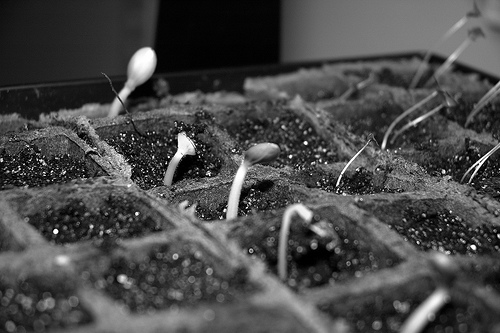
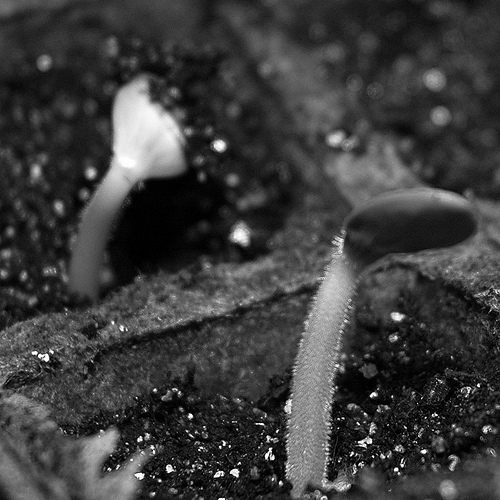
Sprouts

We seem to be clearing that first hurdle without much difficulty.

Can the next step be that much more difficult?

In the Mountains

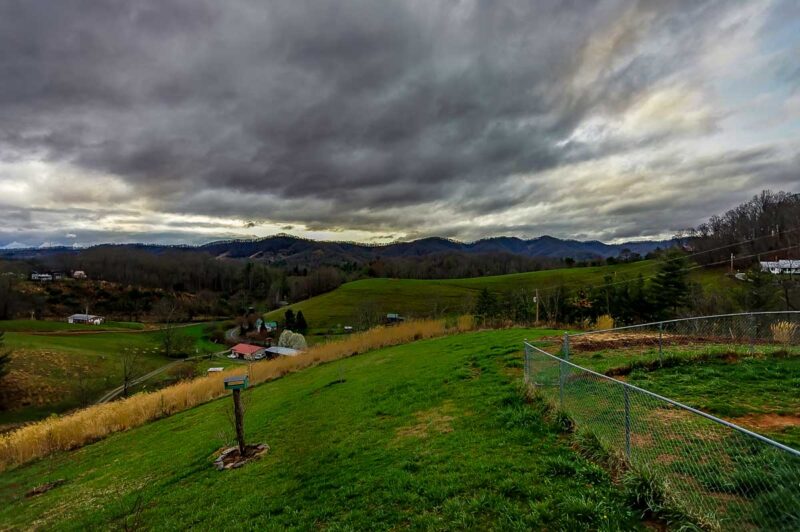
Waking up in the mountains, with French press of coffee and a fire filling the house with inviting, warm odors. It's rare that the physical act of visiting friends -- the actual physical being there, in this case, in the mountains -- is nearly as pleasant the conversation that lasts into the early morning hours.

When we arrived, things were dark and wet.

The next morning, the opposite.

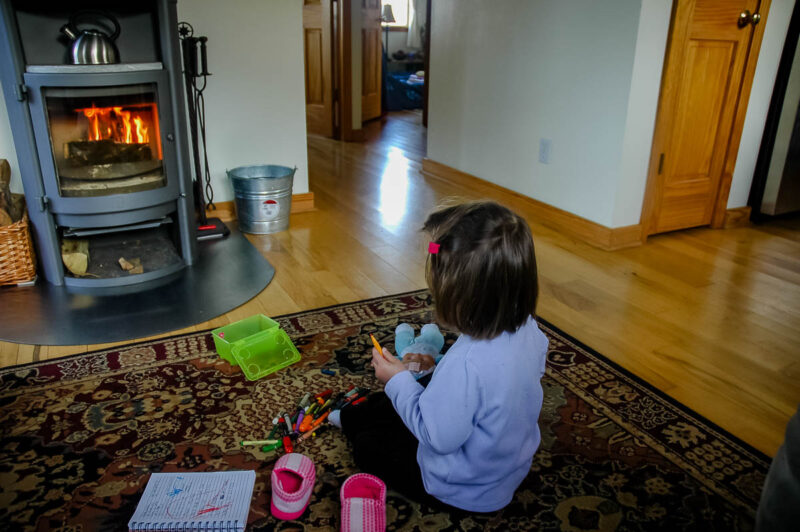
We were all up early thanks to our self-portable alarm clock. There was soon a fire burning in the stove and coffee working its magic in a press. And the conversation picked up where we'd left of the evening before.

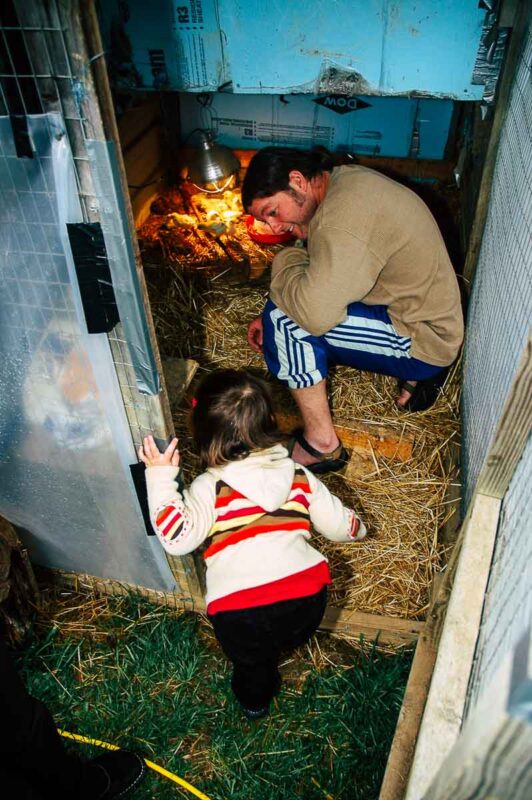
The highlight for the Girl: animals. Four friendly dogs and twenty-some chickens made for an overjoyed little girl.

First Steps

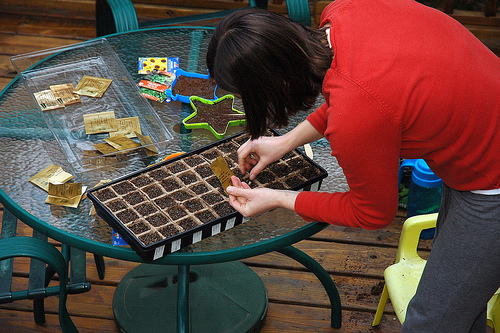
We've begun our garden -- sort of. We ordered seeds some weeks ago, and they finally arrived earlier this week. The first step was to get them started.

We're both excited about hte prospect of growing our own beans, potatoes, zucchini, tomatoes, and other veggies, but we sometimes wonder if we're biting off more than we can...

Scratch that.

Planting more than we can hoe.

I recall all the work Nana and Papa put into our garden when I was growing up, and I think, "When are we ever going to find the time." Of course, being a teacher, I have summers off. Yet being a teacher, I also have to spend at least some of my summer expanding my horizons, so to speak -- a useful euphamism for "sitting in teacher in-service sessions."

Still, a longer day means more time to dig, which hopefully will mean more to harvest.

You’ve Got Kissibility

"You can be a star -- it ain't hard."

All you've got to do is have the right shades.

And have an eye-catching pose or two.

And know how to put your sunglasses on right side up -- something that's initially challening for a two-year-old.

With Papa

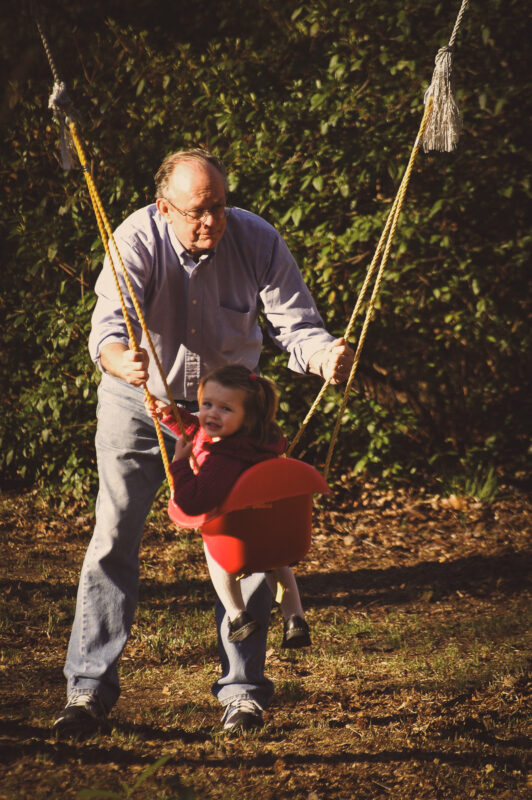
Nana and Papa came over for a late lunch yesterday, which meant a string of "Yes's" and "Of course's" from Papa. Because we all know who always says, "Yes."

1/640, f/4.2, 95 mm

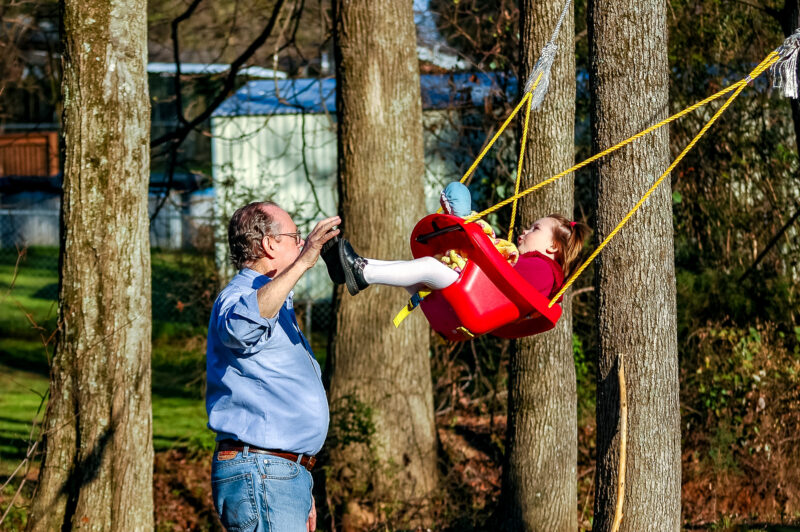
The light was warm and the Girl was occupied; only one thing to do.

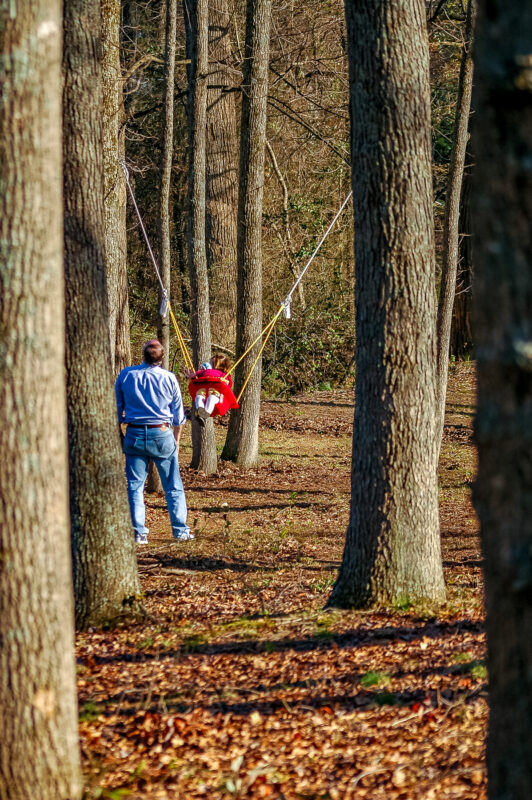
K said just yesterday, "We have so many pictures at the swing!" Portraits are supposed to reflect the subject and her personality, and what better way than to take pictures where she loves to be?

1/1250, f/4.0, 86 mm

But point taken, K -- enough with the swing, already!

Spring

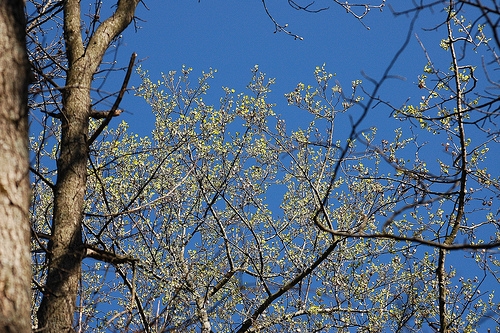
In South Carolina, spring comes when the calendar says it does: late March. The tops of trees, where the light is most direct, already have buds beginning to open.

The tulip poplars have buds all over.

In the brush beneath the trees, there is just enough light for some blossoms.

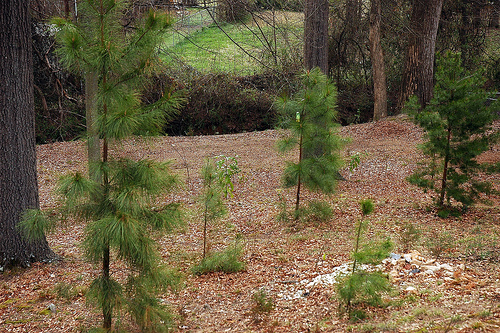
All this inspires me finish up with the leaves that have been blanketing the ground for four months now.

A new mulching mower makes relatively quick work of the leaves (except for those in the rocky, uneven areas that remained undisturbed this time around), turning them into a powder that will improve the soil for the spring of 2011, when we think we might get around to doing something with the backyard. This spring we're concentrating on getting veggies growing; next spring will be the front yard's turn.

DSC_4460

Reading

We took the Girl to the library this weekend. Favorite books were getting stale; she needed something new. Though she wound up obsessed with Curious George, she was initially fascinated with other things.

Time!

Ten or so years ago, while preparing for the GRE in Poland, I was getting frustrated with the analytical section and how rushed I felt during the practice tests. One evening, I sat down with a cup of coffee and no timing device whatsoever, and I took a practice analytical section -- and completed it without a single mistake. It took me almost twice the usually allotted time for the section.

When I took the actual GRE, my analytical results were substantially lower than the perfect score of 800. I attributed this solely to time pressure, and included a note in my grad school applications to that effect: "This test, I feel, was a test not of my analytical ability, but my ability to work under artificial time restraints," I wrote, or something similar.

Yesterday, while taking ETS's "Principles of Learning and Teaching, Grades 7-12" Praxis test, I found my mind returning to those long-forgotten themes.

What is the point of a time limit on a professional test? I understand that the administrators don't want examinees to be there all day, but what is the thinking behind making the time so incredibly short that everyone is frantically working up until the moment time is called?

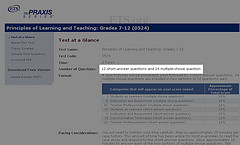
The PLT test consists of twelve short-answer questions and twenty-four multiple-choice questions. Or, as it's put on their web site: "12 short-answer questions and 24 multiple-choice question" (my emphasis added). Those twelve "short answer" questions are divided into four scenarios, with each one having a long case history.

Here's a sample, provided by ETS:

Case History: 7-12

Directions: The case history is followed by two short-answer questions.

Mr. Payton

Scenario

Mr. Payton teaches world history to a class of thirty heterogeneously grouped students ages fourteen to sixteen. He is working with his supervisor, planning for his self-evaluation to be completed in the spring. At the beginning of the third week of school, he begins gathering material that might be helpful for the self-evaluation. He has selected one class and three students from this class to focus on.

Mr. Payton's first impression of the three students

Jimmy has attended school in the district for ten years. He repeated fifth and seventh grades. Two years older than most of the other students in class and having failed twice, Jimmy is neither dejected nor hostile. He is an outgoing boy who, on the first day of class, offered to help me with "the young kids" in the class. He said, "Don't worry about me remembering a lot of dates and stuff. I know it's going to be hard, and I'll probably flunk again anyway, so don't spend your time thinking about me."

Burns is a highly motivated student who comes from a family of world travelers. He has been to Europe and Asia. These experiences have influenced his career choice, international law. He appears quiet and serious. He has done extremely well on written assignments and appears to prefer to work alone or with one or two equally bright, motivated students. He has a childhood friend, one of the slowest students in the class.

Pauline is a withdrawn student whose grades for the previous two years have been mostly C's and D's. Although Pauline displays no behavior problems when left alone, she appears not to be popular with the other students. She often stares out the window when she should be working. When I speak to Pauline about completing assignments, she becomes hostile. She has completed few of the assignments so far with any success. When I spoke to her counselor, Pauline yelled at me, "Now I'm in trouble with my counselor too, all because you couldn't keep your mouth shut!"

Mr. Payton's initial self-analysis, written for his supervisor

I attend workshops whenever I can and consider myself a creative teacher. I often divide the students into groups for cooperative projects, but they fall apart and are far from "cooperative." The better-performing students, like Burns, complain about the groups, claiming that small-group work is boring and that they learn more working alone or with students like themselves. I try to stimulate all the students' interest through class discussions. In these discussions, the high-achieving students seem more interested in impressing me than in listening and responding to what other students have to say. The low-achieving students seem content to be silent. Although I try most of the strategies I learn in workshops, I usually find myself returning to a modified lecture and the textbook as my instructional mainstays.

Background information on lesson to be observed by supervisor

Goals:

  • To introduce students to important facts and theories about Catherine the Great
  • To link students' textbook reading to other sources of information
  • To give students practice in combining information from written and oral material
  • To give students experience in note taking

I assigned a chapter on Catherine the Great in the textbook as homework on Tuesday. Students are to take notes on their reading. I gave Jimmy a book on Catherine the Great with a narrative treatment rather than the factual approach taken by the textbook. I told him the only important date is the date Catherine began her reign. The book has more pictures and somewhat larger print than the textbook.

I made no adaptation for Burns, since he's doing fine. I offered to create a study guide for Pauline, but she angrily said not to bother. I hope that Wednesday's lecture will make up for any difficulties she might experience in reading the textbook.

Supervisor's notes on Wednesday's lesson

Mr. Payton gives a lecture on Catherine the Great. First he says, "It is important that you take careful notes because I will be including information that is not contained in the chapter you read as homework last night. The test I will give on Friday will include both the lecture and the textbook information."

He tape records the lecture to supplement Pauline's notes but does not tell Pauline about the tape until the period is over because he wants her to do the best note taking she can manage. During the lecture, he speaks slowly, watching the class as they take notes. In addition, he walks about the classroom and glances at the students' notes.

Mr. Payton's follow-up and reflection

Tomorrow the students will use the class period to study for the test. I will offer Pauline earphones to listen to the tape-recorded lecture. On Friday, we will have a short-answer and essay test covering the week's work.

Class notes seem incomplete and inaccurate, and I'm not satisfied with this test as an assessment of student performance. Is that a fair measure of all they do?

From this, examinees answer three questions. They're called "short answer" questions, but they're really essay questions if one wants to answer the question carefully and thoroughly.

Question One

In his self-analysis, Mr. Payton says that the better-performing students say small-group work is boring and that they learn more working alone or only with students like themselves. Assume that Mr. Payton wants to continue using cooperative learning groups because he believes they have value for all students.

  • Describe TWO strategies he could use to address the concerns of the students who have complained.
  • Explain how each strategy suggested could provide an opportunity to improve the functioning of cooperative learning groups. Base your response on principles of effective instructional strategies.

Question Two

In the introduction to the lesson to be observed, Mr. Payton briefly mentions the modification he has or has not made for some students. Review his comments about modifications for Jimmy and Burns.

  • For each of these two students, describe ONE different way Mr. Payton might have provided a modification to offer a better learning situation for each.
  • Explain how each modification could offer a better learning situation. Base your explanation on principles of varied instruction for different kinds of learners.

There are two sample questions provided at ETS's web site; on the actual test, there are three questions, each one asking for two specific examples of this or that. For each case-history essay section (like the one above, though with one more question), ETS allotted twenty-five minutes.

This might be fine if the case histories didn't sometimes require multiple readings:

  • trying to figure out things like whether Bobby is in the first group of students Mr. Tadeusz spoke with or the second group;
  • wondering about the nature of the student-teacher relationship and prior interventions in a question about dealing with a disruptive student; or,
  • fighting the urge to scream, "This test is ridiculous!"

Teaching is a reflective task, and often one's first response to a situation is not the correct one. It leads me to believe that this test is only about testing how ingrained standard "first responses" are and nothing more. Indeed, any test with a severely restrictive time limit can only be testing how quickly examinees can recall and synthesize information.

One positive emerged from it all: I need to be more aware of how much time I'm giving my own students for tests and exams.

To its credit, South Carolina does not impose a time limit on its main standards-assessing test, the PASS (Palmetto Assessment of State Standard).

Big Wolf

A new story L likes to tell — Big Wolf. The premise is careful: “Big Wolf! Be careful! Run away!”