matching tracksuits

fun in threes, sometimes fours

Longing

When I moved back to America from Poland in 1999, I had a difficult time adjusting. I missed my friends in Poland; I missed my students and working with them; I missed the adventure.

It was a rough time.

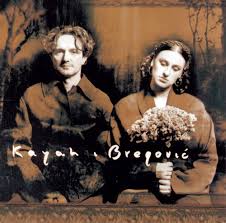
Listening to the last album purchased before leaving Poland, Kayah i Bregovic, didn't help.

Kayah is a Polish pop star; Goran Bregovic is a composer from the Balkans. An odd pairing, but effective. It became the best-selling album in Polish history, if memory serves.

You'll find no other popular music so utterly filled with yearning as this one.

All the tracks have at the very least a ting of longing, but one drips it: "Trudno Kochac" ("Hard to Love"). Though obviously a love song, the refrain captured the duality of my feelings for Poland:

Tak trudno kochac
Lecz trudniej jest
Nie kochac wcale cie

What a summary of the love-hate relationship many of us have with Poland: difficult to love, difficult not to love.
Mystery

One evening, not long ago, I strolled out to dump some potato peels and other goodies on the enclosed pile when I saw motion in the bin -- it was not yet totally closed up. Since our cat had wiggled her way in there once before, I thought it was the cat. I removed the wire-mesh cover, a shadow jumped out, and I gave it a not-quite-light, certainly-not-swift kick. In the dark, it was hard to discern much of anything other than the fact that the shape moved away from our house, toward our neighbors fence. It climbed the fence and turned to look at me. Our bandit was just that: a raccoon. I'd thought to reach my hand into the composter and grab the "cat" by the scruff of the neck; I was certainly glad I didn't when I realized who our "visitor" was.

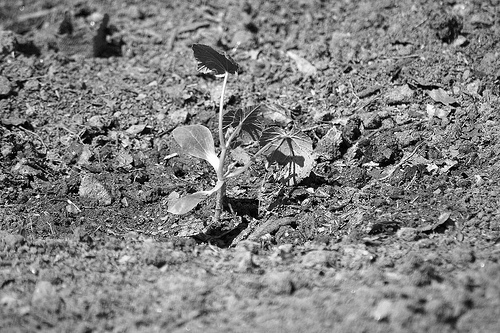
We're going crazy with the compost, though, because we've been trying out our green thumbs, only to find them to be a paler green than we'd really like. We planted some melons and squash in a patch in front of the house where I pulled up some diseased boxwoods. Started from seeds, they were smallish, but we didn't really they were too underdeveloped for planting -- especially the squash. Still, almost two weeks later, despite careful watering, sixty percent of the squash is dead and forty percent of the melons. The soil was quality; the seedlings looked healthy -- who knows.

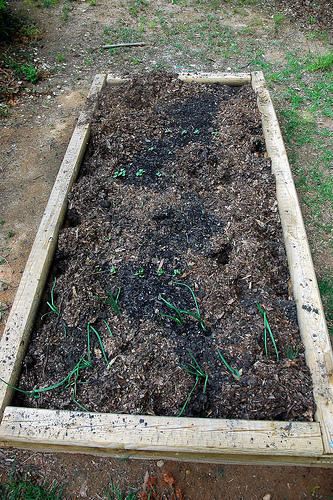
The bigger mystery is in the backyard, where we have our raised bed, which houses some onions, radishes, and a few other goodies. We were walking around the house this evening when we saw this:

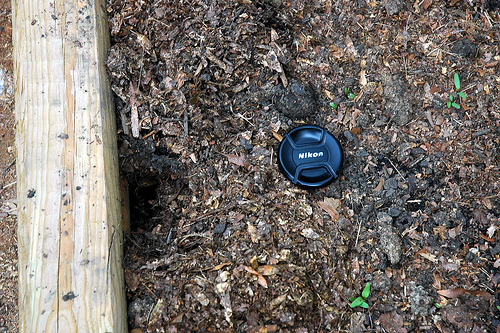
Something absolutely ravaged our garden. There were seemingly countless deep, narrow holes along the landscaping timbers.

Lens cap for scale, not horticultural technique

It's certainly not a dog, for canine-dug holes aren't so precise.

My bet: the raccoon. Squirrels could be another good bet, but we're not sure exactly when the raid took place. Any ideas?

xtranormal Shakespeare

I've been playing with xtranormal.com, the site that allows you to create a movie merely from text. I'm thinking I might use it somehow next year with my English I Honors class when we work on Shakespeare.

Something like this:

(Since removed.)

The pronunciation is a bit off at times, but otherwise, a potentially useful tool.

I'm just not quite sure how to use it...

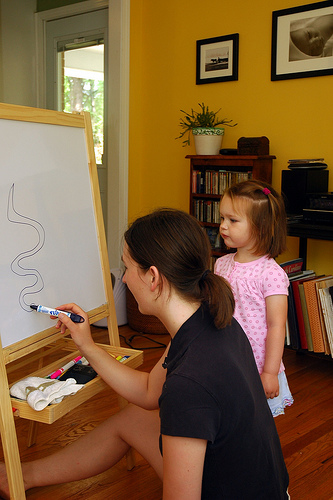
Drawing with Mama

Pandemic Education

Teaching eighth grade as a pandemic approaches creates certain challenges, especially when a girl passes out in the bathroom and a local high school closes for disinfection.

Thirty Greenville County School District employees wearing gloves and masks started to clean Mauldin High School from the top down last night and will continue to disinfect desks, lockers, doors and bathrooms throughout the day today after up to 18 of 70 students who had attended a band camp at Disney World last week reported flu-like symptoms which led the district to close the school today. (Greenville Times)

Students come running into the classroom, desperate not to touch anything but the bottles of hand sanitizer that they're most eagerly sharing amongst themselves. They sit down and put their hands in the air as if they're being held up at gun point. They open doors with their feet and they laughingly refuse to touch the copies of Much Ado About Nothing we've been using in class.

A quick look around the room confirms my suspicions: I won't be able to accomplish anything without dealing with this first. A quick review of how viruses are spread. "You can't get it from simply touching a desk, even if an infected person has just touched it," I say. "If you touch that contaminated desk then rub your eyes, pick your nose, and dig something from between your teeth, you might get it."

It truly satisfied few, but at least there was some semblence of calm afterwards.

Snack

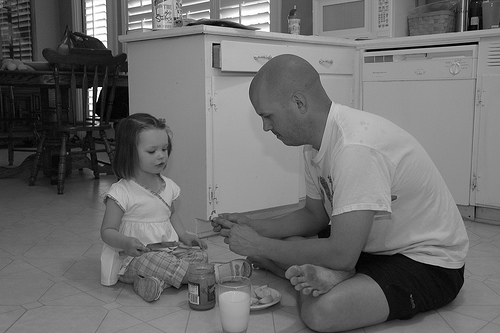
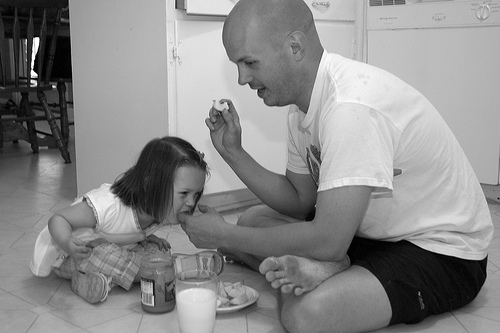
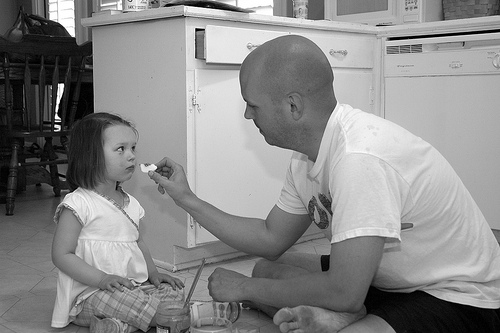
Often, when L and I arrive home, we take a snack together. An eternal favorite is apple slices with a light spread of peanut butter and a shared glass of milk.

I don't know how we began sitting on the floor, but we do now consistently -- even when it's a Saturday afternoon snack.

I hold the apple; L spreads the peanut butter. The cooperation is a blessing: she often insists on doing everything herself, and that can lead to frustration.

She also cleans up messes. Occasionally, the mess is bigger after she completes the task, but in the case of peanut butter on a finger, she does a thorough job.

Dress

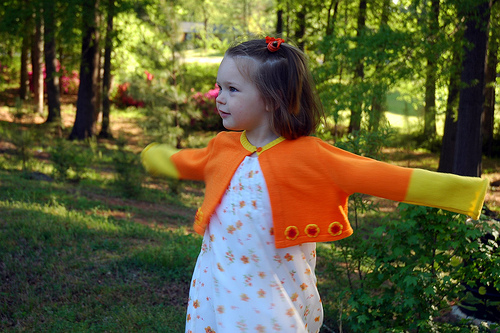
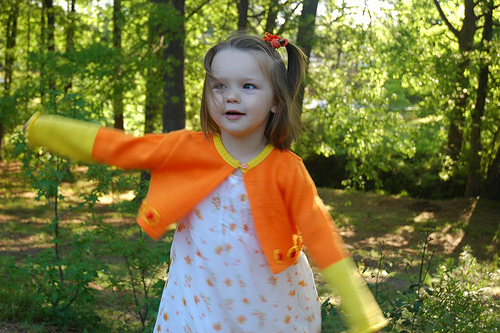
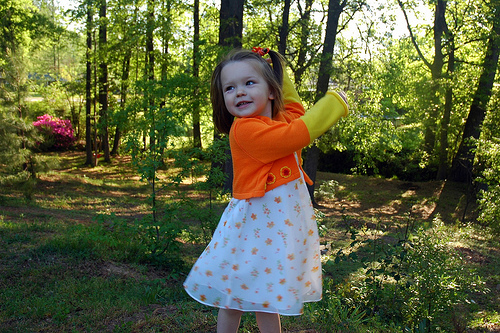
Sunday morning, before church, there was some twirling and dancing in the backyard. I was there with a camera, of course.

For a brief moment, I look at this photo and think I can imagine what she'll look like ten years from now. Every few months, I catch a moment that seems to be speaking from the future. "Prepare yourself, Tata," she says in those moments. "I'm not going to be a toddler for long."

Definitely not, but she'll certainly be a dancer. She dances endlessly, tirelessly.

"All kids at this age like dancing and music," says the lady at daycare.

"Yes, but you don't understand," I want to say. "She dances more than any other person I've ever encountered."

But I don't say it. She's probably already heard it a million times.

Digging and Playing

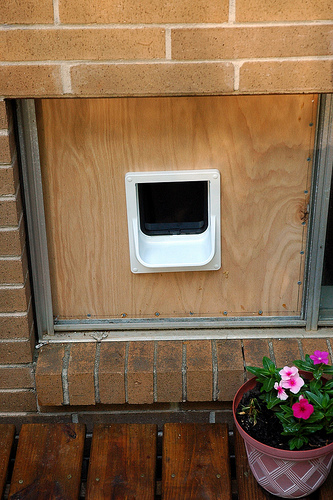
A busy weekend. L's confirmed cat allergy necessitated the re-thinking of our cat situation. She how sleeps in the basement. (The cat does, not L.) Part of the solution involved a cat door, but where to put it? Simple: in the basement window. That involved creating a framed enclosure for the door -- yesterday's project. There's still a shelf to be built on the outside portion as it's too high for convenient entry.

Sunday was planting day. Squash and melons. The squash looks heartier than the melons. In fact, the melons, while healthy, look almost miniature compared the the hefty squash plants. Don't worry, melon -- you'll catch up and surpass your neighbor in our improvised front garden.

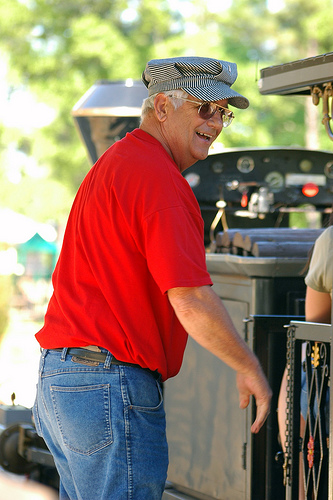
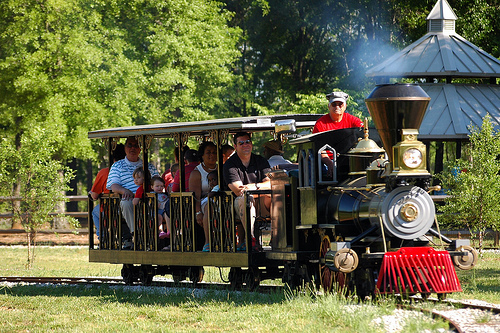
The day ended with another first for L -- her first train ride. With beautiful weather and a jolly conductor, we were certain it was going to be a big hit.

L sat waiting, watching the train make a circuit and excitedly talking about getting on the train.

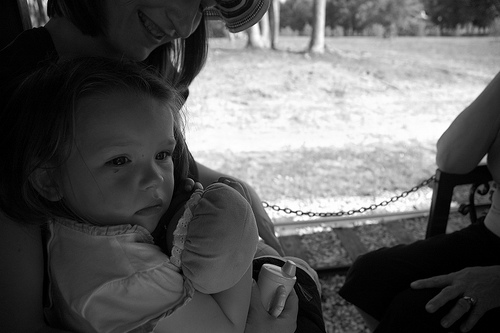
Once she boarded with K, though, it was a different story

It's something we should have expected, for it happens often enough. We could have prepared her: it usually helps if she knows what she's expecting.

Still, the swinging, running, sliding, jumping, and general frolicking undid the anxiety.

1600 and All That

It's rare that we read something that makes us say "ah!" I'm not quite talking about epiphanies, but something very similar. Take the following passage from Sam Harris' The End of Faith: Religion, Terror, and the Future of Reason:

It is a truism to say that people of faith have created almost everything of value in our world, because nearly every person who has ever swung a hammer or trimmed a sail has been a devout member of one or another religious culture. There has been simply no one else to do the job. We can also say that every human achievement prior to the twentieth century was accomplished by men and women who were perfectly ignorant of the molecular basis of life. Does this suggest that a nineteenth-century view of biology would have been worth maintaining? There is no telling what our world would be like had someone great kingdom of Reason emerged at the time of the Crusades and pacified the credulous multitudes of Europe and the Middle East. We might have had modern democracy and the Internet by the year 1600.

A kick to the head when I first read that.

Simply put, there is no difference between the Earth today and the Earth when Shakespeare was was writing Julius Caesar, Much Ado About Nothing, or As You Like It (all possibly written around 1600, give or take a few). Granted, we've depleted many resources since then, but the no new elements have been created (except a few radioactive ones in the lab).

More tellingly, nothing has changed about the physiology of humans. Our brains haven't become more efficient; our general intelligence hasn't really increased; our bodies haven't become necessarily more adept at anything. Granted, we do live longer and are stronger, but that's due to improved living conditions, which has been brought about by improved technology -- the whole point of this.

But as far as resources and intelligence go, it is, at first blush, difficult to understand why we haven't had "modern" technology for centuries.

What could have held the human race back? Only the human race itself.

How? Simple: unrelenting, unbending dogma.

Take away all the restrictions of dogma, all the assurances that slaughtering animals will somehow help us after death, all the certainty that initially unexplainable experiences (pestilences, plagues, diseases, seizures, and the like) can only be explained supernaturally, take away the fear that someone's different thoughts pose an existential threat to us as individuals, and what do you have left? Free inquiry: the liberty to pursue questions to their end no matter how uncomfortable. It is this, above all, that leads to technological development.

Yet there is always a push against it -- a reaction from the powers that be, because those powers understand that their authority is based on a presumption of never-changing Truth. Because eternal Truth and new, contrary evidence are in conflict, one or the other must be crushed. Usually it's the new, contrary evidence.

Progress undermines Truth, and history is replete with examples:

The printing press was invented in fifteenth century, but Bibles in the vernacular were banned many decades afterward. Why?

Someone looked at nature and came up with an explanation for its diversity that differed from that which had been delivered in a book written in pre-scientific times; many people wanted (and still desire) to muzzle the theorist.

A gentleman provided reproducible, mathematical evidence that an earlier gentleman's suggestion might in fact be correct: the motions of the planets might better be explained by placing the sun at the center of our planet's rotation instead of the opposite. The gentleman was condemned as a heretic.

And "heresy" is a useful term here, for its Greek root means "choice." Choice historically has been stifled in the name of salvation and homogeny between what individuals see and what those with metaphysical authority say must be say. In short, dogma, in its many forms, stifles choice, and in turn, stifles curiosity, and in turn, stifles progress. Without people constantly looking over their intellectual shoulders for centuries, we might have achieved a much greater technological development much earlier.

Really, the only thing that stopped us was ourselves. And that is perhaps the most tragic legacy I can imagine delivering to our progeny.

A sobering question is whether or not we've rid ourselves of this dogma. The simple answer is, "No." And why?

Because dogma cannot change. Dogma cannot even admit the possiblity of change. Development -- of any kind -- depends on the ability and (more importantly, for humanity has the ability) the willigness to change our ideas when new evidence emerges. Dogma prevents this. Dogma says, "What is true is true, for all times." Dogma instists on its own veracity and because Truth never changes, dogma never changes.

Could we have had the Internet in 1600? Certainly, but we didn't give ourselves the necessary freedom.

Eighth Grade Shakespeare

Shakespeare is a challenge to our modern ears, no doubt about it. Even the most knowledgeable experts halter a line or two of a performance before they settle in to the poetry. In my experience, it takes me about a few minutes before the language on stage sounds completely natural and non-foreign.

I've been teaching Shakespeare to eighth graders of various academic levels for the past week: an enlightening, frustrating, ultimately rewarding experience. We're reading an abridged version of Much Ado About Nothing. It is, in fact, part of the required eighth grade curriculum here in Greenville County, and I'm thrilled that those who designed the curriculum had the wisdom of chosing a comedy rather than, say, Julius Caesar. (A perfectly fine play in its own rights, it's an absolute bore to teenagers.) Much Ado has all the elements adolescents can relate to: unrequited love; jealousy; the twittery, jittery joy of new love.

Yet it's still been difficult enough for them that it's been, at times, a chore. And so to remedy that, I changed my unit plan and decided to show the Branaugh Much Ado concurrently with our own reading. We've completed the first two acts in class; we watched the first two acts today.

What a joy to watch the kids watch Shakespeare and enjoy it. What was most rewarding for me was to hear them laugh at lines that had been omitted from our abridged version. "They're really getting it," I almost said aloud.

Head

This was an unpublished entry that had been lurking with the other drafts.

A couple of years ago, when I was working with autistic children, I learned the versatility of using “head” as part of a compound word. The children were absolute masters. A small selection:

  • poo-poo head
  • Barbara head
  • shoe head
  • chair head
  • silly head
  • birthday head
  • sugar head
  • bye head
  • pizza head
  • straw head
  • puckle head (no idea what that is)
  • five minutes head

A Prayer

I've mentioned Hania Rybka before. She's talented in many ways, but above all other talents, Hania Rybka has a voice more beautiful than most.

This is a song called "Modlitwa" ("Prayer").

Planting

April showers bring May flowers: so the saying goes. Hopefully, they'll bring summer veggies as well.

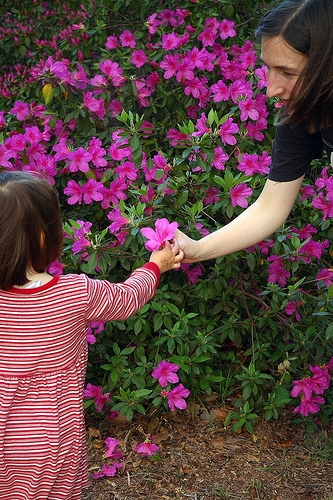
We've already got the flowers covered. Those are nature's doing, though. We do very little. Strike that. We do nothing.

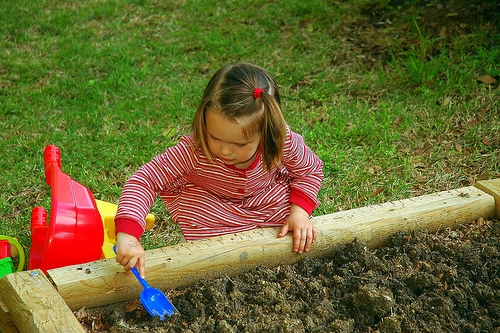
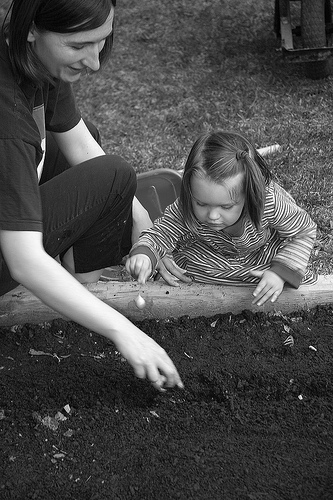
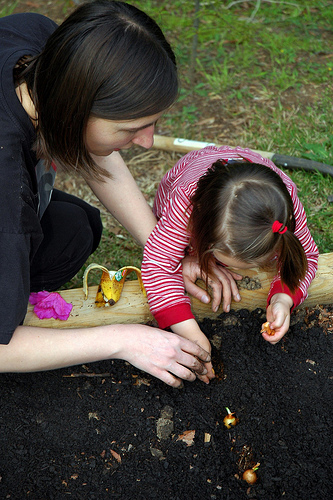
The veggies require a little intervention. Fortunately, we have a helper these days.

At this point, L is so fascinated with imitating us that she gladly helps. She'll clean, mop, "clip" her finger nails, clean out Mama's ears -- everything we can do, she can do, if not better in her own eyes.

Hopefully, we can keep that willingness -- that desire -- to help developing.