matching tracksuits

fun in threes, sometimes fours

The Eternal Project

The Perpetual Motion machine does exist: it is mischievously named "the house".

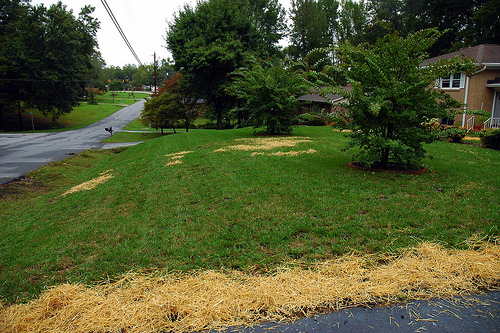
When we moved in, the front looked like this:

June 30, 2007

Grass that was fried; shrubs that were ignored.

A general feeling of neglect.

A clogged sewer line a year ago finally prompted us to pull out the dying boxwoods; embarrassment at having the worst-looking lawn in the neighborhood prompted us to emergency measures with our yard.

Now, our yard is well on its way to becoming the envy of all who drive by.

The boxwoods are gone, roots and all.
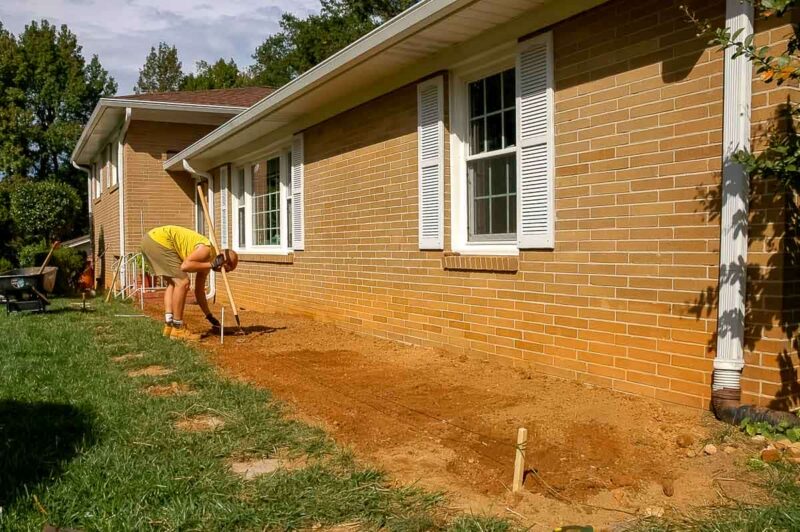
As is my back.
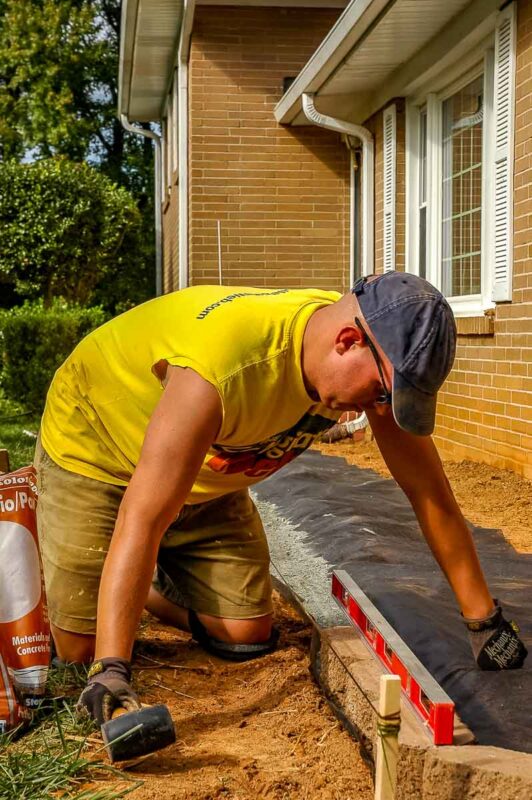
The replacement bushes are still sitting in a nursery somewhere: that's Wednesday afternoon's project. In the meantime, the bed sits empty.

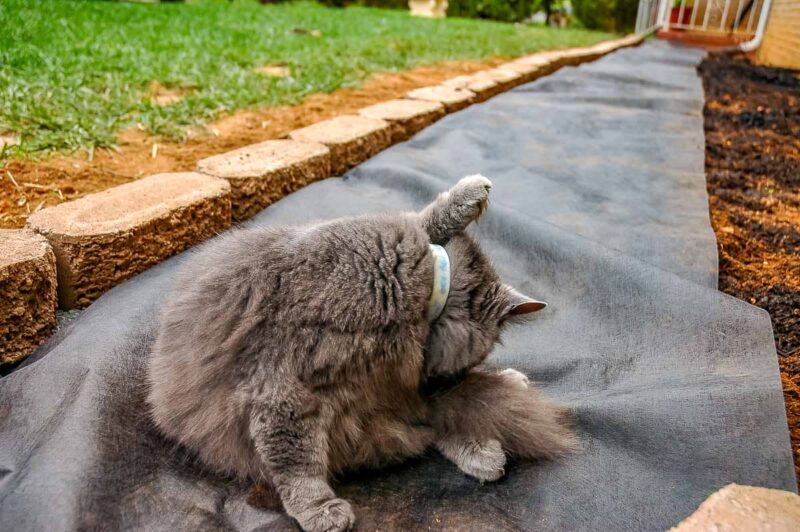
The upshot of all of this: the cat has a new place to nap.
Opportunity Lost

Not many people have a chance, a clear-cut chance, to be magnanimous. Obama had one today, and he blew it. By his own admission he doesn’t deserve the Nobel prize, yet he accepted it, leading to countless howls from the right and some raised eyebrows on the left.

He should have declined to accept it. There’s precedent: Lê Ðức Thọ was awarded the Peace Prize (along with Kissinger) in 1973, but he did not accept it, explaining that there was still no peace in his country. He’s the only person to decline it, and it shows a certain honesty that is rare.

Obama should have said, “I am humbled by the honor bestowed upon me. However, I feel I do not deserve it; therefore, I respectfully decline to accept the award.”

What could anyone, on the right or the left, have said about that? Amid the inevitable cries of “political posturing,” a reasonable person could only, however begrudgingly, admit that it was a magnanimous decision.

Shock and Disbelief

In preparing to read the dramatization of Anne Frank’s diary, I spent some time going over the Holocaust with students. I was taken aback at how little they seemed to know about it. “A bunch of people — I think they were Jews — got killed” seemed to be the general view. They do know something about it now, but their questions revealed both how complicated and unfathomable such an act is.

Most common was, “Why did they hate Jews?” Why indeed? Many answers, none of them short and simple. I offered a few: notions of Jewish conspiracies; Jews as “Christ killers” and the old blood libel; the fact that there are a substantial number of Jews in banking (which is directly traceable to early Christians’ reluctance to engage in usury) as proof of some international Jewish conspiracy. All those explanations in turn (which is why I was silent about The Protocols of the Elders of Zion).

As I spoke, though, and showed pictures and short clips of survivors, it was almost eerie how closely they paid attention. Any noise brought immediate shushing, and the look of shock on everyone’s face told me that there is at least one thing they’ll remember from their time with me.

Rituals

Having a child makes it obvious why there are yearly rituals in all cultures. They measure time and serve as a standard for growth and progress.

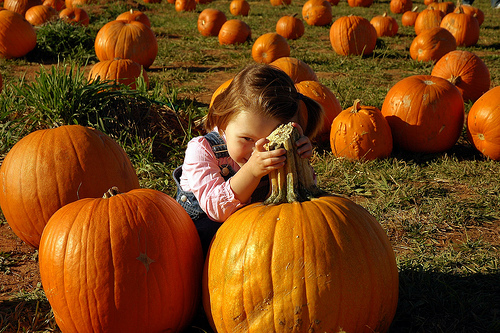
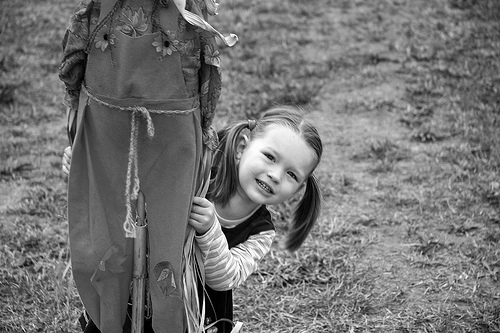
A year ago, L was small enough to hide behind a pumpkin.

DSC_1531
October 26, 2008

She was considerably bigger this time around, and more independent. Getting her to go here or there and do this or that was much more difficult. She had her own session photos in mind and was not really thrilled to cooperate with photographer or assistant -- even when we switched roles.

And her imagination has developed, not to mention linguistic skills.

"Tata! It's a dragon!" she cried on finding a bright gourd.

DSC_8149

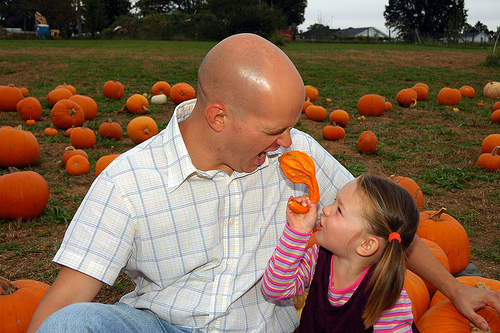
Yet, she still can be surprised when the tables are turned and another gourd counterattacks.

DSC_8154

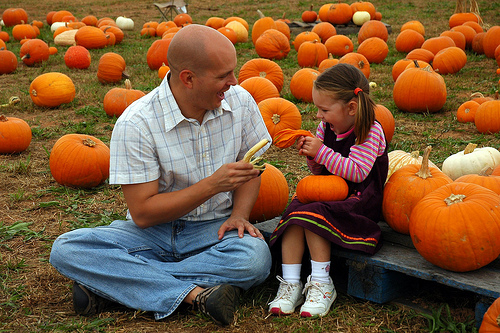
We battled for a little, with each Dragon Gourd showing a propensity to tickling its victim.

DSC_8167

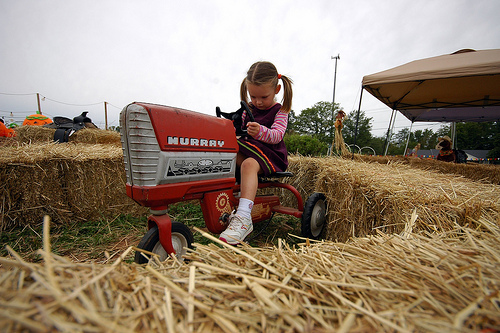
The tractor was just as fascinating this year as last year, but this year, she could pedal. Then again, in the intervening months, the chain had broken, so L's efforts didn't result in much more than a bit of confusion.

DSC_8182

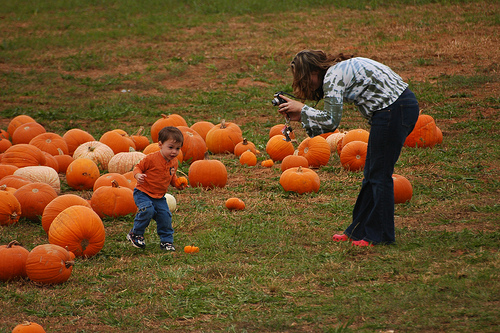
There's something about a field of pumpkins that inspire people to bring their children for pictures. The contrast? The obviously seasonal motif?

DSC_8208

L came up with her own poses this year. The set involved as many small pumpkins as could possibly be gathered.

DSC_8222

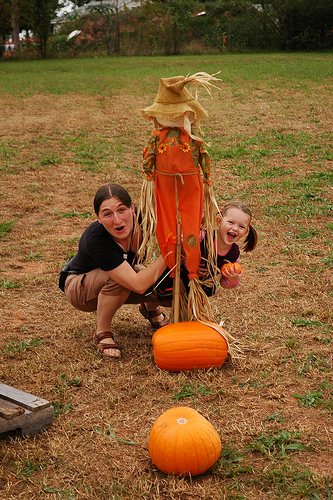
The session was not to be, though. L saw the scarecrow, and with a little gentle suggestion from K, we managed a shot that more accurately shows L's personality: playful, silly, always looking for a surprise.

DSC_8229

What will next year bring?

DSC_8235

Perhaps a third photographer?

International Festival

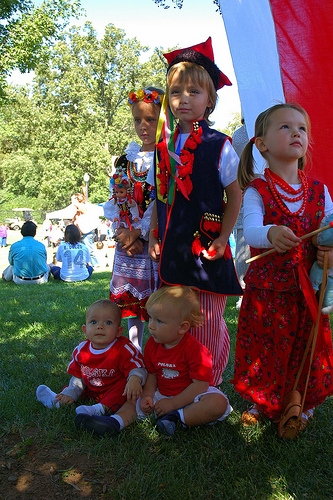
Keeping kids in touch with their non-American heritage can be tough. The Girl hears Polish daily, but still rarely speaks it.

Even rarer is the opportunity to dress traditionally.

DSC_8098

This Is a Test

I gave three of my four classes a test a few days ago. It's worthy of comment because I so rarely give tests. In fact, I despise giving tests. It's true that they're a relatively quick way to assess student understanding, but our school district has such a regimen of standardized tests and tests from other teachers that I seem always inclined to find alternative methods of assessment.

Recently, our state mandated yet another standardized test for eighth graders. We now take the MAP (Measure of Academic Progress), ITBS (Iowa Test of Basic Skills), Explore, and PASS (Palmetto Assessment of State Standards) tests. Additionally, students who elect to pay the fee can take the PSAT test. Each of these tests require multiple days to complete, and so we have thirteen testing days built into the 180-day calendar (not including the day it takes for the PSAT).

When teachers complain that their students are drowning in an acronymic sea of standardized testing, this is precisely what they mean. When states complain that their schools are underfunded, these tests represent a significant expenditure.

What are these tests for? What is taxpayers' money buying?

The PASS test is the assessment used for NCLB (No Child Left Behind) compliance. It's a new test, replacing the PACT (Palmetto Something-or-other Challenge Test or something like that) at the start of the 2008/9 school year.

Because it's a new test, there are additional costs as the first year's results are audited to determine cut-off points for the achievement standards. This in itself is problematic for me, because it underscores the arbitrary nature of any standardized test. Once the results were in, test administrators began analyzing the scores to determine what score should be the thresholds for the Exemplary/Met/Not-Met standards. And what standard did they use to determine those standards? Did they perform basic statistical analysis that showed X% scored within some range, Y% scored within another range, and Z% within yet another and then used those numbers as the thresholds? If so, that would only measure future test takers against the first year's results. Surely there must be an objective standard, right?

The MAP test is administered twice, at the beginning and end of the school year. It is just what the name implies: a measure of the progress of individual students in the school year. It's useful for teachers to see how much progress individual students have made; it's useful for administrators to determine how much progress the teacher has made. Of all the tests, this has the most practical application.

The ITBS is a measure of basic skills. I'm not sure its purpose. We get attractive printouts that we send home. That's about all I use it for.

The Explore test is the newest addition. It is, as far as I can determine, a pre-ACT test. Useful, I suppose. For all students in eighth grade? I'm not so sure.

We began taking the Explore test today; we'll finish up during the first half of tomorrow. The one heartening aspect of the test: at least one student wondered aloud about the impact so much testing was having on his education.

Getting to Know Them

Donald Graves, in A Fresh Look at Writing, suggests a deceptively easy pen-and-paper method to gauge one’s familiarity with students. After creating a three-column table for a given class, begin writing students’ names in the left-hand column and including information about interests (especially academic) and not-quite-obvious personality traits in the middle. The third column is to indicate whether that has been specifically confirmed by the student.

Doing it all from memory should show how well a teacher knows his students. It also shows the students a teacher enjoys and worries about most (the first listed) and the students who are not immediately noticeable in the classroom (those listed last and/or forgotten).

I tried it mentally immediately after reading Graves. There is only one excuse for how insufficiency and insignificance of my list: it’s still very early in the year. It looked something like this (names changed, of course):

Samuel Enjoys talking with friends; plays The Godfather like a master but has never seen the film √
Justine Plays violin; switched piano violin . √
Andrew Likes eating hot food √
Susan Shy; admittedly tends to think of herself as inferior to many others in her class √
Janet Likes dancing

It continued on like this for another five or six students.

I learned that I still know nothing terribly significant about anyone in that class. I have given myself a mandate: learn more about these students by the month’s end.

Yet how? The opportunities to have a genuine conversation with students are few. Certainly one could simply spend class time talking to some of them, during student conferences and such, but that’s not always the most efficient method, not to mention it being a particularly ineffective use of class time.

A few of the ideas I have begun implementing:

  • In the hallway between classes. Because our school uses the team-teaching model, students stay in the same area of the hall throughout most of the day. They have the time to chat with each other, so they have the time to chat with me.
  • In lunch lines. There’s always a long line of students waiting to get their lunch. They chat with each other, and it’s a good, non-academic environment for conversation.
  • In the hallway, on the way to the library/lunchroom/computer lab/etc. While I require my students to remain silent as we walk along, I break my own rule and chat with one or two of them quietly. Perhaps it’s unfair, but as a colleague tells students, “I earned a college degree to get this privilege.”
  • During fire drills. Once we get the students outside and counted, there’s always a few minutes before we’re called back into the building.

The single best way to get to know students, though, is through a journal assignment. I have one class writing a thrice-weekly journal, and I learn more about the students in ten minutes of reading than I could ever learn in 180 days of teaching. This girl runs cross country; that boy enjoys using Google’s Sketch Up; she has a talkative father; he has a talkative mother. I walk into class the next day and see a whole person rather than a 50-minute sliver.

Russian Spam

In our spam list was the following comment:

Ты как обычно радуешь нас своими лучшими фразами спасибо, беру!

Given the source, it seems to be a spam. But “беру” also seems to be an off-kilter version of my name, so I struggled with it a while.

Then I called K over, and we puzzled together.

Our Russian is rudimentary at best, but we pieced together a bit. Apparently, the spammer/commenter wanted to say that “You so…” (Ты как) something or other about “enjoying” or “being happy” about one’s own фразами.  And it ends with the the first word most folks learn in Russian: “спасибо.” “Thanks.”

Of course, these days, one doesn’t have to trouble oneself over an unknown tongue — there are plenty of translation sites out there. Google translates it, “You’re normally so happy about us with the best phrases thank you, take.” Little help there. Still, it sounds quite spamolicious.

In response, I say “спасибо.” I think.

Update

Russian spam looks just like English spam: Спасибо автору блога за предоставленную информацию. “Thanks to the blog author for the information provided.”

Critical Mass

Basilica of St. Mary

To hear Catholic Mass in one's own language was, for centuries, impossible for the majority of Catholics. Vatican II changed all that, allowing Mass to be celebrated in the vernacular. As a result, Catholics worldwide hear the same Mass yet different sounds.

Poles in America experience a certain foreigners in the English Mass, regardless of the individuals' fluency. This goes a long way in explaining the significance of the Polish Mass celebrated in Greenville today. A Polish priest, on loan from Polska, is stationed in Columbia, a mere hour-and-a-half from Greenville. After much persuasion, he came to a little church outside Greenville proper, and probably almost every Pole in a thirty-mile radius was there. The kids stood and knelt at the all the proper times, but being raised in the States, they didn't know the hymns or the responses/prayers. They seemed lost. I would imagine that's what they're like visiting Poland as well: strangers in a land that sounds strangely familiar.

For me, it brought a smile. The first time I ever attended a Catholic Mass was in Poland, and Polish is, for me, the language of liturgy. From hearing alone, I know the prayers and formulations in Polish better than English.

Aside from the language, there are subtle and not-so-subtle differences. Poles still do the mea culpa in the Confiteor. "Moja moja, wina, moja wina, moja bardzo wielka wina," all chant in the church, jabbing their thumb into their chest with each "moja wina."

At the end of the Mass, he asked for a show of hands for a commitment to a monthly Polish Mass. Every hand in the church went up, including mine (after some prodding from K -- I was simply absent-mindedly daydreaming about the oddity of hearing a Polish Mass after so many years).  Critical mass achieved, the priest then announced that there would, henceforth, be a monthly Polish Mass. Applause broke out, and it was then that the significance of the moment was clear. A bit of their heritage, their youth in Poland, their past given place right here in Greenville, home of Bob Jones University, one of the most virulently anti-Catholic institutions in America.

While I was living in Poland, the closest I ever got to getting a taste of my own culture was to drop into McDonald's or watch the latest American blockbuster.

10,000 Holes

Though not in in Blackburn, Lancashire. Rather, they're in our yard, now.

DSC_8066

Weeding, aeration, leveling, seeding, fertilizing -- it's been a long day.

Rise to the Top

For many years of my youth, my mother and I went on Wednesday afternoons to a nearby farm to get fresh milk. The cream would sit on top, a visible band of white that dared you to disturb it.

Eventually, the couple stopped producing milk for sale and we went back to store-bought milk. It was a let-down.

Through a friend, though, K and I have found another farm.

DSC_8061

Now if K’s mother were only here for a visit so she could make her amazing doughnuts…

Propriety

Pre-teaching
Kupa is Polish for "poo-poo", and it's pronounced, "koo-pa." Siusiu is Polish for "wee-wee", and it's pronounced "shoo-shoo."

When you're nearly three years old, everything has a proper method. There is no gray area; there are no acts or activities that don't have strict rules, regulations, and expectations.

Rituals abound, and often, the adults don't even realize there is a ritual for this or that, let alone what the various elements of a given ritual are.

L's morning rituals are set. We wake Her Highness up, and the first stop is the kitchen bar. We get out the milk; she opens it. We bring her the cocoa mix; she opens it. We pour the milk; she adds the cocoa. She stirs and tastes; we stir and taste. She closes the sippy cup; we check that it's tightly screwed on.

Any violation of these sacrosanct rituals is troubling. Try to open the milk and L cries, "I do it! I do it!" Try to screw on the sippy cup lid before she has a chance and she cries, "I do it! I do it!" It has become so problematic that we introduced a ritual of our own: "L's Magnificent Mornings." It's a sticker-bribery system, basically. It works, but it has only added one more ritual to our ritualistic lives.

Most of the rituals appear without warning. A new ceremony concerns entering the bathtub. It is not to be done at one end or the other, but precisely in the middle. Galaxies collide and gravity dissipates otherwise.

Occasionally, we get to watch a ritual being born. Slowly, it develops and moves from the status of "occasional addition to an existing activity" to full-blown sacrament.

This afternoon, I might have witnessed it.

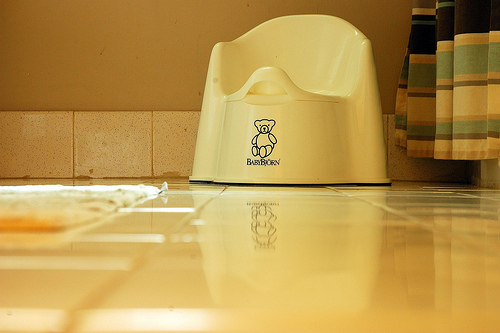
DSC_8037
20 sec, f/8.0, 55 mm

L came to me asking for help in the bathroom. This can only mean that baby wipes will be necessary. After L created her "awful smell" (as she once referred to it), I suggested that we flush it down.

"No, I need to siusiu," she replied solemnly.

"Well, we can flush and then you can siusiu," I suggested.

She shook her head. "No, no! Kupa needs to swim!"

I suggested that kupa might have more room in the big potty and she reluctantly agreed. If I were to place a wager on it, though, I suspect it won't be the last time L tries to protect kupa's right to exercise.

Artist

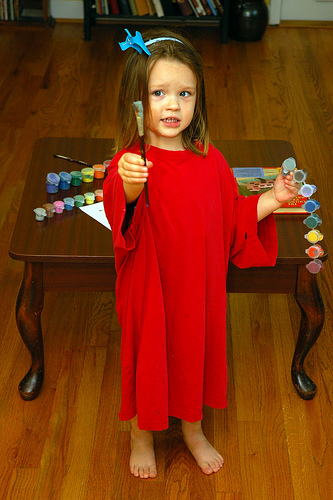
Occasionally, a picture can capture someone’s personality perfectly.

DSC_7996

Manners

The room was dark; L and I were in the rocking chair, just moments before she went to bed. A time to calm down, this time of day often brings out stories about how L's school day went.

L began telling me about the order they sit in during circle time.  She's in a new group, and most of the children in there are new friends, so there were lots of new names floating about. She hardly finished one name when she started another. Then a pause.

"And beside Alex..." her voice tapered off.

"Who's beside Alex?"

"I don't know." We rocked for a few moments, then she amended it. "I don't know her name."

"Why don't you ask her."

"No," said L in a quick, clipped voice: it's how she's shortened "I don't know" for many months.

"You just have to introduce yourself. Walk up to her and say, 'Hi. My name's L. What's your name?'" A few more rocks, then I suggested we practice.

Within a few moments, she began improvising -- "What's your name? My name's L." -- and adding a handshake with, "Nice to meet you."

The following night, I asked her how it went. "Did you meet that girl from your circle time?"

"No," she replied, and then gave a meandering explanation that only a toddler could come up with. Still, we practiced again.

Malden Center

Funny how an odd thought can lead to nostalgia. Thinking about Boston before going to bed, I did a quick search on YouTube. I found a video of the MBTA (Massachusetts Bay Transportation Authority) stop at Maulden Center, Orange Line.


Like Poland, I don’t miss it and I do.

Two things I miss: first, Boston is a big city packed in a small town. The area the Greater Boston area covers is really small, and the are Boston proper covers is minuscule. The rest is Cambridge, Allston, Brighton, and a handful of others. And Malden, where I lived. Yet it has a lot of the advantages of a larger city: vivid downtown, arts, music, etc.

DSC01985

Second, I miss public transportation.

DSC01989

I miss being able to travel from here to there to way over there and back again without a car. A monthly T-pass, a bicycle, and the occasional taxi were all I ever really needed.