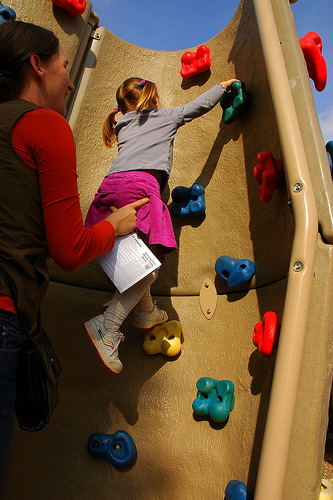
matching tracksuits

fun in threes, sometimes fours

Babcia’s Coming

In a little over a month, Babcia will arrive for a several-week visit. It will be the first time in a year and a half that we’ve seen her; L has gone from being virtually an infant to being something more than a toddler.
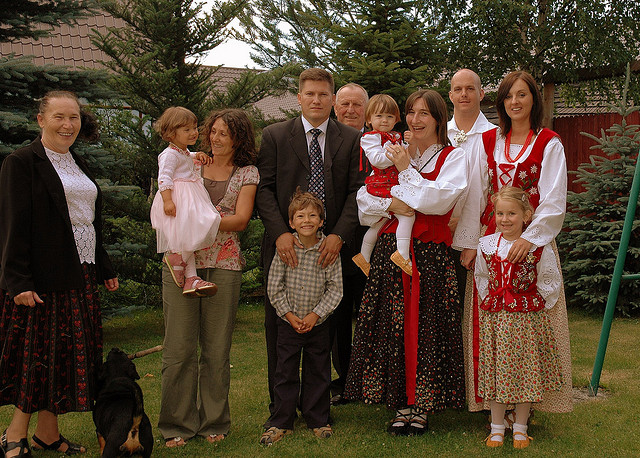
DSC_7309

L is excited about the arrival. She mentions it every now and then, and every time an airplane flies over our house, L points and asks, “Is that Babcia?”

It will be a time of linguistic development for L. She understands Polish perfectly, and she even mixes a few Polish words into her English vocabulary. She doesn’t speak more than these occasionally mixed up words. When Babcia arrives, though, it will be time to start speaking Polish.

Only recently it occurred to me that this might be almost as difficult as learning to speak English. Her initial instinct will be to speak English, and knowing L’s stubbornness, she is likely initially to refuse even to try. Babcia has a secret weapon, though: fluent Russian. She might turn the tables on L.
Measured Words

Lesson Planning

Robert Frost reportedly said, "Writing poetry without rhyme is like playing tennis without a net." The same could be said of meter-free poetry.
We've been working on poetic meter in English I Honors, and yesterday I sent them packing with deceptively simple homework: write a sonnet.

"What's a sonnet?" they thought. Fourteen lines of iambic pentameter -- da-Dum times five.

One by one they filed in today, and one by one they declared, "That homework was a nightmare!"

We took some individual lines and examined them, adding words and massaging the lines until they were roughly iambic pentameter. The homework for tonight: rework the first four lines so that they are all the proper meter. Just before the bell, I reminded them of the next hurdle in sonnets: "Remember, we're working on English sonnets, so ultimately we'll be having an a-b-a-b rhyme scheme for this first quatrain."

The moans were overwhelming, but at the very least, they have a newly found respect for Shakespeare: "He wrote 154 sonnets."

"Did he not have any friends?" one young man asked.

Manic Depressive

The problem with teaching is that it leads to manic-depressive thinking. When things are up, they’re really up. Confidence soars; it’s easy to get out of bed; grading and planning are a snap. When things are down, it can make one lose confidence in the entire national competency and grind one down into a pessimism that is almost palpable.

Riches

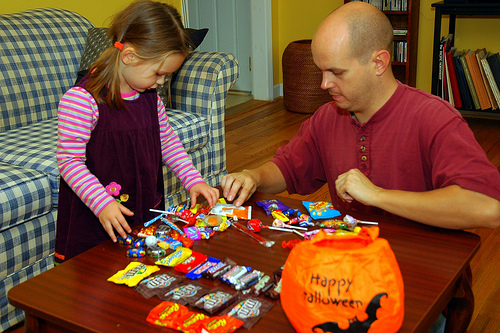
With L's newly found sweet wealth, a daily activity is the counting of the candy. We pour it all out at the kitchen table; we dump it on the coffee table; we spread it around the floor -- we count it again and again. And again.

DSC_8750

It's a blessing and a curse, really: she is counting, but I'm not sure what she's counting is actually worth counting.

We were hoping that L's initial reaction to candy -- a wrinkled up nose and immediate retreat -- would last, but she's developed a love for sweets that we absolutely have to monitor.

"That much candy will last you for two months," I guessed the first time she dumped it out; with our one-a-day rule, I just about got it right.

Trust but Verify

When Gorbachev and Reagan signed the Intermediate-Range Nuclear Forces Treaty, Reagan used one of his most loved slogans:

The President: [...] We have listened to the wisdom in an old Russian maxim. And I'm sure you're familiar with it, Mr. General Secretary, though my pronunciation may give you difficulty. The maxim is: Dovorey no provorey -- trust, but verify.

The General Secretary: You repeat that at every meeting. [Laughter]

The President: I like it. [Laughter] (Source)

It was in that spirit that I approached an administrator to verify a student's explanation of her absence.

"No she did not come talk to me" came the reply, and my own words to the students, from the beginning of the year, echoed: "You have my trust now. Once it's gone, it will take a long time to rebuild it." This young lady, sadly, has lost my trust.

I'm not sure she'll care. I can see her brushing it off as if it's no big deal, and it might very well not be a big deal. Someone who hasn't spent much time in an environment that fosters trust might not know what it's worth, and in that case, it's difficult not to try to care for her.

Normal

A couple of weeks after our wedding, K and I went for a walk in the fields of Lipnica Wielka, the village in southern Poland that was my home for seven years, our home for one. We'd returned home from our honeymoon at Balaton, moved her stuff to our small apartment, and begun the process of settling down.

My Wife
Lipnica Wielka, Poland (August 29, 2004)

The day after I took this picture, I wrote in my journal,

Finally everything seems to have settled down a bit. [K] and I have moved into the apartment; we've done some decorating; we've had dinner here; we've gone to [K's] folks' house for Sunday lunch already. And here it is, just before seven, and I'm writing in my journal. Everything's back to "normal" in other words, but that "normal" isn't quite like it ever was before.

It's odd how one's sense of "normal" changes so easily. For several years, we had a "normal" newlywed life: traveling, having parties, meeting friends for dinner, staying up.

Burping
January 7, 2007

Then L came along, and for a while, getting no real sleep and always having an infant in our arms was "normal." Getting up multiple times in one night became an expected routine, and it often had its own pleasantness: there is an unparalleled intimacy involved in helping an infant -- getting a bottle, changing a diaper, calming a nightmare -- when the rest of the city is asleep.

Now "normal" is "No!" and "No, no, no!" It's "I want it!" and tantrums. It's dealing with independence in a still-dependent little girl. It can be more frustrating than getting up for the fourth time with an infant.

DSC_8440

Soon enough, I know "normal" will be something entirely different, and it occurs to me, as it has to many through the millenia, that perhaps a static normal is not normal.

Halloween 2009: Candy, Candles, and Costumes

This time of year comes around and I begin thinking once again of all the different ways I've experienced it.

As a youth, I avoided it. Halloween was bad, just another marker of evil in an evil world. Our church explained it along lines like this:

Throughout mankind’s turbulent history, Satan has always managed to find a way to separate man from God (Isa. 59:1-3) by tempting him into various sins and false ideas that may seem right–that may seem innocent and harmless–but are in direct opposition to God! [...] Even when the Roman Catholic Church attempted to gloss over strange pagan practices of the Celts and Romans, it introduced its own false, Satanic doctrines, passing them off as Christian. Halloween is riddled with deceit and falsehoods. (Source)

In Poland, I experienced All Saints' Day: quiet reflection, talking with family and friends, and candle-light cemeteries.

DSC00035

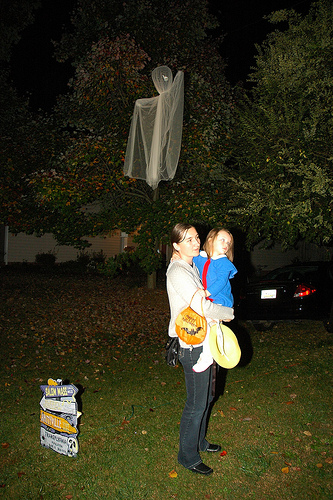
And now, with a child of my own, I experience trick-or-treating for the first time. I can't say that it's something all that thrilling: not being a big candy fan myself, I can see that I verily easily lived without the experience. The thrill is vicarious.

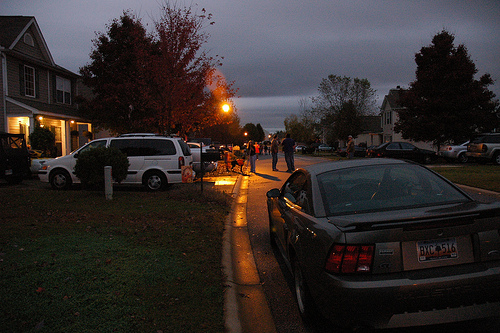
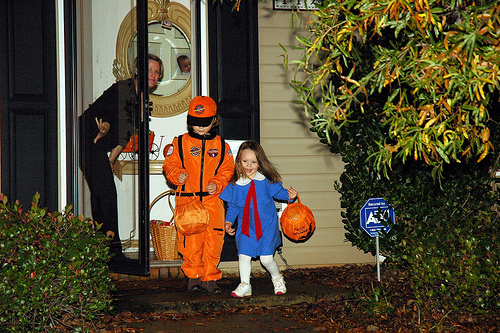
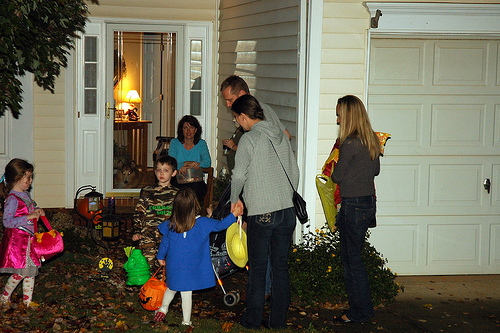
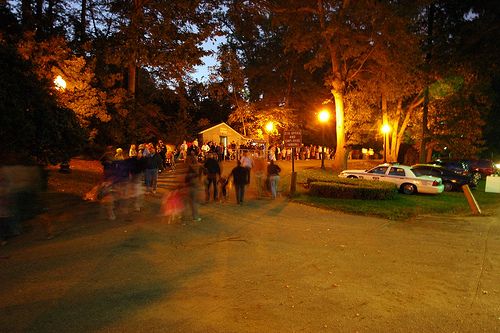
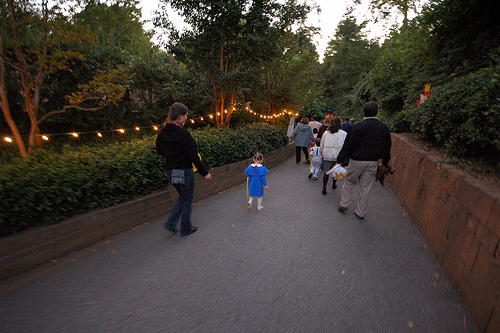
This evening, we took L for an evening of trick-or-treat in a well-heeled neighborhood where the houses are large and packed closely -- lots of return on the walking investment, and there were literally hundreds of families there.

DSC_8693

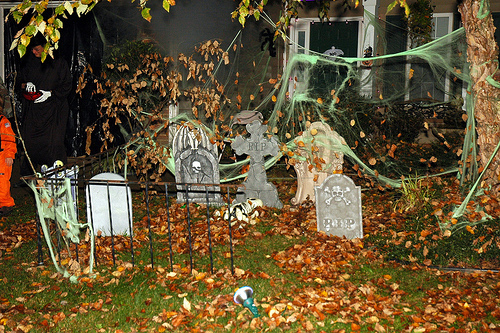
The whole neighborhood was decorated, with some going to the extreme.

DSC_8714

DSC_8715

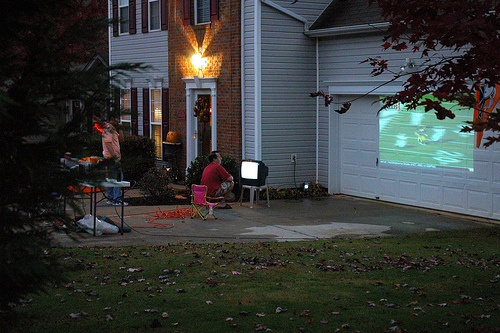
The hosts made everyone feel at home -- even the dads who were upset about missing the game.

DSC_8690

But none of us had any interest in the game. We -- specifically L and her friend -- were there for one thing alone.

DSC_8698

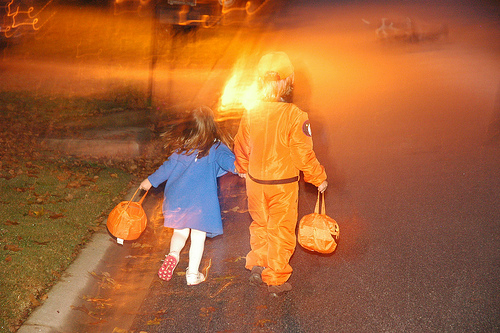
Almost every house had its front porch light on, so the candy was bountious. L's Jack-o-lantern basket was literally too heavy for her to carry. When we got home, we counted: 60+ pieces. Enough for two months.

DSC_8702

DSC_8716

DSC_8721

Busted

Reading over student work, I find a sentence that troubles me: it has a maturity that belies its author. I continue reading, and within a few moments, I'm pulling out the laptop and Googling the suspect sentence: it's lifted directly from Wikipedia. With a sigh, I write "See me" at the top of the paper, underlining it emphatically.

Dealing with plagiarism is one of my absolute least favorite duties as a teacher; it's especially tough when it's a student I really like, a student who is sensible and gives every impression of being a conscientious student.

Plagiarism is a sin that is hard to treat evenly. Is unintentional plagiarism as bad as intentional? Is malicious plagiarism ("He'll never catch on, the old doddering fool.") worse plagiarism motivated by laziness or procrastination?

As I'm reading, and I begin to grow concerned about the authenticity of a particular essay or poem, I find myself tensing up. A brier patch of issues awaits, and it's seldom a pleasant experience.

Celuacy for non-Poles, is a grade above an "A". It signifies mastery of a subject accompanied by superior extra-curricular work.

On one occasion, though, a young lady of supreme character managed not only to avoid losing respect but managed to increase it. She was a student in Poland, and she worked hard to have celuacy ("excellent") in as many classes as she could. She turned in a journal that was clearly plagiarized. (With English learners, it's easier to discover copied work, for obvious reasons.) I spoke to her about it, asking her why she'd done it.

"I just didn't understand that we weren't supposed to copy."

A lame excuse, but she had so endeared herself to me (to all teachers) with her hard work and dedication that I put off the inevitable. "Well, I'll think about how we can handle this; my standard policy, though, has always been to give a failing grade for plagiarism." She said nothing, but she was clearly upset.

The next day, she approached me. "I've been thinking about it," she began, impressing me with her correct use of the present perfect continuous tense. "I should have known better. I want you to give me a zero."

I did, but I made sure she had plenty of opportunity to offset that zero and maintain her high average.

She did.

Every time I've had to deal with plagiarism since then, I've hoped for such a response. So far, no luck.

Maybe tomorrow.

Retrieving Apples

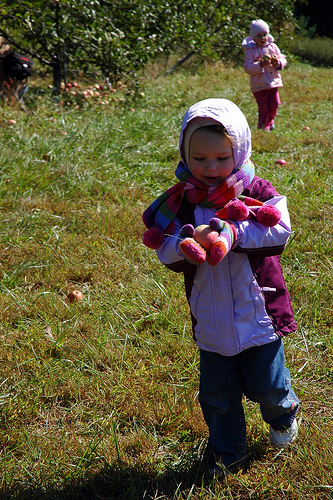
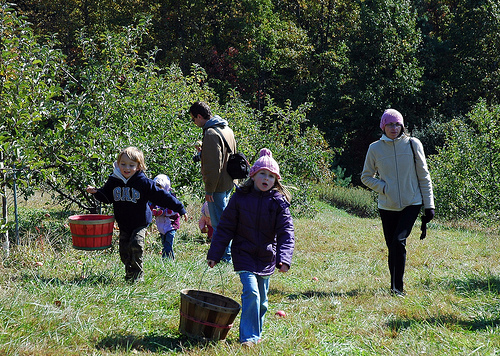
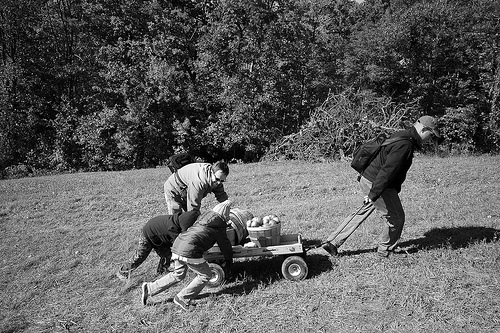
A trip to the orchard is supposed to involve stretching to pick the perfect apple that is just out of reach. It's supposed to mean a delicate tug and twist to remove an apple without causing others to fall to the ground. It's supposed to be about branches bending under the weight of apples. Last year it was about all those things. This year, it was a question of picking them off the ground.

DSC_8510

It's a little disheartening to be scavenging apples rather than picking them, but Pink Ladies -- sweet with a tart edge and a crunch that is audible -- are not apples one leaves to rot on the ground.

So we picked them,

DSC_8455

hauled them in baskets

DSC_8451

as well as wagons,

DSC_8541

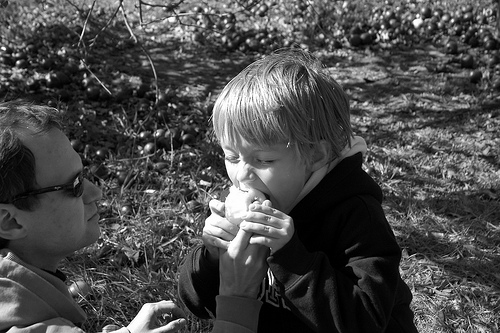
and brushed them off and ate them.

DSC_8461

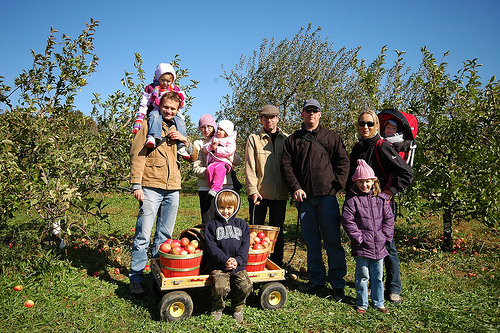
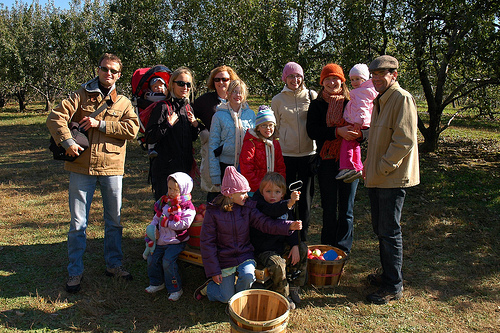
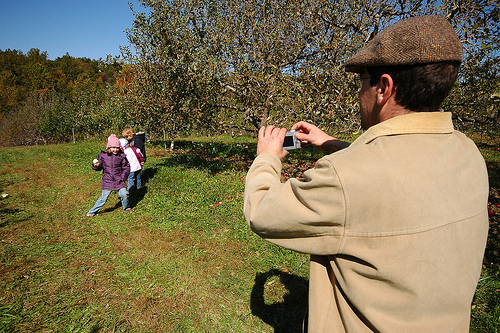
Every now and then, we stopped for a group picture, which reminded me of the greatest features of digital photography: easy sharing. No more line of cameras at the photographer's feet. No more "One more! Just one more!"

DSC_8538

No more last minute re-groupings as someone realizes that he wants a group picture, too.

DSC_8551

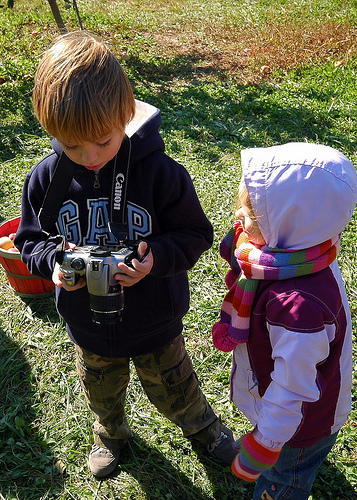
And that certainly was a possibility, given the number of photographers in the group.

DSC_8514

DSC_8518


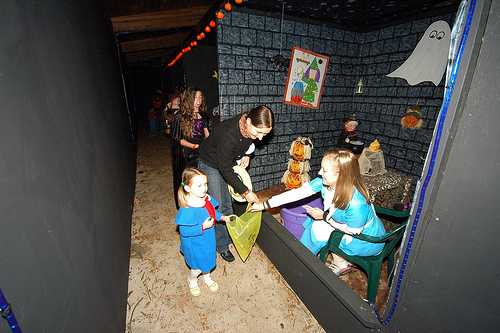
Madeline at Boo in the Zoo

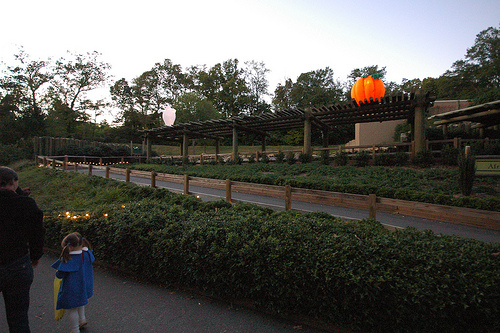
In an old zoo in Greenville that was covered with vines
Weaved hundreds of children in one very long line;

DSC_8659

The smartest, cutest, and funniest was Madeline.

DSC_8660

She was not afraid of the candy-sharing workers of the zoo,

DSC_8624

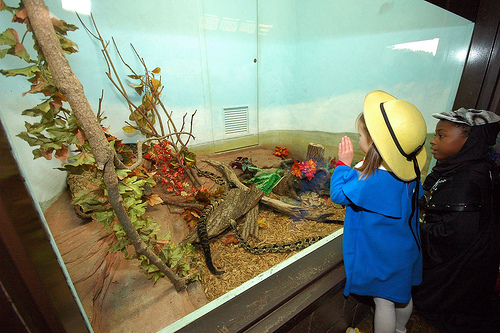
And to the snake behind the glass, she just said "Poo poo!"

DSC_8611

"Poo poo" to the lion, too.

DSC_8645

The animals in the cages had all gone to sleep,

DSC_8633

And it almost made poor little Madeline weep,

But the thought of more treats made her pick up her feet.

DSC_8635

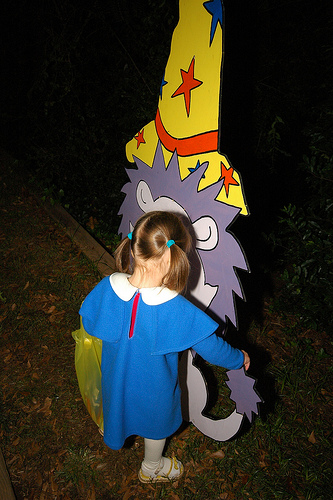
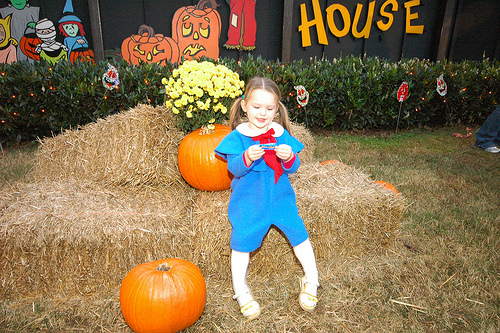
She posed for pictures with pumpkins and hay,

DSC_8643

DSC_8621

But in the end, she was glad to call it a day.

In the parking lot, "Watch out for the cars" was almost all she could say.

Amateurs

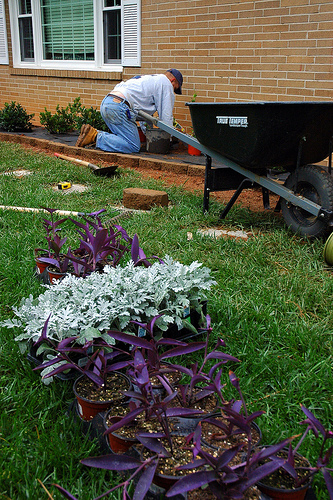
Four Saturdays of work. A couple of pros would have the backs and arms to get it all done in one day. We took somewhat longer.

DSC_8415

Part of it was inexperience. Having never dug up and recreated a planter, we had no idea how long it would take; we certainly didn't know how much effort it would require.

DSC_8421

Although the vision was very amorphous, we somehow knew what it would look like, though.

DSC_8432

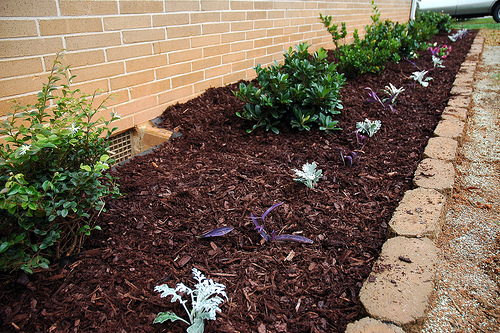
Now, instead of five boxwoods we have:

  • two Loropetalum chinense,
  • two Gardenia brighamii,
  • three Rhaphiolepis indica,
  • three Rhynchospermum jasminoides,
  • a line of alternating Tradescantia pallida and Senecio cineraria,
  • a small patch of Viola tricolor hortensis.
DSC_8428

Who am I kidding? I can barely remember the plants' common names, let alone the Latin.

The Bad Hat

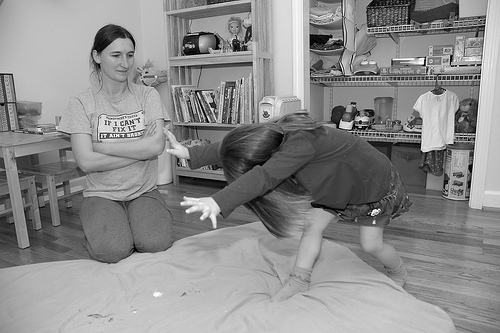
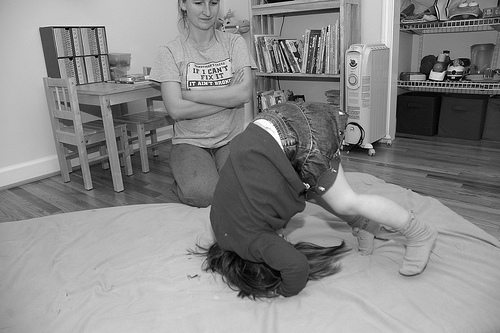
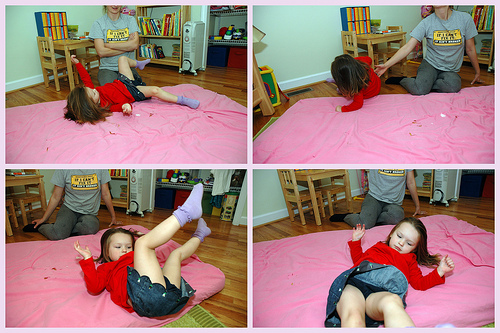
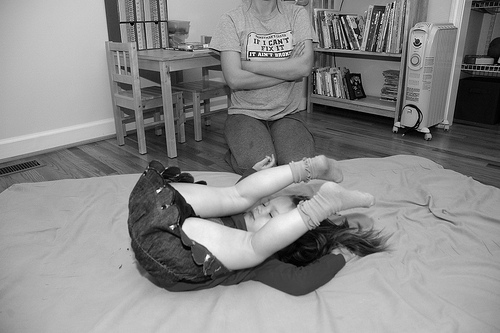
That Brooke — she’s a bad influence. At school, she teaches L to disregard all safety, to live on the edge, to do somersaults.

DSC_8355

DSC_8356

DSC_8357

There were a handful of less-than-perfect landings for each perfect one.

091015_flips

Jack-o-Lantern

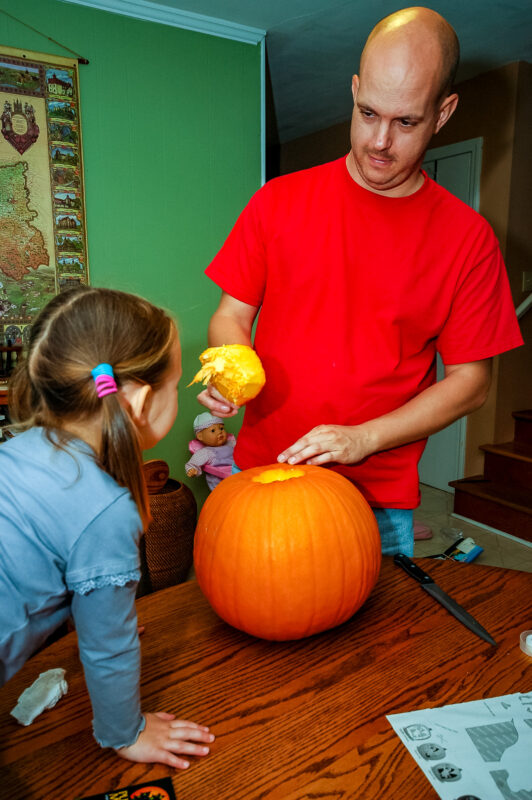
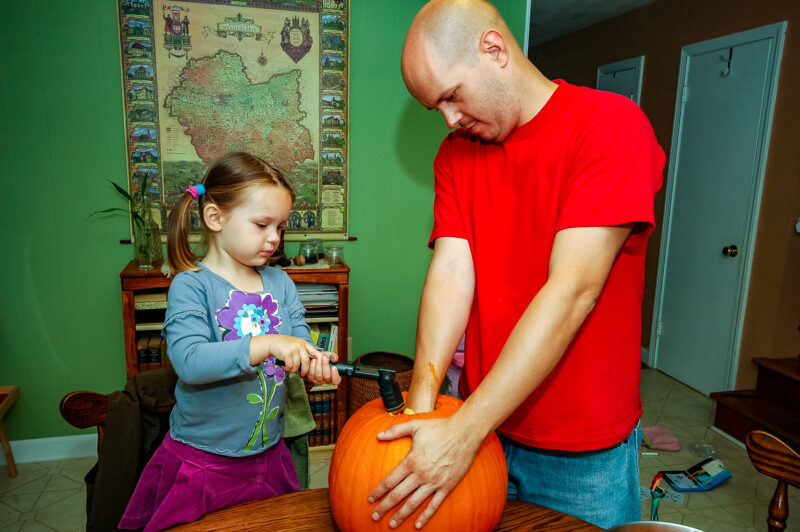
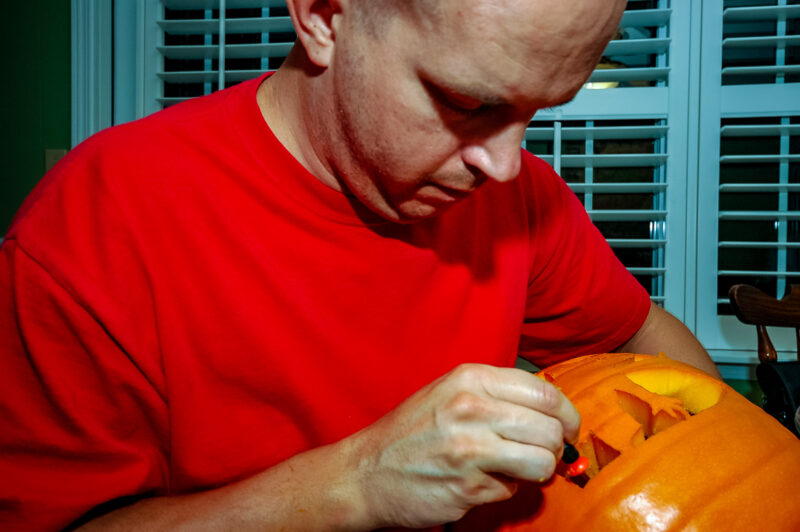
Carving a jack-o-lantern is a paradox: it requires forceful and delicate motions. And it's often simply messy.

Head = effective illustration of the effects of a wide-angle lens

The lesson I learned this year: don't cut the top hole too small. It makes scraping the insides a nightmare because there are no do-overs with that first cut.

There are also no re-dos with the delicate work.

Which is why our ghost is holding a blog instead of a three-candle candelabra.

Next year.

Outsourcing

For the first several months of L’s life, K and I could be fairly sure that everything she knew was something we’d taught her, directly or indirectly. Sometimes she would imitate us with prompting, sometimes without. There were few moments that prompted comments of “Where’d she get that?” and the like.

When she started spending time with other kids and adults at daycare, the gradual shift began. Slowly she picked up as much at daycare as at home; then, daycare overtook us.

Now she comes home with songs we’ve never heard:

Twinkle, twinkle traffic light…
Red means stop
Green means go
Yellow means very, very slow

She comes home with skills we haven’t touched on: tracing numbers and letters is the most recent.

These things come from the teacher, who told K this morning during the first of many parent-teacher conferences, that L is a “good old-fashioned girl” with good manners and a strong sense of right and wrong.

DSC_8285

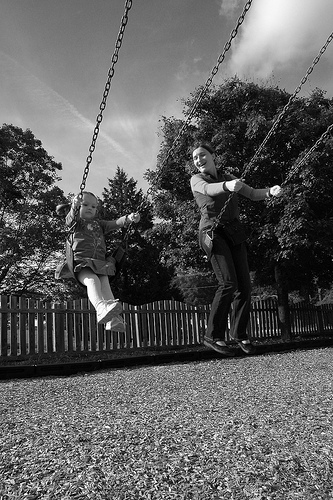
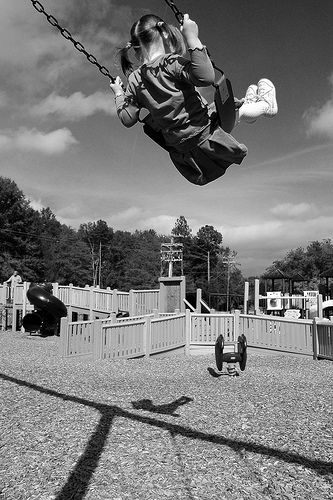
Other things come from friends. Brooke taught her how to swing by herself.

DSC_8289

She’s growing more and more independent.

DSC_8298

Now, she knows she can get her information from other sources, that she’s not dependent on us mentally any more than she is physically.

DSC_8303

Which, in reality, is still quite comforting: still many years to go. It comes in mercifully slow steps.