matching tracksuits

fun in threes, sometimes fours

Breaks

The thing about breaks is that they are the epitome of entropy:

Turning and turning in the widening gyre
The falcon cannot hear the falconer;
Things fall apart; the centre cannot hold;

Breaks encourage cessation.

As a teacher, I experience this every single Christmas break and summer vacation. "As soon as I rest for a short while, I'll accomplish so much." It never happens, for breaks -- in my experience -- encourage mere anarchy to be loosed upon my world. At least for a brief moment.

With a blog, it's the same. For two weeks, I've done virtually nothing here, and the break has been almost unnoticeable: with the end of the semester, I've been so busy that grading and more grading has filled any break I might have convinced myself I was taking.

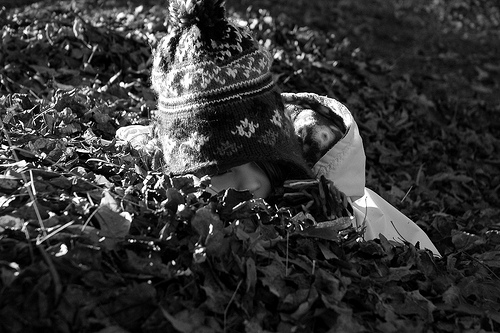
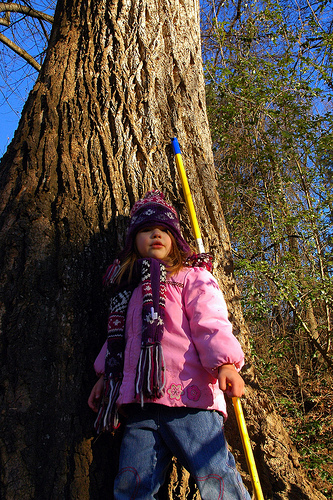
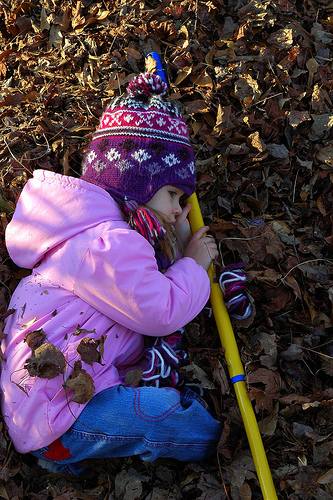
Through the break, though, there have been pictures:
DSC_0107

DSC_0109

DSC_0113

Quotes from Yeats' "The Second Coming"

Ladies and Gentleman, May I Introduce William Shakespeare

I have the privilege of introducing a group of twenty eighth graders to the unabridged, unadulterated Shakespeare. We began Romeo and Juliet this week, and it is the highlight of my year.

I began preparing a foundation earlier in the year by having the kids write sonnets and wrestle with iambic pentameter. I mentioned that Romeo and Juliet is, for the most part, in metered verse. “You mean he wrote the WHOLE play in iambic pentameter?” they asked incredulously. I got my Riverside Shakespeare, large enough to use in the gym as a free weight. “Not only that — most everything he wrote was in iambic pentameter.”

They were, in a word, terrified.

That’s understandable: the Bard does have quiet the reputation for being inaccessible to many casual modern readers: long sentences that sometime contain clauses with convoluted, inverted structure, and vocabulary that can make one’s toe nails curl.

We took it slowly.

In fact, we took a whole lesson on the prologue:

Two households, both alike in dignity,
In fair Verona, where we lay our scene,
From ancient grudge break to new mutiny,
Where civil blood makes civil hands unclean.
From forth the fatal loins of these two foes
A pair of star-cross’d lovers take their life;
Whole misadventured piteous overthrows
Do with their death bury their parents’ strife.
The fearful passage of their death-mark’d love,
And the continuance of their parents’ rage,
Which, but their children’s end, nought could remove,
Is now the two hours’ traffic of our stage;
The which if you with patient ears attend,
What here shall miss, our toil shall strive to mend.

The next day we spent an entire lesson on the opening fight scene. With some group work, class discussion, and multiple readings, they actually began to find Gregory and Sampson to be, amusingly, “losers.” Laughter in the classroom while reading Shakespeare is musical.

The result: comments like this on our online forum:

  • The language isn’t as hard as I anticipated.
  • Now that we have taken the time in class to discuss the play in normal language, I find it rather challenging but yet understandable.
  • I was scared at the beginning because i didn’t think i would get any of it. Now that we have started i actually understand most of it.
  • At first i figured the language would be extremely difficult to understand and read like words such as “tis” or “thy” or “ay,” but if you read the words you can figure them out over time.

The most enjoyable will be observing their reaction as they watch Romeo + Juliet, the Luhrmann version of 1996. Not the best version in cinematic history, but I show it to illustrate the timelessness of the story.

It’s going to be a fun month.Photo by shizhao

Reflection

Every single blog in the Western world has been reflecting lately on the significance of starting a new calendar year. I, for one, elected to abstain.

It’s probably a good idea. I suppose there too much reflection is almost an oxymoron, unless you’re facing a life-and-death situation. Which few of us ever face, thankfully.

So I’ve taken the start of a new year as an opportunity to do the opposite: stop reflecting. At least here. A short break. A breather.

Lights

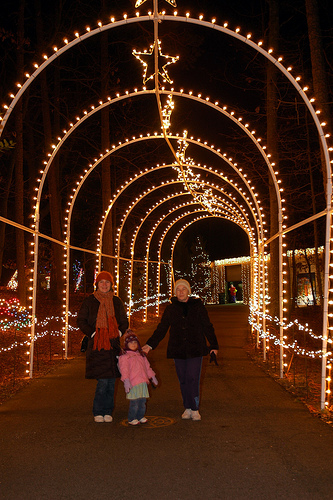
Lights are an integral part of Christmas. Certainly everyone breathed a Christmas sigh of relief with the proliferation of electricity: no more candles on dried firs. And outdoor displays enter the realm of possibility.

DSC_9947

Add the invention of the airplane, digital cameras, powerful flashes, and unleaded fuel and you get the perfect Christmas image -- post-Christmas, of course.

DSC_9948

Most of the Christmas exhibition at Roper Mountain was open to cars only, though -- how thoroughly American.

DSC_9966

We walked through the small pedestrian portion,

DSC_9971

took some pictures, and still more

DSC_9974

before getting back in the car and continuing on the winding road through the lights. Stopping was prohibited, as was exiting the car, so the pictures end here.

What a shame we couldn't have the option of exploring it all on foot. Then again, much of that would have entailed L in arms, so perhaps it's for the best.

New Games

I never really liked card games as a kid. I guess Uno was alright once in a while, but that doesn't really count as a real card game. Since Windows hadn't yet come out when I was a kid, I never learned to play Hearts. Spades was popular among some friends, as was -- oddly enough -- euchre, but I just didn't get it. What was the point? (Bridge, of course, was out of the question then; now, it's the only card game I truly enjoy.)

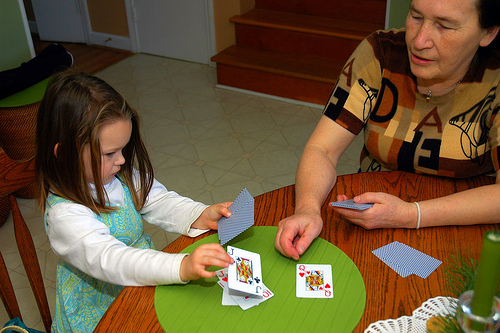
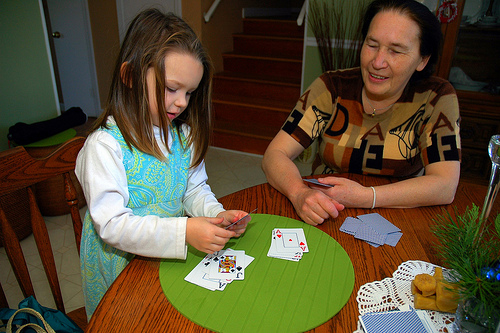
L learned a new game today -- "learn" being used in a most generous way. She didn't quite get the point; she couldn't quite understand why Babcia took the upturned cards for herself sometimes and sometimes gave them to her.
DSC_9909

I can't remember what this particular game is called in English. In Polish, it's "wojna" -- war. Perhaps it's the same in English. I can't really recall. (Another one of those odd circumstances in which I know the Polish but am unsure of the English.)

DSC_9914

Most importantly: the Girl enjoyed it (for a few minutes).

"Let's play it again!" she chimed again and again.

Still in English, though...

A Walk Downtown

A cloudy day. We'd been in the house all weekend, with the sole exception being a trip to the church on Christmas day. So after L woke up, we headed downtown.

Cloudy days are good for photographing moving water: slow shutter speeds.

DSC_9873
0.4, f/22.0, 18 mm

One step over-exposure combined with a closed down lens meant I was able to get the shutter speeds I'd always wanted.

DSC_9874
1/4, f/22.0, 70 mm
DSC_9875
1/4, f/22.0, 52 mm

But L wasn't interested in shutter speeds or f-stop values: we'd promised her chocolate milk once we got downtown, and that was her only interest.

DSC_9881

Latte for K and me; hot chocolate for Babcia; and fruit juice for the Girl (unfortunately, no chocolate milk to be found) -- we were ready for a walk down main street.

DSC_9887

There were a few of us out for a walk. Most everyone else seemed to be huddled in the bars and restaurants that line Main Street. I guess with the bowl games and the southern love affair with football it's logical.

DSC_9889

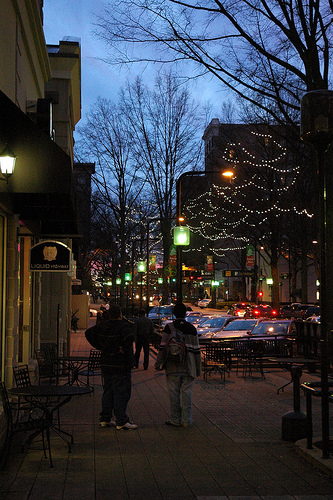
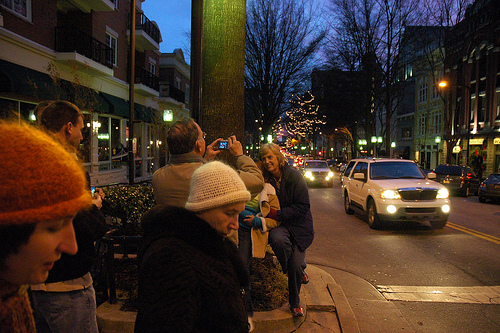
Still, there were a few families out. A grandmother and granddaughter posed for pictures against a backdrop of traffic as we crossed the street to head back to our car. Just a few blocks down the street the view is much more striking, with the waterfall and bridge and lights. As we walked by, I idly wondered about their choice of location.

DSC_9892

Being downtown always makes me a little frustrated that we don't head there more often.

DSC_9895

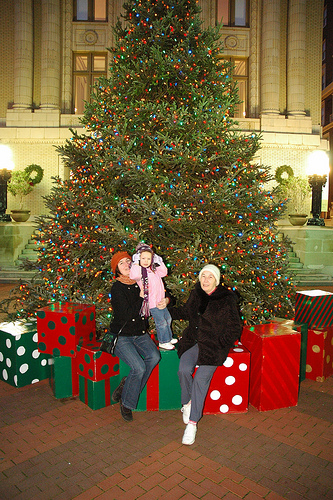
The winter answer to that question is obvious. After a couple of shots in front of the large city Christmas tree, we headed back to the car.

DSC_9897

We parked within view of some of the most expensive condos in the area. Location, location, location. Their owners probably don't complain about not going downtown often enough.

Accidental Christmas Present

We were leaving the church after a Christmas Mass in Polish when we noticed a group of men standing around the priest's new Volvo. Apparently, someone had hit his car and driven off without anything. I saw a little scratch, but I couldn't discern any significant damage.

The priest was angry.

He called the parish pastor to let him know it had happened, and he requested that the local priest announce it in Mass, asking for information.

"I guess this is my Christmas present," said the Polish priest sarcastically.

Perhaps it was.

It seems to me that the material should not be terribly important to a priest. It seems to me he should have been more concerned with the individual who hit his car: what would cause someone to do this? Is this a lack of conscience or a fear of facing consequences? It would have been heartening to hear the priest say something like this.

So maybe it was a Christmas gift. Maybe it was an opportunity to show instead of tell the parishioners that the spiritual is more important and things like cars and iPods are of little value. Perhaps it was a chance to preach with actions rather than words, to show forgiveness and express concern about the mental state -- the soul -- of the individual who committed the act. Possibly it was an occasion to show selflessness, to show concern for others before showing concern for one's own silly objects.

The homily had been about having Christ in one's heart and how God doesn't force himself on anyone -- a fairly common sentiment among Catholics and Protestants alike. I suppose the gift of salvation isn't the only gift God doesn't force humans to accept.

Wigilia 2009, Redux

More pictures from Christmas Eve dinner and festivities

DSC_9798
DSC_9801
DSC_9804

Wigilia 2009

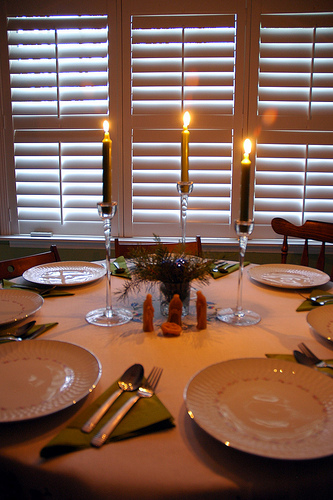
Everyone began preparing in the morning. Truth be told, K started weeks ago: making pierogi and uszki (two different types of dumplings) and freezing them. Still, with two soups, dumplings, kraut with wild mushrooms, and a main course (accompanying salads and such not counted) on the menu, we had to get a quick start.

DSC_9768

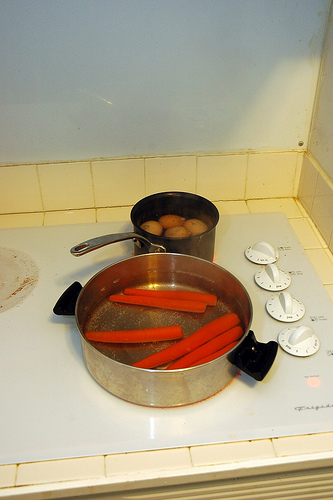
There was a salad to make, beginning with boiling veggies and eggs -- lots of this. And sauteing onions on a cosmic scale.

DSC_9764

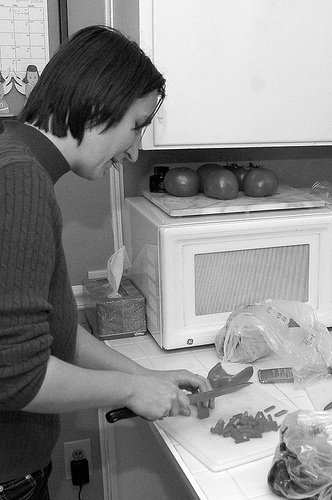
There was chopping galore: before and after the boiling; during this; before that. "Click, click, click," was the soundtrack of the morning.

DSC_9769

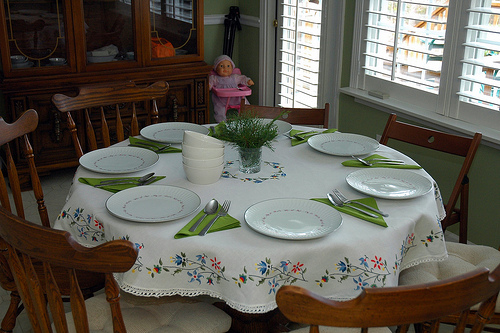
And there was ironing and setting of places.

In the end, it was the common lament: all the time spent cooking, and the food disappeared so relatively quickly. There's the eternal entertaining conflict: one wants them to savor everything, yet while everything is warm and the fish is still moist, one wants everyone just to hurry up and get to the next course.

It was a special wigilia for us because it was a special Christmas Eve for L: the first one she knew what was going on, possibly the first one in her memory for some time. She ate the barszcz; she devoured the mushroom soup; and she sat calmly as the rest of us ate. Afterward, Nana and Papa successfully spoiled her with their generosity (not to mention us: as I write, I'm listening to Madeline Peyroux's excellent new album, Bare Bones, on a new iPod -- the woman is incapable of making a bad album). With guests, gifts, and attention, the Girl danced, sang, smiled, laughed, and was the center of the evening. It's likely to be that way for, well, the foreseeable future.

Previous Years

Merry Christmas

You Have Five Minutes

It's amazing the number of confrontations and tantrums we've avoided by giving L a time frame. Simply establishing a temporal structure allows us all to avoid frustration. She knows what to expect and, more importantly, when; we know that we'll have a much more compliant little girl.

It works for almost everything. When L is watching a movie, it's referenced in terms of the film's scenes: "When this scene is over, we'll go for our bath." The scene finishes; she toddles off to the bathroom when requested to do so. When L is reading a book before bedtime, a reminder that she'll be going to be in five minutes elicits "Okay"; saying, out of the blue, "Okay, put the book up. It's time for bed!" is likely to produce nothing but conflict.

It would if some parts of life had more pre-established time frames.

Relativity

Rereading Faulkner's Absalom, Absalom! (the greatest achievement in American literature), I've realized anew how relatively temporally close Quentin is the events Rosa Coldfield is relating. Coldfield relates the story of Sutpen to Quentin (though he knows it already -- it's in his blood from growing up in Jefferson) in 1910, and Coldfield makes it clear that Sutpen was the reason God saw fit to let the South lose the war. Coldfield wants Sutpen's story told so that those

who have never heard her name nor seen her face will read [the story of Sutpen] and know at last why God let us lose the War: that only through the blood of our men and the tears of our women could He stay this demon and efface his name and lineage from the earth.

It is, in other words, a story of the Civil War. And while that seems so very distant to us now, it's easy to understand the lingering resentment Southerners feel in the story. After all, it's only been forty-some odd years since the war when Quentin sits in Coldfield's house, listening to the story of the most mysterious man in the county.

For us today, that's the nearness of the Vietnam War, something that's still in most everyone's cultural consciousness. Many are still upset about "Hanoi Jane," and I suppose that resentment might be something akin to what Coldfield is feeling in the novel: a resentment of a defeat that seems due to so many non-military, non-combat reasons.

Yet it's still difficult for me to understand the continuing resentment many white Southerners feel about a defeat that was almost a century and a half ago. "The South will rise again!" would have made sense in Quentin's turn-of-the-century culture, but another century after that and so many are still boiling about it?

Then again, a century and a half is nothing compared to the length and depth of some of Europe's ethnic and national resentments. Hatred and disappointment never die, I suppose.

Party

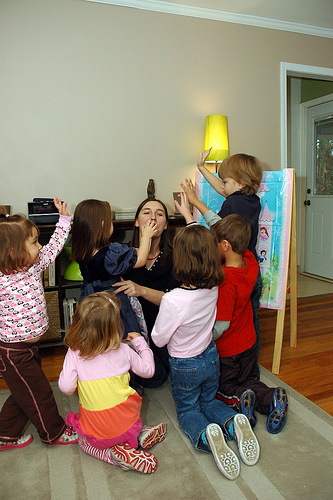
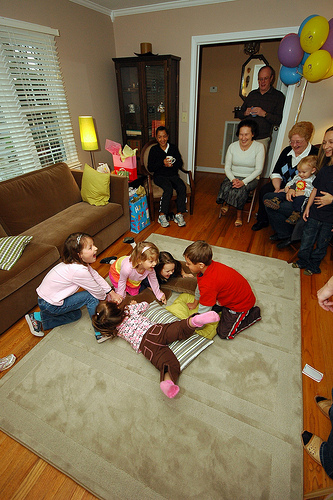
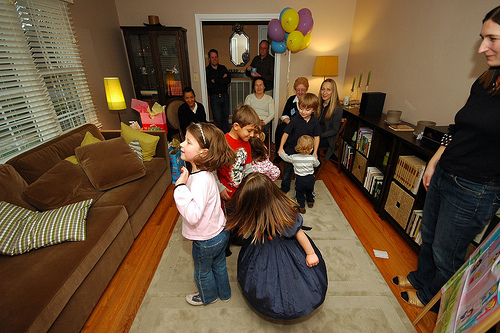
Though her birthday was three days ago, L's birthday party was today. Her first birthday was a much more adult-centered party. Her second birthday party was still dominated by adults. This year, it was all about the kids.

DSC_9658

There was pizza and ice cream and candy and juice, but most importantly, there were games.

DSC_9703

I believe we were seeing a little bit of L's school side, As mentioned earlier, L's teachers always comment on her mellow, compliant nature, something we don't see too often here.

Whenever we try to play a game with her, there can be tense moments of an attitude that can be described as a typical toddler egoism: "It's mine; I'll do with it as I please."

DSC_9720

Today, there was none of that. L exhibited a simple graciousness that never demanded to be first, never begged to have it all, never stated that it must be this way and not that. She was the perfect host. It was her party, and she didn't cry because apparently she didn't ever want to.

And who could blame her? L's two best friends from school were there, and what's more, there was dancing.

DSC_9732

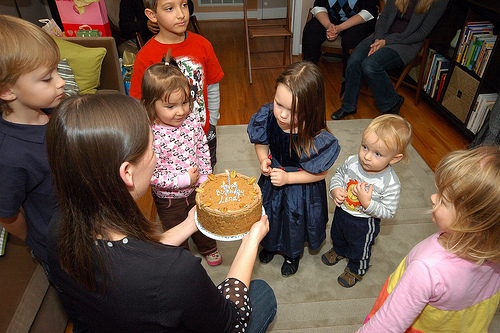
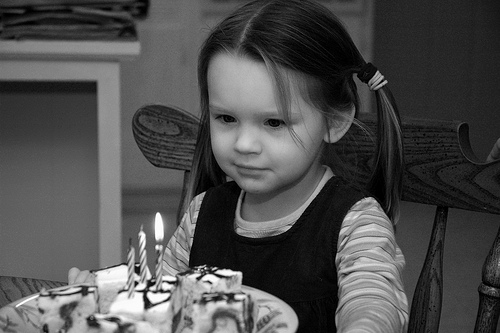
The three candles were out in a flash, and the party seemed to wrap up even faster. I glanced at the clock and saw it was, in fact, two hours since the first guests arrived.

DSC_9737

In a word, a success. "See you next year," said one parent as a best friend was leaving.

We're looking forward to it -- especially the Girl.

Three

Today, you turn three. You hold up your fingers, struggling to hold down the thumb and pinkie, and tell me — show me — that you’re three.

In the morning, we celebrate your threeness with activities arranged into trinities: three hugs, three kisses, three tickles. As we head to the kitchen, you decide you want three jumps, so I stand at the base of our small staircase and catch you three times as you leap, in complete trust, three times into my arms. We go back to your room and you want three pushes: I sit on your rug and you gradually, with steady pressure, push me over, landing on me with giggles.

For three years now, we’ve been three. While it’s hard to accept that it was three years ago that you rushed into the world after only an hour of your mother’s labor, it’s equally difficult to accept that it’s only been three years. It seems like so much longer. This is undoubtedly due, in large measure, to the simple fact that you’ve developed more — cognitively and physically — in these three years than you’ll ever develop in your life. You’ve learned to talk, walk, run, dance, tickle, fix chocolate milk, sort things by color, chose your own clothes, put on your jacket, and a million other things that you will take for granted in the future but are in fact life changing advances. you have, in short, become more independent.

In the beginning, there was dependence. You could do nothing for yourself except burp and mess in your shockingly small diaper.

Father and Daughter

Each year, you’ve grown more independent, and more stubborn.

Trying

You’ve gone from having things done for you to insisting on doing everything for yourself. Insisting to the point of utter frustration at times.

DSC_2593

And now, we celebrate your completion of three years. You’re starting your fourth year with us.

DSC_9546

We bring you a small cake — Babcia’s work — and clap as you blow out the candle. Your first year, we did it for you.

DSC_9554

Your first birthday’s presents were of a simple kind: they made noise, or flashed, or rattled. We unwrapped the presents for you and showed you how they work.

DSC_9558

Now, you unwrap your own presents and excitedly examine them.

DSC_9568

We still help you, though. It will be that way for a very long time. Hopefully, a very, very long time. You’ll understand that desire when you have children of your own.

Babcia’s Arrival

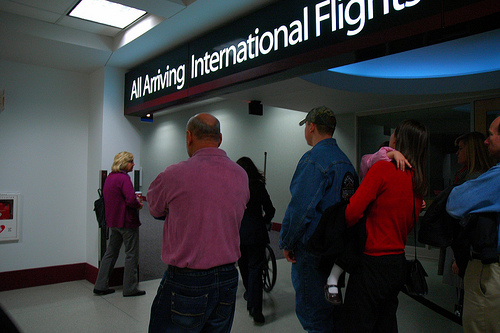
Going to the airport for an international arrival is a game of waiting.

We stood at the end of a long corridor and wait as the passengers trickle out, one by one, two by two, a group here and a group there. With three simultaneous international arrivals, it makes for a long process.

DSC_9517

We saw several lovely reunions as we anticipate our own. An uncle arrived from Italy to a niece and nephew running to him full speed. A father returned to a mother and smiling baby. A sister came from German for a visit.

DSC_9519

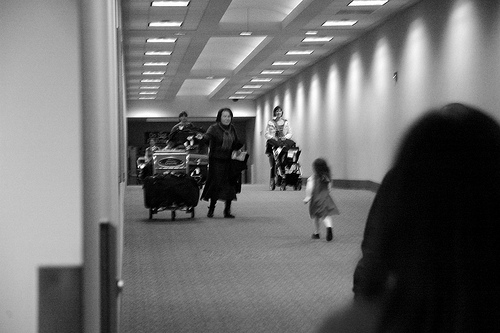
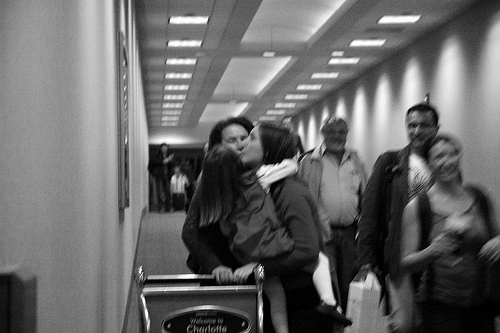
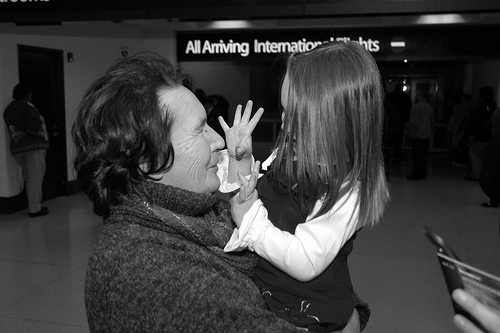
Finally, it was our turn. L ran to meet Babcia, who scooped her up and gave her a long hug.

DSC_9522

K joined them for a three-generation, all-mother-daughter group hug. It caught the attention of others, just as earlier reunions brought smiles to our face,

DSC_9526

More hugs followed.

Now L just has to start speaking Polish…