fun in threes, sometimes fours
How can you talk to someone who doesn’t accept facts? How can you have a discussion with someone who takes expert opinion with the same degree of credibility that she takes television advertisements?
How do you talk to an anti-vaxxer? How do you talk to a climate-change denier? How do you talk to a creationist?
In all three examples, the jury is in: vaccines work; the climate is changing due to human activity; evolution happened (and is happening). We don’t have to understand how all these things work in order to accept them. I don’t understand how my anti-lock braking system or my cell phone touch screen works but I use them.
Here’s an exchange between an anti-vaxxer and me when I posted this video to social media.
The anti-vaxxer, a neighbor whose kids play with my kids, replied,
There has been no confirmed case of polio since the 70’s. Why would I have my children vaccinated against a disease that no longer exists?
There is a bit of ignorance as well as self-centeredness in this response: there have been confirmed cases (the ignorance) but just in third-world countries (the self-centeredness: who cares about them?). I replied diplomatically:
Polio still exists in the third world, but you’re right about the States: no confirmed cases since 1979. The intent of this post is more about vaccines in general: why haven’t we had polio in the US in almost forty years? The answer is simple: vaccinations.
There’s not a lot of debate among researchers, doctors, and epidemiologists regarding this: vaccines have virtually eliminated polio. Period. The CDC confirms this; the WHO confirms this; numerous university research facilities confirm this. Her response was telling:
I don’t buy it. 90% of the cases were misdiagnosed (example: FDR actually had GBS, not polio). And, you can look a records [sic] that show that the numbers of cases were already declining before the vaccine was put into play.
With those four words, “I don’t buy it,” she discounts thousands, perhaps millions, of man-hours of research, analysis, and thinking by people that have forgotten more about disease and its spread than she and I know collectively. She exemplifies a kind of conspiracy-based thinking that discounts experts and authority on a seeming whim.
What do you say to someone like this? How can you continue such a conversation? In short, I’m not sure it’s possible. My response was simple: I didn’t respond. I wanted to, though. I wanted to ask where in the world she got this 90% statistic.
I wanted to ask how she had that information about the decline of polio prior to the discovery of the vaccine. I wanted to ask her if she had peer-reviewed articles to substantiate her position. But it’s clear that she doesn’t see any value in this type of peer-review authority.
We don’t share a common definition of reality, so how can meaningful dialogue occur?

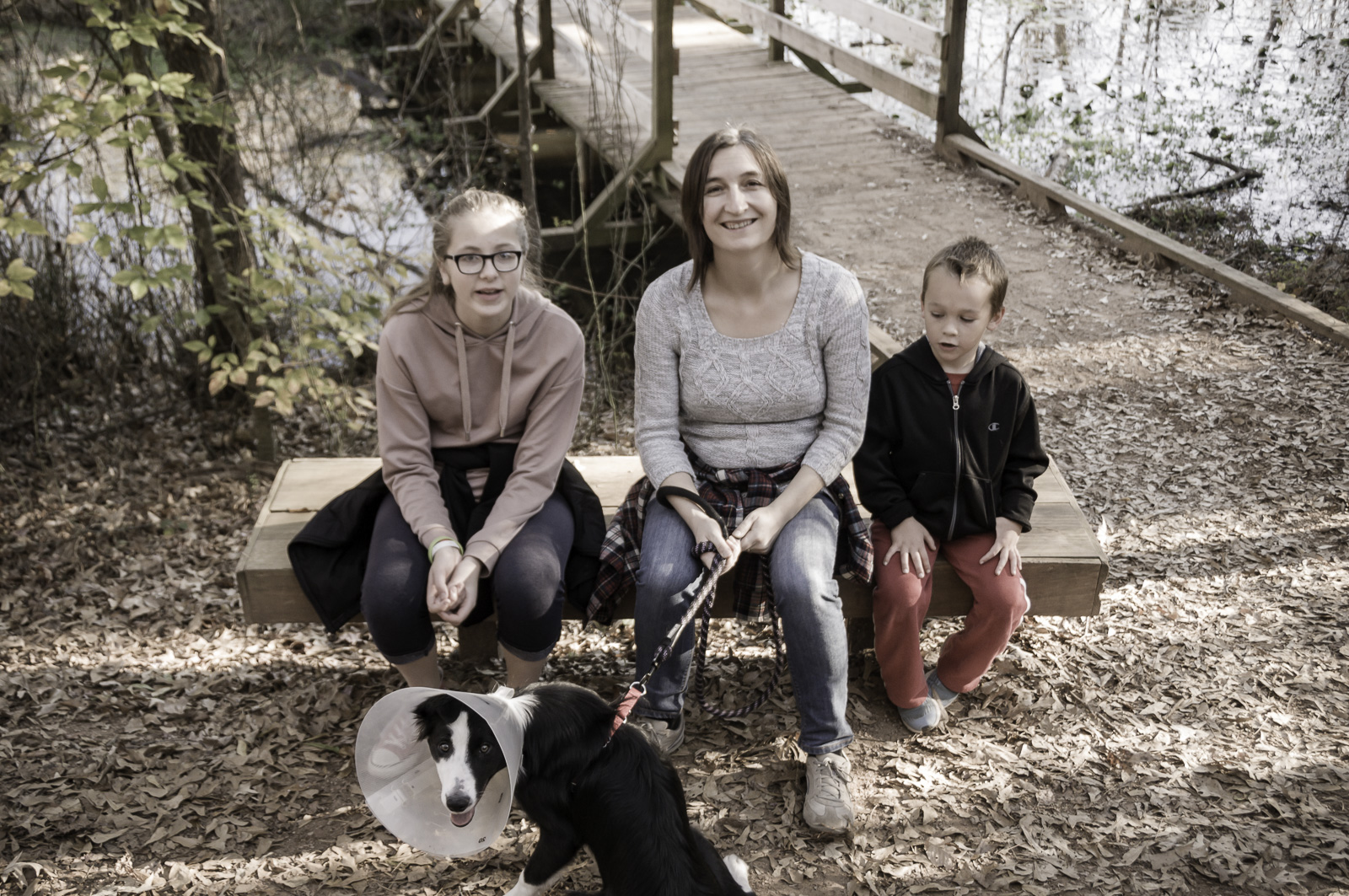
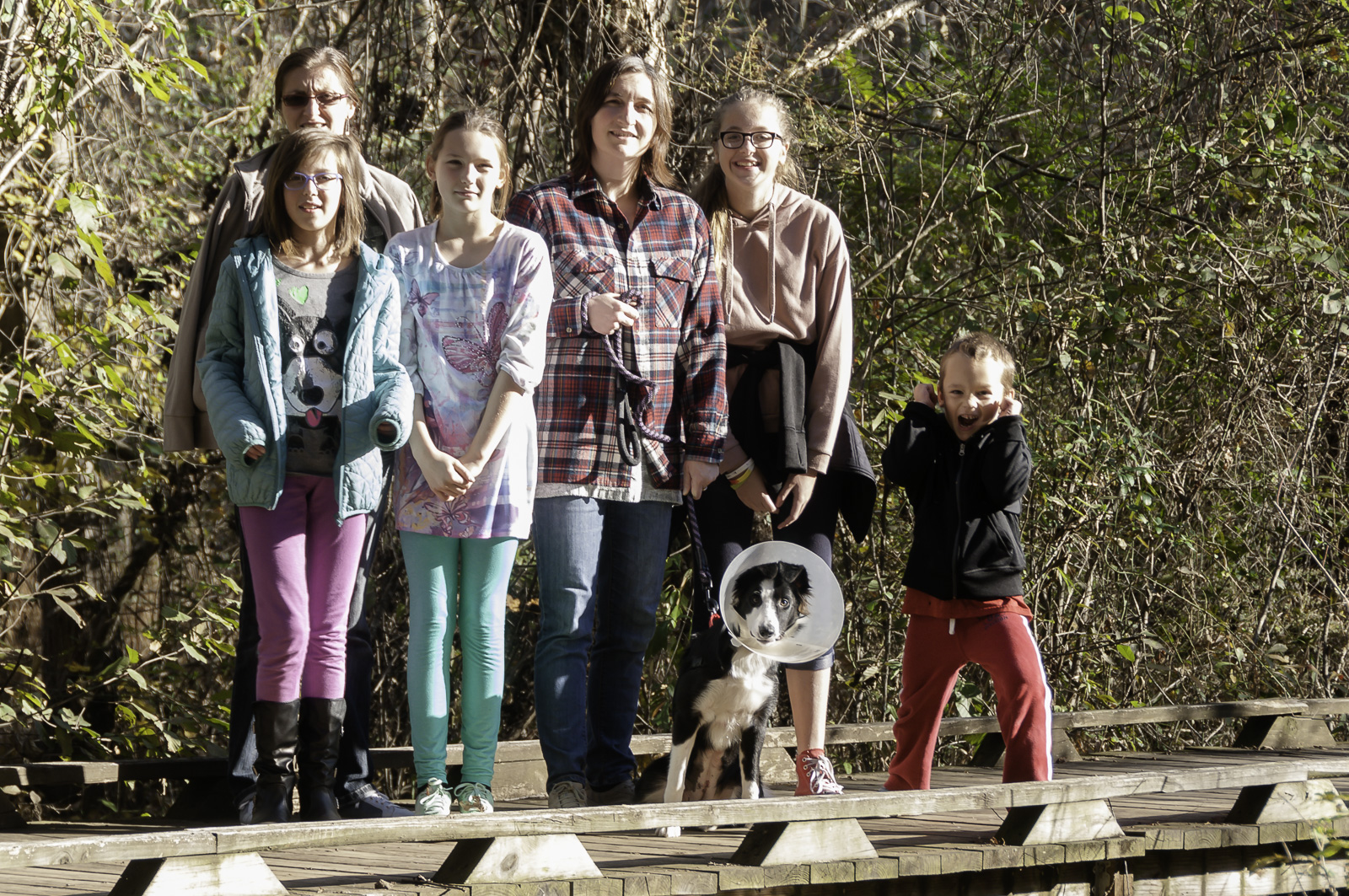
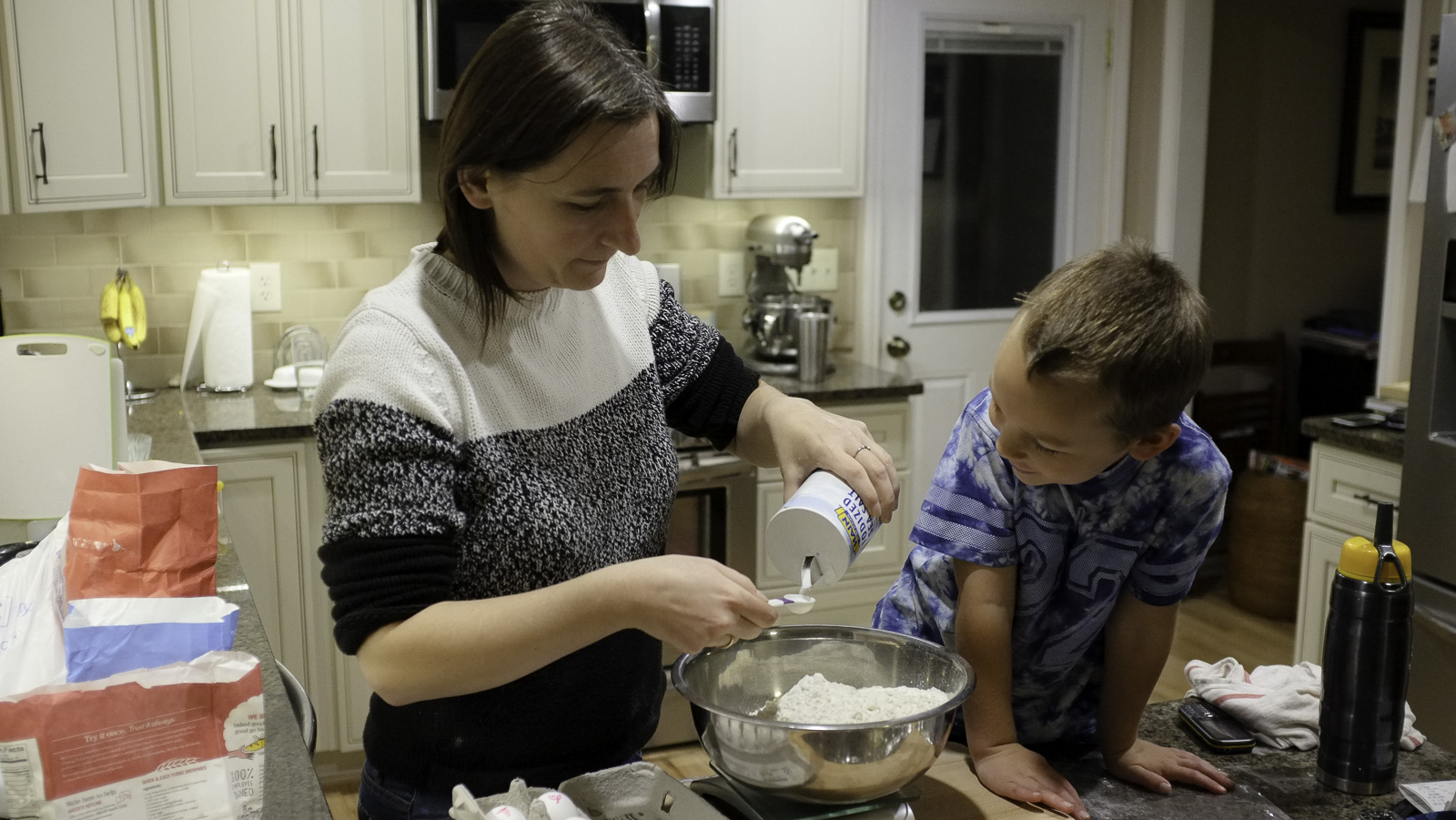
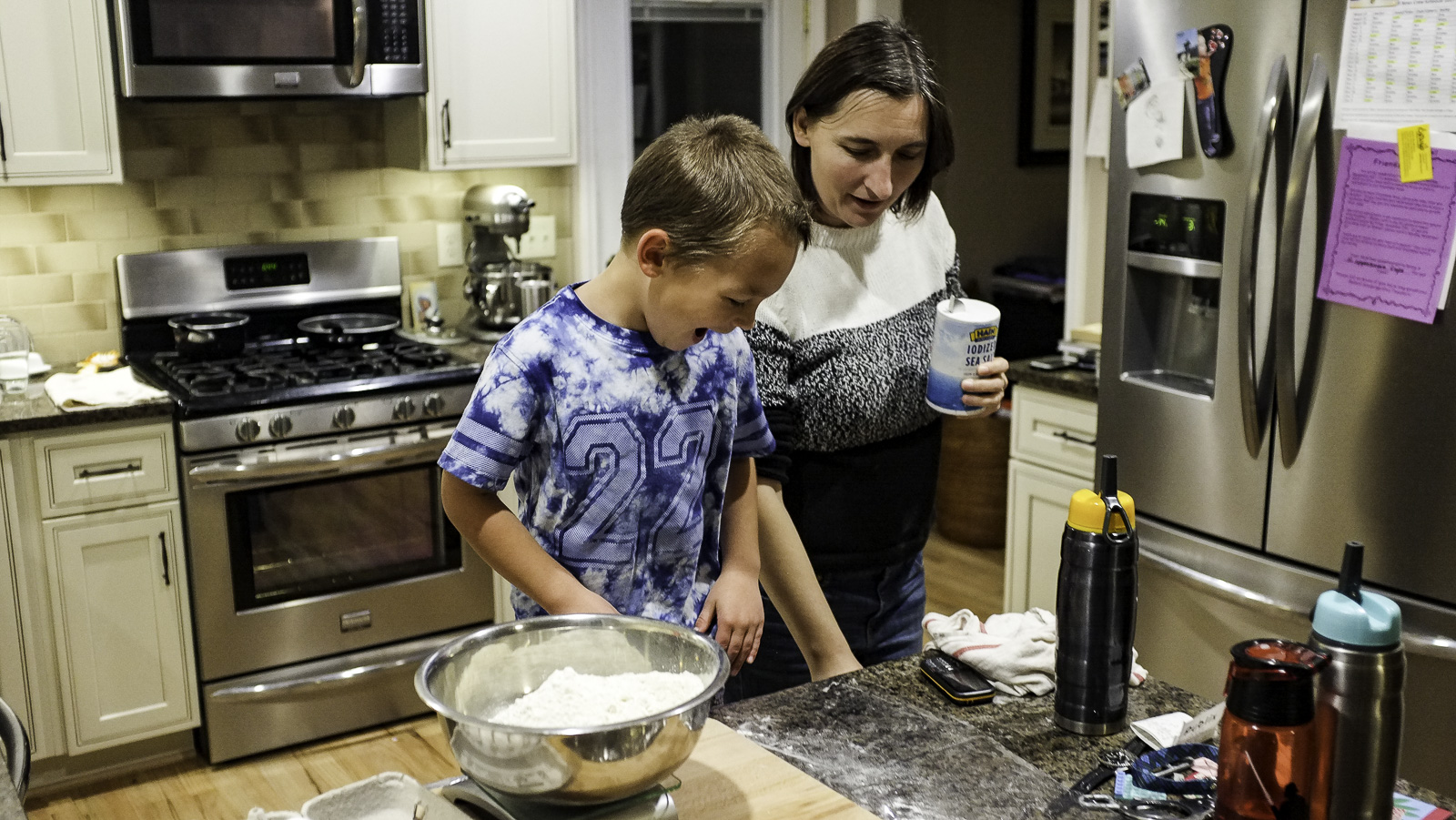
Three hours in the kitchen yesterday morning; five hours in the kitchen this morning; I've listened to over half of Paul Auster's Sunset Park in the meantime. (Does he ever write anything that doesn't have a writer in it? I love his style, but sometimes I get the feeling I'm just reading variations on his autobiography. This one, so far, has no connection to Paris.) I'm thankful that it's almost done. The turkey is in the oven; the dressing is cooling; the soup and cranberry sauce (this year stewed spiced chai with a bit of bourbon as an experiment) sit in the refrigerator; the broccoli casserole (yes, there simply must be a casserole or else it's not Thanksgiving) is ready to go in the oven; the giblet gravy is almost ready. It's time for a cup of coffee, a pipe of tobacco (after years of smoking English and Virginia/Perique blends almost exclusively, I've begun exploring burley-based blends--it's like smoking a pipe again for the first time), and some quiet.
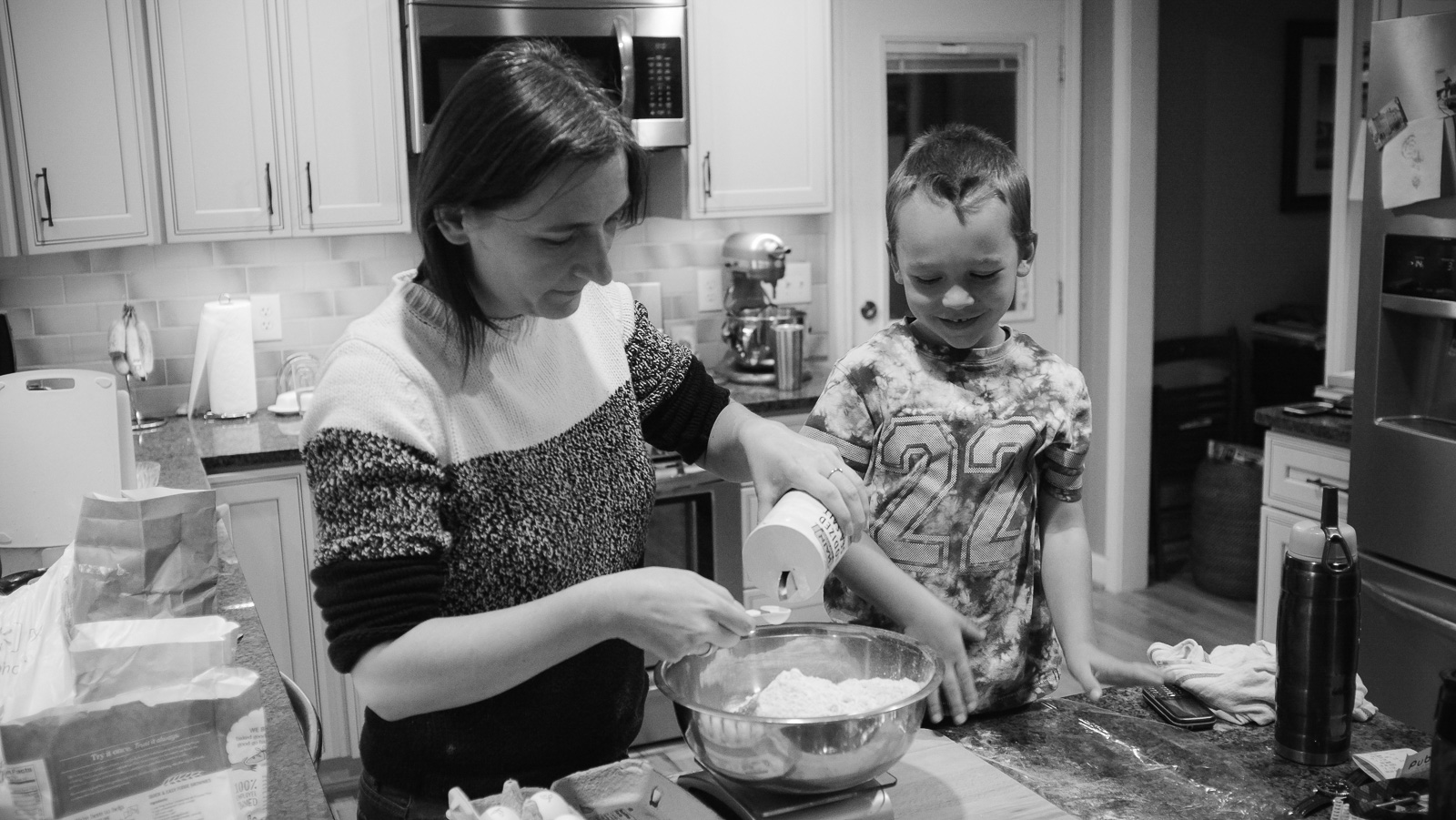
It's been a crazy morning: the dog, less than twenty-four hours after being spayed, has returned to normal energy levels and is highly irritated about being stuck inside with an Elizabethan collar on. The Boy wanted to help, of course, but the difference now is that he's able actually to help. He broke the dried bread into chunks for the dressing; he crushed crackers and mixed the liquid components for the casserole; he willingly taste-tested the pumpkin pie baklava; he kept an eye on everything. How did I listen to a story and talk to the Boy? Simple: his fits of helping merely punctuated his playing.
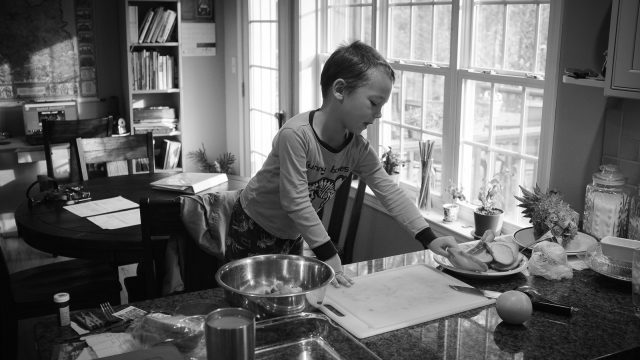
It's always the same -- Thanksgiving, Christmas, Easter, you spend all that time cooking and it's over before you know it. Even when you slow down, even when you're mindful, even when you want to stretch things out, you can't.
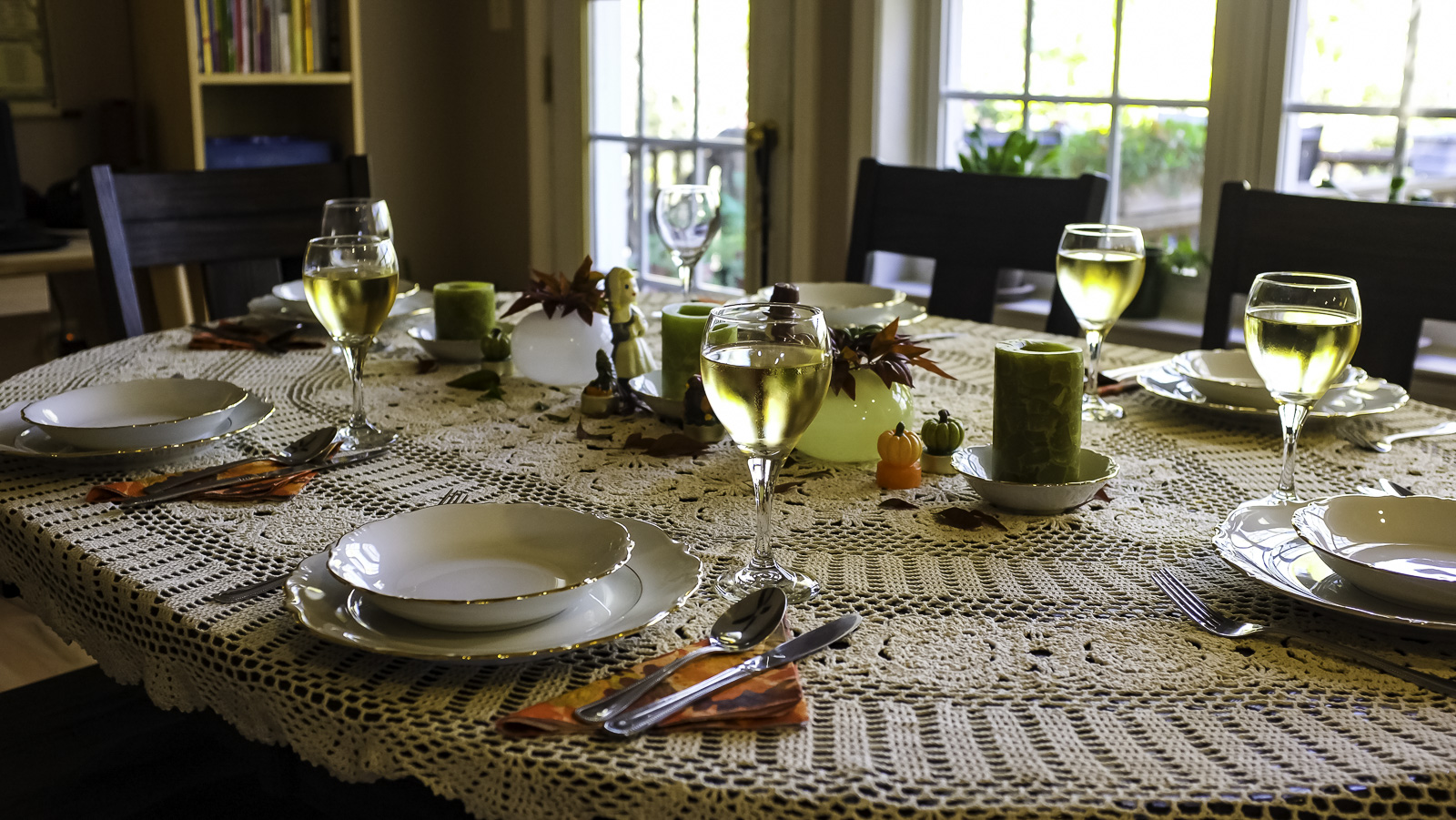
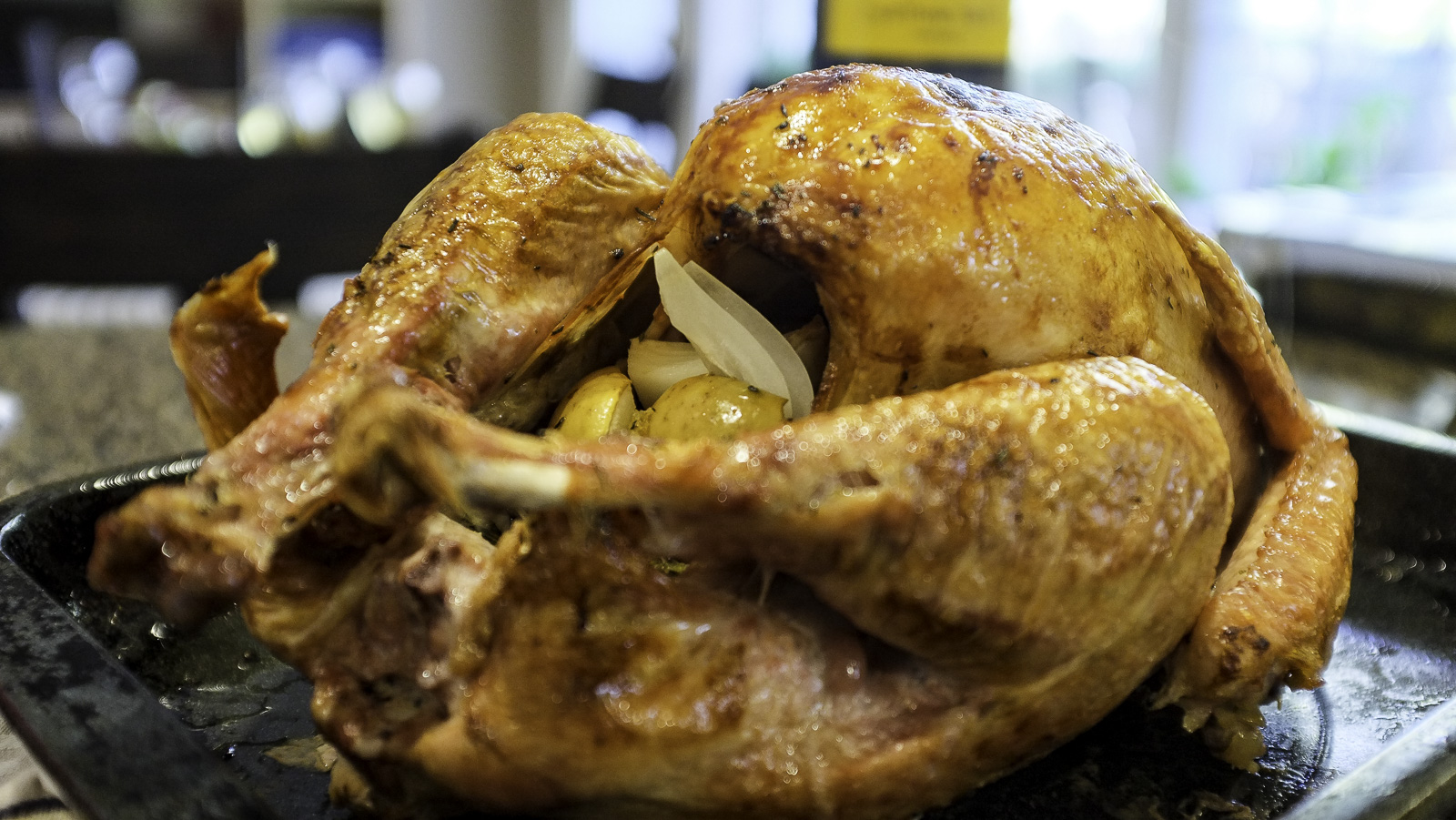
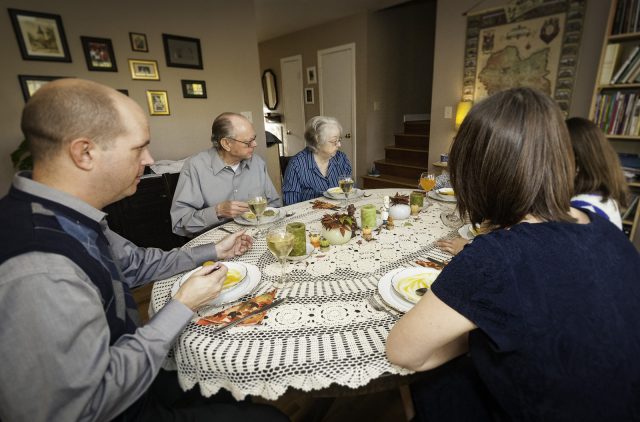
You sit and listen to the Boy's stories, plow through the food, and it's done. Of course, when you compare the amount of prep to the time eating, even two hours would be "plowing through." But you can't complain: people aren't eager to eat food that tastes mediocre at best, so I take it as a complement.
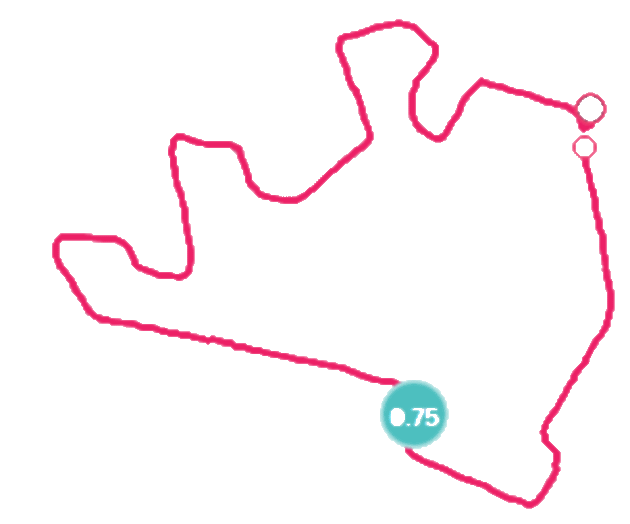
And go for a meandering walk afterward, the first quarter of it with the family. The rest head back because the poor dog, with her radar hat on, probably shouldn't be out too long.
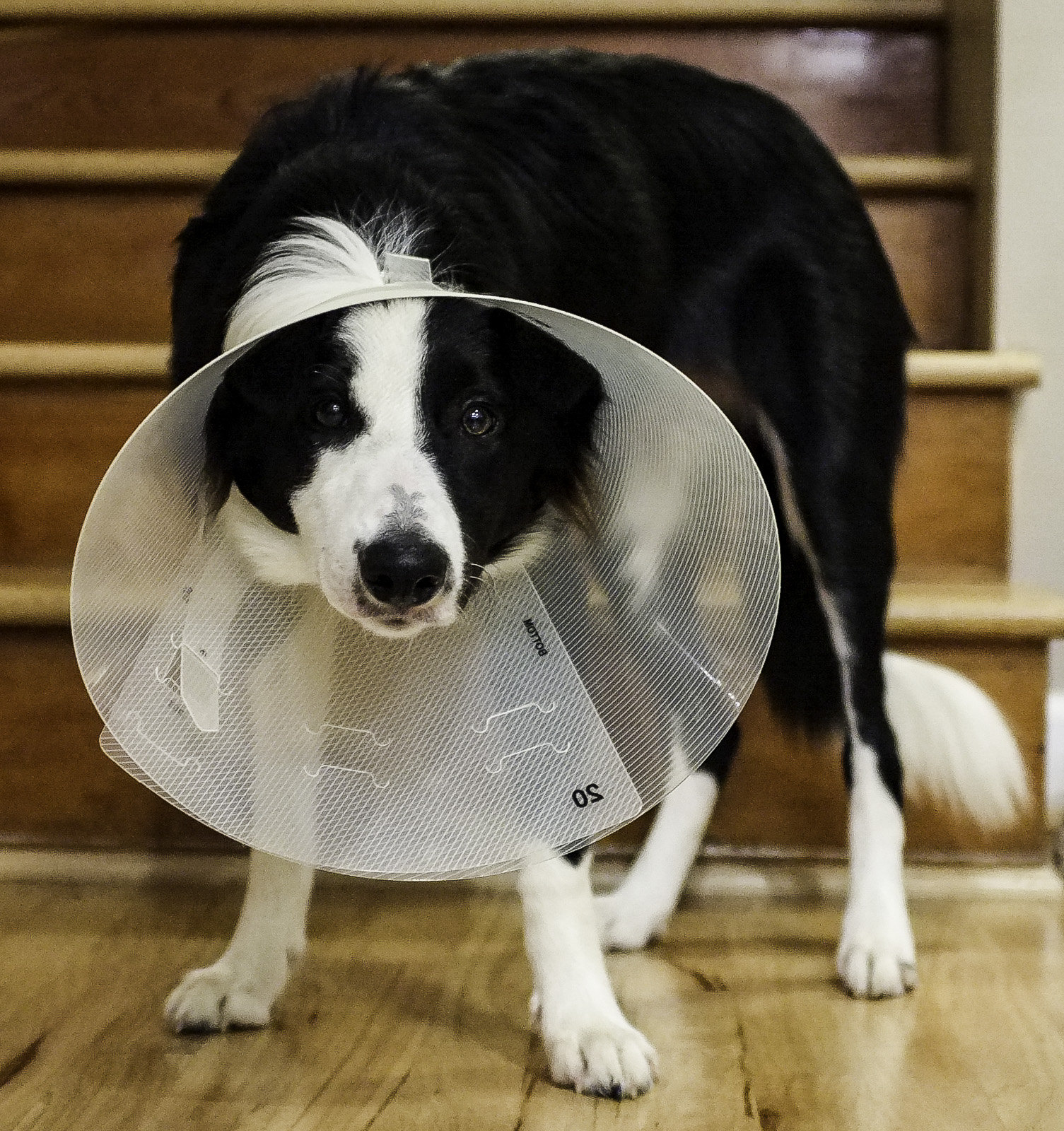
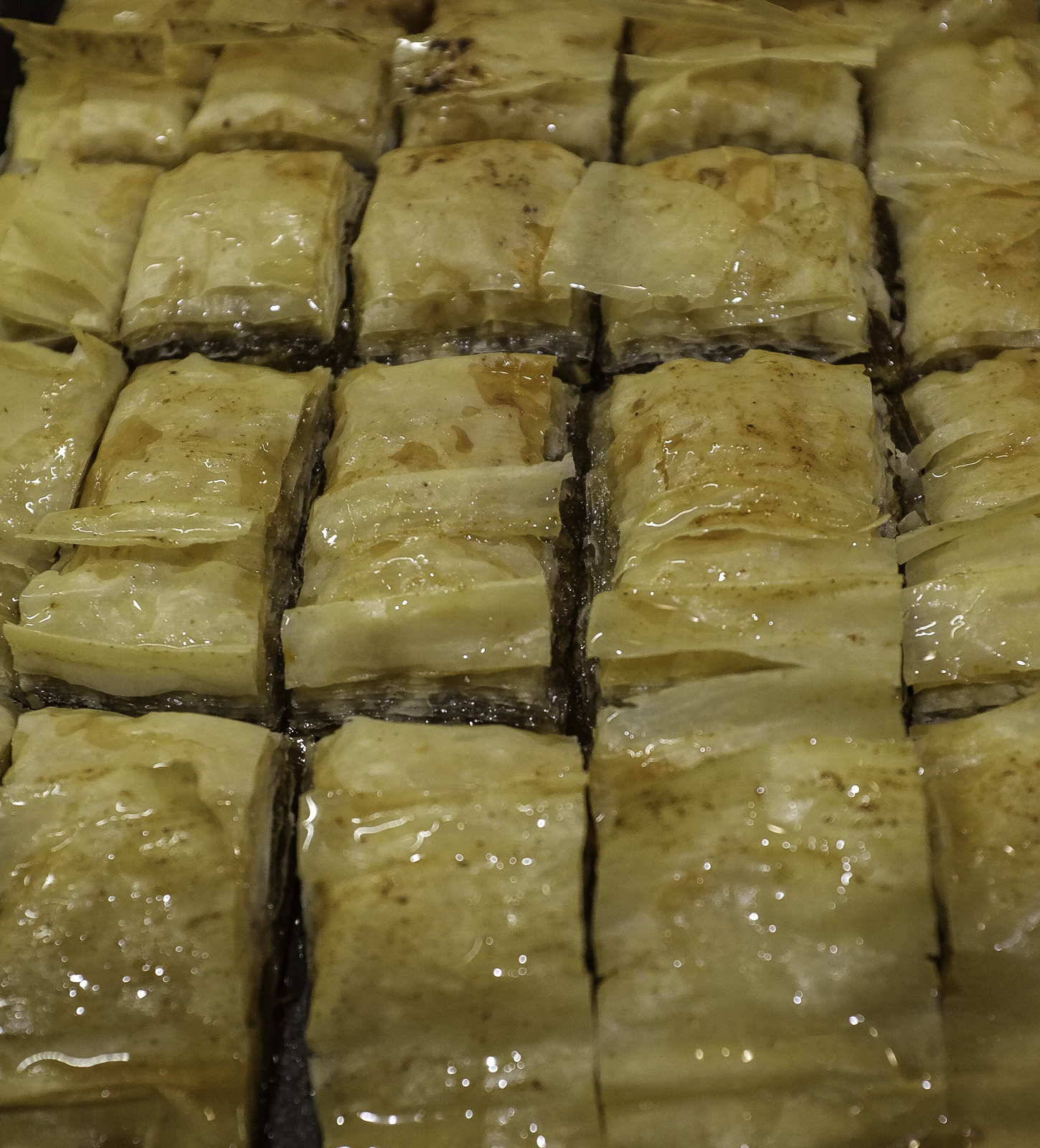
Pumpkin pie baklava and a post-operative dog.

I’ve always heard of incense being symbolic of prayer, and most formulations follow something similar to what Doug Eaton writes at Christian Theology, where he gives four ways incense is like prayer:
Today in Mass, watching the smoke waft up from the thurible into emptiness above it, I realized that, incense being smoke, there are a couple of ways a skeptic can continue to view incense as a symbol of a believer’s prayer.
The priest swings the thurible and billows of smoke flow from it, but like the spidery line of smoke rising from a cigarette, a few feet above the priest’s head, it’s turned to haze. As it rises to the top of the church, it disappears, indistinguishable from the smokeless air.
So too, words mumbled in prayer dissolve to nothingness as soon as they leave the lips. They rattle around inside hearers’ heads for just a moment, producing a warm feeling if they are believers, to be sure, but if there is no god, they are just so much noise.
Breath enough smoke and one risks cancer: we see that warning everywhere. The Mayo Clinic’s web site describes the process thus:
Doctors believe smoking causes lung cancer by damaging the cells that line the lungs. When you inhale cigarette smoke, which is full of cancer-causing substances (carcinogens), changes in the lung tissue begin almost immediately.
At first your body may be able to repair this damage. But with each repeated exposure, normal cells that line your lungs are increasingly damaged. Over time, the damage causes cells to act abnormally and eventually cancer may develop.
In my slow arc back from belief to skepticism, I’m reading again Sam Harris’s The End of Faith, and I think the idea of faith, and its outward expression through prayer, causing a brain to act abnormally — carcenogeically — is apt. The funny thing about prayer is that for the believer, even when it’s not answered, it’s answered. “God just said ‘No'” is the common response. Or “God has different plans.” Nothing counts against it. No evidence stands contrary to it.
That’s the very nature of faith, but that’s not how we work on a daily basis. We seek evidence for what we do. Teachers seek evidence for student mastery. Lawyers seek evidence for guilt or innocence. Construction workers seek evidence of a strong foundation before building higher. They all test, probe, ask questions, and ultimately, they might say, “No, there’s not sufficient evidence.” And faith is not enough. I don’t want to drive on a bridge that the engineers built on faith. I don’t want to get in an elevator that an inspector has inspected on faith.
Why should it be different with religious belief? Extraordinary claims require extraordinary evidence asserted Carl Sagan (among others). To do otherwise is to think, in a sense, abnormally.
There are some times in my classroom that I am positively at a loss, that I am standing there, looking at what just happened, listening to what's being said, watching what's going on, and I find myself wondering, "What in the world do I do about this?" I've been in the classroom for almost twenty years now, and I've come to realize that I will always -- always -- have these moments.
Last week, for example, in order to load a document I wanted the students to view on the projector, I turned my back on my most challenging class -- challenging in that they are, by and large, not motivated and therefore not inclined to behave in a manner that produces the most efficient use of our limited class time -- and in the few seconds that I had my back turned, this happened.
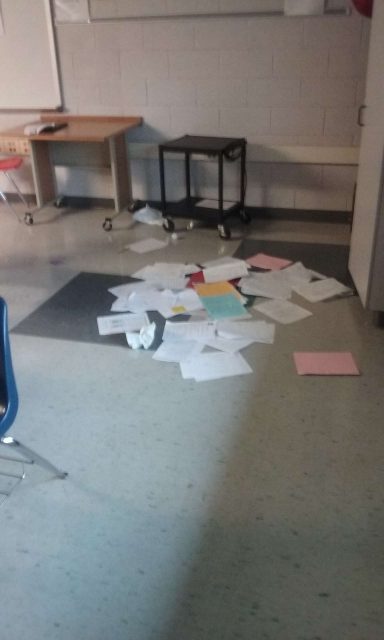
This, in fact, is a photo after I kicked some of the papers into a more consolidated pile.
Apparently, in a matter of seconds, a boy who sits in the back of the room stood up, ran to the front of the room, grabbed a girl's binder, ran back to the back of the room, and emptied its contents on the floor with the girl in heated pursuit. This girl is not very popular, and she has a habit of antagonizing everyone around her and then playing the victim. In this case, though, she was the victim, but that didn't stop the kids from hooting in approval at the boy's actions.
I called them down; they stopped after a few seconds; and I didn't have the slightest clue what to do. I removed them both from the classroom, but that's hardly a preventative measure for the next time the kid gets an impulse to do something like this. Truth be told, the boy can be more antagonistic and disruptive among his peers as the girl.
These are thirteen-year-old kids. They're not two or three. Yet their behavior belies their age, because this sort of thing happens so frequently. If it was a one-time occurrence, it would just be a question of youthful hi-jinks, but something similar happens on a regular basis, and I never really know what to do to prevent it.