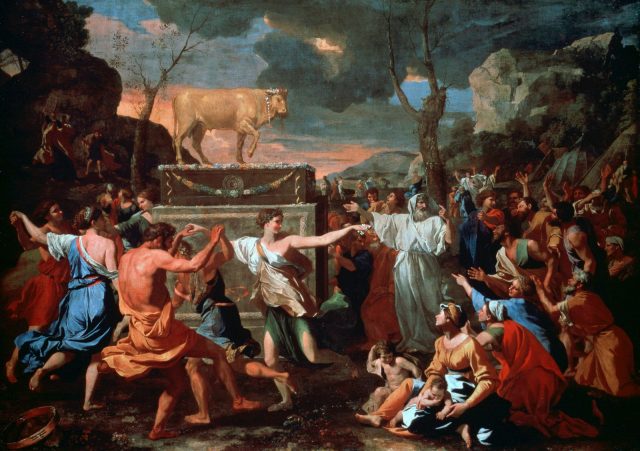
A few days ago, Fr. Mike, on day 50 of his Bible in a Year podcast read Exodus 37 and 38 as well as Leviticus 26. The passages in Exodus all had to do with sacrificial offerings, but the chapter from Leviticus was, in many ways, the most troubling passage in the whole Bible so far. It is, in short, a list of the punishments the god of Old Testament will mete out on Israel if they abandon the proper worship of him, but it presents such a conditional love, which bears all the hallmarks of an abusive relationship that I don't see how someone can read these chapters and not absolutely cringe.
It begins with a promise of what will happen if they do remain faithful:
“If you walk in my statutes and observe my commandments and do them, then I will give you your rains in their season, and the land shall yield its increase, and the trees of the field shall yield their fruit. And your threshing shall last to the time of vintage, and the vintage shall last to the time for sowing; and you shall eat your bread to the full, and dwell in your land securely. And I will give peace in the land, and you shall lie down, and none shall make you afraid; and I will remove evil beasts from the land, and the sword shall not go through your land. And you shall chase your enemies, and they shall fall before you by the sword. (Leviticus 26.3-7)
One might question whether this god would be upset to discover that people were worshiping him because they want all the benefits, but this supposedly omniscient being should know that and perhaps work that into the passage. "You must honestly love me and worship me." Something like that. Still, that's a trivial point compared to what happens later in the chapter.
By verse 14 it turns quite troubling:
“But if you will not hearken to me, and will not do all these commandments, if you spurn my statutes, and if your soul abhors my ordinances, so that you will not do all my commandments, but break my covenant, I will do this to you: I will appoint over you sudden terror, consumption and fever that waste the eyes and cause life to pine away. (Leviticus 26.14-16)
Fr. Mike, in his commentary, explains, "There are consequences for actions. [...] He hands them over because he loves them." If this doesn't call Israel back to their god, Fr. Mike explains, then their god will let more stuff happen to them until they do turn back to him. "The whole point of this is not punishment," Fr. Mike assures us. "The whole point of this is rescue." This is the first problematic idea, and it hits at one of the biggest issues I've had with Christianity for some time now. "Rescue" suggests the following:
- Force A
- affects entity X
- and entity Y somehow stops force A by
- getting rid of force A,
- removing entity X from the effects of force A, or
- mitigating the effects of force A.
Within all of this is the idea that force A is separate from entity X doing the rescuing. If I'm beating my son and then stop beating him, I'm not rescuing him. If I'm holding my daughter's head underwater and then stop holding her head underwater, I'm not rescuing her. It's only a rescue if someone or something else is doing it, and I somehow stop it.
The problem with Christianity is simple: this god is the one doing the beating; this god is the one holding heads underwater. How so? Simple: Christians frame all this "rescue" as a rescue from the consequences of sin. But the god of Christianity defined sin. He designed the consequences of sin (and everything else) by creating the world as he did. He's ultimately the victimizer and the savior. That's not rescuing. That's a sick relationship.
Putting that aside, though, it's disturbing to look at the consequences listed in Leviticus, through verse 45:
- I will bring more plagues upon you, sevenfold as many as your sins.
This is not a consequence. This is God responding to one's actions, and with a sort of severity that might even be rare in the mafia. - I will let loose the wild beasts among you, which shall rob you of your children, and destroy your cattle, and make you few in number, so that your ways shall become desolate.
Who is really paying the price if the children are getting devoured by wild beasts? And what kind of relationship does this inspire? We're just cowering in fear of what this being might do to us. - I will walk contrary to you in fury, and chastise you myself sevenfold for your sins. You shall eat the flesh of your sons, and you shall eat the flesh of your daughters.
What!? God here is saying he will, in fury, bring such desolation that the Israelites will turn to cannibalism. Will he be like with Pharaoh in Egypt? Remember: several times Pharaoh agreed to let the Israelites go, but according to Exodus, "God hardened his heart" so that he would change his mind. Is God going to harden the hearts of the Israelites to make them turn to cannibalism, or will things just get so bad that they won't feel they have any choice? (And when would a parent ever really feel that way?) - And I will devastate the land, so that your enemies who settle in it shall be astonished at it.
The implication earlier is that Israel's enemies will do all this destroying, but here it seems to indicate that God doing it. After all, the enemies come and are astonished, presumably at the brutality which has swept through the land. - And as for those of you that are left, I will send faintness into their hearts in the lands of their enemies; the sound of a driven leaf shall put them to flight, and they shall flee as one flees from the sword, and they shall fall when none pursues.
Again, God does this, not the enemies. He seems to be suggesting that he'll make them such cowards that they'll be eradicated.
How does Fr. Mike explain all this? He makes the move I've been waiting for him to make the whole time, really the only move he can make: The fact that it doesn't seem right is our fault. "We just need to trust God and understand that there is an answer to all these questions," he argues:
This is the discipline of a father, and this is so important to us. You know, when we approach scripture, and we don't trust God, we see these things and go, "Wow, that's crazy. I'm done with this. Day 50, that's it. I'm out." But when we approach the word of God, and we have that spirit of trust where it's like, "Okay, if I don't understand this, it must be me that doesn't understand this."
If I begin to be suspicious of God, and I say, "Wait, let me pause. God is a good dad. And while I don't understand what he's doing here or not doing there, I have to look at him, look at life, look at myself through the lens of 'Okay, God is a good dad.' So why would a good Dad allow these punishments to come upon those who are disobedient?" Well, because, like any good dad, like any good parent, I want more for you than just your comfort. I want more for you than for you to just go about your life and do whatever it is you want to do. I want the best for you.
So this is God, who is the good dad. And he says, "I want the absolute best for my children, so if they refuse to walk in my ways and walk contrary to me, here's the consequences. Because I want to bring them back to my heart."
But how do we know that this god is a "good dad," as Fr. Mike suggests? It hits at the very heart of the question of theism: how do we know anything about this supposed being? All Christians claim to know about him comes from three sources:
- Personal experiences with what we call the divine.
- What the church teaches about this being (and here I have in mind the Catholic idea that the Bible and the church are equal authorities).
- What the Bible says about this thing we call the divine.
Personal experiences are just that: personal. If you have a warm feeling in your heart, that's all you know. To attribute it to the Holy Spirit or anything else is interpretation and therefore highly subjective. In this sense, the believer is putting faith in herself and her interpretation of her inner experience. The other two sources, though, inform that faith.
What the church says about its god is just what other people say about, and so ultimately the believer is putting her faith in these other people.
The Bible is just a book. Nothing more, nothing less. If believers purport it to come from the hand of their god, there should be evidence of some sort in the book itself. The safest way to approach it, then, is to look at the Bible and ask, "What sort of god is presented in its pages?" From this reading in Leviticus, it seems a stretch to say that this being is in any sense "good." He's vindictive, envious, and petty at best and ghastly, wretched, and unspeakably cruel at worst.
So where does Fr. Mike get this "good dad" stuff? Simple: it's his working preconception. He's making assumptions about the Bible before he reads the Bible, and he's suggesting believers do the same. And to be fair, what else are they going to do? If they're committed to his idea that their god is good, they have to approach it with that assumption, and no one really wants to worship an evil god. In addition, if they were raised in the church, they were taught that their god is a good and loving god long before they can read the Bible for themselves and see all these terrors.
It is here that the true horror of the situation enters, for it is here that believers being to look like spouses in an abusive relationship. Take what Fr. Mike said about his god and reframe it: imagine that Fr. Mike is an abused wife and his god is the husband:
If I begin to be suspicious of my husband, and I say, "Wait, let me pause. My husband is a good husband. And while I don't understand what he's doing here [with all the unspeakable abuse mentioned earlier] or not doing there, I have to look at him, look at life, look at myself through the lens of 'Okay, my husband is a good a good husband.' So why would a good husband allow these punishments me? It must be because I am disobedient." Well, because, like any good husband, he wants more for me than just my comfort. He wants more for me than for me to just go about my life and do whatever it is I want to do. He wants the best for me.
That is classic victim-blaming. Worse: it's victim self-blame. "My husband beats me because I deserve it. It's for a greater good, and if I don't understand that, it's just because I'm not as smart as he is."
If any of our friends spoke this way, we would encourage her to go to a shelter immediately with her children. But Christians simply stay in this relationship. They believe they deserve it because of Original Sin and their own short-comings. How many times have I heard Christians talk about how wretched they are? "Amazing grace, that saved a wretch like me."
Most Christians would respond, I think, by saying, "That's the Old Covenant. Look at how beautiful the New Covenant is! That's where I draw my faith. Jesus saved us from all of that!" Yet the response to this is so simple that even a child can make it -- and has. "But that's the same god!" These are not different entities. The Christian doctrine of the trinity paints them into a corner, and they fail to see that it's happened. In doing so, it makes the relationship even more toxic.
I, for one, got out of that relationship, and I feel so much better for it.