


1925 in 2025


I remember wondering, as a kid, if there could be other groups of believers who kept all the holidays Old Testament festivals like we did, who attended church on Saturday (calling it the Sabbath) rather than Sunday, who had all the doctrine distinctives that our church had but had developed all this on their own apart from any of the WCG ministry. I knew that if God called people like our church taught, such a scenario was entirely possible, that he could call someone without providing direct access to our group. Herbert Armstrong always said after all, “Don’t believe me Believe your Bible,” and he always taught that everything that the church believed came directly from the Bible. So it is entirely logical that someone could arrive at the same conclusions as Armstrong, even without the aid of God calling them. Throw in that supernatural element, and it seemed almost unlikely that there wouldn’t be some other groups out there lurking about keeping the sabbath, paying tides, going to the Feast of Tabernacles, eschewing Christmas and Easter, but not formally part of our organization.
The data podcast on Church of God Network has gotten me to thinking about this. They claim that there are somewhere between 500,000 and 1.5 million Sabbatarian Christians in Madagascar. They bring up the idea that theoretically someone in India could be reading their Bible and reach the same conclusions that all the churches of God do, namely, that we should be going to church on Saturday and following Old Testament festivals and the like. They pondered if that might have already happened, and if they’re not English speakers, how in the world could the COG‘s existing in America get in touch with them or even know if their existence to help them in their spiritual development.
It is, of course, somewhat presumptuous to assume that they would need the spiritual development. It reeks of theological colonialism. If God is calling them, they don’t need any help from people here.
Yet that just speaks to the cognitive dissonance that provides the churches of God. God calls you, but he needs a little bit of help from literature and television programs. What's amazing is that the hosts come right to the edge of this realization before backtracking:
Not only is this not the only day of salvation but it’s not our job to proselytize. So this conversation is not about going in and like, “Why aren’t people responding,” like this is the only day of salvation kind of thing. It’s more of, God does the calling, but God’s also not a respecter of persons, so you’d imagine the distribution as to where people are called would largely be either, I don’t want to say random, but dispersed based on something that has some sort of logical sense, if that make sense. Maybe you’d have one or two nations where, that would fall into this bucket, but to have a decent chunk of nations that are high population, low hostility, and a cultural presence of more mainstream Christian Western views that would raise a red flag of, “Okay well, it wouldn’t make sense that God wouldn’t call anyone in this nation.” Is there something about how this message is getting out? Maybe there’s a lot of response but it just independent groups who haven’t maybe reached out for affiliation.
They're right there: they're almost about to realize that if their theology about God calling people out of the world (and that being a precious and rare event), there should be people coming out of the world on their own. They shouldn't any exposure to the various COGs literature or television shows or webinars. It should happen naturally, and it should be evenly spread around the world. Things like the amount of hostility toward religion in a given community shouldn't matter; cultural awareness of mainstream Christianity (which these COGs reject) shouldn't matter; language shouldn't matter. But it all does matter, to the point that the vast majority of the COG membership is located in the US. Perhaps that's because these COGs preach that the US is of special theological significance and along with those in the UK among the most special of the lost tribes of Israel. That won't sell well in Poland or Hungary, two countries they mention that have no COG presence even thirty some years after the fall of the Berlin Wall and the opening of the Iron Curtain.
They come so close to realizing that Armstrongism is a highly culturally specific theology targeting English speakers specifically, and that alone explains the US-majority membership.


I had a conversation with B today about differences she's observed between my classroom and other teachers' rooms, particularly with English I classes. She said that it's not better or worse, just different. And apparently, the students are noticing and talking about it. "And if the students are talking about it, the parents will be soon, too."
So the question is what makes me different from other English teachers on the hall? Well, with G, it's experience: she's just starting in eighth grade, and though she has experience in that grade, it's well in the past. "I'm just following the curriculum guide and the book," she's told H and me several times.
With H, it's a difference of teaching styles. I'm much less old-school. I don't read things to them and then explain it. I don't have whole-class discussions very often. I do a lot more collaborative work with the kids. I design lessons that don't involve me doing much more than coaching them along the way. I let them struggle and get frustrated. I answer their questions with questions.
Overall, I think I've somehow managed to be more rigorous than other teachers. I expect a lot more of my students, and things in my class seem to have a more intellectual feel.
"The clearlest solution," I told her, "is just to let me teach all the English I classes."
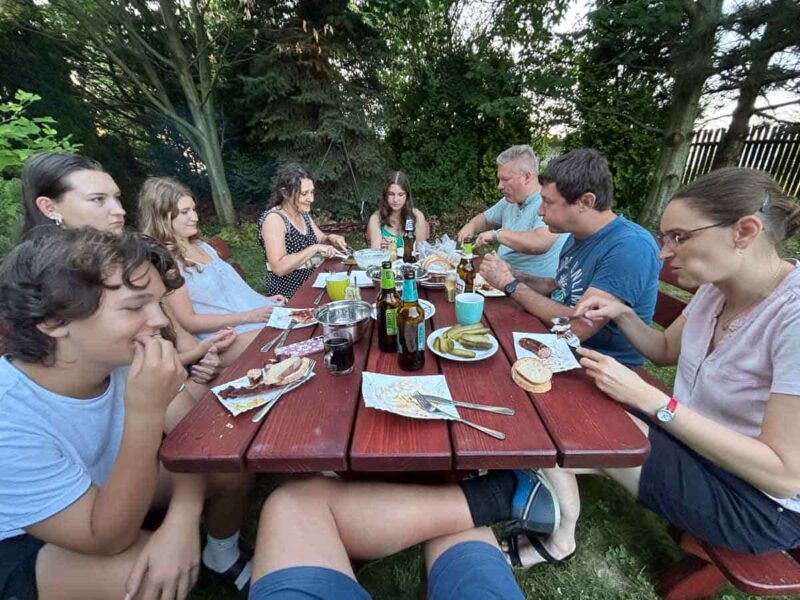
After lunch, the students at our new school have a short recess. The school is trying to get back to some more traditional ideas in school, and providing kids with a chance to get out and run about and be kids once in a while is an important element in the planning of the schedule. Right now since, we are just visitors in the building that houses are small school, we don’t have a lot of space for this recess. On days when the weather is fine, we simply go out to a grassy area in front of the school and let the kids have some free time. The boys throw a football, and the girls and a few boys for a circle and knock around the volleyball. everyone seems to enjoy it, so much, so this several of that we have mentioned it in the school journals, they are keeping in my class. Most days it has been intolerably hot for me during this break, so I have sought shelter under an awning in the front of the school. Today, however, the weather was simply perfect. It was sunny, but not hot. It invited rambunctious play but not sweat. it was a perfect Polish summer day in other words right here in South Carolina. Combined with the cool mornings we’ve had this week, this simply suggest that autumn is finally approaching.
This will be our first autumn without the Girl living in our house. And although she will not have much of an autumn in Florida, this will be the first autumn of her college days. Eventually, she might associate cooler days with the beginning of a school year, and cool mornings like we’ve had this week might bring back little floods of memories of her time in college.
For me, autumn brings back memories of my childhood growing up in a heterodox Christian that still insisted on observing the Jewish Old Testament festivals, although they gave them a unique and somewhat twisted spin. The highlight of all of this is always the Feast of Tabernacles, an eight day extravaganza Filled with activities, restaurants, and daily church services. The daily church service was really just the price we had to pay all the rest of the fund. At least that’s how we kids looked at it.
For kids, this weeklong convention was little more than a replacement for Christmas, which was forbidden in the church because of its pagan roots. My own parents would bribe me to behave well in the daily services by giving me a new Matchbox Car every day to play with. They would also buy one or two large gifts, toys that I had an eyeing for months on end at Sears or Kmart, toys that lured me like a sirens call every time we entered those stores, toys that I would play with his best I could through the packaging, which was Just cleverly enough open for little kids to get their fingers in and manipulate the toy, just enough to heighten the desire. One year I got a large diecast tractor with a working frontend loader and functional backhoe.

Another year, when I was in my full summer succession, they bought me Millennium Falcon. I thought I was in heaven.

Of course, once I got to be about Emil’s age, a teenager in other words, this eight-day festival really met one thing: a fling. In fact that’s just what we all called it. A feast fling. Teenagers would start to search for likely candidates from the very opening service, which was always an evening service before the first day proper, which always necessitated two church services. One in the morning and one in the afternoon. The day was just that special. Still, while these daily church services were simply the cost of the rest of the enjoyable week, that first day having double services was actually something of a blessing, for it was just before, and just after the services that the real hunting happened. Since we had so sequestered ourselves away from the rest of “the world,” that diabolical morass of the unchosen all out to steal our salvation, most members of the sect came well before weekly church services and stayed long after in order to fellowship. With that habit well established, it simply spilled over into these extraordinary days in the fall. Before and after services, clusters of teens would roam throughout the auditorium (or arena, depending on the popularity of a given location) rented for the week, all of the most one thing on their mind: to meet someone of the opposite sex.
Truthfully, it wasn’t just the teens who are doing this. Although they took a more nuance to approach, most single members of the site approach these festivals with a similar mindset. Because the group discouraged or even forbade members from marrying outside the sect, these weeklong gatherings offered everyone a chance to meet someone who was safe, who could be eventually married without the risk of losing one’s place in the church and therefore one's salvation and eternal life. I, too, participated in this gigantic mating dance, although it was somewhat half hearted, I believe. By that time, it was clear to me that I would not be staying in the church forever, and I would eventually drift out and leave my parents behind and their religion. Little did, I know that they too, due to the changes that have occurred, would eventually just return to plain Jane Christianity.
Still, after all these years (it’s been well over 30 since I last attended one of these gatherings), those yearly retreats remain to my mind one of the few benefits of growing up in what truthfully could be called a cult. Because of the double layered tithing system of the sect (and triple layered every third year), members entered these weeklong festivities with approximately 6 to 8% of their yearly earnings to blow in one week. That meant going to restaurants that we would never have gone to, visiting sites we would have never seen, staying in cities we would’ve never visited otherwise. This did come in a price, of course. When you’re taking off 20% of your salary every paycheck (and that was 20% of the gross not the net), even an engineer like my father made wages that could sometimes be stifling small. But in truth, that really just made the feast all the more special. It was a week of excess, a Bacchanalia as much as a conservative sect could allow itself to have.
So when the morning turn chilly, and the evenings finally become actually cold, my mind turns back to those magical weeks when just for a moment, just for the shortest of files, we lived like royalty.
A traumatized kid enrolls in our school, and only weeks later, he's gone, entangled in the court system with all the fatalism and unfulfilled dreams that that entails for a fourteen-year-old black boy.
That sentence itself is a tangle of contradictions and enigmas. "A traumatized kid enrolls" suggests that the kid made the decision, completed the paperwork, and entered our school community. Or it implies a parent made the decision to enroll him in our school and completed the requisite paperwork to enroll. In this child's case, neither is likely: the kid, of course, is a minor and couldn't do it; the parent (and statistically likely only one, and most statistically likely only the mother) seems from all accounts to be relatively uninvolved.
“Only weeks later, he’s gone” suggests more volition that he likely lacked. It implies that he just didn’t like it — wasn’t challenged or felt the dress code too stifling. In truth, he was taken away, with all the ambiguity that passive-voice sentence suggests. More accurate from our perspective is simple: “only weeks later, he disappears.” That still suggests he is in some sense a agent in the decision, and while his behavior certainly played a role in it all, that behavior was likely not entirely consciously volitional and at least in part the crusted-over habit of years of surviving a trauma-filled life no kid should endure.
When I first met him, he was respectful, demure even: "I don't like saying I came from West Greenville," he quietly began when we first met, referring to one of the district's alternative schools, "because they think I'm a bad kid."
"Well, we all make mistakes in life," I reassured him. "I'm sure no one will judge you on where you came from but rather on your behavior."
Yet his record suggested he was what quick judgment would label a "bad kid." He came to us from alternative school, and as teachers reviewed his records, we saw that he had been in not one but two different alternative schools that year. A kid who makes a single bad decision that lands him in alternative school -- say, bringing a vape to school -- would not have such a record.
Still, he knew how to play the game: he knew first impressions count, and he made a good one. Once he got into class, though, it was another story. Passive incorrigibility and even the occasional aggressive defiance became the norm. Once, in the hallway when I was trying to direct him where he needed to go, he shouted, "Man, this is why I hate white people."
Over a few weeks, I'd managed to establish a decent relationship outside of class, though, and that helped inside the class. He began applying himself just a bit, here and there, occasionally. But much like an abused dog will bear its teeth at any perceived threat or provocation, KB’s interactions continually belied that demure front he’d put on at the start of his time with us.
“Who’s that kid?” A teacher on another team asked as KB passed by. I told her, and she replied, “He’s really something.” Soon, everyone on the hall knew who he was, and not because of the sterling impression he was making on everyone.
Occasionally he would be absent and return to school a few days later explaining he’d had a court appearance. “For days?” I’d think, but I kept my doubts to myself.
There are kids teachers encounter that we know will disappear into the vast cracks in our system and appear on the evening news as a suspect in some crime or other (one former student), or perhaps as a fatality after a police chase involving a stolen car (another former student). We all pay for these kids: our tax dollars will support them in one form or another. But they pay for it as well with lost and wasted lives that represent a net negative on our society, indicting us all: that’s the true price we pay.

I remember wondering, as a kid, if there could be other groups of believers who kept all the holidays Old Testament festivals like we did, who attended church on Saturday (calling it the Sabbath) rather than Sunday, who had all the doctrine distinctives that our church had but had developed all this on their own apart from any of the WCG ministry. I knew that if God called people like our church taught, such a scenario was entirely possible, that he could call someone without providing direct access to our group. Herbert Armstrong always said after all, “Don’t believe me Believe your Bible,” and he always taught that everything that the church believed came directly from the Bible. So it is entirely logical that someone could arrive at the same conclusions as Armstrong, even without the aid of God calling them. Throw in that supernatural element, and it seemed almost unlikely that there wouldn’t be some other groups out there lurking about keeping the sabbath, paying tides, going to the Feast of Tabernacles, eschewing Christmas and Easter, but not formally part of our organization.
The data podcast on Church of God Network has gotten me to thinking about this. They claim that there are somewhere between 500,000 and 1.5 million Sabbatarian Christians in Madagascar. They bring up the idea that theoretically someone in India could be reading their Bible and reach the same conclusions that all the churches of God do, namely, that we should be going to church on Saturday and following Old Testament festivals and the like. They pondered if that might have already happened, and if they’re not English speakers, how in the world could the COG‘s existing in America get in touch with them or even know if their existence to help them in their spiritual development.
It is, of course, somewhat presumptuous to assume that they would need the spiritual development. It reeks of theological colonialism. If God is calling them, they don’t need any help from people here.
Yet that just speaks to the cognitive dissonance that provides the churches of God. God calls you, but he needs a little bit of help from literature and television programs. What's amazing is that the hosts come right to the edge of this realization before backtracking:
Not only is this not the only day of salvation but it’s not our job to proselytize. So this conversation is not about going in and like, “Why aren’t people responding,” like this is the only day of salvation kind of thing. It’s more of, God does the calling, but God’s also not a respecter of persons, so you’d imagine the distribution as to where people are called would largely be either, I don’t want to say random, but dispersed based on something that has some sort of logical sense, if that make sense. Maybe you’d have one or two nations where, that would fall into this bucket, but to have a decent chunk of nations that are high population, low hostility, and a cultural presence of more mainstream Christian Western views that would raise a red flag of, “Okay well, it wouldn’t make sense that God wouldn’t call anyone in this nation.” Is there something about how this message is getting out? Maybe there’s a lot of response but it just independent groups who haven’t maybe reached out for affiliation.
They're right there: they're almost about to realize that if their theology about God calling people out of the world (and that being a precious and rare event), there should be people coming out of the world on their own. They shouldn't any exposure to the various COGs literature or television shows or webinars. It should happen naturally, and it should be evenly spread around the world. Things like the amount of hostility toward religion in a given community shouldn't matter; cultural awareness of mainstream Christianity (which these COGs reject) shouldn't matter; language shouldn't matter. But it all does matter, to the point that the vast majority of the COG membership is located in the US. Perhaps that's because these COGs preach that the US is of special theological significance and along with those in the UK among the most special of the lost tribes of Israel. That won't sell well in Poland or Hungary, two countries they mention that have no COG presence even thirty some years after the fall of the Berlin Wall and the opening of the Iron Curtain.
They come so close to realizing that Armstrongism is a highly culturally specific theology targeting English speakers specifically, and that alone explains the US-majority membership.


I had a conversation with B today about differences she's observed between my classroom and other teachers' rooms, particularly with English I classes. She said that it's not better or worse, just different. And apparently, the students are noticing and talking about it. "And if the students are talking about it, the parents will be soon, too."
So the question is what makes me different from other English teachers on the hall? Well, with G, it's experience: she's just starting in eighth grade, and though she has experience in that grade, it's well in the past. "I'm just following the curriculum guide and the book," she's told H and me several times.
With H, it's a difference of teaching styles. I'm much less old-school. I don't read things to them and then explain it. I don't have whole-class discussions very often. I do a lot more collaborative work with the kids. I design lessons that don't involve me doing much more than coaching them along the way. I let them struggle and get frustrated. I answer their questions with questions.
Overall, I think I've somehow managed to be more rigorous than other teachers. I expect a lot more of my students, and things in my class seem to have a more intellectual feel.
"The clearlest solution," I told her, "is just to let me teach all the English I classes."
After lunch, the students at our new school have a short recess. The school is trying to get back to some more traditional ideas in school, and providing kids with a chance to get out and run about and be kids once in a while is an important element in the planning of the schedule. Right now since, we are just visitors in the building that houses are small school, we don’t have a lot of space for this recess. On days when the weather is fine, we simply go out to a grassy area in front of the school and let the kids have some free time. The boys throw a football, and the girls and a few boys for a circle and knock around the volleyball. everyone seems to enjoy it, so much, so this several of that we have mentioned it in the school journals, they are keeping in my class. Most days it has been intolerably hot for me during this break, so I have sought shelter under an awning in the front of the school. Today, however, the weather was simply perfect. It was sunny, but not hot. It invited rambunctious play but not sweat. it was a perfect Polish summer day in other words right here in South Carolina. Combined with the cool mornings we’ve had this week, this simply suggest that autumn is finally approaching.
This will be our first autumn without the Girl living in our house. And although she will not have much of an autumn in Florida, this will be the first autumn of her college days. Eventually, she might associate cooler days with the beginning of a school year, and cool mornings like we’ve had this week might bring back little floods of memories of her time in college.
For me, autumn brings back memories of my childhood growing up in a heterodox Christian that still insisted on observing the Jewish Old Testament festivals, although they gave them a unique and somewhat twisted spin. The highlight of all of this is always the Feast of Tabernacles, an eight day extravaganza Filled with activities, restaurants, and daily church services. The daily church service was really just the price we had to pay all the rest of the fund. At least that’s how we kids looked at it.
For kids, this weeklong convention was little more than a replacement for Christmas, which was forbidden in the church because of its pagan roots. My own parents would bribe me to behave well in the daily services by giving me a new Matchbox Car every day to play with. They would also buy one or two large gifts, toys that I had an eyeing for months on end at Sears or Kmart, toys that lured me like a sirens call every time we entered those stores, toys that I would play with his best I could through the packaging, which was Just cleverly enough open for little kids to get their fingers in and manipulate the toy, just enough to heighten the desire. One year I got a large diecast tractor with a working frontend loader and functional backhoe.

Another year, when I was in my full summer succession, they bought me Millennium Falcon. I thought I was in heaven.

Of course, once I got to be about Emil’s age, a teenager in other words, this eight-day festival really met one thing: a fling. In fact that’s just what we all called it. A feast fling. Teenagers would start to search for likely candidates from the very opening service, which was always an evening service before the first day proper, which always necessitated two church services. One in the morning and one in the afternoon. The day was just that special. Still, while these daily church services were simply the cost of the rest of the enjoyable week, that first day having double services was actually something of a blessing, for it was just before, and just after the services that the real hunting happened. Since we had so sequestered ourselves away from the rest of “the world,” that diabolical morass of the unchosen all out to steal our salvation, most members of the sect came well before weekly church services and stayed long after in order to fellowship. With that habit well established, it simply spilled over into these extraordinary days in the fall. Before and after services, clusters of teens would roam throughout the auditorium (or arena, depending on the popularity of a given location) rented for the week, all of the most one thing on their mind: to meet someone of the opposite sex.
Truthfully, it wasn’t just the teens who are doing this. Although they took a more nuance to approach, most single members of the site approach these festivals with a similar mindset. Because the group discouraged or even forbade members from marrying outside the sect, these weeklong gatherings offered everyone a chance to meet someone who was safe, who could be eventually married without the risk of losing one’s place in the church and therefore one's salvation and eternal life. I, too, participated in this gigantic mating dance, although it was somewhat half hearted, I believe. By that time, it was clear to me that I would not be staying in the church forever, and I would eventually drift out and leave my parents behind and their religion. Little did, I know that they too, due to the changes that have occurred, would eventually just return to plain Jane Christianity.
Still, after all these years (it’s been well over 30 since I last attended one of these gatherings), those yearly retreats remain to my mind one of the few benefits of growing up in what truthfully could be called a cult. Because of the double layered tithing system of the sect (and triple layered every third year), members entered these weeklong festivities with approximately 6 to 8% of their yearly earnings to blow in one week. That meant going to restaurants that we would never have gone to, visiting sites we would have never seen, staying in cities we would’ve never visited otherwise. This did come in a price, of course. When you’re taking off 20% of your salary every paycheck (and that was 20% of the gross not the net), even an engineer like my father made wages that could sometimes be stifling small. But in truth, that really just made the feast all the more special. It was a week of excess, a Bacchanalia as much as a conservative sect could allow itself to have.
So when the morning turn chilly, and the evenings finally become actually cold, my mind turns back to those magical weeks when just for a moment, just for the shortest of files, we lived like royalty.
A traumatized kid enrolls in our school, and only weeks later, he's gone, entangled in the court system with all the fatalism and unfulfilled dreams that that entails for a fourteen-year-old black boy.
That sentence itself is a tangle of contradictions and enigmas. "A traumatized kid enrolls" suggests that the kid made the decision, completed the paperwork, and entered our school community. Or it implies a parent made the decision to enroll him in our school and completed the requisite paperwork to enroll. In this child's case, neither is likely: the kid, of course, is a minor and couldn't do it; the parent (and statistically likely only one, and most statistically likely only the mother) seems from all accounts to be relatively uninvolved.
“Only weeks later, he’s gone” suggests more volition that he likely lacked. It implies that he just didn’t like it — wasn’t challenged or felt the dress code too stifling. In truth, he was taken away, with all the ambiguity that passive-voice sentence suggests. More accurate from our perspective is simple: “only weeks later, he disappears.” That still suggests he is in some sense a agent in the decision, and while his behavior certainly played a role in it all, that behavior was likely not entirely consciously volitional and at least in part the crusted-over habit of years of surviving a trauma-filled life no kid should endure.
When I first met him, he was respectful, demure even: "I don't like saying I came from West Greenville," he quietly began when we first met, referring to one of the district's alternative schools, "because they think I'm a bad kid."
"Well, we all make mistakes in life," I reassured him. "I'm sure no one will judge you on where you came from but rather on your behavior."
Yet his record suggested he was what quick judgment would label a "bad kid." He came to us from alternative school, and as teachers reviewed his records, we saw that he had been in not one but two different alternative schools that year. A kid who makes a single bad decision that lands him in alternative school -- say, bringing a vape to school -- would not have such a record.
Still, he knew how to play the game: he knew first impressions count, and he made a good one. Once he got into class, though, it was another story. Passive incorrigibility and even the occasional aggressive defiance became the norm. Once, in the hallway when I was trying to direct him where he needed to go, he shouted, "Man, this is why I hate white people."
Over a few weeks, I'd managed to establish a decent relationship outside of class, though, and that helped inside the class. He began applying himself just a bit, here and there, occasionally. But much like an abused dog will bear its teeth at any perceived threat or provocation, KB’s interactions continually belied that demure front he’d put on at the start of his time with us.
“Who’s that kid?” A teacher on another team asked as KB passed by. I told her, and she replied, “He’s really something.” Soon, everyone on the hall knew who he was, and not because of the sterling impression he was making on everyone.
Occasionally he would be absent and return to school a few days later explaining he’d had a court appearance. “For days?” I’d think, but I kept my doubts to myself.
There are kids teachers encounter that we know will disappear into the vast cracks in our system and appear on the evening news as a suspect in some crime or other (one former student), or perhaps as a fatality after a police chase involving a stolen car (another former student). We all pay for these kids: our tax dollars will support them in one form or another. But they pay for it as well with lost and wasted lives that represent a net negative on our society, indicting us all: that’s the true price we pay.