When K closes on a house, we splurge a little and have a special dinner. Tonight, it was crab cakes and crab legs.
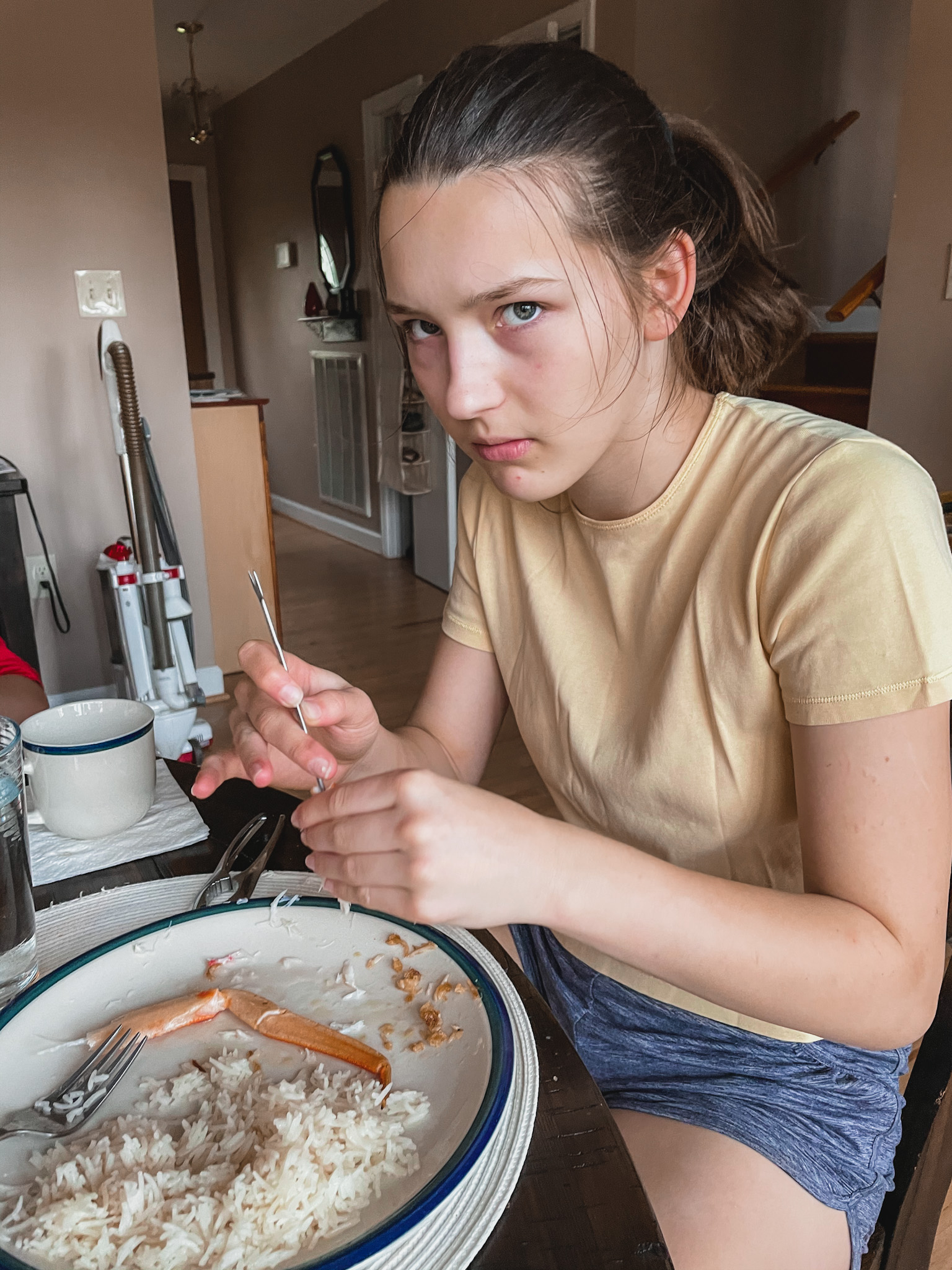
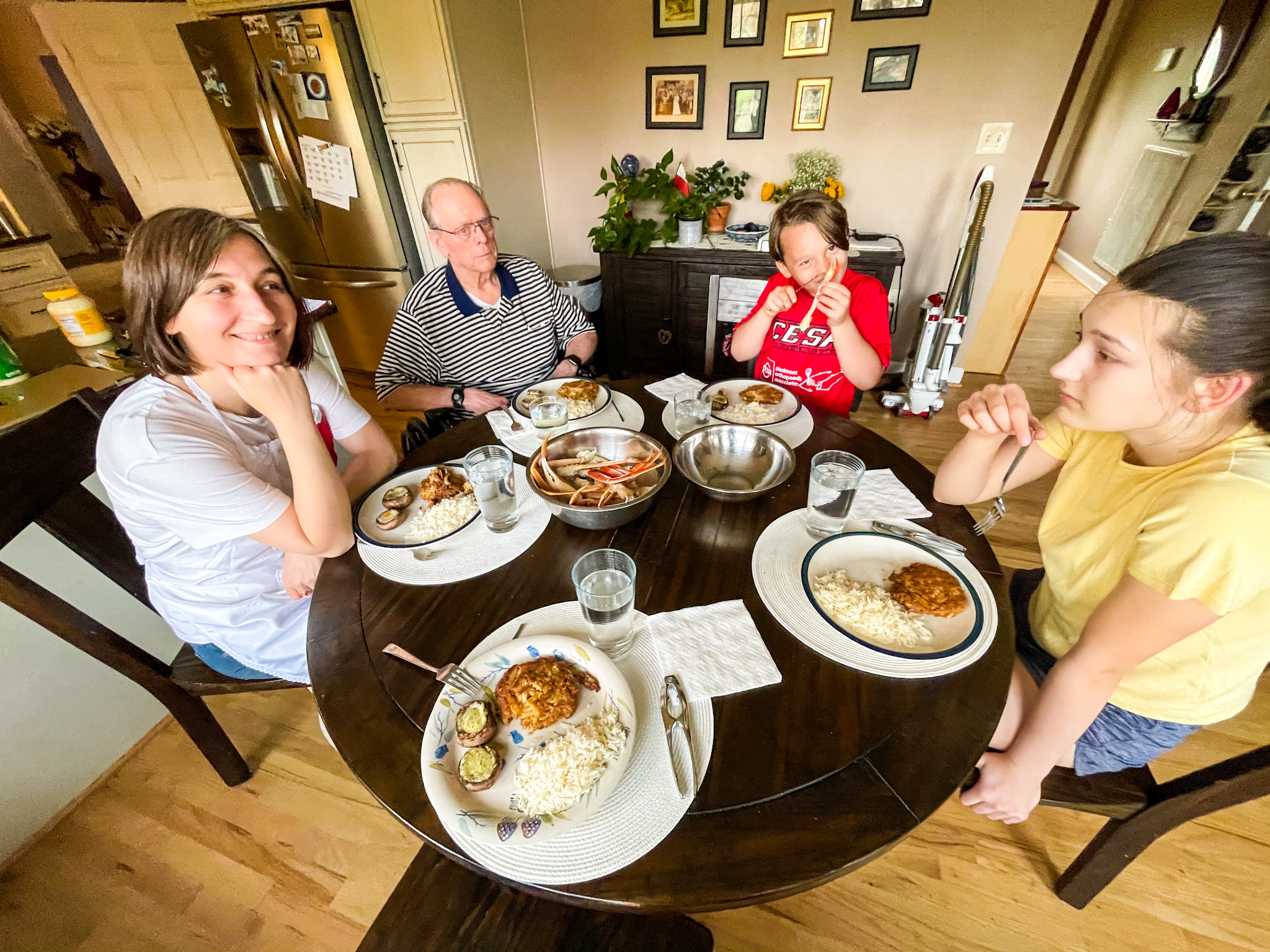
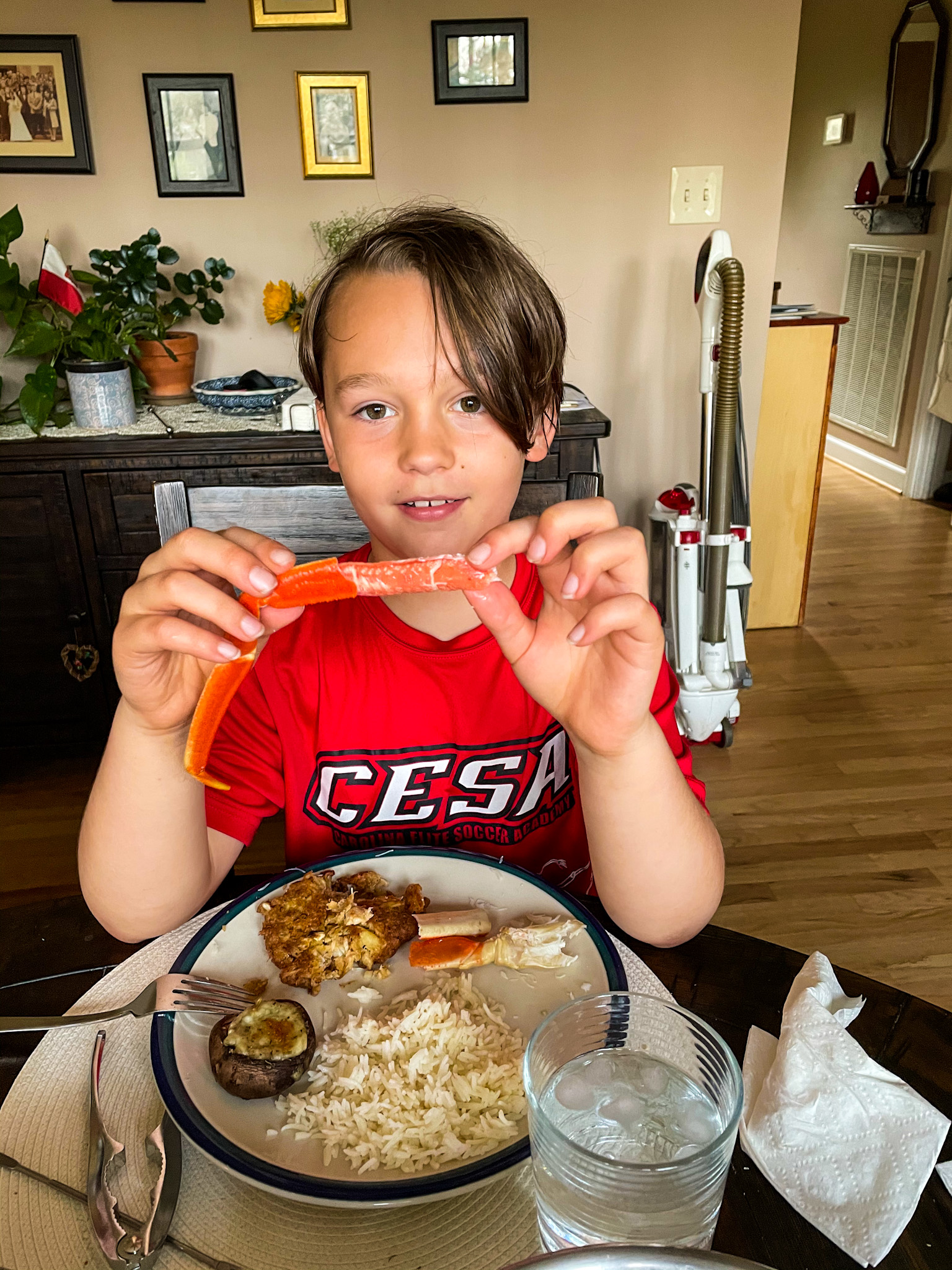
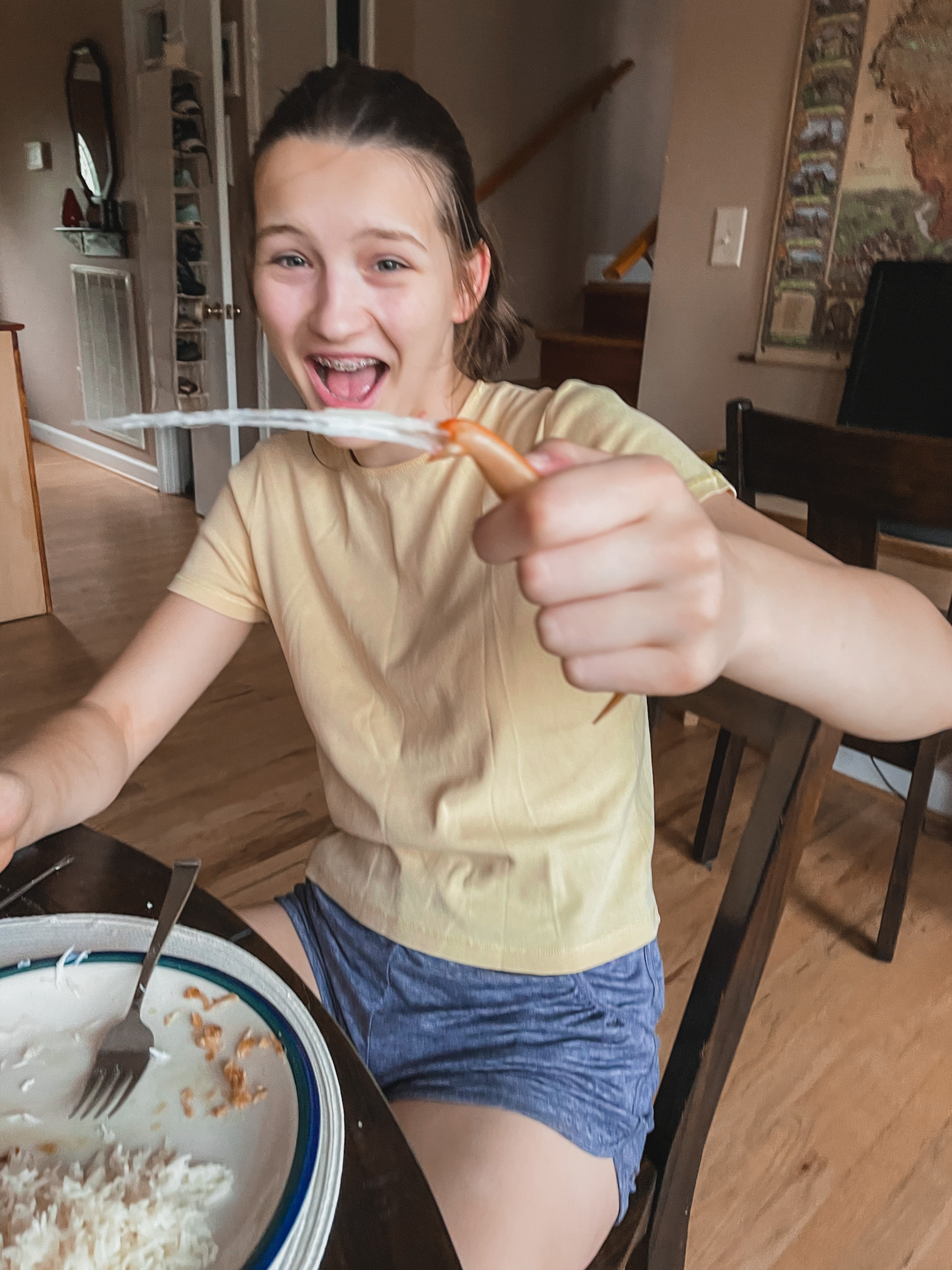
The best thing about crab legs (other than the taste) -- they're fun to eat as well.
fun in threes, sometimes fours
general
When K closes on a house, we splurge a little and have a special dinner. Tonight, it was crab cakes and crab legs.
The best thing about crab legs (other than the taste) -- they're fun to eat as well.
The Boy has decided he needs to do more conditioning to improve his soccer game. Tonight, he ran a series of interval training exercises that we kind of made up as we went along. Then he decided he wanted to make up his own.
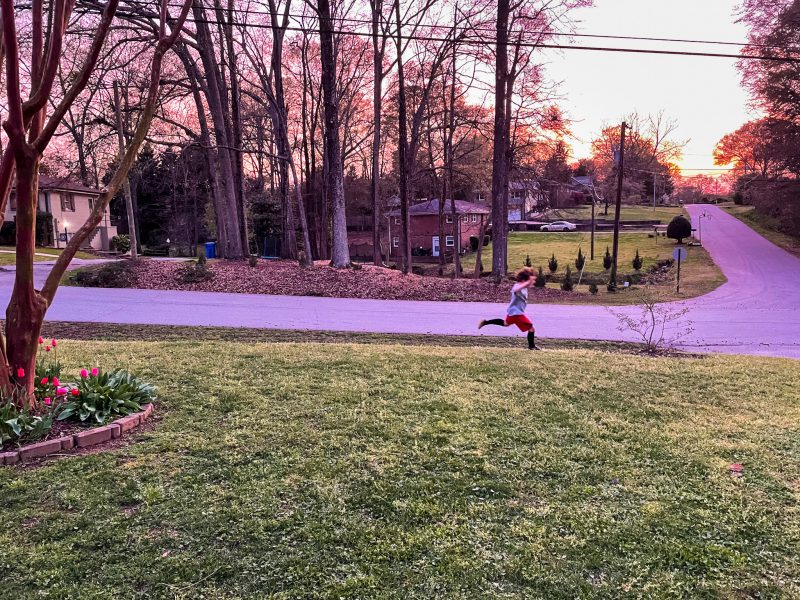
He struggles a bit this year in soccer. He’s one of the youngest on the team, and as a result, he’s less aggressive/experienced than others and a bit slower than many of them. To his credit, he’s not giving up, though he wanted to at first. The thing is, he actually likes playing soccer, and that makes all the difference.
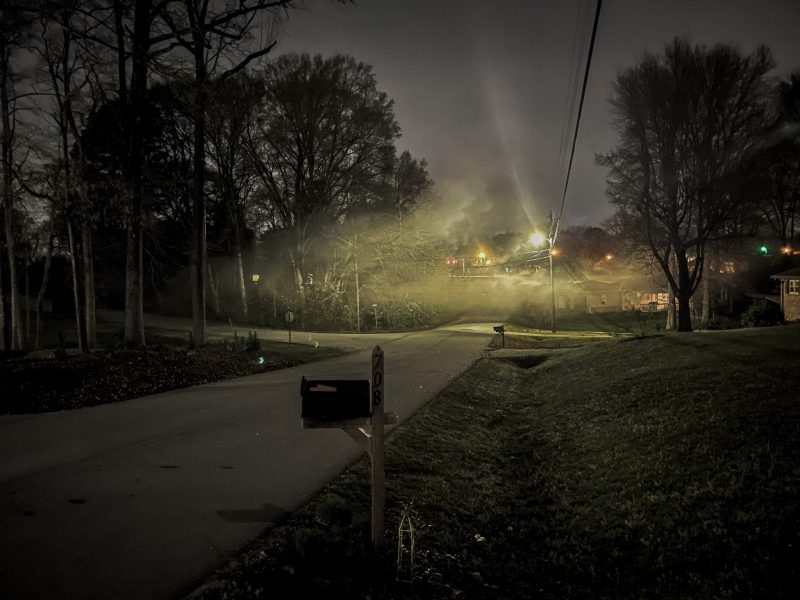
In the evening, I took the dog for a walk and discovered our neighbor had started his weekend backyard fires. Perhaps I’ll go over for a visit tomorrow night.
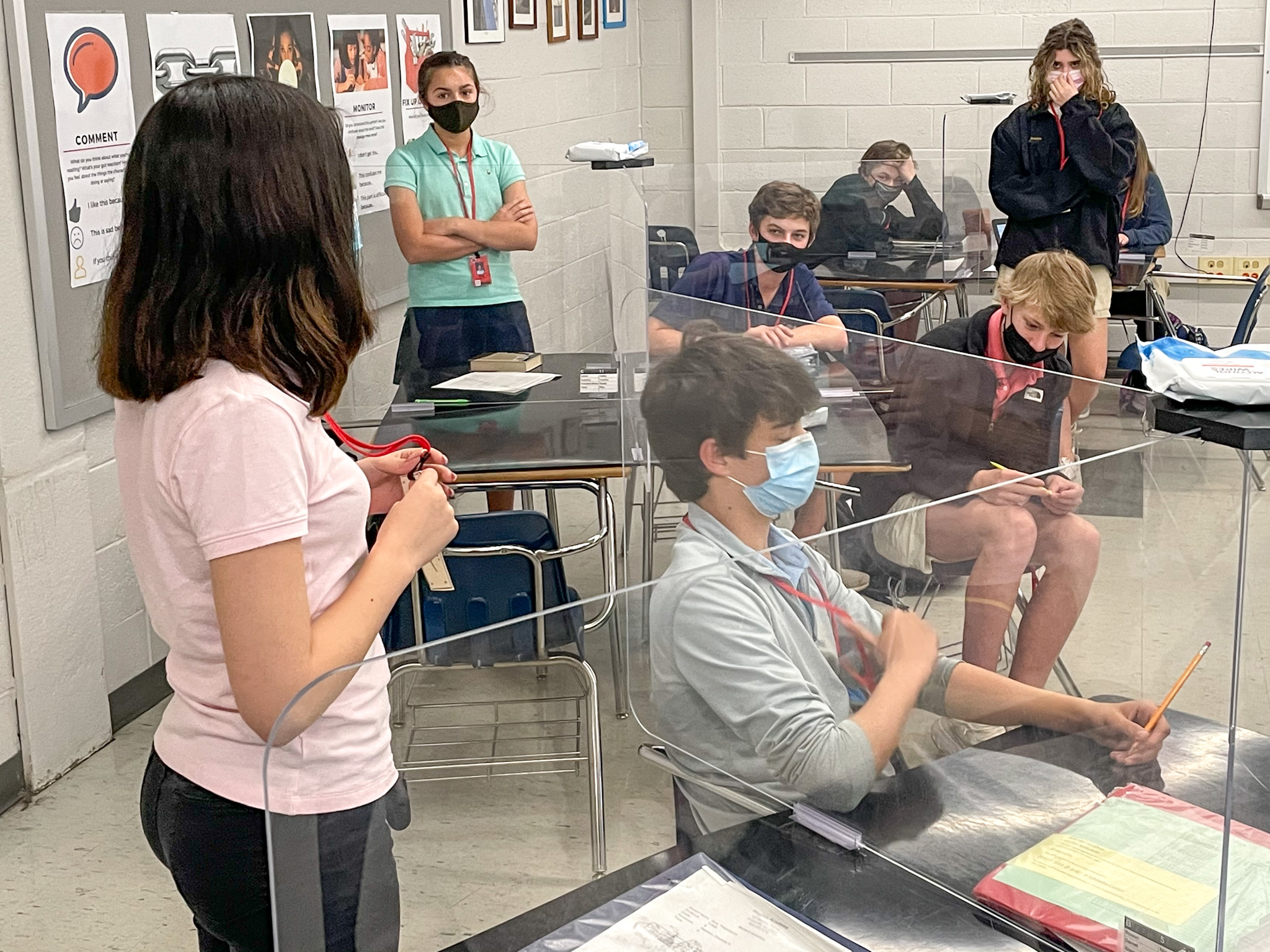
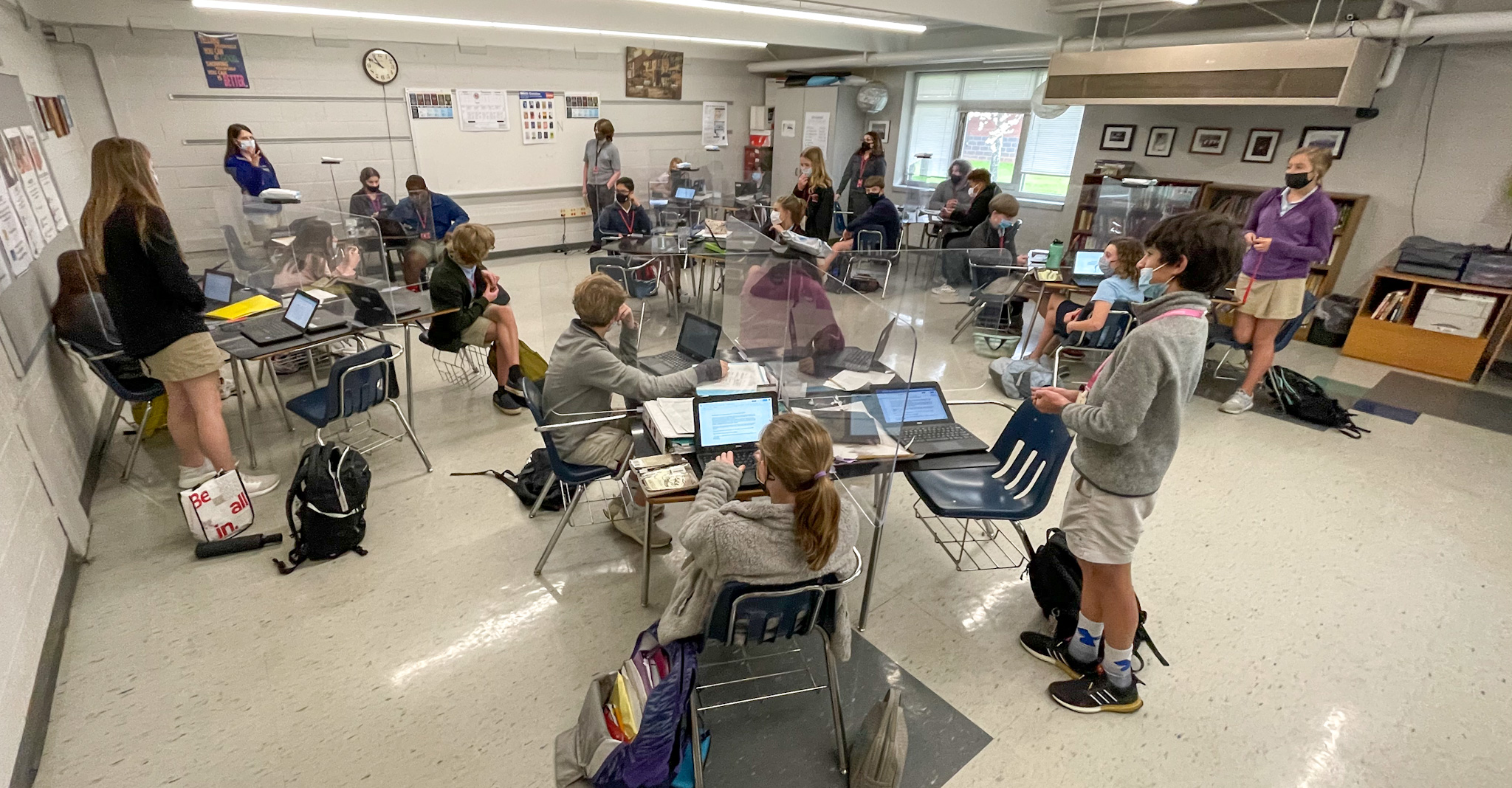
Today, we ran one of the students' favorite activities: a Socratic seminar. There are few things fourteen-year-olds love more than arguing, and a Socratic seminar (obviously altered for Covid safety) is the perfect way to wind up a week. Today's discussion: who was the most morally upright of the minor characters in To Kill a Mockingbird.
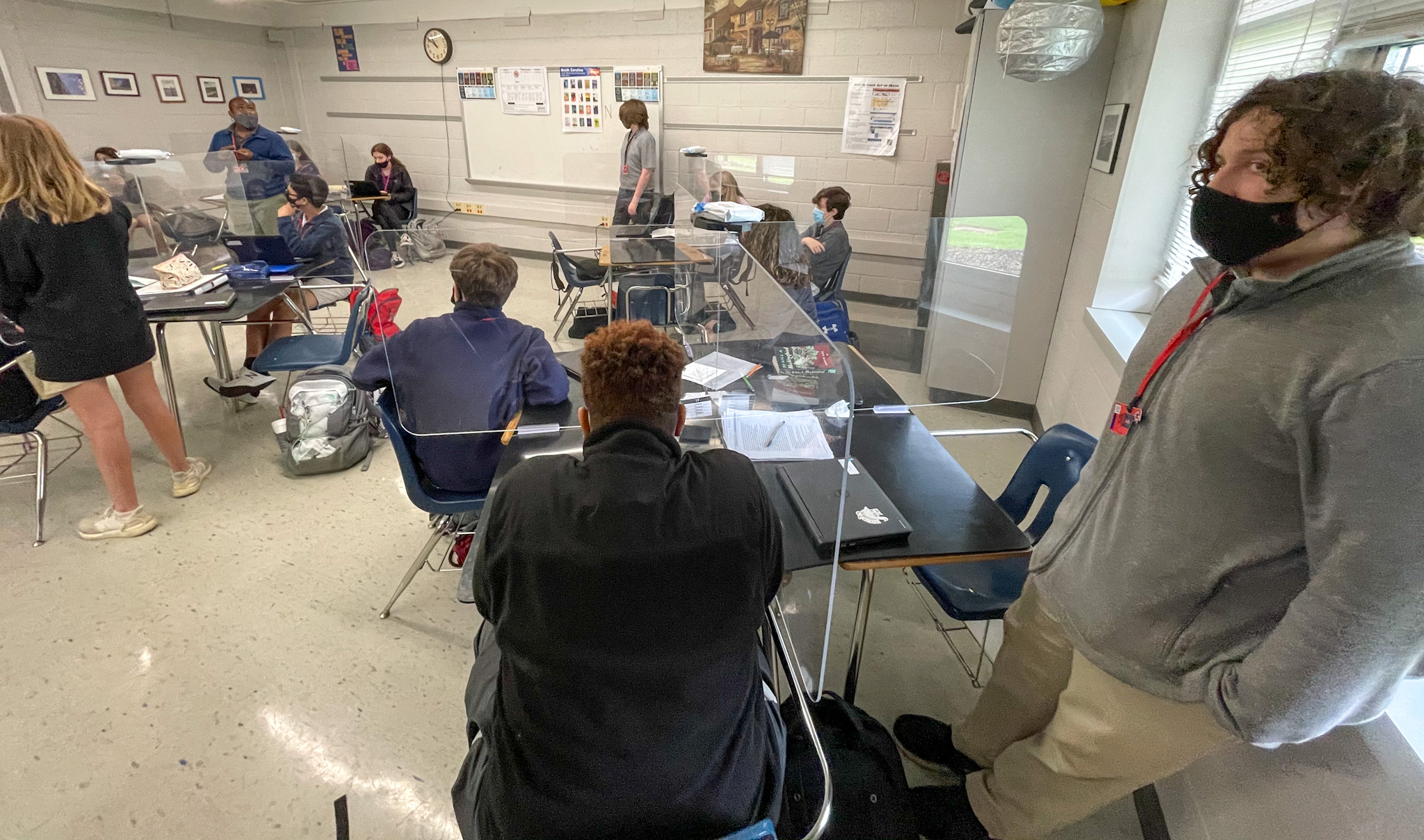
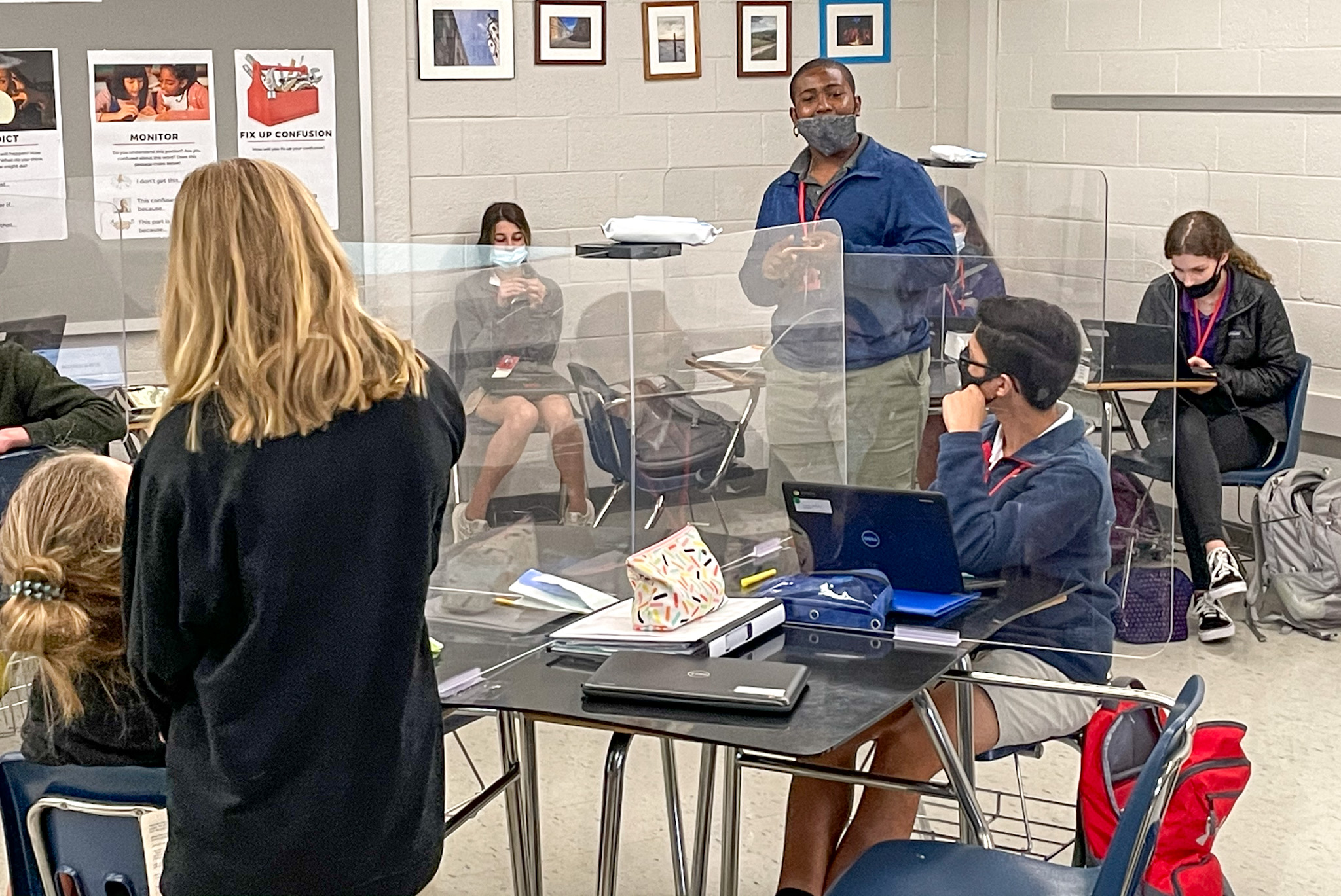
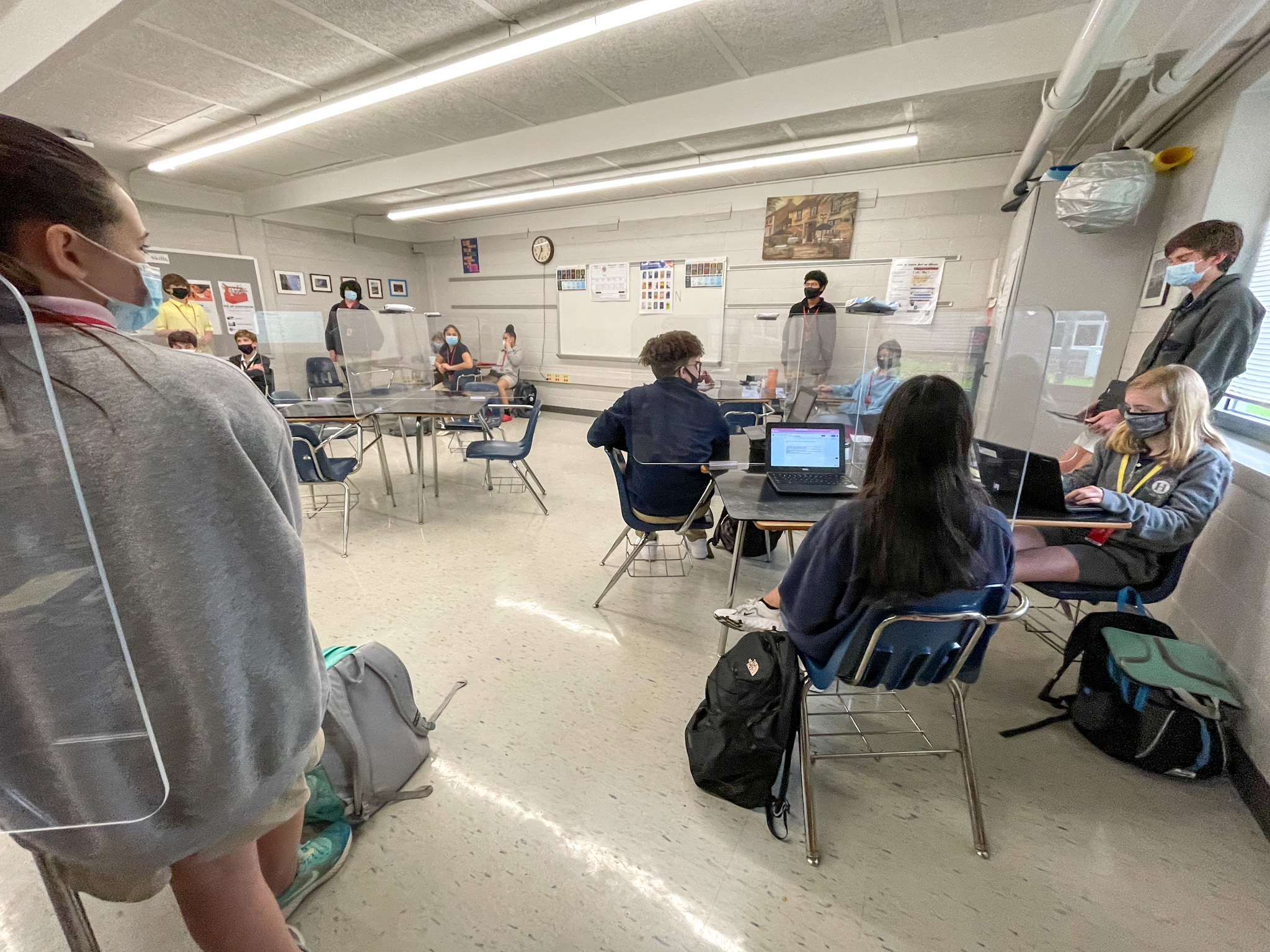
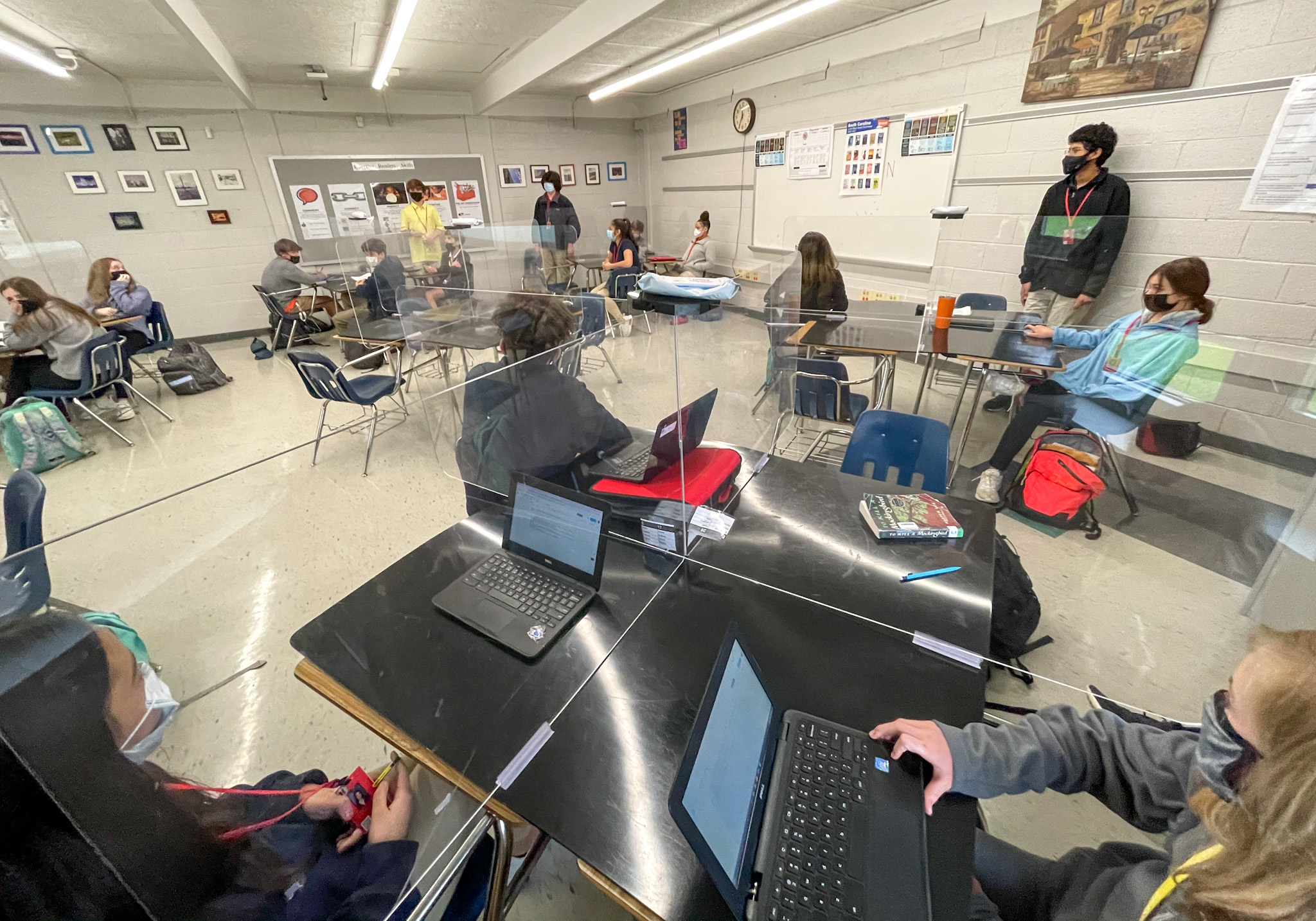
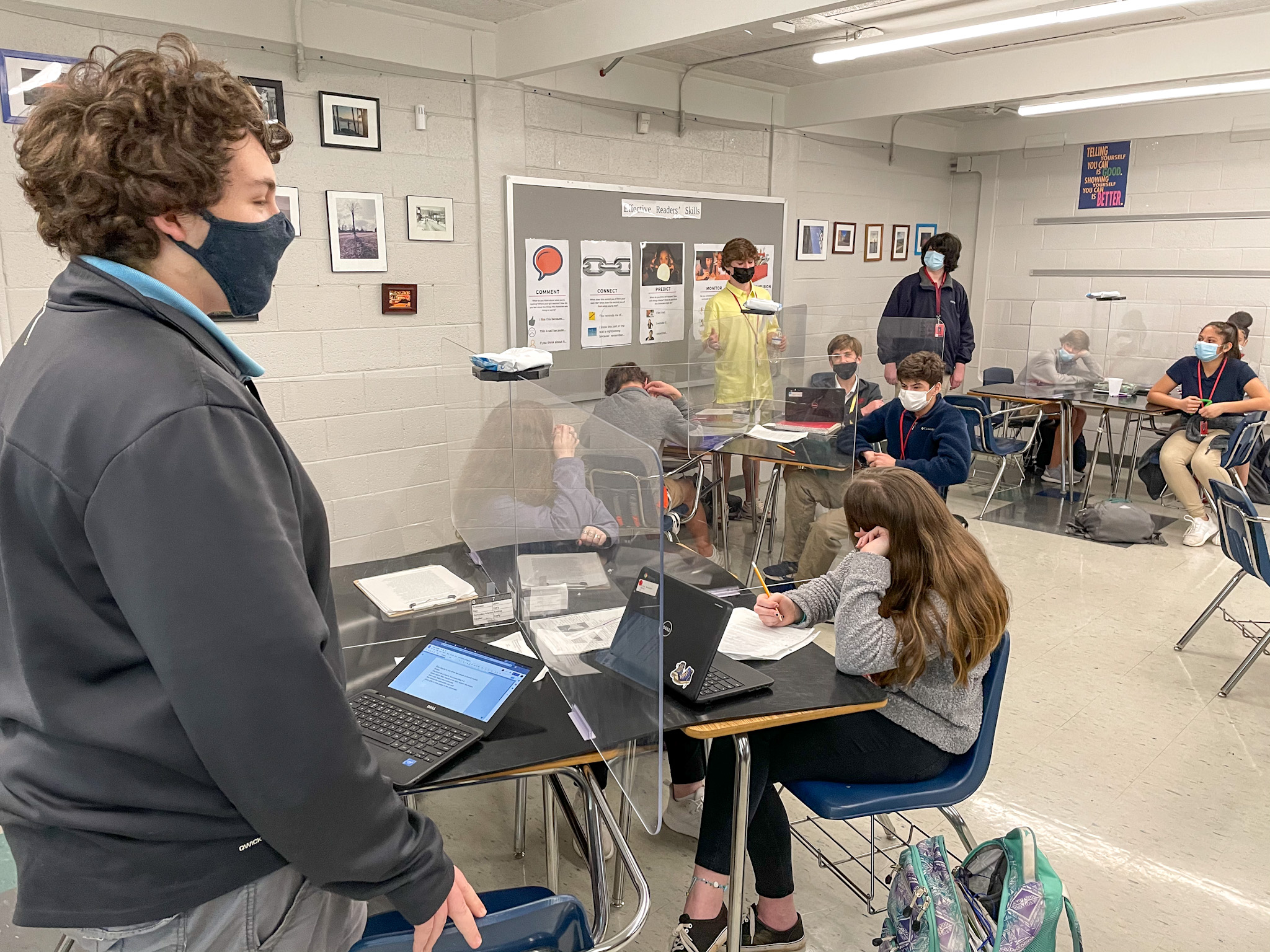
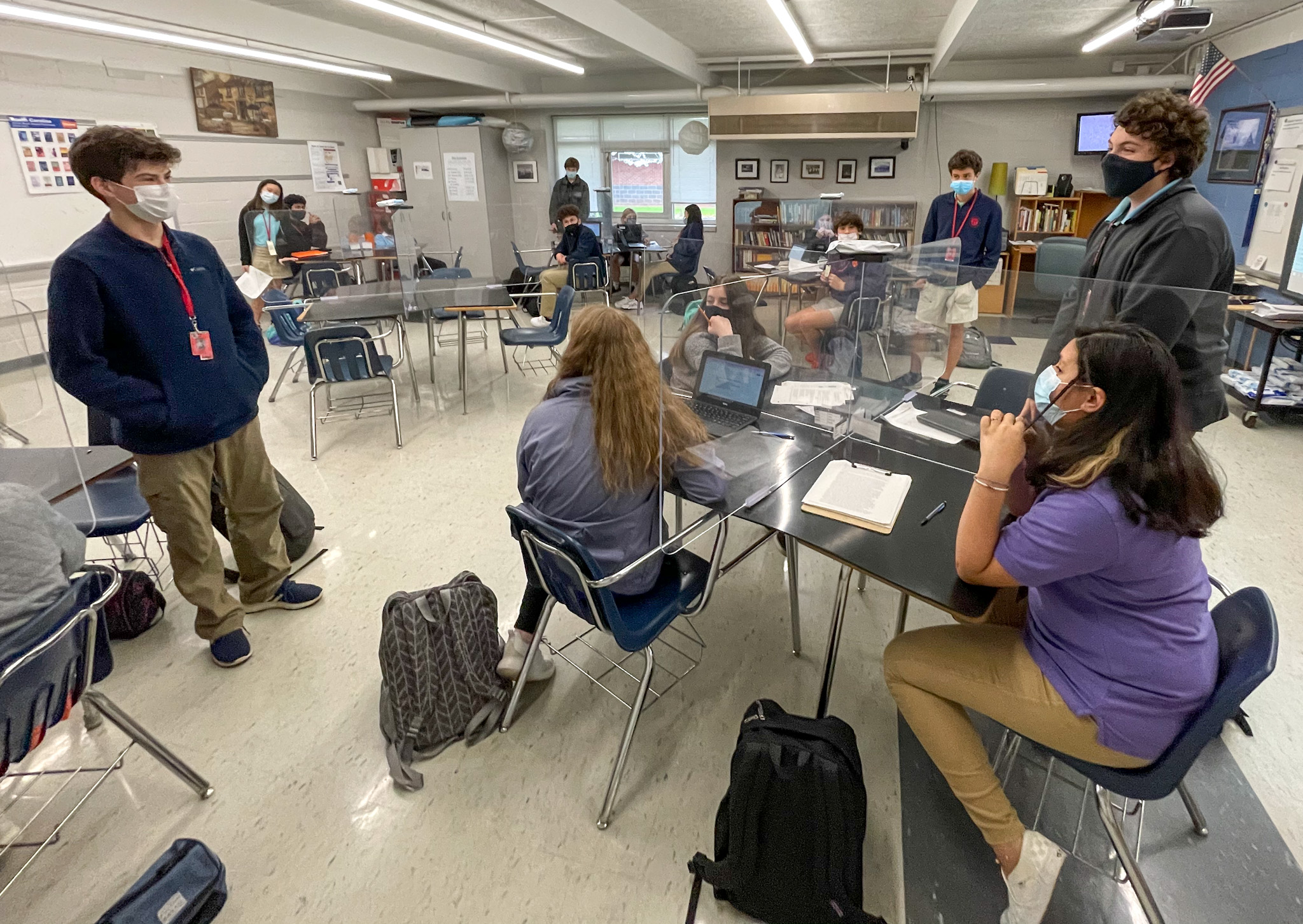
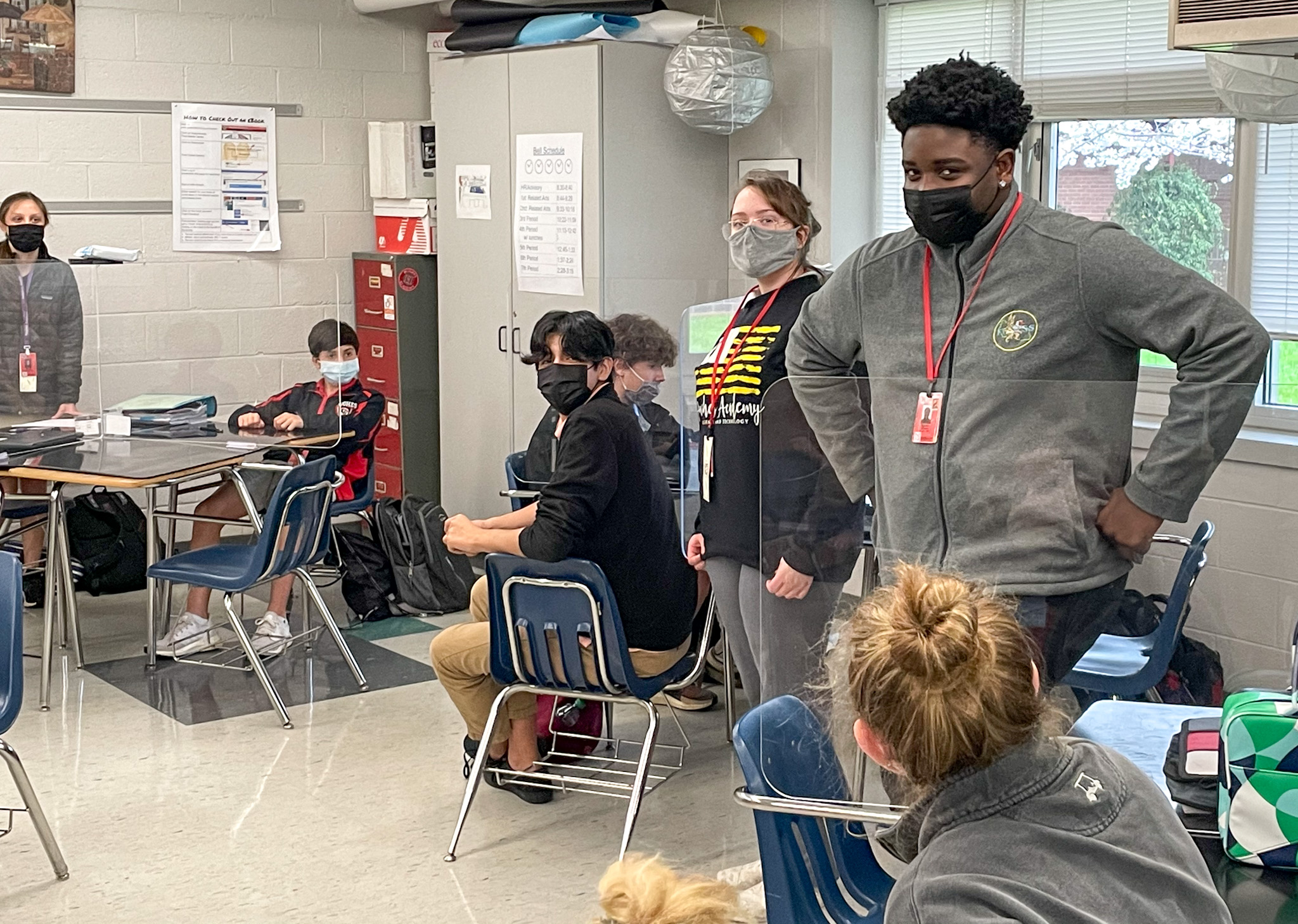
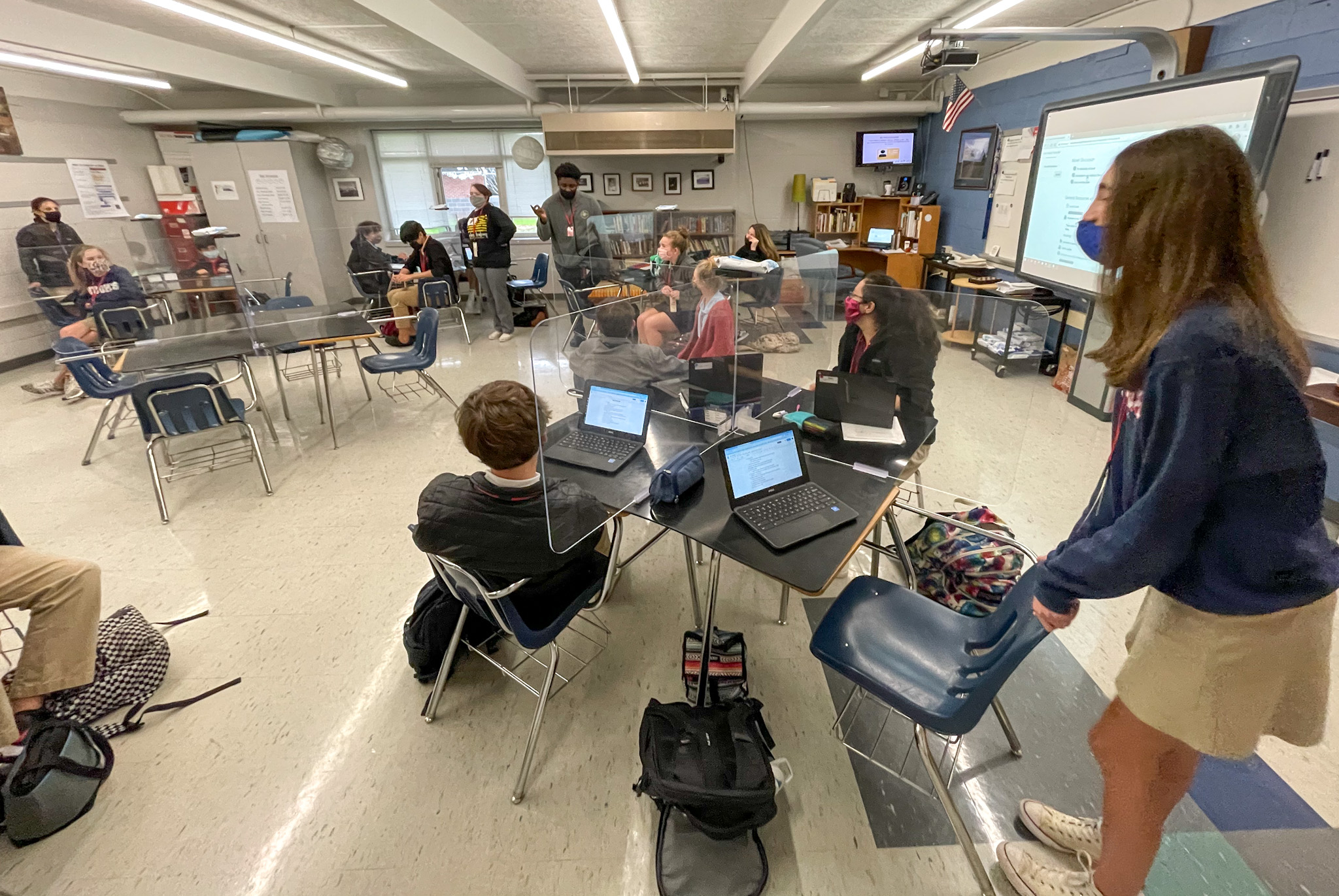
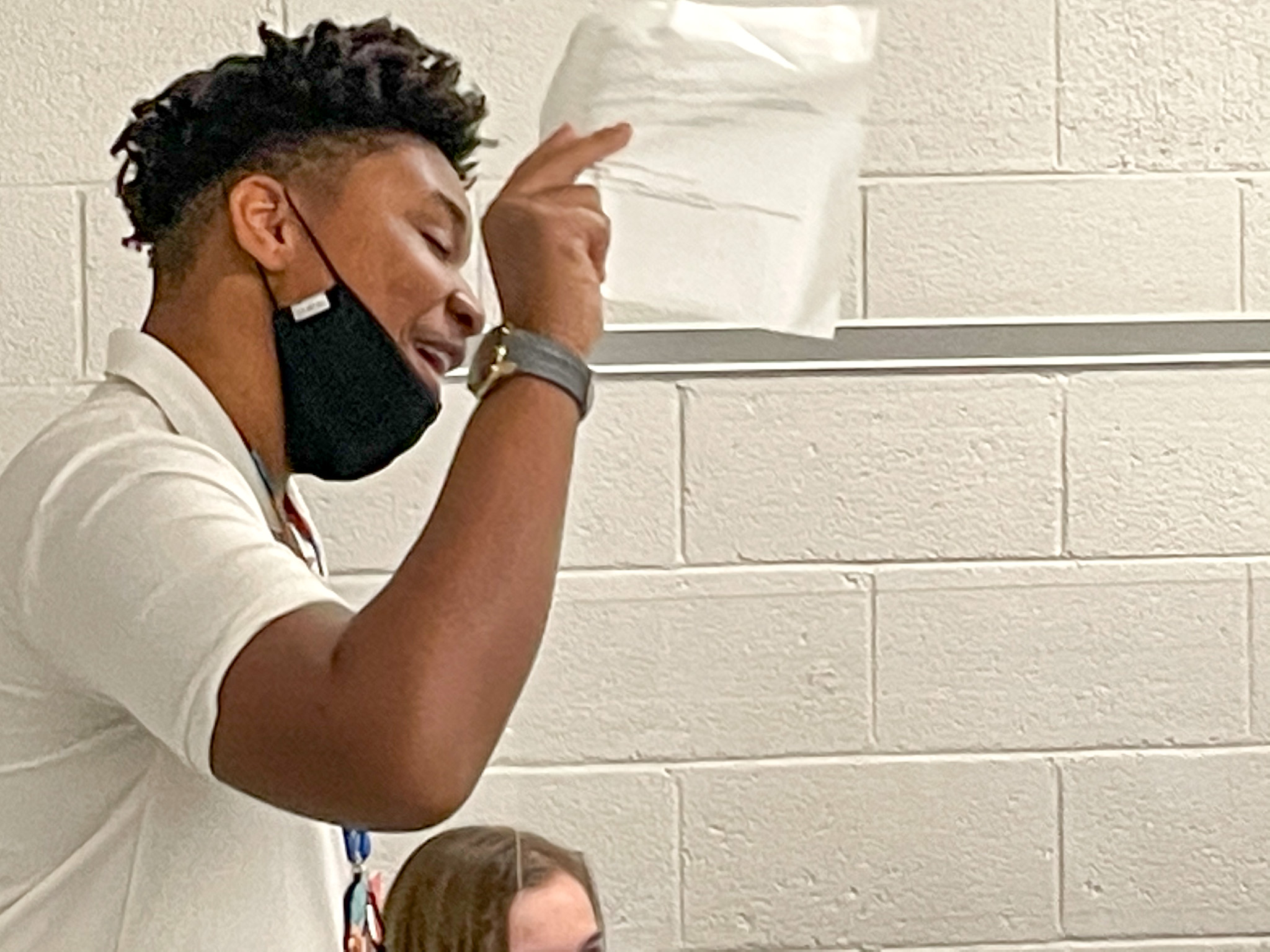
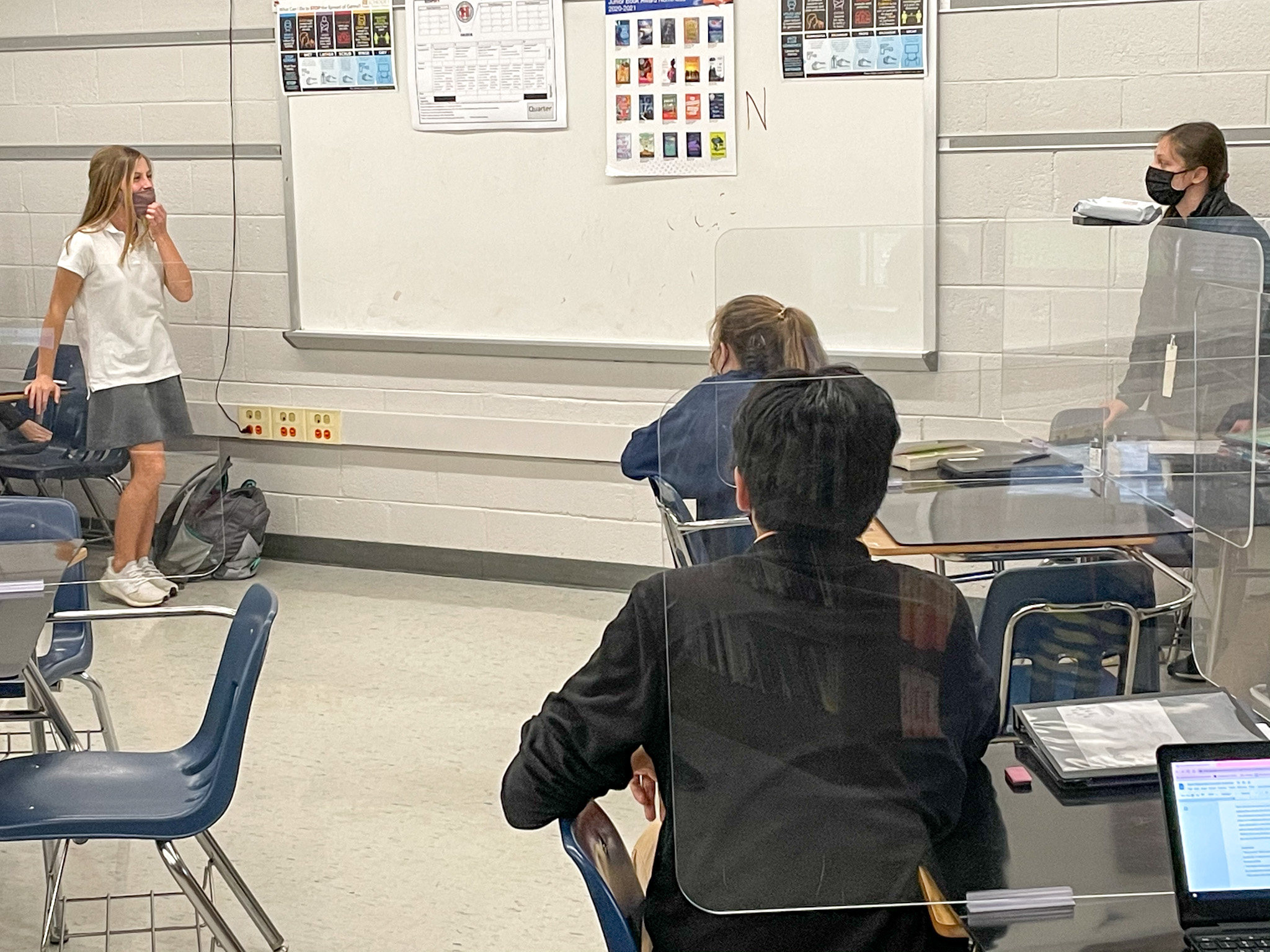
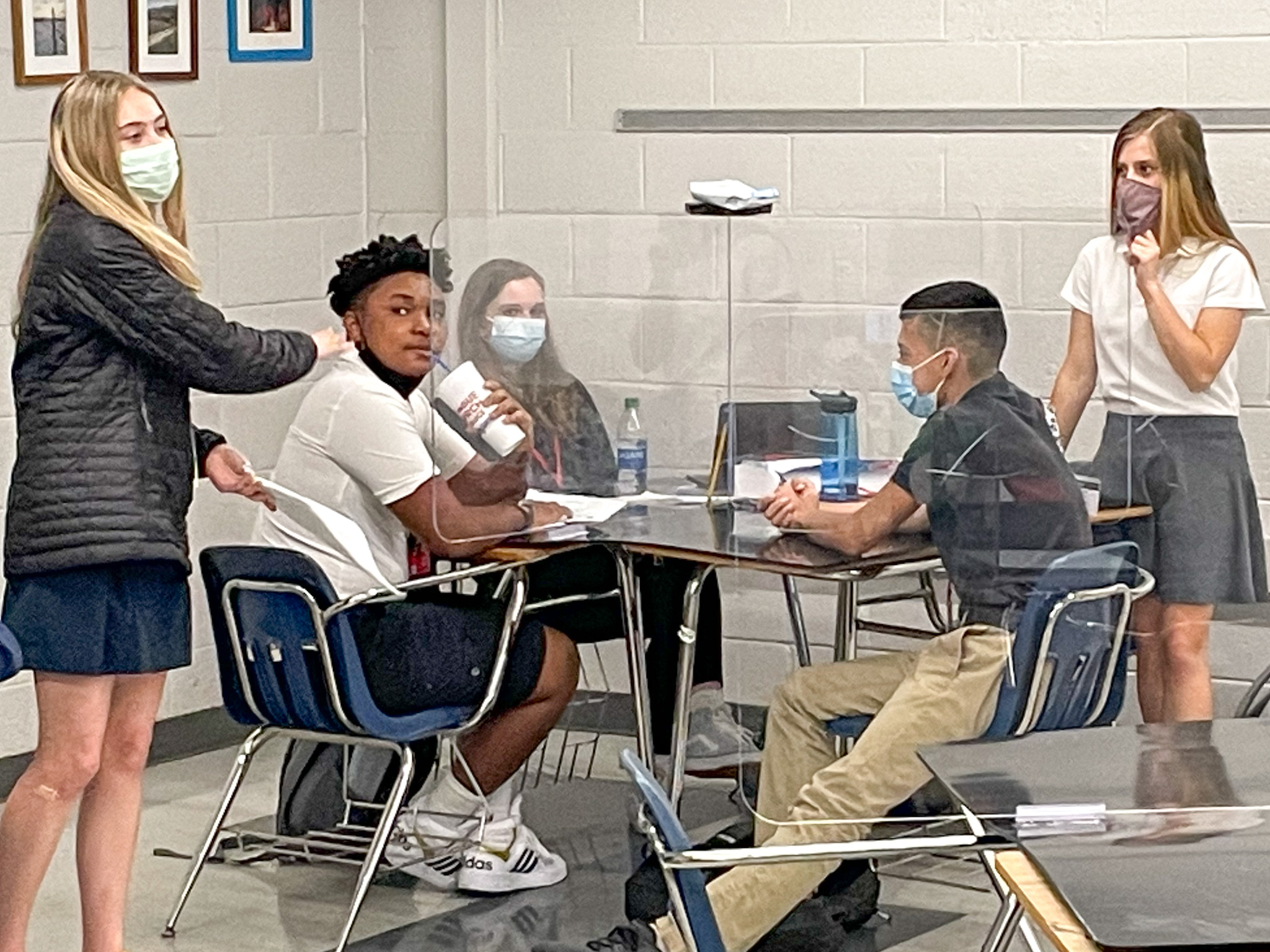
After school, we got to hang around a bit because of a tornado shelter-in-place order.
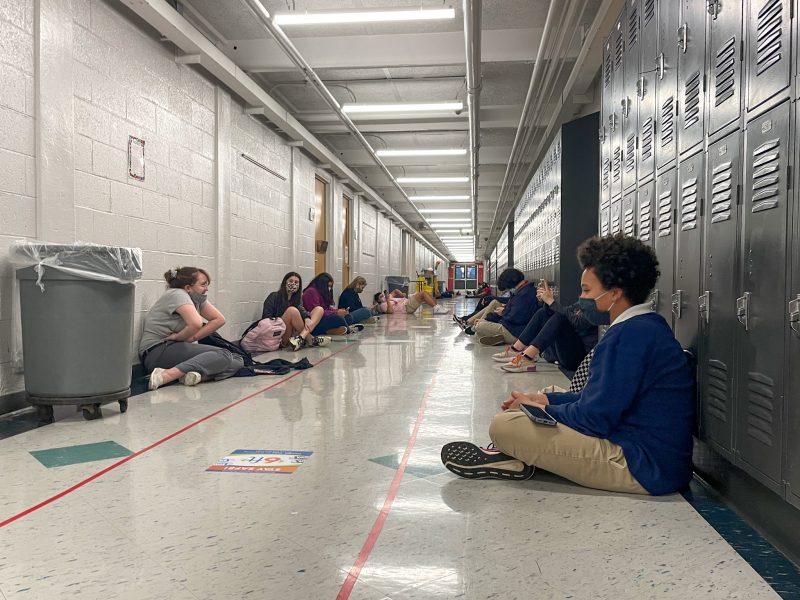
The few kids who were still around sat in the hallway and made silly poses.
The last time we had a shelter-in-place order, the whole area got flooded.
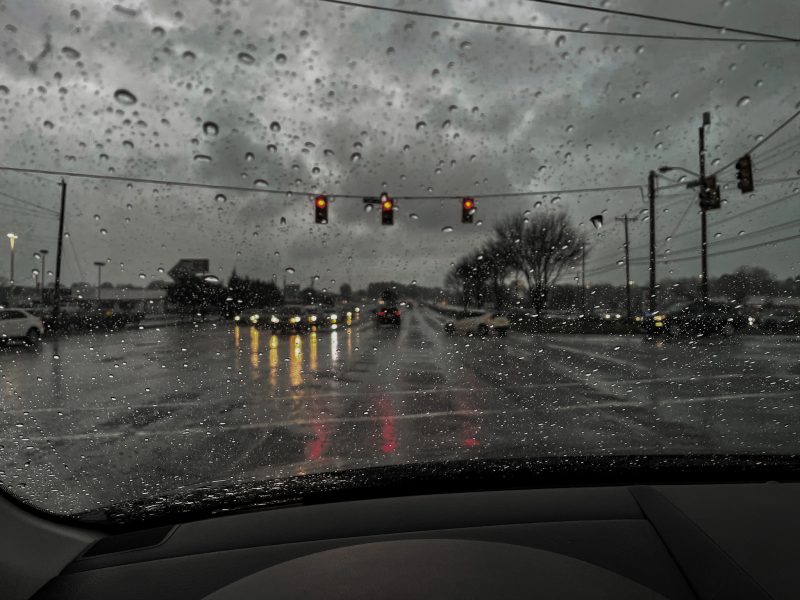
The journey home was dark.
The girls went to watch their coach’s other team play — a college men’s team.
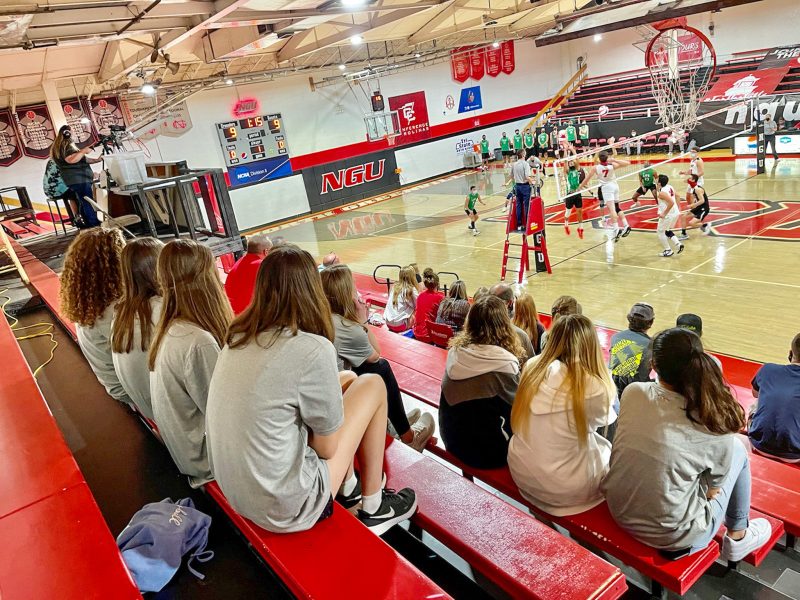
“They jump so high!” was the common comment. “And the net is higher!”
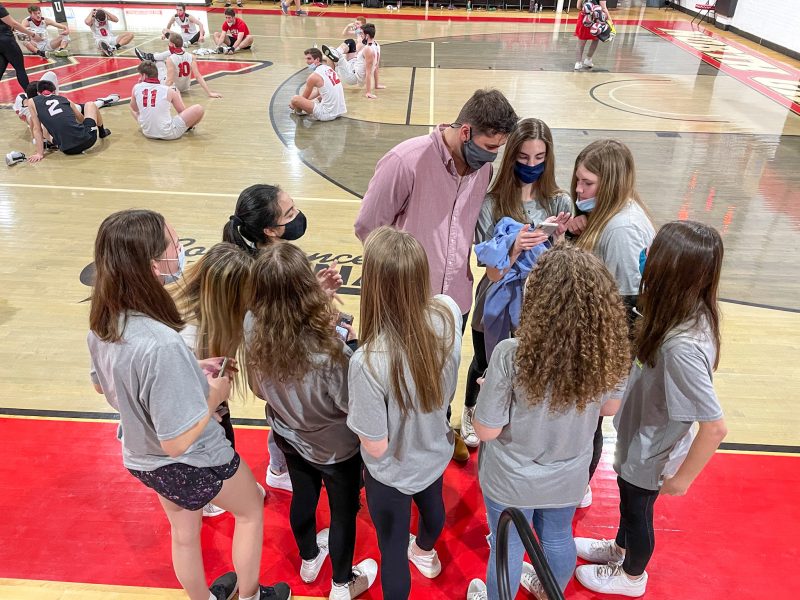
At one point, they were discussing the other team with coach M. “I liked number 10,” one girl said.
“Really?” coach asked incredulously. “He was terrible.”
“I’m talking about looks, coach,” she clarified.
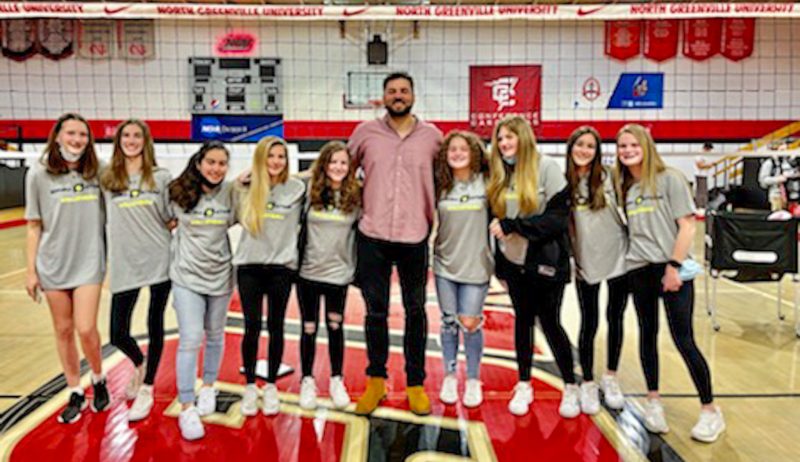
“I was not part of the conversation,” the Girl clarified when I related it to K.
(I also didn’t take the pictures…)
Last Thursday, the kids had an e-learning day as the whole district took a day off for teachers to get vaccinated. I gave the students the following work:
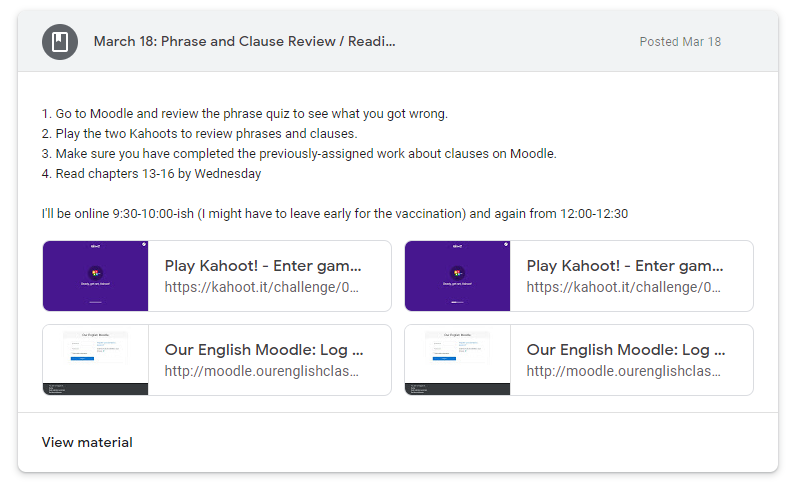
So many issues with this. First of all, the time I was supposed to be online (and therefore the time students were expecting me) was 9:00-9:30. When I got online at 9:30, everyone was leaving. How did I look at the school schedule and think I was supposed to be online during math teachers’ time? Oh well — it was no big deal.
The real problem, though — did you notice that fourth point? “Read chapters 13-16 by Wednesday.” But on Wednesday to have them read by Monday. So when I began class today ready to work with chapters 13-16 of To Kill a Mockingbird, a substantial number of students hadn’t done the reading.
“You said on Classroom to have it done by Wednesday,” a sweet and honest girl said. She offered me her Chromebook with the assignment pulled up: “See?”
I stood there, looking at the clear evidence I’d screwed up, wondering what happened (I just mixed up the chapters — it should have been chapters 17-20 for Wednesday), and wondering if there was any way to salvage the day.
“Reading day.”
“Seriously?” they asked incredulously.
What else was I to do?
Every now and then, I learn something so profound that it marks a significant change in my thinking. The last two days have constituted such a change. I listened to Josh Clark's podcast The End of the World, and I can't remember anything having a more profound effect on me. Not the realization that I doubted the existence of God; not the change I made from being very left-leaning to being right-leaning and the return to the left I seem to be experiencing now; not the knowledge that I was going to be a parent.
The podcast deals with how the world might end, and by that it means how humanity might end. The world itself might continue on but humanity might not. And the podcast begins with an odd question: given the size of the universe, the number of galaxies it contains, and the number of stars in those galaxies, the universe should be absolutely teeming with life. We're talking about billions upon billions of galaxies each with billions of stars. Even if the odds of developing intelligent life were a 1-in-100-billion, there should be almost countless examples in the universe. So why have we found no sign of them? That's the Fermi paradox, and it is the material for the first couple of episodes. The fact that we see no signs of intelligent life anywhere has one of two explanations:
Option one is the less interesting of the two, but Clark convincingly illustrates that it's unlikely. It's the second option that is terrifying, because it breaks into two options itself:
Thinking about option two leads us to question what could have happened to them? Presumably, they advanced at least as far as we have, and presumably, they would have advanced further if they could, spreading out into the cosmos and colonizing their solar system, their galaxy, significant portions of the universe itself. That they didn't suggests that they never existed (back to option one) or that they met an insurmountable obstacle that resulted in the end of their existence. This is known as the Great Filter -- in this case, the thing that prevented a given alien species from colonizing beyond its original planet.
What does all of this have to do with the end of the world? Simple: due to the technologies we have developed now, we are almost certainly about to pass through our own Great Filter. There are so many threats to the continued existence of humanity that it seems inevitable that one of them will catch us by the ankle, so to speak, and drag us back down to primordial sludge (or nothingness). Clark covers several of them, including artificial intelligence, biotechnology, and physics experiments, but in my mind (and in Clark's as well, I believe), the greatest risk comes from artificial intelligence, though biotech is not far behind.
The risk from artificial intelligence is not a Terminator- or Matrix-style war between robots and humans. It's something much more subtle. Imagine, for example, that a paperclip factory hires a programmer to create a program to maximize paperclip production. The programmer creates algorithms that have the freedom to make their own decisions about how to go about the productivity improvements. Its goal is simple: create more paperclips. Should it attain super-intelligence, it could wreck the world in its effort to make more paperclips. It takes over other computers in order to increase its computational capacity to make more paperclips. It develops machines that make machines that make machines that make machines to improve paperclip production. Eventually, it learns how to create nanotechnology that can actually manipulate things at an atomic level. It can then literally begin the process of turning everything into paperclips, manipulating atoms to transform everything into aluminum to make paperclips -- everything, including us. It then launches probes into space and eventually turns the whole universe into paperclips.
It's hyperbolic and a little silly, but it gets at the heart of the concern: once AI achieves super-intelligence, it will be to us as Einstein is to an earthworm. There are no guarantees that it will have any concern with us at all. After all, could we expect Einstein to spend his tremendous intellect and life worrying about the happiness of every earthworm? So we have to figure out a way to program these things in a way that they have morals compatible with ours.
The biotech and physics experiment risks are equally fascinating, but it was about this point in the podcast (this would have been episode five out of eight) that I began thinking of how any one of these might be our Great Filter -- the thing that we run up against which destroys us -- in terms that Clark never mentioned: the impact of religion on all of this. Most believers would not take this seriously at all because they already are convinced that there's intelligent life out there, and it's responsible for our existence and has a plan for us. That plan doesn't include us destroying ourselves, so they would be unlikely to take this situation seriously. "Eradicate ourselves from the earth? Come on -- Jesus will return before that could ever happen." God would never let the pinnacle of his creation destroy itself entirely. This is in part why so many Christians don't take global warming seriously (and after listening to this series, I'm of the mind that global warming, while a threat, is at least not an existential threat to all humanity).
This itself could be the Great Filter: time after time, intelligent life has arisen that evolves tremendous intelligence at the same time it holds radically superstitious ideas. At the point when the species has developed the technology capable of destroying itself, it harbors the superstitious lack of wisdom to know how to handle those technologies, and they destroy themselves.
Much of Clark's podcast was on the foundation of Nick Bostrom's work. He's been thinking along these lines for a long time:
The Boy had two soccer games today. His team won them both, but the second game was a real bruiser. The kids on the other team were much more aggressive than any other kids we’ve encountered. Fouls don’t occur in eight-year-old soccer, but these kids fouled. They pushed and shoved, getting very physical in almost all aspects of the game. Still, our boys managed to pull out a 3-1 win.
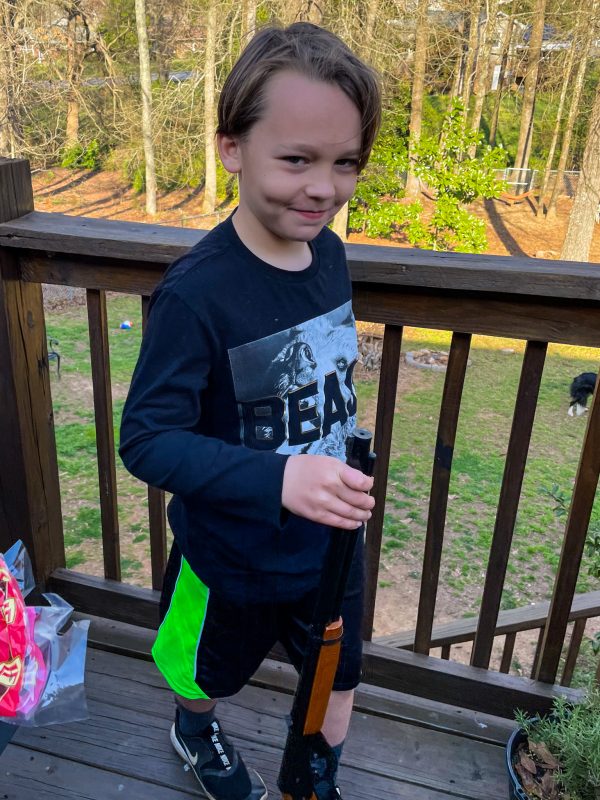
E didn’t play for most of the game, though. He went in for about the last three minutes of the second half. My understanding was that the coach let the bench decide: leave the kids in who were doing well or get subbed in. They decided to let the kids who were already doing so well continue doing so.
The Girl is with K outside of Atlanta for a volleyball tournament. Their team won the first two matches they played but lost the final match. They took one set, though, so that’s always some little bit of compensation.
Finally, the Boy played a little guitar tonight. He’s decided it’s time to get serious about his playing, so I printed him out a simple chord chart, and off we went.
A year after the first day of school in quarantine, I got my first dose of the vaccine. A local hospital and the county school system partnered in an impressively well-organized effort to get all teachers who wanted the vaccine vaccinated. The school system had a single-day e-learning break and transformed two high schools into mass-vaccination sites.
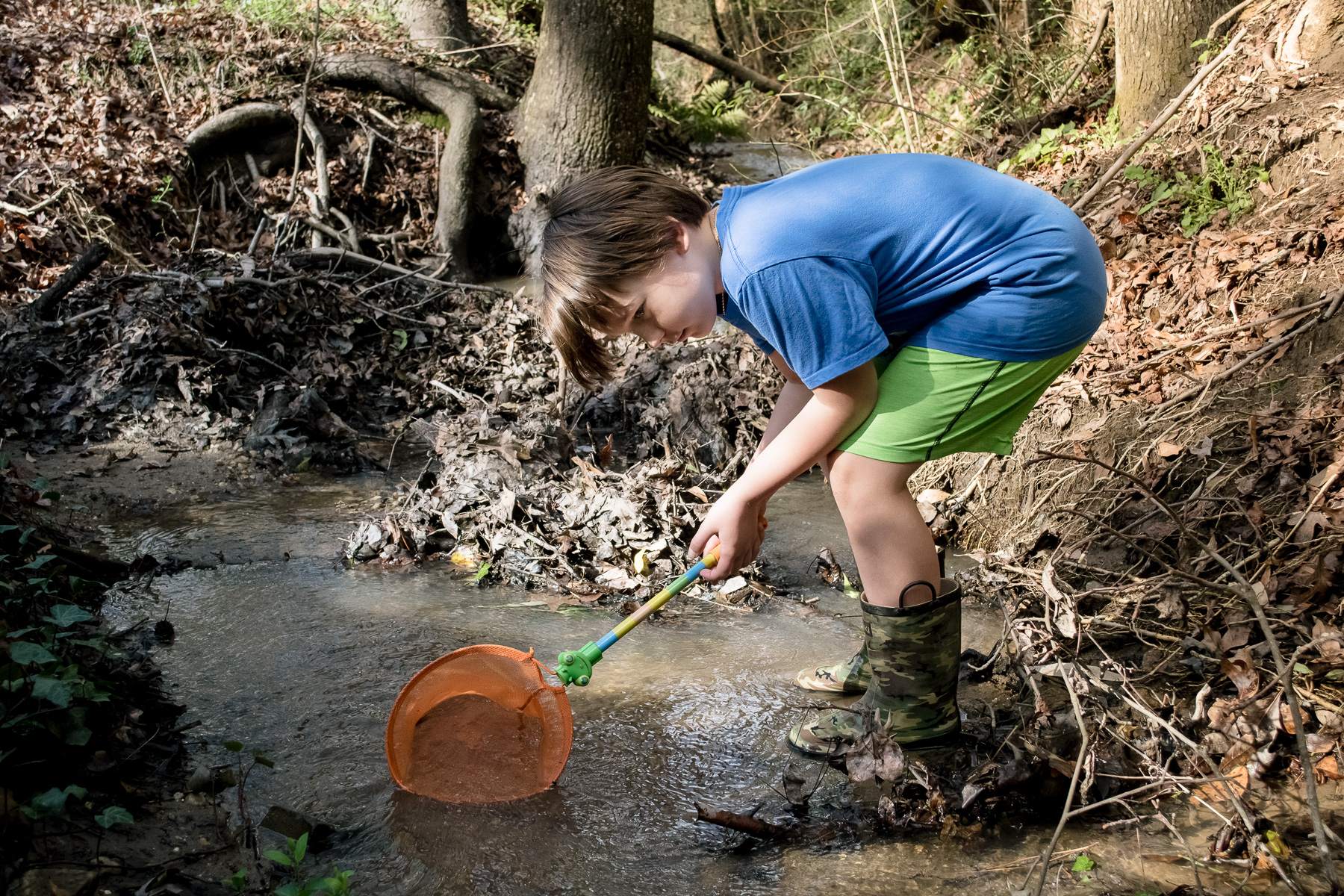
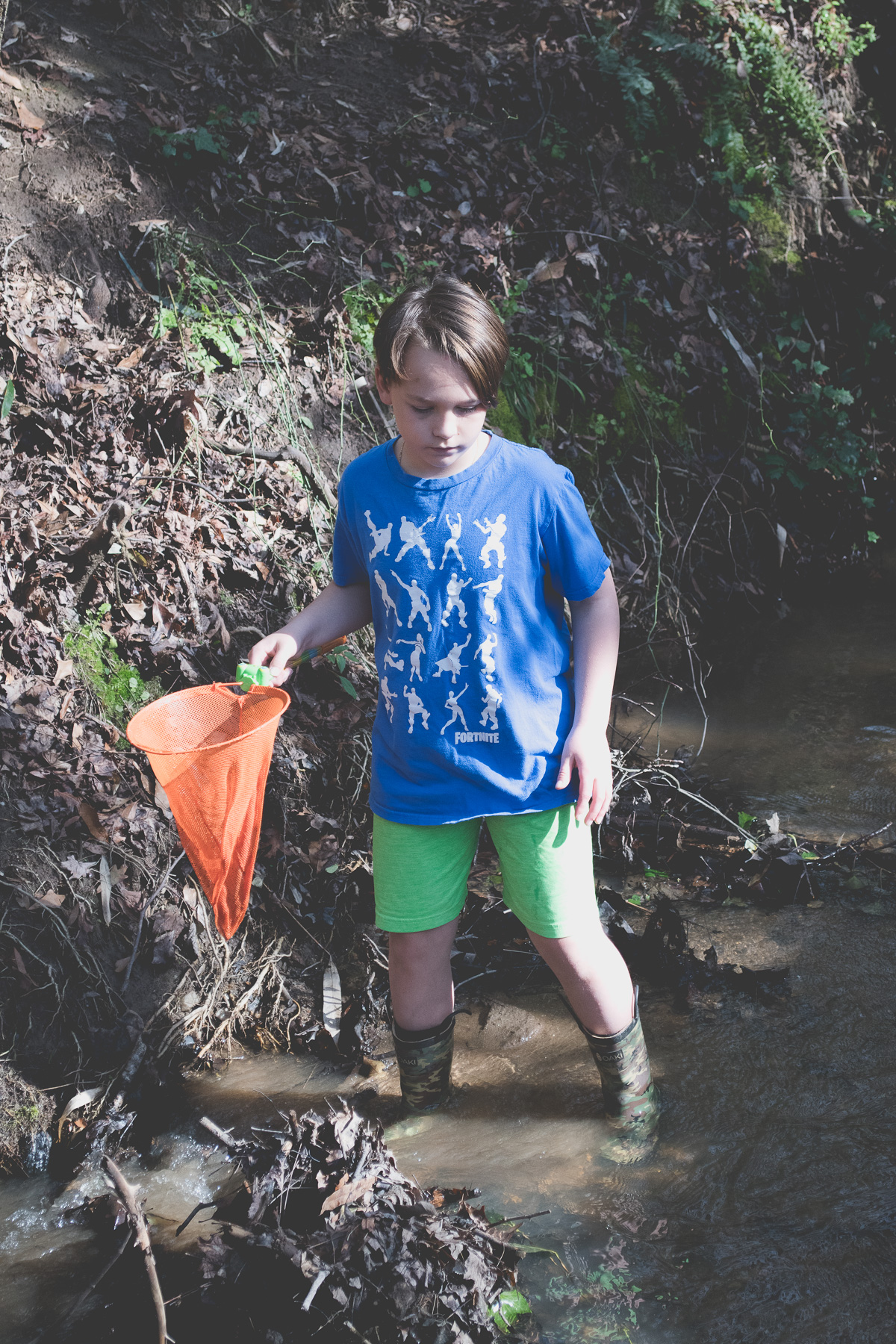
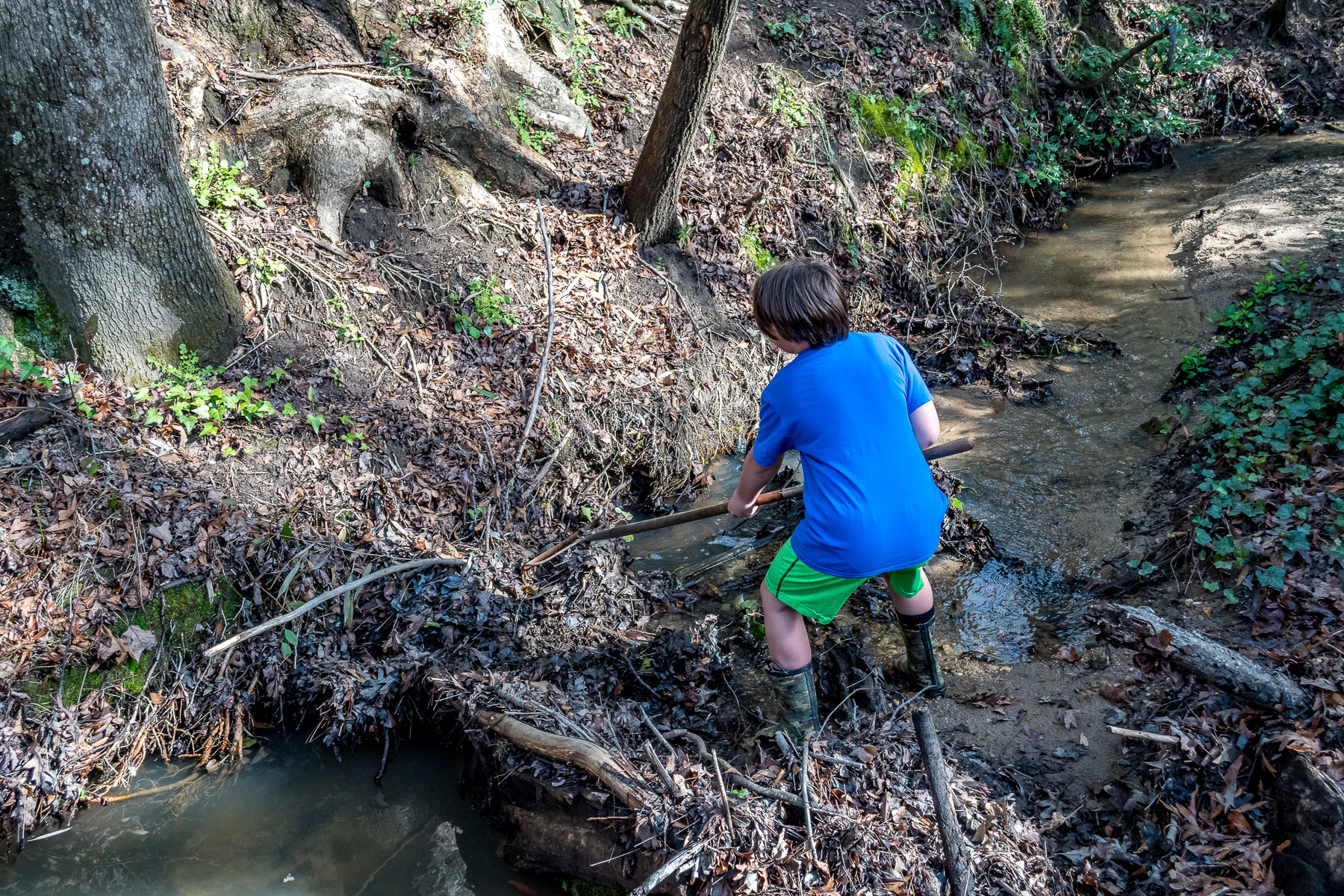
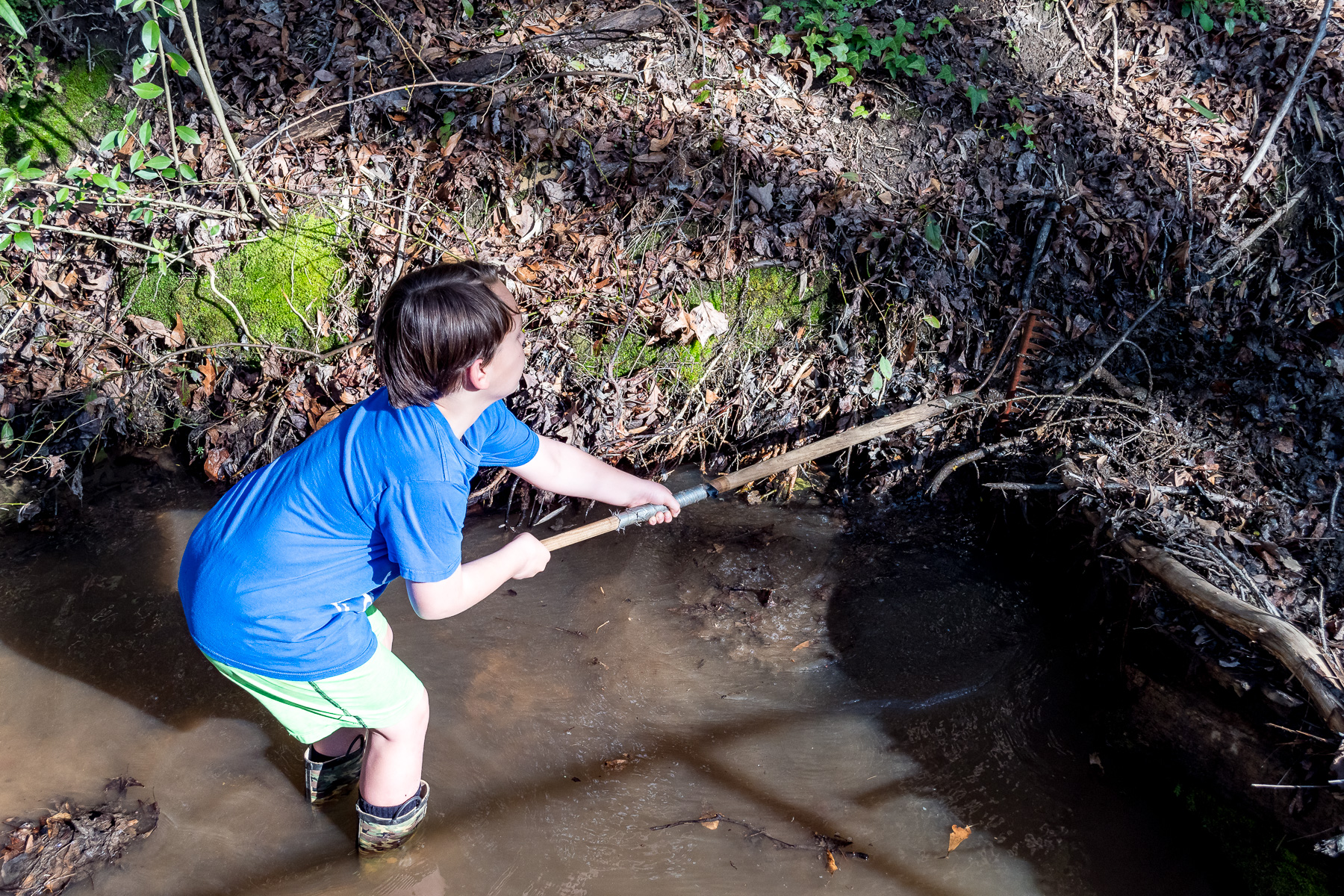
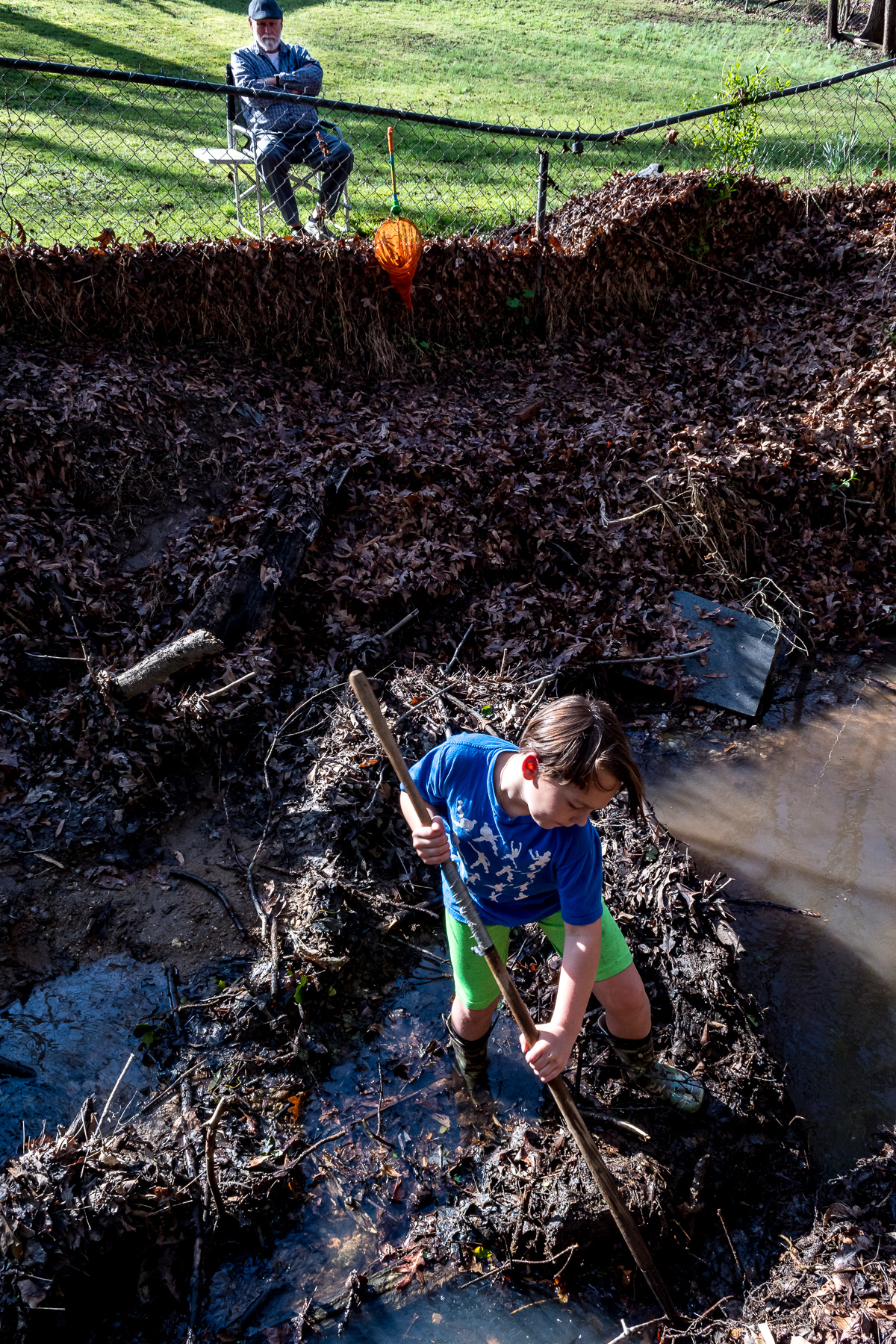
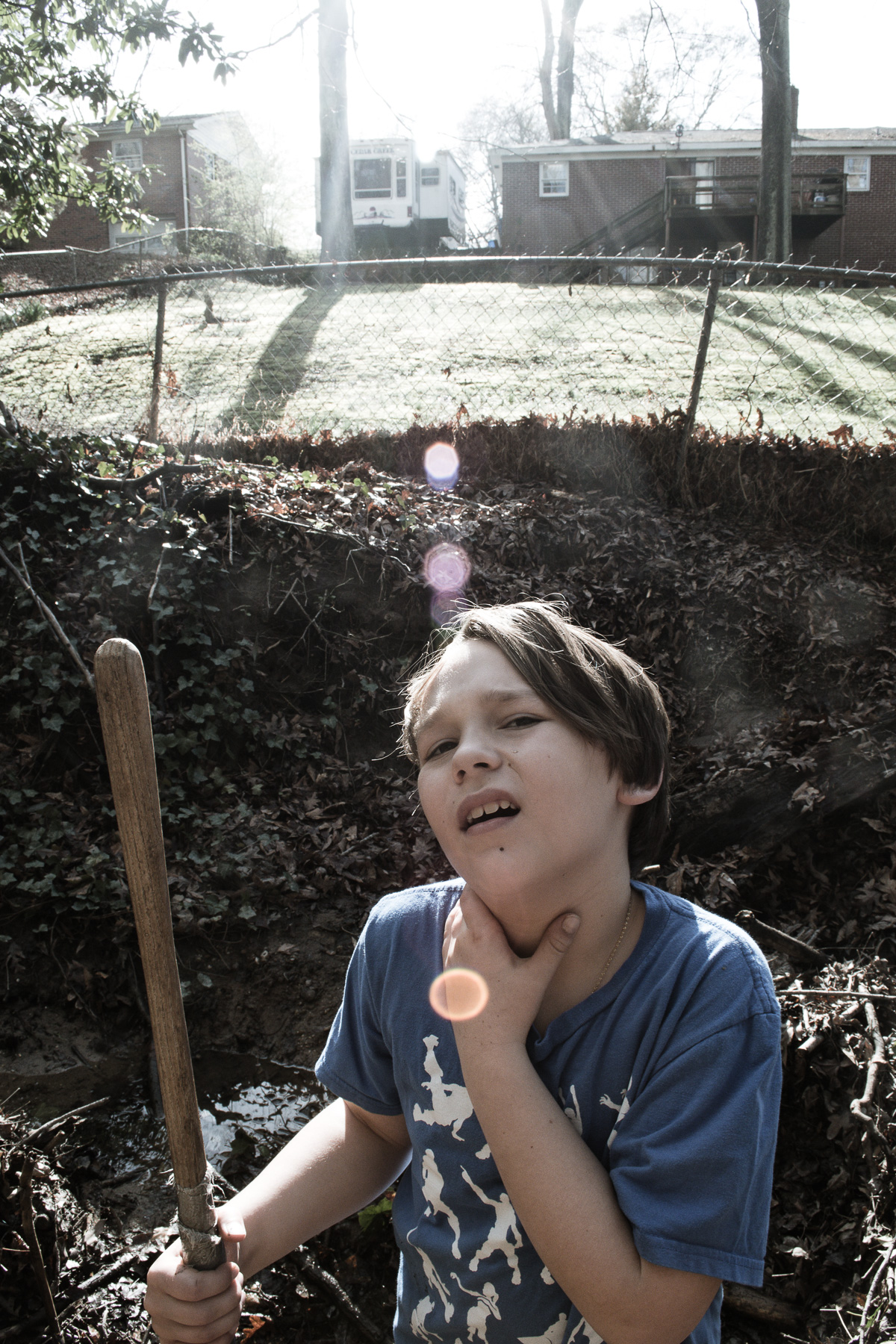
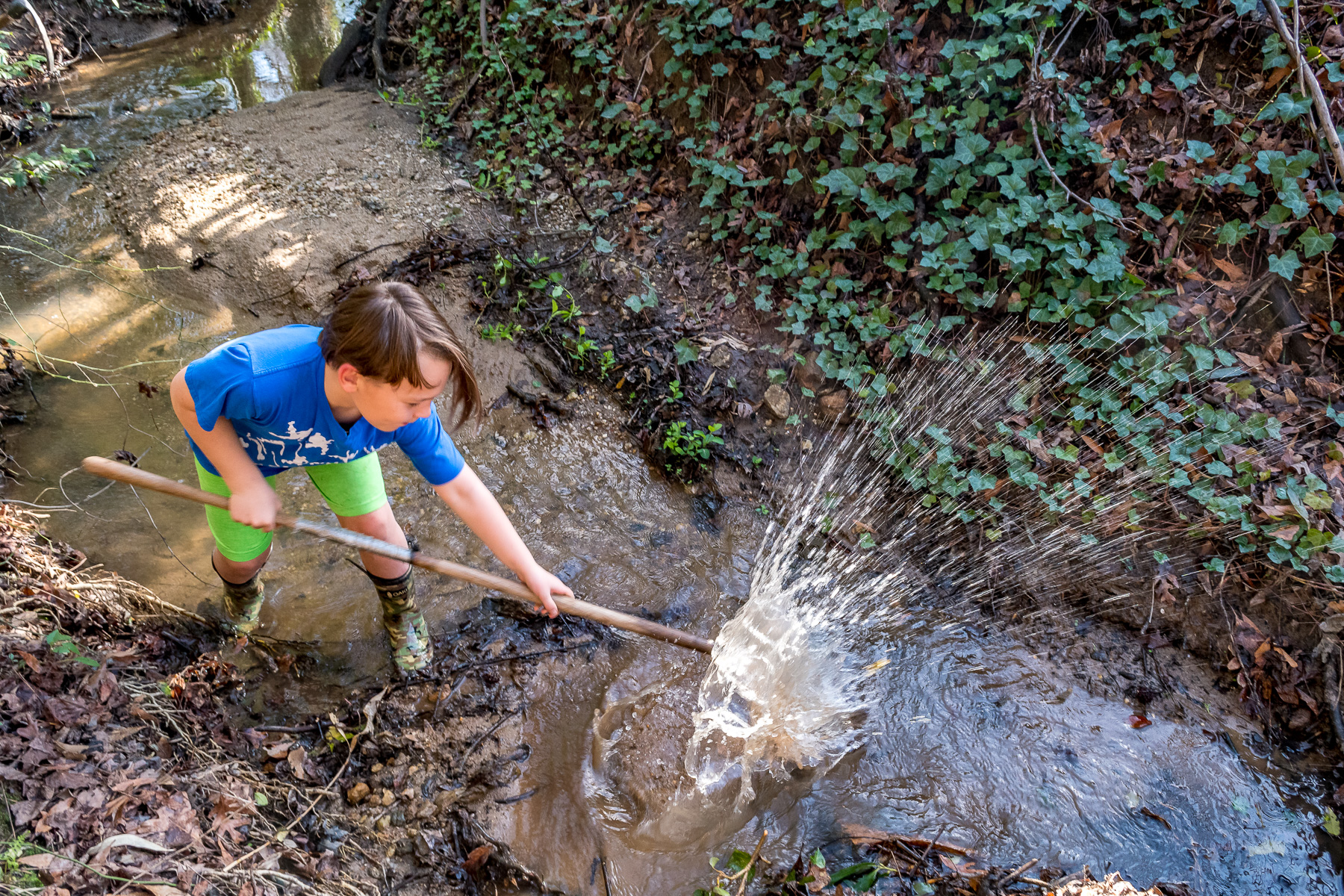
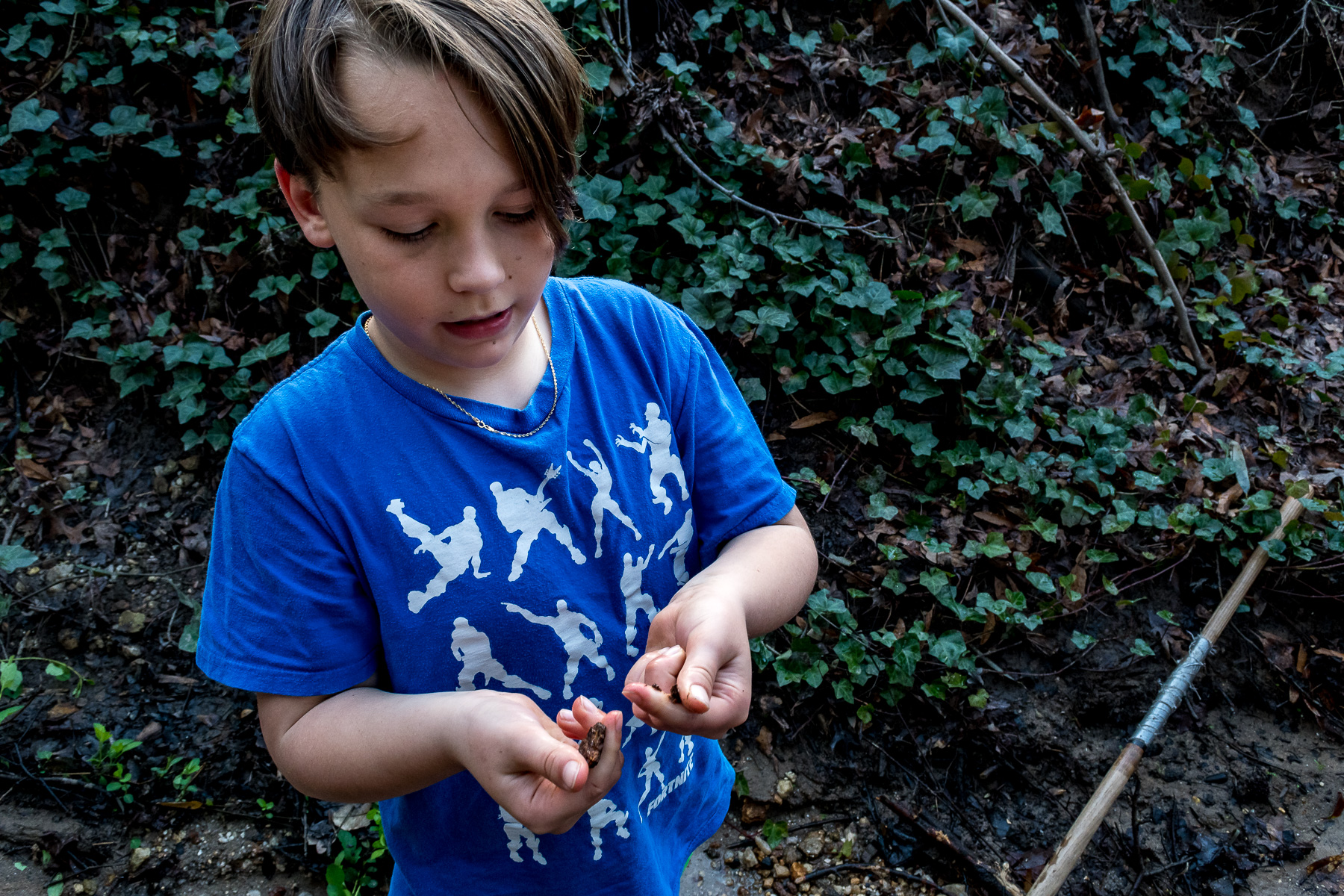
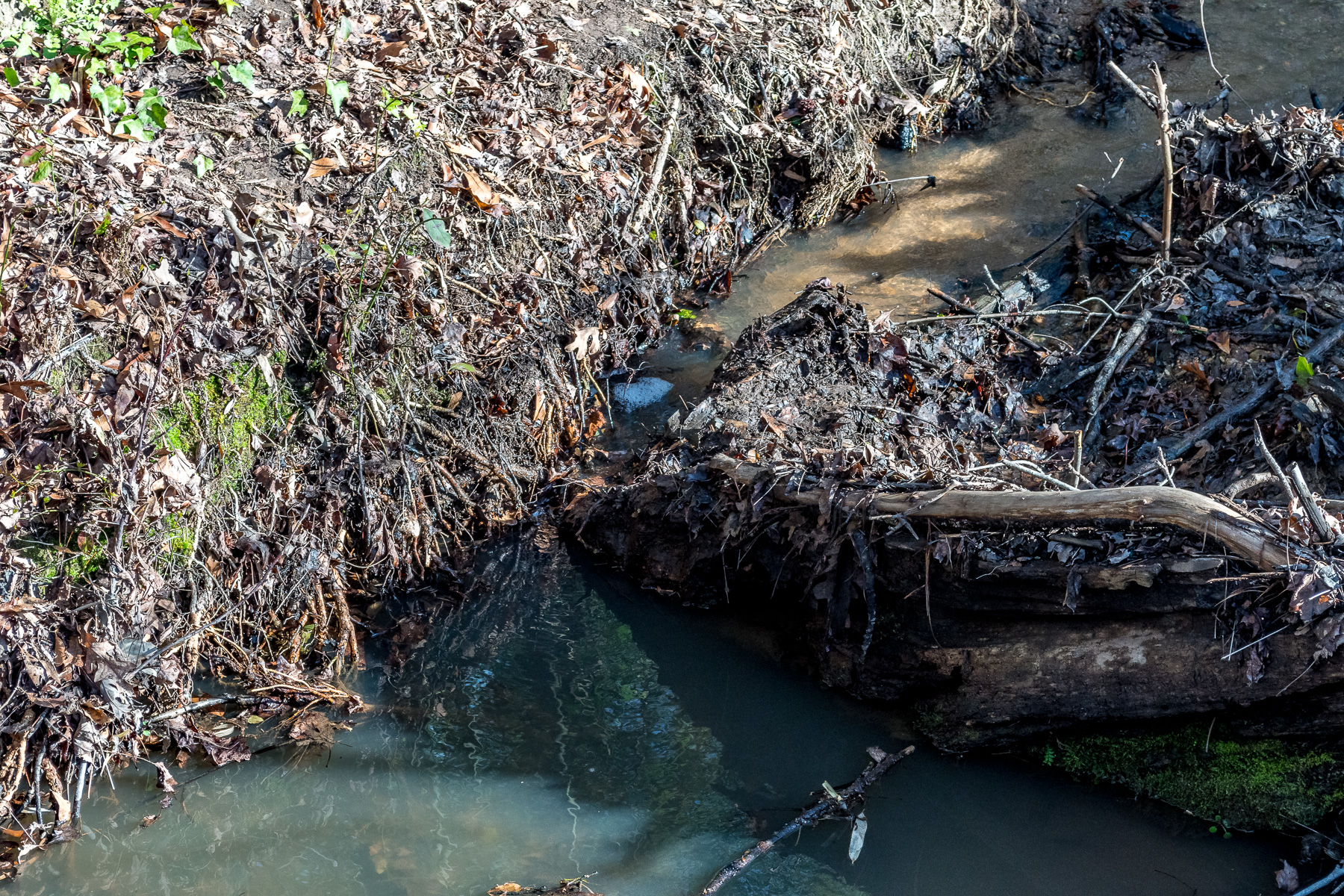
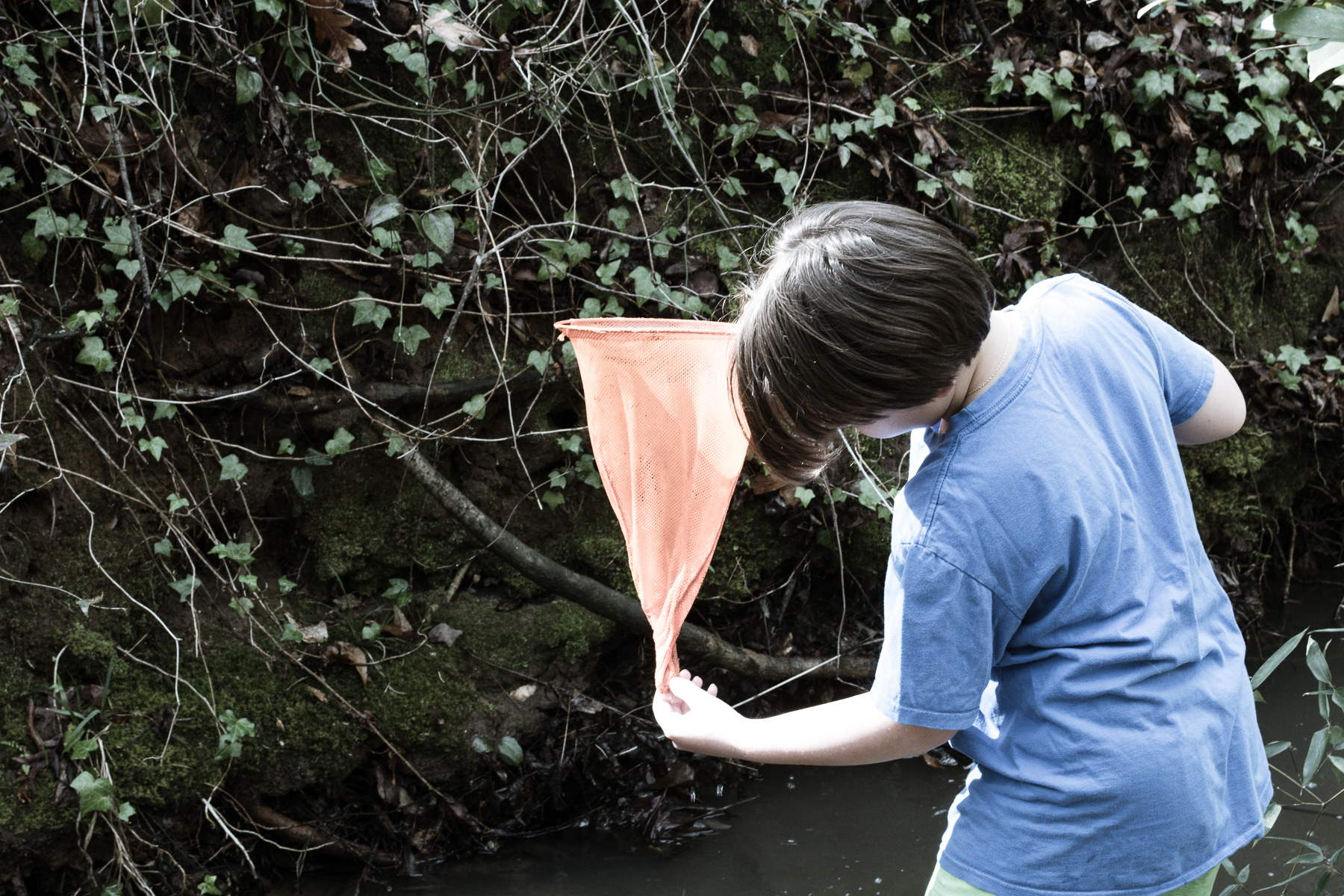
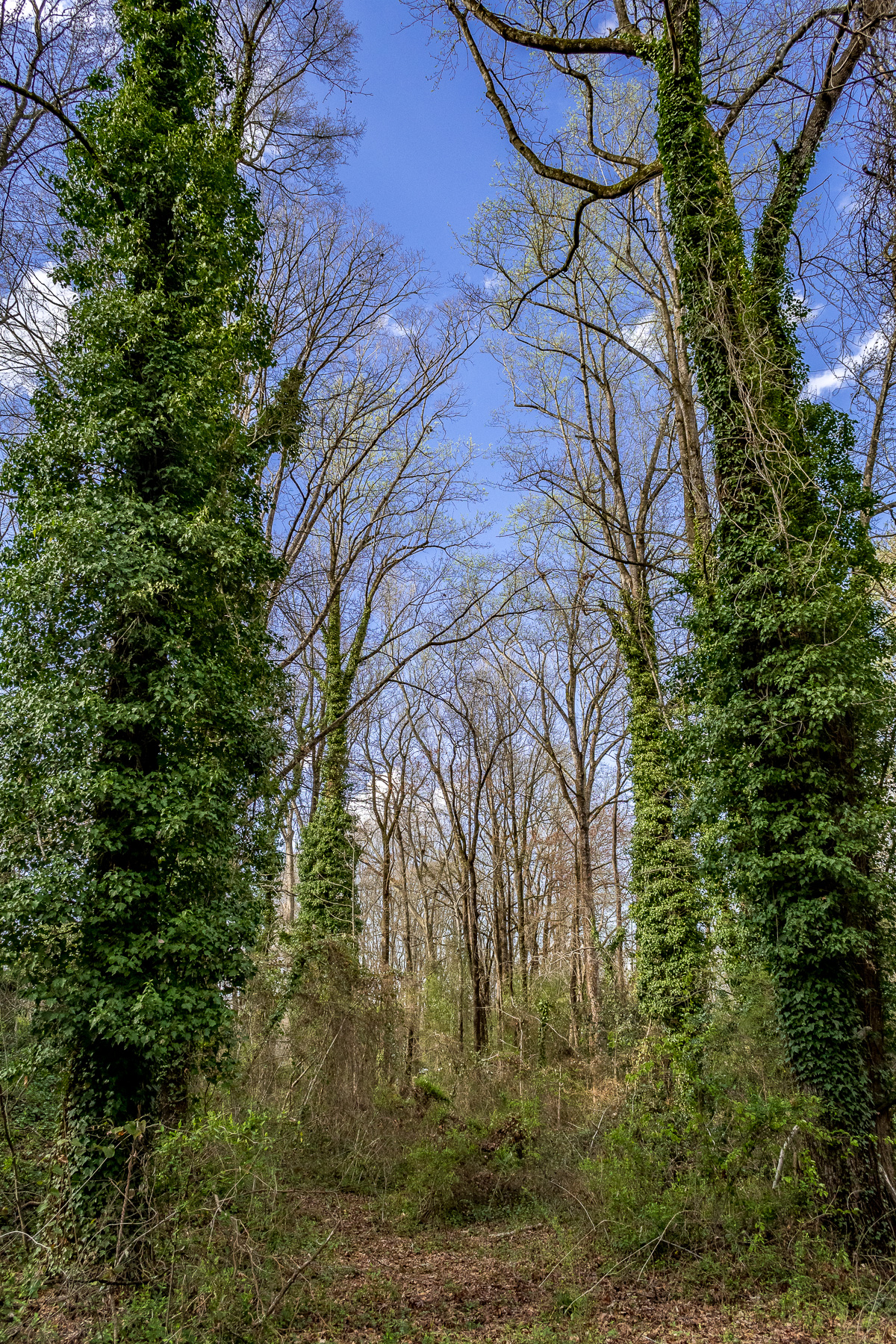
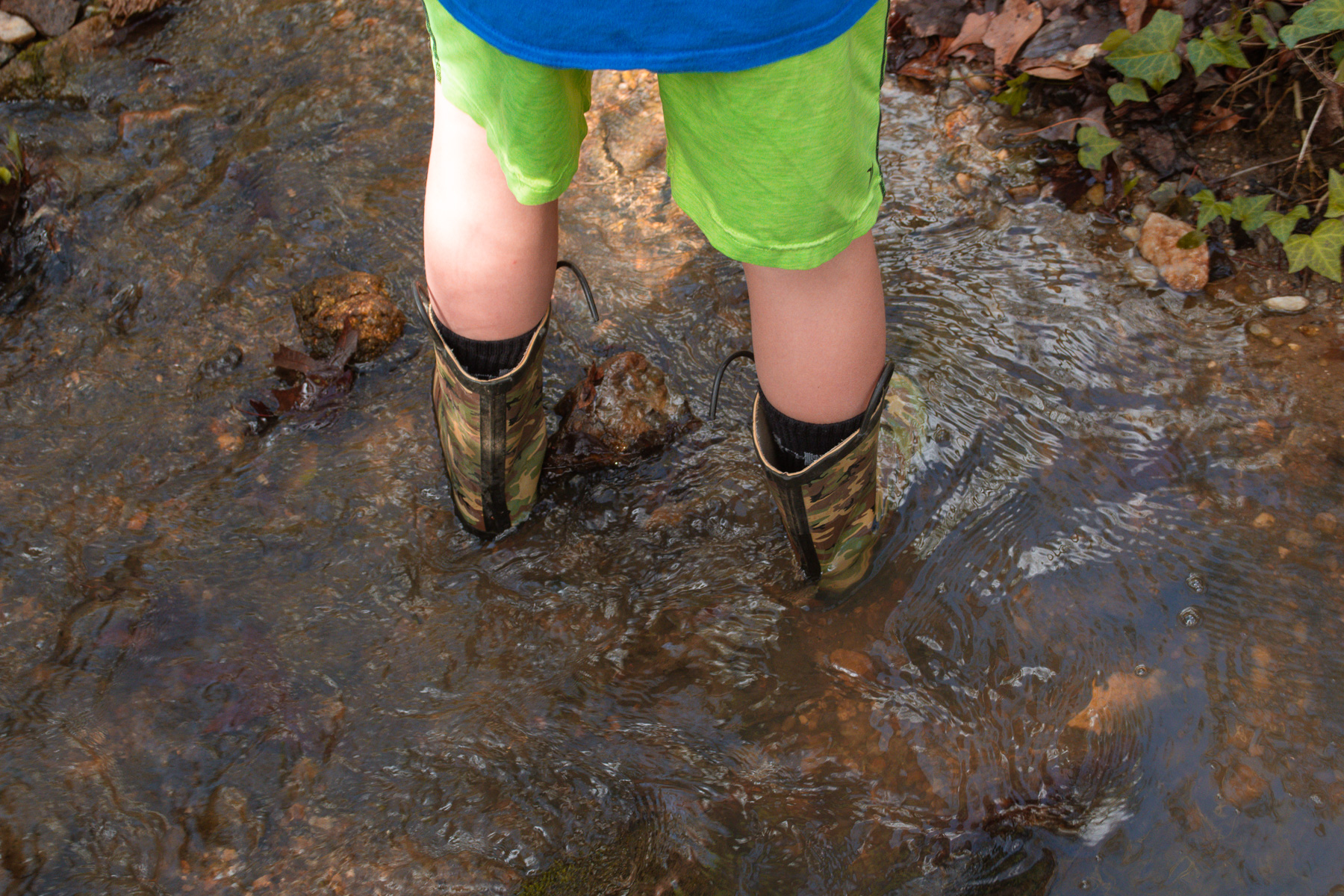
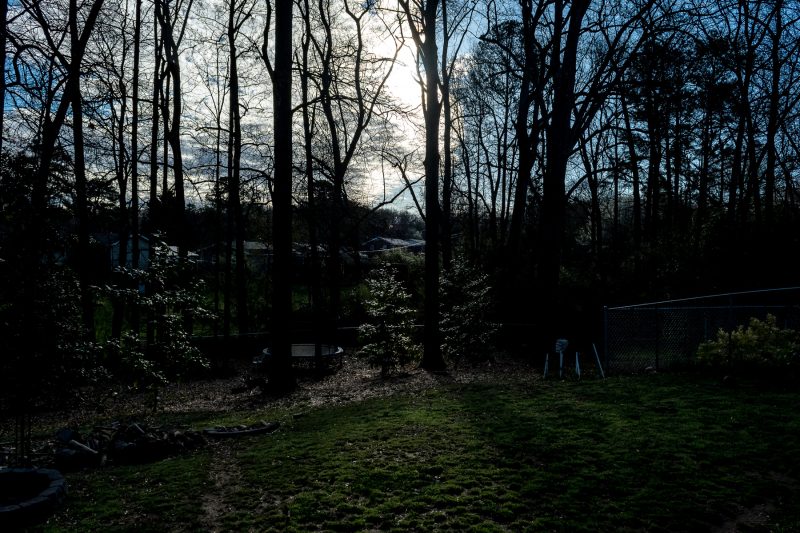
But the important part of the day was after everything was done, and the Boy and I headed out for some exploring.