matching tracksuits

fun in threes, sometimes fours

general

Jobs

My first real job was as a lifeguard at the pool in my high school. During the evenings, from 6:30 to 8:30, it was open for public swimming, and those hours were extended in the summer to include morning and afternoon swimming. Those hours on the lifeguard stand seemed endless, making the evening shift seem more than double its actual time. At times, I had to tell myself, to force myself, not to look at the clock, to resist the urge for as long as possible because I knew that, despite being sure fifteen or twenty minutes had passed, I knew I would look up and see that only five minutes had dragged by. After everyone had left, I had to clean the pool deck, clean the bathrooms, and once every few days vacuum the pool.

“Being a lifeguard is not as glamorous as it seems,” my boss (who was also my swim coach) warned us when we all began taking the requisite courses to become certified. “Being a lifeguard is, in reality, nothing more than being a glorified janitor.” He’d forgotten to mention the utter boredom.

Many teens start their working lives in fast food, and so the second job I got was at a Wendy’s franchise one summer. Tired of being a glorified janitor, I applied for the job on the advice of a friend who also worked there. It was a little better than being a lifeguard: there was at least some variety. One day I might be working on the grill; the next day I might be serving up fries. I never got to work the register, though, because I quit after a month: the manager was scheduling me to work so little that I was sure I could find a better way to spend my time — at least looking for a job with more hours.

One summer in high school, I worked mornings with a man who did landscaping. It was tiring work, and it was frustrating as well: he often didn’t explain things terribly well and then fussed at me when I didn’t do things the way he’d intended.

Today, E and I dropped off L at a local ice cream franchise for her to apply for her first job. Her friend S applied for and got a job there, and she was to start her first shift just after L’s interview.

“I’d have to work the register,” she explained on the way there, “because I can’t use any of the equipment. S said she can’t even touch the microwave.”

“How old do you have to be for that?” I asked.

“Sixteen.” So by the time she’s allowed to make milkshakes for people rather than just taking orders for them, she’ll also be old enough to drive herself to work. And that’s all in just two short years.

Going through some photos while taking an afternoon coffee today, I noticed some pictures I hadn’t remembered: the kids, out with Babcia and K during their Polska 2015 visit. The children are both vastly different in these images than they are now, with E currently just about the same age as L in the image. And the same old thoughts and realizations came back yet again…


Endings and Circles

Today was the last day of the 2020/2021 school year: we had a faculty breakfast, acknowledged and expressed our appreciation for the faculty members who will not be returning to the school next year, and packed away the last of our materials, closing up our room for the summer.

Endings used to bother me as a kid because I never could be sure that what came after would be as good as what I'd just experienced. That's no longer the case because I realized as I grew older that, as long as no disaster strikes, there's no better or worse -- just different.

Flood


Jacksonville — Vacation Day

Jacksonville: The Tournament

It was just a one-day tournament today, and it was a tough one for the girls: the heat combined with the wind off the ocean and its effect on the ball teamed up against them, making the girls feel it was one team against three.

It was tough, but I think, as I always suggest, that losing can be as important as winning -- if it builds character.

Jacksonville Arrival

K and the kids headed to Jacksonville today for a beach volleyball tournament in which L will be playing tomorrow. They arrived, checked in, and headed straight to the beach.

Then had ice cream for dinner. Sounds like vacation...

Confirmation

The Ball

L's school had the eighth-grade ball this evening.

Eighth-Grade Day 2021

Social Media Theology

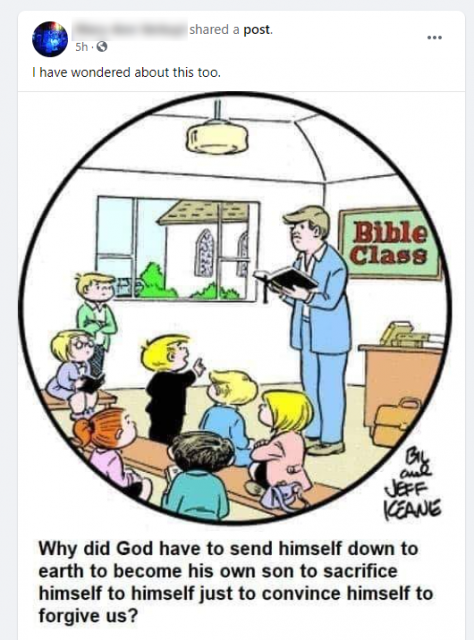
I'm scrolling through a social media group dedicated to the Bible in a Year program with Fr. Mike when I see a post that took me aback:

This seems to be a parody caption put under a Family Circus cartoon. I suspect this because:

  1. Family Circus is a fairly pro-Christian cartoon, and this particular cartoon is pointing out the circular logic and near-absurdity of the Christian idea of salvation and
  2. It seems like the font just doesn't fit the rest of the cartoon.

I recall when I expressed my own doubts how I was attacked and lambasted when, instead of accepting the offered explanations serenely, I replied the rebuttals I'd thought of long ago.

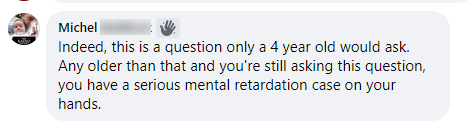
Michel, as if on cue, enters with a classic ad hominem argument.

I try to keep quiet, but I can't: "An ad hominem argument from an apologist is always effective."

Yet one person doesn't see it that way:

How to interpret this? A misunderstanding or the dawning of doubt? Probably the former. But I was curious how they would respond to this ineloquent way of explaining a weird little knot of contradiction that lies at the heart of Christianity, all complicated further by the doctrine of the trinity.

The basic idea is this: Christianity teaches that Jesus had to die in order to make humanity right with God somehow. Through the "stain of Original Sin," humans are separated from God, and to bridge this separation required a sacrifice. But only a pure and unblemished sacrifice would do the trick because God is completely holy. So God sent "his only begotten son" down to die a horrid death he didn't deserve because he lived a perfect and sinless life, thus serving as the sacrifice that makes all good with God. God did this because he loves humanity and wants humans to spend eternity with him, but the sinful nature of humans prevents this. He's perfect; we're not. He can't be around the imperfect, so there must be some way of atoning for those imperfections. (I probably didn't explain that well because there are a million different interpretations on what exactly Jesus's sacrifice accomplishes depending on the denomination of the apologist. I know for a fact that I mixed and matched several different explanations of what Jesus's sacrifice, in the eyes of believers, really does, but that's kind of the point. They can't even agree on what's going on here.)

The first problem with this comes when we consider the supposed omnipotence of God. If God is all-powerful, why not just forgive and welcome everyone back into the fold? Why all this song and dance about Jesus? What's more, if you don't believe this and accept it, it's back to square one with you: you'll remain forever separated from God, destined for the eternal firy torments of hell. (Never mind for a moment the painfully obvious question: why would a being who is even vaguely decent let alone completely benevolent like Christians teach their god is send anyone to eternal punishment for anything?)

The biggest problem comes when we mix the trinity into all this. Because God and Jesus are the same entity (as well as the Holy Spirit -- never mind how that seems to make no sense in and of itself), we can replace all those instances of "Jesus" with the more generic "God." That shows the absurdity of it clearly. God is doing the sending and is sent. God is doing the condemning and the restitution. God is sending God to die to satisfy God's demand of punishment for humanity's disobedience of God. What kind of sense does that make at all? Skip all the middle man stuff and just forgive humanity.

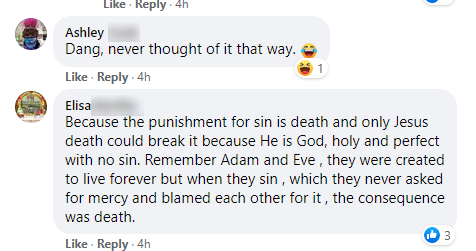
That's what the cartoon is highlighting. The poster's comment of "I've wondered about this too" as well as Ashely's admission that she "never thought of it that way" with a smiley face indicates that the circular logic breaks through to others' thinking for just a brief moment.

Others jump in quickly, though, trying to explain why Jesus had, in Christian theology, to die.

Elisa's contention is that Jesus could only "break" (not sure what that means) "the punishment for sin" by dying because "He is God, holy and perfect with no sin." Yet this doesn't get at the heart of the objection in the cartoon, which is that an omnipotent God shouldn't have to go through all this rigamarole to forgive people: if he's omnipotent, he just forgives them. End of story. This suggests that Elisa doesn't really grasp the underlying objection.

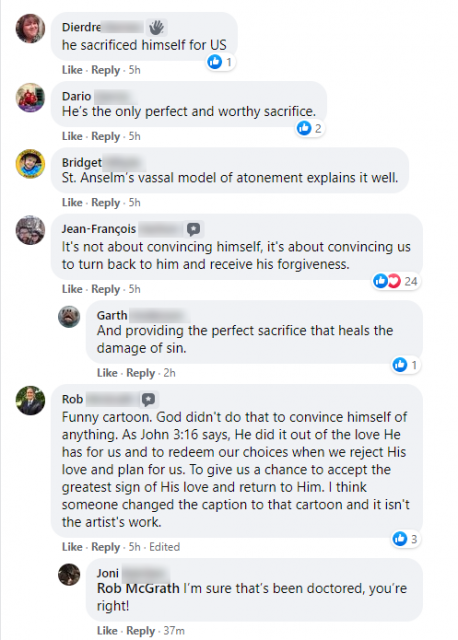
Others' explanations show the same lack of understanding:

They all turn back to the same explanation I butchered above. Sin separates us. God loves us. God wants to bridge that gap. So on and so forth.

It is at this point that I jump in:

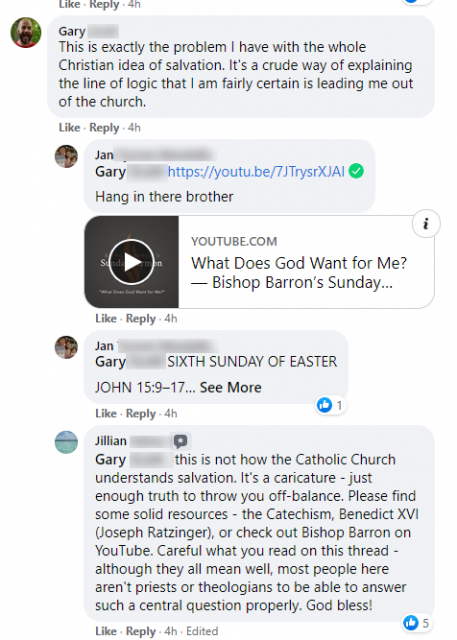
Granted, it's not "leading me out of the church." It and countless other objections have already done that. I just don't want to sound like an aggressive outsider. I want to see how they'll respond.

Bishop Barron's sermon that Jan links to just reiterates how God is love and that's why he died for us. It doesn't answer the question of why he couldn't just forgive outright.

Jullian rightly points out that "this is not how the Catholic Church understands salvation." He correctly admits that it's "a caricature." But that's the point. Caricatures by design highlight the absurdity of something to bring it in sharp relief. To make it stand out.

What's more interesting about Jullian's response is that "most people here aren't priests or theologians" who would be "able to answer such a central question properly." That raises an objection in and of itself. Why would an omnipotent god create such a convoluted system of salvation that only a specialist with years of theological study behind him (and remember that theologians don't really study God but simply study what other men have said about God) could answer?

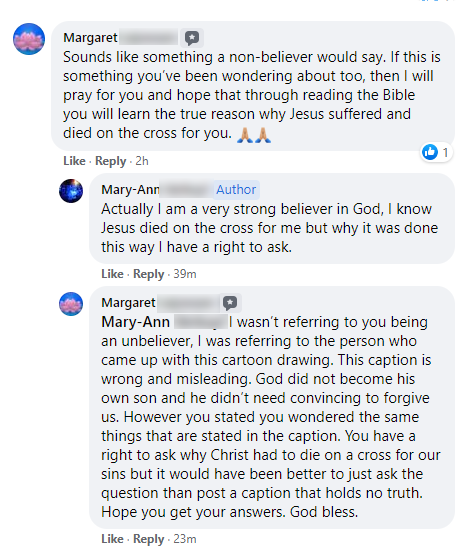
Finally, Margaret calls a spade a spade:

Mary-Ann, the post author, quickly reassures everyone (and likely herself) of her undying faith

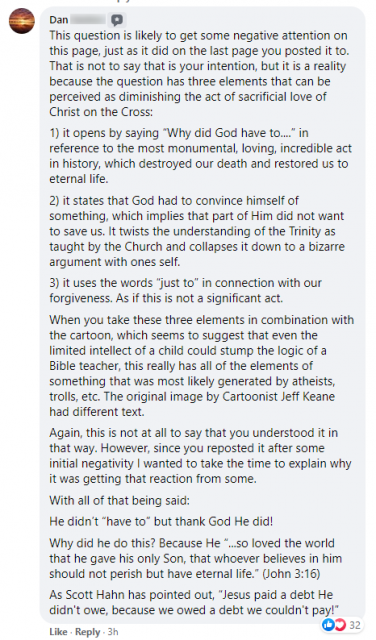
Finally, Dan tries to explain everything:

Dan's first objection is in using the formulation "Why did God have to." He didn't even answer what's behind the question: the notion is that without doing this, we can't be with God. If that's the case, and God wanted humans to be with him, then God did indeed have to do this.

Dan's second objection comes from the confusion this creates regarding the trinity: it "collapses it down to a bizarre argument with ones [sic] self." That is the point. In doing so, it highlights the absurdity of the doctrine of the trinity.

Dan's third objection is with "just to." I think that's meant to highlight the fact that, if God is omnipotent, he should be able just to forgive humans our foibles and move on. It's another reflection of the first objection, in other words.

He ends with Scott Hahn's assertion that "Jesus paid a debt He didn't owe because we owed a debt we couldn't pay." And we're right back where we started.

All this simply confirms what I've come to realize over the last couple of years: most believers don't seem to understand what's at the heart of most skeptics' objection to Christianity. Whether this is an inability to understand it because of their blind faith or an unwillingness to try because of a fear of the consequences, I don't know. Of course, there are other explanations, and it's likely the case that for most believers, it's a mix of any and all of them.

But I see these problems. And I can't unsee them.