In Polish, there are two plural forms for every noun.
It works like this. For numbers 2 through 4, and anything number that includes those numbers (i.e., twenty-two, thirty-five, but not eleven, twelve), there is one plural form; for numbers 5-10, there is another plural form.
“Huh?”
Exactly.
An example might help. “Piwo” is “beer” in Polish. “Two beers” would be “dwa piwa.” “Four beers” would be “cztery piwa.” But “five beers” is “pięć piw.” But at “twenty-one” (yes, I know — who needs to know how to say “twenty-one beers” in Polish?), it would change back to “piwa.” Until you decided to get really wasted and go for twenty-five, at which point you would order “dwadzieścia pięć piw.”
Another example: “Roll” in Polish is “bułka.” “Two rolls” is “dwie bułki.” At five we get the switch again: “pię bułek.” At twenty-one, it goes back to “bułki.”
Further, if you want to use a plural noun as a direct object in a positive sentence, you use the first plural form; if you want to use it as a direct object of a negative sentence, you use the second form. In other words, to say “I like rolls” you use “bułki,” but to say “I don’t like rolls,” you use “bułek.”
And Poles wonder why their language is so hard for non-Poles…
Any linguistic strangeness where you live?

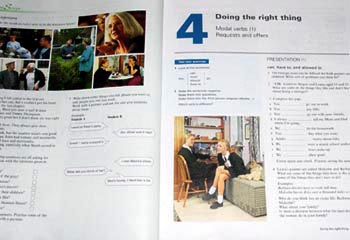
 Ever wonder what an EFL (English as a Foreign Language) textbook looks like? I certainly did as I was preparing to come to Poland for the first time back in 1996. After all, how often do you get to see a textbook teaching something you already know fluently? Naturally, after four and a half years' experience, I've seen and used more textbooks than I care to remember. I thought I'd share a little about the books I've been using.