matching tracksuits

fun in threes, sometimes fours

general

Tom’s Diner

English has twelve tenses; Polish has three. It’s a nightmare for beginning students to keep all that straight. We spend a lot of time drilling, doing “boring” written work, etc. but from time to time, I’m able to think of something completely original and — dare I think — even entertaining.
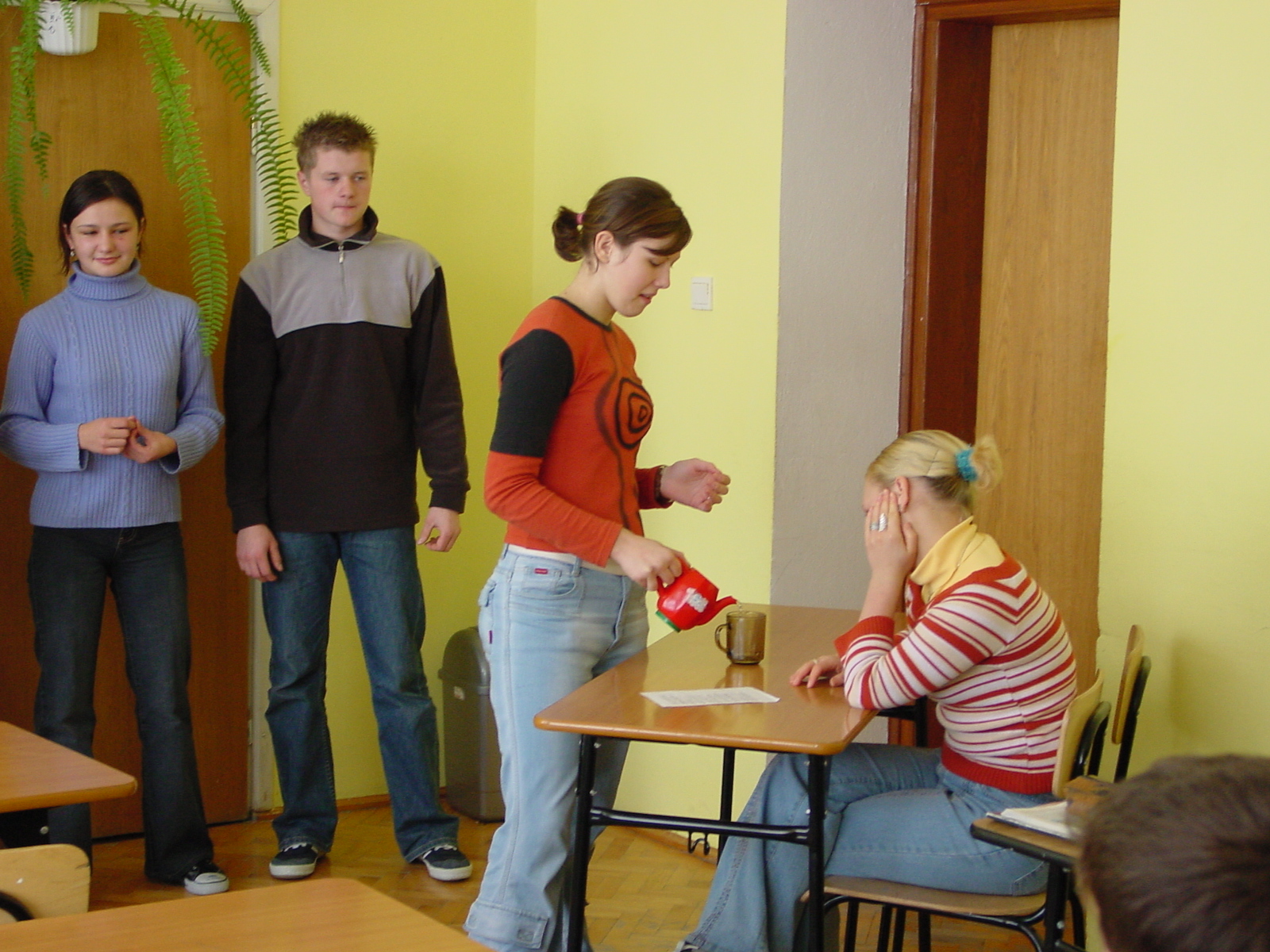
It happened one evening that I was planning lessons, thinking, “I need a good, fun lesson for present continuous,” and wondering what I would come up with. (Present continuous, for those of you who don’t know, is, for example, “I’m reading a book at the moment.”) I put some music on, sat down, and began planning.
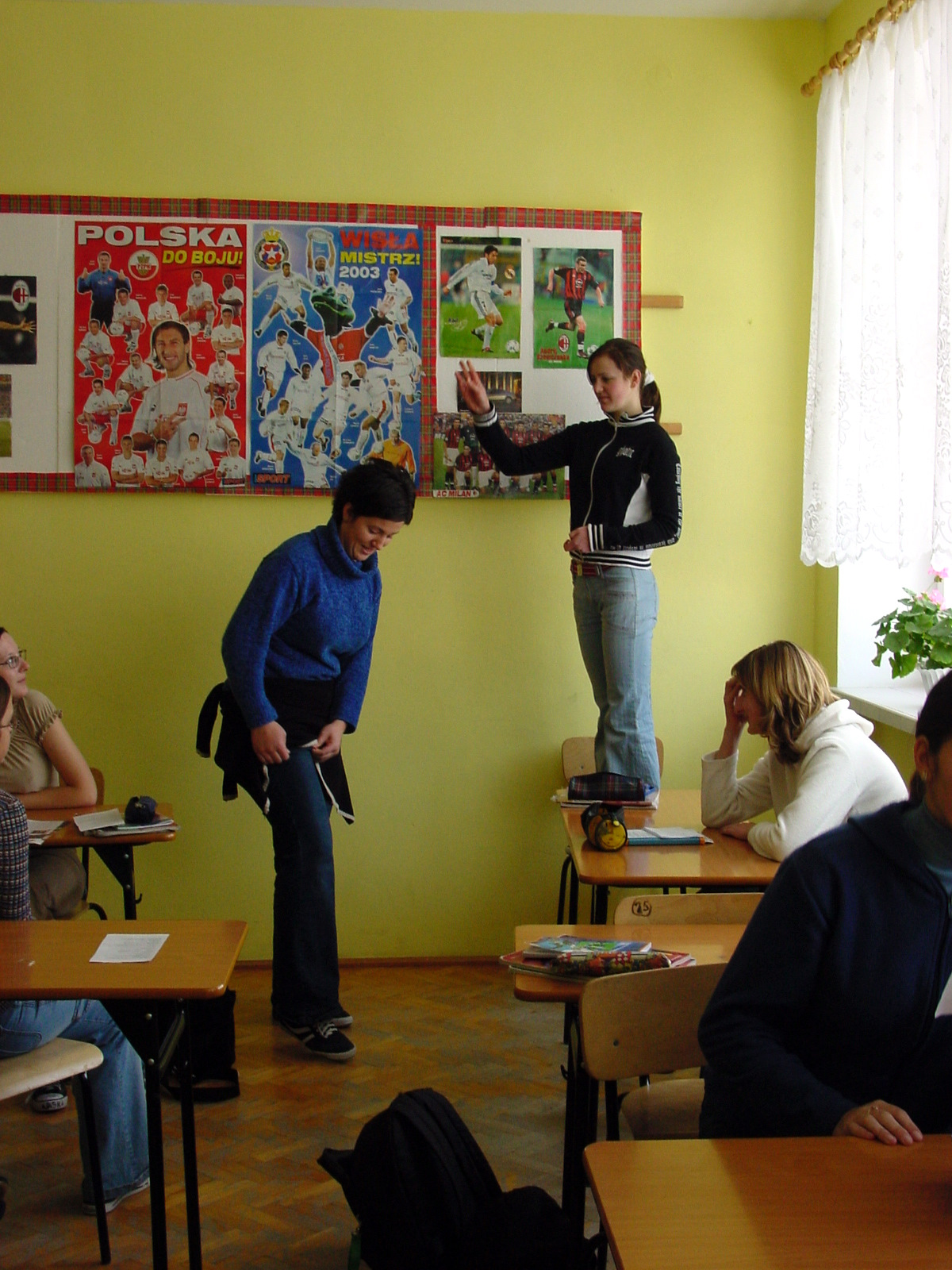
Gradually, I found my attention drawn to the music I’d begun planning, and I sat there, jaw open, as I listened to the perfect present continous lesson (not to be confused with the not-so-perfect present perfect continuous lesson) — Suzanne Vega’s “Tom’s Diner.” It had everything going for it: the whole thing is in present continuous; it’s very popular in Poland, especially the DNA mix; the vocabulary is relatively simple.
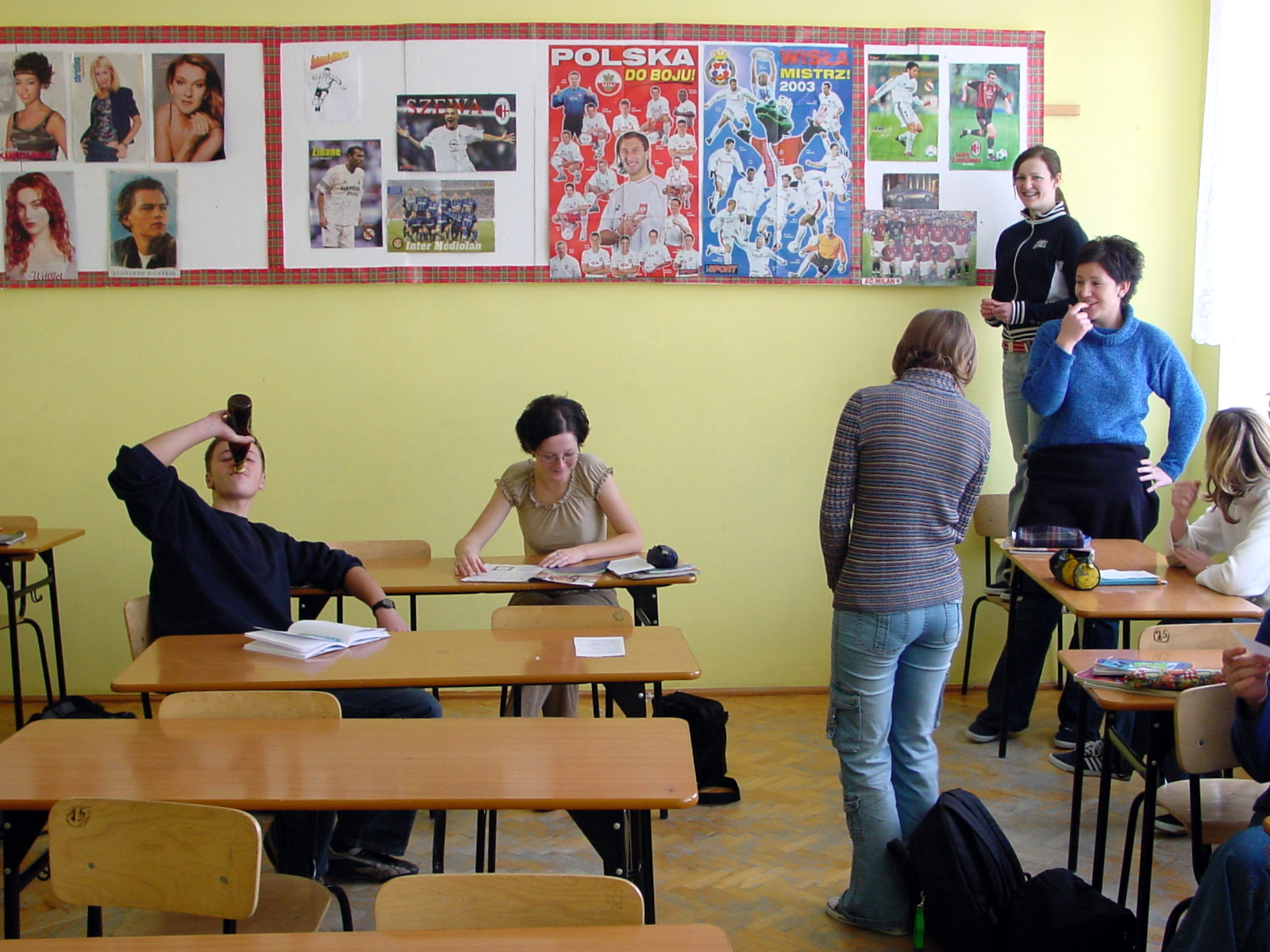
In the intervening years, it’s become one of my most successful lessons.

It goes like this:

  1. Students get a worksheet that has the lyrics printed out, but without the verbs, and in the incorrect order. For each verb, they’re provided the necessary infinitive, the tense necessary, and any additional information/words (like “not” or “already”).
  2. After students take fill in the verbs, we check them all, and make sure they have a basic understanding of the meaning.
  3. Then, I just put the song on and watch — who is going to catch on? Eventually, I point out that it’s the worksheet we’ve been working on and tell them that the next task is to put the stanzas in the correct order. We talk about what the song means and make sure they understand it all, or, they translate it all for homework — depending on how much time we have.
  4. The next day, they’re divided into groups and prepare to act out the song in time with the music — a live music video, I tell them. This takes only a few minutes, and then we do something else. The actual video is the next day.
  5. Show time — and some classes take it very seriously and come in dressed up, with props and materials.

This was the most recent “performance” of the video. The day we were preparing the skits, several people were absent, who were then not absent when we were to perform it. What to do with them? Simple — they were a doo-wap chorus, and they even danced.
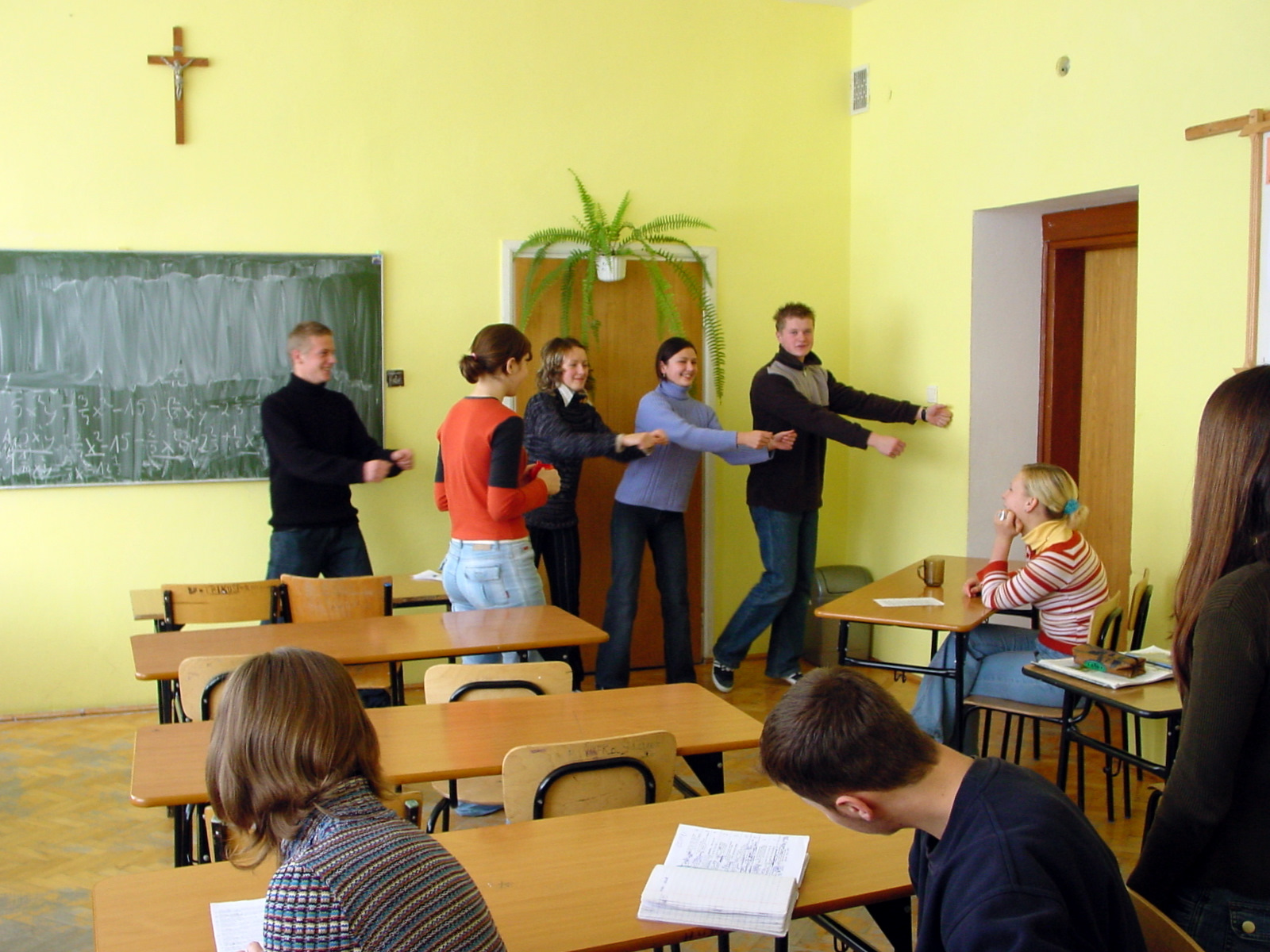
Most of the time, it’s very rewarding being a teacher. Sometimes, it’s simply fun, as well.
The Magic of Zamfir

Yesterday at school there was an unexpected “surprise” — a concert. Zamfir came, and brought his whole music-lite ensemble: a keyboard player. They began with a few classical-esque selections, but once the keyboard player got the programmed drum beats and bass going, there was no stopping them.

Many of the students were having trouble sitting still to such stirring music and would half leapt into the aisle to go Polka mad but for the fact that everyone was crammed like “herrings in a jar.” So they just tapped there feet and smiled merrily.

Some, moved by the music’s depth and power, sat in awe — I think I saw a tear or two trickle.

A couple of students whispered to me, “This is great, sir, but I sure wish we were back in class!”

Of course, ninety percent of this is made up. Ninety-nine, more like it. There was no Zamfir, no Polka sparkle in the eyes, no longing to go back to lessons. There was a concert, and it did include a young man of about twenty-five playing the pan flute while a woman accompanied. And the music was as artificial as you have probably been imagining.

I’m all for broadening students’ cultural awareness, but not in this way. Introducing them to such music as a way to get them interested in styles of music other than techno or metal (the two dominant preferences among my students) is doomed from the start, mainly because the students agreed to go (each class had the option of going or not, but they had to go as an entire class) in order to get out of lessons. Of course, I would have done the same thing at their age. Also, just giving a concert is not going to engage a sixteen-year-old male in any meaningful way if it’s the music he’s not used to, and he wrinkles his nose on first hearing it. Better to have a shorter concert, interspersed with explanations of the songs — their history, the period they come from, etc. — followed by perhaps short discussion afterward of the music. “Yes, that particular song did have a bird song quality to the melody. It’s because…” And for Mahler’s sake, don’t let it be simply a way to get out of class. That accomplishes nothing.

I try to introduce my students to various types of music throughout the year. One lesson I like to do toward the end of the year involves at least five different songs. It’s for intermediate students, and I simply have them do some free-writing (that’s where you just write uncritically what comes to mind — like most blogs, I would imagine) while I put on various songs. “Imagine you’re at the cinema,” I tell them, “and as the movie begins, this is the song you hear. What’s the movie about? What do you see happening?” And then I put on an incredibly eclectic mix: Ben Folds Five, Mozart’s requiem, Albert King, Ella Fitzgerald, and Johnny Cash come to mind as I recall past lessons.

The reaction is generally bad.

But at least once I held them in rapt attention. While doing some quite writing work (not related to the lesson described above), I put on Bruce Springsteen’s The Rising and told them that much of this album was connected to 9/11. Students who were usually squirmy sat and wrote quietly, while others just listened to the music, hands on folded arms, eyes wide open, utterly still.

I’m still at a loss, though, as to how effectively to broaden students’ musical awareness.

Shake and Freeze

The oddest thing for an inhabitant of Poland to be writing: we had an earthquake yesterday at around 6:20 in the evening.

It was a slight little hiccup by most standards: 3.6 on the Richter scale. Kinga was at home and said she felt the building shaking for about five seconds. I, on the other hand, was walking home and felt nothing. Reportedly in the nearest town, some houses were shaken enough that books fell from the shelves, and on the other side of the Tatra Mountains, Slovakians reported having felt it.

No reports of damage, but of course everyone’s talking about it.

Earthquake and Poland — they go together about as well as . . .

#$*@!

Ah #&@*, I did it again -- trying to stop cursing and let another one loose unconsciously.

Without the redundant profanity (a sorry attempt at a joke), that's what I thought last night when something irritating happened and, muttering to myself about it, I used "colorful" language.

Stopping cursing is about like stopping smoking, I'd imagine. Perhaps more difficult from a certain point of view -- you don't have to buy profanities. They're there, piled up in our heads, for free! And you never run out of them, so you can't really think to yourself, "As long as I don't stop by a convenience store and see a wall of cigarettes, I'm fine."

My parents tell the story of when my father was trying to stop cursing, he and my mother set up a system that each profanity cost some part of their weekly spending money. They were a young couple, and the purse strings were tight, so they allotted themselves only a few dollars a week as personal spending money. My father "spent" all his money and then some one afternoon waiting for, if I remember correctly, a "woman driver" to turn left.

What is it about profanity that has such a draw? It's so difficult to stop, and yet so easy to begin. You can sit with an infant, patiently trying to teach her how to say something -- anything -- and she, with stubborn resoluteness, sits and says nothing. Then you hear the soup boil over, exclaim something you shouldn't, and when you come back a second later, the infant is chanting your profanity.

It's not that children have an ear for the vulgarities of their own language. An acquaintance told my wife and me that her daughter has recently begun using "the 'f' word" because -- guess. It's a word that has no meaning in Polish, though it does sound like "Kwak," a somewhat common surname.

Nonetheless, there she was, running around the apartment saying, well, the obvious.

When I moved to Boston after having spent three years in Poland, I began muttering Polish profanity -- and it is a language rich in profanity -- at work when something was trying my patience. Then a Pole started working there.

In Polska, cursing is strangely culturally accepted. That's not to say that it’s universally practiced, for if everyone cursed, then it would cease to be profanity. Still, in the States someone out "in public" doesn't usually let the four-letter words fly at will. A bus driver, for example, wouldn't be sprinkling is conversation with a passenger with profanity, but here, it's a common occurrence. I've heard fathers let loose while their four-year-old daughters stand beside them, grandfathers going crazy while their five-year-old grandsons run around at their feet -- and then it's no wonder that you hear a five year old say the Polish equivalent of, "Hey, *#@$-for-brains, where they *#@! are you going?"

Why did I write *#@$ rather than "shit?" It's always amused me to read quotes in something like Sports Illustrated where instead of quote the pitcher verbatim, puts words like s*$# in his mouth. As if we don't know what it means, and, more importantly, as if we don't sound the word in our heads as we read it. Is "shit" any worse than *#@$ for conveying the same idea? It's even gotten to the point that without any context, we have a pretty good idea what *#@$ means, so what's the point?

I'm not sure if it's the rural environment, or Polish culture in general, but one does hear much more "in public" than one hears in the States. In stores, in bus stops, on the streets -- it's everywhere. In Polish, it's not "the 'f' word" but rather "the 'k' word" and it's shocking -- almost impressive -- to hear how many times a riled up Polish man of, say, twenty-five, can use "the 'k' word" in a sentence.

Perhaps it's a question of American culture's Puritan roots. After all, there are advertisements for soap in Europe that show women's breasts -- unthinkable in the States.

I'm curious about other cultures -- how is cursing viewed wherever you sit reading this?

Photo by Internet Archive Book Images

Gorecki’s Third

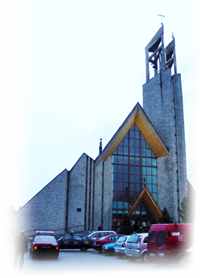
Holy Cross Church, ZakopaneUndoubtedly my favorite contemporary composer, Górecki often vies for “best composer of all time” in my opinion – it all depends on when you ask. It was his music, particularly his Third Symphony (subtitled”Symphony of Sorrowful Songs” – more information here) that was a major factor in my choosing Poland when I joined the Peace Corps back in 1996.
Since then, my appreciation of his music has only grown, particularly with my improved Polish and the ability to understand the texts of his vocal works.

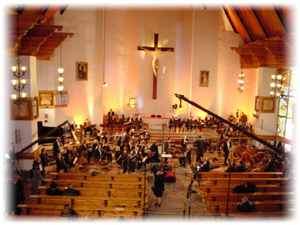
When I was about to leave for Poland, I joked with someone that I was going to meet Mr. Górecki no matter what it took. I had my chance this weekend, in the most auspicious of occasions: Górecki conducting his Third Symphony in celebration of his seventieth birthday. In the end, I’m ashamed to say, I chickened out. I couldn’t think of anything to say that wouldn’t make me sound like a babbling teen meeting some superficial movie star.

Górecki concertIt’s enough, I suppose, that I got to experience his Third Symphony, under his own baton (well, no – he didn’t actually conduct with a baton), in a location that was intimately connected with the text of the second movement.
The whole adventure was blessed by luck from the beginning. Kinga and I left at 1:40 in the afternoon, not knowing when we had a bus or even how long it would take us to get there. We arrived at the bus stop just as a bus to Nowy Targ was pulling up. The chances of that happening are miniscule. We made it to Nowy Targ, waited half an hour for a bus to Zakopane, with me babbling like a little girl going to meet The Back Street Boys. Hopped off the bus in Zakopane, took a cab to the church, and arrived half an hour before the concert started. Those without invitations had to sit in the small balcony. Though we arrived only half an hour before the concert was to begin, the balcony was virtually empty. We ended up standing at the railing of the balcony to get the best view, and by the time the concert started, there was quite a crowd.

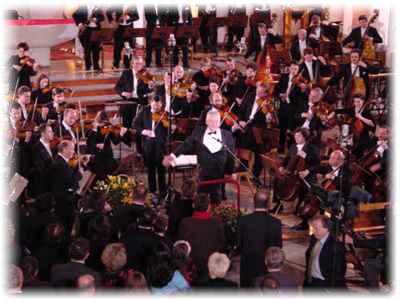
The concert itself was something of a blur. At 60+ minutes, the symphony could, I suppose, be called “moderate” by some standards, but for me, it seemed to last about ten minutes. I blinked and the first movement was over, with an outbreak of coughing and sneezing in the audience – the backlog of half an hour silent, respectful listening, I suppose. The second movement, at only nine minutes, seemed a flash. And the third moment, at about twenty minutes, seemed about a tenth that. I didn’t take any pictures because the concert coordinator politely asked that we not.

Górecki concertAfter the concert, the orchestra performed “Sto Lat” (“100 Years”), the traditional Polish well-wishing song. Mid-way through, Górecki jumped onto the podium again and directed everyone, audience and orchestra alike.
After some well-wishing and chatting, the orchestra came back out and they did a playback recording session, as this is intended to be a DVD released sometime later. It was a strange thing – they were basically making a music video, playing along with their earlier performance. They played for a bit – most of the first movement – then suddenly the director stopped everything just as the music reached it’s most emotional point. Strange how art can so easily succumb to commercial needs.
In synagogue Saturday

My wife and I spent the weekend in Krakow. Saturday we went for a stroll in Kazimierz, the old Jewish quarter.

As I've mentioned before, Jews in Poland occupy a strange position. There are very few left in Poland today, and that's why we were able to find ourselves in an old synagogue on a Saturday.

"We shouldn't be here," I thought.

"This should still be in use. We should feel as if we're intruding, coming into the Jewish quarter on a Saturday as bumbling tourists."

Politely Declining (Or “Why Polish is really a nightmare”)

I recently wrote about Polish plurals and the strange fact that there are two forms.

That was only the tip of the iceberg. The easy part of the language. Today -- how to make a Polish sentence meaningful. Or "how to make sure you say 'The dog bit John' rather than 'John bit the dog.'"

In English, word order is an essential grammatical element. We know in the sentence "The dog bit John" that the dog did the biting, and not John, from the position of "The dog" in the sentence.

Polish, however, is an inflected language and that means that word order has no effect on the meaning of the sentence. In Polish, you could just as easily order the words, "John bit the dog" without any change in meaning. For that matter, "Bit John the dog" and "The dog John bit" are possible as well.

So how are they differentiated? By their ending. In Polish (in all highly inflected languages) you indicate a word as a direct object, an indirect object, a subject, or whatever by adding a suffix according to a given pattern.

An example may help. Imagine in English that subjects ended in "-doj" and direct objects ended in "-aldi." Our sentence would then look like this: "The dogdoj bit Johnaldi." In that case, "Bit Johnaldi the dogdoj" would have the same meaning, as would the following:

  • "Johnaldi bit the dogdoj."
  • "Johnaldi the dogdoj bit."
  • "The dogdoj Johnaldi bit."

English does indeed have a bit of declension. Some examples:

  • "-ed" to a verb to make it past tense
  • "-s" to make a noun plural
  • "-ing" to make a verb a gerund (i.e., "Swimming is a healthy activity.")
  • "-er" and "-est" in the comparative and superlative forms
  • "-'s" to denote possession (i.e., "Samantha's mother left for Switzerland.")

By and large, though, English is not an inflected language. "The dog bit John" and "John bit the dog" are very different sentences as a result.

Thanks to Oliver for the correction. Originally I'd mistakenly claimed that German has five cases.

An inflected language uses cases to differentiate functions and forms. Greek and German have four cases.

Polish has seven:

  • Nominative case -- The subject of a sentence
  • Accusative case -- The direct object of a positive sentence
  • Genitive case -- To denote possession (i.e., "That's George's bag.")
    • The direct object of a positive sentence for some verbs
    • The direct object of a negative sentence
    • For quantities of five and above.
  • Locative case -- To specify location after certain prepositions
  • Instrumental case -- To denote the method or tool used to do something
  • Dative case -- The indirect object of a sentence
  • Vocative case -- Used in addressing people (i.e., Did you take it, George?)

These changes even occur to names, providing a clear example of the complexities of Polish grammar. We'll use "Bill Clinton" as a direct object, indirect object, object of a preposition, etc, and see just how insane Polish is:

CaseExample
Nominative caseTo jest Bill Clinton. (This is Bill Clinton.)
Accusative caseLubię Billa Clintona. (I like Bill Clinton.)
Genitive caseSzukam Billa Clintona. (I'm looking for Bill Clinton.)
Locative caseMyślę o Billu Clintonie. (I'm thinking about Bill Clinton.)
Instrumental caseRozmawiam z Billem Clintonem. (I'm talking with Bill Clinton.)
Dative caseDałem Billowi Clintonowi. (I gave Bill Clinton... s'thing.)
Vocative caseWzia…łes›, Billu? (Did you take it, Bill?)

Because of declension, the word order doesn't make any difference. For example, if you want to stress that you gave it to Bill as opposed to George, you could say, with the proper vocal inflection to stress it, "Billowi dałem."

But learning Polish grammar is not simply a matter of remembering some endings, for all nouns in Polish have a gender (as in German, French, Spanish, etc.), so you have to learn a hell of a lot of endings.

  • Three genders
  • Seven cases
  • Singular and plural

So when you utter a Polish noun, there are forty-two possible endings, depending on whether it's singular or plural, masculine, feminine or neuter, and whichever case is necessary.

And the exceptions, for some forms are exactly the same except in given cases.

  • The accusative plural and the nominative plural of neuter nouns are identical, but feminine and masculine nouns are different.
  • The female genitive and locative cases are the same for singular nouns but not for plural nouns.

Aside from that nonsense, there are various considerations for exceptions. Is it a masculine alive noun? Does it end in "a"?

Shopping in Rural Poland

is a little different than its American counterpart. We’re used to express lanes and in-and-out shopping. In some supermarkets now, you can theoretically do all your shopping without interacting with a single employee. Just swipe your ATM card at the self-check-out and off you go.

Not so in rural Poland.

Until recently, even the notion of a self-service shop was unknown. Shops were organized like the old general stores we see in westerns: a counter, with all the goods on one side behind the owner, with you on the other.

Such was the setup in Poland when I first arrived. I went to the store and instead of shopping, told the shopkeeper what I wanted, and she ran around behind the counter gathering my purchases. It was strange at first, but excellent for my early language acquisition.

There are more and more self-service shops in Poland these days, and virtually all the shops in larger towns and cities are self-service.

But the old mentality lingers:

  • Some older women have a habit of doing their shopping as they check-out, so they bring a few items, then continually run through the store, getting this and that, while I stand, all my items in the basket, waiting.
  • Some much older women ask the cashier to run around the shop doing their shopping for them. Old habits, I guess.

Despite its inconvenience, I miss the old shops. You had to interact while you were shopping, and as a foreigner, the more the better.

“I’m not anti-Semitic but . . .”

"I'm not anti-Semitic, but I just don't trust Jews."

I was sitting in a bar with an American friend and a Polish acquaintance when the Pole, in utmost seriousness, said that. He could not be made to see the inherent contradiction in what he'd said.

"I don't really know many Jews, but I don't like them."

Thus said another Pole to me, explaining a situation he'd had earlier that week in Krakow with someone who was "obviously a Jew." He too maintained he's not anti-Semitic.

Jews in Poland occupy a strange position. Before the Holocaust, "Poland's Jewish community numbered 3.5 million, which represented 20 per cent of world Jewry and 10 per cent of the pre-war Polish population." (Source) Today, Jews number less than twenty thousand in the whole country. Most people in modern Poland have never even met a Jew.

There were so many Jews in Poland thanks to Casimir the Great's opening the borders and accepting Jews in the Middle Ages when they were being expelled from many other countries in Europe. When they began prospering, the Poles began resenting them and their success.

Contemporary anti-Semitism in Poland is fueled by far-right parties like "Liga Polskich Rodzin" ("The League of Polish Families") and the populist party "Samoobrona" ("Self-Defense"), both of which overtly and covertly blame Poland's present economic woes on Jews. They deny that there are only about sixteen or so thousand Jews in Poland, and with some on the fringes insisting that President Kwasniewski himself is of Jewish descent.

Others blame the Jews for the Second World War, saying that Hitler was particularly brutal to Poland because of the large number of Jews here. The "logic" there is baffling, but I've personally heard the argument at least once.

Anti-Semitism is not just a problem in Poland, though. Jean Marie Le Pen's surprise success in the French elections some time ago showed that nationalism and rabid xenophobia find fertile ground even in supposedly liberal France.

Anti-Semitism is on the rise in Europe. A supposedly suppressed UN report that blamed "a new wave of Antisemitism on Muslim youth and on anti-globalization activists" (Listen to the NPR Report) shows that it's not just right-wing, neo-fascists who are spreading the ancient, illogical hate of Jews.

People talk of how to reduce anti-Semitism and other forms of xenophobia, but anti-Semitism seems like a hydra. It's been around for so long and taken so many forms that it seems always to be changing.

  • Anti-Semitism in Christianity has a long history. Jews are still "blamed" for having killed Jesus, as the recent outcries over Mel Gibson's brutal Passion showed.
  • Hitler magnified a "racial" dimension to anti-Semitism that had been brewing in Europe for at least a hundred and fifty years. Instead of being a religious-ethnic group, Jews became a different race. Indeed, a different species.
  • Contemporary liberals sometimes blame Jewry as a whole for Israel's sometimes-excessive dealings with Palestinians.
  • Even the super-nutty fringes are not immune. Take a look at Freedom Press and it won't take long to find a connection ultimately between Jews and aliens (?!?) through the supposed conspiracies of theIlluminati.

Anti-Semitism is, indeed, everywhere, and has been for ages. And despite our "enlightened" times, it appears we might be heading toward another wave of increased anti-Semitism.

Party

1-10
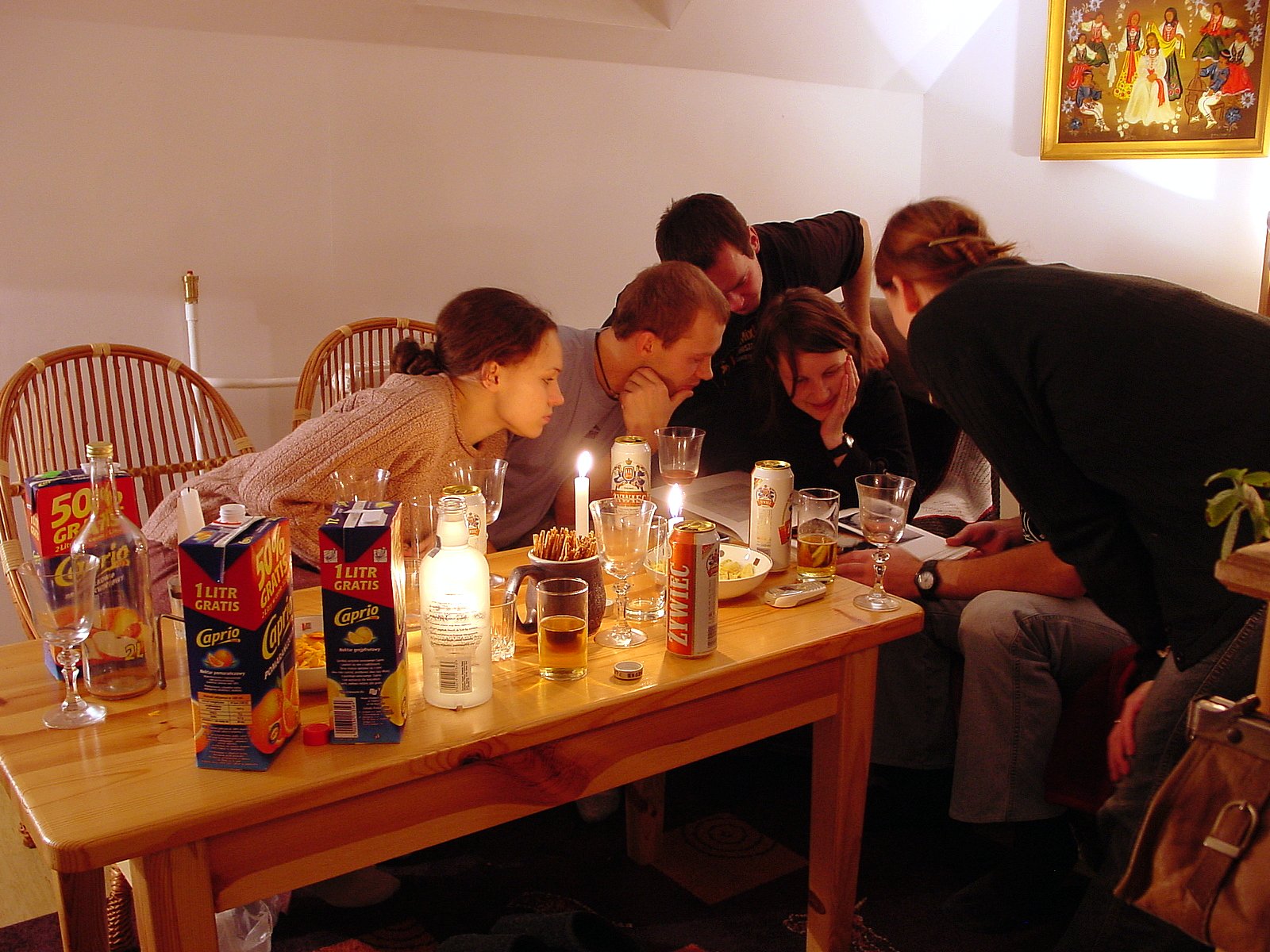
Friends who were unable to come to our wedding look at our wedding album