matching tracksuits

fun in threes, sometimes fours

general

2k

One of the young men I work with was doing afternoon chores today, and he asked me to show him how to tie up a garbage bag. When I finished, I asked, “Would you like me to help and take the trash out for you?”

“If you would, please.”

Such a simple response — something most of us might not pay much attention to. But when working with kids who sometimes demonstrate that, through no fault of their own, they have somewhat limited social skills, I notice.

Indeed, it’s my job, among other things, to notice.

I pointed out that I felt he’d earned 2,000 points for that interaction. He pulled out his point card and jotted them down, and after I signed it, I asked, “Do you know what you did to earn those points?”

He explained that he’d been polite.

“Correct.” I asked, “Do you know why it’s important to accept help politely like that?”

“Not really.”

Indeed, why? I paused for a moment, thinking about it. Why is it better to say, “If you would, please” than respond, “Yeah,” or “If you want to,” or any number of less-than-perfect formulations. It’s one of those things many of us parse without thinking, a response we expect to hear.

I thought for a moment, but not long. To be honest, I’m beginning to develop a skill for this explaining of social conventions.

“Because the next time you need help, I’ll be more likely to offer it. If you’d just said, ‘Yeah, if you want,’ I probably wouldn’t have felt that you really appreciated my help. But saying it like you did showed me that you really appreciated it, and so I’ll be more likely to offer to help you the next time I see you working on something.” Not a bad reason.
He accepted it and moved on.

The question is, will he remember it next time?

I’m starting to be optimistic enough about my job to think it’s quite possible. Dare I say, likely?
Microsoft Voice Mutilation

I can’t recall all the steps that led me to doing this insanity, but for some reason, the install wizard popped up and offered to install Microsoft’s voice recognition program. I figured, “Why not? Let’s see how M$ does with voice recognition.”

What I said:

I am so thankful that my job does not depend on using this sorry technology. I’m not even sure why I took the time to do the voice recognition training. I think it popped up on its own somehow, knowing Microsoft, and I thought, “Why not?”

What it produced:

  • I’m so thankful to the using this very moment . I’m not even sure why the times to worries me to train. I think of the ones I’m so Microsoft and I saw one
  • I am so I’m told the job, and using is so late in the period in the nation we’re going to be two ways recognition training a week off a moment so million Microsoft and I saw when the
  • I am so

During the last one, I slowly said each word distinctly. It couldn’t get “thankful” even though I’d said it three times.

About what I was expecting.

Chili

Chili

A’s

In science class, we’re learning about the atomic world and what makes different elements different. To their surprise, it’s just the number of protons. Some are somewhat interested, but we’re not yet to the interest level that produces questions like, “You mean mercury could turn into into gold if we just took away one proton and one electron.”

What I wouldn’t give for a question like that. But we’re getting there.

One thing I’ve done to try to keep interest levels up is to make as many lessons hands-on as possible. Thus, last Friday we put all our new knowledge to work by making clay models of atoms. Each student chose an element (from a list I provided — I didn’t want anyone coming up with protactinium, for example) and then devised a way to make a model. Forgetting about the number of neutrons, we made semi-anatomically-correct models of sodium, oxygen, neon, and others. And at the end of the lesson, I announced there would be a quiz Monday.

The young men I work with probably have made very few A’s in their lives. This is not because of a lack of ability or intelligence, but the fact that their behavior problems get in the way of learning. And so, to this point, the grades have been relatively low as I learn how to tweak my lessons and quizzes and homework assignments just so — they must be instructive, vaguely interesting, challenging, yet not defeatingly so.

The quiz was simple: I put each clay model on a piece of paper that had a number in the corner, gave the students a periodic chart and sheet of paper, and told them to identify the elements. I let them take the time they needed, because when I saw some counting protons, others counting electrons, I thought, “This could be it — the quiz everyone passes.”

Not only that, but everyone got an “A.”

There was some bravado, as showing pleasure at having aced a quiz would have been a sign of weakness to some of these kids. But their eyes told me that they were pleased.

With that positive start, it was difficult not to have a productive lesson

Pasta

Pasta

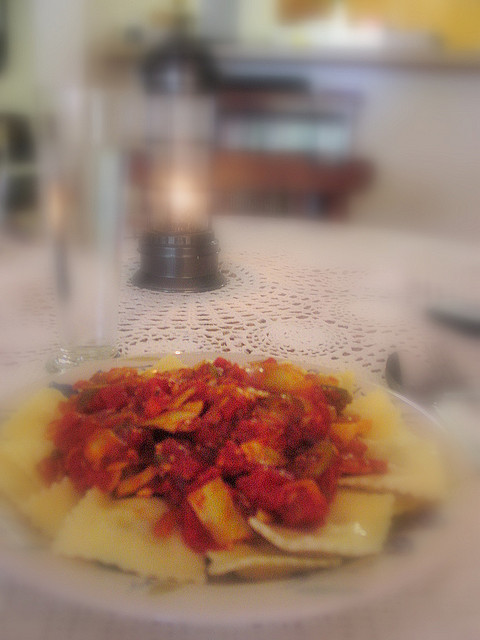
The sauce:

  • sauteed onion
  • garlic
  • tomatoes
  • some green olives
  • artichoke hearts
  • capers

The ravioli: chicken and Parmesan cheese.

A fifteen-minute meal.

Dinner

Math

There’s an op-ed piece in today’s New York Times about the ineffectiveness of “fuzzy math” instruction:

One of the most infamous fads took root in the late 1980’s, when many schools moved away from traditional mathematics instruction, which required drills and problem solving. The new system, sometimes derided as “fuzzy math,” allowed children to wander through problems in a random way without ever learning basic multiplication or division. As a result, mastery of high-level math and science was unlikely. The new math curriculum was a mile wide and an inch deep, as the saying goes, touching on dozens of topics each year.

I was shocked about this time last year when I was substitute teaching for a few weeks at the level of math juniors and seniors were working on. “We did that in fourth grade,” was K’s response.

K, studying for a national licensing exam for the last few weeks, recently revealed that the math she was working was “fun.” Matrices and such. “When did you learn that?” I asked, fearful of how her response might indict American education.

“Well, we started learning about it in primary school.” Around seventh grade (at the time, primary school in Polska was K-8).

Now some American educators are aiming for algebra by the seventh grade:

Under the new (old) plan, students will once again move through the basics — addition, subtraction, multiplication, division and so on — building the skills that are meant to prepare them for algebra by seventh grade. This new approach is being seen as an attempt to emulate countries like Singapore, which ranks at the top internationally in math.

The question is, what are students in Singapore studying in seventh grade math? I’d be willing to bet that, like in Poland, they’ve left algebra far behind by seventh grade.

The answer to catching up with some parts of the world in the education level of our schools lies not only in curriculum changes – rearranging deck chairs in the oft-used cliche. The answer depends, in part, on more educational time: a longer school day and a longer school year.

Out of the Closet

So I recently admitted to reading the Washington Times.

Sure, it's a rough-and-tumble mouthpiece of the right wing, but it's so much fun. Just look at this stuff from the op-eds:

  • The French irritation with America grows out of wounded pride, a sense that France is not as important in the world as it once was, but a President Sarkozy might restore some of that lost pride and with it an appreciation for stronger links with America. (Suzanne Fields)
  • The following are the chamber remarks of the fictional Lord Harold Reid (whose fictional grandson, in the 21st century would become leader of the fictional Democratic Party in the U.S. Senate).I regret to have to stand up tonight, on the day of defeat at the hands of the Germans of our French ally's armies at Sedan and on the Meuse River to observe that on this solemn occasion Prime Minister Winston Churchill has chosen to politicize and cheapen the moment. (Tony Blankley)
  • Just as the mainstream media is fond of Bush bashing and calling all Republicans right-wingers -- even when there is no conspiracy -- the local press view politicians through biased eyes. They demonize pro-life politicians as anti-abortion rights; they view advocates of school choice as opposing public schools; they write profusely about a Jewish Democratic candidate Ben Cardin beating Kweisi Mfume, who has a African name, in Maryland with only 44 percent of the Democratic vote, and practically ignore the fact that Michael Steele, a black Catholic Republican, bested his primary run with 87 percent of the vote -- nearly twice that of Mr. Cardin. (Deborah Simmons)
  • Yet the ephemerality of the sense of solidarity, to me, seems more an indication of its artificiality than of squandered sustainability. The United States, in the post-September 11 world, would be going places where few would be able to follow even if they were inclined to do so, starting with Afghanistan. Because Afghanistan was a quick success in terms of ousting the Taliban government and scattering al Qaeda to the four winds, people tend to forget the "graveyard of empires" analysis that swirled around the notion of dispatching the U.S. military to undertake "regime change" there. People also tend to forget the early reports of a bogged-down operation. (Tod Lindberg)

Good stuff...

Seriously, though, I find it difficult to understand folks who say, for example, "Oh, I never read the New York Times -- too much liberal bias." How would one know, then?

"I don't watch CNN because it's owned by Ted Turner." "I don't read the Washington Times because it's owned by Sung Yung Moon." I don't see much difference.

Occasionally I'll even find myself somewhat agreeing with the WT -- but that's for another day.

Blind Irony

I’m certainly not the first to comment on this, but it’s been rattling around in my head for a couple of days.

Action and reaction:

  • The pope makes comments that, when taken out of context, can be interpreted as implying that Islam is a violent religion.
  • Some Muslims react by shooting a nun and others by fire bombing a church.

I really feel like a wing-nut for saying this, but…

  • Why are we not hearing equal outrage in the Muslim world at these violent reactions?
  • Why, when Madonna used crucifixion imagery in her latest tour (BBC), did we not get riots and violent protests at the Vatican?
  • Why, when Jews are insulted, do we not see violent protests in Tel Aviv and Jerusalem?
  • Why can various Muslims (including the leader of Iran) call for the destruction of Israel while we non-Muslims are expected to tip-toe around troubling ideas found in the Muslim world?

Update: Just after posting this, I read in the newest The Week of a Dutch priest who, angered at Madonna’s depiction of the crucifixion, phoned “in a fake bomb threat to a Modonna concert. […] He was tracked down easily because he called from his home phone.” Google turns up a few stories about it.

Four Inches of Paper

The staff at the center I work has been, from time to time, encouraging me to take a look at the psychological profiles tucked away in each student's file. The other day, I finally got around to looking at them.

It's the closest I've come to holding anything "Classified" in my hands. Big thick folders filled with forms, evaluations, surveys, histories, and legal documents -- all of it confidential.

While working in an EC classroom last year, I sat in on a couple of IEP meetings. The IEP ("Individual Education Plan") is a road map of issues, proposed solutions, expected outcomes, and standards for quantifying success prepared for each student receiving special services.

IEPs are usually heafty tomes as well.

The discussion ranged from previous goals to the student's medical issues, from how to incorporate the student more in regular ed opportunities to amusing things the student had said recently. Throughout the meeting, teachers, administrators, and parents alike referred to the child's records on file -- also a Tolstoy size packet of forms, notes, and evaluations.

It was a long meeting, but for me as an observer, fascinating.

"What if we had this kind of involvement for each and every student?" I muttered to my colleague as we left the meeting.