matching tracksuits

fun in threes, sometimes fours

general

Sick

The Girl has been sick-ish. Lots of saline nose drops and bulb syringe work as a result. Lots of crying. And least significantly: a beautiful weekend spent inside.

L is at the age now where she's starting to recognize things -- including bulb syringes. Which means she sometimes starts before the whole process starts. Then, the degree of difficulty increases significantly as she jerks her head from side to side, crying, snorting, and being generally miserable.

And so now that we're at the point of L's life we were all sort of looking forward to (the time when she's not so fragile as when she was first born), we're looking forward to when she's able to communicate her needs, and, more importantly, we're able to communicate with her.

"I know this hurts, but I need to do it so you'll be able to breathe better."

Souma yergon, sou nou yergon…

Throughout much of the world, March 8 is a day to celebrate "the economic, political and social achievements of women." It's International Women's Day, and though it was (according to Wikipedia) first celebrated in America, it's not widely known here. Perhaps the fact that the organization that initiated it was the Socialist Party of America. And most places that still celebrate it with any real vigor are (or were) communist or socialist. (In the minds of many Americans, those terms are equivocal, I know.)

Extra points for knowing the significance of the title without resorting to Google.

Poland is one such country. Though I lived there for seven years, Women's Day never worked its way into my unconscious cultural calendar. I took the cues from those around me and never really made an effort to remember it myself.

In retrospect, that was a very bad idea. That realization occurs most forcefully when you marry a Polish woman and then come home March 8 empty handed...

At the Tone

J (K’s mother) has a new Polish friend (call her “M”) here in town: a retired doctor who just moved to the area. They met the “Welcome to America” party we threw J a couple of weeks after her arrival. They hit it off, and exchanged telephone numbers, with the promise of getting together again soon.

J called M a few days later. She didn’t get in touch with M, but left a message. J waited a few days, and, after hearing nothing, called M again. And again, no answer. J left another message and, after a few more days, began getting concerned.

Eventually, M returned the call. M, however, didn’t know she was returning a call, for the first thing she asked J was “Why didn’t you call?”

“I did call,” J said, explaining the messages she left on the answering machine.

“There were no messages from you,” M said. She suggested they hang up and J try to call and leave a message again.

J hung up, waited a couple of seconds, and called. She left a message, then waited. M called back in about ten minutes, asking why she hadn’t called.

“But I did call,” J confusedly protested.

M asked to talk to K, and asked K to do the same. “Maybe she’s doing something wrong?” M suggested.

K dialed. She left the message. M called back shortly and confirmed receipt of the message.

Then K had an idea. She had her mom dial the number, and it was all clear.

Though she was calling from a cell phone, J didn’t know that she had to put the area code in as well. M, in fact, didn’t include it on the piece of paper she’d given J.

“But what about the voice I heard?” J asked.

And so K explained what “Message JG-23…” means.

Early Thanksgiving

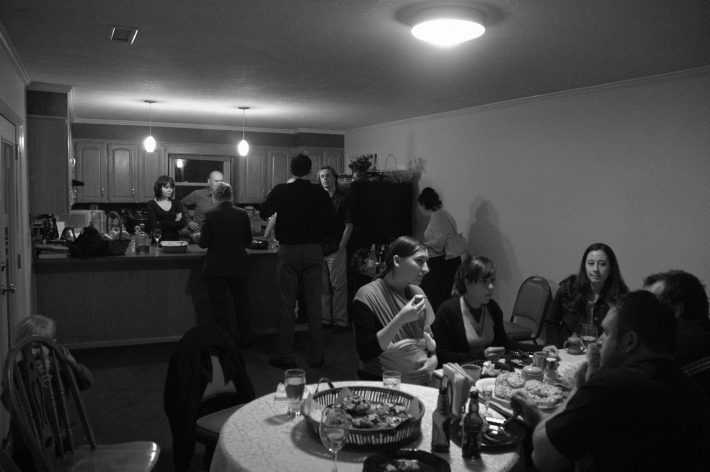
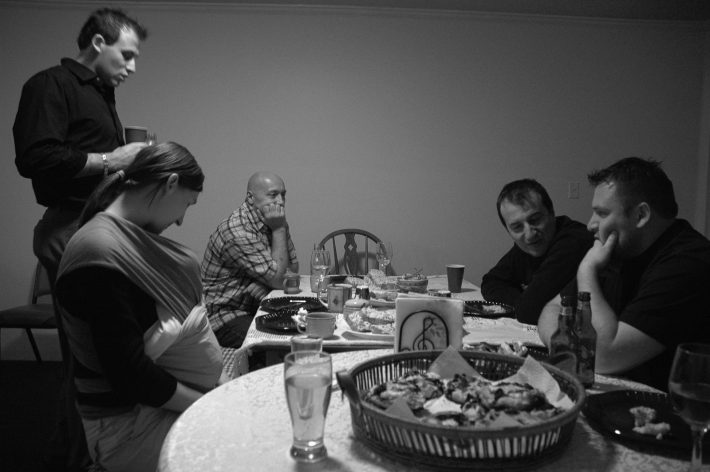
K's mom obviously won't be here for Thanksgiving, but we still wanted to give her some idea of what it's like. So my mom did the obvious: cooked a small Thanksgiving dinner.

Turkey, dressing, potatoes, green beans, giblet gravy, rolls and a nice chardonnay. And of course for dessert, sweet potato pie.

The dressing and the pie were the big hits. Made from cornbread (itself a novelty), the dressing is doubly unlike anything in Polish cuisine. As for the pie, the notion of doing anything with a tuber other than boiling it and serving it with salt and pepper is fairly foreign to the village Polish way of cooking.
Talking about Thread, Watching the Game

After dinner, it was time to pull out the thread collection and discuss one of those things that crosses most all western cultural boundaries: crafts.

Wiki wars

From Language Log, I recently learned about Conservapedia, which, as you might guess from the title, is a conservative Christian version of Wikipedia. (Language Log was interested in Conservapedia's erroneous entries on linguistics.)

Conservapedia's welcome message includes the following explanation: "Conservapedia is a much-needed alternative to Wikipedia, which is increasingly anti-Christian and anti-American."

Conservapedia's entry on Wikipedia begins,

Because anyone can edit it, and because of its system of governance, it does not have standards similar to those of printed encyclopedias. As with any wiki, the balance of the content in Wikipedia inevitably represents what its contributors find interesting to write about, rather than what encyclopedias traditionally contain. Thus, gossip and hundreds of thousands of entries about pop songs or celebrities are pervasive on Wikipedia. (Conservapedia)

And what does Wikipedia, in turn, say about Conservapedia? Until recently, nothing. Wikipedia redirected "Conservapedia" to "Eagle Forum," and the entry itself was in the "Articles for Deletion" bin. Most voting for deletion feel it's not notable, it's trivial, etc.

And then Language Log mentioned it, and over the weekend, it's reappeared...

Twenty-Second and Twenty-Third Firsts

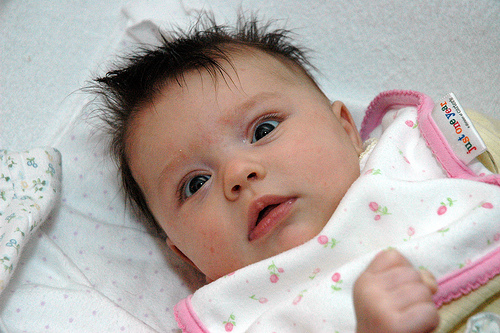
L is almost eleven weeks old, which means she's entering that period where every day she does something new for the first time. A few of the recent firsts:

She's slowly discovering that those spindly things sticking out from her sides are arms -- her arms. This morning she tried to bring her hand to her mouth after holding it in front of her, studying it for a few seconds before slamming her hand directly into...her forehead.

L has added a new cry to her repertoire: the "I'm bored" cry. She likes to be toted around the apartment so she can see anything and everything.

Lastly, she's discovered her voice, and learned that it too is subject to her control. And so she's taken to making vowel sounds to show her interest and her joy. We've captured it twice on video.

Cartographic Roots

K is a cartographer. As such, she has an abiding interest in maps. As such, we have a very nice map of the region of Poland where she comes from (and where I lived for seven years) hanging in our forayer.

L is turning into a smiler. It's gone from "Honey, come quick! She's smiling!" to a many-times-a-day occurrence. In fact, she smiles on-cue now. Sort of.

Whenever we hold L so that she can see our forayer map, she smiles -- 99% of the time. We've caught it on video a couple of times.

The question is, what is so fascinating for her about that map? It has nothing but muted earth-tones; it is extremely low-contrast; it is very detailed -- all the things a baby L's age are not supposed to find particularly interesting. But she loves it -- she comes closest to laughing when looking at it.

Maybe she senses that mom's a cartographer. Maybe she senses that its a representation of her roots. Maybe she just gets off on low-contrast images...

Language Soup

We have several Polish friends in the area, and a surprising number are in mixed marriages: a Pole and a Bulgarian; a Pole and a Czech; a Pole and an American. We went to a house-warming party at the Pole/Czech couple's house, and as always happens at such parties, I got to thinking about the effects of the English language's relative isolation. Last night, the Czechs spoke Czech, the Poles spoke Polish, and everyone was mutually intelligible. And a Slovak couple been there, they could have spoken Slovakian as well and we'd all get along fine.

I try to imagine what it would be like to experience something similar: to hear someone speaking Dutch, for example, and understand enough of it to be communicative. Poles understand Slovaks; Urdu speakers understand a sizable portion of Hindi; someone fluent in Spanish would make a bit of sense out of Portuguese -- but there's no equivalent in English, that I know of. Sure, German has "gut," and there are a lot of English/French cognates thanks to 1066, but nothing approaching the level of intelligibility speakers of Slavic languages experience.

For me, it can be a bit of a nightmare. I understand a lot of Czech, but it's a stretch to get a real sense of what's being said.

Of course the real winners in such a situation are the children. Growing up speaking three languages -- what a gift to give your child. But I know of situation slightly more linguistically advantageous: a former Polish student of mine married a Spaniard. They live in Vienna and speak English to each other. Now if they could only get a, say, Chinese babysitter...

First Smile

It really began some weeks ago -- the first smile, K says, was when L was six weeks old. I didn't see it for some time, because L would smile once one day, give it a couple day's rest, then smile again -- usually when I wasn't home.

And then she began smiling often enough that I saw L with her eyes sparkling above a toothless grin.

But it took some time to be able to capture that on film memory card.

Now, we can cause her to smile -- if she's in the right mood. All we have to do is flash (and hold) an exaggerated smile and within seconds, she joins in.

The best time to get a smile out of her is after a bath. L absolutely loves being bathed, so much so that it is actually an effective calming mechanism.

And when she's calm and smiling, we're calm and smiling.

Surprise

When I photograph L, I try to avoid using a flash -- for somewhat obvious reasons.