Notes from a Class
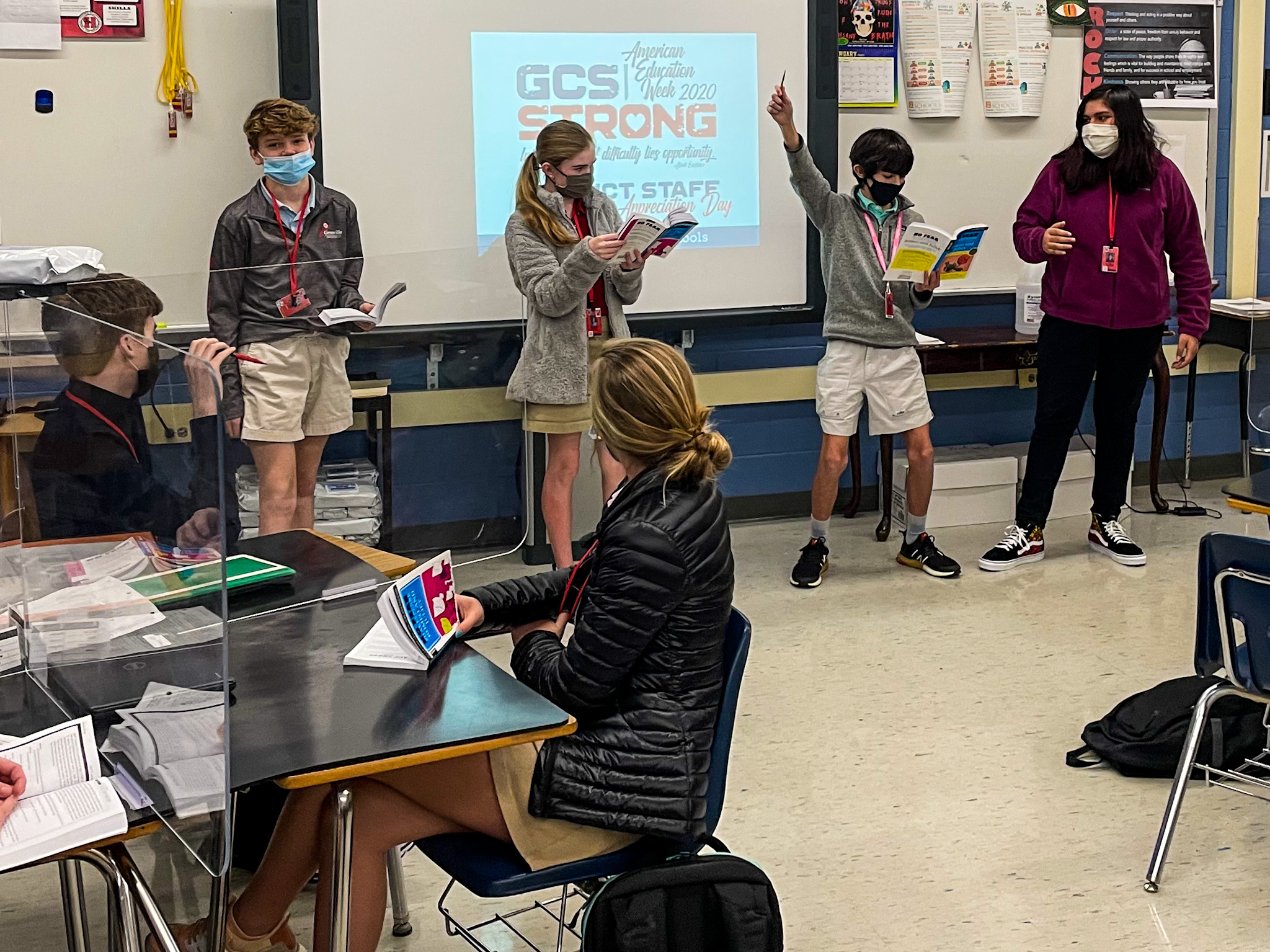
It’s funny how much meaning a few notes scribbled on the board can have for a group of fourteen-year-olds and yet be completely incomprehensible to others — to other students, to other teachers, to other adults in general.
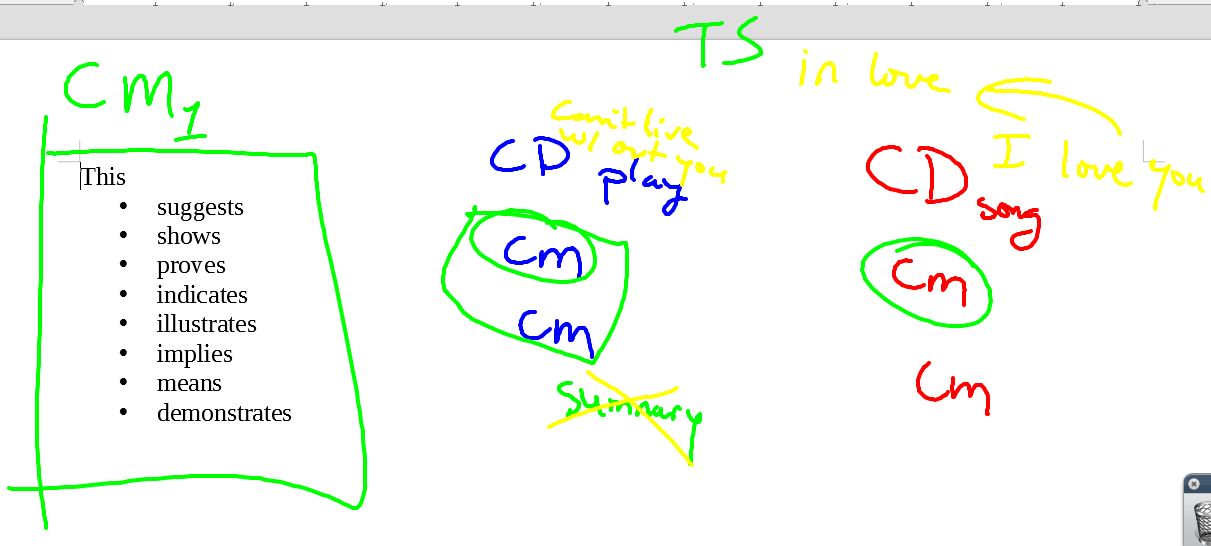
Below are the notes from today’s class. The scribbles don’t look like much, but to the kids with whom I’ve been working now for several months, they represent the last little bit (though critical bit) of guidance for a major writing assignment. These few words and abbreviations include notes about organization, notes about planning, notes about content, guidance for self-correction, potential problems and their solutions

We’ve developed our own shorthand, or own codes, or own abbreviations, as I do with every class every year. And it all moves the students toward writing that they would have found impressive a few months ago and now is their new-normal, their new standard.
It’s an honor to be a part of that growth, to play a small part in it.
Return II
I’ve sometimes wondered what would be the reaction in the Christian community if somehow some irrefutable proof surfaced that Jesus would never be coming back, that the second coming was all a pipe dream. Now, I know that no such proof is possible, and the events of recent weeks demonstrate all too clearly that irrefutable evidence can be refuted simply by a movement in the will, a forcible rejection of what is clearly and demonstrably true. We see that in the election; we see that in denial of climate change and evolution; we see that everywhere. But let’s just run this thought experiment: there’s somehow evidence that Jesus’s second coming will never happen, that the Christians, who have been predicting for 2,000 years now that Jesus is coming back “any day now,” were completely wrong. What might that look like?

I think we’re seeing it in real time now as Qanon conspiracy theorists grapple with the reality that none of Q’s theories have come true and that, with Biden now sworn in, they won’t come true.
One account on Reuters:
On Wednesday, they grappled with a harsh reality check: Trump had left office with no mass arrests or other victories against the supposed cabal of Satan-worshipping pedophile cannibal elites, especially Democrats, he was ostensibly fighting.
Instead, Democratic President Joseph Biden was calmly sworn into office, leaving legions of QAnon faithful struggling to make sense of what had transpired.
In one Telegram channel with more than 18,400 members, QAnon believers were split between those still urging others to ‘trust the plan’ and those saying they felt betrayed. “It’s obvious now we’ve been had. No plan, no Q, nothing,” wrote one user.
Some messages referenced theories that a coup was going to take place before the end of Inauguration Day. Others moved the goalposts again, speculating that Trump would be sworn into office on Mar. 4.
“Does anybody have any idea what we should be waiting for next or what the next move could be?” asked another user, who said they wanted to have a ‘big win’ and arrests made. (Source)
Two movements here: one, a return to reality; the other, a doubling-down, squirming deeper into the hole.
The BBC includes this:
Many reacted with shock and despair as Joe Biden was sworn in as the 46th US president.
“I just want to throw up,” said one in a popular chat on the Telegram messaging app. “I’m so sick of all the disinformation and false hope.”
Others insisted “the plan” had not failed, finding new theories to latch on to.
For weeks, QAnon followers had been promoting 20 January as a day of reckoning, when prominent Democrats and other elite “Satanic paedophiles” would be arrested and executed on the orders of President Trump.
The 65 days that led to chaos at the Capitol
What is QAnon?But, as Mr Biden took his oath and no arrests were made, some in the QAnon community had an uncomfortable meeting with reality.
“It’s done and we were played,” wrote another. (Source)
Those who are doubling down are coming up with increasingly bizarre explanations of what’s going on:
Some of them just don’t even make any sense at all:
https://twitter.com/CopingMAGA/status/1352272333130657793?s=20
Some of them are waking up, though. One TikTok video, now viral, is supposedly from a Qanon woman who has come to her senses:
So, who else is feeling just a little silly? […] I went too far down the rabbit hole, now I’m back out again — and it nothing happens on the 20th, how many of you are going to feel stupid as hell? And who the f*** is Q? Who is it? Who is this person? Because none of it has come true, and I was just thinking — what if this person knows that none of this stuff is true and they’re just messing with people, like getting inside their heads.
The video is here:
So what does this tell us about Qanon and conspiracy theories? I feel like these reactions would mirror what would happen in our hypothetical proof of the non-return of Jesus. There would be some who would accept it — probably more liberal believers. For that matter, there are Christians liberal enough already to say that Jesus didn’t really rise from the dead, didn’t really ascend into heaven, won’t really return, but insist that that doesn’t really matter. “It’s all about the teachings!” they say, and then they paint this picture of Jesus who seems in some ways at odds with the Jesus in the Bible. (He certainly seemed to think he was coming back, so there’s that…)
Most believers would stick by their guns. Nothing — absolutely nothing — could convince them otherwise.
This leads to the thought that has plagued me for a few years now, a thought that ultimately pushed me back away from Christianity: If a belief is not falsifiable, if nothing counts against it, to what degree can we call it a rational idea?
This, in turn, leads to another thought I’ve had rattling around in my head for some time now: there are a lot of similarities between conspiracy theorists and religious believers. And in fact, I think an argument can be made that religion in general and Christianity, in particular, are, at heart, a gigantic, cosmic conspiracy theories.
Return
One of the things I’m most looking forward to in the Biden administration is being able to go for days on end without giving a single thought to the president and what he’s doing. That’s how it’s always been, even with presidents I didn’t particularly like or agree with. I’ve always just assumed, “Well, he’s an adult. He’s a reasonable human being. How much do I possibly have to worry about something over which I have no control?”
The Tension Dials Up
The End of the Season
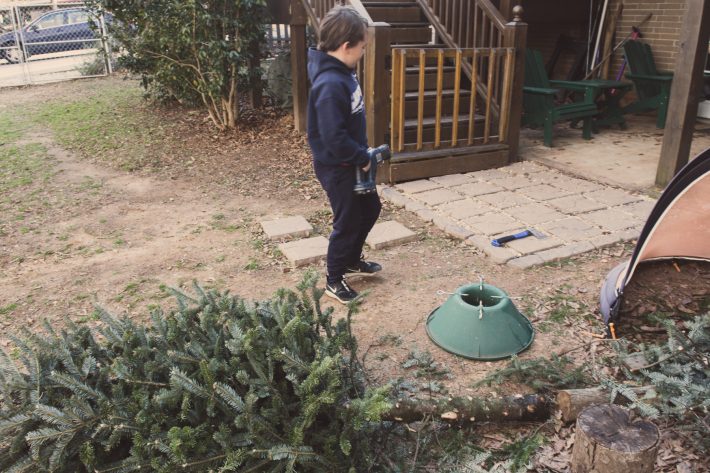
Part of it was laziness, but we’ll chalk it up to Polishness: we finally took down our Christmas tree today. We’d been meaning to do it for a couple of weeks, but we didn’t adequately work it into our schedule.
Or we can use K’s Polishness as an excuse: Poles always put their Christmas trees up later (sometimes, only a couple of days before Christmas) and take them down later.
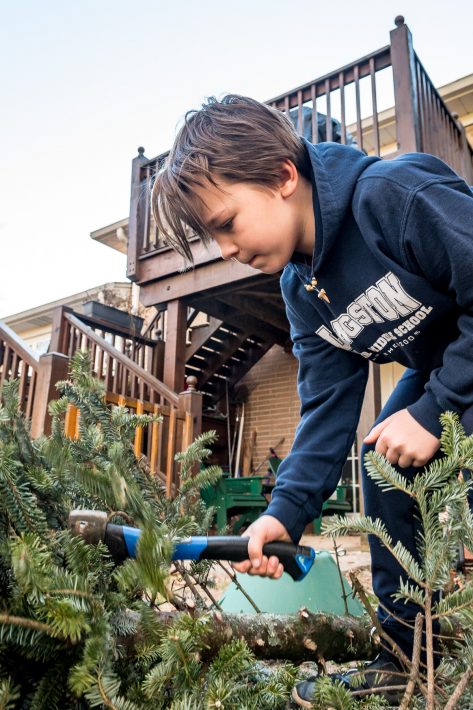
The Boy and I chopped it up in the afternoon. “This is so satisfying,” he said. For us all, in different ways…
Dalton 2021 Day 2
Dalton 2021 Day 1
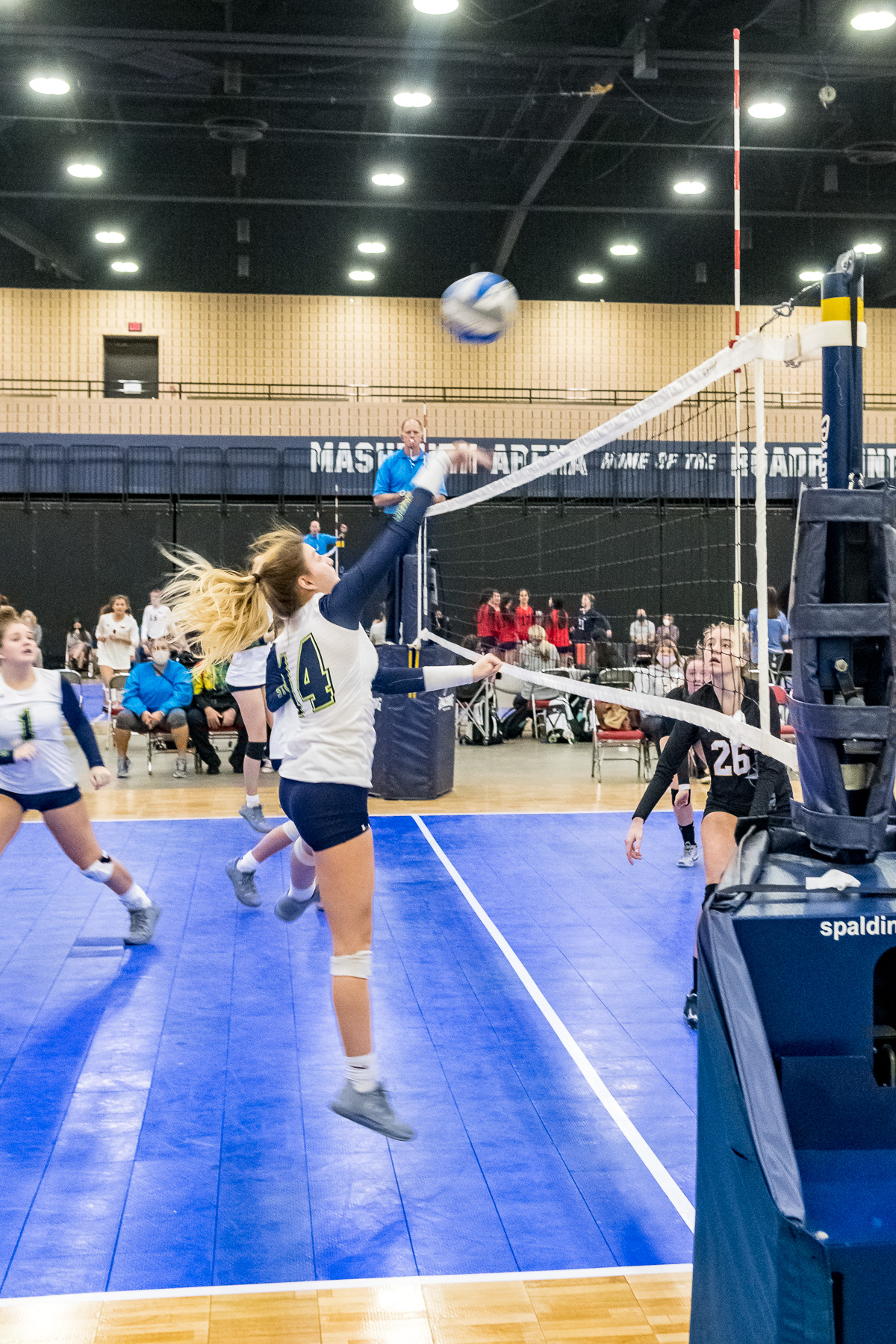
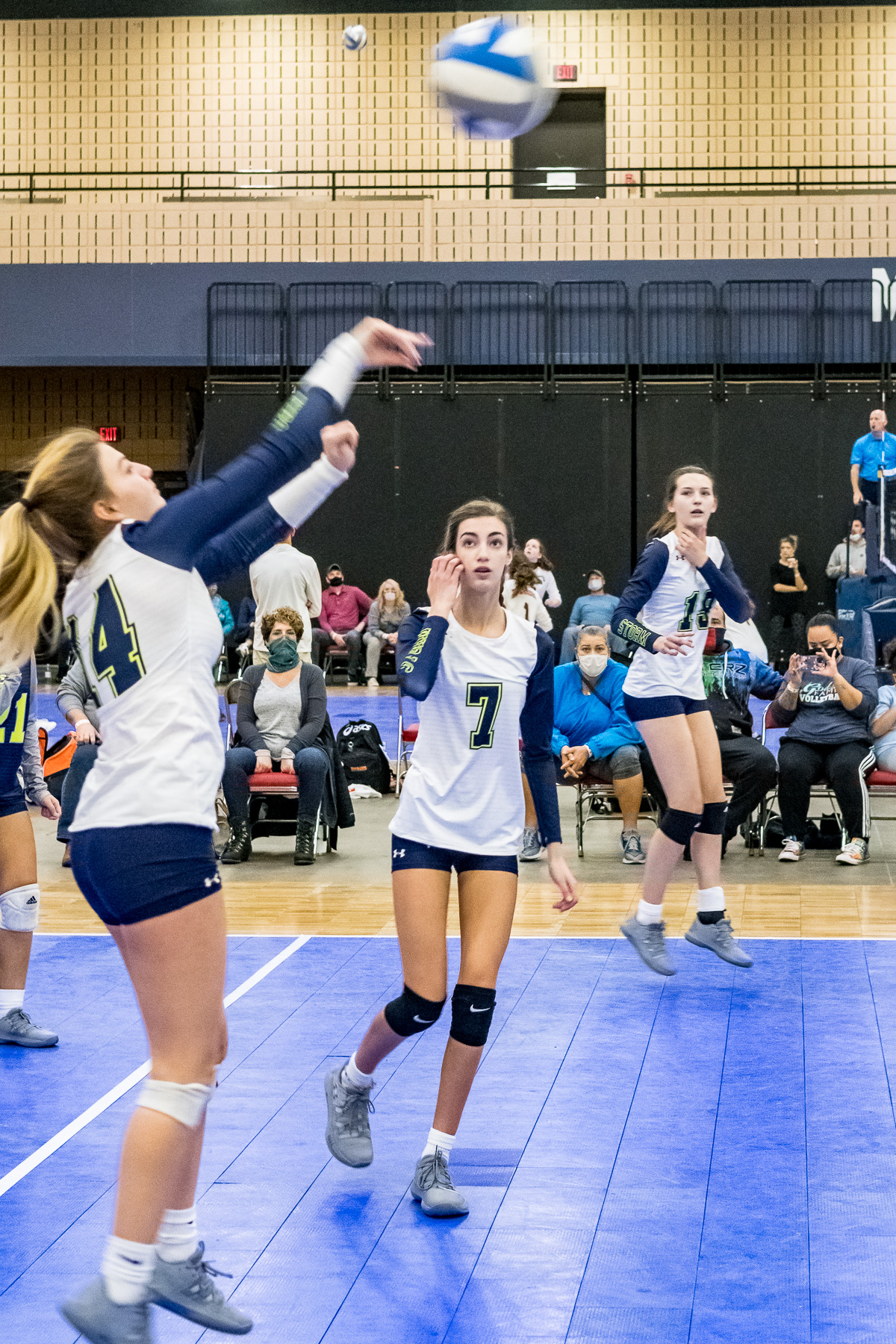
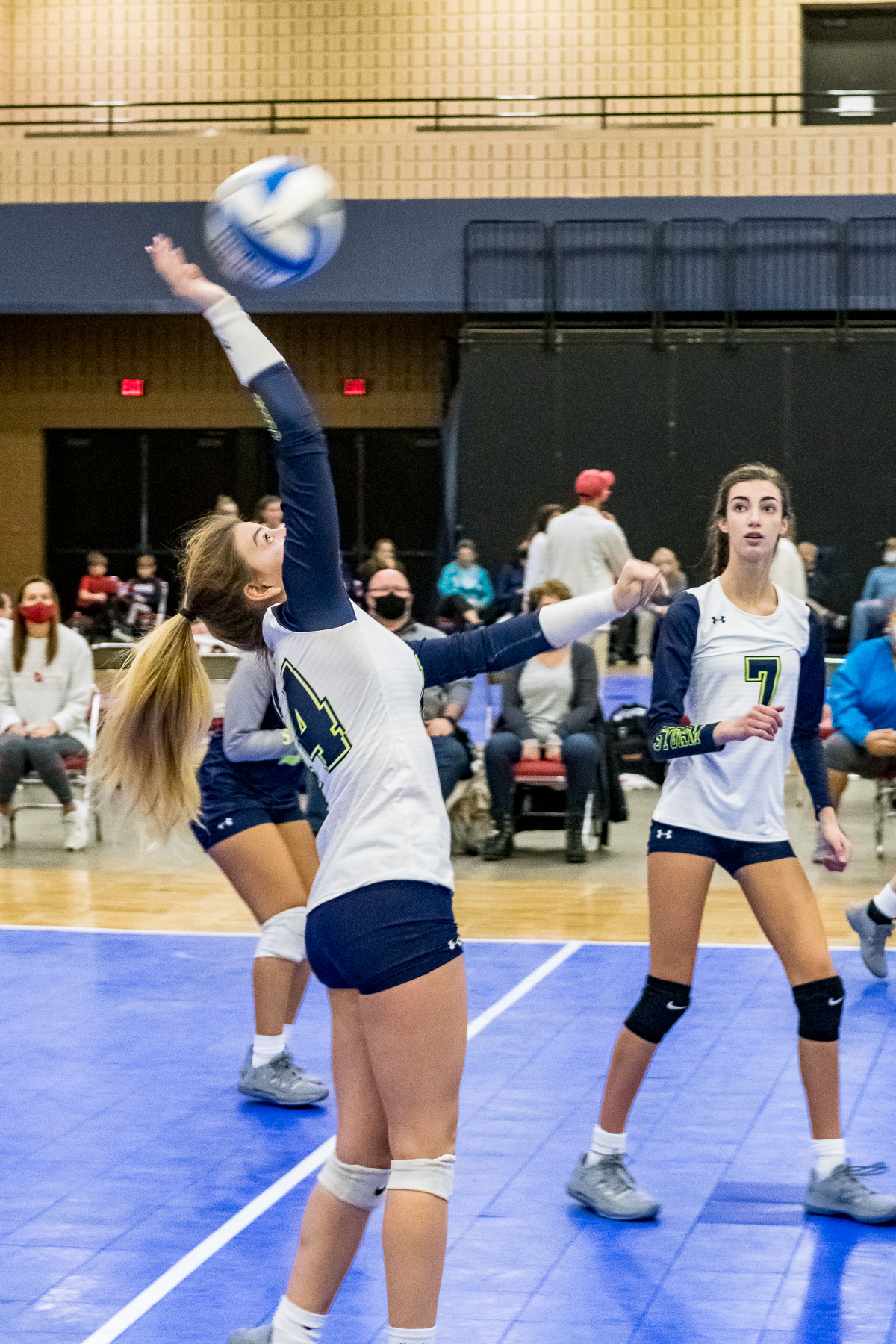
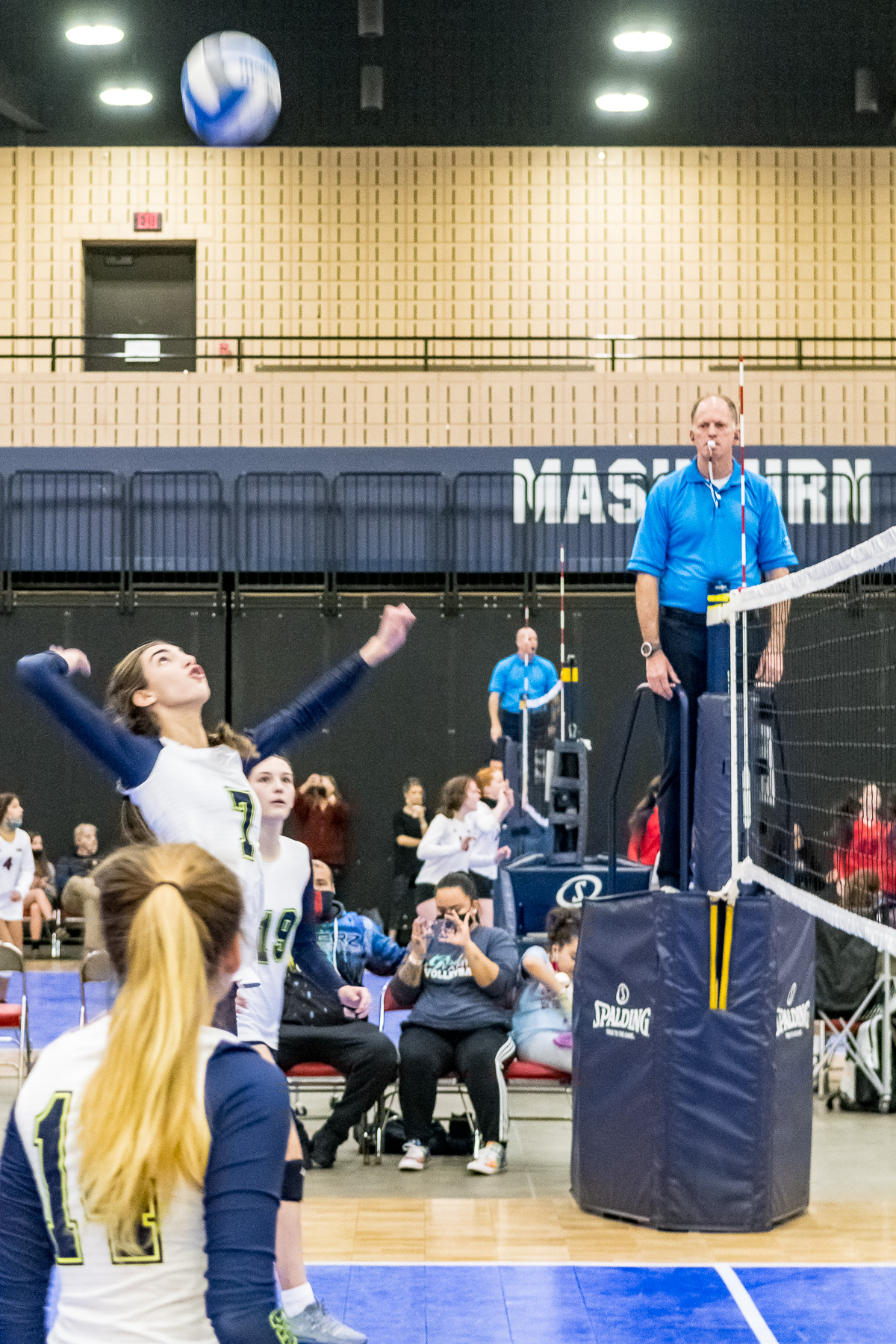
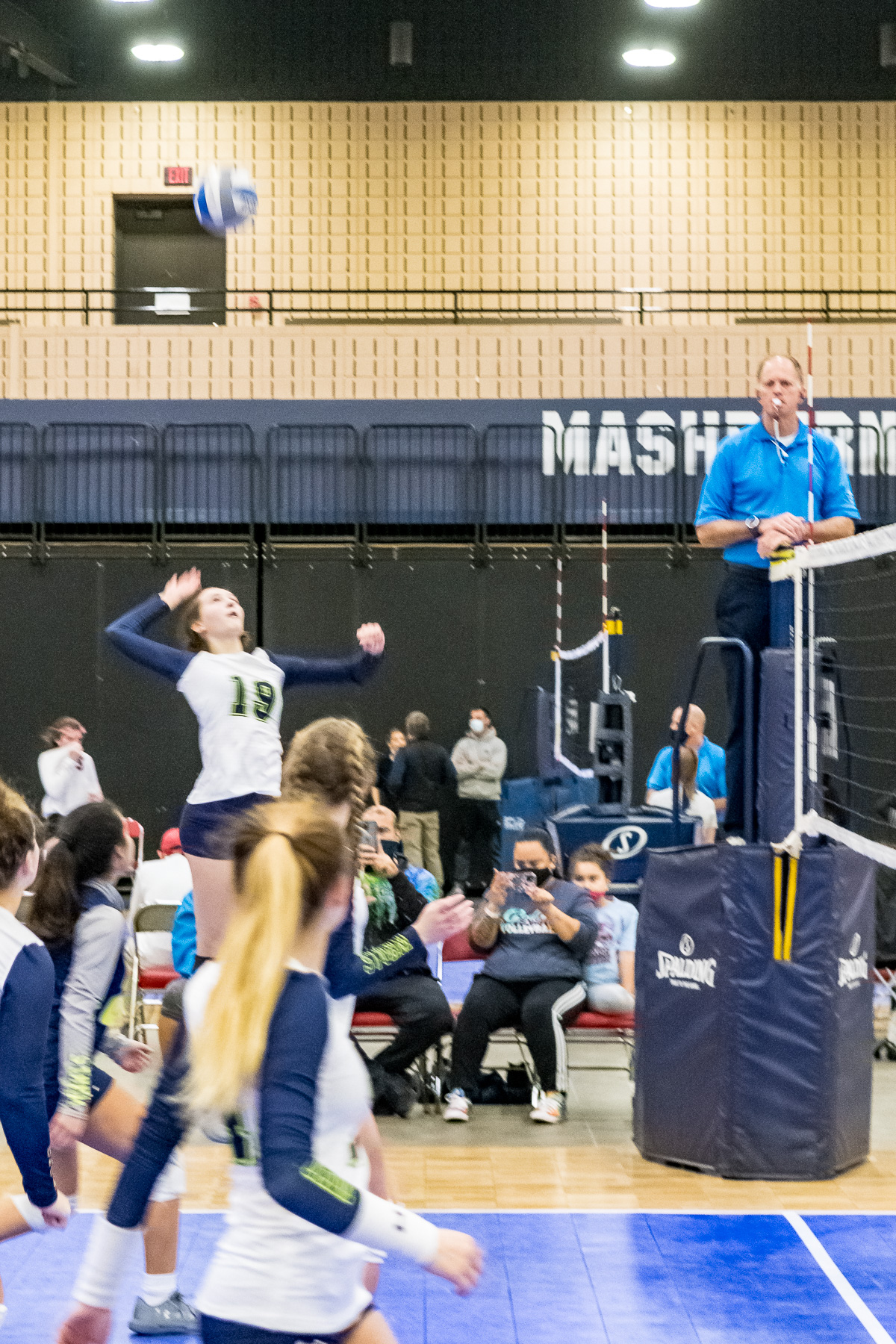
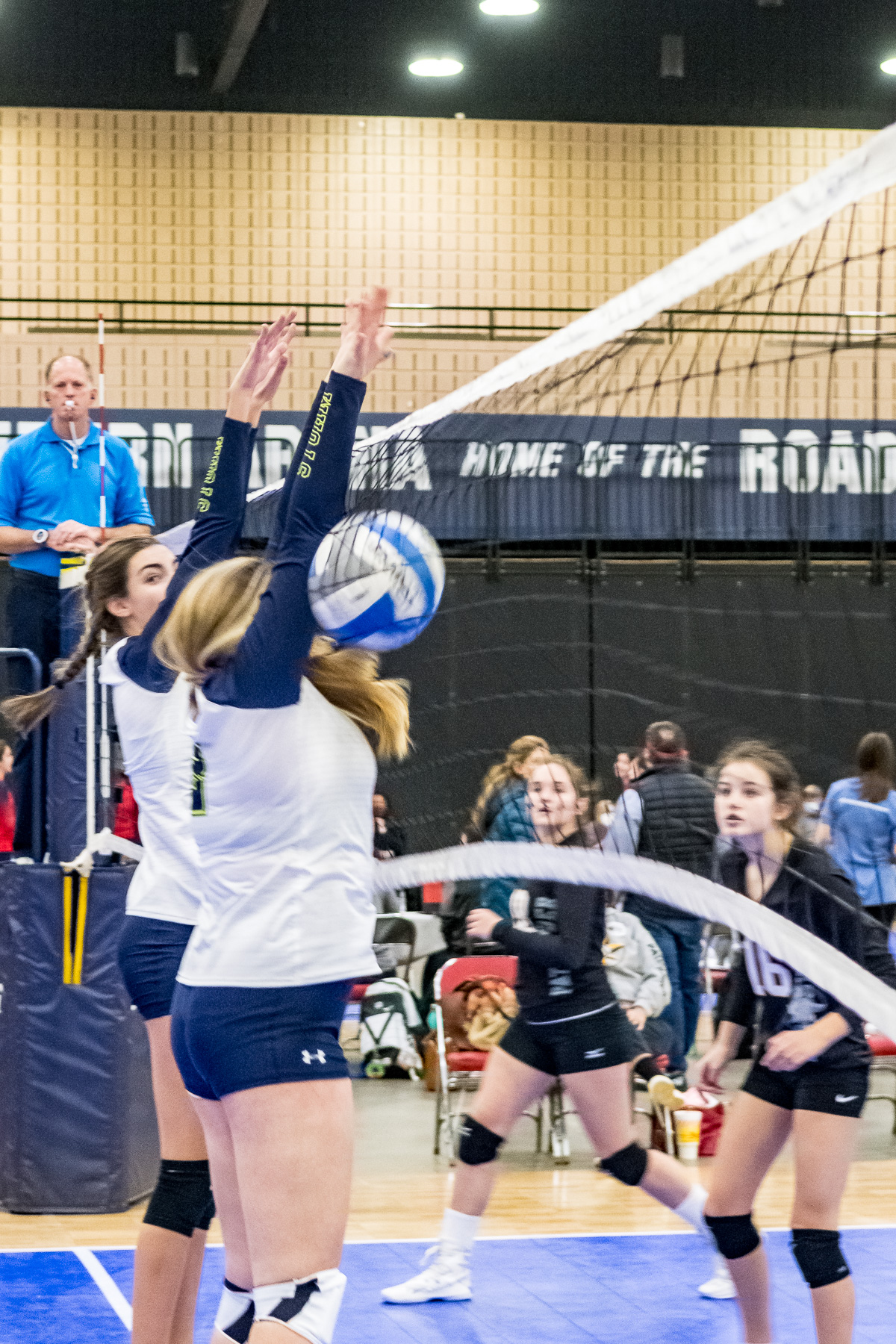
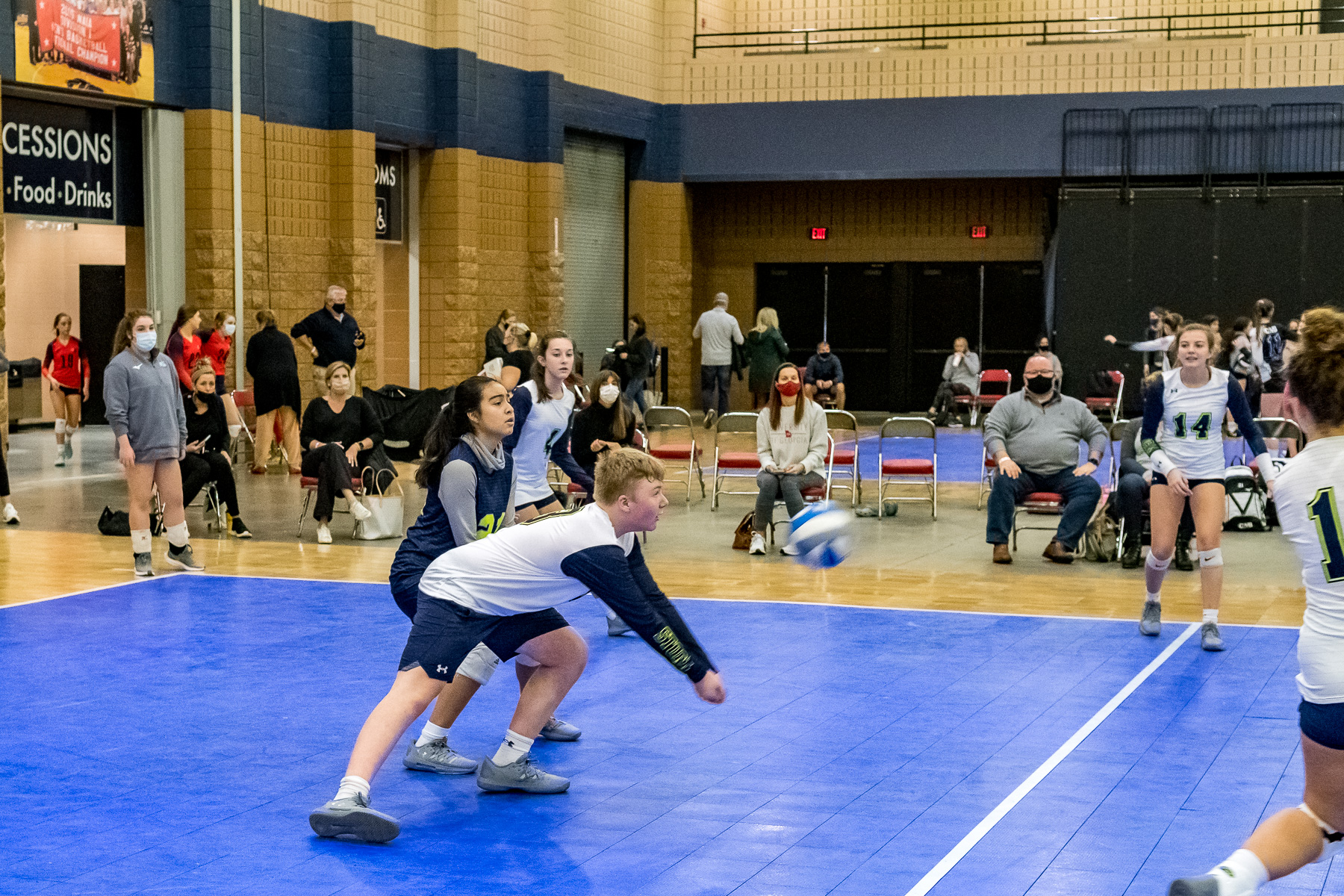
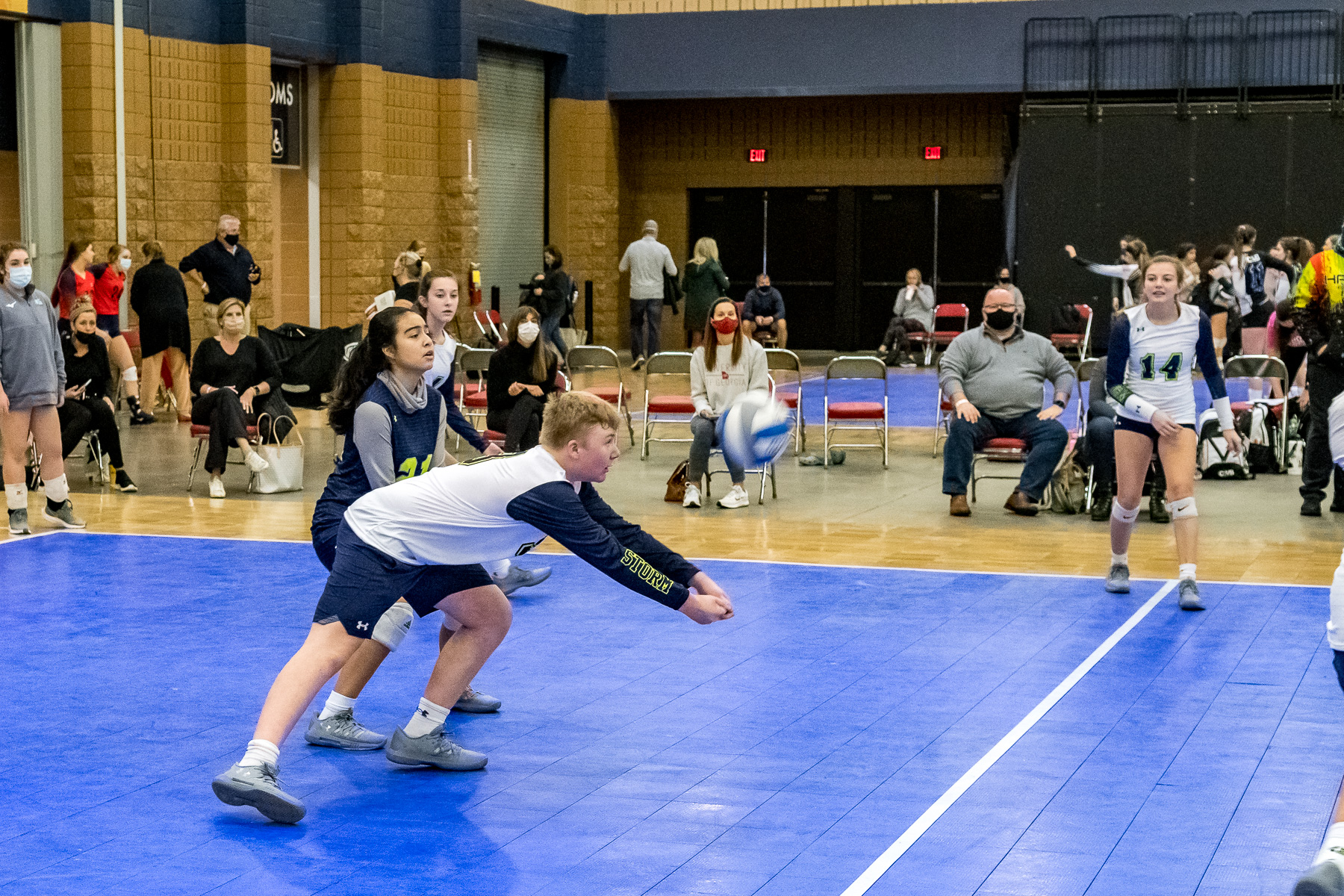
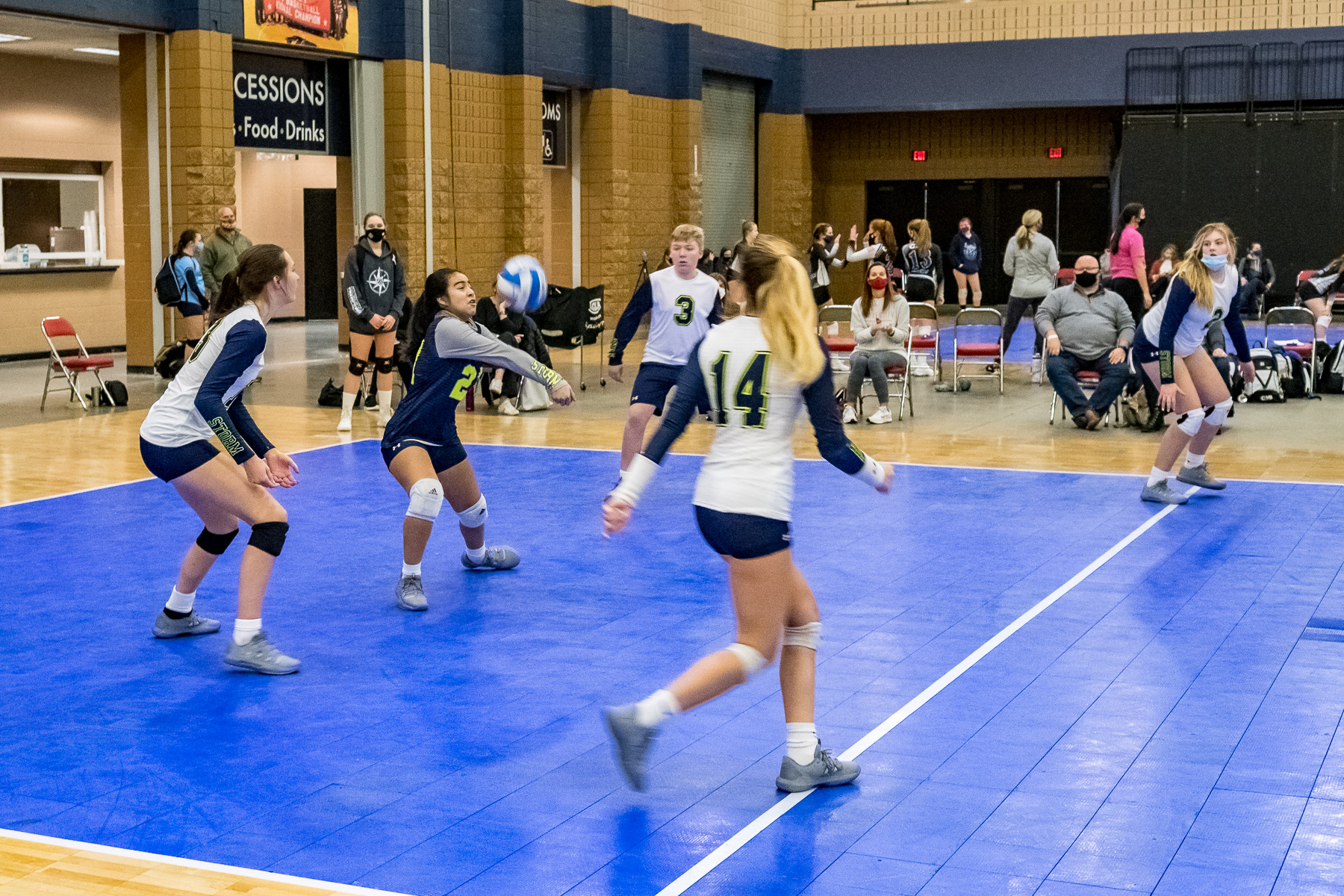
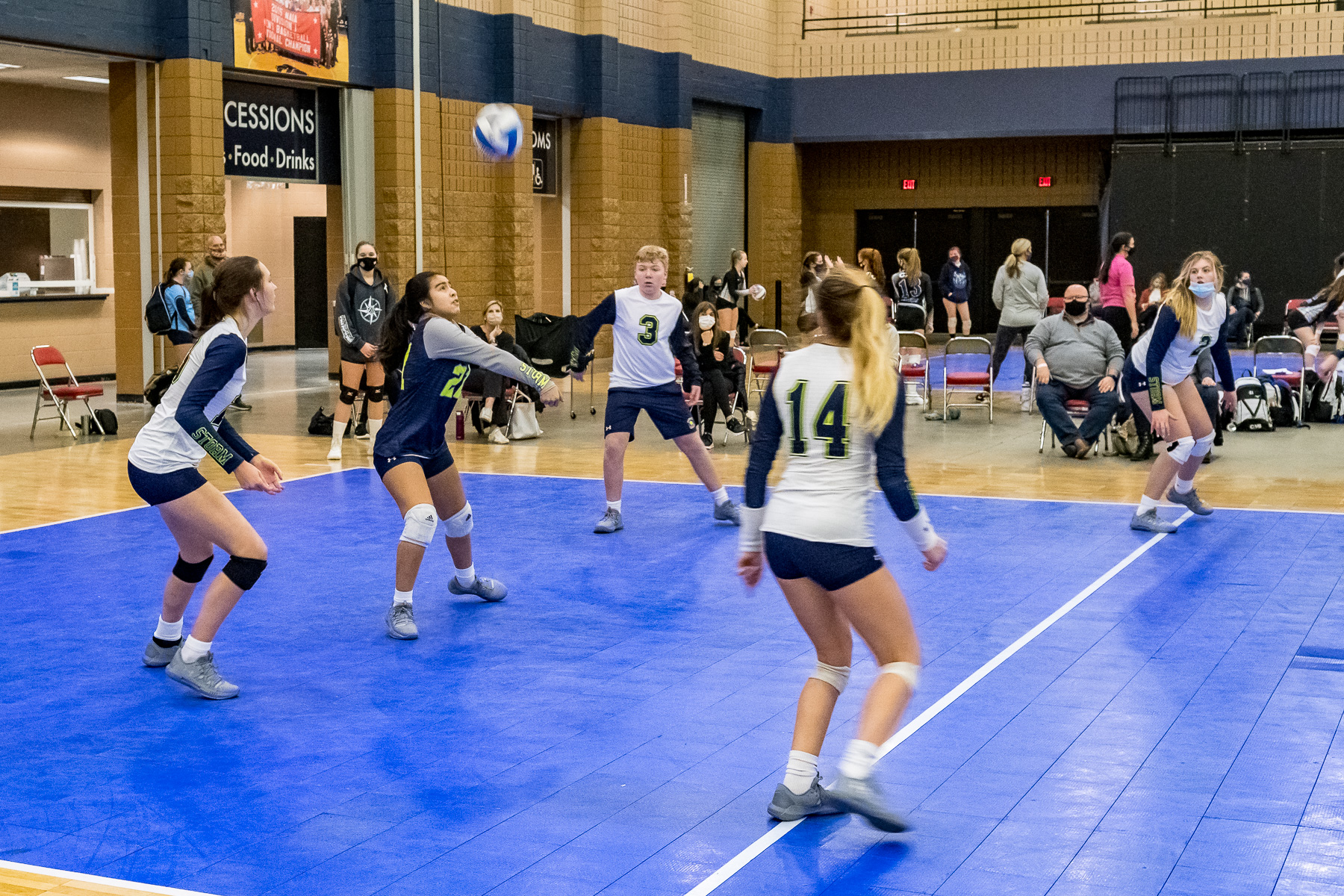
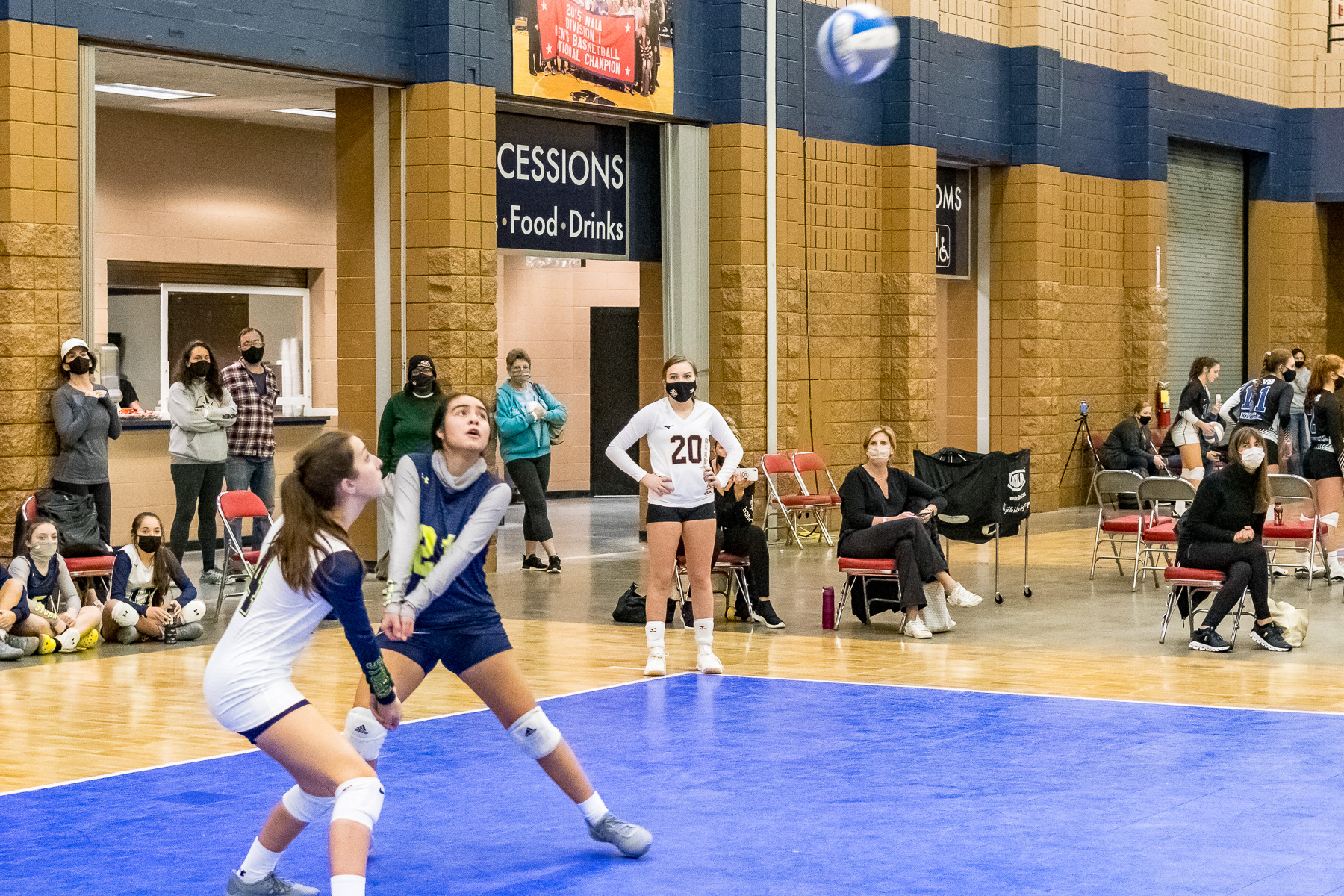
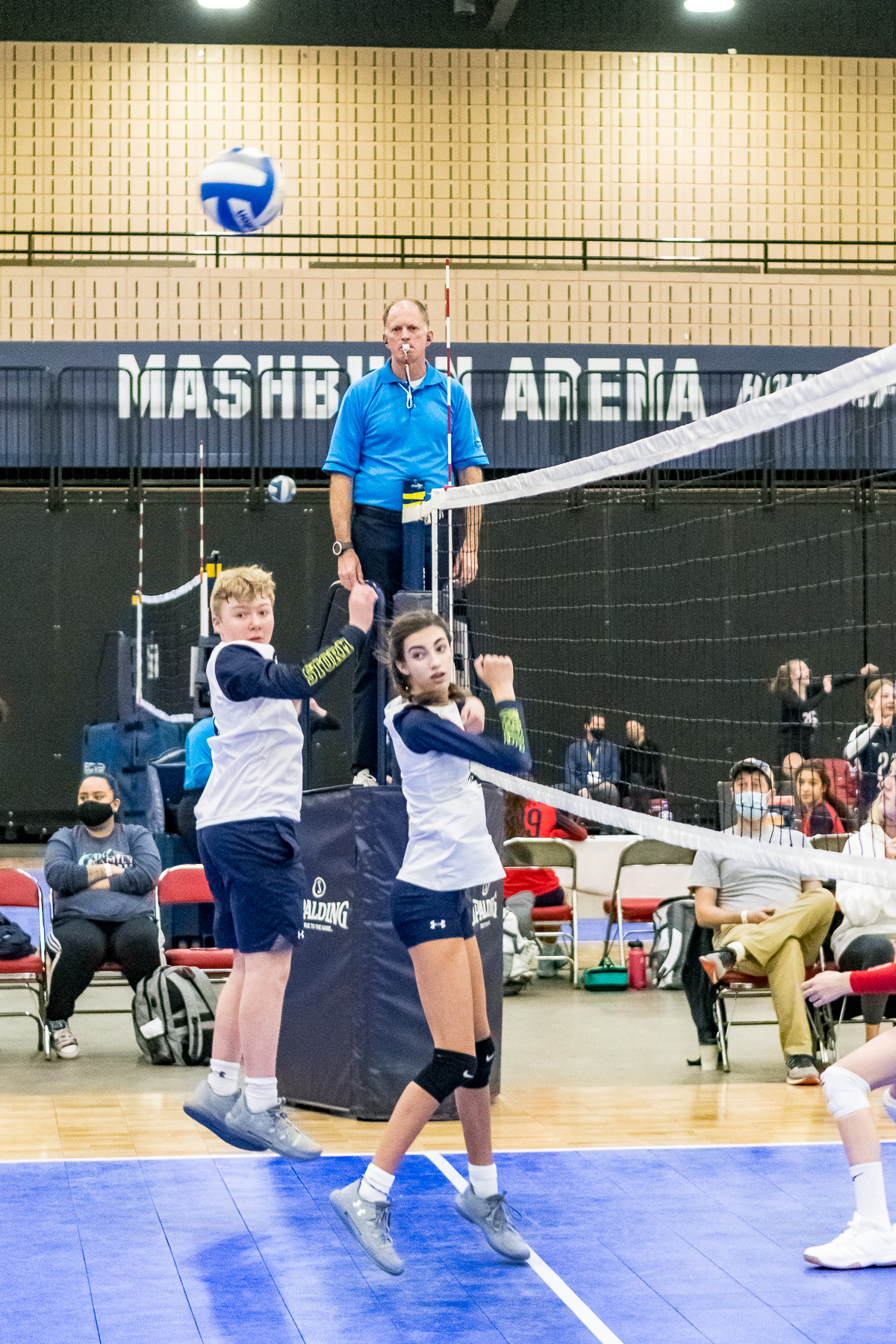
It’s a different tournament this year. There are fewer courts this year: five instead of eight. This means fewer teams in the building, so fewer players, fewer parents — reduced risk, in short.
They won their first two games in straight sets. They didn’t have much problem with either team.
As often happens, though, the third team was a different story. Our girls (and single boy — long story) lost the first set something like 25-22. Not a devastating loss, but a loss nonetheless.
They started the second set strong and before we knew it, our team was up 19-12. “Surely this is a done deal.” Nope. They ended up losing 26-24, which means in the second half of the game, they were consistently outscored 2-1.
It’s a question of experience, of gelling together as a team. It’s only their second tournament, and many of the points they lost were from silly, unforced errors. They’ll weed those out with time, with some experience.

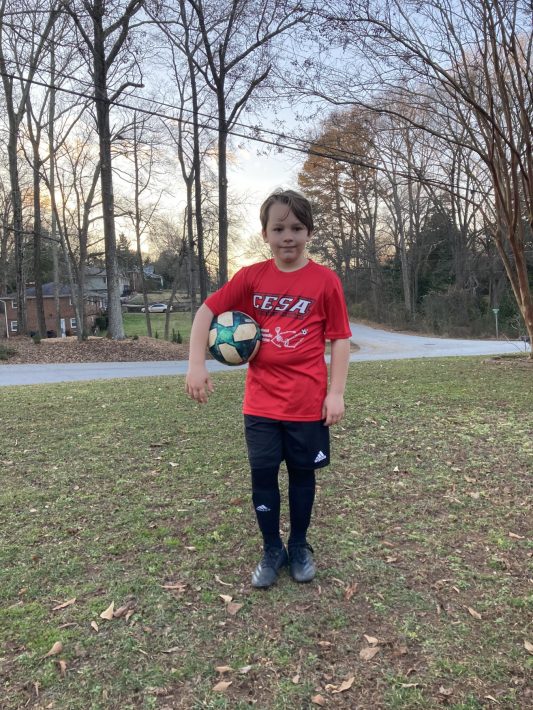
And the Boy got his soccer uniform for the spring season.
Spendings
The Boy loves to spend money. He has a million and one ideas about what he’s going to buy, and it changes from day to day. We protected his first communion money and steered him toward spending it on something useful: a new bike. However, his allowance is a different story.
This week, he decided he wanted to buy a prank kit. He spent $15 on kit that included
- a whoopee cushion,
- a small plastic finger that one pulls to create a sound that I think is supposed to sound like flatulence but instead sounds like just wildly chaotic noise;
- slime, and
- some kind of strange little bouncy rubber ball.
Four items that probably cost a total of $2 to make, and he paid $15 for it. K advised him that it was not the best way to spend his money. It was especially ill-advised since the last time he bought a whoopee cushion, it burst the first time he sat on it. (I always thought the idea was that someone else sat on it, but I guess I was wrong.)
Today, at dinner, he had an epiphany: “I wasted that money!” The realization caused great stress, but K reassured him: “If you learned a lesson from it, it’s money well spent.”
Celebrating 48
48
Kwasnica, an evening run, a bit of time with the family — a simple turn of the calendar. And not much else to say.
Media on January 7
As an English teacher, there are times that demand I drop what we’re doing in class and talk about what’s going on. Or as Kelly Gallagher put it,
Sometimes when history unfolds, it immediately supersedes tomorrow’s lesson plan. Today is one of those days. Students will need to read, write, and talk about this.
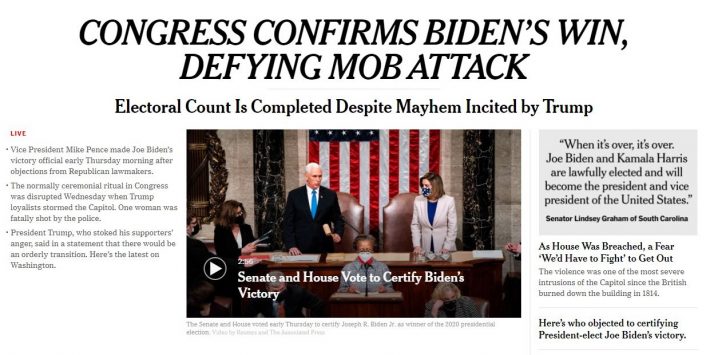
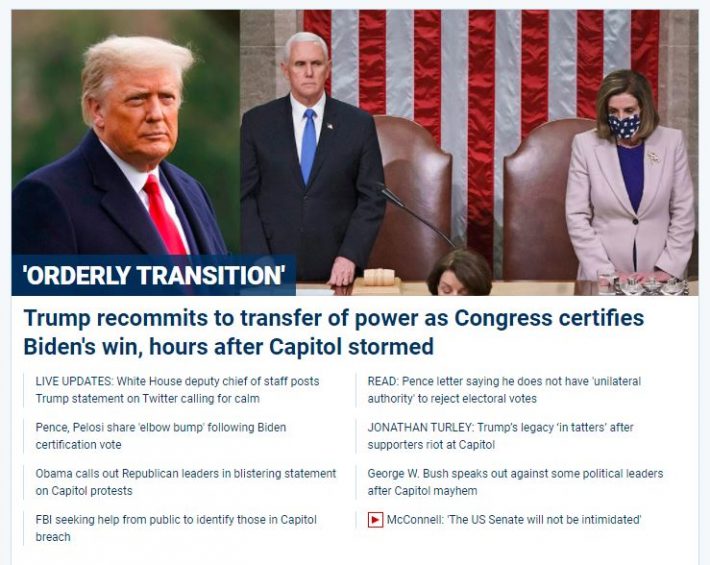
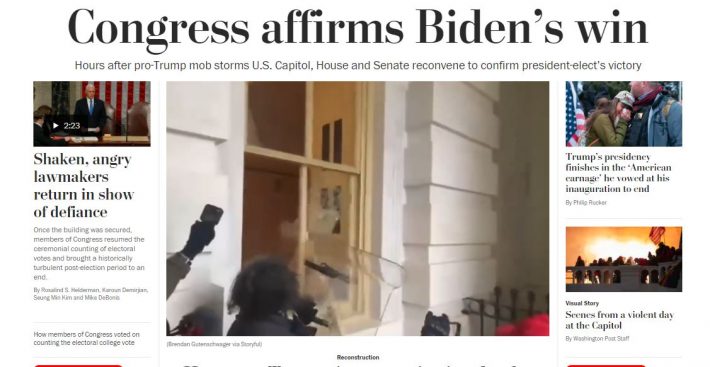
I took his thoughts (and one of his ideas) to heart and took the opportunity to do a short media studies lesson. We looked at seven screenshots of seven media outlets and asked a few questions about them:
- What is said?
- What is not said?
- How is it said?
- What images were selected?
- What images were not selected?
- Why this order of links?
- Why the selected font sizes?
- Who is the intended audience?
- What is the intended purpose?
- What inferences can we draw about the source?
As best I could, I scrubbed all indications of the source from the screenshot. I missed a bit from the CNN shot, observant students probably noticed the “South Carolina Public Radio” media player on the NPR shot, and I accidentally left in image attribution for The Washington Times but otherwise, I kept them a mystery. (The first time I went through the lesson, I told the students which images came from which sources. Because of the reaction, I decided not to do that in subsequent lessons.)
Here are a few things the students noted.
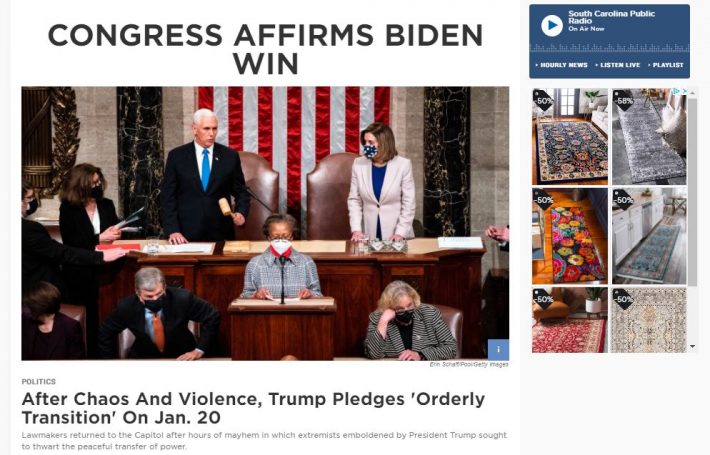
Screenshot 1: NPR
Of the two big stories from January 6, this source focused on the positive (for the survival of our democracy, that is) story. The attack on the capital was referred to only as “chaos and violence.”
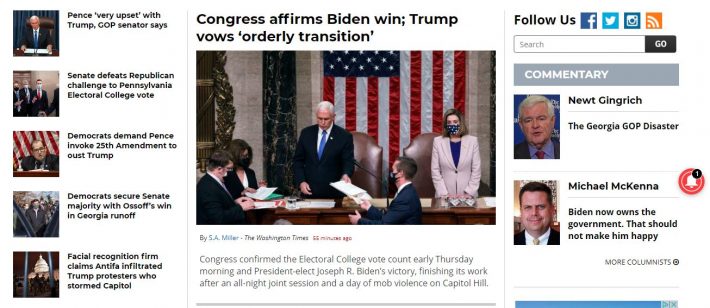
Screenshot 2: The Washington Times
Students, after I explained who Newt Gingrich is and what “GOP” refers to, decided this was definitely targeting a right-leaning audience. I was surprised that not a single student knew what GOP meant.
“Why did Republicans get that nickname?” they all asked.
“I don’t know.”
“Do Democrats have an equivalent nickname?”
“Not that I know of.”
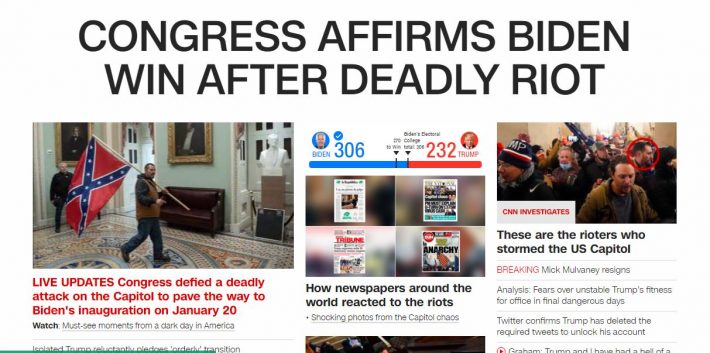
Screenshot 3: CNN
Students immediately commented on the amount of screen real estate the headline takes up. They also commented on the vote count graphic.
“I’ve only ever seen this on election day,” I pointed out.
We discussed the use of the term “rioter.”
“What else could we call the people who participated in that event?” I probed.
They came up with a list:
- protesters
- gang
- terrorists
- attackers
- mob
I added one more: insurrectionists.
We put the words on a continuum, and they decided that the most benevolent was “protesters.”
“Using that term would suggest they support them,” one student succinctly observed.
At the far end: insurrectionists. All that being said, they felt that “rioters” was the most objective.
Screenshot 4: The New York Post
Students immediately noticed that, with source 4, we could win a beach house vacation! In other words, they realized quickly that this site relies heavily on ad revenue.
“Maybe it’s a blog,” someone ventured.
As to the content, they thought it was striking that the lead story was about the rioter who was shot, but they also thought it was significant that the headline left so much out.
“In the Capitol — it sounds like something happened to a tourist or something.”
Screenshot 5: The New York Times
This source included a video, which suggests that the images in the other articles are screen grabs from this video.
There’s also the word choice: mob and mayhem.
“What’s ‘incited, Mr. Scott?” they asked. “Isn’t it like ‘encouraged’?”
Screenshot 6: Fox News
The immediate thing students noticed was “Orderly Transition” is the headline. It’s in all-caps, so it somewhat dominates the second headline below it.
Also, in the picture, Pelosi looks a little weak: she’s a little slouched over with downcast eyes. If this was from a video, it could have been a conscious choice, which would indicate a bias. Additionally, with the placement of Trump’s picture, it seems to highlight the distance between the two parties.
Screenshot 7: The Washington Post
The final shot came from The Washington Post. It seemed, the kids noted, to balance between both: the headline was about Biden; the image was from the assault.
“If you look at the area just below it,” I pointed out, “you’ll see what looks like the tops of letters. That was the headline for the second story, which was about the assault.”
Once we were all through, I reminded kids that the purpose of the lesson was not to teach them what to think but rather how to think. “An informed citizenry is critical to the success of any democracy,” I said.
Oh, the things we (rightly) leave unsaid in the classroom when talking about such matters, though…
Working in the Evening
The Boy sometimes has trouble getting work done in class. I say “sometimes” but in fact, it’s more like “most of the time.” He’s easily distracted; he takes his time sometimes; he gets off task. The end result is a fairly common occurrence: we spend some time during the evening getting caught up with his work.
We worry about his ability to keep up with things return to “normal” (whatever that might be) and teachers are no longer so very forgiving. We worry that we might hear suggestions of “ADHD” and, more ominously, “medication” from well-meaning, concerned teachers.
I don’t recall ever having any significant issues like this growing up, but I also wasn’t surrounded by electronics and instant gratification. It must put a strain on the attention unlike anything we ever experienced growing up.
Sunday in the Park
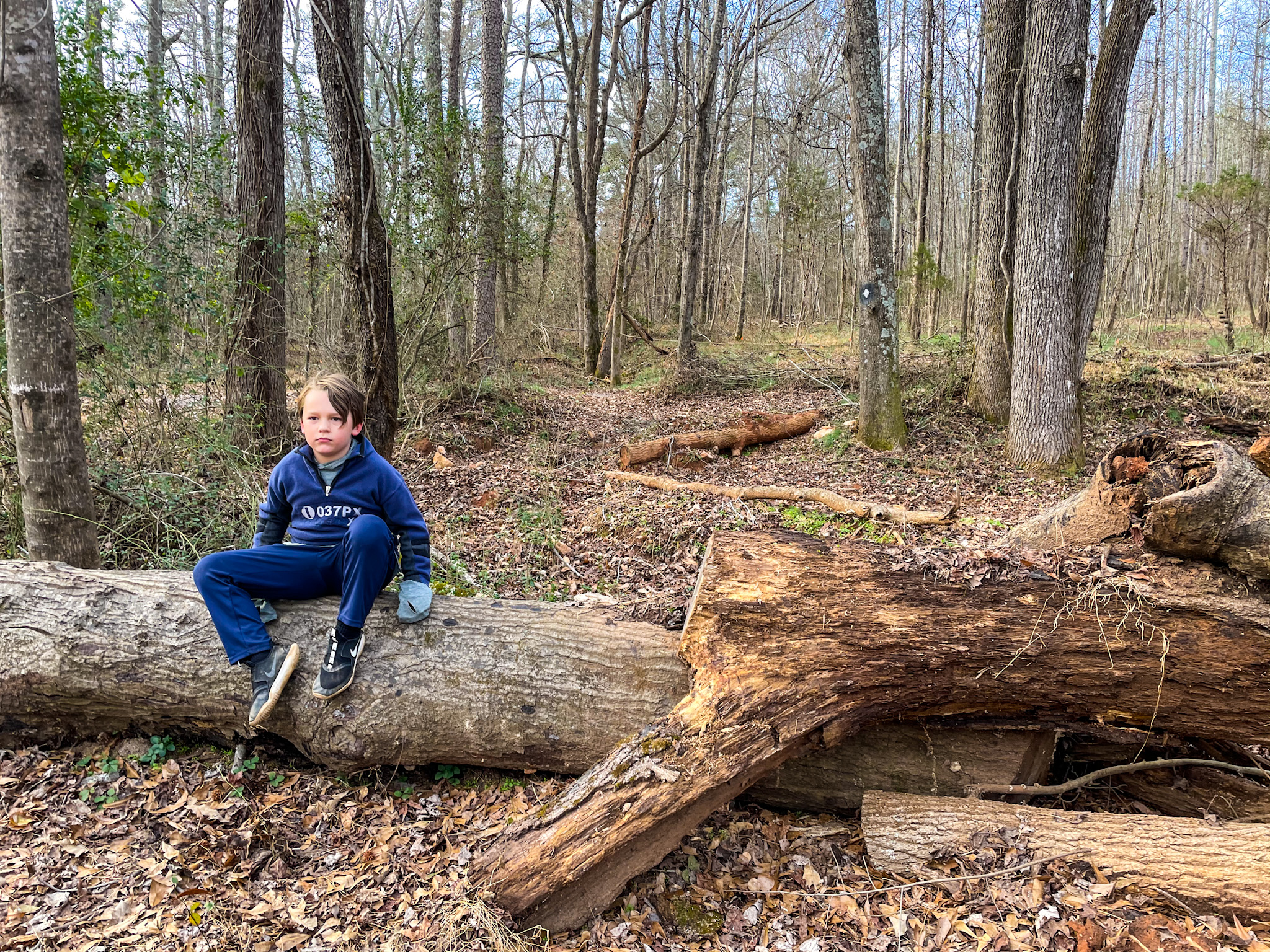
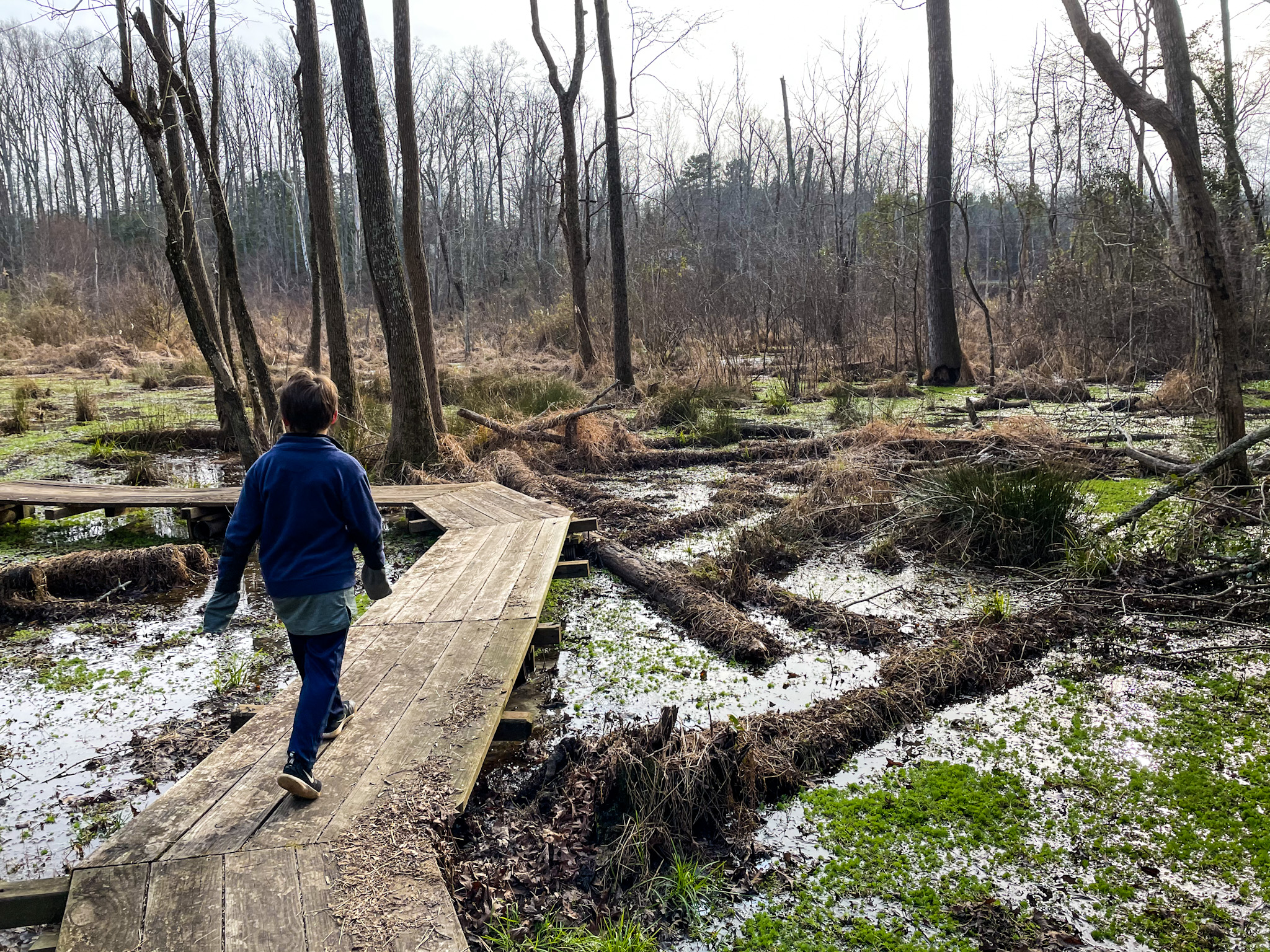
Saturday Hike
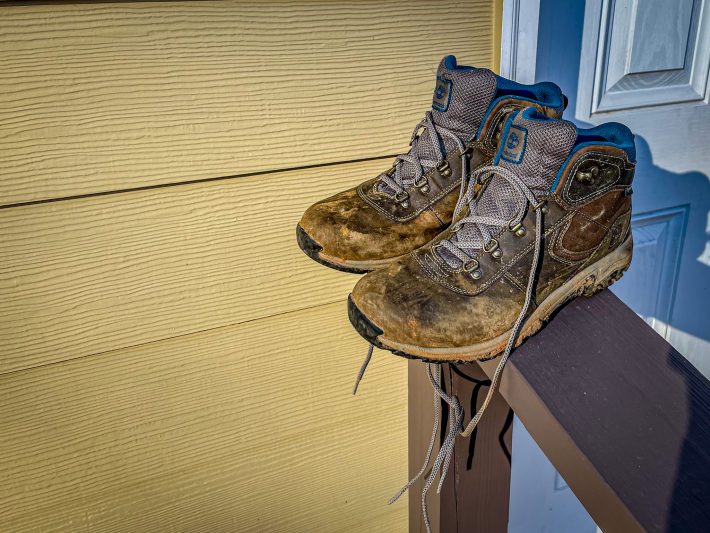
When the Girl hears that we’re thinking about a family hike, the reaction is seldom positive. When we’re on the hike, there can be a bit of complaining, a bit of whining, a bit of “I’m sooo tired”-ing. We get it: hiking is not her thing. But it’s K’s thing — by far her favorite outdoor activity. And I love it, too. Probably not as much as K, but I love K, so I love it more than I probably would without her.

But when her oldest friend asks her if she wants to go on a hike with him and his family, the boots come back looking like this, and there’s only positive words about the hike.
I guess we need to invite him along for our next family hike.
Various Visions
Today, we looked at six performances of various parts of the famous so-called balcony scene. I’d just discovered a new one:
This calm, nuanced performance has become my favorite.
In Which the Girl Gets Her First Phone
Thread of Democracy
It could have been worse.
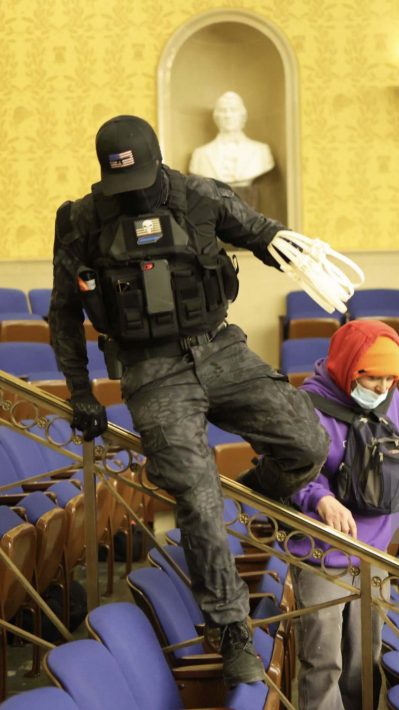
When Sen. James Lankford was speaking and an aide informed him that so-called protesters had entered the building, that announcement could have come in a flurry of gun shots. After all, it’s not hard to imagine that the majority of the rioters were armed.
If this many people had charged the capital with guns blazing, the capital police would not have stood a chance.
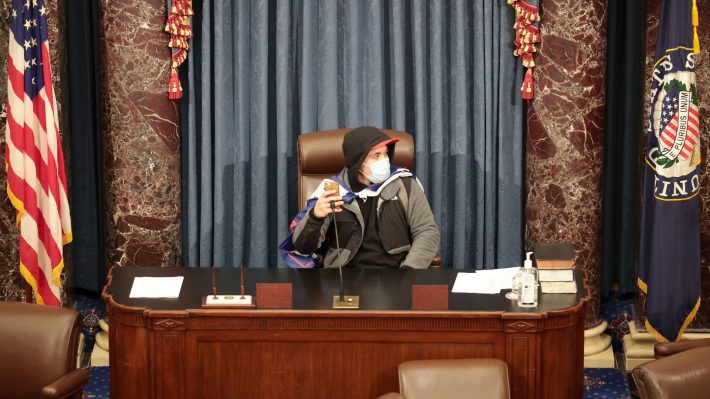
Once they’d achieved that, the insurrectionists’ plans seem fairly obvious:
They came with zip ties to do in DC what they could not do in Michigan. And once they zip-tied them, we all know they wouldn’t have been content with just this:
Or this.
Or even this.
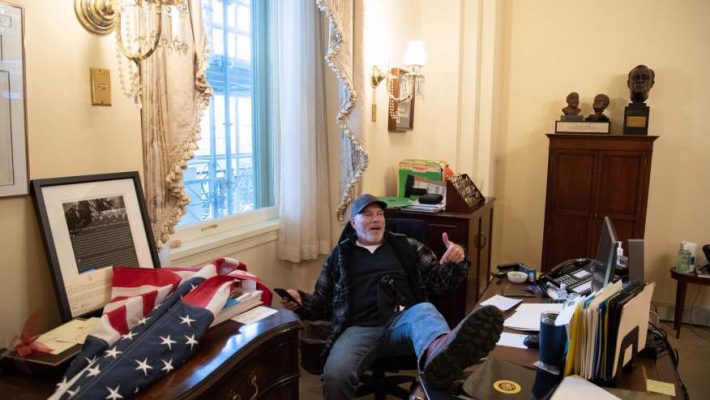
No, they had different things in mind.
Everyone who incited this needs to face justice. We need to see Rudy Guiliani standing before a judge.
Josh Hawley needs to be removed from the senate.
And Donald Trump should be impeached and convicted immediately in order to prevent him from running for federal office again.
That anyone needs even to consider the validity of these last three statements — let alone the fact that millions would dispute them, and some violently — shows the hole into which America has fallen.
That anyone would ever consider voting Republican again shows the hole into which America has fallen.
That (to my knowledge) not a single person was arrested for this immediately shows the hole into which America has fallen.
That almost every single inhabitant in America is not out marching in the streets, shouting these things in a deafening roar, shows the hole into which American has fallen.
Chess with the Boy
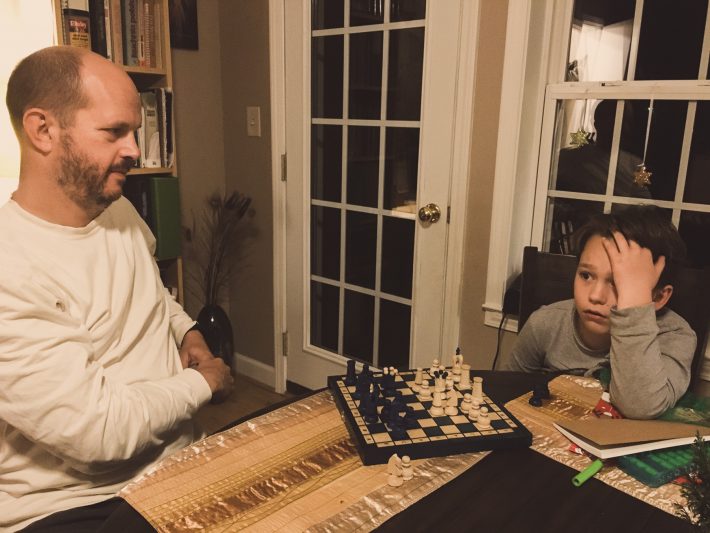
He’s improving. He’s thinking in terms of potential. He’s looking at my last move and giving it consideration.
Tonight, he moved his rook to the semi-open file — always a good development strategy in the opening 8-15 moves.
“Why’d you do that?” I asked.
“So I could attack that,” he replied matter-of-factly, pointing at one of my pawns.
“How many defenders does it have?”
“Three.”
“How many attackers?” I enquired further.
“Two.”
“Is it safe to take?”
“Nope.”
I looked over at K. “He’s going to be able to beat you sooner than later,” I said.
“I’m sure,” she smiled.
Then his tummy started hurting — but that’s a different story.
Shifting Ground
Coming out of cultic, conspiratorial thinking is a process. It’s not something that happens overnight. It’s not the flip of a switch: “I believe in lizard people. BOOM! Now I don’t believe in lizard people.” There’s a push and pull, a rise and fall to the process. It starts with the most basic thought: “I could be wrong about this.” But turning your back on a set of theories (for lack of a better term) that one has invested so much into is difficult, and giving up all that, admitting that one is wrong is tantamount to admitting that one wasted a significant portion of the short life we have here on earth.
DeAnna Lorraine, the QAnon conspiracy theorist and rabid Trump supporter who recently ran for Congress, seems to be making those mental movements in a recent video. She begins with the assumptions of QAnon:
Because we have so much trusted this plan, we always think he’s playing 5-D chess. Anything that looks questionable, we think, “Okay, it’s a strategy. He’s playing 5-D chess. We don’t have anything to worry about.” Is it possible that that is a detriment to us?
That’s a level of self-reflection and vulnerability I would not have expected. She seems to be suggesting that her assumptions about Trump’s acumen and about the whole farcical idea that he’s battling a cabal of Satanic, cannibalistic pedophiles that has embedded itself in the government and entertainment industry — she sounds like she’s suggesting she might be wrong.
Later in the video, she says,
We’re going to know for sure. Is Trump really the 5-D master chess player who is just going to totally decimate the swamp and arrest all these deep state operatives and everything we’ve seen up to now is just a massive, you know, all these brilliant chess moves and it’s all going to come into play in a sting operation and QAnon is real and everything is happening and everyone was right. Is justice finally going to be served? Are we finally going to see that checkmate? Are we finally going to see the traps close? Or, we’re not. Or we’re going to find out the truth. Maybe things failed. Maybe QAnon operation wasn’t real. Maybe, maybe some things weren’t really the truth, right? But we’re going to know in about twenty-five days.
Such an admission, it seems to me, is something we should be applauding. Yes, Lorraine has done tremendous damage in spreading the QAnon nonsense, but if she can manage a shift, if she can see the light for herself, perhaps there’s hope for others. Perhaps she could be a force that mitigates the damage of the QAnon cult.
Unfortunately, I fear she’s going to be mocked. Right Wing Watch explained the video thusly:
Perhaps I’m wrong. Perhaps she’ll never stop rationalizing. One user tweeted in response:
https://twitter.com/WasOptimist/status/1344001808906256389
But maybe that pessimism is wrong. Maybe we should give her the benefit of the doubt and not mock her. Mocking never works. It’s fun, I know — I’ve done it enough in my online life. But we know it never works. It’s like a cold wind trying to blow the jacket off someone: she just holds on more tightly. It’s a natural reaction. Mocking certainly does little to reverse this slide into hyper-partisanship we’re suffering in America now.
If anything, the more I think about it, the more I realize folks like this need compassion more than anything. They’re trapped in conspiratorial thinking that is not often easy to escape. That sounds condescending, but it’s not meant that way. These people aren’t stupid. They might have ruts in their thinking; they might lack critical thinking skills; they might gain a certain comfort from this kind of gnostic, insider thinking; they might be lacking in education to one degree or another. But they’re not stupid.
I think Michelle Obama was right: when they go low (however we might define that), we go high.