g

Visiting Coach

The girls went to watch their coach’s other team play — a college men’s team.

“They jump so high!” was the common comment. “And the net is higher!”
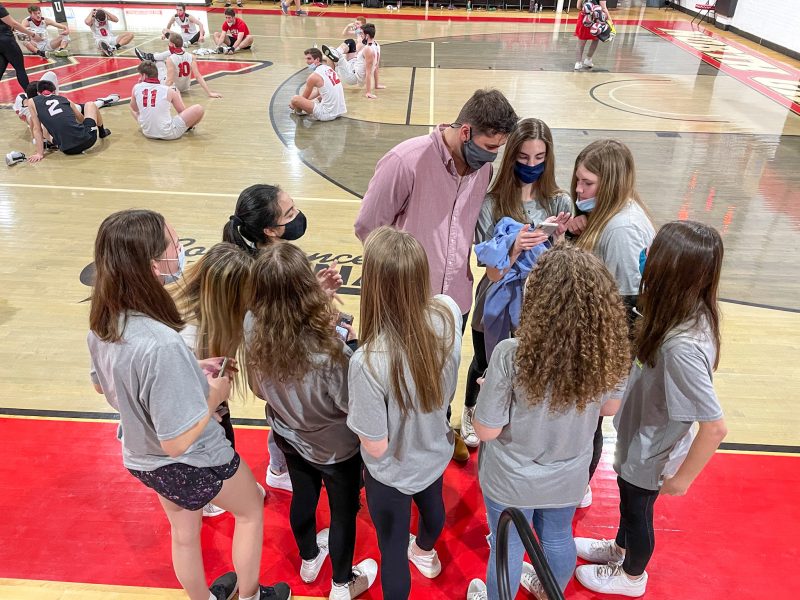
At one point, they were discussing the other team with coach M. “I liked number 10,” one girl said.

“Really?” coach asked incredulously. “He was terrible.”

“I’m talking about looks, coach,” she clarified.

“I was not part of the conversation,” the Girl clarified when I related it to K.

(I also didn’t take the pictures…)

 

In Which the Teacher Screws Up

Last Thursday, the kids had an e-learning day as the whole district took a day off for teachers to get vaccinated. I gave the students the following work:

So many issues with this. First of all, the time I was supposed to be online (and therefore the time students were expecting me) was 9:00-9:30. When I got online at 9:30, everyone was leaving. How did I look at the school schedule and think I was supposed to be online during math teachers’ time? Oh well — it was no big deal.

The real problem, though — did you notice that fourth point? “Read chapters 13-16 by Wednesday.” But on Wednesday to have them read by Monday. So when I began class today ready to work with chapters 13-16 of To Kill a Mockingbird, a substantial number of students hadn’t done the reading.

“You said on Classroom to have it done by Wednesday,” a sweet and honest girl said. She offered me her Chromebook with the assignment pulled up: “See?”

I stood there, looking at the clear evidence I’d screwed up, wondering what happened (I just mixed up the chapters — it should have been chapters 17-20 for Wednesday), and wondering if there was any way to salvage the day.

“Reading day.”

“Seriously?” they asked incredulously.

What else was I to do?

The End

Every now and then, I learn something so profound that it marks a significant change in my thinking. The last two days have constituted such a change. I listened to Josh Clark’s podcast The End of the World, and I can’t remember anything having a more profound effect on me. Not the realization that I doubted the existence of God; not the change I made from being very left-leaning to being right-leaning and the return to the left I seem to be experiencing now; not the knowledge that I was going to be a parent.

The podcast deals with how the world might end, and by that it means how humanity might end. The world itself might continue on but humanity might not. And the podcast begins with an odd question: given the size of the universe, the number of galaxies it contains, and the number of stars in those galaxies, the universe should be absolutely teeming with life. We’re talking about billions upon billions of galaxies each with billions of stars. Even if the odds of developing intelligent life were a 1-in-100-billion, there should be almost countless examples in the universe. So why have we found no sign of them? That’s the Fermi paradox, and it is the material for the first couple of episodes. The fact that we see no signs of intelligent life anywhere has one of two explanations:

  1. It exists, and we simply haven’t found it.
  2. It doesn’t exist currently, and we alone constitute all the intelligent life in the universe.

Option one is the less interesting of the two, but Clark convincingly illustrates that it’s unlikely. It’s the second option that is terrifying, because it breaks into two options itself:

  1. There never was any other intelligent life — we’re it.
  2. There was once intelligent life somewhere in the universe, but it no longer exists.

Thinking about option two leads us to question what could have happened to them? Presumably, they advanced at least as far as we have, and presumably, they would have advanced further if they could, spreading out into the cosmos and colonizing their solar system, their galaxy, significant portions of the universe itself. That they didn’t suggests that they never existed (back to option one) or that they met an insurmountable obstacle that resulted in the end of their existence. This is known as the Great Filter — in this case, the thing that prevented a given alien species from colonizing beyond its original planet.

What does all of this have to do with the end of the world? Simple: due to the technologies we have developed now, we are almost certainly about to pass through our own Great Filter. There are so many threats to the continued existence of humanity that it seems inevitable that one of them will catch us by the ankle, so to speak, and drag us back down to primordial sludge (or nothingness). Clark covers several of them, including artificial intelligence, biotechnology, and physics experiments, but in my mind (and in Clark’s as well, I believe), the greatest risk comes from artificial intelligence, though biotech is not far behind.

The risk from artificial intelligence is not a Terminator- or Matrix-style war between robots and humans. It’s something much more subtle. Imagine, for example, that a paperclip factory hires a programmer to create a program to maximize paperclip production. The programmer creates algorithms that have the freedom to make their own decisions about how to go about the productivity improvements. Its goal is simple: create more paperclips. Should it attain super-intelligence, it could wreck the world in its effort to make more paperclips. It takes over other computers in order to increase its computational capacity to make more paperclips. It develops machines that make machines that make machines that make machines to improve paperclip production. Eventually, it learns how to create nanotechnology that can actually manipulate things at an atomic level. It can then literally begin the process of turning everything into paperclips, manipulating atoms to transform everything into aluminum to make paperclips — everything, including us. It then launches probes into space and eventually turns the whole universe into paperclips.

It’s hyperbolic and a little silly, but it gets at the heart of the concern: once AI achieves super-intelligence, it will be to us as Einstein is to an earthworm. There are no guarantees that it will have any concern with us at all. After all, could we expect Einstein to spend his tremendous intellect and life worrying about the happiness of every earthworm? So we have to figure out a way to program these things in a way that they have morals compatible with ours.

The biotech and physics experiment risks are equally fascinating, but it was about this point in the podcast (this would have been episode five out of eight) that I began thinking of how any one of these might be our Great Filter — the thing that we run up against which destroys us — in terms that Clark never mentioned: the impact of religion on all of this. Most believers would not take this seriously at all because they already are convinced that there’s intelligent life out there, and it’s responsible for our existence and has a plan for us. That plan doesn’t include us destroying ourselves, so they would be unlikely to take this situation seriously. “Eradicate ourselves from the earth? Come on — Jesus will return before that could ever happen.” God would never let the pinnacle of his creation destroy itself entirely. This is in part why so many Christians don’t take global warming seriously (and after listening to this series, I’m of the mind that global warming, while a threat, is at least not an existential threat to all humanity).

This itself could be the Great Filter: time after time, intelligent life has arisen that evolves tremendous intelligence at the same time it holds radically superstitious ideas. At the point when the species has developed the technology capable of destroying itself, it harbors the superstitious lack of wisdom to know how to handle those technologies, and they destroy themselves.

Much of Clark’s podcast was on the foundation of Nick Bostrom’s work. He’s been thinking along these lines for a long time:

Games

The Boy had two soccer games today. His team won them both, but the second game was a real bruiser. The kids on the other team were much more aggressive than any other kids we’ve encountered. Fouls don’t occur in eight-year-old soccer, but these kids fouled. They pushed and shoved, getting very physical in almost all aspects of the game. Still, our boys managed to pull out a 3-1 win.

E didn’t play for most of the game, though. He went in for about the last three minutes of the second half. My understanding was that the coach let the bench decide: leave the kids in who were doing well or get subbed in. They decided to let the kids who were already doing so well continue doing so.

The Girl is with K outside of Atlanta for a volleyball tournament. Their team won the first two matches they played but lost the final match. They took one set, though, so that’s always some little bit of compensation.

Finally, the Boy played a little guitar tonight. He’s decided it’s time to get serious about his playing, so I printed him out a simple chord chart, and off we went.

Full Circle

A year after the first day of school in quarantine, I got my first dose of the vaccine. A local hospital and the county school system partnered in an impressively well-organized effort to get all teachers who wanted the vaccine vaccinated. The school system had a single-day e-learning break and transformed two high schools into mass-vaccination sites.

But the important part of the day was after everything was done, and the Boy and I headed out for some exploring.

The Slip

One thing I love about being a teacher is that I don’t have to know everything. “I don’t know” is a perfectly acceptable answer to a student’s question, and I’m not afraid to admit as much. I follow that admission with a promise to find out, or, in some situations, I suggest to the student to do a little research herself.

When you’re a priest leading who knows how many thousands of listeners through 365 days of Bible reading, you’re going to encounter some troubling passages. You’re probably going to do your best to explain them, and sometimes, the explanation might be reasonable. But statistically speaking, you will eventually say something that is so completely outrageous that you’d probably wish you hadn’t said it.

Today Fr. Mike had just such a day reading Numbers 31. It tells the story of God’s command to the Israelites to wipe the Midianites off the face of the earth. What was the Midianite crime? Well, they’d introduced the Israelites to the false god Baal, and the Israelites became so smitten with this new god that at least two of them conducted a fertility ritual in the Holy of Holies — the holiest place on Earth, Fr. Mike explained. It’s a troubling passage, and Fr. Mike struggles to explain it from God’s point of view:

You have to go to battle against the people who have already corrupted you. … You have already been corrupted, so you have to put an end to this. That’s one of the reasons why the warfare there is, like, ‘kill everybody,’ which is really hard for us. And it’s not because God wanted everyone to die. That is not the case. In fact, that kind of warfare would not have existed — this is important for us to understand — that kind of warfare would not have existed if the people of Israel had been faithful. This is so critical for us to note, that that is not the plan of God.

The first problem I have with this is that it’s almost as if Fr. Mike has forgotten the reading from just the other day from Deuteronomy 28.63:

And just as the Lord took delight in making you prosperous and numerous, so the Lord will take delight in bringing you to ruin and destruction; you shall be plucked off the land that you are entering to possess.

Killing and bringing things to ruin seem to be what this god enjoys, and he seems to boast about how much he enjoys it. How does Fr. Mike reconcile these two passages? Simple. He doesn’t. He probably didn’t even notice it.

Second, what about the responsibility of the Israelites? If they went astray, the Midianites certainly had something to do with it, but ultimately, it’s the Israelites who went astray, not the Midianites. Fr. Mike is essentially saying that they deserve total eradication because they tempted the Israelites to idolatry. But Fr. Mike tries to deal with this:

They are so weak that they worship other gods. It’s because of the people’s weakness that Moses has to command — and I say, ‘has to command’ because it’s just, like, no other way around their weakness than the kind of total destruction of the Midianites here. We’re going to see this warfare again and again. It can be troubling for us, and that’s okay that it’s troubling for us because it’s not good, right? It’s not good. It’s not what God would ultimately want.

There’s no other way around their weakness?! This is an omnipotent, omniscient god we’re supposedly talking about here. Surely he could figure out another way to deal with this that doesn’t involve wholesale slaughter. Hell, I’m just a stupid human, and I can probably come up with at least half a dozen other ways that don’t involve genocide.

It’s as if Fr. Mike’s version of the OT god is sitting up in heaven going, “Dang, I wish they hadn’t done that. I don’t know what I’ll do about it. Well, I can’t see any alternative to killing them all.” It’s ludicrous. But Fr. Mike doesn’t see the box he put this god into. He just has to explain it.

He can’t say, “I don’t know. I just don’t get it. It seems brutal, and I can’t really understand it myself.” That’s not an option if you approach the reading with an a priori assumption that this book is the perfect word of a perfect being. That assumption forces you into saying utterly stupid things like Fr. Mike.

There’s another little treasure in the reading that Fr. Mike didn’t mention: “Now therefore, kill every male among the little ones, and kill every woman who has known a man by sleeping with him. But all the young girls who have not known a man by sleeping with him, keep alive for yourselves” (Numbers 31.17). “Keep the virgins for yourself,” is what this god is saying.

In the Moment

The two girls were having an argument over how they were supposed to complete their homework. One girl insisted that they were supposed to write much more — much more — than I’d required. And she wrote much more. (That’s her in the upper left corner with the puffy jacket on, hair in a bun, looking down at her computer.)

“You know, H, I’m really going to miss you next year,” I said with a laugh when we got everything cleared up. “You’re the type of kid who never takes the easy way out, and that’s going to serve you well as an adult.” She smiled a little (or so it appeared — it’s hard to tell with masks on), thanked me, and headed back to her seat, shooting playful daggers at the girl she’d been arguing with and jokingly hissing, “See? I told you!”

Fear and Trembling

Today’s reading included Deuteronomy 28, which is about the blessings and curses that God offered (for lack of a better term) the Israelites. I guess you could say they constituted the terms of the contract. It begins,

If you will only obey the Lord your God, by diligently observing all his commandments that I am commanding you today, the Lord your God will set you high above all the nations of the earth; all these blessings shall come upon you and overtake you, if you obey the Lord your God

Right away, I noticed how this seems to be such conditional acceptance. Fr. Mike argued that this was simply the same as parents do (laying out consequences for actions), but I beg to differ. The consequences are quite harsh, including this gem from verses 54 and 55:

Even the most refined and gentle of men among you will begrudge food to his own brother, to the wife whom he embraces, and to the last of his remaining children, giving to none of them any of the flesh of his children whom he is eating, because nothing else remains to him, in the desperate straits to which the enemy siege will reduce you in all your towns

It’s not the first time God has threatened his people with conditions that induce them to cannibalism, but this one notches it up a level somehow. It’s not that they’ll eat each others’ children; they’ll eat their own children and not even share! That sounds like I’m being flippant, and I guess I am — I don’t know how else to react to this but mock the brutal stupidity of it. A god that threatens to do this is somehow good?

Verse 63 states that not only will God do this, he’ll enjoy doing it:

And just as the Lord took delight in making you prosperous and numerous, so the Lord will take delight in bringing you to ruin and destruction; you shall be plucked off the land that you are entering to possess.

What does Fr. Mike say about these troubling passages? Not a single word. Why? There’s nothing he can say. There’s no way to excuse it. (I sound like a broken record, but I want to keep an account of all these issues that arise, and this silly blog is the easiest way to do it.)

Finally, though a little earlier (verses 58 and 59) there’s this gem:

If you do not diligently observe all the words of this law that are written in this book, fearing this glorious and awesome name, the Lord your God, then the Lord will overwhelm both you and your offspring with severe and lasting afflictions and grievous and lasting maladies.

I don’t get this desire to be feared and worshiped. It feels a little like what a despot would want. It feels like it could come from Kim Jong-Un more than an omnipotent, omniscient being.


First Spring Sunday 2021

We are creatures of habit and ritual, and I am a blogger of habit and ritual for constantly pointing that out. But sometimes rituals fall away, replaced by others as we outgrow them or simply lose interest in them.

Exploring up the creek, trying to catch minnows, talking about snakes and snapping turtles — these used to be nearly daily events in the spring and summer. Last year, though, the Boy and I didn’t go out to the creek all that often.

But once we establish rituals, they seem to bubble up again from seemingly nowhere. Today, with his friend N over for a visit, the Boy regained his interest in the creek.

They caught minnows and crawdads, talked about the possibility of seeing a snake, discussed where the snapping turtles might be.

And spent a lot of time looking into the net to see what they’d scooped up.


lot of time looking into the net.

First Spring Saturday of 2021

We had to be on the soccer field at 8:15 in order to warm up for the 8:45 game. That meant leaving before eight, which we didn’t accomplish, which is why we were late.

We finished the game (we won 3-1 — glad the opposing team got a goal as it’s always disheartening to be blanked) and headed to his scout den’s morning fishing trip.

After lunch, it was time for chores — trimming the crape myrtles in the front.

Nothing left to do but light the cigar and play some chess.

More Fr. Mike

We’ve been going through a rough stage with Fr. Mike. It’s stoning, stoning, stoning. I finally got sick of screaming into the wind and joined a discussion group to talk about it.

I struggle greatly with all these passages about stoning. Why would God command such a brutal and barbaric method of execution? I wish Fr. Mike would address that. Thoughts?

People responded, but they tended to be the same thing. Later, more stoning, so I posted again:

Today’s reading was the most shocking thing I’ve ever encountered in the Bible. Stoning your own children because they’re incorrigible?! Does anyone really think there’s any way to defend this command? I think this is the last straw for me.

I’ve heard the same argument so many times now that it’s almost predictable: “But God was dealing with barbaric people in barbaric times.” It’s the justification believers make for the barbaric passages in the Old Testament that so upset our modern moral sensibility. People are commanded to stone rebellious children, stone people who break the sabbath (including a man who was simply picking up sticks), stone women who don’t scream when they’re raped, and genocides are demanded time after time. All those verbs were in passive voice to reflect what seems to be happening in believers’ brains. There is a strange bifurcation that happens that prevents believers from seeing what is startlingly incorrect in their argument.

Their suggestion is that we can’t judge these passages by modern standards because God was working with a barbaric and backward people. He was civilizing them step by step. This argument would be applicable if the passages in question read like this:

Now the Israelites sought a method of punishment for adultery, and they decided that stoning was an adequate deterrent. God saw these things and was displeased at their decisions but understood that it was an improvement over the barbarity they had been displaying. He said, “I will allow this for a time, but know that there are more humane ways of living. I wish to raise you to the highest moral standard, and you will not behave this way forever.”

In other words, it would work if these were acts of free will, acts the Israelites committed of their own volition, acts which God was simply allowing.

But they’re not.

These are God’s commands to the Israelites. These are God’s statutes, God’s requirements, and God’s prescribed punishments. This is God saying, “You shall do this.” What’s more, the god of the Old Testament says over and over that these commands to be kept in perpetuity.

And I’ve yet to see anyone really confront that directly.

Soccer

Today I got to watch E play soccer for CESA (Carolina Elite Soccer Academy) for the first time. His first game was a couple of weeks ago, but L and I were in Knoxville for a volleyball tournament. Last week’s game got rained out, so this was the first time I got to watch him play.

In the first half, he played for about half the time as a defensive player. He was a little less aggressive than some of the other boys, but he soon gained some confidence and went after the ball.

In the second half, the coach put him in as an offensive player. He had one break and pulled back for some odd reason, turning to look (or so it seemed to me) to see if he had any backup. But he was alone, and ahead of all the defenders.

I meant to talk to him about what happened, but we never did.

Five, Six, Pick Up Sticks

Today’s reading with Fr. Mike included Numbers 15, and if I’m writing about it, you can probably guess why: more brutality. Verses 32 through 36 read
When the Israelites were in the wilderness, they found a man gathering sticks on the sabbath day. Those who found him gathering sticks brought him to Moses, Aaron, and to the whole congregation. They put him in custody, because it was not clear what should be done to him. Then the Lord said to Moses, “The man shall be put to death; all the congregation shall stone him outside the camp.” The whole congregation brought him outside the camp and stoned him to death, just as the Lord had commanded Moses.

Fr. Mike knew that this was a troubling passage. I could hear it in his prayer after the final reading:

Father in heaven, we thank you for your word. We thank you for your scripture today. We thank you also for the great wisdom you give to us in helping us understand your word. Lord God, for all the times we are perplexed and troubled — not just perplexed but deeply troubled, even troubled in our heart by you, by your teaching, by what you reveal about yourself, we ask that you give us not only a, not only take away a spirit of skepticism or spirit of cynicism, but you give us a spirit of openness, a spirit of truth and of honesty. A spirit of trust that when we don’t understand, we ask. And when we still don’t understand, we continue to ask. Lord God, give us a spirit of trust. Give us a spirit that is open to whatever it is you will for us this day and every day.

What’s wrong with a spirit of skepticism? Shouldn’t we be skeptical about a great many things? Just look at the news — Qanon, claims of a stolen election, anti-vaxers. There’s plenty we should be skeptical of. Being skeptical just results from being a critical thinker, so I feel like Fr. Mike is asking his god to turn off our critical thinking faculties for this passage.

To his credit, Fr. Mike does try to explain things this time. In the past, he’s just glossed right over it, but he deals with the troubling passage this time:

Remember: the heart of these laws is that God has said, “No, you are my people.” He has set his love upon them. This is so important. These laws, the consequences of sin, the consequences of going against the Lord are so great that they shock us, right? Capital punishment as a violation of the sabbath. For picking up sticks, it says here in Numbers chapter 15.

Then he reviews the passage before continuing,

We can look at that, we can hear that and think, “That is, um, I don’t want to say crazy, but that is something we wouldn’t expect […] out of God’s law. Clearly it’s not something we would expect from the god that is mercy and love. How do we understand this?”

That’s exactly my point: it’s something we wouldn’t expect out of a God that is described as loving and merciful. How do we deal with that contradiction? There are a few options:

  1. Suggest that this is evidence that this god is not loving and merciful.
  2. Suggest that this god’s sense of love and mercy is conditional at best, barbaric at worst.
  3. Suggest that we might not understand it and move on.
  4. Suggest that it is indeed loving and merciful but that we simply don’t understand it.

“It can seem so extreme for us,” Fr. Mike admits, but he simply points out that there is a provision for those who do this unwillingly. They’re not to be executed. It’s only those who do so willingly, flagrantly — those who thumb their noses at this god’s commands. He then suggests that the third tithe

Third tithe mentioned in Deuteronomy 14 somehow makes up for it.

Every third year you shall bring out the full tithe of your produce for that year, and store it within your towns; the Levites, because they have no allotment or inheritance with you, as well as the resident aliens, the orphans, and the widows in your towns, may come and eat their fill so that the Lord your God may bless you in all the work that you undertake.

It can seem “schizophrenic” (his word), but he points out that it’s extremely generous and merciful to take care of widows. That’s what we’d expect from a god of love

I joined a FB group for this Bible in a Year reading plan and posted my concern: “I struggle greatly with all these passages about stoning. Why would God command such a brutal and barbaric method of execution? I wish Fr. Mike would address that. Thoughts?”

One person responded, “That’s what they could understand 3,500 years ago. You can’t read the Bible with a 21st Century lens.” I’ve heard that argument so many times, but I just don’t understand it. From a Christian perspective, if it’s wrong it’s because God says it’s wrong; so if it is wrong in 21st century, it had to be wrong in all time.

I took a slightly different argument in my response, though:

God is not just condoning this. He’s not looking down from heaven and saying, “Well, they’re stoning people now. That’s wrong. I’ll take care of that, but it will take time because they’re so backward now. By the 21st century they’ll have outgrown this.” He commanded it. It was his instruction. There are other ways to kill that they could have easily understood. They would understand, “Hey, don’t stone people. It’s brutal. It’s awful. To execute them, here are some herbs you mix in water. It’s painless and nearly instant.”

At this point, there are lots of likes for the response to my question, little acknowledgment of the content of what I asked. And I get if: I’m asking questions that challenge comfortable belief. I’m asking questions about one of the many things that led me away from belief. I can understand if no one wants to touch it.

Flat

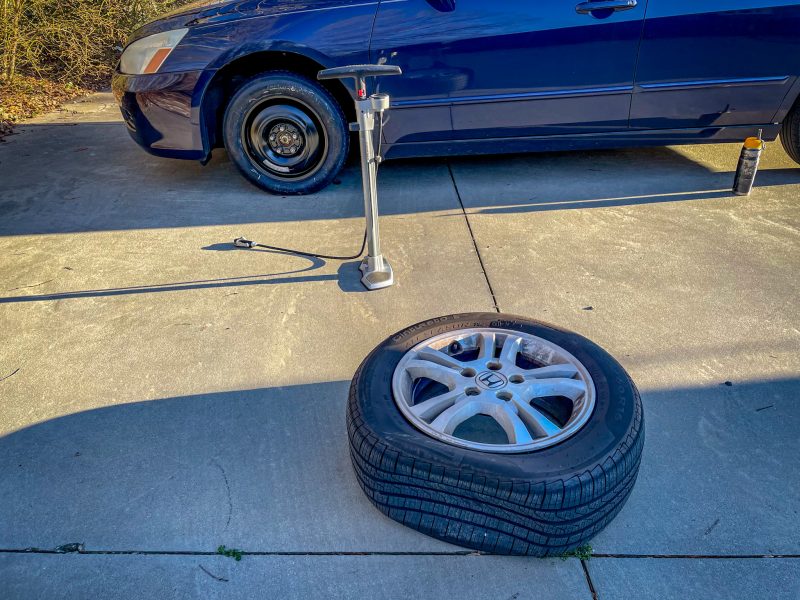
I came out this morning, cranked K’s car, walked around to my car ready to head to work when I saw I had a flat. Not just a tire with extremely low pressure — a tire with no air at all. It made for a rushed morning.

When I got home in the afternoon, my first priority was to get the flat off and the spare on. The spare had been in the trunk untouched since we bought the car. It had probably been untouched since the car rolled out of the dealership. And it was predictably flat as well.

One would think it’s a Monday…