g

Jacksonville: The Tournament

It was just a one-day tournament today, and it was a tough one for the girls: the heat combined with the wind off the ocean and its effect on the ball teamed up against them, making the girls feel it was one team against three.


It was tough, but I think, as I always suggest, that losing can be as important as winning — if it builds character.


Jacksonville Arrival

K and the kids headed to Jacksonville today for a beach volleyball tournament in which L will be playing tomorrow. They arrived, checked in, and headed straight to the beach.

Then had ice cream for dinner. Sounds like vacation…

The Ball

L’s school had the eighth-grade ball this evening.

Social Media Theology

I’m scrolling through a social media group dedicated to the Bible in a Year program with Fr. Mike when I see a post that took me aback:

This seems to be a parody caption put under a Family Circus cartoon. I suspect this because:

  1. Family Circus is a fairly pro-Christian cartoon, and this particular cartoon is pointing out the circular logic and near-absurdity of the Christian idea of salvation and
  2. It seems like the font just doesn’t fit the rest of the cartoon.

I recall when I expressed my own doubts how I was attacked and lambasted when, instead of accepting the offered explanations serenely, I replied the rebuttals I’d thought of long ago.

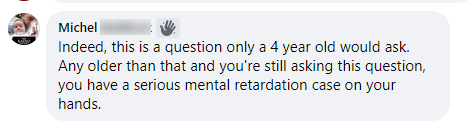
Michel, as if on cue, enters with a classic ad hominem argument.

I try to keep quiet, but I can’t: “An ad hominem argument from an apologist is always effective.”

Yet one person doesn’t see it that way:

How to interpret this? A misunderstanding or the dawning of doubt? Probably the former. But I was curious how they would respond to this ineloquent way of explaining a weird little knot of contradiction that lies at the heart of Christianity, all complicated further by the doctrine of the trinity.

The basic idea is this: Christianity teaches that Jesus had to die in order to make humanity right with God somehow. Through the “stain of Original Sin,” humans are separated from God, and to bridge this separation required a sacrifice. But only a pure and unblemished sacrifice would do the trick because God is completely holy. So God sent “his only begotten son” down to die a horrid death he didn’t deserve because he lived a perfect and sinless life, thus serving as the sacrifice that makes all good with God. God did this because he loves humanity and wants humans to spend eternity with him, but the sinful nature of humans prevents this. He’s perfect; we’re not. He can’t be around the imperfect, so there must be some way of atoning for those imperfections. (I probably didn’t explain that well because there are a million different interpretations on what exactly Jesus’s sacrifice accomplishes depending on the denomination of the apologist. I know for a fact that I mixed and matched several different explanations of what Jesus’s sacrifice, in the eyes of believers, really does, but that’s kind of the point. They can’t even agree on what’s going on here.)

The first problem with this comes when we consider the supposed omnipotence of God. If God is all-powerful, why not just forgive and welcome everyone back into the fold? Why all this song and dance about Jesus? What’s more, if you don’t believe this and accept it, it’s back to square one with you: you’ll remain forever separated from God, destined for the eternal firy torments of hell. (Never mind for a moment the painfully obvious question: why would a being who is even vaguely decent let alone completely benevolent like Christians teach their god is send anyone to eternal punishment for anything?)

The biggest problem comes when we mix the trinity into all this. Because God and Jesus are the same entity (as well as the Holy Spirit — never mind how that seems to make no sense in and of itself), we can replace all those instances of “Jesus” with the more generic “God.” That shows the absurdity of it clearly. God is doing the sending and is sent. God is doing the condemning and the restitution. God is sending God to die to satisfy God’s demand of punishment for humanity’s disobedience of God. What kind of sense does that make at all? Skip all the middle man stuff and just forgive humanity.

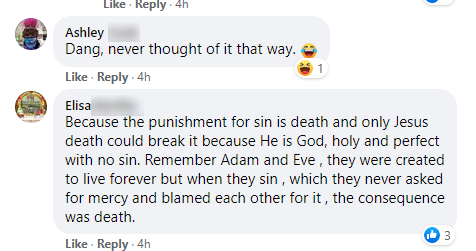
That’s what the cartoon is highlighting. The poster’s comment of “I’ve wondered about this too” as well as Ashely’s admission that she “never thought of it that way” with a smiley face indicates that the circular logic breaks through to others’ thinking for just a brief moment.

Others jump in quickly, though, trying to explain why Jesus had, in Christian theology, to die.

Elisa’s contention is that Jesus could only “break” (not sure what that means) “the punishment for sin” by dying because “He is God, holy and perfect with no sin.” Yet this doesn’t get at the heart of the objection in the cartoon, which is that an omnipotent God shouldn’t have to go through all this rigamarole to forgive people: if he’s omnipotent, he just forgives them. End of story. This suggests that Elisa doesn’t really grasp the underlying objection.

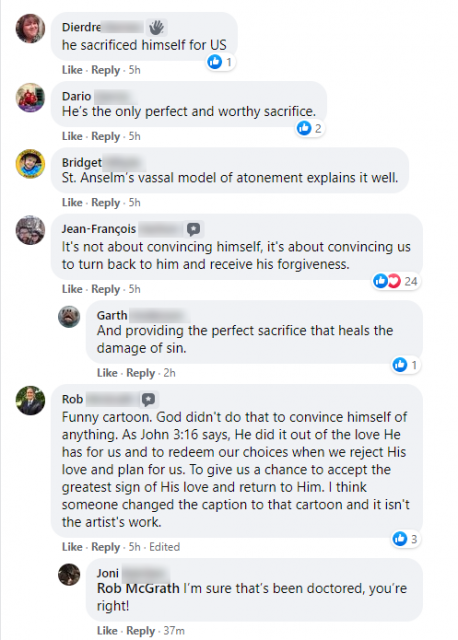
Others’ explanations show the same lack of understanding:

They all turn back to the same explanation I butchered above. Sin separates us. God loves us. God wants to bridge that gap. So on and so forth.

It is at this point that I jump in:

Granted, it’s not “leading me out of the church.” It and countless other objections have already done that. I just don’t want to sound like an aggressive outsider. I want to see how they’ll respond.

Bishop Barron’s sermon that Jan links to just reiterates how God is love and that’s why he died for us. It doesn’t answer the question of why he couldn’t just forgive outright.

Jullian rightly points out that “this is not how the Catholic Church understands salvation.” He correctly admits that it’s “a caricature.” But that’s the point. Caricatures by design highlight the absurdity of something to bring it in sharp relief. To make it stand out.

What’s more interesting about Jullian’s response is that “most people here aren’t priests or theologians” who would be “able to answer such a central question properly.” That raises an objection in and of itself. Why would an omnipotent god create such a convoluted system of salvation that only a specialist with years of theological study behind him (and remember that theologians don’t really study God but simply study what other men have said about God) could answer?

Finally, Margaret calls a spade a spade:

Mary-Ann, the post author, quickly reassures everyone (and likely herself) of her undying faith

Finally, Dan tries to explain everything:

Dan’s first objection is in using the formulation “Why did God have to.” He didn’t even answer what’s behind the question: the notion is that without doing this, we can’t be with God. If that’s the case, and God wanted humans to be with him, then God did indeed have to do this.

Dan’s second objection comes from the confusion this creates regarding the trinity: it “collapses it down to a bizarre argument with ones [sic] self.” That is the point. In doing so, it highlights the absurdity of the doctrine of the trinity.

Dan’s third objection is with “just to.” I think that’s meant to highlight the fact that, if God is omnipotent, he should be able just to forgive humans our foibles and move on. It’s another reflection of the first objection, in other words.

He ends with Scott Hahn’s assertion that “Jesus paid a debt He didn’t owe because we owed a debt we couldn’t pay.” And we’re right back where we started.

All this simply confirms what I’ve come to realize over the last couple of years: most believers don’t seem to understand what’s at the heart of most skeptics’ objection to Christianity. Whether this is an inability to understand it because of their blind faith or an unwillingness to try because of a fear of the consequences, I don’t know. Of course, there are other explanations, and it’s likely the case that for most believers, it’s a mix of any and all of them.

But I see these problems. And I can’t unsee them.

Yearbooks

Today, we handed out yearbooks, and as we had an extended homeroom period, I let all the kids sign each others’ yearbooks.

This was always a fun but stressful time when I was a kid: you want to ask people to sign your yearbook and you don’t — what are they going to write? You want to sign other people’s yearbooks and you don’t — what are you going to write?

Memorial Day 2021

Nana died on Memorial Day in 2019, which was May 27 that year. This year, however, it’s four days later. So the two-year anniversary of her passing was on Thursday, but today was the day we felt it. We spent some time this morning at her grave, cleaning her bench/marker, reminescing.

We spent the evening with friends.

Sunday Ride and Party

The day began with a ride. It was unplanned in every way imaginable: we hadn’t planned on going for a ride today, and when we decided to go, we really didn’t make a plan where we would go. We simply got on our bikes and started riding. The only criterion: “I want to go somewhere we’ve never been,” the Boy said.

We started out going to a little neighborhood about two miles from our house that includes a really significant climb. When we finished, we were close to the back route that I take to work, which leads right by Nana’s and Papa’s old place.

“Want to ride to Nana’s and Papa’s old place?” I suggested.

“Sure.”

And so we headed over to the old townhouse. We explored here and there coming back, and in the end, discovered we’d been gone for two hours and had ridden over 27 kilometers.

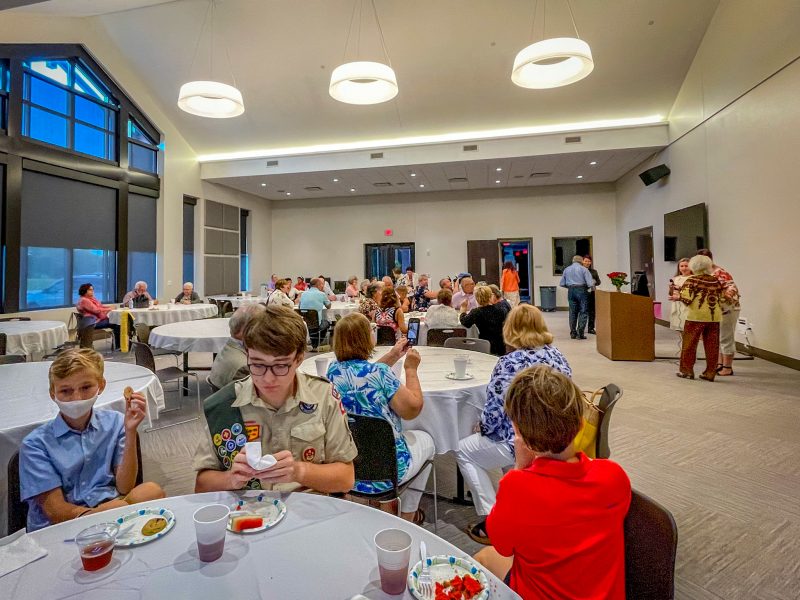
In the afternoon, we went to Polish Mass. After this particular Mass, though, the Polish community gathered for the first time for a little socializing.

The mothers got roses for Polish Mother’s Day, which was this week.

And naturally, there were speeches and singing.

I’ve said it often before: you can’t get a bunch of Poles together and not expect a speech.

Letters

At the end of every school year, I have students write letters to the rising eighth graders who will have me in English.

“Don’t lie, and don’t exaggerate too much,” I tell them, “but I want you to give them advice and scare them. Just a bit.”

I also use excerpts from these letters on my class website, Our English Class.

Some of the excerpts I selected:

  • The Dreaded Mr. Scott is an extraordinary teacher and will become one of your favorite teachers this year but his work is no easy walk through the park. It will be difficult and really make you think. This class is not like any class you’ve ever had before. But at the end you will feel ready and prepared for what comes next, high school.
  • Mr. Scott’s class is made for those who like and can put up with everyday disasters.
  • Mr. Scott has impossibly hard standards, but he is there to help you meet those high expectations. This will probably be one of the most difficult classes that you will take throughout your education, but Mr. Scott is there to assist you along the way. He is one of the best teachers that you will ever have, and his class will thoroughly prepare you for high school.
  • Mr. Scott is arguably one of the most difficult teachers you will have, partly because of his high expectations and teaching style. Mr. Scott will always expect the best from you, and will accept nothing less.
  • This class that you have joined, can and most likely will be the toughest class you will ever take in middle school, but, it will teach you some of the most valuable lessons in writing and literature you will ever encounter.

To read these things makes me feel that I finally have reached the goal as a teacher I have always sought: to be demanding but fair; to be challenging but just.

Awards Night 2021

It’s been two years since our school held an awards night. This year we held a drive-by awards night.

Backstroke

The swim team worked on backstroke today. The Boy was fairly confident that he’d mastered backstroke until he had to swim a full 25-yard lap of it.

He struggled. Mightily.

And then they had to swim back.

And then they repeated it.

By the last lap, each stroke was little more than plopping his arm behind his head and pulling a little bit. It was heartbreaking to watch because he was so far behind everyone else. He’d do a couple of strokes, stop, and turn around to see where he was. Then he’d repeat it.

But he never stopped. He never gave up. He kept plugging away at it until he’d made it to the wall.

“Work on backstroke” I added to my list of notes for when we go to the pool as a family for the first time.

Swim Team

E has joined a swim team at a local pool, primarily because his three best buddies from school have joined the same team. I am naturally thrilled because competitive swimming was an important part of my life. I began swimming competitively in elementary school when I competed for the small community pool to which we belonged.

In high school, the swim team was my only athletic endeavor. I certainly would not have gone out for football or basketball, and while I ran track during my freshman year, an awful case of tendonitis made running more than a quarter of a mile excruciatingly painful: I quit after the first year. But swimming had always been kind to me, and even though I was always mildly frustrated that the swim team never got the kind of recognition that the basketball, football, or even baseball teams received, I would have continued swimming competitively even if the other swimmers and I were the only ones in the pool.


It’s not that I wanted to be seen as a jock — certainly not — but a little recognition for the amount of work we put into our sport would have been nice, I thought.  We did have one occasion to bask in a little attention. It was during my junior or senior year, and the head swim coach arranged for some of the cheerleaders to come to support us. A cheerleader stood behind the starting blocks for the home swimmers and cheered us on from there. That I can’t remember whether it was my junior or senior year and that I am only partially certain they were standing behind the starting blocks to cheer us on (that just doesn’t seem right) show how relatively insignificant the event was for me, so I suppose I really didn’t care that much about that recognition.


For the most part, what I liked about swimming was its solitary nature. Except for relay events, swimming was just the swimmer in the water. Everything else seemed to dissolve into the muffled yelling of the few spectators — mainly parents, boyfriends, and girlfriends — who came out to support the team. To train or to compete, we didn’t need anything other than a body of water.

I also found that training had a certain meditative quality to it: back and forth and back and forth. One two three breath; one two three breath; one two three breath. Count the strokes in each lap. Count the breaths in each lap. Get a song going in your head and just let it run in cycles. I lost myself in swimming many times.

The Boy, though, is just beginning. He doesn’t have a good breathing pattern. He takes as many strokes as he can and then pulls his whole head out of the water to gulp air for a few seconds, then plunges his head back under and goes at it again. There are so many kid on the team (probably close to 30) that I doubt he’ll get much one-on-one stroke help, so I’ll have to do that as soon as school is out, and we start heading to the pool together on a regular basis.

He also stops swimming when he gets too tired. That means he swims the first length entirely. In the second length, he stops at the 15-foot red markers. After a few more lengths, he’s stopping almost midway.

“That’s when you’ve really got to push it,” I tell him. “You’ve got to ignore that pain and push through it. That is how you get stronger.”

It looks like we’ve got a summer goal cut out for us.

Treasures

I’m not sure how it happened, but everyone — L, E, and K — took turns going through Nana’s old jewelry. It’s been stowed away in Papa’s room since they moved in two years ago, and I think it’s only now that they’ve gone through it.

Crossing Over

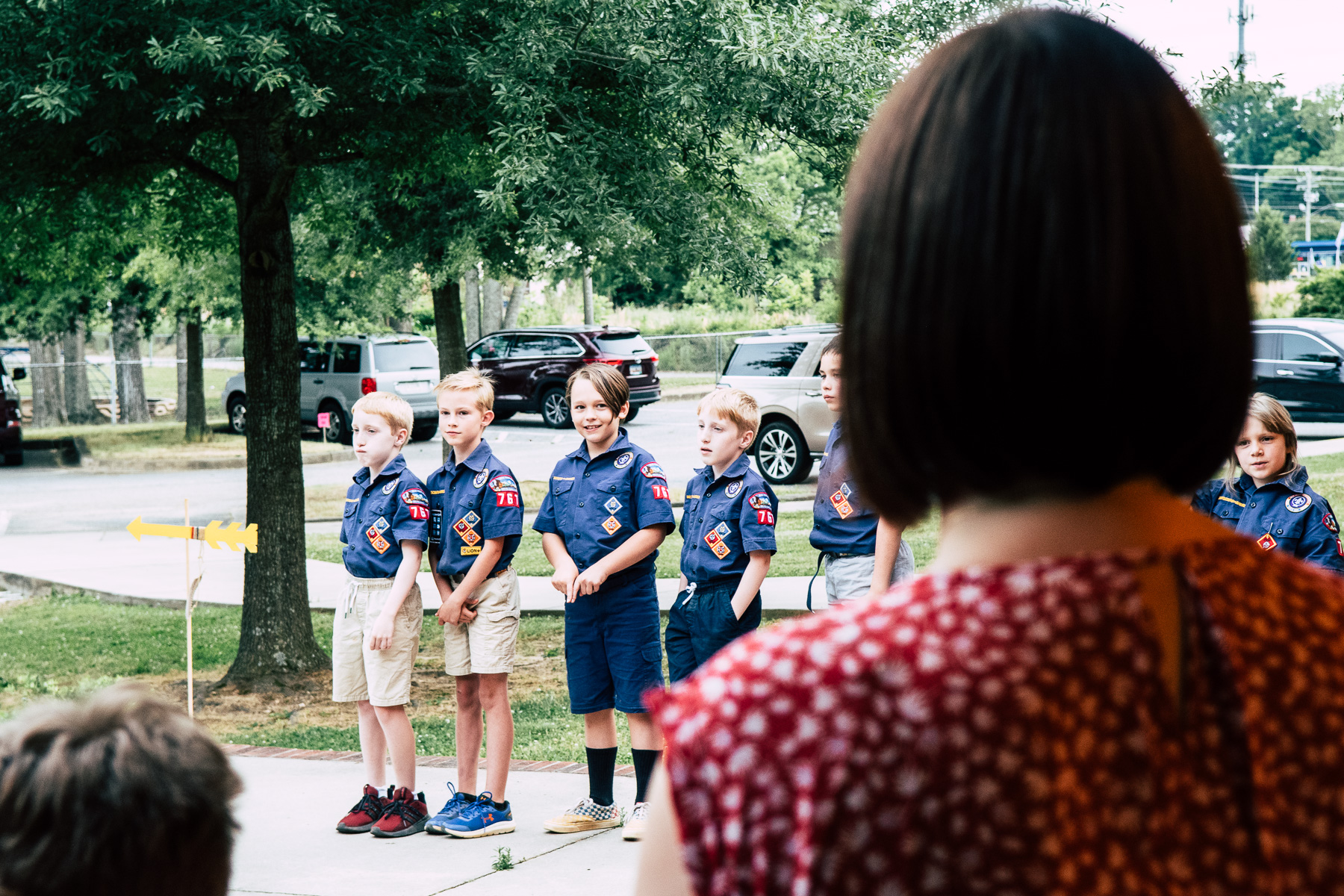
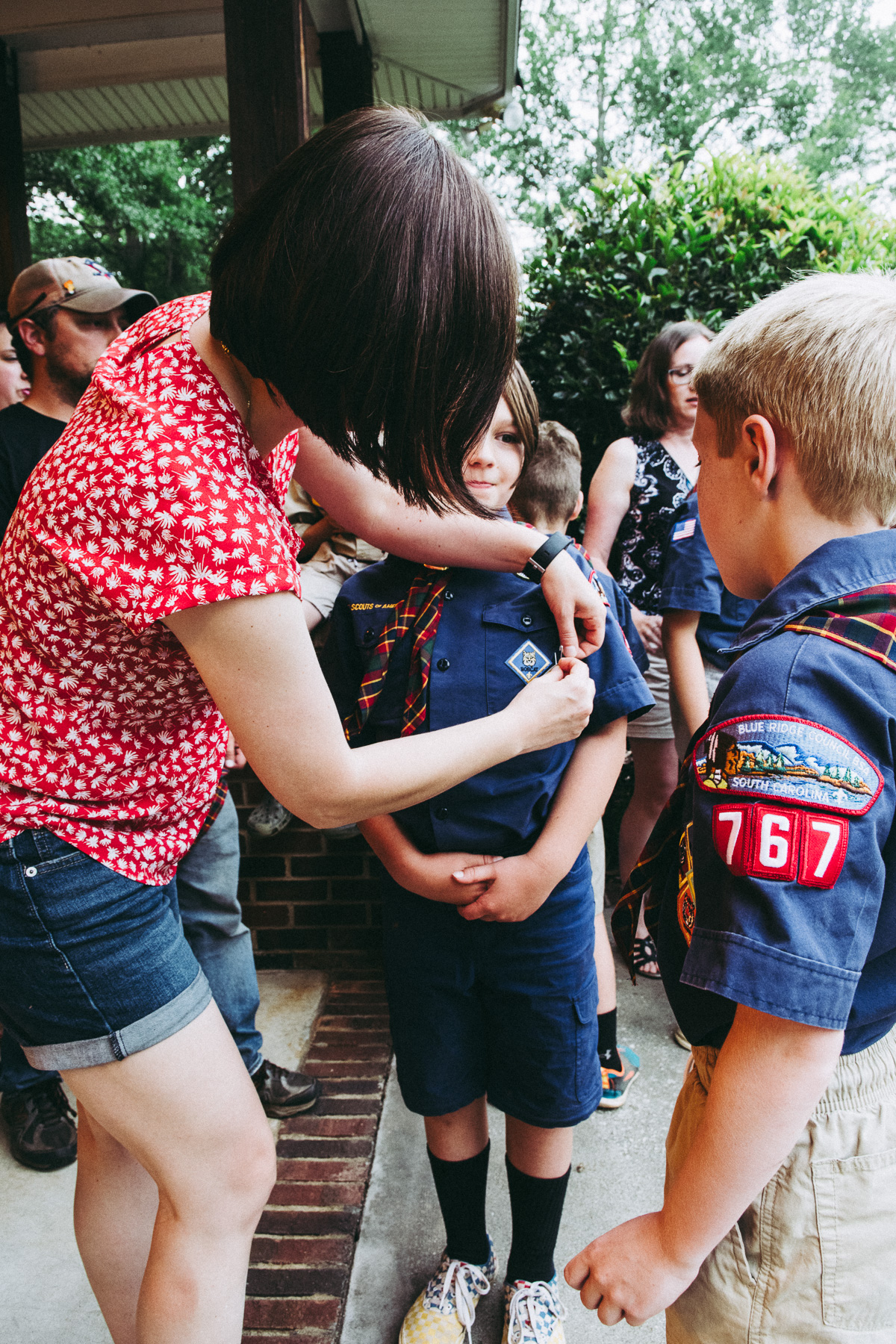
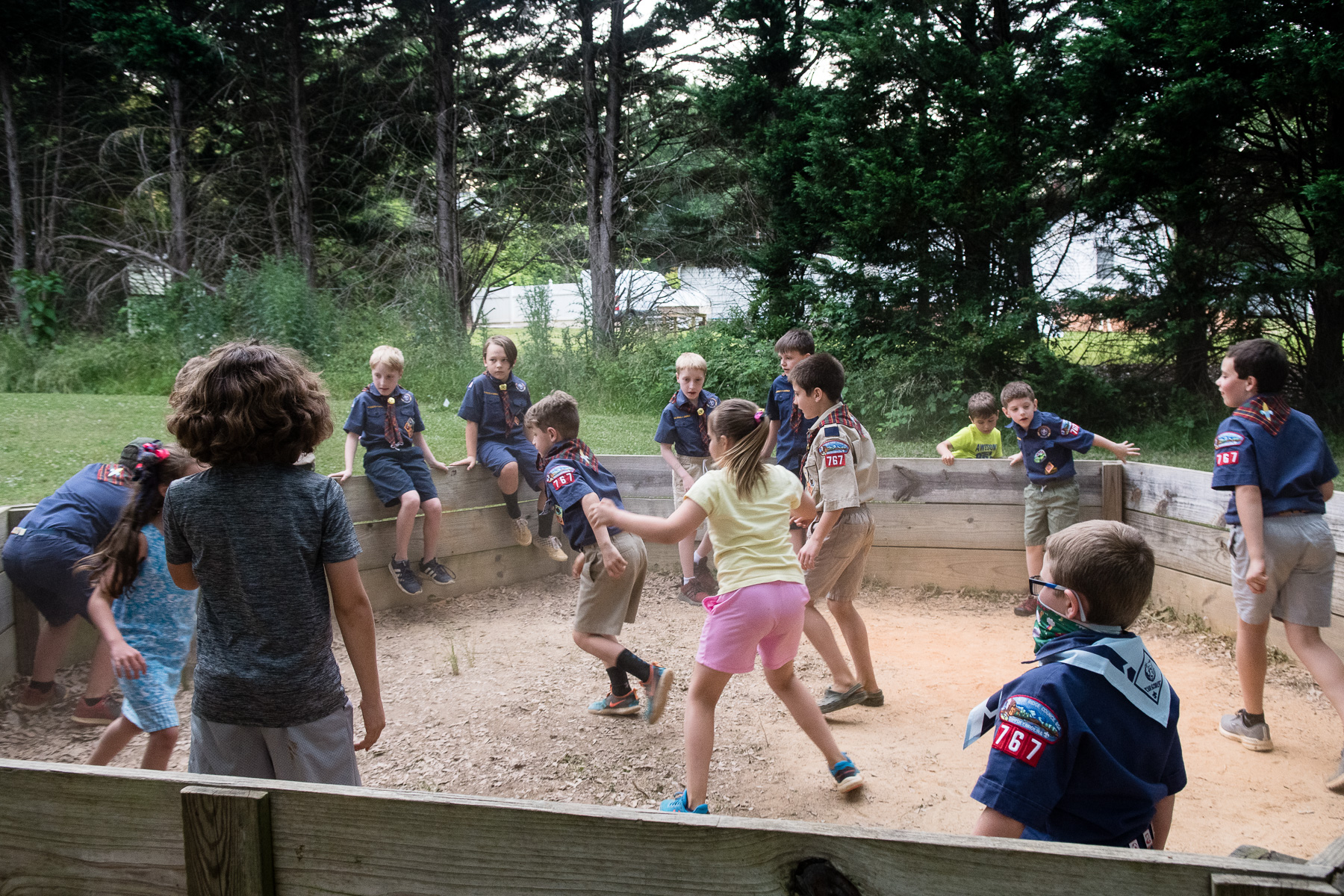
The Boy returned to scouting this year after a year’s absence (or was it two?), this time joining a troop that includes his three best friends from school. He moved from Bear to WEBELOS (We’ll Be Loyal Scouts).

It was a strange scouting year, an abbreviated scouting year, due to covid, but we made it through, learned a thing or two, and most importantly, strengthened friendships.

Diagramming

As our last group of starters, we began some sentence diagramming today. Most classes spent about 15 minutes on it before moving to Great Expectations character presentations.

In school, I always felt a little like a freak because while everyone else was complaining about diagramming sentences in school, I enjoyed it. Taking a jumble of words and placing each one in its own slot to indicate its precise function in the sentence felt like drawing meaning and order out of what would otherwise be near chaos. Sentences are a jumble of words that we comprehend without giving it much thought (if we’re fluent), yet within that apparent jumble is a simplicity that we can demonstrate graphically, even if it is a bit tricky to find that order for some sentences. Other kids groaned and complained about it, but for me, each sentence I had to diagram was a little puzzle I could crawl inside with a tool belt and take the whole thing apart as if it were a toy the inner workings of which had entranced me for ages. I knew, though, that I could put the sentence all back together, and I didn’t have that kind of assurance when pulling apart toys.

Yet even today, there are a number of sentences that flummox my diagramming ability. Look at that last sentence, for example. Had I not originally written “when I was pulling apart toys” I wouldn’t have seen the subtle, almost-hidden clause in the revised “when pulling apart toys.”

It’s these little idiosyncrasies of language that I hope to help students discover by going over sentence diagramming with them as a starter these final days.

Sports Banquet

The Girl gets some recognition: “This person almost won [the most improved] award in tryouts.”

Back to BIAY

Although I haven’t listened to a Bible in a Year podcast in over a month now, I’m still following a couple of groups on social media. Every now and then, I’ll see something that interests me: someone expresses a doubt or a worry, and I immediately begin listing the ways people will try to help. Sometimes, I make my own comment.

Today I read,

Although I had a lot of children’s bibles growing up, went to catholic school, and go to Sunday church so I know the stories of the Bible for the most part – this is my first time really “reading” the Bible all the way through with BIAY.

And honestly – I’m struggling. Every day it just seems like one depressing story after the next. Every day it’s just horrifying tales, little Joy, and lists of names. Men being awful and women’s lives being ruined. […]

I decided to use the line of reasoning that’s not entirely true at this point in time but was true some months ago:

I had similar problems. So much of the awfulness comes with God’s tacit approval or, worse, at his command. I’ve taken a break, but it’s done serious damage to my faith.

Granted, I’ve rejected faith altogether (again), but I did go through this process. I was wondering (again) how people would respond. Typically, there are a few responses to “Oh, that gory stuff in the Old Testament is troublesome.”

  • It’s for the Israelites, not for all of us.
  • Just because it’s in the Bible doesn’t mean God approves of it.
  • God in the Old Testament is slowing bringing about moral change. It’s a slow, gradual process. These are the first steps.
  • God said to do it, so it is right. Who are you to judge God?

Eric jumped right in with the tried and true “just because it’s in the Bible doesn’t mean acceptance” argument, almost word for word:

Assuming the existence of tacit approval is a dangerous move to make. It assumes that because a bad thing is recounted, it is recounted with approval, but that’s just not how biblical texts are written. I’m sorry to hear your faith is wounded, but rest assured God does not approve of immoral actions, even when He brings good out of them.

This reply always frustrates me because it misses the point. I’m not saying that the immoral behavior of various characters is troubling: I’m saying the immoral actions and commands of God are troubling. I replied:

Just look at all the awful punishments he commanded. Look at the genocides he commanded. That goes well beyond tacit approval.

His response? The classic “God said to do it, so that makes it acceptable” line. He didn’t ask me directly “Who are you to judge God,” but it was implicit:

OK so for those, did people other than God make those commands, or was it God, who after all does decide, every day, who lives and who dies? If I commanded that, or my national leader, that would be wrong, but when God commands punishment of people that are very clearly morally in the wrong, isn’t that the one time it’s OK?

It’s important to point out that according to this theory, the only thing that Islamic suicide bombers got wrong was the god. The reasoning behind what they’re doing is sound: God commands it; that makes it right.

Still, I didn’t go that line. I simply asked, “To punish by stoning?”

At this point, Eva jumped in:

God had to do a cleansing, just as he will when Jesus comes again. After all the evil in the world God still gave his son for our salvation. How much more can we ask of God? The world is lucky God is making the decision not mortal man because I as a human would have given up on humans a long time ago.

“God had to do a cleansing” sounds an awful lot like “God had to do an ethnic cleansing,” and that’s because it’s exactly what he does in the Bible. He commands the Israelites to wipe out whole nations. The Bible says it’s because they’re so immoral, but that just sounds like propaganda to me. Add to it the fact that there’s no evidence any of this immorality that keeps appearing in apologist arguments (namely, that the Canaanites burned their children alive as offerings to Ba’al). There’s simply a claim in scripture, which sounds a lot like after-the-fact justification.

Eric also replied, using another of the popular arguments: it’s a gradual movement to a more moral society:

Remember that God was leading his people gradually to an end point. The original moral framework He gave was just the 10 commandments. But when Moses came down Mt. Sinai and the people had sinned, God gave more laws—a lot more. And those extra laws are the ones that contain more age-specific laws that we rightly shake our heads at today.

Jesus himself made this exact point when he said that Moses had allowed things like divorce, it was not b/c that’s how things should be, but b/c that’s what the people were capable of at the time, but it was not always so and hence that’s not the rule now. Laws and commands for a people in 1000BC were tailored by God for them at that time. They weren’t His vision for How Society Should Work; they part of a larger plan for guidance, so they only needed to be Better Than What Came Before. Case in point: the lex talionis “an eye for an eye”. This sounds terrible compared to today, but the comparison we should make is with what proceeded it. “An eye for an eye” was *limiting* revenge to something approaching proportionality. And so on with other decrees of the law of Moses. You absolutely have to judge them in comparison to the societies Israel was surrounded by.

I’m sorry, but stoning someone is not a moral step up from anything. I can’t think of anything that would rank below that. Still, it shows how people fall back on familiar tropes to justify the unjustifiable because the alternative (rejecting the Bible, even in part) is utterly unthinkable.