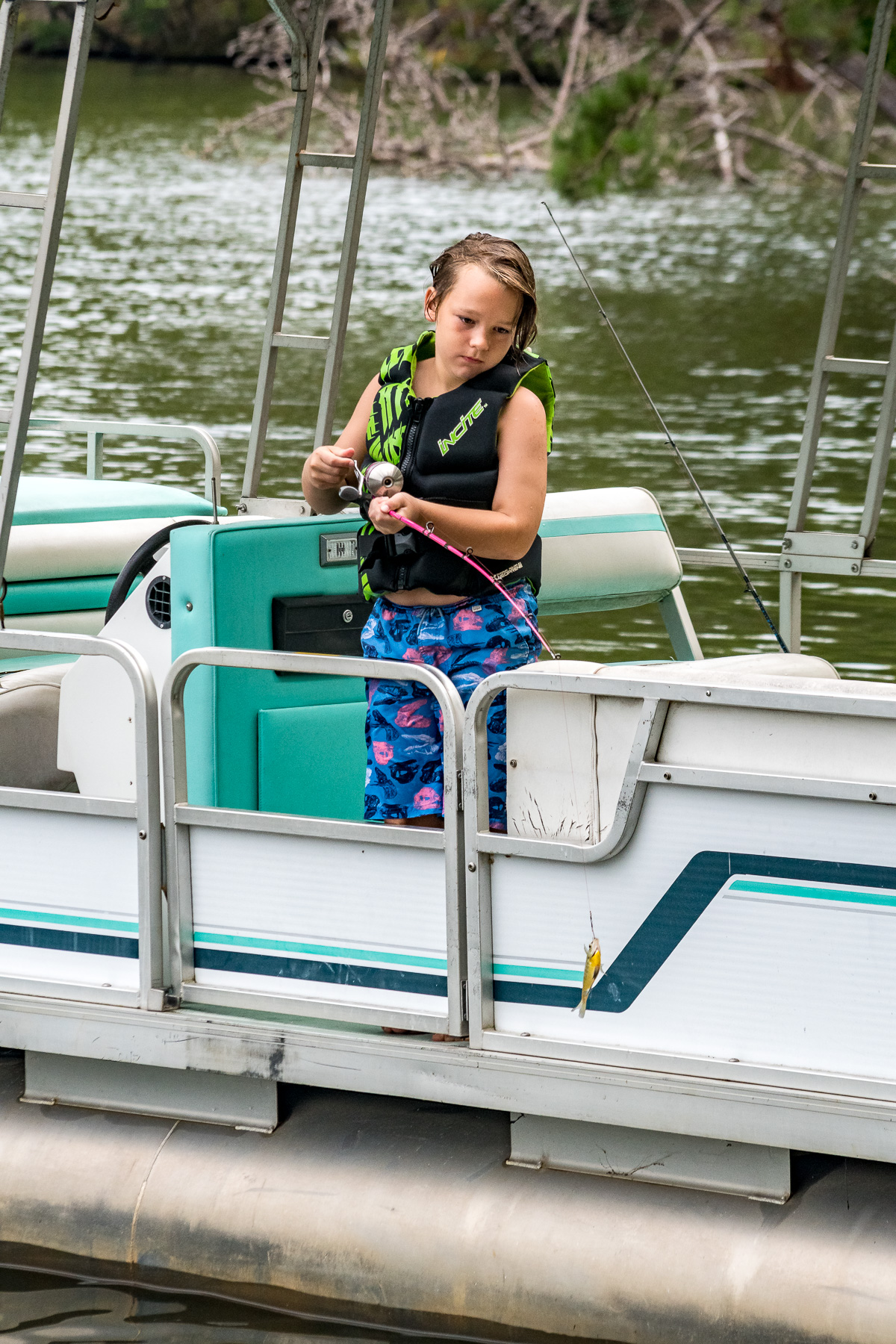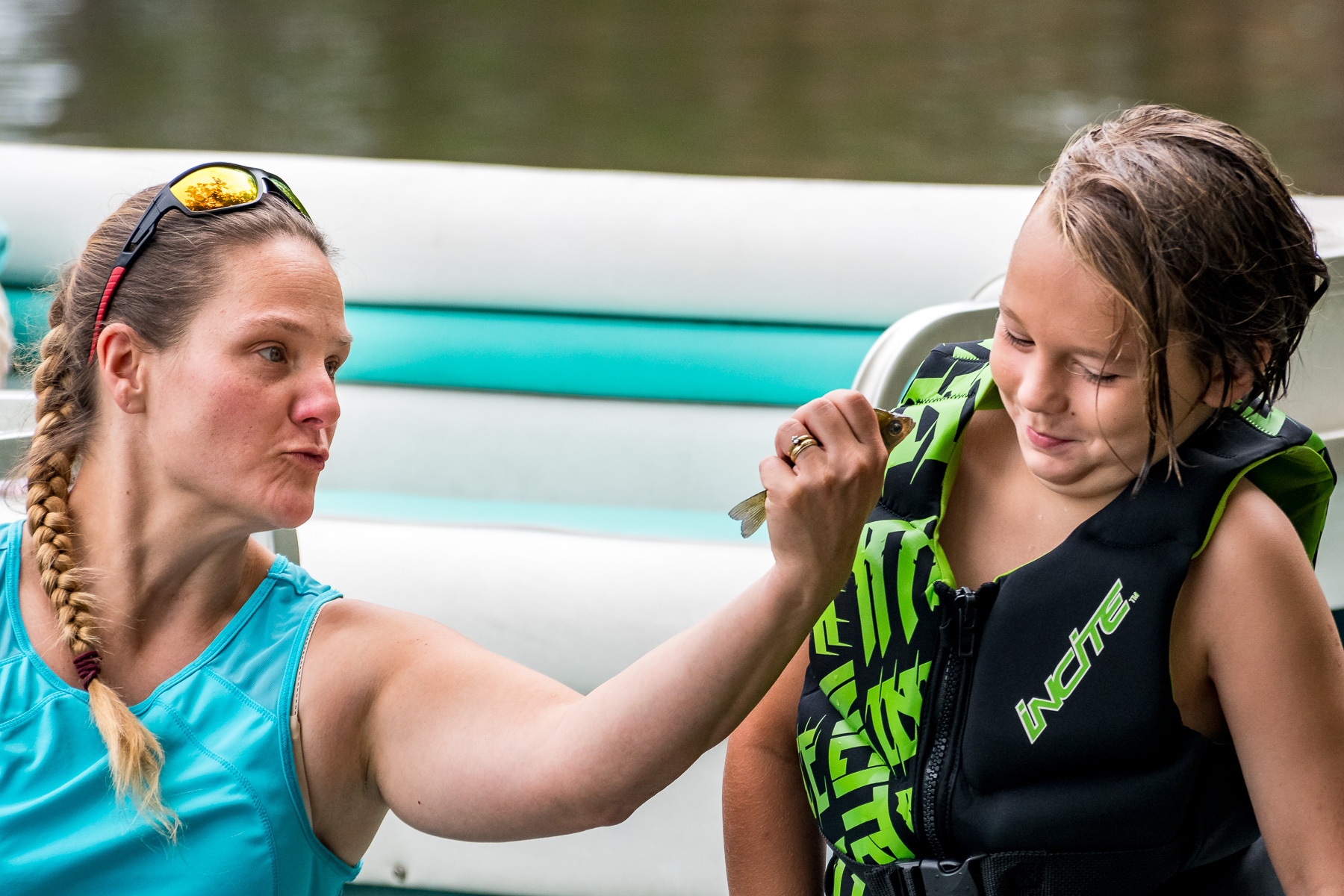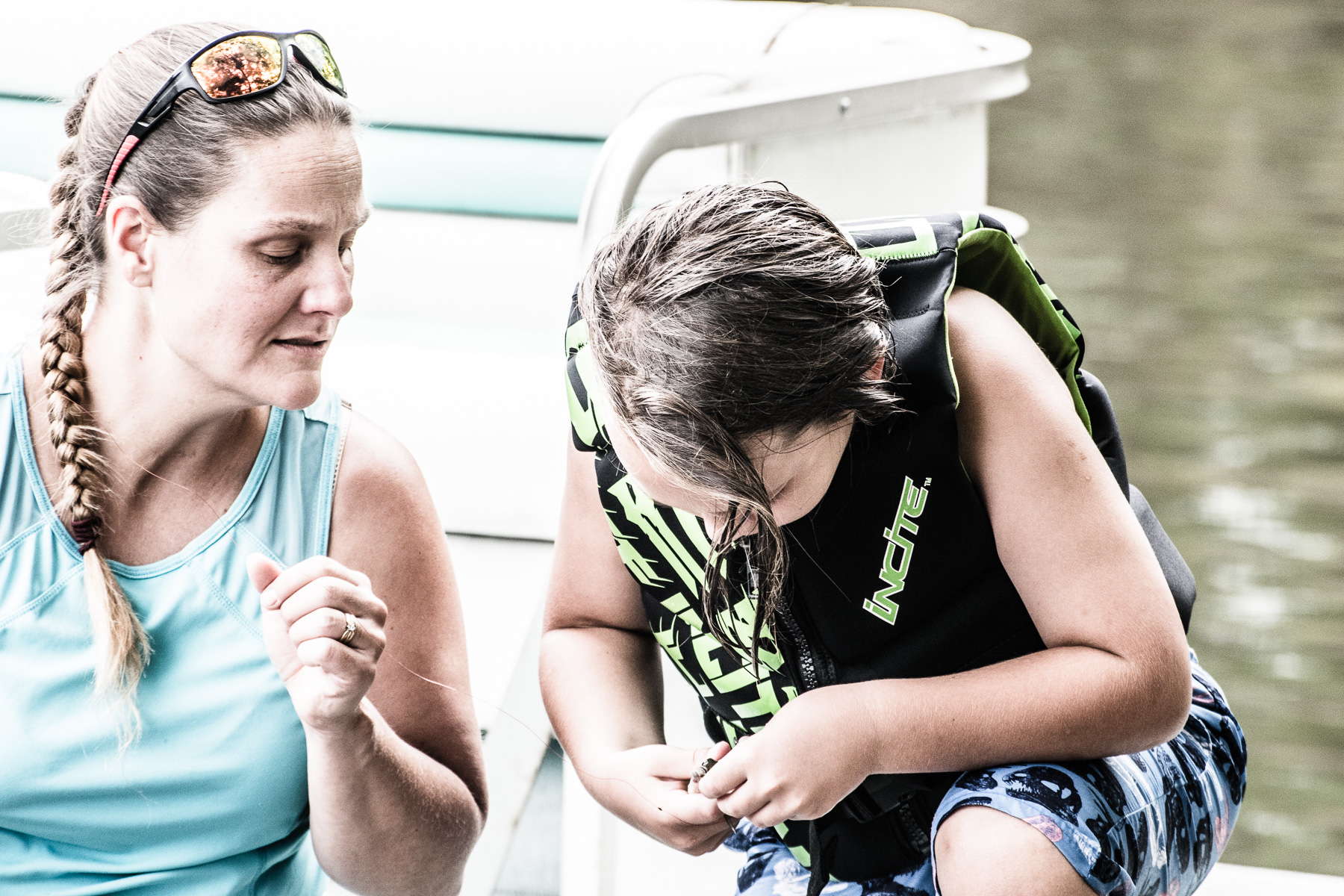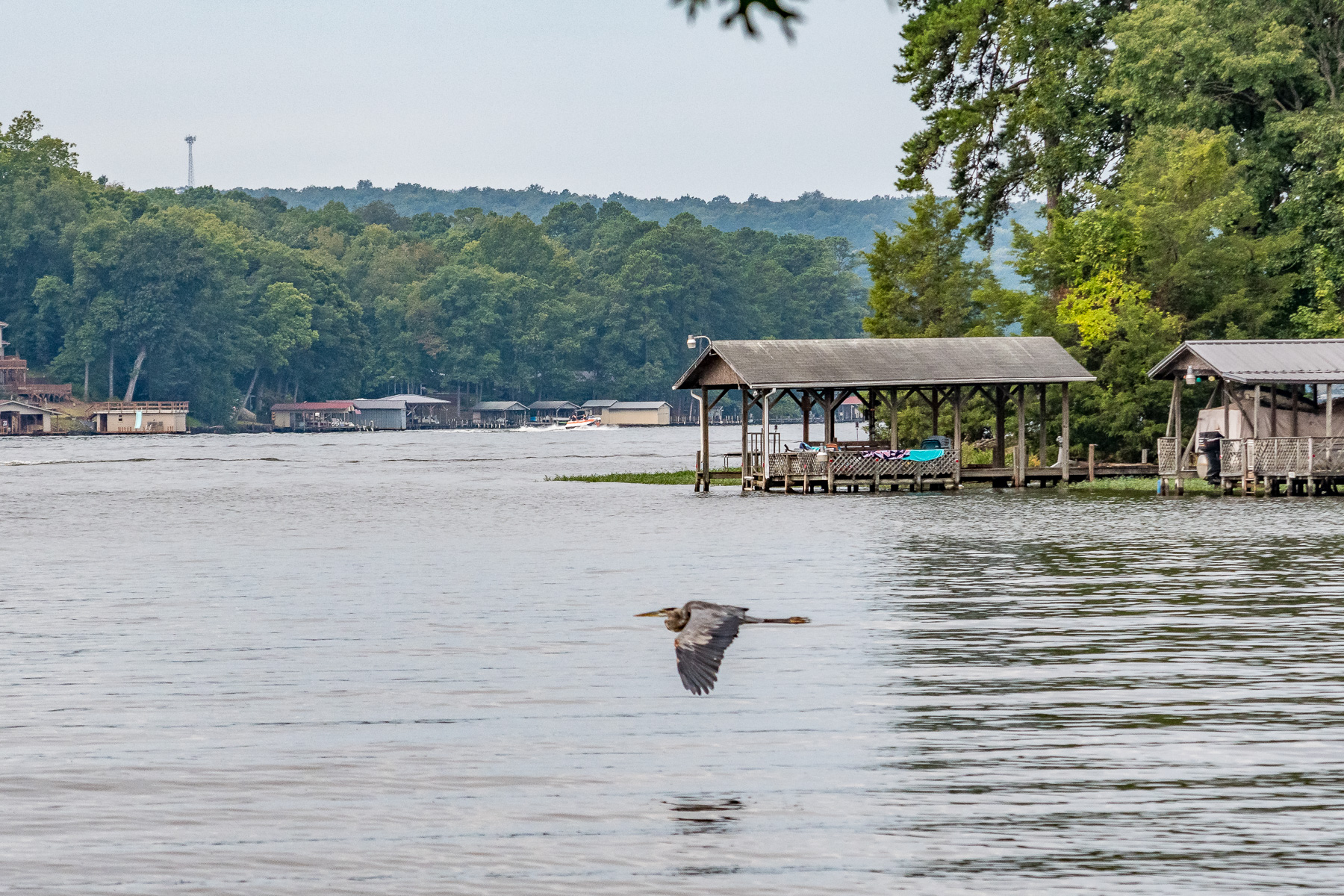
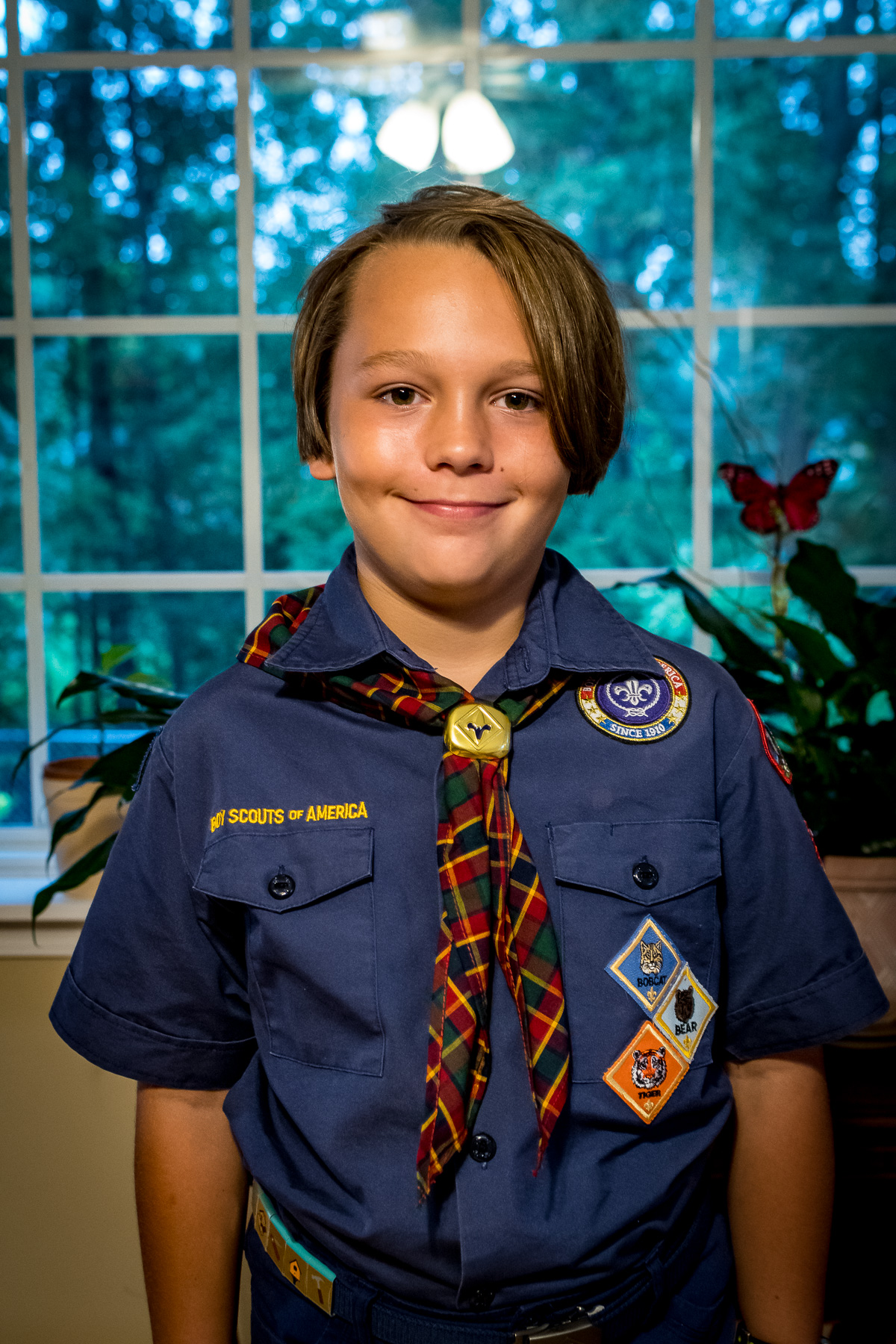
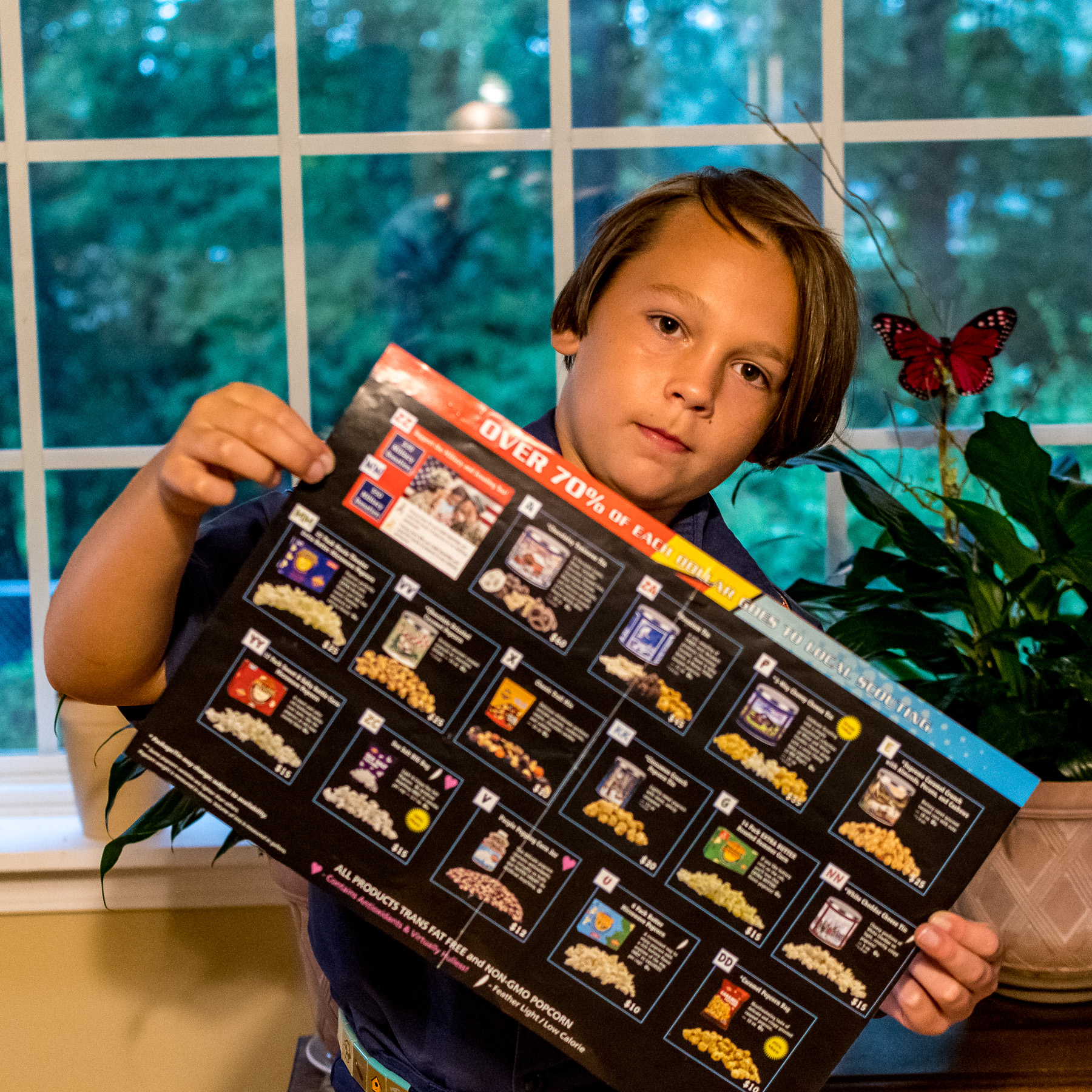
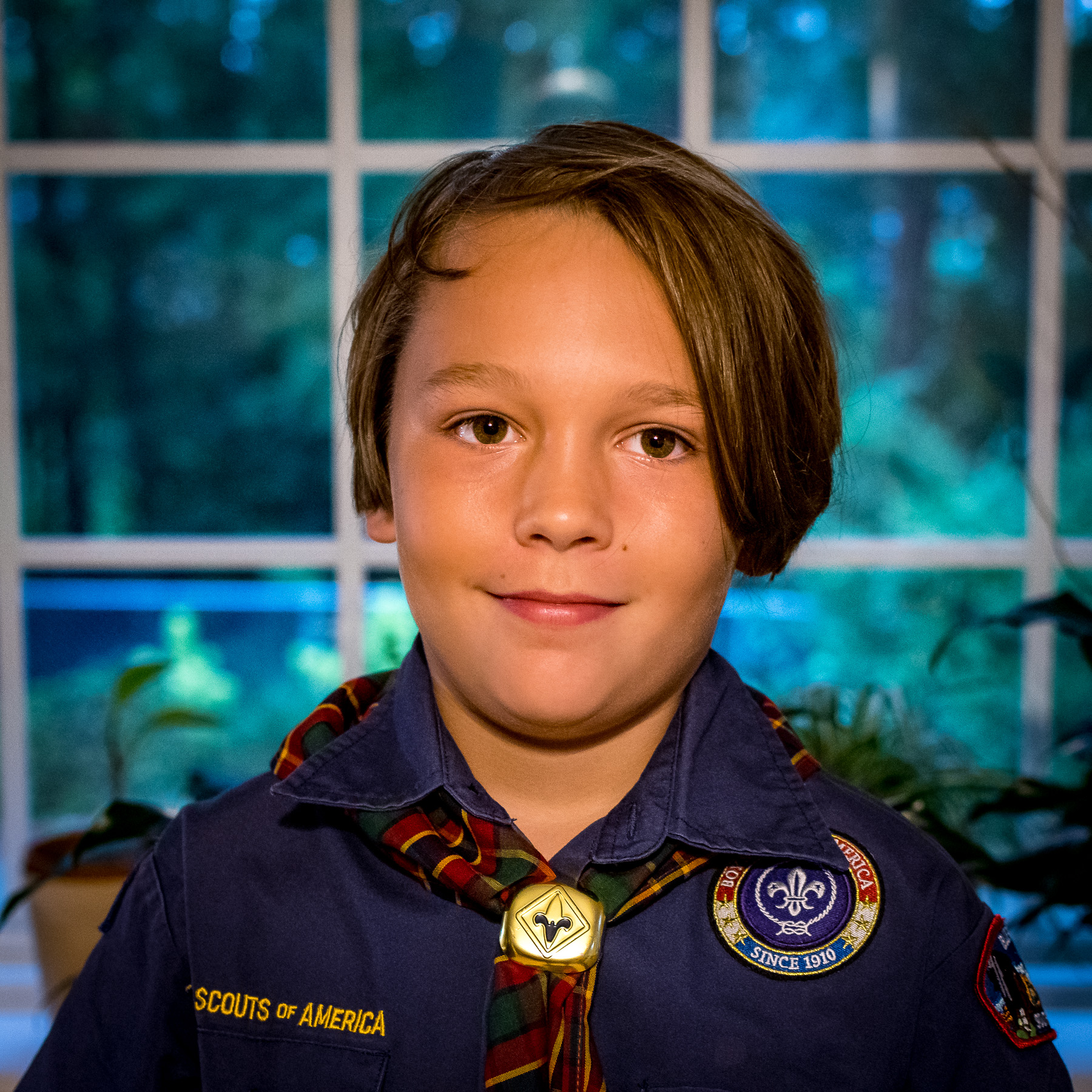
The Boy has been selling popcorn for his scout troop. We decided to make a poster tonight for me to put in the teachers’ mailroom (pending approval) inviting teachers to indulge their popcorn cravings. A few of the shots in for the poster…
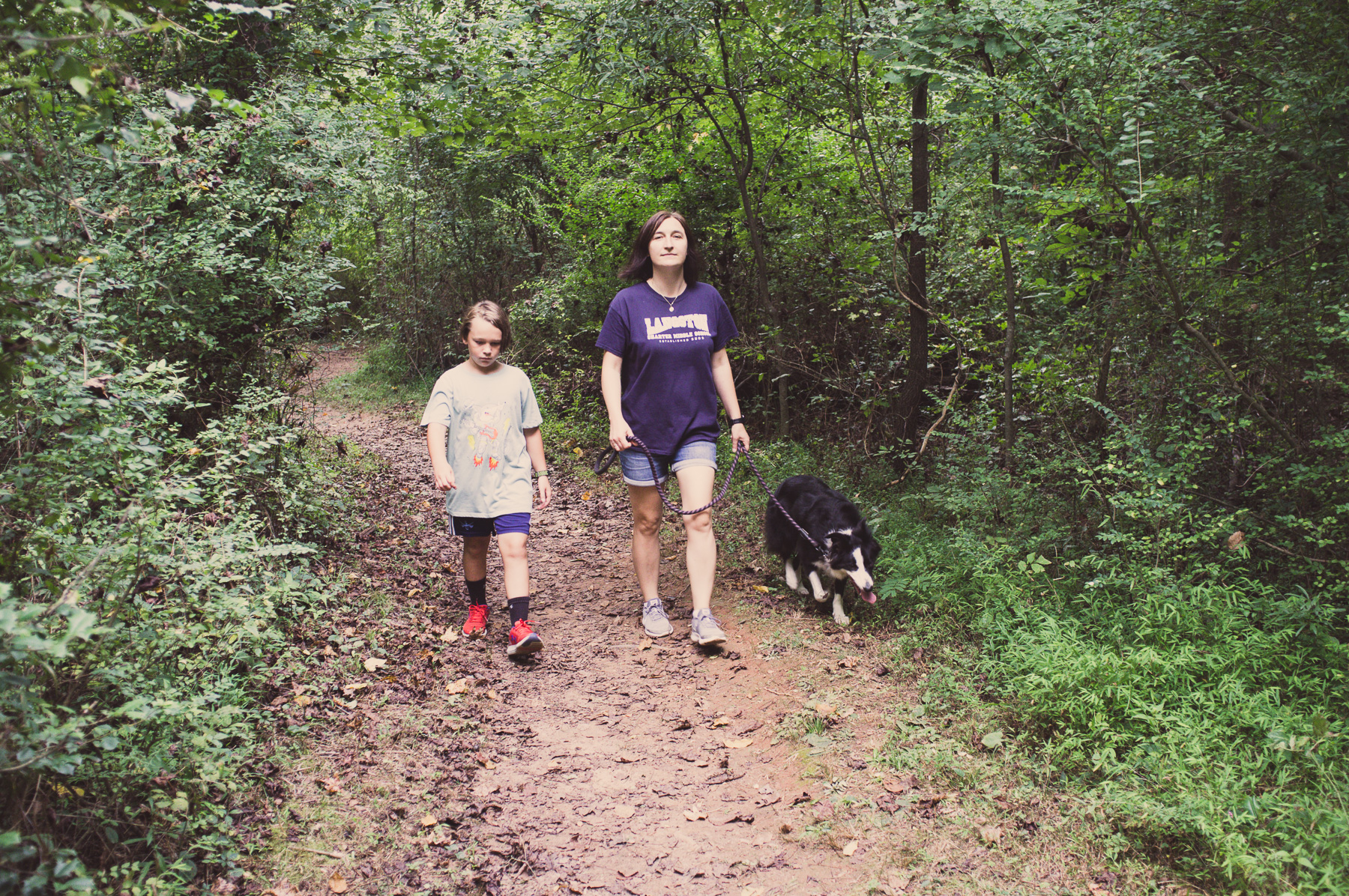
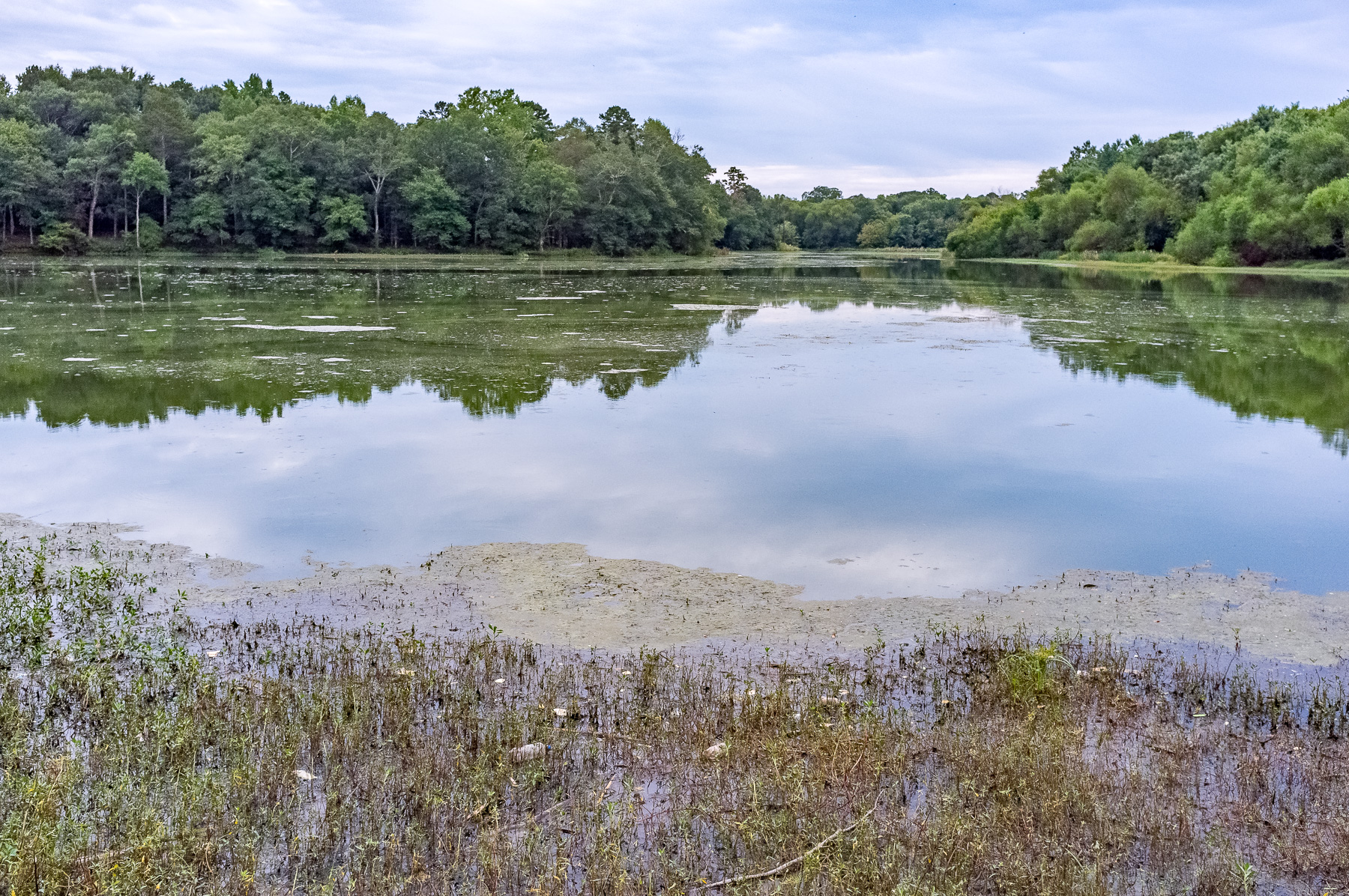
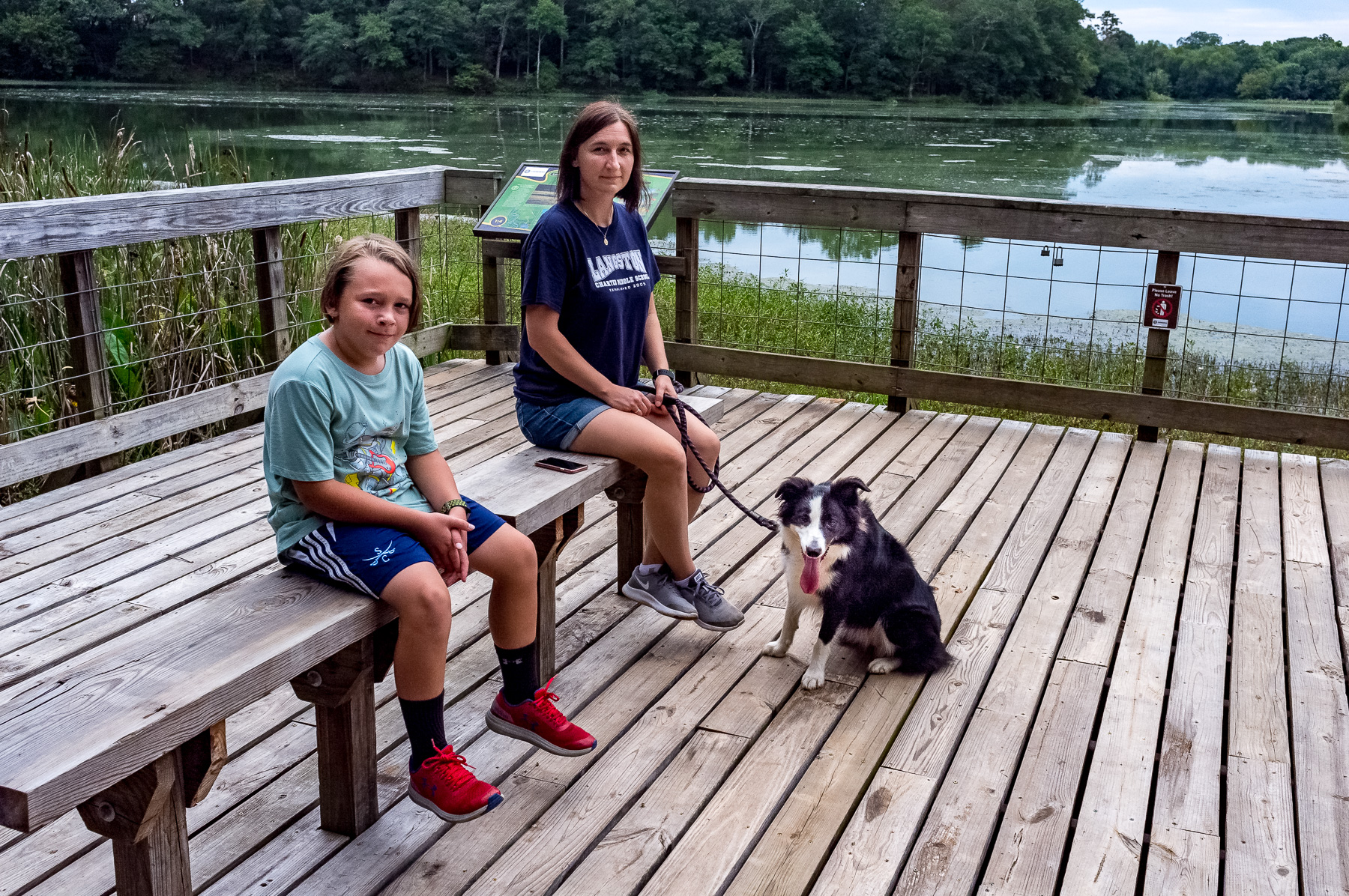
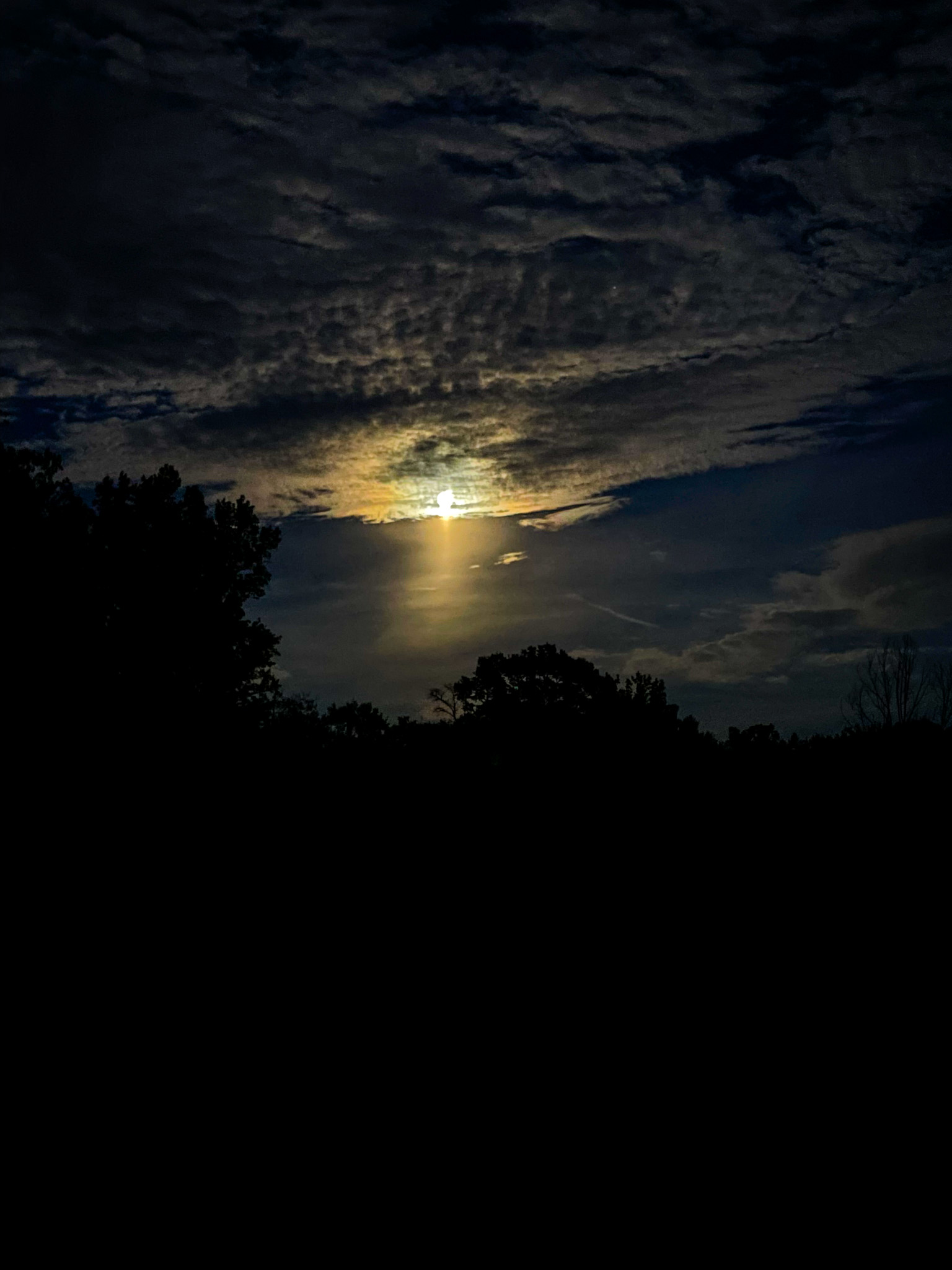
It’s been a while since we went out for a walk in our favorite local part. Months, even. L is sick at home — an awful sinus infection — but we made the most of it as three.


Another post on social media about Abraham’s near-sacrifice of Isaac, this time as a comedy:
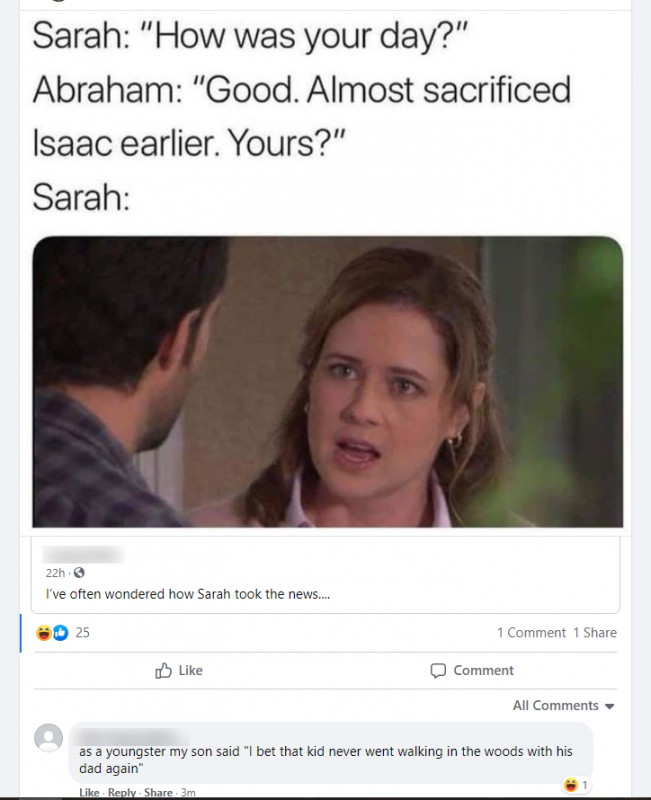
I would think that such an event would cause near-trauma in the mother: any other reaction seems unhealthy. I would hope that if I came home with one of our children and told K that I’d almost killed the child because I was sure God had told me to sacrifice the child but thankfully an angel stepped in and stopped the whole thing that she’d gather the children and get away from me as fast as possible until I got substantial counseling.
As for the child, I would think it would be more than just a mere reluctance to go into the woods with the father.
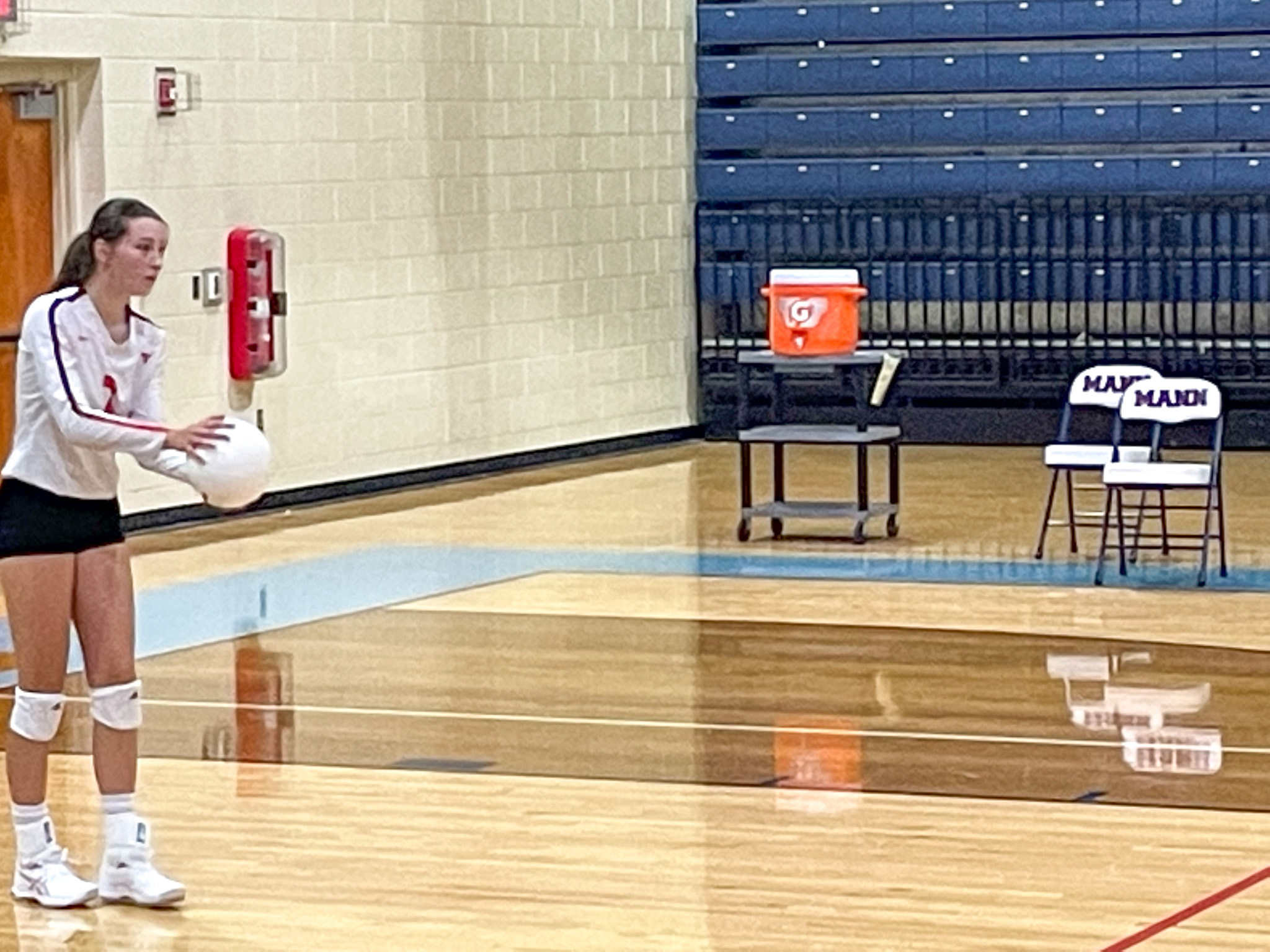
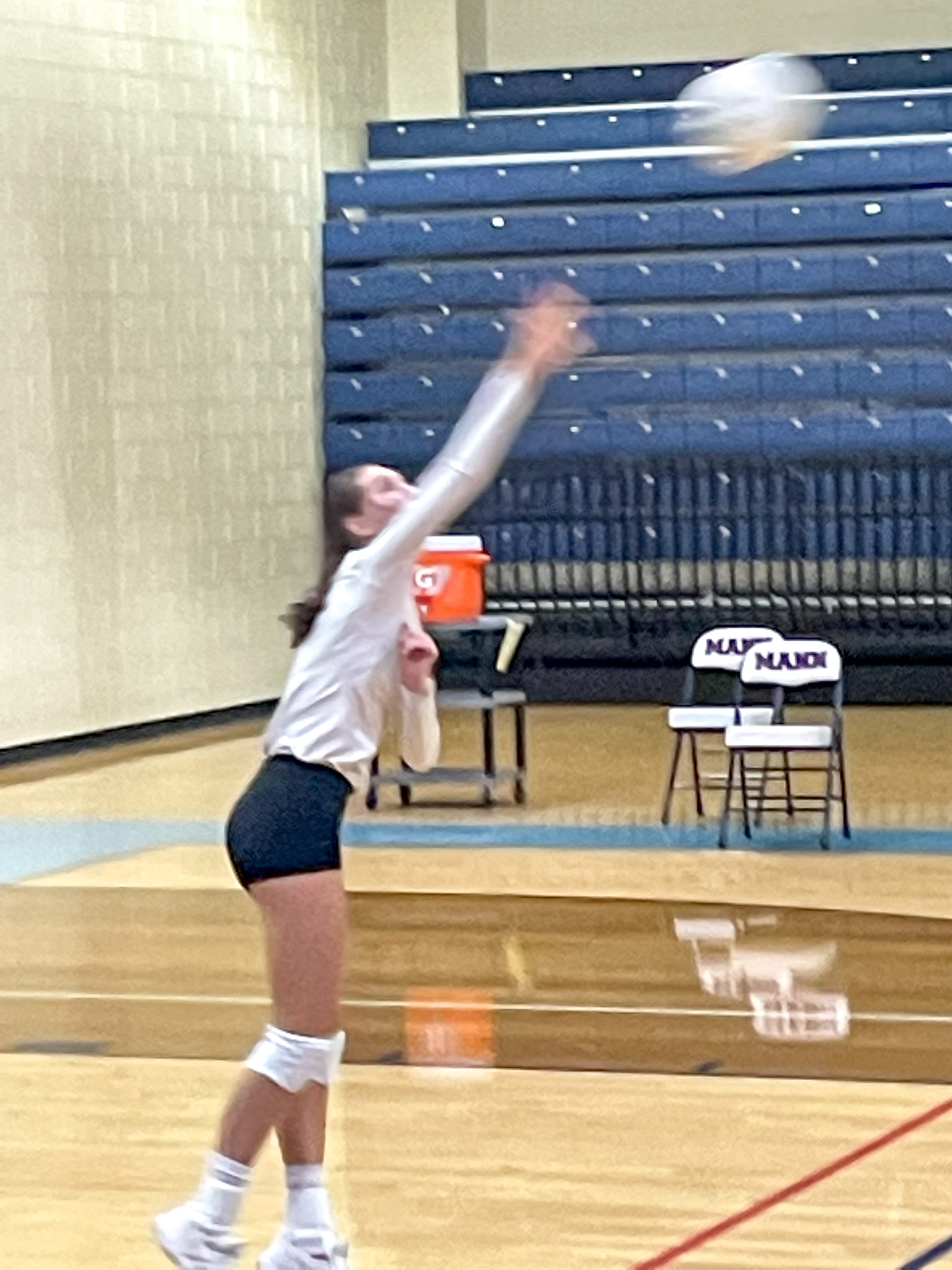
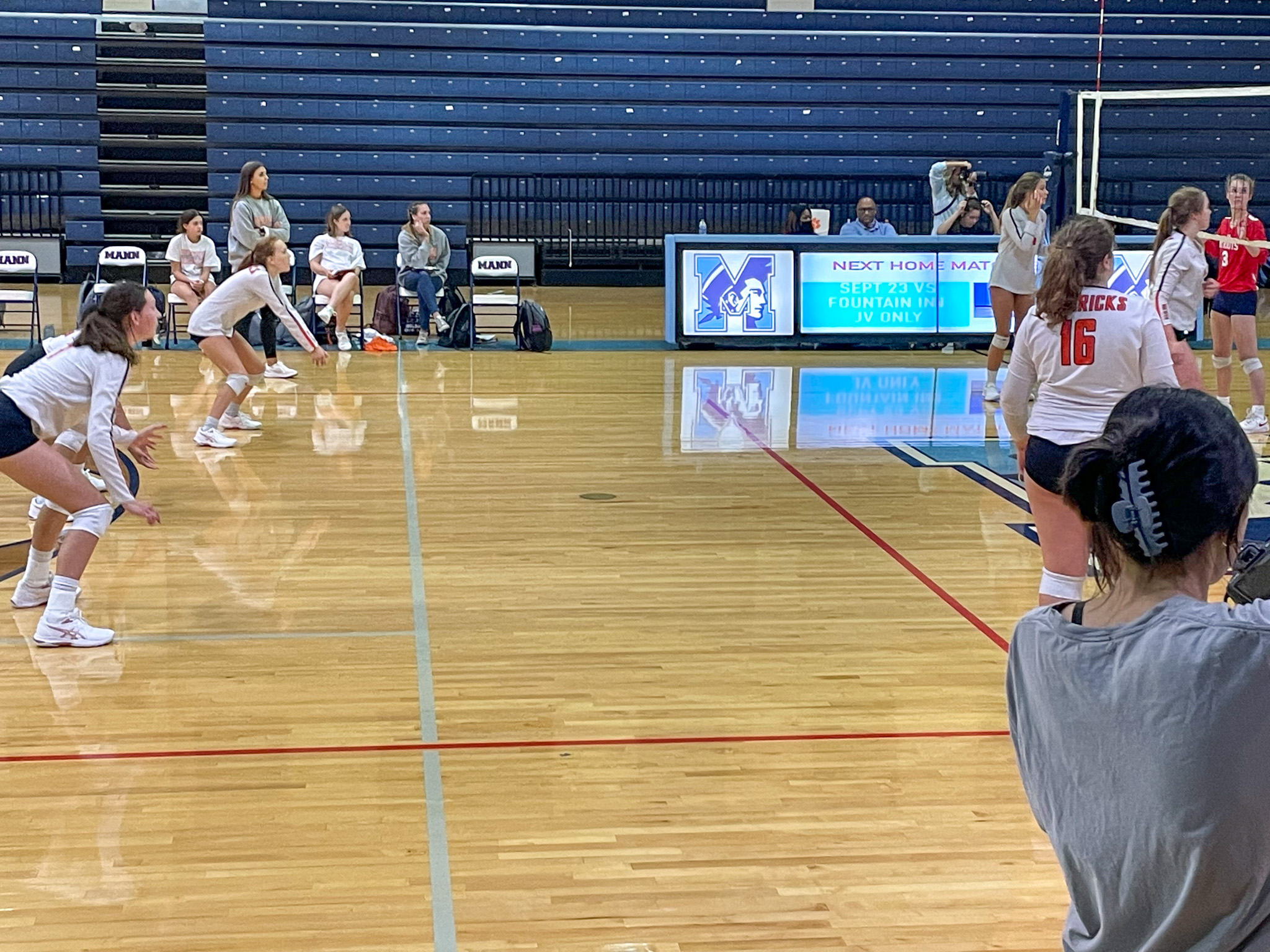
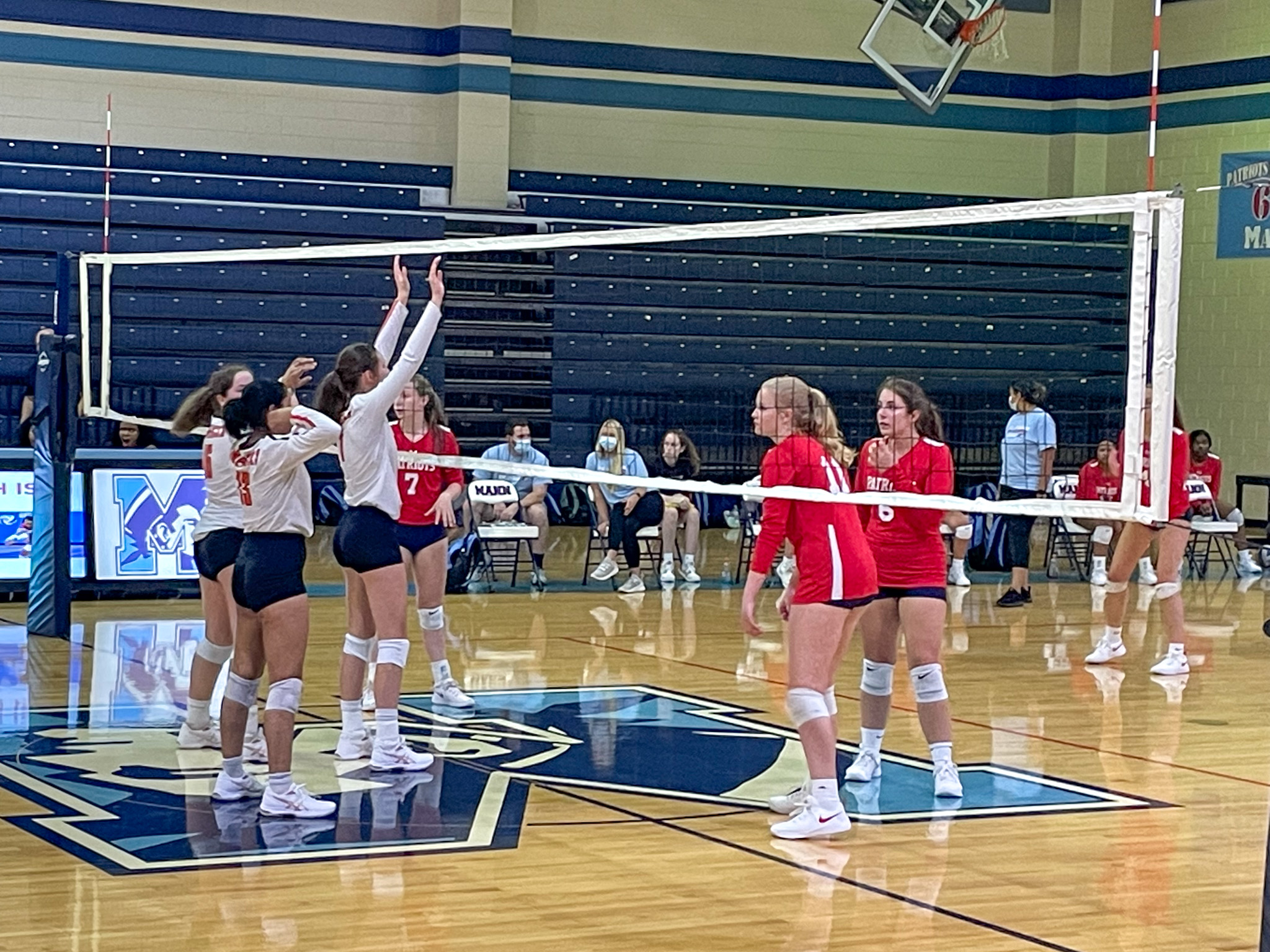
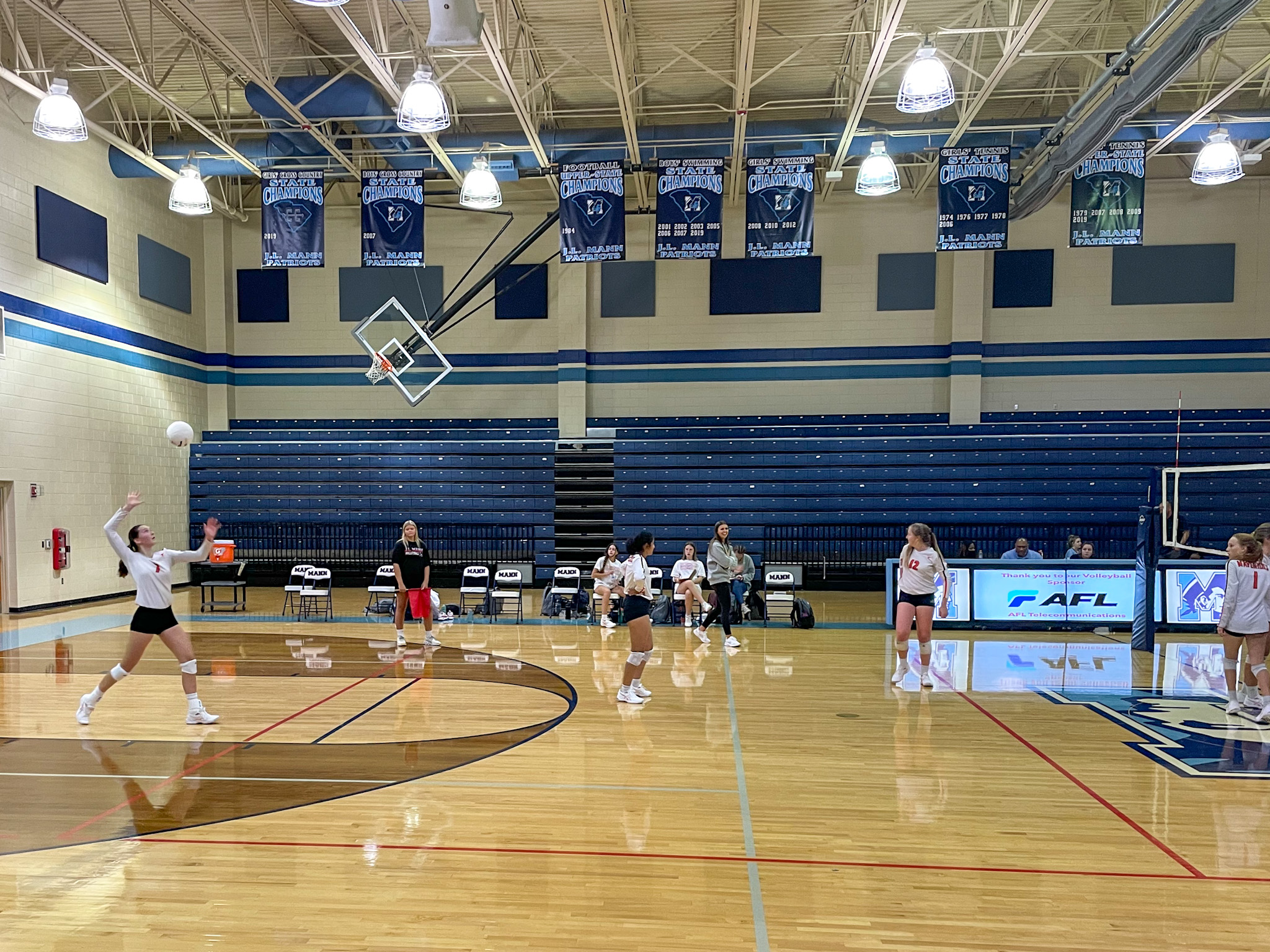
I went to a volleyball game for our school team tonight — in part to take pictures, in part because I have to attend a given number of school events, but mainly because several of my sweet new students play on the volleyball team. It was a tough match against Mauldin, the middle school L would have attended if she hadn’t gone to a charter school. Our girls were out in front at the beginning, but soon fell behind. And then fell further behind. And then lost 10-25. The second set looked better, but they still went down 19-25. The third set was much like the first: 11-25.

I still haven’t attended one of L’s high school games, so all my associations with school volleyball are with last year’s perfect season: not a single set lost. I sat watching and thinking: L’s team from last year would beat Mauldin like Mauldin beat Hughes tonight. And versus Hughes? It would be brutal.
It was a good reminder of how much our L has improved.
When we lived in Asheville, I worked for one year at a day treatment facility for kids who’d been expelled from alternative school. It was a tough bunch of mainly fourteen- and fifteen-year-olds. At one point, though, two boys who’d known each other “on the outside” (as they’d referred to it) were in the program at the same time. At lunch they’d revel in their former football glory, recalling magnificent plays they’d been a part of and sharing in the sorrow of those losses that had stung so badly. At one point, one of the boys mentioned having a recording of one of those games.
“Really!?” The program director was incredulous, but he managed to talk the boy into bringing in the video.
A couple of days later, during afternoon free time, the kid put the video cassette into the VHS player and pressed play. Soon, the director was howling in laughter as he watched a little league game in full chaotic, cute glory.
“Man, I thought you were talking about games you’d played in middle school or something,” he laughed. “I didn’t realize you were talking about second grade!” He was just good-naturedly ribbing the kids, and they took it fairly well.
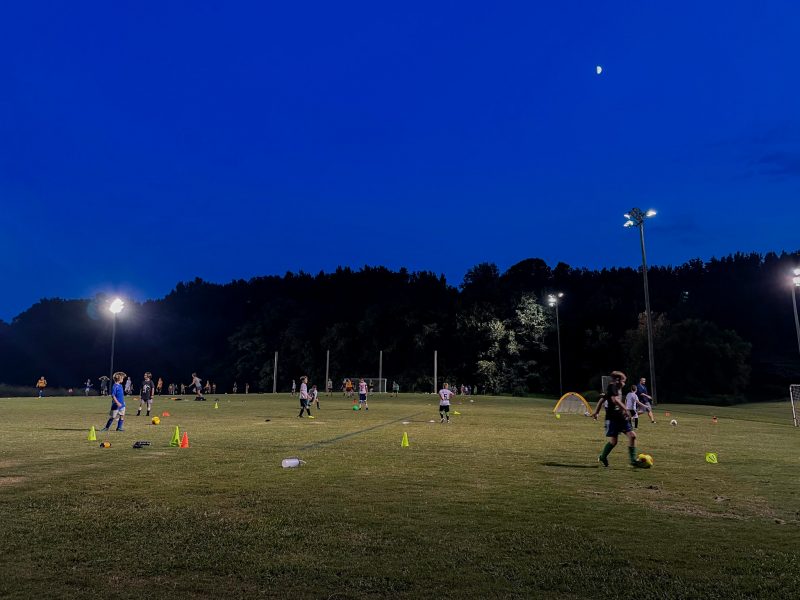
Looking back on it this evening as I jogged laps in a parking lot while the Boy had soccer practice, it suddenly took on a newly instructive dimension for me. Had any of us really thought about it, we would have known it could not have been middle school football the boys were talking about. They’d experienced little success in middle school, showing out enough to be removed from the setting altogether. Even the most gifted player is going to have to meet certain standards — administrators might bend some requirements for such a boy, but there are at least some requirements. These boys couldn’t even make it through alternative school let alone the less structured setting of a typical middle school classroom, so there was no way we adults should have assumed they were talking about playing organized football in the last several years.
We made those assumptions, though, because they neatly and immediately fit our assumptions. When a fourteen-year-old boy is reveling in past glory, we don’t expect it to be from early elementary school but from the recent past. It’s an immediate and logical assumption that we make without even being aware that we’ve made such an assumption. The thing is, we make these kinds of assumptions constantly throughout the day. We couldn’t function, I’d argue, if we were to give extended critical thought to each and every decision we make and every thought that flits through our mind. The trick is being aware enough of our thoughts to have as a conscious option the ability to switch on our critical thinking and go, “Now, hold on there.”
It’s one of the reasons I enjoy teaching literature to middle schoolers. It’s just those “Now, hold on there” moments that critical reading encourages.
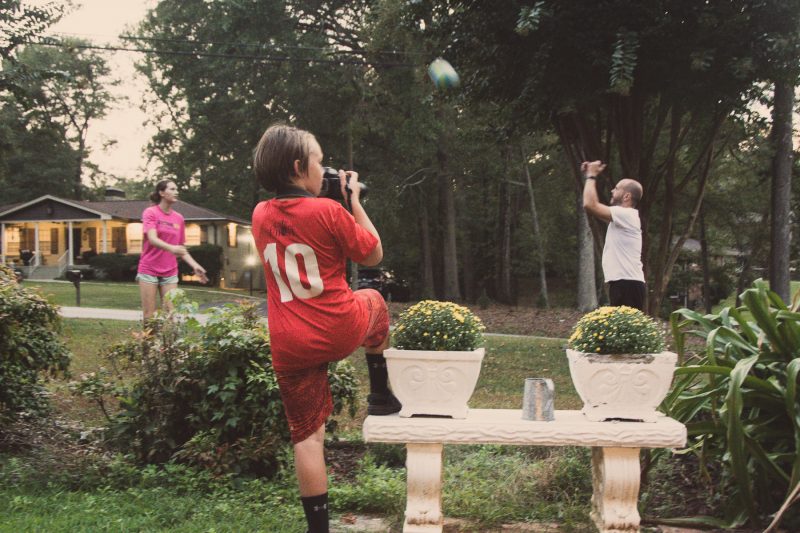
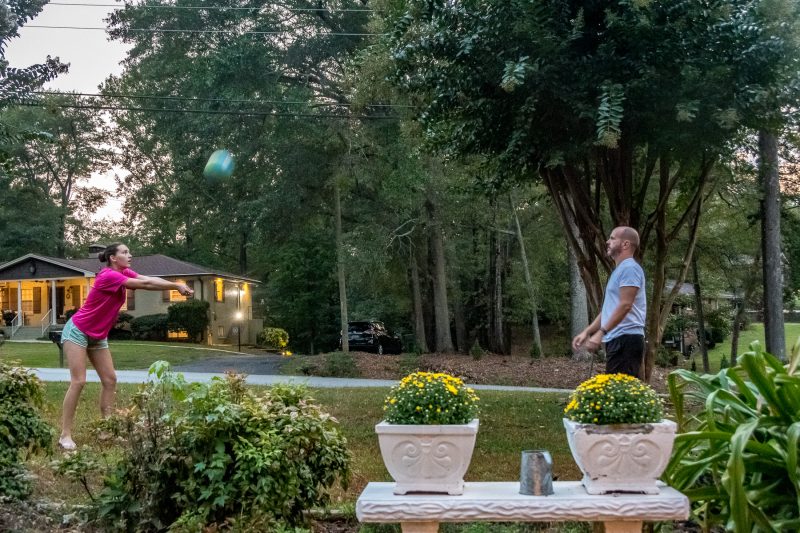
After desert, when K pretended she was about to eat E’s while he ran inside for a moment, we went to the front yard to get a little family exercise. L, having stayed home today because of sinus issues, passed the volleyball to me. Later, the Boy and I worked on his defensive skills in soccer.

As the Girl and I played, I noticed that, over her shoulder, the waxing moon was almost a half-moon. A waxing moon in the autumn was always a harbinger of the greatest week of the year, hands down, year after year. It was in the fall that our heterodox sect took a week off of work and school to celebrate the Feast of Tabernacles in a strange attempt to follow the pattern of Old Testament holy days that we were taught were still required.
When I was L’s age, the sight of such a moon in September would edge me toward near-giddiness as I thought about all the adventures that awaited after the obligatory, daily, and often boring church service (yes, daily church — a two-hour service, no less, with a sermon that lasted anywhere from sixty to ninety ass- and mind-numbing minutes). Surely I’d meet new friends. Maybe we’d see some great attractions. But most enticing was the promise of what everyone called a feast-fling: a week-long adolescent romance that ended with addresses and phone numbers exchanged along with promises and more promises, a romance that was lucky to reach Christmas break. “Maybe we’ll go to the same feast site next year!” was the excitement.
It never worked, of course, because adolescent romances are just that — flings. But that excitement along with the excitement of all the other amazing experiences we’d certainly have hung in the glow around waxing autumnal moons.
My children know none of these things. The specifics of my religious upbringing are a complete mystery to them. I’m content to let them assume what they will. I’ve hesitated to tell them anything about it because it doesn’t seem all that relevant to their lives, and quite honestly, I didn’t want to shade how they saw Nana and Papa. That of course assumes that it would color how they see them, which is likely a projection: through almost all of my adult life, I have looked at the beliefs they inculcated into me, beliefs they held with complete conviction but were without a shred of logic even within a strictly Christian theological context, and wondered how in the world they could have fallen for such silliness. I know they came to view their own beliefs similarly, returning eventually to a more orthodox Protestant faith, but somehow I still hesitated.
“I hesitated,” I say as if it’s something that’s occupied a large part of my conscious thoughts. In truth, it has, but only in a theoretical, theological sense. My thoughts have only turned to that theology while mowing or having a cigar and scotch on a Saturday night. Unless I happen to see a waxing autumnal moon…
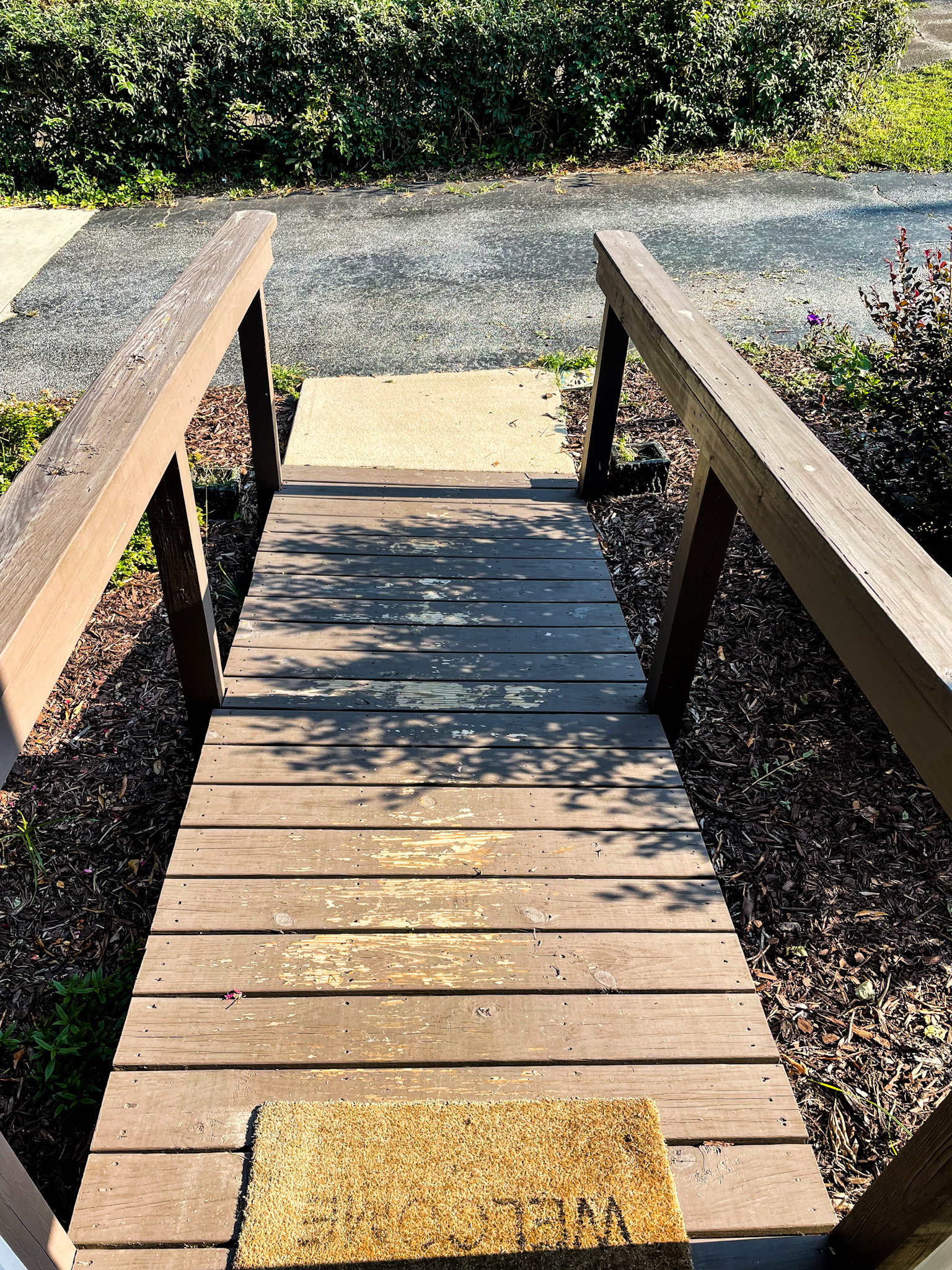
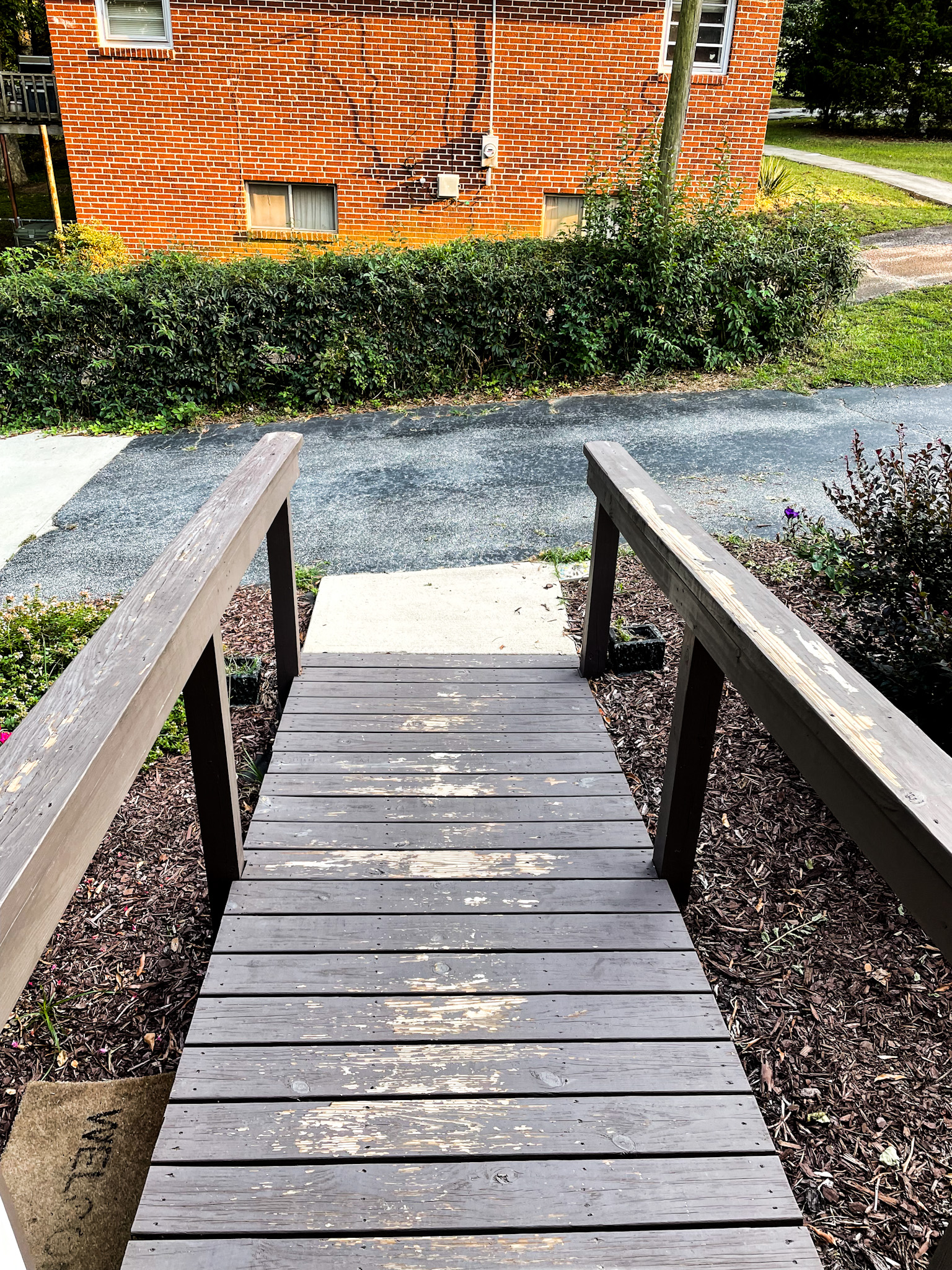
What we accomplished this weekend and what I have documentation for are two different things. I spent some time this afternoon scraping paint from the ramp that leads into Papa’s room (it will likely always be Papa’s room). When will we repaint it? Who knows. But I wanted to accomplish something today other than schoolwork.
February. There’s ice everywhere from snow packed on the road, snow compressed on the sidewalks, early melts in the fields that have refrozen. I am walking to the post office that’s in the serve-all commercial building in the village center of Lipnica Wielka.

The building houses a large public (as in government-owned) store downstairs, a large hall for wedding celebrations upstairs, and the post office upstairs in the wing to the right. Below it — who knows? Like many public buildings in Poland in the 1990’s, there’s a lot of empty space. In my hand, a pile of letters to family and friends. As I begin up the outer steps, I meet the director the rehabilitation center at the top of the village, just under Babia Gora, the mountain that looks over the whole village.
It’s a center the Duchess of York has established for children recovering from the chemicals and radiation used to treat cancer. I’ve been going up to spend time with the kids from time to time since the first weeks of my arrival. I always leave feeling depressed and heartened. Children have always been a joy to me, but so many withered children, boys with no hair, girls covering their bald heads with kerchiefs leave me emotionally drained.
Halina is one of the residents, a girl of seventeen who is trying to complete her first year of high school in Lipnica. She’s tried twice before, but her cancer and its treatment have made it impossible. She sits in my first-year class, clearly older, clearly more mature than the other students, and she often looks at me with an expression that seems to say, “You have no idea what you’re doing, do you?” A first year teacher, I really don’t.
Just before Christmas break, Halina disappeared. When I meet the director of the center, we make small talk for a few moments before he abruptly tells me, “Halina died.”
I stand there for a moment, silent. What do I say? What can I say? Everything feels so trite, so silly, so empty.
Borders are strange things — they can turn our perceptions on our heads. Take Poland and Slovakia, for example.
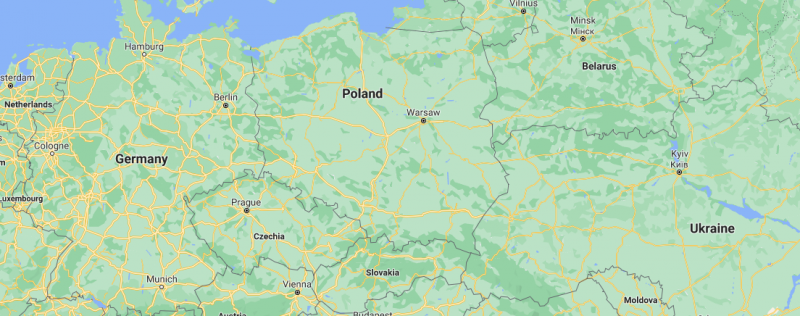
We generally think of Slovakia as south of Poland because, well, it is. But there are a few points of the border near where I lived and K grew up where the border follows a stream for a while. The result: you can travel north from Poland and arrive in Slovakia.
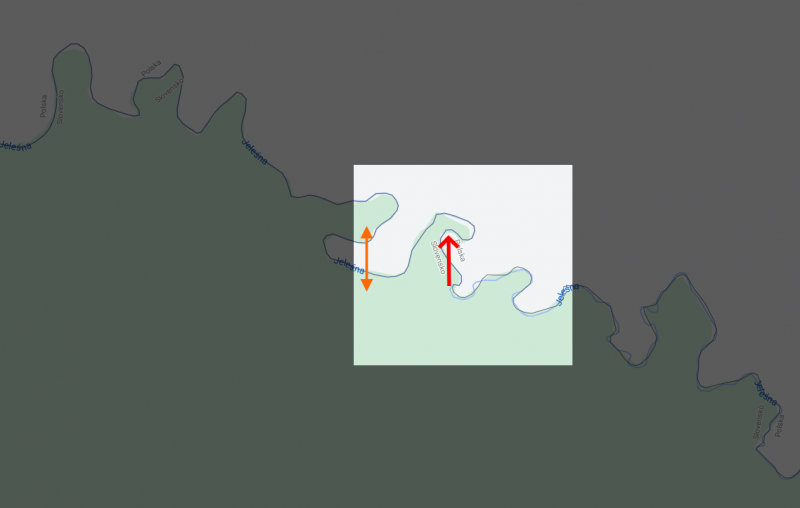
And there’s one spot where you can go either north or south to reach Slovakia.
A priest in a local parish recently included in his homily a quote that appears to be a variant of something Thomas Aquinas said. The priest phrased it thusly: “For those who don’t believe, no miracle is enough; for those who believe, no miracle is necessary.” Aquinas’s quote is a little different: “To one who has faith, no explanation is necessary. To one without faith, no explanation is possible.” The order is different, but the idea is the same.
The quote has a certain rhetorical symmetry to it, a certain parallel structure that makes it resonate in believers’ minds. That symmetry makes it more memorable, and that memorableness combined with its emotional resonance means it will stick.
The quote will seem clever as well. In believers’ view, it encapsulates both the weakness of the skeptic’s position and the strength of the believer’s. It creates a simple juxtaposition that both validates their own position and invalidates the position of opponents. In short, it’s the perfect rhetorical flourish believers can take home with them and use when talking to or about skeptics.
Like many rhetorical constructions, however, this one ultimately fails because of its oversimplification of both sides of the structure. From the skeptic’s point of view, it represents neither the skeptic’s position nor the believer’s position accurately. It is filled with generalizations and question-begging most believers would not notice.
The first part of this quote deals with skeptics. The assertion is that no miraculous event could convince the skeptic. There is some degree of truth to that. Were someone to rise from the dead, for example, the skeptic’s first response would not be, “Oh, this is possible proof of God’s existence.” Rather, she would begin looking for natural explanations. Even if no natural explanation were obvious, the skeptic would not default to a supernatural explanation. Rather, the skeptic would simply say, “We don’t know.” So in that sense, the assertion is correct: it’s doubtful that anything so puzzling could happen that a skeptic would move beyond a simple “I don’t know” into a theistic explanation based on the supernatural suspension of natural laws.
Believers, though, already primed for belief, eagerly accept as miraculous anything they can’t understand. It’s the argument from incredulity, which could be framed thusly: “I don’t understand how this could happen, therefore God must have done it.” Much creationist theorizing that attempts to refute the clear evidence of evolution lies along these lines.
This is no to say theists are not willing to admit ignorance. Indeed, when pressed on contradictions in their faith, the fall-back position is often simple: “God is a mystery.”
“Why would a loving god allow such suffering among children who can gain nothing from it and who simply suffer?” the skeptic asks.
“I don’t really know. I just know God has a plan, and that this is somehow part of that plan,” the believer responds.
The second element of the quote in question that we need to examine is the nature of miracles: A miracle is the suspension of natural laws. Yet because it is is it a suspension of natural laws, there’s no way to test a miracle to prove that it is a miracle. All of our knowledge is bound up in the natural laws that govern the universe. The suspension of those laws in order to create a miracle would be indistinguishable from a new law or principle we have yet to discover, and as miracles are one-time events, there’s no way we could test it to prove that it was not, in fact, some bizarre quantum event but instead a miracle. So in that sense, this assertion is correct: because skeptics generally deny the possibility of miracles, it would not even be an option.
Yet if the purpose of miracles was to convince skeptics, an omniscient god would know exactly what it would take to convince a skeptic. The Christian god’s very characteristics make this merely a question of will: if this god exists and it wants a skeptic to believe, it knows what it would take and would merely need to do this. The fact that it doesn’t suggests — again, if it exists — that it chooses not to, that it doesn’t want to.
The quote from the believer’s side is quite disingenuous, but it’s not immediately obvious. It states that “for those who believe, no miracle is necessary.” This suggests that miracles are secondary to some other method of conviction. But if we’re discussing Christianity (as the priest obviously was and as Aquinas was), the entire religion is based on faith in a central miracle: the resurrection of an executed first-century Jew. So in fact, the quote has it exactly backward: the central tenant of the Christian belief system is a miracle.
When discussing why they believe in this miracle, Christians point to accounts of the event in the New Testament and to personal experiences they claim to have had with “the risen Christ.” In order to accept the accounts in the New Testament, one has to have a certain degree of confidence in the accuracy of the New Testament’s accounts, and given the fact that there is not a single eye-witness account in the whole collection of books but instead multiple second- and third-hand accounts decades after the event, most skeptics find the Biblical evidence weak at best. On the other hand, to accept the authenticity of a believer’s accounts of personal inner experiences with Jesus, skeptics must necessarily accept that believer’s interpretation of that inner event. No one would doubt that the believer had that moment of clarity, that experience of warmth and love that they claim. However, just because a believer had that experience doesn’t mean that experience came from some god or other. Believers are often looking for reasons to believe: they’re looking for miracles large and small. They’re seeking these quasi-mystical experiences with their god. Since they’re looking for them, they often find them. As Augustine of Hippo said, “Faith is to believe what you do not see; the reward of this faith is to see what you believe.”
Yet a believer is likely to protest that such an analysis is going too far. “It’s about skeptics’ calls for miracles to aid in belief now. ‘God, give me a miracle so I believe!’ skeptics proclaim, but this quote is suggesting that’s not necessary for believers.” Skeptics are skeptical, though, not because there are no miracles today; we’re skeptical because we find the evidence for the source of any potential miracles lacking. To look at an event, proclaim it a miracle, then use that as evidence for a god is question-begging: it assumes the god exists in the first place. It works backward to an unwarranted assumption. Skeptics see things that believers proclaim to be miracles and say, “Now hold on — there’s probably another way to explain that phenomenon.” And if there’s not, skeptics will simply say, “We don’t know how to explain it.”
In the end, the quote is just as much an indictment of believers’ question-begging as it is of skeptics’ lack of faith.
I lost four of my students today. They’re not gone from school or even off our particular team grouping. I’m just no longer their English teacher. The reason is the irony of bureaucracy: the law that’s meant to protect in this case hurts.
They’re special education students with IEPs that require a special ed facilitator in the room with them for English class. This special ed teach has been reassigned to another class, so those four students have to go to another teacher’s inclusion classroom. It’s the law. The problem is, there are already too many special ed kids in the classroom my students got moved to, and since there are only four of them, it’s not much of a challenge for me to meet their needs without assistance. But the law is the law. It’s there to protect them, even when it doesn’t.
I spoke to administrators, special ed coordinators, guidance counselors about these kids. “Please, leave these kids in my class! They’re doing great! The classroom atmosphere is very supportive. It’s a smaller class than the one you’re moving them to. I really like them; they like me. They’ve settled into the routines of the class. They know how things work. It’s a good fit. It’s working,” I begged. But it’s the law, and it’s there to help these kids.
I’ve known this was coming for a week. I’ve been fighting it for a week. Today was the first without the kids in class. Three of them came to my door later in the day asking why they can’t be back in my class.
“Trust me, kiddos — I want you in my class,” was all I could say.
We went for a bike ride this evening. The Boy wanted to visit the old garment factory that’ now houses only a costume shop.
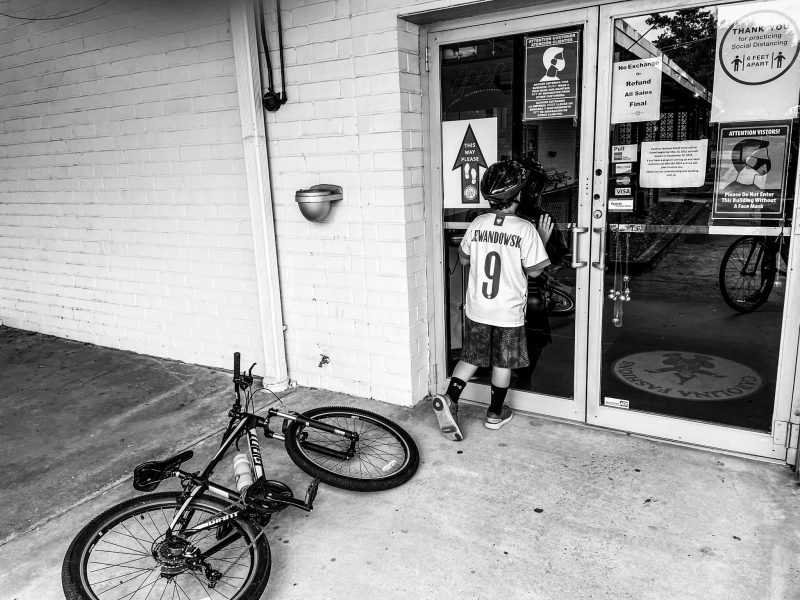
It doesn’t open until later in the month…
We returned to school to find 18 teachers out today due to covid. That’s not 18 positive cases — just 18 teachers affected in one way or another. Quarantined due to exposure. Staying home because of a child being quarantined due to exposure. Staying home because a child’s daycare has closed due to excessive covid cases.
“Why don’t we call the governor to see if he would like to come and cover some of these teachers who are out,” I suggested to another teacher as we stood, sensibly distanced and masked, making copies and preparing materials in the teacher workroom.
Meanwhile, the kids came and went in a variety of styles: no masks, masks worn down on the chin, masks worn properly, and various transitional states between the three. I carried on, masked all day, conscientiously distanced from everyone, teaching English I Honors kids how to parse some crazy Poe sentences.
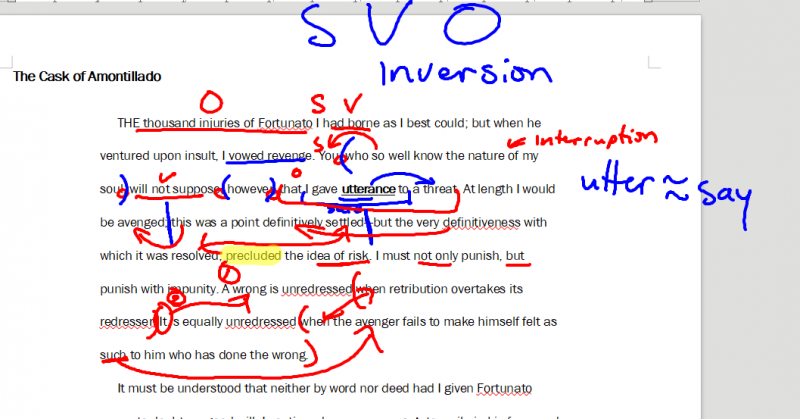
After school and dinner, the Boy and I headed across town for soccer practice.
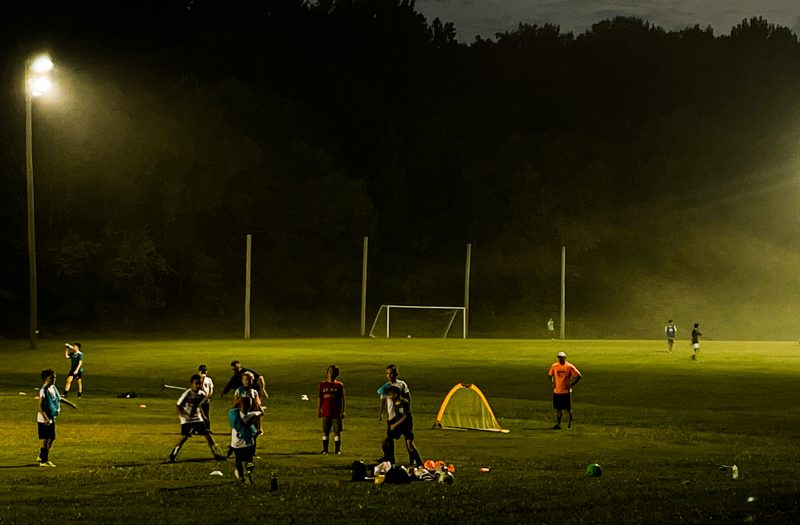
At last — a fairly safe activity in these uncertain times. And after practice, I was pleased to see the Boy making a conscious effort to distance himself.
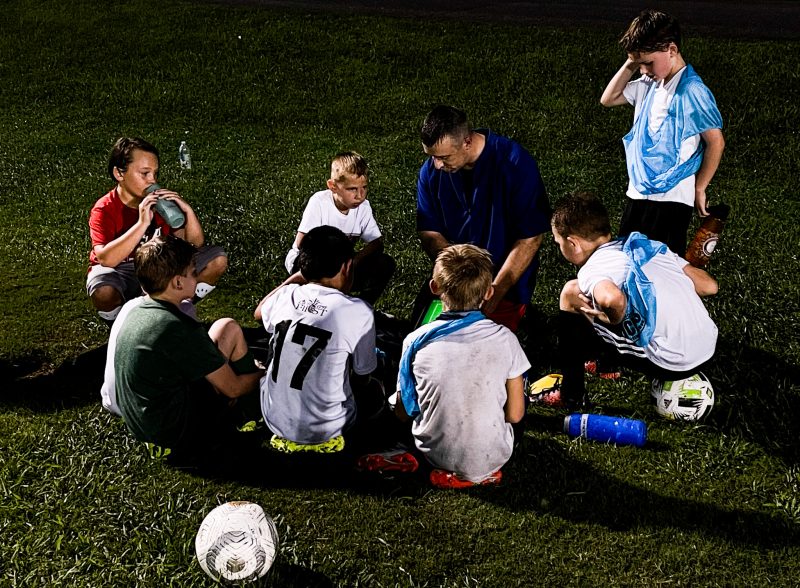
How long will these habits last? Will E still be pulling back from huddled groups ten years from now? Will it become a reflex? Some on the right would bemoan how this somehow scars them. Maybe, but I can think of worse scarring.


If it were anyone other than Tommy and Joscho (the two greatest living guitarists — there’s no way to argue differently), I’d never believe this was the first time they played this song together.