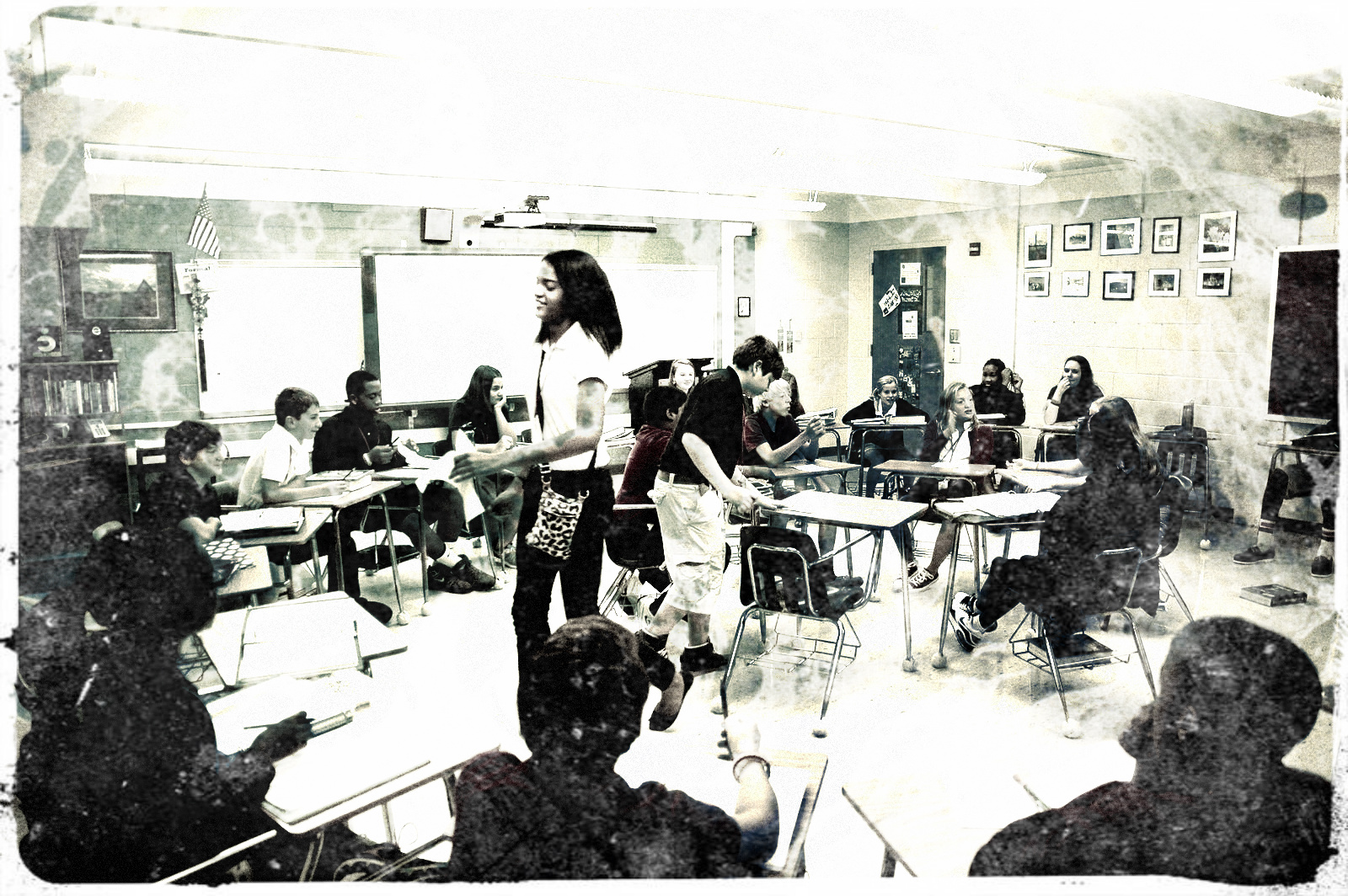
“Mr. Scott, today is my last day.” Nelia looked at me matter-of-factly when she said it one Friday morning, but the news was anything but matter-of-fact. There are students who, though it pains a teacher to admit, could say those words and the teacher would find it difficult to suppress the resulting smile. Few are their numbers, thankfully, but every year almost every teacher has at least one or two students about whom he thinks, “If only this kid wasn’t in my classroom–I could get so much more done with these other children.”
Nelia was not such a student. Indeed, she was the polar opposite: a quiet child who applied herself diligently each and every day, who turned in model work as a result, and who seemed to draw my attention in class like no one else. I knew she was trying; I knew she was paying attention; I knew she wanted to learn the things I had to teach. When explaining things, I found that I glanced at her more than almost any other student. Hard workers get that kind of attention.
I’d had my eye out for her from the first day. Mrs. Wilson, a teacher from a lower grade, had seen her name on my roster and exclaimed, “Oh, Nelia! You’ll love her!” She’d gone on to explain that Nelia had had a difficult life and had brought a lot of issues into the classroom. “But by the second semester, she’d worked a lot of them out–anger management, patience, things like that–and just became a sweet, wonderful student.” We teachers all like to hear that about rising students, so I was ready and very eager to meet her.
Because of her last name and the fact that I arrange my students alphabetically the first few days, Nelia sat in the back. She seemed quiet, not really talking to anyone and certainly not talking out of turn, but she always appeared sad. Tired. When students did group work, I found that she quietly participated but didn’t really take the lead. At the same time, the other students immediately realized that she had a quick mind and grasped things before most others in the classroom, so she became the de facto advisor to the group. She often finished before anyone else and then helped the other members of her group: not exactly the ideal for group work, for among other things, group work is intended to give students and opportunity to practice the real-world skill of cooperation in pursuit of a common goal. Still, her willingness to help had its own positive effects, and not just in the subject matter.
Her work was impressive. Always neatly organized in clear, looping handwriting, her work demonstrated from the beginning her impressive intellect and her pursuit of virtual perfection. Yet when praised for the quality of her work, she often smiled only a bit, the edges of her mouth just turning up and a sparkle temporarily flashing in her eyes.
All of this I noticed in just over a week.
When she told me she was leaving, the news hurt immediately, though initially for admittedly selfish reasons. It’s always a little sad to see a productive student who has a positive impact on the classroom environment leave, but it’s even more upsetting when it’s a student known to struggle, known to have overcome some bad habits and replaced them with some positive behaviors. When I found out why she was leaving, though, I sat silently for a few moments, wondering just how I should respond, considering how I could wrestle the wild and wildly depressing thoughts that surged into my mind when she began her explanation, “You see, I’m in foster care, and the lady that is taking care of me right now has decided she’s too old to do it anymore.”
Suddenly it all made sense, all the things the other teacher had mentioned, all the little implications. The changes Nelia had made, breaking habits built up from years of disappointment, rejection, and loneliness, were all the more impressive. I found myself suddenly grateful that I and my children knew where we would wake up tomorrow, the next week, the next year. I found myself unexpectedly thankful for the little habits that we take for granted, habits that sometimes even annoy, but habits that can only form in a secure environment where there are no surprises like, “Guess what!? You’re moving next week and that means changing everything in your life!”
And then the wild thoughts, the unrealistic thoughts that I just couldn’t beat down: “How quickly can someone get to be certified to be a foster family? Could we do that fast enough?” Thoughts that I knew the answer to.
As she left class that day, I pulled her aside and told her that I was very sad that she was leaving us. “I was really, really looking forward to working with you this year. I can see already that you would be one of those students that make me think, ‘This is what I got into teaching for.’” She smiled and thanked me, then started down the hall. I called after her and told her, “Make sure you head up to the seventh grade hall and say goodbye to Mrs. Wilson.” She smiled and assured me she would.
On the drive home that day, I began wondering if I should have said more, if it would have been helpful or even appropriate to say what I truly wanted to tell her: “If I had it in my power, I would take you into my family’s house and gladly try to provide a stable environment for you until you graduate high school, or even longer if necessary.” Unwarranted hope? Perhaps. Perhaps not. Maybe hearing those words, essentially telling her, “You’re not unwanted. You can have a secure place in this world” would have been an incredibly positive thing; perhaps hearing those words would have had the opposite effect. Possibly she would have thought I was just being a little weird. I don’t regret not saying it, and yet I’m thinking and writing about it still.
I did say something though, something to hint that she’s wanted, that she’s appreciated. Enough to make up for any of the sadness in her life? Certainly not: that’s a hole impossible to fill with only a few minutes of chatting. But she smiled when I said those things, and it made the day a success.
When Monday rolled around, I was still hopeful she would walk into my classroom. “Perhaps there’s been a change. Perhaps she got the dates mixed up,” I thought. No mistake. No change. Simply no Nelia. She was always so quiet that I really didn’t notice her absence until five or so minutes into the class, the students working on their bell-ringer and I checking roll.
“Michael,” I said, glancing up, checking his name with I saw his tuft of blond hair.
“Nelia.” And then I remembered. A voice from the back of the classroom: “I think she moved.” I stood silent for a moment, wondering where Nelia was, wondering what family had taken her in, wondering what school she’d landed in, wondering if she would settle in quickly, wondering how long it would take for her teachers to notice what I and others had seen, wondering if old habits might return as defensive mechanisms, wondering, wondering, wondering.
“Yes, she moved,” I finally confirmed, hoping the students wouldn’t notice the crack in my voice.