matching tracksuits

fun in threes, sometimes fours

g

Numbers

2

Every night just before bedtime, just before we read a story, just before one or the other of us cuddles with him until he drifts to sleep, the Boy has a choice to make: which cars will I take to bed with me? We allow him two because otherwise, there would be no room on the bed for him — he would pack every single wheeled vehicle he owns onto his bed every single night.

He makes his choice carefully, and as is typical of his personality, changes his mind a time or three most nights.

9

This weekend, the Girl will have her birthday party. Her ninth. Her last in single digits. Her interests are maturing with her body. She’s planning on painting her fingernails before her birthday party Saturday, and it’s a choice that, like the Boy’s cars, requires significant thought.

220

The average RIT score on the MAP test for eighth-grade students is 220. My gifted classes have averages well above 230. My struggling classes have sometimes had averages below 200, putting them in the range of a first- or second-grade reader. When such a class, during optional winter testing, actually goes down as a whole class, it leaves a teacher feeling particularly ineffective. What can numbers tell us about reading? Nothing? Everything? Something?

3000

At a post a day, it would take eight years to reach 3000 posts. However, to reach this, the 3000th post, it took 11 years, which makes an average of 0.747 posts per day — posting about 75% of the time. Eleven years to make it to this, the 3000th post.

Immaculate Perception

Tonight, on the way home from Mass for the Solemnity of the Immaculate Conception, K got a text. “H’s mom just sent me a text,” she said to the backseat. “H is coming to your birthday party and is very excited about it.” An affirming thought: someone other than family likes our kid. Yes, it’s sort of an obvious assumption in a sense: by age nine, most every kid has learned how to make friends with someone.

And yet, there’s the girl that sits in our lunchroom at school every single day alone. One of the sweetest young ladies I’ve ever had the privilege to teach, and yet without a single friend some days. “I just like being alone,” she said once when I plopped down across from her during lunch with my salad and began chatting. And I believed her: I was a bit of a loner myself, and I sometimes thought being alone was just easier than dealing with the uncertainties of other people. So here’s this thirteen-year-old who can’t or doesn’t want to make many friends, and I realize that it’s entirely possible that L might have made it to nine without making any real friends.

What is friendship at that age, though? Just a few weeks ago she was complaining about how some of the very people she’s invited to her birthday party were being none-too-friendly toward her — the usual petty playground stuff. Can she tell when people are really her friends and when they’re just using her, I’ve wondered. How accurate is the perception of a young girl?


Carol: Mennyből az angyal

A Hungarian Christmas carol

Monday Afternoon

Yesterday was such a busy day that I didn't even take the time to share everything that happened. The Christmas tree got a mention but little else, and the promise of the lights we put up around the house was about there was of the final product. So it would be tempting just to post those pictures and call it day. After all, there is continuity with the pictures and the day's before.

"That tree is enormous" seemed to be the general consensus -- certainly the biggest one we've ever brought into our house. "Remember that first tree stand we used?" K mused as she held the tree later that night while I, sprawled on the floor, loosened all the screws holding the tree in place and reinforced it with planks of wood. He might have held a tree half the size of the one we have in our living room now, but it would just laugh at the tree we brought home Sunday.

1-DSCF7437

But to leave today's story at that would be leaving out the wonder of today. For example, a girl in my most challenging -- and as a result, often most rewarding -- class left the room without asking permission. It's not the kind of thing I would have expected her to do. I went out to talk to her and determined that she'd removed herself from a stressful situation so that she wouldn't say something she regretted. It turned out, she'd already kind of said that anyway, making a comment under her breath that probably shouldn't have even been said at all. "But she was off task, and being distracting," S protested. I suggested that she really didn't need to say what she said, no matter what M was doing, and after some thought, she agreed. We went back into the room and I suggested that to be really mature, to take the situation to the next level, she might want to apologize to the girl in question. And she agreed. And in a few moments, the two of them were in the hall together, working out their problems like forty-year-olds instead of fourteen-year-olds. So to leave that out of the day's story would be a minor tragedy.

But there was still the Boy and our time exploring before dinner.

As I was putting on my shoes, E pointed out that the giant ladder truck that had been mine at his age and which Nana and Papa had saved was in sad repair. "It's not new and shiny like it was when you got it," he observed rather philosophically. "Did you get that from Santa?" he asked after a pause, and I thought, "Well, here it is." It's a moment I knew was coming, was surprised that never came with L, and yet while dreading it in a way, paradoxically never really gave it too much thought.

But it reminded me of something I wrote on a blog I used to run, now almost ten years defunct, in which I dissected the statements of leaders of various religious groups that all clung to the same beliefs I grew up with after the church in which I grew up declared its own beliefs heretical and moved to Protestant orthodoxy. When L was born, I struggled to find the time and motivation to keep it up, so in August of 2007, I resigned:

I’ve been struggling—to find topics for this blog, to maintain my interest in all things Armstrong, to find time to care.

Truth be told, to care.

Jared said it best in a recent comment:

[A] moribund XCG is [not] entirely a bad thing either. After all, there’s only so much one can say about Armstrongism before you’ve said it all. (Source)

I don’t feel like I’ve said it all—there are thousands of words that could still be written about the phenomenon of Herbert Armstrong and the sect he formed. Yet, I really no longer have the interest or time to write anymore words about it.

I feel like Chicken Little, for our common XCG sky will continually fall. David Pack will talk about his web site statistics until the day he dies. Rod Meredith will provide critics with still more reasons to call him Spanky until the day he dies. Those in the upper echelons of the dwindling WCG will continue to talk about their amazing transformation until the day they die.

But I will not be commenting on them at that point, and I certainly won’t be commenting on them when I die.

About six months ago, I started preparing a final post, but I kept putting it off. I thought, “Maybe I’ll just write a little here, a little there,” for a while. Several have noticed and commented on this, and I have remained silent as to the cause of this dip in output.

My initial draft of this post might provide clarification:

Certain things in life force us to see things in a different perspective. Births, deaths, marriages, divorces, conversions—these are the kinds of things that make us stop and reflect on where we are, what we are, and most importantly, what we’re doing with the short time we have on Earth.

We have twenty-four hours in a day. We work at least eight of them; we sleep six to eight of them; we wash, shave, cook, eat, clean, drive, exercise and a million other forms of maintenance for another three or four a day. That leaves us with precious few hours a day for ourselves.

What do we do with that time?

Until recently, I spent time looking at, analyzing, and even mocking the beliefs and actions of a group of people I no longer have anything in common with.

Recent developments in my life now make that a less-than-ideal way to spend my free time.

The “certain event” I was referring to was the birth of my first child.

Since then, I’ve been of thinking about what I want my daughter to know about my own religious past. Truth is, I want her to know as little as possible. Because of shame? Embarrassment? Certainly not. I don’t want her to know for the simple reason that it no longer impacts my life. I can’t see much positive coming from me ever going into any detail with her about what I used to believe, about what her grandparents used to believe, about the fact that a true handful of people in the world still believe it. I don’t believe it, and that’s that.

And so, to quote one of my favorite authors:

“The time has come,” the Walrus said,
“To talk of many things:
Of shoes—and ships—and sealing-wax—
Of cabbages—and kings—
And why the sea is boiling hot—
And whether pigs have wings.”

To talk of many things—but not the XCG. And not here.

I appreciate all the support I’ve received during this little two-and-a-half-year adventure. I thank all the fellow contributors who, throughout these last nearly thirty months, have helped to make the discussion here a little more balanced. I am grateful to all you regulars. You really kept the site going.

Most of all, I’m heartened by some of the comments of the past, folks telling me that I have helped them in some way. I appreciate you sharing those thoughts, for it gave me a certain joy that I will truly never forget.

But the time has come.

Best wishes to all, ill wishes to none, and I leave with the hope that if we ever meet again, we’ll have so much more to talk about than the XCG.

And since then, the Girl never once asked about Santa for me (for we didn't celebrate such heathen festivals), and I'd really forgotten about it. Of course I still write about the phenomenon, as evidenced by a post earlier this week (and as the thirtieth anniversary of Herbert Armstrong's death is just a little over a month away, I will likely write about it again in the near future). But I hadn't thought about what I'd say to the Boy or the Girl about my religious upbringing. It just didn't seem important at all in a way. Until E asked me if Santa had brought me the ladder truck. I thought about it for a moment, realizing that a philosophical/theological treatise was certainly not required, and simply answered, "No, buddy, Santa didn't bring it to me." Maybe some day, he'll ask about it again. Probably not. We'll cross that little relatively insignificant bridge when we come to it.

Musevisa

Alf Prøysen performs his Noregian carol, “Musevisa”

Mikołaj’s Arrival

When we go to bed, it's something of an act of faith. We assume that we'll wake in the morning, that life will continue as normal.

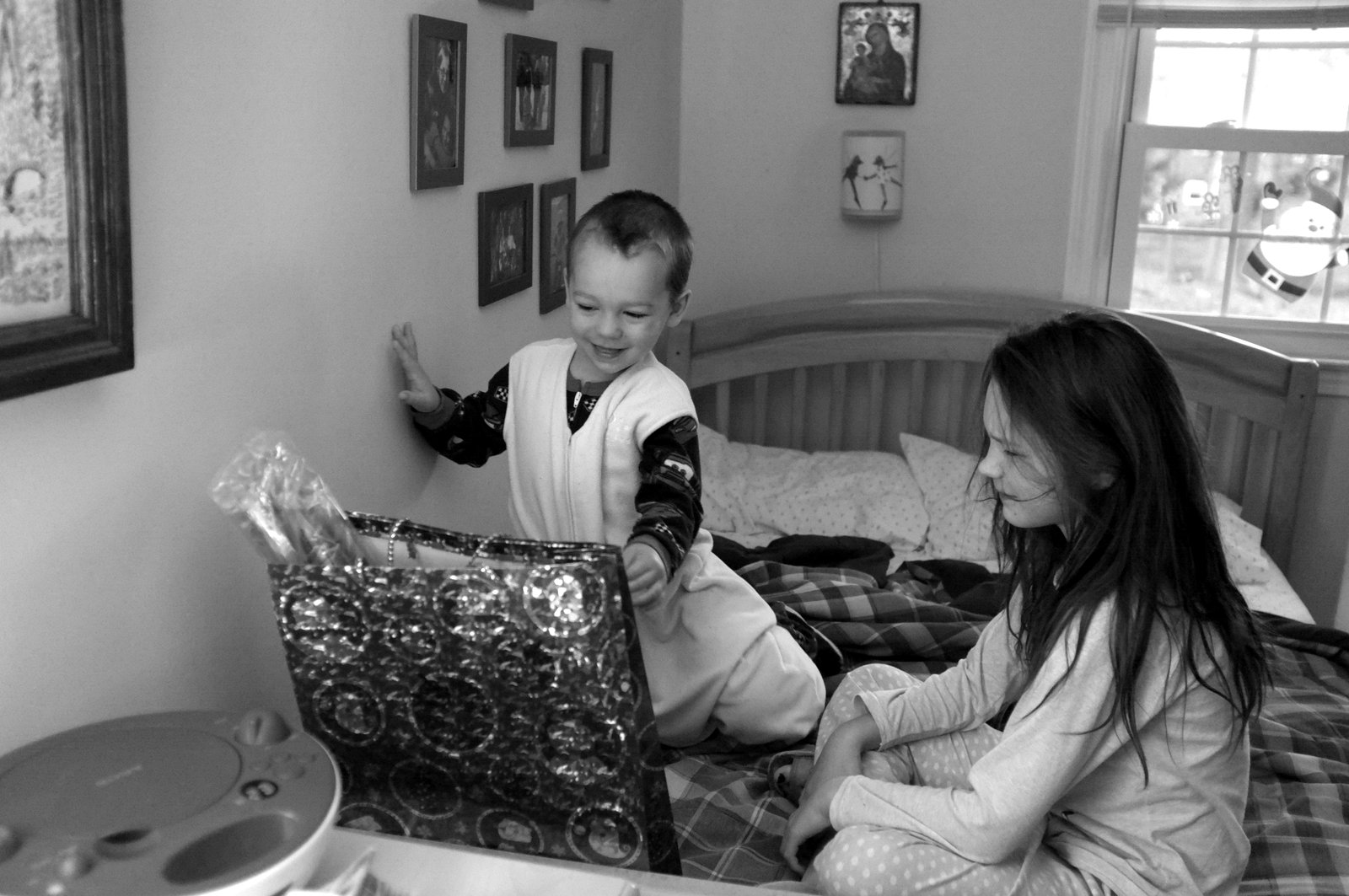
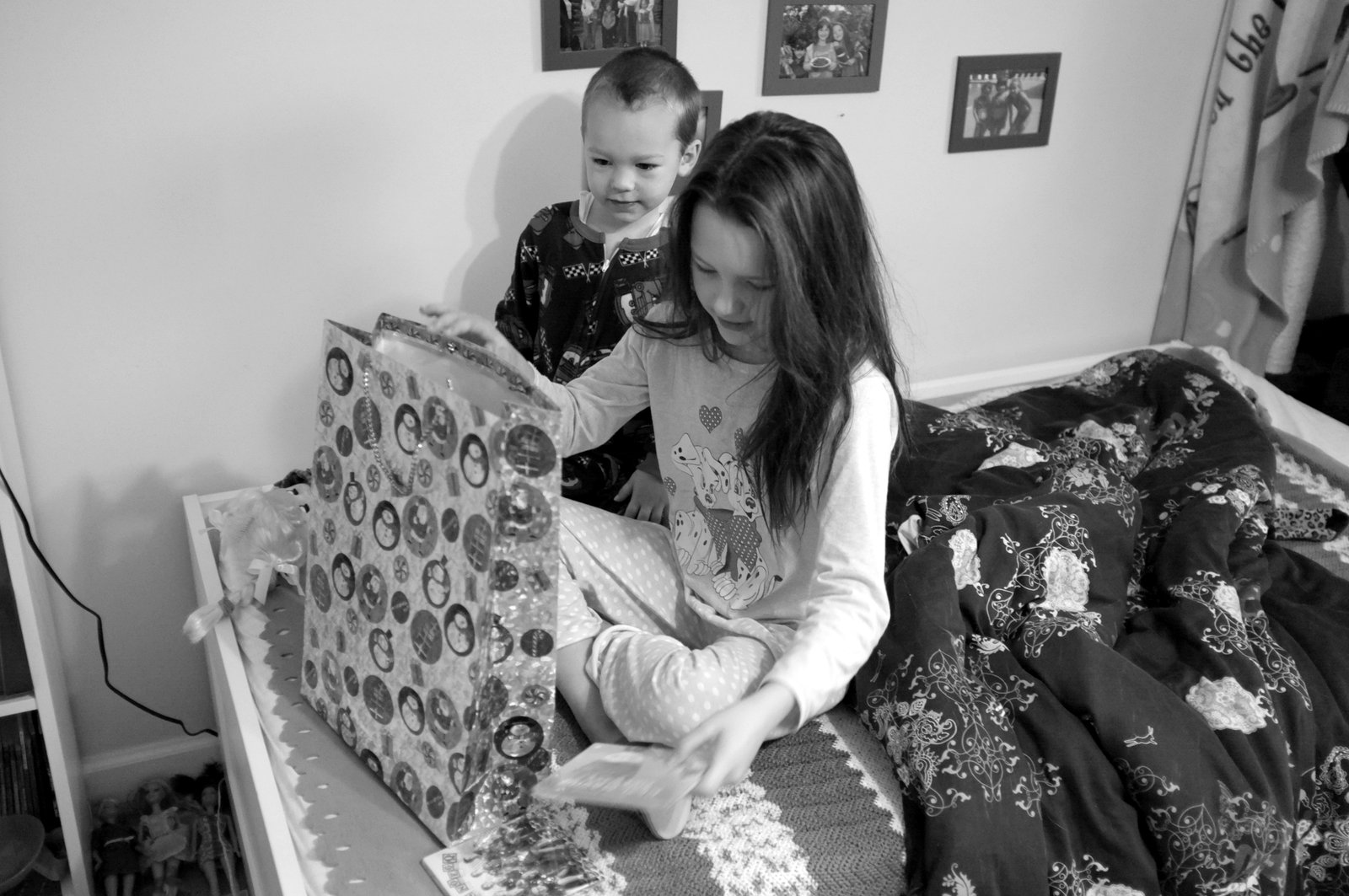
When you're a child of Polish heritage and you go to bed on December fifth, you do so with a certain faith that Mikołaj will come and leave a little something if you've been good. It's probably not just Polish kids -- it's probably a Catholicism thing, since St. Nicholas's day is today.

1-DSCF7390

At our house, Mikołaj tends to bring practical gifts. No toys or games -- books and other such every-day items. For instance, we recently had issues with lacking umbrellas when we had a lot of rain for several days on end. No one really had a satisfactory way to keep the rain off them. Somehow, Mikołaj figured that out and brought umbrellas for the kids. The Boy got a Thomas the Train umbrella while the Girl received an umbrella with a print of Van Gogh's Starry Night.

2-DSCF7396

And as usual, there were Polish books and CDs for everyone.

3-DSCF7412

After lunch, we all headed out to the yard for some decorating.

And some playing.

4-DSCF7416

Once everything was hung and the power cords stretched out and draped here and there, the ladders put up and the empty boxes replaced, we went to the local open air market to get our tree. It's often such a chore in a way: which one do we choose? We end up going back and forth between two or three, thinking about it, talking about it -- at least that's how it's always seemed to me. Today, though, it was a simple enough matter. I suggested a tree; K agreed, then reconsidered; K suggested a tree; I agreed; we purchased it.

5-DSCF7422

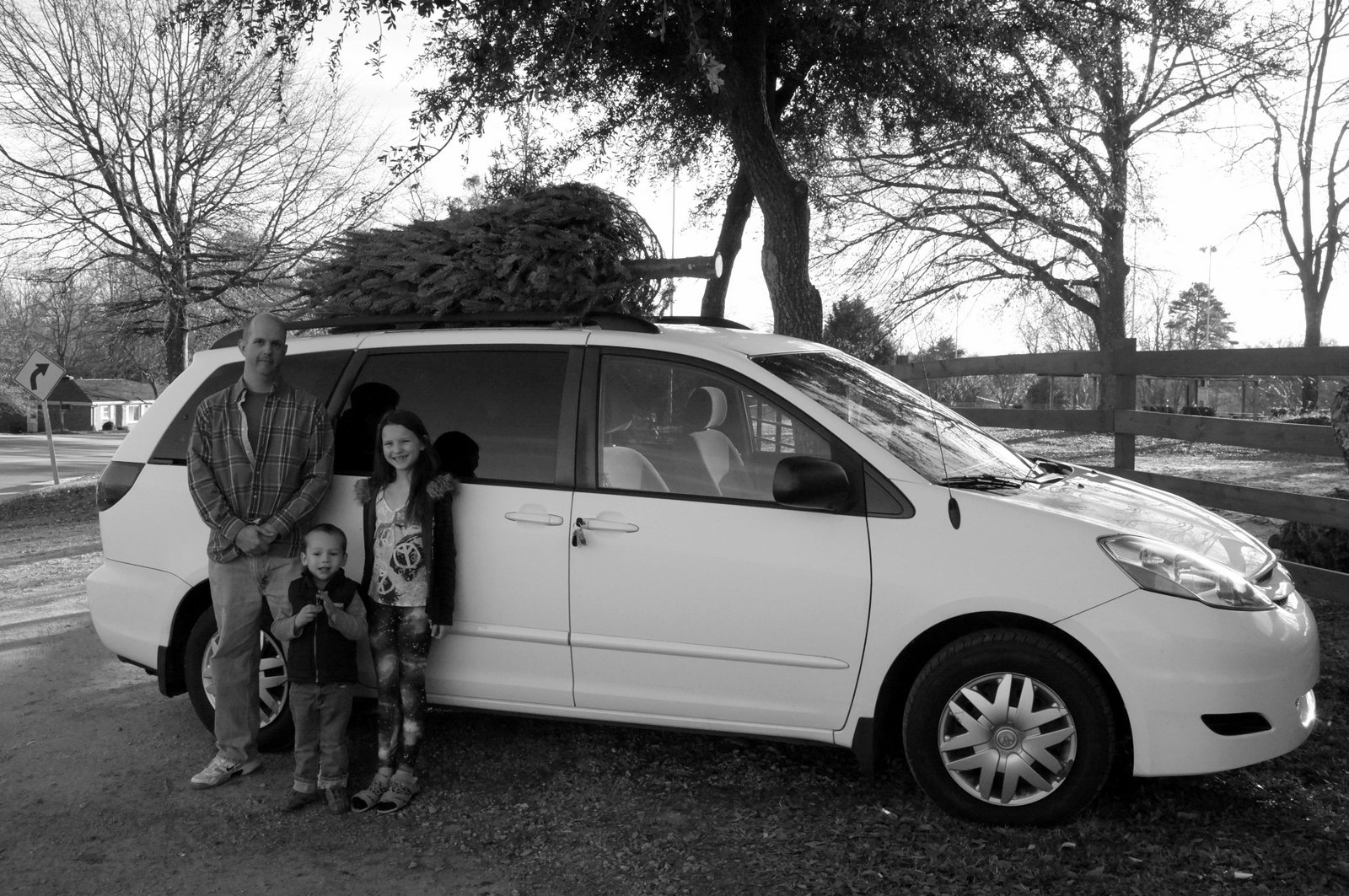
Soon enough it was strapped down to our car, then propped on our back patio, then standing in our living room. A fairly painless adventure this time. But I really shouldn't complain: however long it takes to pick a tree is however long it takes to pick the perfect tree. This year, we certainly picked a perfect one -- full, thick, and heavy, not to mention tall -- so perfect that when we put it up and K and the kids hung all the decorations, it began leaning toward the middle of the room.

6-DSCF7428

But that's a story for another post. This one needs a perfect ending, like catching Santa just as he hops in his minivan and heads out to spread some Christmas cheer.
Decorating and Exploring

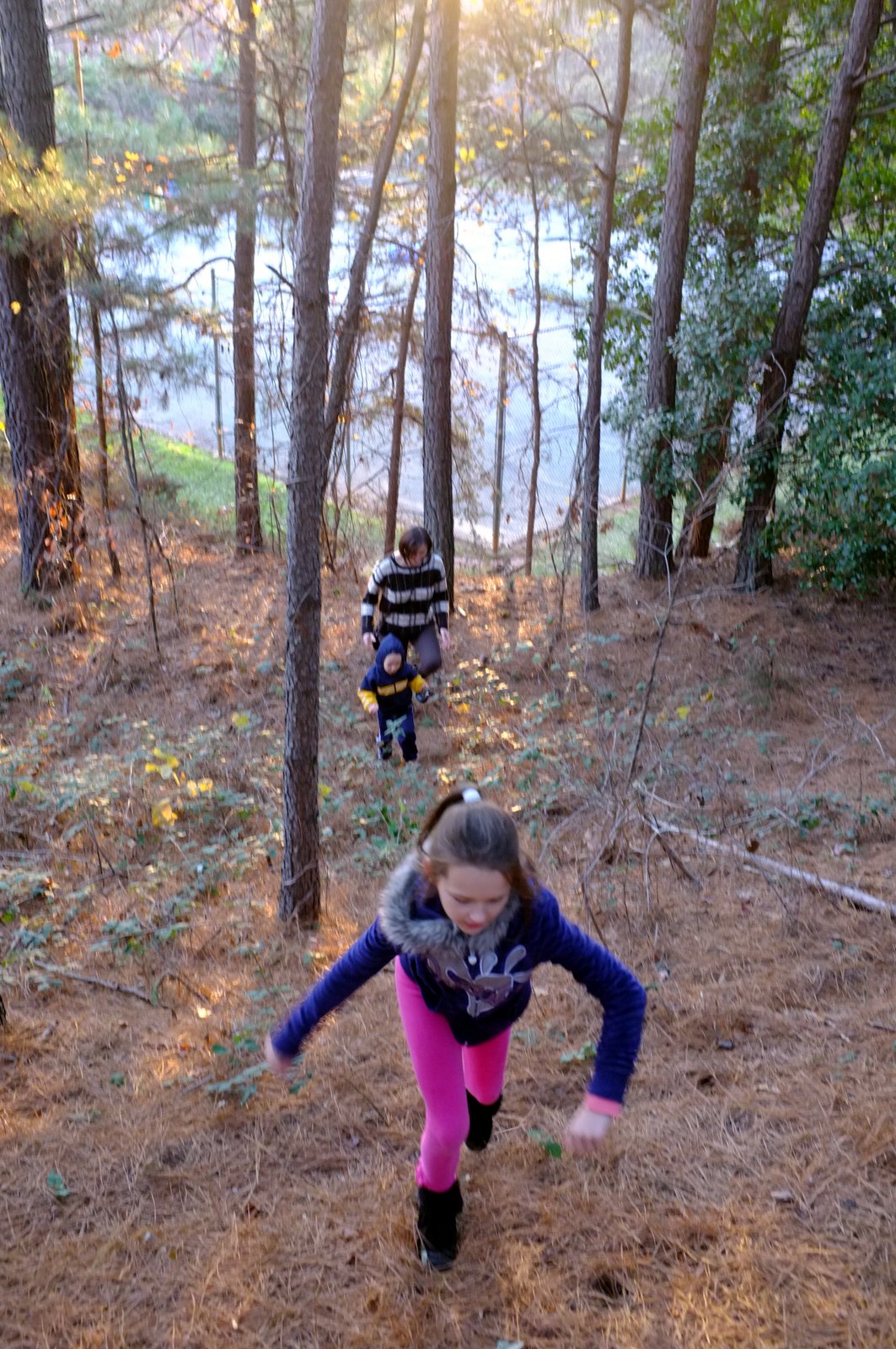
When I was a kid, there was nothing better, nothing more exciting, than the discovery of some invitingly unknown path in a place I thought I already knew. Finding a bit of mystery in the known and the everyday. So today, while we were out for a walk with the kids at Nana's and Papa's, we decided stroll over to a very familiar area, the swimming pool, where we discovered a mystery: a fence atop a small ridge.

The morning had started with a mystery: the Boy had lost in the night his blue pickup truck, and rather than simply pull the bed out and retrieve it (for if it wasn't in the covers or under the pillows, there was only one place it could be), I let the Boy search on his own. Being the Boy, he looked in some original places.

DSCF7337

As soon as sister woke up, the urge to build a fort overwhelmed the desire to find the pickup truck, and so the bit of mystery in the middle of the morning disappeared.

DSCF7340

It reappeared at Nana's and Papa's. First there's the strange bit of mystery in getting holiday decorations up. To begin with, the mystery of finding everything. Then there's the mystery of figuring out how it all goes back together. Not to mention the mystery of the season.

Mystery everywhere. Including, it turns out, in places we might never have thought to look. The weather was so gorgeous that we had to head out for a walk.

DSCF7371

Of course the pool looks a bit mysterious with its winterizing cover.

DSCF7386

But more mysterious, behind the tennis courts that the residents have turned into a dog park is a small ridge, the top of which is crowned with with a fence. Reaching the top of it, we all saw easily that it was not natural but instead part of a detention pond.

Heading up the slow
"Daddy, why is there a fence here"?
Bog 1
Bog 2
Bog 3

K insisted that it couldn't be a detention pond proper because real detention ponds in such developments are well taken care of.

Perhaps that's why there's a fence.

Showing, Not Telling

What do you do when you come into work to find that a tool you’ve used for almost ten years, a tool you’ve created yourself and spent probably thousands of hours over the course of almost a decade, a tool you use now daily as a result of the initiative of your principal and his vision of turning your school into a true tech academy — what do you do when that tool is suddenly, inexplicably, and without any notification made completely unavailable to your students? It was the situation I found myself in this morning, as my first group of students filed in, logged on, and one by one said, “Mr. Scott, the site is blocked.”

My first reaction, of course, was fury. For the briefest of instants, I took it personally, as if my web site was specifically targeted for blocking. That took only a few moments to clear up in my mind: surely it was just a new filtering rule that had been applied, and like dolphins caught up in a net trawling for tuna, my poor site just got dragged into the mix. In the end, I’m really not sure what was going on, and I’ll likely never know the cause. What’s most important is not the cause but the effect: one of the most useful tools in my classroom is unavailable because of the actions of unknown people who work for the same organization as I.

At this point, the astute reader is probably thinking, “Surely that is a mechanism in the school district through which teachers can request that a site be unblocked.” Indeed, there is. I’d made such a request a couple of years ago and another one at the beginning of the school year. According to the district records, those requests are still pending. There are many different ways to explain this, but none of them are particularly complementary of the school system’s mechanism for unblocking web sites. Still, I filled out the online form, and even sent an email, CC’ing my principal, explaining the situation and the fact that “all of my requests [for unblocking] are still pending” and my worry ” that it might be several months before any action is taken on this issue,” requesting that the powers that be “process this request immediately,” and expressing how much I “appreciate [their] prompt help in this matter.”

As a third fail-safe, I called the help line and explained my situation. The lady with whom I spoke explained that she had no power to unblock web sites, which was what I expected. She mentioned that she saw my email, which was what I expected. She explained that she’d forwarded it on to tier three, which I didn’t quite understand as I don’t know how many tiers there are in this particular case, but it was still a little unexpected. It sounded like progress. I asked if I might have some kind of contact information for someone in this tier three, and the help desk attendant explained that she didn’t even really know who they went to, simply that they went to tier three, which I somehow expected.

But how to turn it into a teaching experience? My second class filed in, and by then, I was in a white-hot righteous fury of epic proportions. The more I thought about it, the angrier I got, which sounds about right for me. Yet the students could not discern how angry I was, for I did my absolute best not to manifest it at all. In that particular class, I’m blessed to have a co-teacher, and when she entered, I explained to her what happened, then explained to the class what had happened. I went so far as to say that I was extremely angry about it. But I excused myself, went to the restroom, ranted for a little bit, washed my face to freshen up, and went back to the classroom and carried on as if nothing had happened. Students were finishing up summaries of a reading we’d just finished, and I and my co-teacher went from student to student, advising, helping, praising, encouraging — all the things we try to do on a daily basis to build the self-confidence of the students in this class, all of whom read below grade level. A corollary to this low reading ability for many of them is a low level of self-control. Several of them say what comes to mind when it comes to mind. Many of them, when they come into the classroom angry about some excessively emotional interaction that occurred in the hallway — “drama” they call it — enter the classroom already doomed: they will sit and stew about it the entire class, refusing to work, refusing to calm down, often disrupting the class further.

On Monday, I’ll be able to debrief them about how I dealt with my anger. “Please notice,” I’ll begin, “that I didn’t take it out on you and that I didn’t refuse to work. I dealt with it and moved on. Was I still angry at the end of class? Very much so. But I kept it from controlling me.” Will it help? Perhaps. Teaching by example is always better than teaching by words. Show, don’t tell. Who knows — that might turn out to be the most valuable session we had all year for some students.

Is it love?

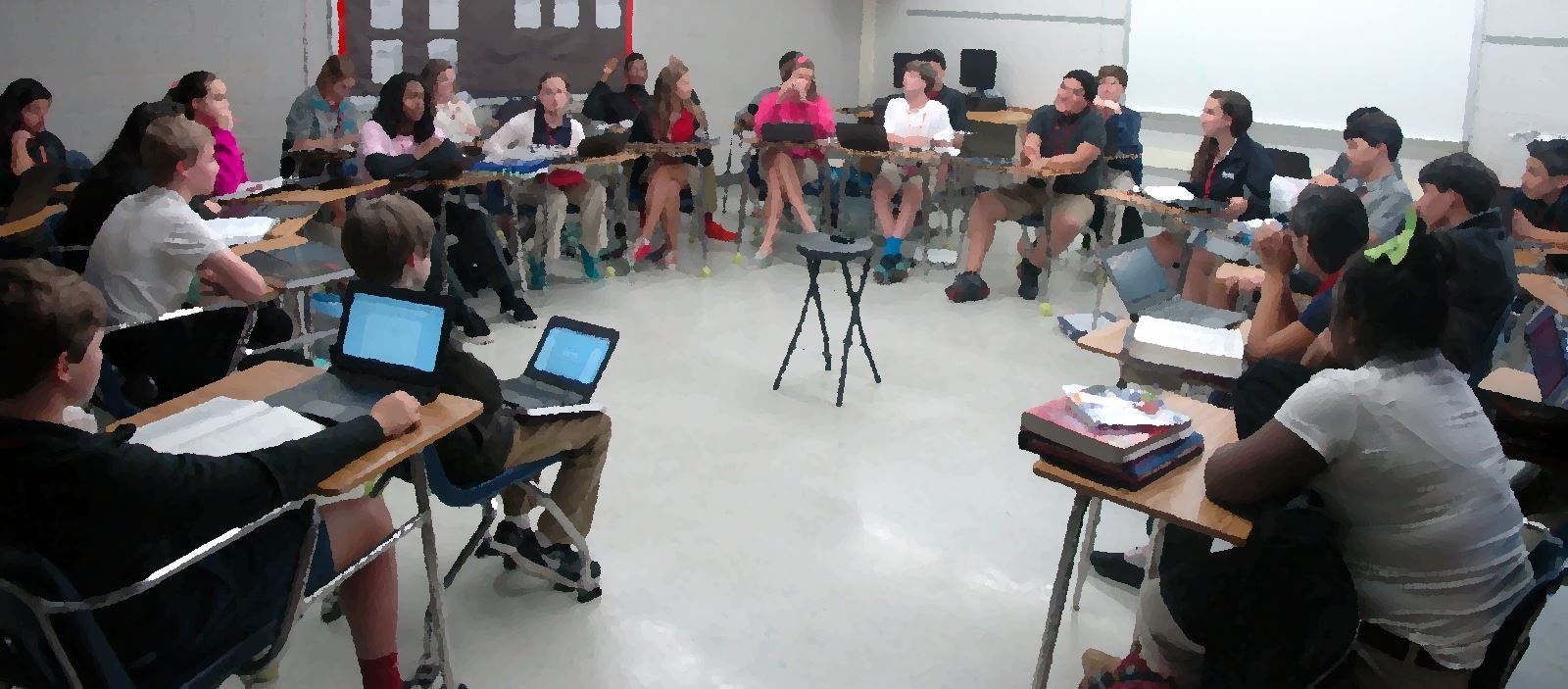
Does Romeo really love Juliet? Can Juliet trust her emotions about Romeo?

The first group just dives in. They've got proof from the text -- they're ready to go. Never mind that during the preparation period with their partners, they didn't know whether they would be arguing that it is love or that it isn't. No matter: they're prepared for both.

1-DSC_8951

The second group takes a bit more to get going. They're quieter, both as a simple group of kids and as a class. But once they get going, they're backing everything -- I mean everything -- with direct quotes from the play. "In act one, scene five, lines x through y, we read..."

This is why my job is so fun -- getting kids to the point that they can have discussions like this.

(Originally published on my school web site.)

Forty Years Ago in Prophecy

"YOUR own future is laid bare, now, in prophecy!" Though intended as a compelling beginning, a startling call for readers to wake up and realize the cold reality they're facing, almost sixty years later the opening sentence of Herbert Armstrong's 1975 in Prophecy reads like the dating advertising copy it essentially was.

Written in 1956, it was a centerpiece booklet in his radio ministry. Claiming to have discovered -- rather, to have received through divine inspiration -- the key to unlocking Biblical prophecy, Armstrong claimed a certain clairvoyance unique among other religious figures. To his credit, he didn't take credit for it: he was merely an instrument of God. Still, there is a certain headiness in being the one to whom has been revealed a startling truth that, for ages, no one knew.

Prophecies that were closed and sealed tight now stand REVEALED. This mystifying, neglected third of the Bible now becomes plain. Mysteries of God, never before understood, now become crystal-clear. God's own time for this revealing has come. The KEYS that locked the future have been found.

Hidden prophecies seldom sell if they're absolutely and completely good. Like those who slow down and crane their necks when passing the scene of an auto accident, we all have a touch of the morbid in us and a suggestion of how bad things are really going to get can be utterly fascinating. This could be even more true in the 1950s, when 1975 in Prophecy first appeared. As the Cold War continually escalated, nuclear war with the Soviet Union seemed a very real possibility. Indeed, it wasn't so much a question of if it happened but rather when for most Americans. Catastrophe waited in the not-so-distant future, and it was this uncertainty upon which Armstrong built his ministry, and it was with this expected nuclear showdown with the Soviets that Armstrong created his catch, because of course, there was always a catch, according to Armstrong:

But what is actually going to happen is not what the world expects!

Today this world is changing - fast! Unprecedented events are shaking the world already. Yet what we have seen is mild compared to the catastrophic happenings that will rock this world in the near future!

You'll have to live into these tremendous times. This is YOUR life! You live here, in this erupting world! It behooves you to know what the Creator-RULER of the Universe now makes known!

Armstrong claimed that the United States and Western Europe were in fact the original ten tribes of Israel, supposedly lost to the mists of time. (Jews were only of the two break-away tribes the formed the Kingdom of Judah.) The Germans, though, were an exception: they were the ancient Assyrians, forever battling the Israelites. This battle spilled into the twentieth century, and explained both world wars. It was to be the Germans, not the Soviets, who attacked and conquered America.

Before getting to the bad news, though, and perhaps in an effort to pad the manuscript, Armstrong rehearses all the technological advances of the mid-twentieth century.

Feverishly, science, technology and industry are working to produce a fantastic, push-button world of leisure by 1975. The emphasis today is on "saving steps." Everything is to be done for us, by machines. Just push the magic button, and your work will be done automatically.

Already automobiles are equipped with push-buttons to shift the gears, raise or lower windows, move the seat forward, backward, up or down.

It's difficult to look at our current reality, with in-dash GPS, smart phones, and loads of cheap Chinese imports, and not think the advances of the 1950s somehow quaint. In spite of the stresses of the Cold War, there was a certain naivety at the time, on both sides of the Communist-capitalist ideological spectrum. Both sides were sure that their economic model would produce a not-too-far-in-the-future utopia. Francis Spufford recently portrayed this in Red Plenty, a clever, well-researched novel about the hope in the Soviet Union under Khrushchev that the Soviet Union would soon be the envy of the West; Armstrong beat Spufford by fifty years with his visions in 1975 in Prophecy:

In the dream-world MAN is devising for tomorrow, it will no longer be necessary to cook food on stoves. Food is to be cooked by heat waves in packages. You'll no longer bother taking a bath in a tub or shower. You'll take an effortless and quicker waterless bath by using supersonic waves! When you pick up your telephone, you'll see the party at the other end! The new automobiles, the new homes, the new schools are to be truly fantastic. The stores, hotels, and railroad trains will take your breath!

So far, surprisingly close to the reality we experience. Of course the waterless shower never took off -- or appeared, as best I can remember -- but we have had microwave dinners for over thirty years now while Skype and smart phones make land lines obsolete.

And air travel? Well, already leading air lines have placed multi-million dollar orders for still larger jet planes that will leave New York at 11 in the morning and arrive at Los Angeles by noon. These are under production, now. But what do you suppose air travel will be like by 1975?

For one thing, it is expected that many people will commute in their own private helicopters. Very probably these immense jets now being built will then be obsolete, and we'll travel in rockets at two or three thousand miles per hour. Think of it! Elapsed flying-time, New York to Los Angeles reduced to one hour! Since it is only 9 A.M. in Los Angeles when it's noon in New York, we may be flying across the continent, and arriving in Los Angeles two hours before we start! And elapsed flying-time from London to New York will be reduced to 1½ hours! As it is noon in London when it's only 7 A.M. in New York, we may be flying across the Atlantic and arriving in New York 3½ hours before we start!

Yes, MAN is devising fantastic things!

Unfortunately for Armstrong and the other futurists of the 1950s, their own predictions were among the "fantastic" things, though in their case, it's meant in the original adjectival form of "fantasy."

It's easy to look back on those predictions and mock them. We have the obvious advantage that it's no longer prophecy but history.

Under Cover in Europe

While America has been focusing its sole attention on its clumsy effort to meet psychological cold-war with antiquated diplomacy and military might, the real number one enemy has been perfecting its plans SECRETLY, UNDER COVER, IN EUROPE!

These plans were laid by Adolph Hitler, during World War II. The methodical Germans took into consideration the possibility they might lose, even as they had lost World War I. This time their plans for coming back and launching World War III were carefully laid before the close of World War II.

The day that war ended, the Nazi organization went underground! Their plans for coming back have been proceeding, under cover, since 1945!

Already Nazis are in many key positions-in German industry - in German education-in the new German ARMY!

In World War I, the Kaiser, allied with Austria, sought to conquer France, Britain and America. American Industry finally beat him. In World War II, Hitler tried to conquer the world, first by taking Austria and the Sudetenland thru diplomatic gangsterism; then second, with lightning-quick war, taking Poland, Denmark and Norway, Holland, Belgium and France; and third, while holding these nations by the throat with his Gestapo, and allied with his junior partner Mussolini, to conquer Russia on the east and Britain on the west. But again, American Industry, three Acts of God, at Dunkirk, El Alamein, and the destruction of the German hydrogen-bomb plant at Peenemuende defeated Hitler.
But this time the Nazis plan to side step the causes of past defeats. Instead of exhausting their own strength by holding European nations as captives at the expense of vital Gestapo man-power, they plan to head and dominate a UNITED STATES OF EUROPE -- and add the man-power of those nations to their own military divisions. And secondly, they plan to strike their first blow, NOT at France or Poland in Europe, but with hydrogen bombs by surprise attack on the centers of AMERICAN INDUSTRY!

I suppose with enough imagination, one could imagine in the mid-fifties, only ten years on from World War Two, that the Nazis had somehow managed to regroup and were planning a horrific third attempt at world domination. Such a theory certainly would work well with those still dealing with the consequences of the war, with so many people still dealing with the loss of life and property in the war.

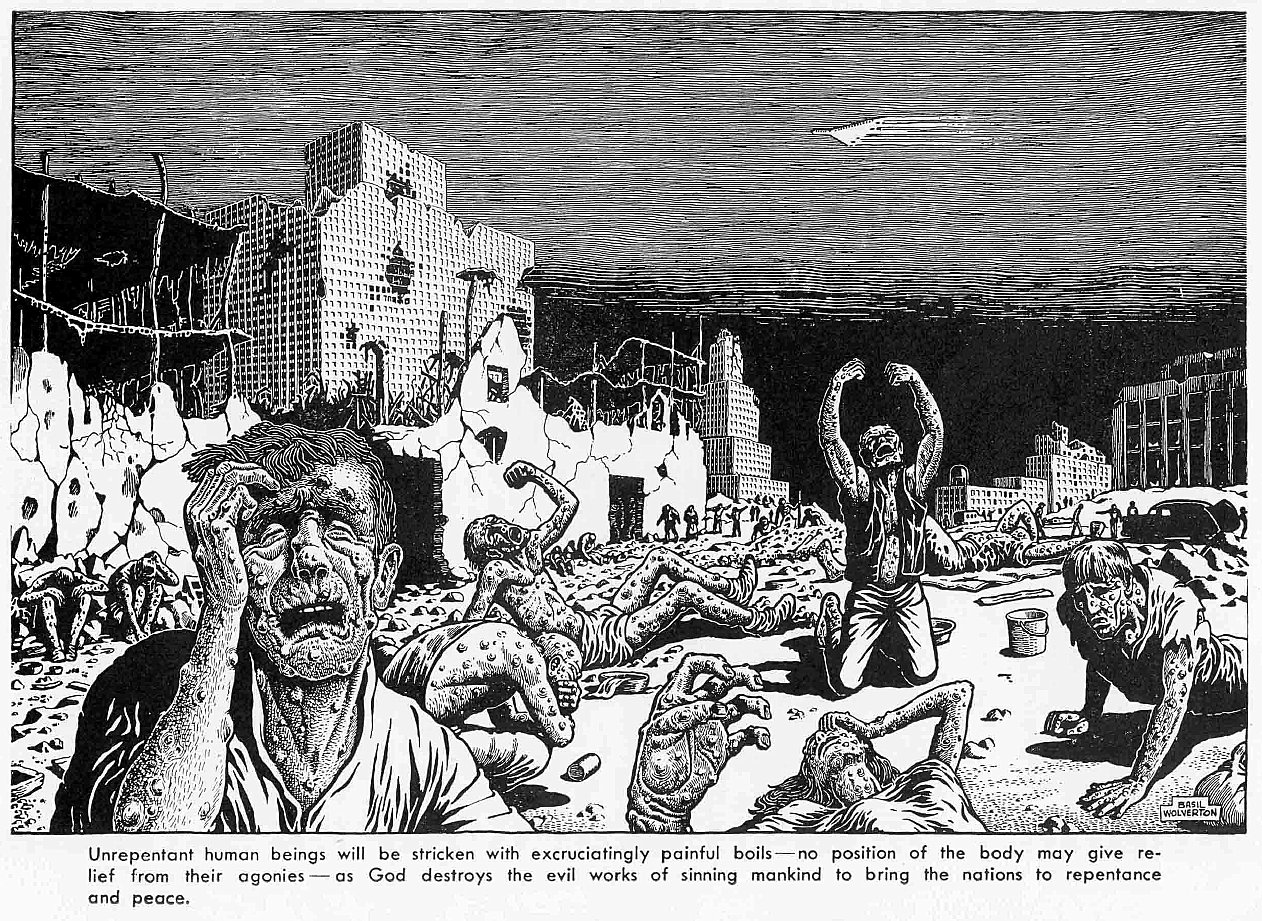
It was this coming cataclysmic doom -- famines and pandemics would also accompany the military defeat -- that 1975 in Prophecy was using to sell Armstrong's theology. The booklet came complete with graphic, violent images depicting the coming horrors, called the Great Tribulation in Armstrongian theology.
Fullscreen capture 1132013 64012 PM

The man-made horrors would not be enough to cause humanity to repent, Armstrong reasoned, so the natural world would add to the world's misery with great earthquakes, tidal waves, famines, and pandemics.

Fullscreen capture 1132013 64018 PM

Armstrong had Basil Wolverton, a cartoonist who joined Armstrong's church in 1941, used his typical over-the-top comic style, creating images that disturb not only because of their content but also their style.

When I flipped through the booklet as a kid, I found these images repulsive and fascinating at the same time, not to mention confusing. They were supposed to be depictions of the coming holocaust, but by the time I was flipping through the booklet, it was the mid-eighties and all of this was supposed to have already taken place.

Fullscreen capture 1132013 64022 PM

It will be, yet it was supposed to have already been.

And now, forty years later, there are still religious groups that believe Germany at the head of the EU will rise again and conquer the United States. The Philadelphia Church of God, the Restored Church of God, the United Church of God, and the Living Church of God are the three biggest groups holding such beliefs, with dozens of smaller groups professing the same thing. They all insist that this is coming, that Armstrong was ultimately correct, and that these pictures are legitimate depictions of the coming horrors.

I find it difficult to believe that people could be so naive, given the fact that so much of what Armstrong taught has been shown to be false. Most significantly, Armstrongists are in the same situation as Mormons due to advances in DNA testing, which show that both groups' claims about the ultimate destiny of the so-called Lost Tribes of Israel are radically wrong: there are no Semitic markers in the European population (except, surprisingly, the Jews), thus discounting Armstrong's theory, and the Native Americans similarly lack such markers, thus disproving Joseph Smith's theory. Still, these organizations pull in members and money.

Long ago I wrote a letter to one of these organizations only to find out later that my letter was read to the entire church as an example of the horrendous persecution that awaits the leader.

I regret that letter in a sense: it seems like I'm saying at the end that I look forward to the death of the group's leader, David Pack. Not at all. Even in my most skeptical periods, I would have never have wished death upon someone. What I meant was that I was looking forward to seeing the scramble for power and more interesting the desperate attempt to remold Pack's statements that he would live to see these prophecies come to pass as something less prophetic than they were, just as Armstrong apologists do with Armstrong's assurances that it would all be over by 1975. Perhaps I should write again and apologize?