
Month: February 2021
Blasphemy
 “I listened to Fr. Mike already,” I told K this morning. I listened to the Bible in a Year podcast while making lunch and breakfast. It’s the best time for me to listen to it: K is taking a shower, and usually I’m alone.
“Was it interesting?”
“Well, more killing, killing, killing.”
Today, Fr. Mike covered Leviticus 24, and verses 10-16, in particular, stood out to me:
Now an Israelite woman’s son, whose father was an Egyptian, went out among the people of Israel; and the Israelite woman’s son and a man of Israel quarreled in the camp, and the Israelite woman’s son blasphemed the Name, and cursed. And they brought him to Moses. His mother’s name was Shelo′mith, the daughter of Dibri, of the tribe of Dan. And they put him in custody, till the will of the Lord should be declared to them.
And the Lord said to Moses, “Bring out of the camp him who cursed; and let all who heard him lay their hands upon his head, and let all the congregation stone him. And say to the people of Israel, Whoever curses his God shall bear his sin. He who blasphemes the name of the Lord shall be put to death; all the congregation shall stone him; the sojourner as well as the native, when he blasphemes the Name, shall be put to death.
It struck me that this is a particularly tricky passage because there’s no set definition for blasphemy. Sure, the Israelites would have codified some definition of blasphemy, but ultimately, it’s a relative thing. Just look at the definition the Oxford dictionary provides: “the act or offense of speaking sacrilegiously about God or sacred things; profane talk.” Sacrilege is simply profane talk: treating something that is sacred as if it were not. If that’s the case, then even highly religious people commit blasphemy all the time — in someone’s eyes. It seems that if God wanted to make sure that people weren’t getting stoned for saying “gosh,” which is really a euphemism for “God,” that this ultimate punishment was saved for at least a more heavy-handed approach, like calling someone a God-damned idiot. (Would that be blasphemy? I was just using the term to quote a hypothetical person in a hypothetical situation — but is that blasphemy?)
Forever Throughout Your Generations
Today, Fr. Mike went through Exodus 32 and Leviticus 23. The passage in Exodus deals with the golden calf that the Israelites started worshiping. Fr. Mike also pointed out that this is where the Levitical priesthood is born, in verses 25-29:
And when Moses saw that the people had broken loose (for Aaron had let them break loose, to their shame among their enemies), then Moses stood in the gate of the camp, and said, “Who is on the Lord’s side? Come to me.” And all the sons of Levi gathered themselves together to him. And he said to them, “Thus says the Lord God of Israel, ‘Put every man his sword on his side, and go to and fro from gate to gate throughout the camp, and slay every man his brother, and every man his companion, and every man his neighbor.’” And the sons of Levi did according to the word of Moses; and there fell of the people that day about three thousand men. And Moses said, “Today you have ordained yourselves[a] for the service of the Lord, each one at the cost of his son and of his brother, that he may bestow a blessing upon you this day.”
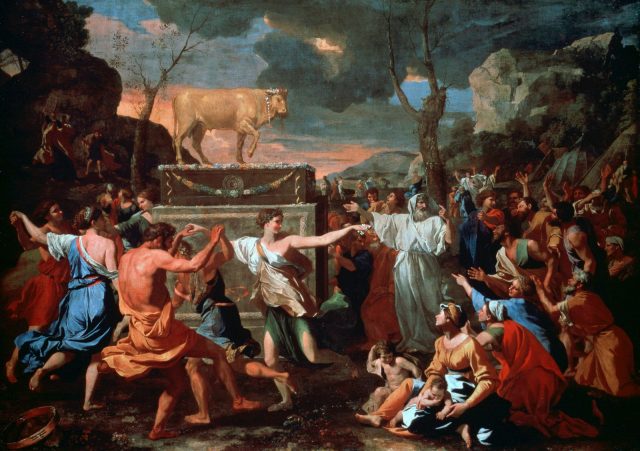
So what made the tribe of Levi so special that priests could come only from them? They slaughtered a bunch of me who were stupid enough to worship a damn cow that they themselves had made. I mean, it's no secret where the cow came from. The chapter begins with a command from the people: "When the people saw that Moses delayed to come down from the mountain, the people gathered themselves together to Aaron, and said to him, 'Up, make us gods, who shall go before us; as for this Moses, the man who brought us up out of the land of Egypt, we do not know what has become of him.'" These idiots see the idol being made and then turn right around and credit it with their deliverance from Egypt. They're simple people at best. They'll literally worship just about anything. God should have had pity on their stupidity, but instead, he had Moses kill a bunch of them.
At first, God wants to kill them all, but Moses talks him down from that ledge:
But Moses besought the Lord his God, and said, “O Lord, why does thy wrath burn hot against thy people, whom thou hast brought forth out of the land of Egypt with great power and with a mighty hand? Why should the Egyptians say, ‘With evil intent did he bring them forth, to slay them in the mountains, and to consume them from the face of the earth’? Turn from thy fierce wrath, and repent of this evil against thy people. Remember Abraham, Isaac, and Israel, thy servants, to whom thou didst swear by thine own self, and didst say to them, ‘I will multiply your descendants as the stars of heaven, and all this land that I have promised I will give to your descendants, and they shall inherit it for ever.’” And the Lord repented of the evil which he thought to do to his people.
It's amusing that the way Moses talks God out of killing them is by appealing to God's pride. "I mean, look -- you're going to seem foolish if you deliver all these people from Egypt and then just kill them." Strangely enough, though God never changes according to the Bible and never does evil (also according to the Bible), he "repented of the evil which he thought to do to his people."
Now how does Fr. Mike deal with these difficulties? Simple -- he doesn't. He talks about how we like to make God into an idol that we can control. We put him in our pocket and then take him out when times are tough. That's a fair enough assessment, I think, but it doesn't really deal with the weirdness of the passages he read for us today.
The other passage today was Leviticus 23, which deals with the feast days God wants people to celebrate. "These are the appointed festivals of the Lord, the holy convocations, which you shall celebrate at the time appointed for them" (verse 4). Obviously, Christmas and Easter aren't in there, but a whole bunch of feasts that I grew up celebrating are, and I grew up celebrating them for a very simple reason: the Bible says to do so, and nowhere in the New Testament does it say to stop celebrating them.
Indeed, the passages requiring them are quite specific that these are ordained for all time:
- Verse 14 is about the offering of First Fruits: "You shall eat no bread or parched grain or fresh ears until that very day, until you have brought the offering of your God: it is a statute forever throughout your generations in all your settlements."
- Verse 21 is about the Feast of Weeks (Pentecost): "This is a statute forever in all your settlements throughout your generations."
- Verse 31 is about Atonement: "You shall do no work: it is a statute forever throughout your generations in all your settlements."
- Verse 41 is about the Feast of Tabernacles (Booths): "You shall keep it as a festival to the Lord seven days in the year; you shall keep it in the seventh month as a statute forever throughout your generations."
Recall Zachariah 14:16 from a few days ago: "Then every one that survives of all the nations that have come against Jerusalem shall go up year after year to worship the King, the Lord of hosts, and to keep the feast of booths." It seems pretty clear that God is ordaining these celebrations for all times and all people. Why don't most Christians celebrate them anymore?
Fr. Mike, of course, did not deal with that. And I can't really blame him: this is "The Bible in a Year" podcast, not "The Bible in a Year for Skeptics" podcast. But it does illustrate one tendency I've noticed about believers. Those tricky parts, those troubling parts -- they don't see them. Even when they're there in front of them, they don't see them.
"God is mysterious," and it's all taken care of.
Savannah 2021




Rainy Sunday
When the day looks like this

you make a pot of this

and watch movies.
More Silence
Earlier, Fr. Mike explained that the reason Christians are to follow some of the Old Testament commands and disregard others is a question of audience. Some were meant to be only for Israel while others are clearly meant for everyone. He tried to elaborate it with an example about homosexuality in the Bible in which he pointed out that the text points out that the nations surrounding Israel "defiled" themselves in this way (I guess by showing tolerance to the gay community) and that Israel was not to do the same. Thus, Fr. Mike contended, it was clearly meant for those other nations as well. That's how he explained away the command not to wear clothes of mixed fabrics but insisted that the prohibitions against homosexuality were still binding.
Alright, so let's take that as a given for the sake of argument. I don't think the point stands: I think it's just a bunch of verbal sleight-of-hand (I know -- horribly mixed metaphor). There's nothing in the text that explicitly even suggests that some of these laws are binding for all people and some are not. Most Christians today don't keep the OT feasts like the Feast of Tabernacles (also known as the Feast of Booths) even though Zechariah 14:16 states, "Then every one that survives of all the nations that have come against Jerusalem shall go up year after year to worship the King, the Lord of hosts, and to keep the feast of booths." If anything seems directed toward all people, this surely is. By Fr. Mike's logic, then, Christians should still be keeping at least observe the Feast of Tabernacles/Booths. Be all that selective-application-of-a-dubious-hermeneutic as it might be, let's just take for the sake of argument that Fr. Mike's interpretative principle is sound. What do we make of today's reading, then?
Leviticus 20 is a brutal chapter. It lists the penalties for various infractions of the law. Most commonly, the penalty is death, and that death, most commonly, is by -- guess! bet you'll never guess it right! -- stoning.
It starts out with a fairly disturbing command: "The Lord said to Moses, 'Say to the people of Israel, Any man of the people of Israel, or of the strangers that sojourn in Israel, who gives any of his children to Molech shall be put to death; the people of the land shall stone him with stones'" (verses 1 and 2). This giving of children to Molech was always explained as child sacrifice. So it's disturbing that child sacrifice is such an issue (or potential issue) that right out of the gate, the first penalty deals with this. We might think, "Well, that's good. At least this god has the children's good in mind." That reassuring thought disappears as soon as we read verse three, though: "'I myself will set my face against that man, and will cut him off from among his people, because he has given one of his children to Molech, defiling my sanctuary and profaning my holy name.'" So it's not that they committed this awful cruelty to children, it's not that they betrayed their responsibilities as parents, it's not that they tortured children -- no, it's all about this god. Burning children is bad because it profane's this god's name. That's just sick.
From that auspicious start, we have a whole litany of death:
- In verse 9, we're instructed to kill incorrigible children: "For every one who curses his father or his mother shall be put to death; he has cursed his father or his mother, his blood is upon him."
- In verse 10, we're instructed to stone adulterers: "If a man commits adultery with the wife of[a] his neighbor, both the adulterer and the adulteress shall be put to death."
- Verses 11 and 12 as well as 14 through 21 deal with the penalty for various forms of incest and beastiality. Death, of course.
- Verse 27 deals with those who supposedly talk to the dead: “A man or a woman who is a medium or a wizard shall be put to death; they shall be stoned with stones, their blood shall be upon them.”
As a side note, many people have demonstrated that this "talking to the dead" nonsense is just that -- it's cold reading. Derren Brown has walked into a room and convinced people he was talking to the dead just after saying to the camera, "I'm going to go in there and make them think I'm talking to the dead, but I'll be doing no such thing."
It's verse 13, though, that stands out when juxtaposed to what Fr. Mike said earlier: "If a man lies with a male as with a woman, both of them have committed an abomination; they shall be put to death, their blood is upon them." This is a clear condemnation of homosexuality. The question is this: if the prohibition of homosexuality is to be interpreted as universal, why shouldn't the punishment be likewise?
Verses 22 through 24, though, is even more interesting, for it seems to demolish Fr. Mike's whole distinction between universal and non-universal application of the Old Testmant law:
“You shall therefore keep all my statutes and all my ordinances, and do them; that the land where I am bringing you to dwell may not vomit you out. And you shall not walk in the customs of the nation which I am casting out before you; for they did all these things, and therefore I abhorred them. But I have said to you, ‘You shall inherit their land, and I will give it to you to possess, a land flowing with milk and honey.’ I am the Lord your God, who have separated you from the peoples."
Fr. Mike argued that the earlier condemnation of homosexuality was universal because it was set in opposition to what the surrounding nations tolerated, but these verses do the exact same thing for all God's commands.
So what does Fr. Mike in his post-reading reflection say about all this brutality? How does Fr. Mike deal with the verse that seems not just to undermine his earlier argument but to demolish it completely? Simple: he says nothing. He instead focuses on the other reading for the day, Exodus 27 and 28, which deal with the priestly garments, and he talks about his own experiences wearing modern priestly garments.
It's not a problem if you don't acknowledge it...
Arguing
It’s a good sign when kids in fifth period walk into the classroom already arguing about the topic up for discussion that day: who is ultimately culpable for the deaths of Romeo and Juliet?

Final Speech
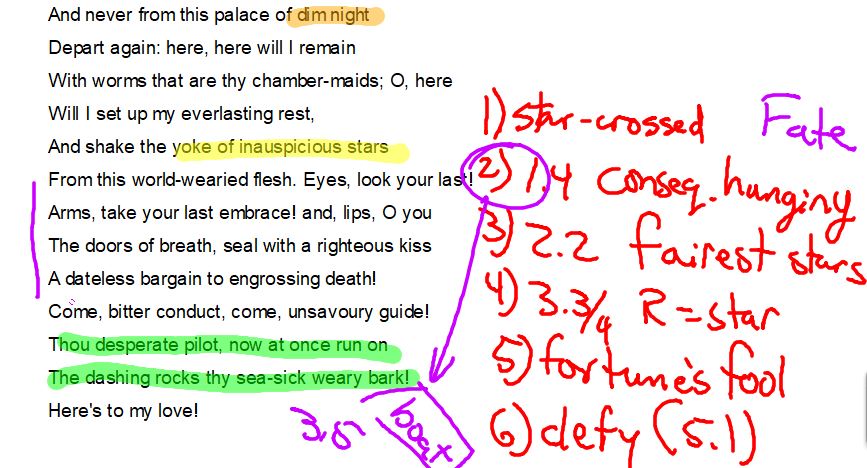
We looked at the final soliloquy in the play, when Romeo loses all sense of rationality and makes a horrible decision based primarily on emotion. We examined how Shakespeare develops this idea within the text by
- extensive use of "O";
- chaotic changes in the soliloquy's subject;
- references to a loss of control;
- and other techniques.
Students first presented their claims about the text, many of which led naturally into the observations I wanted students to have later in the lesson.
They were doing some pre-teaching for me, in other words.


It was a good day to be a teacher.
Darts and Games
I've neglected photos for almost a month now -- almost nothing new added to the Lightroom catalog.

I've been taking pictures -- a few of them.

They've just been sitting on the memory card in the camera.

Plus, I've been writing and thinking about politics and religion...
Emissions and Lapidation
"That can be a very challenging, challenging reading," Fr. Mike begins today's commentary, which I take to mean something like, "It's really tough to explain away these passages that seem so barbaric or seem so weirdly obsessed with relatively unimportant things. They seem to challenge the very goodness and wisdom of the god we worship." The reading was Exodus 22 and Leviticus 15, and he says that the Exodus reading seems to be more commonsensical.
The first part of the chapter has to do with the laws of restitution -- things like what to do if your bull gores another animal. That type of thing. Fr. Mike discusses these laws fairly quickly, and he's probably right: they are fairly commonsensical in a way. These passages, Fr. Mike explains are "revealing something about God's heart." These are "the principles according to justice."
What he says not a word about are the instructions in the latter half of the chapter, particularly the first set of so-called social and religious laws:
“If a man seduces a virgin who is not betrothed, and lies with her, he shall give the marriage present for her, and make her his wife. If her father utterly refuses to give her to him, he shall pay money equivalent to the marriage present for virgins.
“You shall not permit a sorceress to live.
“Whoever lies with a beast shall be put to death.
“Whoever sacrifices to any god, save to the Lord only, shall be utterly destroyed." (Exodus 22 16-20)
We're to stone incorrigible children. We're to stone witches. We're to stone those who change religions. Stoning is such a brutal, barbaric punishment that the fact that not only does this god justify it ("I'd rather you not do it, but I guess if you do it in these situations it's alright") but simply commands it -- that thought alone disqualifies this god of anything other than contempt from right-thinking people, from people who have a modicum of empathy and decency.
These are, remember, the "principles according to justice" instead of vengeance; this god is all about making sure the punishment fits the crime. So apparently, taking your child out, burying him to the waist, and bludgeoning him to death with stones is a just punishment. Stoning is appropriate for the imaginary crime of sorcery. And just as we see in Islam, the punishment for leaving the faith is -- you guessed it -- stoning.
Remember, too, that these things, according to Fr. Mike, "reveal something about God's heart." What it reveals to me is simple: this is not a just god; this is not a decent god.
But it is the god presented in the Bible, so all this behavior must be justified. We have to explain away this barbarity somehow. How does Fr. Mike justify it? Simple: he just doesn't comment about it at all. Not a word about any of the commands to stone anyone. Not one word.
He does go into detail about the passage in Leviticus, which is what all we're to do regarding menstruating women and semen-spilling men. It reads like this:
“And if a man has an emission of semen, he shall bathe his whole body in water, and be unclean until the evening. And every garment and every skin on which the semen comes shall be washed with water, and be unclean until the evening. If a man lies with a woman and has an emission of semen, both of them shall bathe themselves in water, and be unclean until the evening. (Lev. 15.16-18)
This is what the creator of the universe, the ground of all being, is concerned with: what to do after a wet dream.
Fr. Mike explains it this way: "The bodily emissions are important why? Because life is in the blood. They're important because they refer to very intrinsic and necessary parts of our relationships." But why would there be rules about this? Fr. Mike explains,
[It] is because the body is sacred. The emissions of the body refer to life but also because this particular kind of emissions of the body have to do with sex, have to do with reproduction, have to do with relationships. [...] There's some kind of guidance, some kind of restraint again placed upon people when a) they are engaged in sexual acts with one another, and b) they're in community with each other. And this is just part of the genius of God's word. God's word is saying "we're going to show restrait." And that restraint is not for restraint's sake alone and also not like "oh, gross!" -- that's not what uncleanness means. Uncleanness simple means whether this is an issue of blood, an issue of seman, whaterver this is, those are things that can bring forth life. But because they bring forth life, we have to be careful around them. This is something that's so important for us to rediscover in the twenty-first century that because there are things so connected to life we need to be careful around them.
What does that even mean? Why would we "be careful"? In what sense would we "be careful"? Is he talking about being careful with sex? I guess that's what he means, but the Levitical passages aren't solely about sex; they're about menstruation and simply ejaculation (not necessarily during coitus). It all just becomes a big confusing bundle of squishy words that don't seem to mean anything.
I feel like he's just providing an answer that he knows, consciously or unconsciously, is vague but will communicate enough to reassure believers who are troubled by this passage. They might not even understand it, but it gives them something to calm their worries about this passage. I can even hear someone saying something like this, then appending it with, "I'm not sure I explained it right. Fr. Mike does it better. You should just listen to the podcast."
Header image is a still from the film The Stoning of Soraya M.