Matching Tracksuits

fun in fours

Month: March 2014

Aldi Quarter

"Daddy, can I have my quarter back?"

"Just a second," I say, reaching into my pocket as I come to the stoplight. To find my pocket is empty. The irony brings a smile: "Honey, I think I left it in the buggy."

Aldi saves money in many ways, but one method is based on the simple principle that we like physical things, that the slightest bit of actual money has more value than the minute or two we might save in leaving a shopping cart in the middle of the parking lot. The theory was, I'm assuming, that if people have to put down a monetary deposit, they'll want it back, no matter how insignificant. And so we all dutifully roll our carts back to the long outdoor line of carts, snap the metal tab back into place, and retrieve our quarter. (Actually, since we leave our cart at the checkout for the next customer, it's the quarter belonging to the guy who beat us to the checkout lane.) In doing so, we save work for the employees, because no one has to go out and round up all the carts, thus reducing overhead, which leads, in part, to Aldi's famously low prices.

Why do we return the shopping carts? After all, it's just a quarter, and we could easily just tack that on as a shopping expense like gas. But we don't. Not a single one of us: I've never seen a single buggy left in the parking lot at Aldi. Not one. Yet in the parking lots of grocery stores that have buggy corrals and regularly send out young employees to rustle them up, we see shopping carts left here, there, everywhere. Customers must feel that, since someone is already coming out to release the carts from their little prisons that they could just as easily walk a few more steps and pick up the buggy left a few yards away. It's rare that you see a good Samaritan pushing back someone else's cart, but therein lies the beauty of the Aldi system: it relies not on motivating customers to return their own carts but in motivating other customers to round up abandoned carts, because, hey, free quarter. So the rest of us must internalize that thought and tack on a little sense of competition: "Someone's going to get that quarter -- it might as well be me."

At least that's my idea. Any others?

Photo by JeepersMedia

Teaching the Boy

The Boy and the Girl often end the evening together in the tub. "Bubbles!" cries the Boy as he runs to get L.

Sometimes, L gets an urge to play teacher.

Double Down!

1-BW0_3710
Snaggle-tooth Girl

Refill

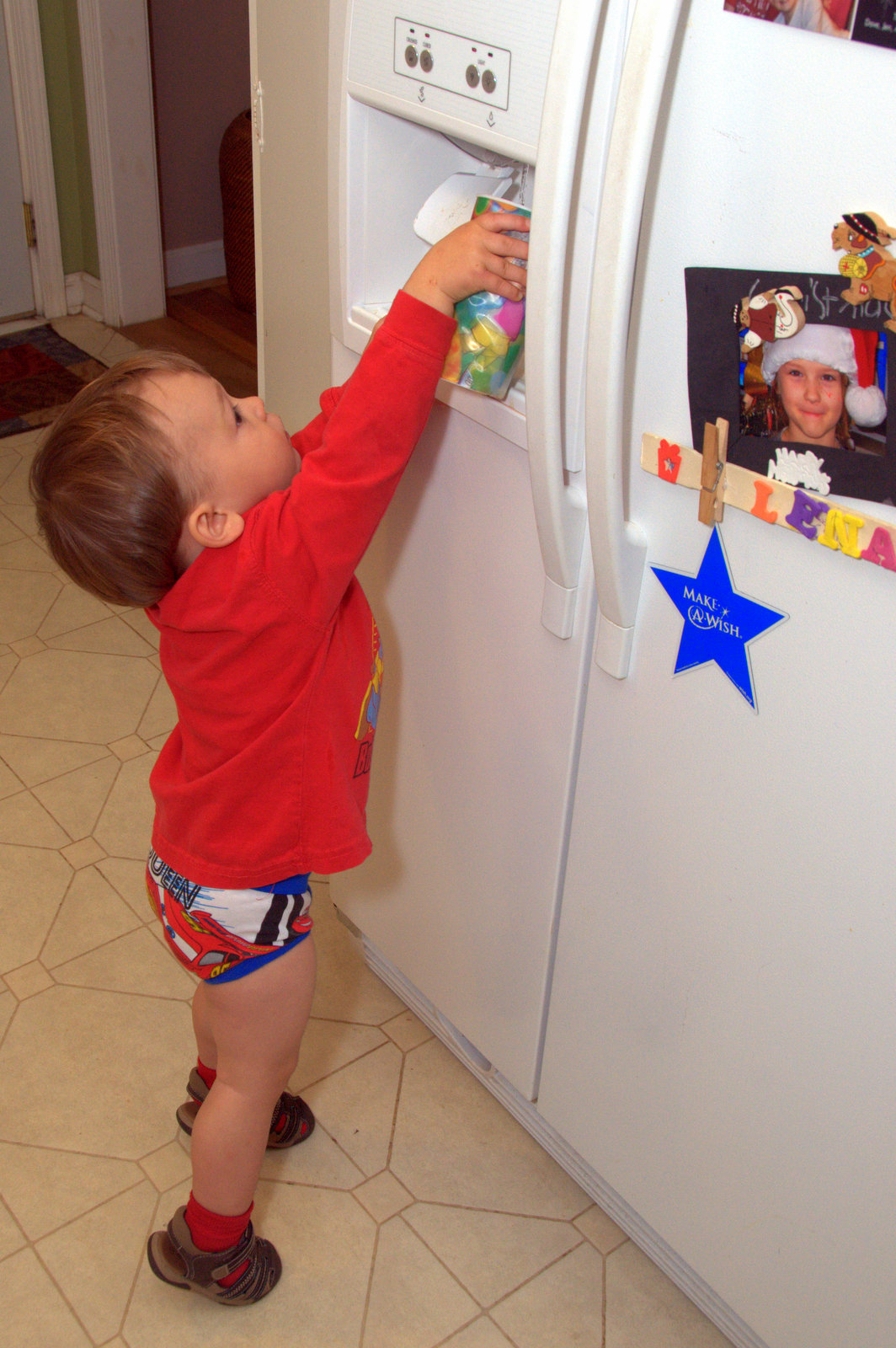
The Boy has learned how dispense water from the refrigerator. He makes a circuit of it: fill up a glass, take a drink, toddle over to the sink, pour out the remainder. Repeat.

1-DSC_3741

Sorting

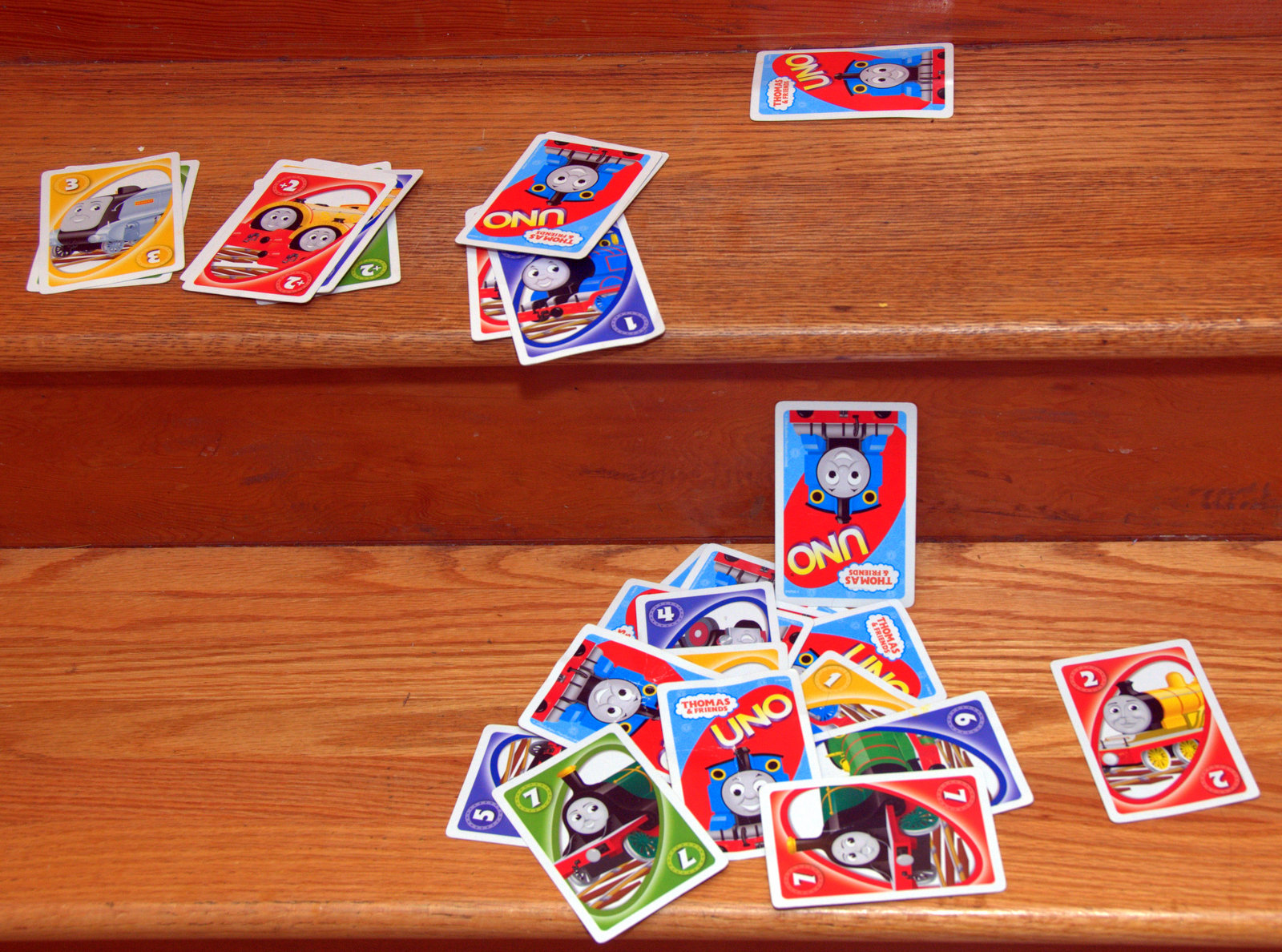
Evening play with the Boy: we put the cards out on the steps, one at a time, sorting. We place Emily on Emily, Thomas on Thomas, and it's all going quite well for the first few cards. E takes a card, looks at it, and places it on the right stack. Soon there are three stacks, and the accuracy decreases. Soon, with five, six stacks, he loses interest in place them on the right stack and simply begins tossing cards on the stairs.

1-DSC_3724

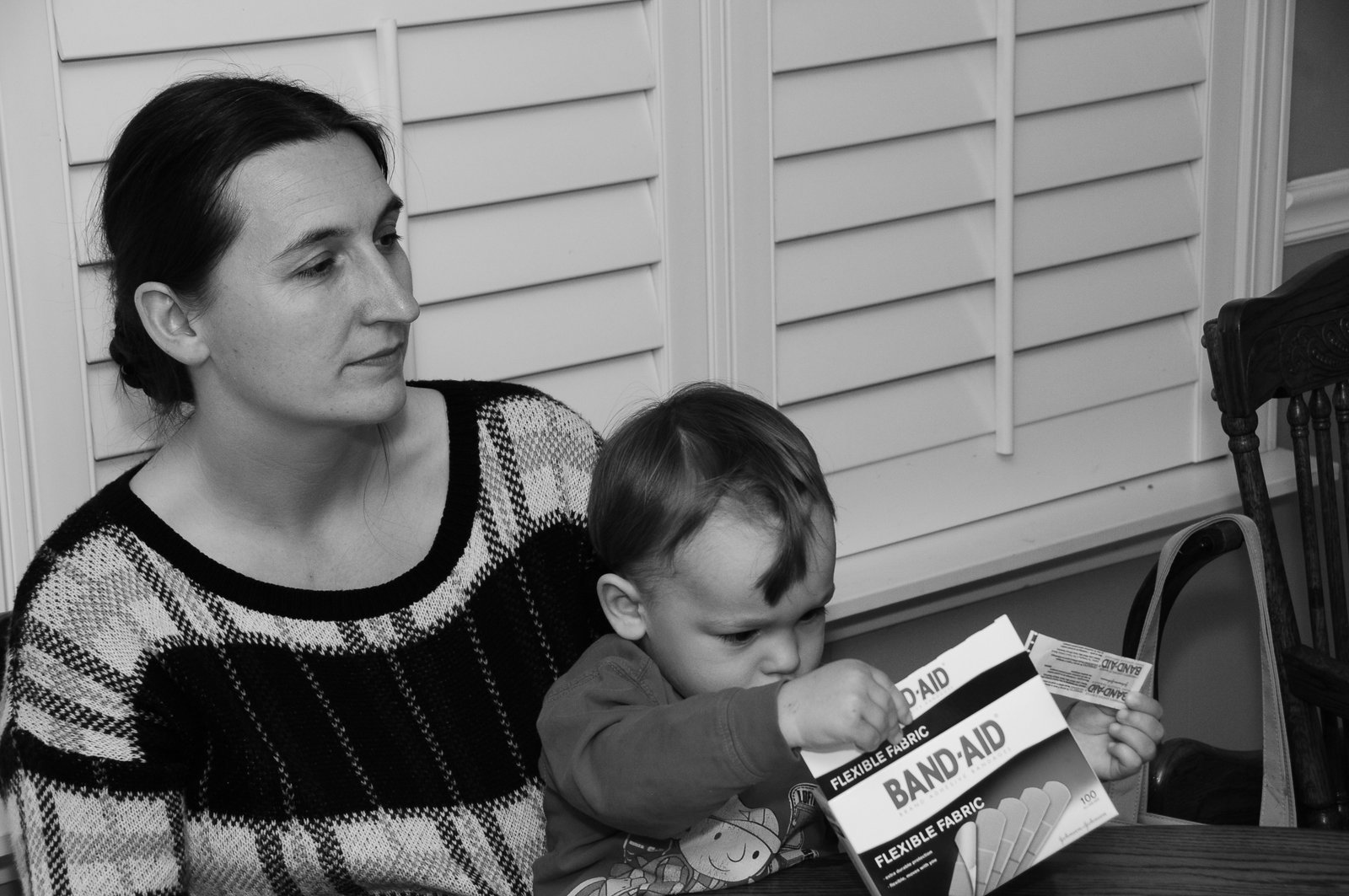
Later, as L is working on her homework, the Boy begins rifling through a pack of bandages. One variety: no sorting, but still there's the question of manipulation, of getting them all in a stack, all in a row, so to speak.

1-BW0_3727

It's captivating to watch, whether cards or Band-Aids, because we never really know what he's trying to do, and I'm not sure he does, either. Patterns emerge that seem to be purposeful then disappear into new chaos.

1-BW0_3728

Home Again

When I was a kid, my father went on business trips once or twice a year -- South Africa, England, and various states in the US. For me, it was a highlight, because we often got to take him to the airport. Watching planes take off and land from the observation deck was sheer heaven for a small boy. Of course the real highlight came on his return, for he always brought something back for us from wherever he sent. It was a bit like Santa in September.

An acquaintance at church mentioned at the post-Christmas-concert pot-luck that in 2013, he'd been in something like fifty countries on business. That's a lot of time in a plane, a lot of time away from one's family, a lot of nights in hotels. I both envy him and pity him. Seeing that much of the world would certainly be a blessing, and it would certainly help one appreciate what's here in the States and likely produce a sense of the possibilities based on what's in other countries. Travel changes the traveler forever. Still, so much time away from home, from family, makes it a bad trade.

As a teacher, I don't get many opportunities to go on business trips. Conferences are about the extent of it. So when I do go for a conference somewhere, I realize anew how much of an aggravation ten countries a year -- let alone fifty countries a year -- would be. But I also smile at the thought of seeing L's smile when I say, "Come here, sweetie, I brought something back for you."

Hurt

190px-Trent_Reznor_Lollapalooza_1991
Reznor

I've never been a fan of Trent Reznor's band Nine Inch Nails. Industrial just doesn't really get it for me, and their seeming sense of self-importance was always a turn-off. Their song "Hurt" seems to me a perfect example of this. A whinny voice that belies the lyrics: any pain this guy's felt is first-world pain, that strange phenomenon that often manifests itself in teens as cutting. Of course, a close listening shows that it's about heroin addiction.

Still -- first world issues with that voice.

Then I heard that Johnny Cash had done a version.

cash
The Man in Black

Nothing new or all that surprising: Cash has covered bands as non-country as Danzig and Soundgarden. He's musically adventurous. But it was more than the novelty of it that excited me as I began listening: it was his voice, that deep bass-baritone that, unlike Reznor's nasally voice, didn't belie the text.

"He's a man who's felt pain, and whose voice won't sound like a whinny kid."

The real musical test of a song, though, is to remove the vocals, to strip it down to the the music alone. If it stands that way, it's a good song. Enter: 2cellos.