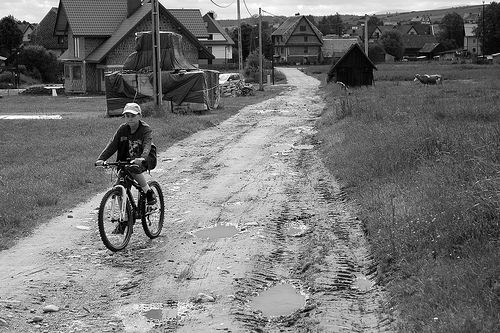
Month: June 2010
Hay Making
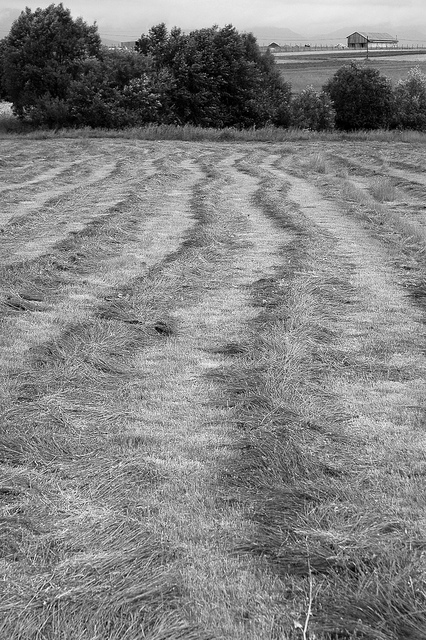
Two Crops
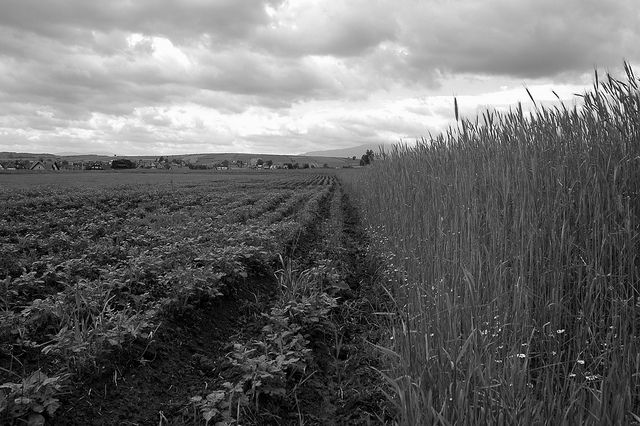
A Break In the Clouds
It felt like it had been raining forever. Perhaps it was just the unavoidable pessimism we were feeling about the weather: the forecast did not look pormising at all. Perhaps it was experience: after living in Poland seven years, I was familiar with the depression about the seemingly-continuously gray sky. So when we woke today and it wasn't raining, we knew we had to go out and do something special.
A trip to Slovakia was in order.
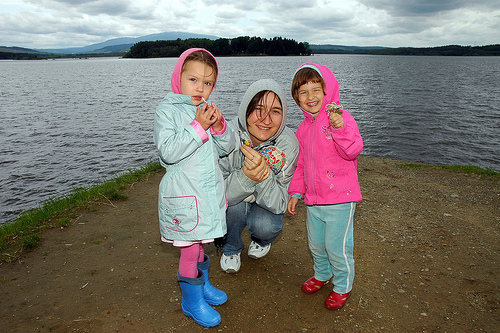
This year, however, it being so cold, we weren't able to take the boat out over flooded village. There was only one goal, in fact (other than taking the cousins out for an adventure): Bryndzove halusky.
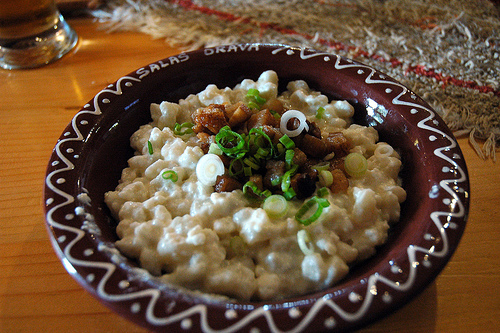

If this Slovakian adventure looks similar to the Slovakian outing two years ago, that's because it is.
It's the known and the comfortable that we're seeking, with a touch of adventure. For example, we'll head south to the Tatra mountains again, but we'll try a walk in a valley new to us. After all, it's not vacation as much as a sort of homecoming.
And so we headed back to Slovakia, back to Namestovo, and it was, in a way, like we'd never left. We drove on the roads that we'd cycled on so many times, around the lake where we stayed during two New Years' vacations. Back to our old mini-vacation spots when we lived here.
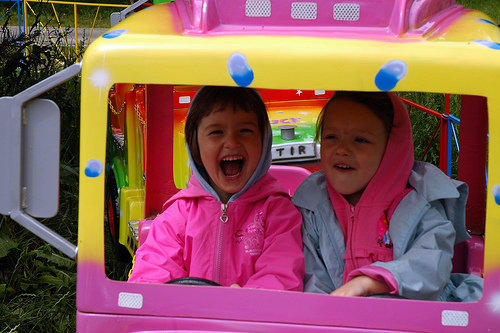
In Namestovo, we discovered gypsy carnival. Except the operators were gypsies only in spirit, traveling from town to town, living in RVs improvised and standard.
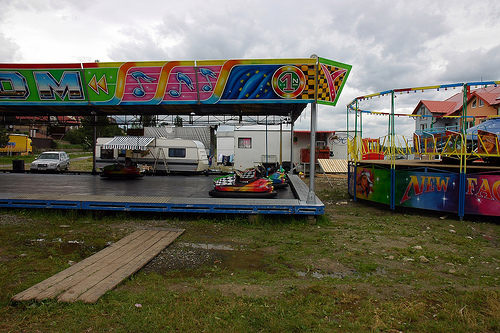
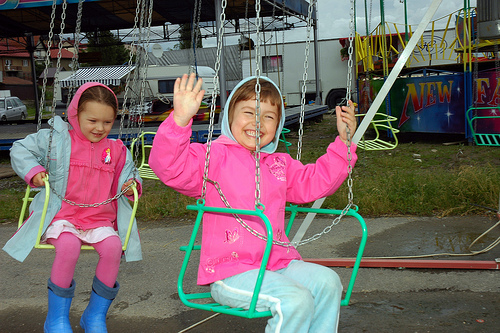
But what was that to the cousins? They only cared about the few rides set up in the corner of the parking lot, all of them involving, in one form or another, going in circles.
Once back home, more of the familiar and the known: a walk to the river.
I recall very few visits to Jablonka that didn't include a walk to the river. Even in the depths of January snow, we took walks to the river, a round-trip journey of about four kilometers (roughly 2.5 miles).
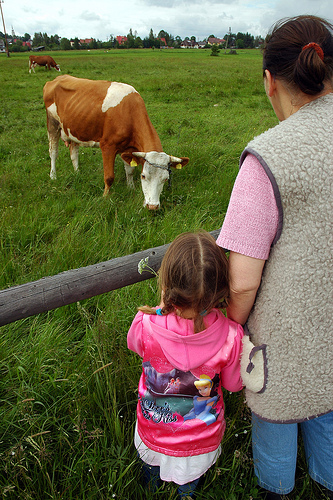
In many ways, it was for the cousins as well. "Who wants to go for a walk?" Reaction: minimal. "And see cows and chickens?" Instant agreement.
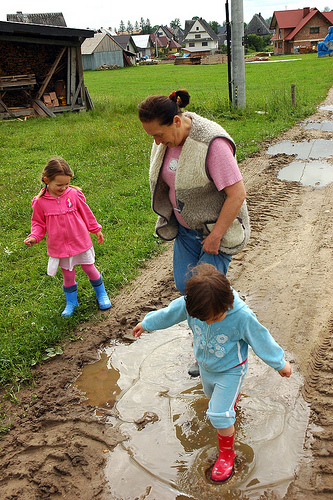
Had we added, "And jump in puddles," we certainly would have gotten a better reaction. Indeed, the puddles and the mud were the hit. "Bloto!" one cried, the second echoed, and in moments, they were plodding through yet another puddle.
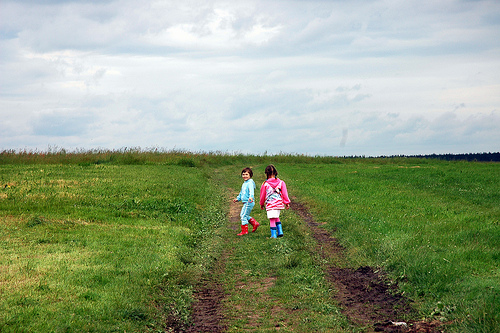
And so it continued throughout the entire walk: the cousins ran ahead, we called for them to wait, they waited. Repeat.
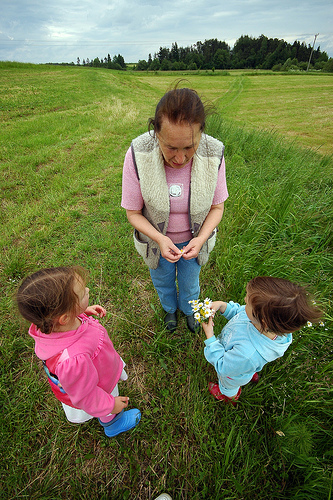
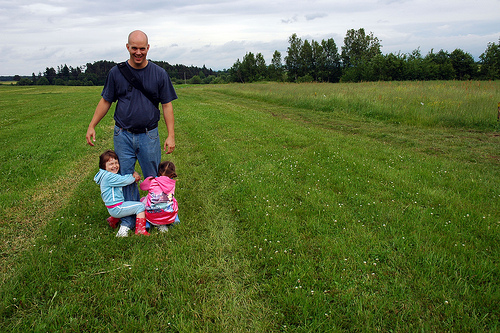
Once in the meadows, the mud disappeared, but flowers everywhere, as were the smiles.

 .
.
In short, a fine second day in Polska.
Portions
One of the many things to love about the slight differences between Europe and America:
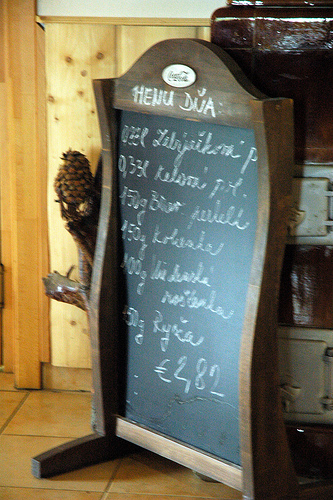
Along with prices, menus include the size of the portions.
The Cold and the Rain
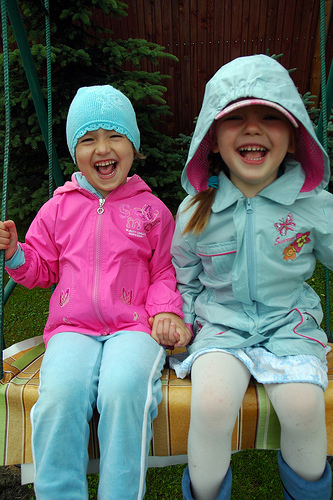
Rain, ten degrees Celsius -- you might say that it's a perfect Polish summer, but that would be too pessimistic. Yet rain or shine, the cousins must swing.
And play in the small play house Dziadek built.
Yet there is a bit of frustration. L understands Polish perfectly; her willingness to speak it is a different situation entirely. As they're swinging, S asks, "Dlaczego ciagle mowisz po angielsku?" "Why are you constantly speaking English?" "Dobra pytania" I respond, yet L says nothing. Instead she begins the international language of three-year-olds: she begins making as many odd sounds as possible.
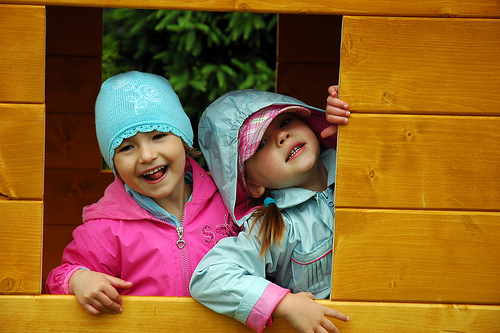
In the end, the swing was the hit of the day. With aunt Dominika, Kinga, and I, the girls must have swung for ten hours straight. Perhaps that's an exaggeration, but not by much.
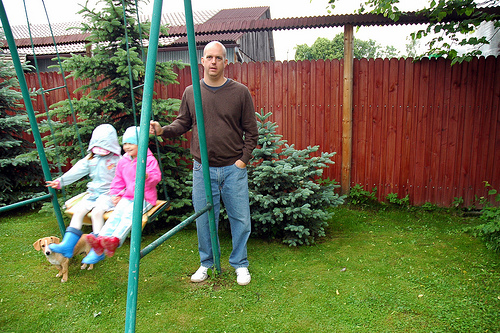
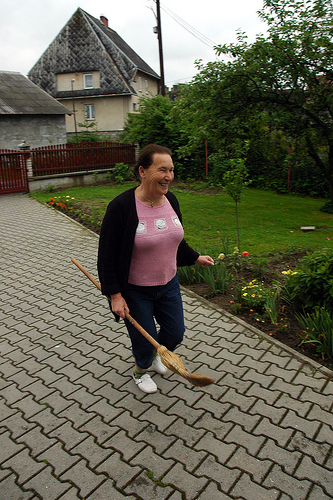
In the meantime, Babcia chases the newest member of the family -- a little mixed puppy -- for digging up her flowers, for about the tenth time. "Ja cie dam!" cried babcia, half seriously, half in jest. "Ja cie dam!"
Poles would call such a day "dzien barowy" -- a bar day. But we're not here to sit in a bar. We're here to visit, and visit with determination. And so we head to the school where I taught for seven years.
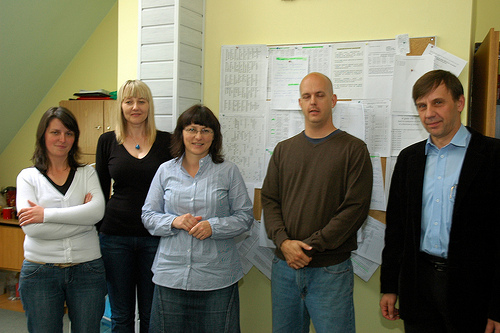
I meet several colleagues with whom I worked even in 1996, but we're all a little older, a little more experienced. The exception is a young lady who was still in middle school when I arrived fourteen years ago (eighth grade) and now teaches high school. My replacement, one might say, but I guess one would be wrong. Time passes and replacement become irrelevant. All things being fluid in the twenty-first century, talk of replacements is useless.
As we wonder through the school, I begin thinking about how little has changed, which is the nature of teaching: one spends years in the same grade only to realize that, from a certain point of view, one has been running in place. I stay forever in eighth grade now; in Poland, I stayed forever in high school. The results are, more or less, the same.
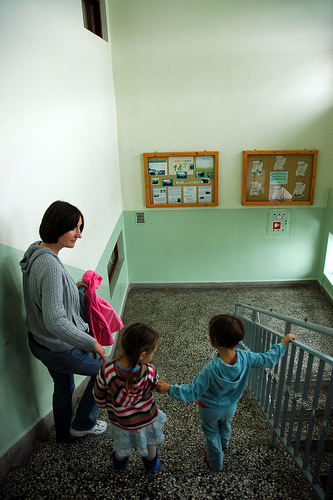
There are some things, though, that can't be replaced, like a virtual Mama. After dropping by the school, we stop by to visit the family with whom I lived for some time after returning to Poland in 2001. I'm greeted with hugs and "Synku!" It's like a homecoming. It is a homecoming.
We meet the two chicks my Polish Mother (PM for future references) saved from certain death when they fell from the nest and made just enough noise for her to hear.
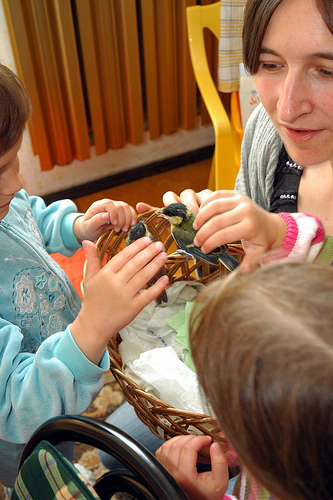
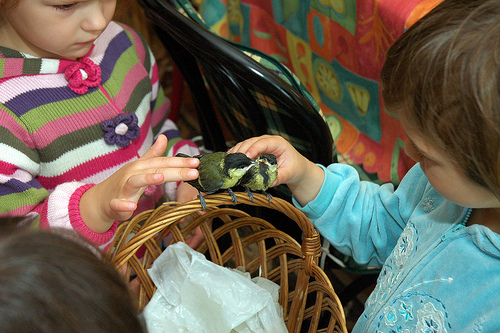
A constant, consistent attraction during our visit.
"I want to see the birds!"
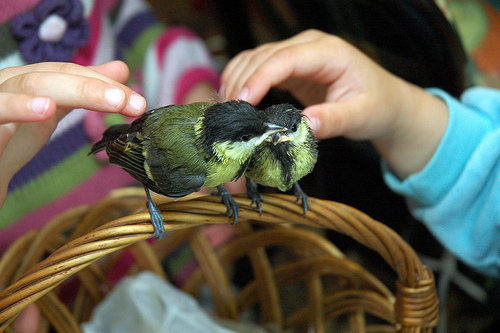
And as a result really get no rest during our visit.
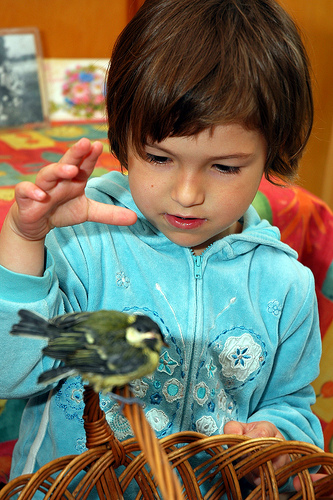
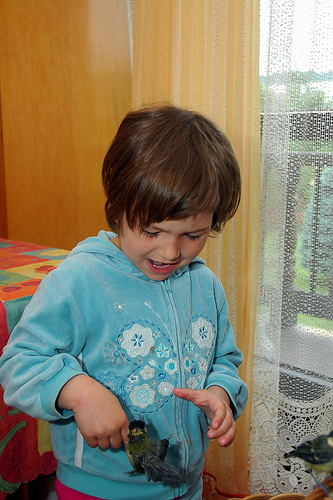
But panic builds instincts and reaction. Or so I'm told.
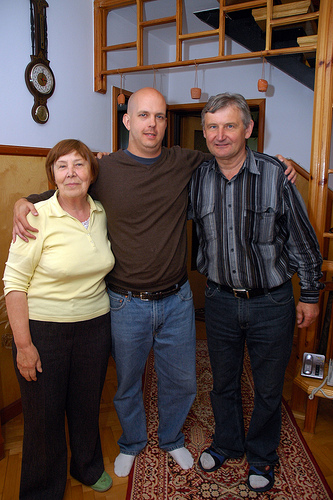
So I've heard, but what do I know? That an evening of football (aka soccer) and assorted liquids makes one less than perfectly willing to blog at eleven o'clock...
Arrival
Twenty-four hours' door-to-door travel disappear the instant the family sits down together for mushroom soup, heavy Polish bread, and the satisfaction of being together again. And then to top it all off, drinks and homemade kielbasa with the father-in-law as we chat and watch Brazil and the Ivory Coast play.
The real joy are the cousins. The girls have met each other once, two years ago. Within a few moments, they were inseparable.
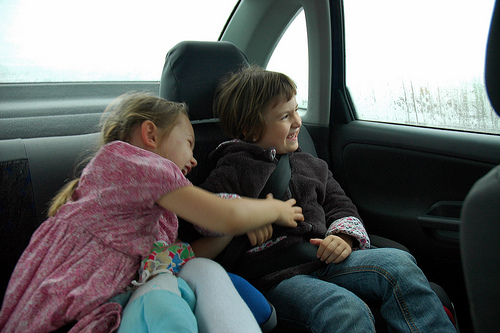
But in a sense, it's impossible to believe that I'm able to sit, have a drink, watch football (really: why would anyone call it anything else; and that pathetic excuse for a sport that we Americans call football -- punting and kicking off are the only times the foot comes in contact with the ball).
There was quite a lot of travel exhaustion to overcome in order to get to that moment. It began in Charlotte, where the stress level immediately rose as Nana and Papa saw us off. "Why aren't they coming with us?" L asked.
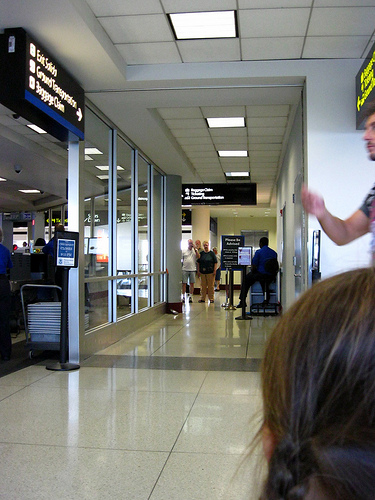
"Security clearance" and "rules" just didn't make sense to the Girl. "Why can't they come?" Such an auspisious start.
L started the long walk to the gate with heaviness. A fussy girl is not a pleasant traveling companion.
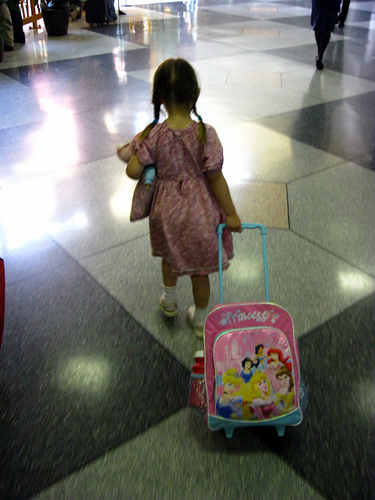
Things calmed down in the plane. A little coloring; a little princess play -- soon all else was moot.
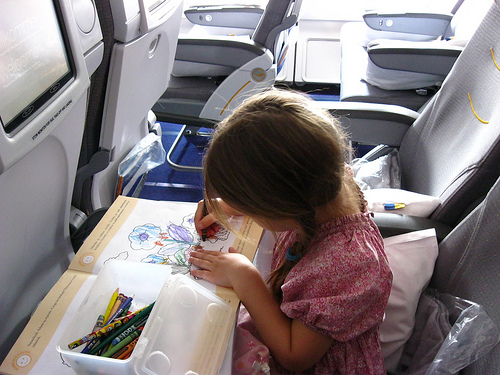
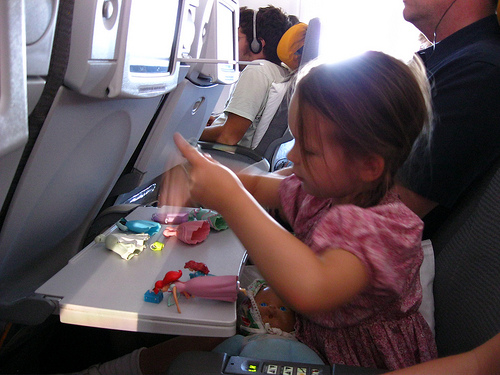
The trip, though, was endless: a car ride, the first flight, a ridiculously long layover, a short flight, and a 100 kilometer car ride.
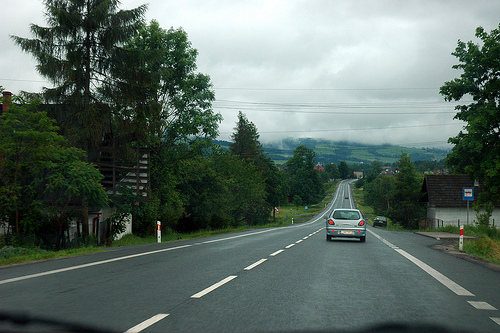
Bottom lines: we're all thrilled to be back in Poland; we're all tried; none of us can wait to see what tomorrow brings.
Video from Bluff
Watch especially for my favorite band at Bluff: Twilite Broadcasters. (2009 Bluff footage of the Broadcasters at goodmorningcapt1's YouTube channel.)
Part two is exclusively Betty Smith, one of the founders of the Bluff Mountain Festival and a living repository for folk music of the Appalachian mountains.
Bluff Mountain 2010
When ethnologist Cecil Sharp came to America during the First World War, he was established as an expert on the British folksong. Unable to support himself during the war (there was not much need for lecturing on folk music during the war), he was drawn by the thought of researching traditional English and Scottish songs that still survived in the American folk tradition.
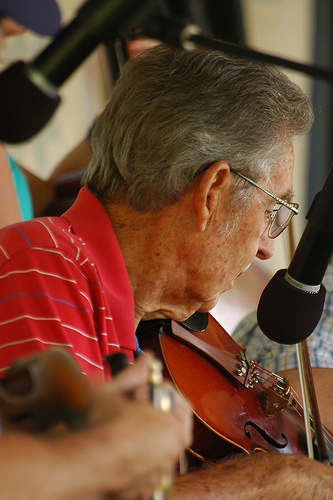
One of the places he stopped was Hot Springs, North Carolina. On August 26, 1919, Sharp wrote in his diary,
Last week I went to Hot Springs, where I got thirty beautiful songs from a single woman. The collecting goes on apace, and I have now noted 160 songs and ballads. Indeed, this field is a far more fertile one upon which to collect English folk songs than England itself. The cult of singing traditional songs is far more alive than it is in England or has been for fifty years or more. […] I must try and get up here by hook or crook next year again. It is work that for the sake of posterity must be done, and that without delay. (Source)
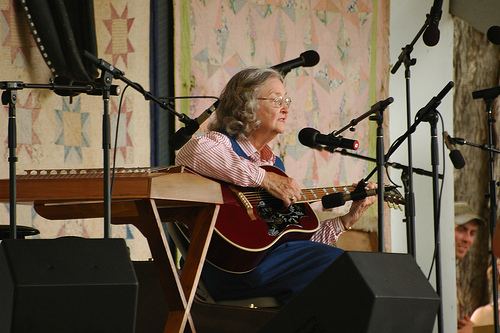
The lady who awed Sharp was Jane Gentry, and her songs live today in the memory of singers like Betty Smith, who is partially responsible for the Bluff Mountain Festival, a celebration of two of the strongest cultural binding agents: music and dance.
When I went to my first Polish wedding, I was shocked at the group singing that would spontaneously begin throughout the night. No instruments necessary, and actual singing talent is completely optional. All that's required is the willingness, and after a few shots of vodka, everyone is willing. That's how I used to look at it, but I've come to understand there's something much deeper.
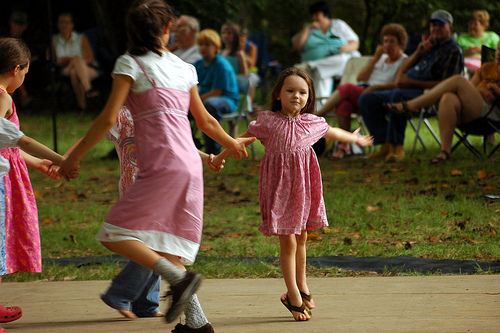
As blood moves the oxygen necessary to keep the body alive, so music and dance transport the oxygen needed to keep a culture healthy. That oxygen is simply a strong sense of regional identity, and music is only one part of that identity. Food, language, and religion are other important elements. These elements, however, are “celebrated” regularly, however: we eat and talk daily, and most people in the rural areas of America attend religious services at least weekly (often more regularly). So music needs specific occasions to be celebrated with the broader culture.
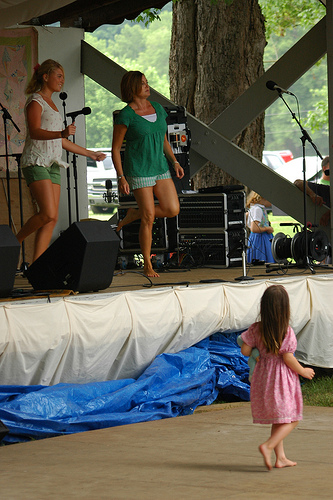
It's to that end that residents of Madison County organize the annual Bluff Mountain Festival. Practitioners of bluegrass and old-timey music play (and discuss) songs that have been in the Appalachian collective memory for years (in some cases, literally centuries, as Cecil Sharp discovered), reminding all of us who don't have daily contact with this music of its beauty and importance.
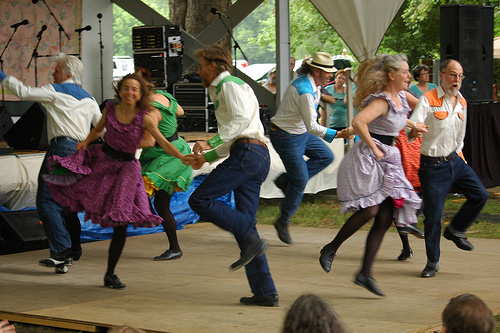
It's getting more difficult to hold onto such traditions. The first difficulty arrived with the rise of mobility that characterized the twentieth century. Instead of staying in the same region as one's parents, individuals began moving to cities where there were more economic possibilities. A second difficulty is the competition imported through mass media. Christina Aguilera is known outside of Appalachia; Betty Smith is not (at least on the same scale).
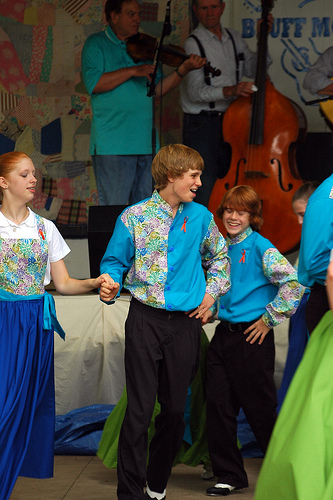
The music and traditions survive, though, and young people continue to value the culture their parents and grandparents pass along.
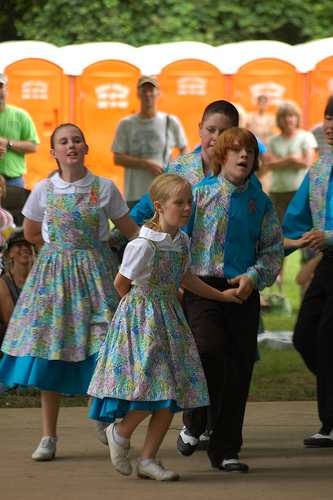
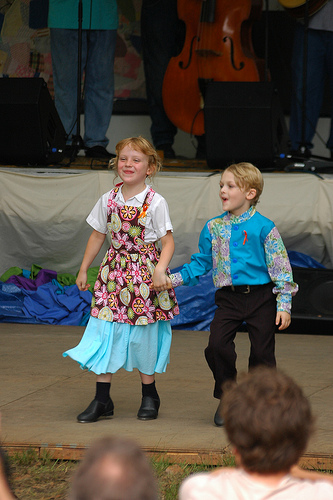
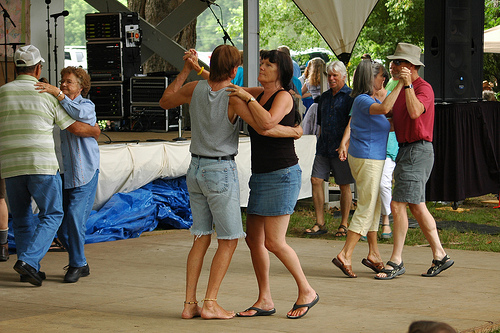
They'll be singing these songs twenty years from now, when Aguilera is a tired pop star desperately fighting obscurity by performing with up-and-coming divas, and maybe making out with them on awards shows in a pathetic effort to stay on the tabloid front page.
Big Hand, Little Hand
I've been in education long enough to realize that most of the fixes that have been floating around only treat this or that symptom; what's at the heart of the condition remains untouched.
Whatever is at the core usually appears to me as a nebulous confluence of technology complacence, with perhaps a bit of torpescence mixed in for thoroughness. I'm no Neo-Luddite, but I'm beginning to wonder if technology, combined with good old fashioned oppression, is not at work in our society, pushing our relative education level down, down, steadily down.
I had an eighth grade student ask me turn on the television so she could find out what time it was. I leave my television on channel fifteen, which is the channel for school announcements and such. When no announcements are posted, a digital clock appears.
I pointed to the analog clock on the wall.
"Why don't you just look at that?" I asked.
"I can't read that!" came the response, as if I'd suggested she translate the Odyssey for kicks.
Mildly shocked, I mentioned it to other teachers at lunch. They all agreed: a shocking number of students don't know how to tell time with an analog clock.
Now a reasonable case can be made that analog clocks are on the way out, that it's not that critical a skill because such clocks will almost certainly disappear in the near future. Point taken. However, what disturbed me more than anything was the girl's reaction: there was no hint of even trying to figure out what time it was. She just gave up.
Math teachers tell me this is rampant in their classrooms these days. "They want instant answers," one told me. "They're not willing to take the time to work through something, step by step." She conjectured that this was due to the ease of information availability on the internet.
I mentioned all this to K, and she sympathized, then added, "On the other hand, our grandparents knew how to do things we have no idea how to do, simply because they're not necessary anymore. Could you guide a horse and buggy?" she asked.
"No," I replied, adding, "But I would at least try to figure out how."
Granted, I'm talking about fourteen-year-olds, and they're a special breed in and of themselves. Still, taking my personal, anecdotal evidence with the fact that America is sliding steadily downward in international academic rankings, and it's obvious that something is terribly, terribly wrong. The anecdotal evidence further indicates it's not just a problem with the education system; it's a problem with the culture, with the Facebook, iPhone zeitgeist.
I find myself asking, "Don't politicians and high-level educators realize what's going on?" Don't they realize that it's a problem so much deeper than making sure teachers know how to "incorporate student test data into their planning"?
If they don't, they're seriously out of touch. There is a breakdown in communication of catastrophic proportions.
Lately, though, I've been thinking that perhaps they do know. And the state of the US education system is just what they -- and the real people running this country -- really want.
An educated public is capable of critical thinking. An educated public stops to think, "Do I really need a BMW when I won't be saving anything for my retirement as a result of my payments?" A public capable of critical thinking would wonder whether the cable news station they watch is giving them the whole story and seek out other points of view, thinking, "There might be something more to this." A public that is knowledgeable about chemistry and biology will look at the labels of most of the "food" that's for sale and demand something real. They'll wonder whether their weekends are best spent in front of the television watching sports and amassing football trivia. An educated public questions, and that's not what corporate America wants.
An uneducated population that, by and large, lacks critical thinking skills is easy to rule. They don't stop to think, "Wait -- those special interest groups and lobbying agencies are spending billions to circumvent my vote."
But what are the options? We have elections every two years for Congress, every four years for the President, and every six years for the Senate, and nothing ever changes. We throw out the Republicans and put the Democrats in; nothing changes. We throw the Democrats back out and put in the Republicans; nothing changes.
The only way this can happen is through the "pressure" of interest groups and lobbying agencies, hired by the corporations that are run by an insignificant percent of our population, people who only want more. They give the Senators, Representatives, and the President the money to get elected and reelected; what do we give them? A meaningless vote.
Maybe this is why the education system is not improving. Perhaps the corporations don't want it to improve. As George Carlin said, the corporations want citizens bright enough to run the machines and do the accounting, but stupefied enough to be content buying meaningless trinkets and ignorant enough not to realize all of this.