Bread in Europe is real bread, you might say. Not this fluffy, soft, completely devoid of all nutritional value nonsense sold in most grocery stores in the States.
To get real bread, you have to find a real bakery.
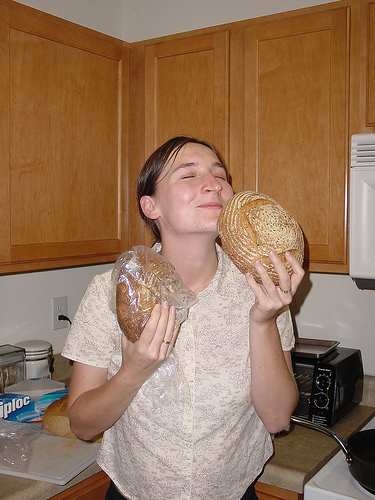
Only then will your wife be happy.
fun in threes, sometimes fours
Month: July 2006
Bread in Europe is real bread, you might say. Not this fluffy, soft, completely devoid of all nutritional value nonsense sold in most grocery stores in the States.
To get real bread, you have to find a real bakery.
Only then will your wife be happy.
The funny thing about working as a contract technical writer/editor for a company that makes air and water purification systems is that you get excited about finding the most unimaginably dull titles in the local university library:
Dave Pack has another sermon. I slogged through it. Notes:
Yawn.
From my journal, ten years ago.
I’ve been working with my host mother on the basic Polish sounds and I have hit a real break through in [the] pronunciation of sz and rz. It’s great!
Earlier in the evening I was trying to pronounce one of the many “sh” sounds and after several failures I finally threw out a last attempt accompanied by a significant amount of spittle, and she cried “Tak!” with great delight.
Learning Polish was unlike learning Spanish and French for me because it occurred in Poland out of necessity. Survival even. And so the result is that I know much more Polish than I ever did French or Spanish, and I have an understanding of linguistic subtitles that escaped me in high school and university.
And I can finally say “chrząszcz” without drowning my conversational companions.
Ah, those Kaczynski boys, they’re a crazy pair:
[Prime Minister] Marcinkiewicz resigned just days after President Kaczynski, 57, canceled a “Weimar Triangle” summit meeting with Chancellor Angela Merkel of Germany and President Jacques Chirac of France.
These summit meetings were first started 15 years ago, soon after the collapse of the Soviet Union to forge closer political, economic and security ties between the three largest countries in the European Union but also to break down decades of suspicions and tension between Warsaw and Berlin.
Kaczynski’s office canceled the meeting with very short notice, officially because Kaczysnki had become ill. But senior Polish diplomats and opposition politicians said the real reason was a satirical article published in the German daily Taz newspaper that described the Kaczynski twins as “the Polish new potatoes.”
Anna Fotyga, Poland’s foreign minister, publicly complained to the German Foreign Ministry and demanded a formal apology. After Berlin said it would not comment since it supported freedom of the press, Fogyta said the lack of response was “shocking” and compared the article to the language used in Der Stürmer, a propaganda weekly during the Nazi era. Former foreign ministers accused the government of damaging Poland’s national interests. (IHT)
I think if this had happened during recess, the Leck or Jarek would have just smacked the editor.
Maybe that would have been less damaging for Polish foreign relations.
I sometimes go to Mass with my wife for companionship, and today, I was certainly glad I did. Before I get into the reason why, some theology.
Catholics of course believe in something they call the "Real Presence," which is the belief that the bread and wine are the actual body and blood of Jesus. It's based on an Aristotelian concept of accident and essence -- what a thing looks like and what it really is. So the Catholic explanation of why it still looks suspiciously like bread and wine is that the outward appearance has remained, but the essential reality has changed.
This is why there's all the genuflection in churches and especially before monstrances, because if that really is God in the flesh flour, then it only makes sense to bow.
This also goes a long way in explaining the controversy about how a parishioner can take the host: standing, kneeling, on the tongue, on the palm of the hand. I think the variety is strictly American. In Poland, the issue is vastly simplified: stand or kneel. There's no way a priest will give it to your hand in Poland.
"Real Presence" also explains why some might be a little uneasy with the idea of anyone other than a priest handing out the host. In the States, members of the congregation hand out the blood and wine (though the priest has consecrated it and all that). Again, this is probably a completely American thing.
All this is to explain the significance of why I've always wondered what would happen if someone tripped and -- whoosh -- there's God, all over the floor.
At this morning's Mass, my question was answered.
An elderly woman, serving as Eucharistic minister, was heading back up to the altar (and so her chalices were probably almost empty) when suddenly there was a stumble, shuffle, and crash. I saw the whole thing out of the corner of my eye, and I immediately directed all my attention there -- as did everyone else in the basilica.
The priest kept right ongoing, but not many people were giving him their undivided attention. Everyone was looking at the aisle, watching the lady pick up the hosts as another Eucharistic minister helped her. Then a deacon came with a cloth that had been dampened, I'm assuming with holy water, and wiped the spot.
The woman was obviously quite shaken. She said some words to the priest, and he sympathetically comforted her. Returning to her seat, she muttered something to her husband, and that was that.
It highlights how atypical Catholicism is in modern culture, where all sense of the sacred has disappeared. "And so much the better" many of us would add, but sacredness fosters a certain respect that I'm not sure you can get any other way. It's simplistic to explain it, "Well of course it's respect -- born out of fear, a terror that some deity will toast you." There's certainly an element of truth in that.
Communism tried to foster some sense of the sacred -- the working masses were the vessels for salvation. The working man is the communist messiah. Marches, songs, flag-waving, speeches -- all these things to foster a sense of the sacred in the people. Yet it didn't work. My wife grew up in that culture, and it was all a joke for everyone. Why?
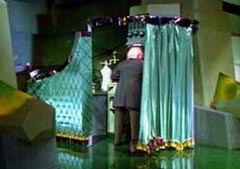 It lacked mystery.
Without mystery, without an element of the unknown and inexplicable, nothing can be sacred. Indeed, sacredness could be defined as a sense of mystery about something thought to be of divine origin. If you see the little old man putting together the wizard show, hanging the curtains, preparing the control panel, it is only through an act of supreme wishful thinking that you can put your faith in the Wizard.
"Come on, Larry. Just once! Let's just see if she'll notice. I swear I won't do anything with her." How many twins have uttered something like that to their identical sibling, trying to convince the sibling to let him go on a date with his brother's girlfriend?
What if the twins both held public office, only one was much higher in rank? Say Jeb and W were twins -- wouldn't you think that Jeb would try, just once, to convince his brother to let him make some kind of address as the president? "Come on, Georgie! We ain't talkin' about a State of the Union address. It's just a little chat out in the Rose Garden. They'll never notice!"
We're fortunate that Jeb and W aren't twins, because they seem just, well, lacking-in-seriousness enough to try it.
 Such a situation is not inconceivable in the near future in Poland, though. Prime Minister Kazimierz Marcinkiewicz has resigned and the ruling party, PiS (Law and
 Order Justice -- Prawo i Sprawiedliwość), has indicated that they want Jarosław Kaczynski to take the position.
"Kaczynski. That sounds familiar," some might think.
 That's because the president of Poland is Lech Kaczynski, Jarosław's twin brother.
Oh, he's so adorable, let's just call him "Jarek."
It's not clear whether Jarek is going to take the position. He turned it down earlier on the reasonable grounds that it might give some people the willies to have twin brothers in the two highest positions in the nation, but I think this time he'll just suffer through those discomforting thoughts and take the post.
But it's no big change. Jarek's been running the country for month's. Marcinkiewicz's just been a puppet, people say.
That sounds awfully familiar.
At any rate, the BBC report seems strangely enough to confirm this:
Over recent weeks, there had been frequent reports of a rift between Mr Marcinkiewicz and Jaroslaw Kaczynski over economic policy.
BBC did not use the Polish character "ł," pronounced like the English "w," so it's not a typo.
 Wait a minute? I know Jarek is the PiS party leader, but his brother is president, is he not? Wouldn't it be tensions between the president and the PM that would cause the PM to resign, rather than tensions between the party boss and the PM? Unless, of course, the party boss is the boss.
The good thing in all this? At least Jarek will admit -- sort of -- that he's in charge.
I prefer the English “football” to the American “soccer.” “American football” barely even makes use of the feet — fat seems critical there.
Perhaps one reason Americans don’t like football is because of the whining, says Jake Novak in Newsday. The Week writes that “European soccer players seem to spend most of the game writing in fake agony.”
Indeed, diving in football — intentionally falling to make it appear one has been fouled — is a growing concern in European football.
Germany World Cup-winning captain and coach Franz Beckenbauer has asked for there to be a crackdown on divers and cheaters.
“The players are looking for an advantage and they attempt to exploit the situation,” said the head of Germany’s 2006 organising committee.
“At the beginning of the tournament, I felt the referees were showing yellow cards too early for trivial offences but the players make it much harder by simulating, and by staying lying on the ground to interrupt play,” he said.
“Perhaps everyone — players, referees and administrators can get around a table after this to come up with a solution to put an end to this kind of unfortunate incidents. (“BBC News)
Often, you see a player gnashing his teeth in pain, clutching a shin video replay shows to have been hardly tapped by an opponent’s leg. The paramedics and team physical trainer all come running out with a medical case and stretcher, only to find that — hey! — he can walk after all! In fact, after a few limps, he’s jogging, then running!
Miracle of miracles.
Aside from being immoral, this behavior simply slows a game of otherwise constant motion.
“How do we deal with it?” everyone moans.
And so I present my simple, three step process.
First, introduce the use of video replay into the game. Too often the ref is too far from the “foul” that takes place very quickly. To make a judgment that this was indeed a case of diving is difficult, at best.
Second, provide refs with a small, wireless video monitor. Simple. When a ref thinks there’s been a case of diving, he simply reviews the play on the monitor.
Third, implement a graduated penalty system for diving:
The proceeds of this go to a charity designed to provide football facilities in developing nations.
Diving would disappear very quickly.
Only when you have lived in two countries can you really appreciate the fact that there is no perfect country. But that appreciation comes with a price — homelessness.
My adventure with kielbasa and vodka began ten years ago last month, when I packed off for what I thought would be two years in central Europe. Little did I know — I lived there for seven years, all told.
The fact that I returned shows that I really didn’t need the last four years to call the place “home.” I’m still not even close to fluent in Polish (nor will I ever be) and the average Pole can still drink me under the table (though I’m not ashamed of that), but somehow the sausage and freezing winters did something to my DNA, and I feel at least partially Polish.
Every time I came back to the States, I lived through reverse culture shock. I immediately hated it and loved it: the ability to get humus at four in the morning versus a culture that seems to be in love with kitche; a hundred kilometers in under an hour versus ridiculous health insurance.
It was even worse moving back the first time. Poland called to me even in my dreams. When I went back for a visit after a year in Poland — culture shock, of a sort. “I can’t believe I lived here!”
Yet there was a strange comfort there, and so I went back, fully aware of the challenges and fully prepared for the material sacrifices. A few days after arriving, I wrote in my journal: “Will I ever learn to be happy with my life as it is at that very moment?”
I hated it. And stayed four more years.
Back to America, full of high hopes, and I hate it again.
Once you live in another culture, your legs are knocked out from under you. You see the silver lining and the disgusting grey of both cultures, and you realize you’ll probably never be entirely happy in either.
Kinga and I have now been back in the States a little over a year. That, combined with the date, makes it appropriate to share some of the thoughts I’ve been having about America lately.
If you were to ask Kinga, after a year here, “What do you think of America?” she’d answer unhesitatingly and unflinchingly, “I hate it.” No, this is not going to turn into an America-bashing diatribe, but I have to admit that, on some level, I do too. Not the people, or the culture, or the government, or even the geography.
I hate the paradox of America.
America in so many ways is an amazing nation. We have freedoms unimagined in other countries. Think of the David Irving conviction for Holocaust denial in Austria and the trial of Oriana Fallaci in Italy for insulting Islam. Such nonsense doesn’t happen here, and the fact that I grew up here explains why I call it “nonsense.” Freedom of speech is so engrained in my thinking that I hate to imagine the purgatorial existence life without it would constitute. Freedom of religion, freedom from religion, protection against unwarranted police action (though this could of late be qualified with “some degree of “), access to legal remediation of wrongs done to us – the list could continue for a few more lines. Additionally, we have attained a standard of living in one short year in America that we would not have in three years in Poland. The economy there is simply shot.
The wealth of this country is unbelievable as well, at least on the surface. The majority of us have a standard of living here that few in the world enjoy. We have a highway system on a scale that beats anything I’ve ever seen. Anything and everything is literally available at any time of day.
And yet…
That wealth is illusory. Who owns our houses, our cars, our computers and furniture – most anything that costs more than we’re able to pay in cash? Banks. We “common” folk have a medium income of roughly $42,000. The average CEO makes $11 million, more in one day than the average American makes in a year. So there is wealth, it’s just not evenly distributed.
The freedoms I speak of are, more often than not, abused. Lawsuits increase, insurance goes up, and in the end, it’s the same story – a few (the winning plaintiffs) getting rich off the toil of the many.
The amazing freedom of speech we have results in what? Thoughtful public debate about issues? Certainly not – talk shows!
America was once a leader in technology and development. We were the first to fly, the first to land on the moon (oops – not the first in space…), the first this, the first that. Americans used to dominate the world of computer programming. And now?
The most amazing thing about this country is also, at the moment, the most ridiculous: our government. We’re bogged down in Iraq; “democratic Afghanistan” is a joke, as the Taliban slowly reasserts itself and Christians almost get executed for being just that; our reliance of fossil fuels is beginning to cause real problems; we’ve lost world respect with the shameful holding facility at Guantanamo Bay; New Orleans has still not fully recovered from the trilateral fiasco of local, state, and national “leadership”; the Bush administration is taking unparalleled liberties with our liberties – and what does Congress do about it? Why, debate the pressing issues of gay marriage and flag burning, of course.
The paradox of America is that it is shortsighted. It’s a young country and it acts the part, especially of late – the blustering machismo of a sixteen-year-old. As a nation, as a populous, we don’t look beyond our own noses. The average American, I would wager, has no idea why gas prices have doubled before our eyes. The fact that SUV sales in the first quarter of 2006 were on par with 2005 growth expectations despite rocketing fuel costs shows the American mindset perfectly. It’s all about short-term material pleasure. In American Axle & Manufacturing’s first quarter fiscal report for 2006, we read, “We are encouraged by the initial market acceptance of GM’s new full-size SUVs and look forward to supporting the launch of GM’s new full-size pick-ups later this year.” (Source) Yes – be encouraged by this recklessly myopic market phenomenon! You’ll make money from it!
American Axle & Manufacturing’s good news is indeed good from a certain perspective: it will provide, in theory, jobs. But to Americans? I doubt it. Perhaps the most striking examples of myopic America are the education and health care systems. America lags so far behind the rest of the western world in providing education and universal health care for its citizens that it would be laughable if it weren’t so tragic.
Not only do many citizens have to scrounge to afford a university education, but the education provided to the public for free (i.e., primary and secondary schools) is so far academically behind the rest of the world that we’re literally laughed at. Some months ago, when I told Kinga what I was working on with eleventh and twelfth graders in general math while substitute teaching, she laughed, “We did that in fourth and fifth grade.”
Yet nothing compares to the chasm between American and European health care. When Polish friends moved to Belgium, the total hospital cost for delivering their second baby was around two hundred euros. Two hundred euros. I doubt you can get much more than an aspirin in an American hospital for that.
Are any of these situations improving? If so, I’ve yet to see evidence of it. Yet, hope and cliches spring eternal…
What I feel most often on the Fourth of July now is mild sadness. I don’t expect America to fall in some spectacular way, but rather to dim slowly, like a candle in an oxygen-starved room. It will burn, but it won’t provide any light to speak of.
The Fourth of July, I’m afraid, will eventually not be a day of pride. It won’t be filled with fireworks and patriotic speeches about sacrifice and a noble cause. It will be a day of remembrance, a day to recall how powerful this nation used to be. A day to recall how we traded our independence for SUVs and iPods.