
fun in threes, sometimes fours
Month: July 2004
As a child, I hated mushrooms — or what I took to be mushrooms: slimy little buds that came from cans. Admittedly, I'd never tried them. Eventually, I did, and I came to like what I'd mistakenly taken as "mushrooms."
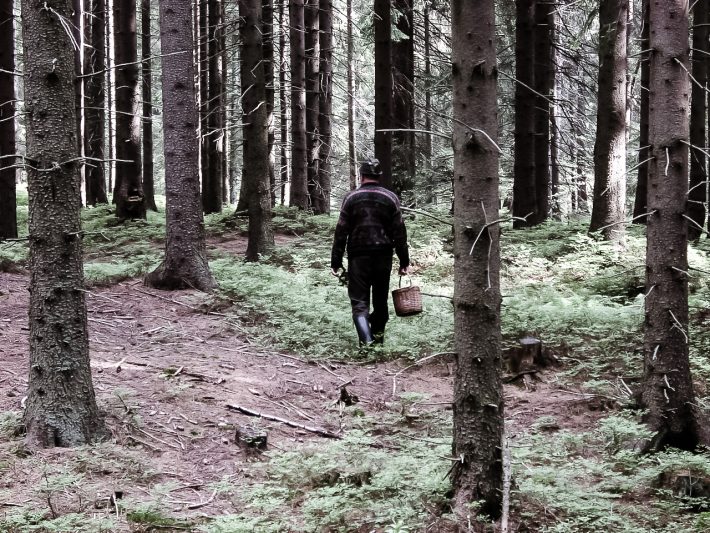
I also recall being in the woods and wondering why we didn't just pick the mushrooms that were all around us. Someone explained that they were poisonous, and my mother later clarified that "We only eat mushrooms we buy in stores."
That limits things somewhat: champignons, portabella, and shitake are the only non-canned mushrooms I recall seeing in stores in the States. Of course, I never really went out looking for other types, so I'm sure I'm misrepresenting mushroom's availability.
Then I came to Poland, and all my conceptions about mushrooms changed. Mushrooms became not something you bought in stores, but something you went out in the woods to find.
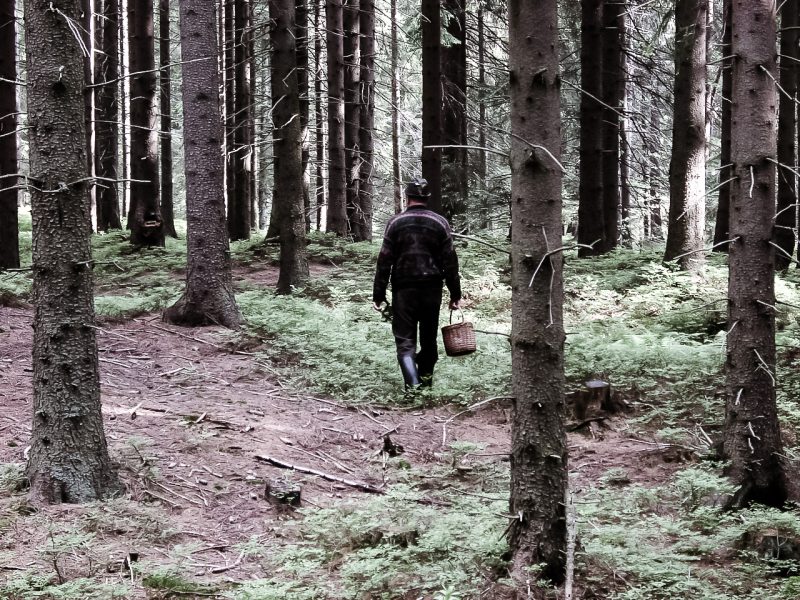
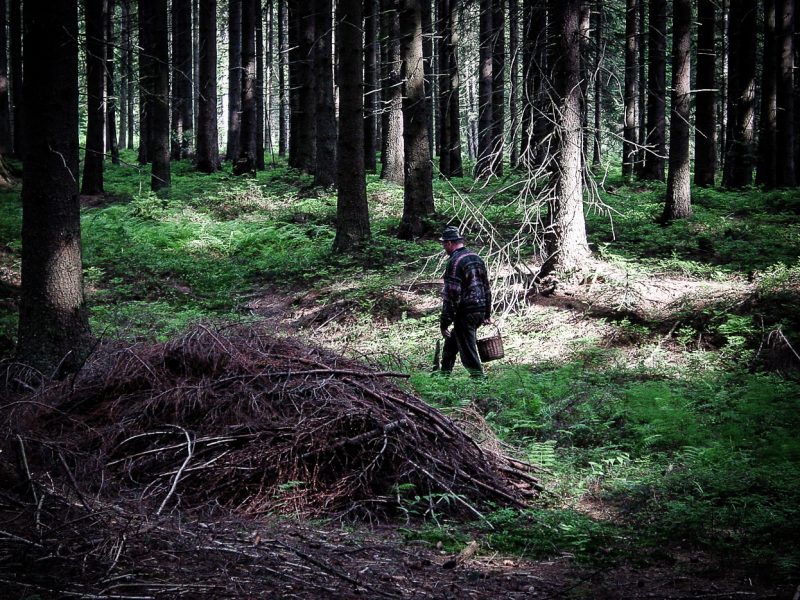
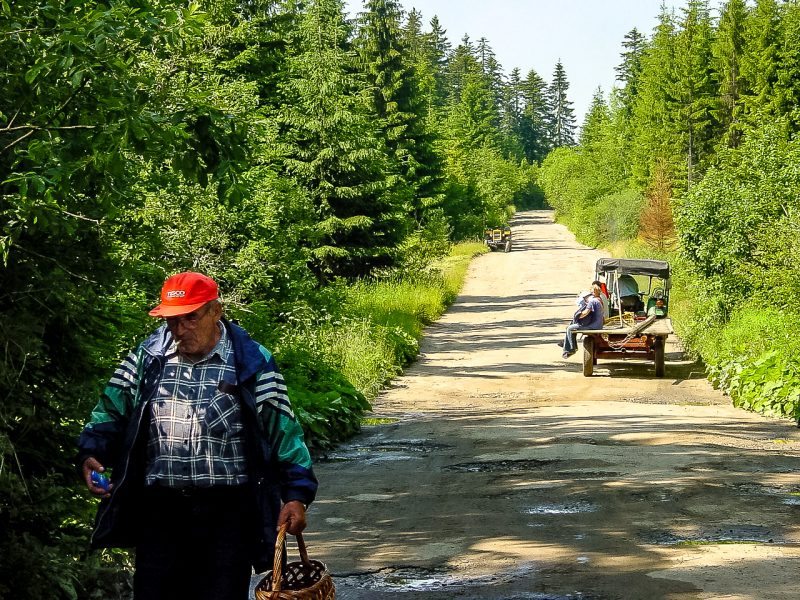
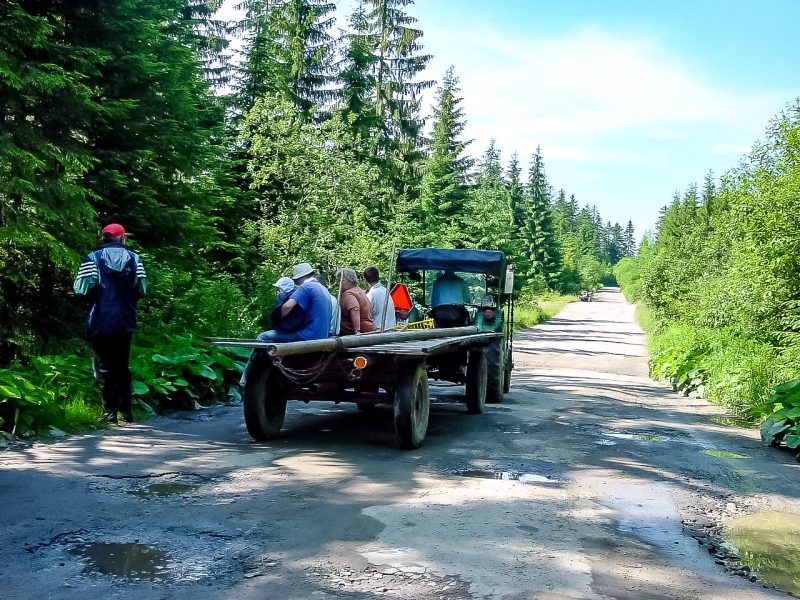
"Mushrooming," for lack of a better term, is a popular hobby in rural Poland, and not only, for often people come from the cities for the express purpose of "mushrooming." It's a simple concept, really: take a basket into the woods and wander around looking for mushrooms.
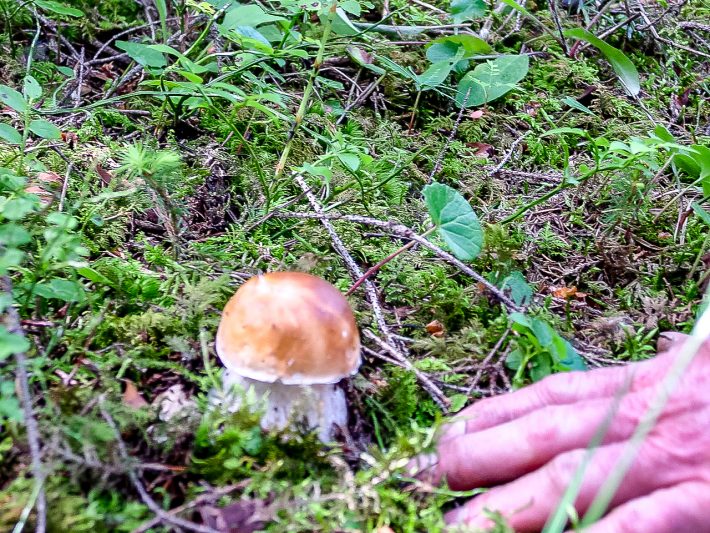
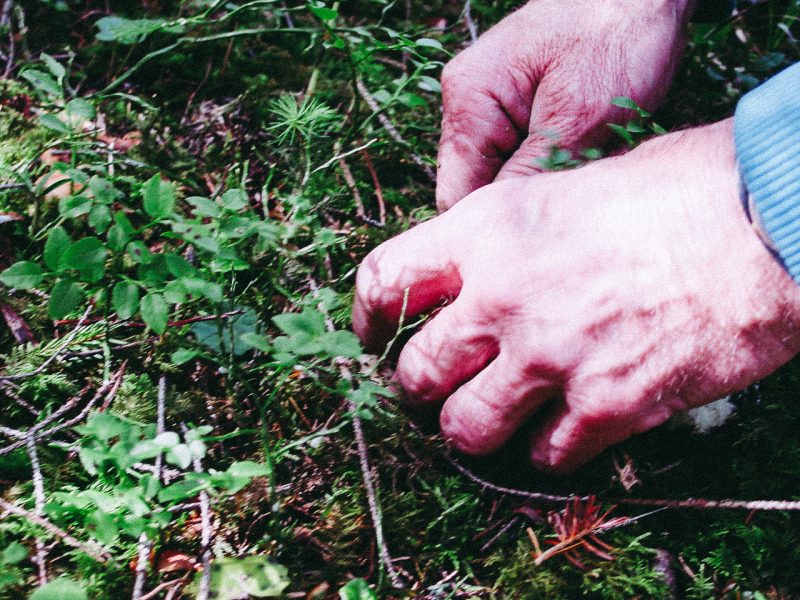
Of course, not just any mushroom will do. Some, as a shroomer put it, are "edible only once." Others don't taste so good. What everyone dreams of is finding "prawdziwki." I've no idea what kind of mushroom that would be (the mushrooms in the first image are "prawdziwki" — anyone know what they're called in English?), but the word "prawdziwki" would be literally translated "little real ones."
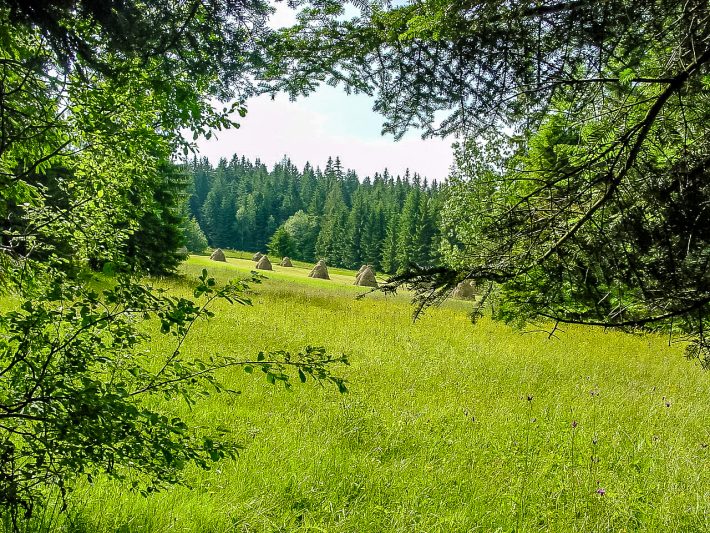
The first step is to find them. Most often they're at the base of trees, or near them, partially covered, growing in damp ground.
A friend told a story of someone who, while out hunting mushrooms, unexpectedly came upon a deer with a broken leg, it's antlers caught in the undergrowth. The gentleman managed to kill the deer with the small paring-knife he'd brought along for cutting mushrooms. Then he went back into the village, borrowed someone's van, drove out into the woods, and loaded the deer up, only to find that the animal was much larger than he'd imagined and the antlers were still on the ground. So he tied the antlers up to the roof of the van, drove it home, and had venison for a week.
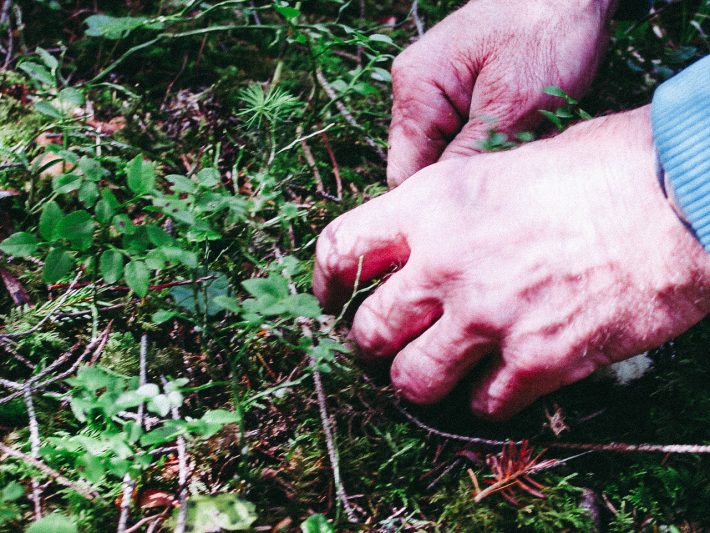
Once you find them, it's not a question of jerking them out of the ground. Instead, you have to cut them carefully at the base.
In some ways, it's a pleasant enough activity even if you don't find any mushrooms. Fresh air, sunshine, singing birds — a pipeful of tobacco in my case. It's not a bad way to spend a morning.
But the longer you look without finding anything, two conflicting thoughts start rising. First of all: "I've been out here for ninety minutes already and I haven't found anything edible. This is a waste of my time now." Second: "I've been out here for ninety minutes and I haven't found anything edible. I can't possibly go home empty-handed, so I'll look longer."
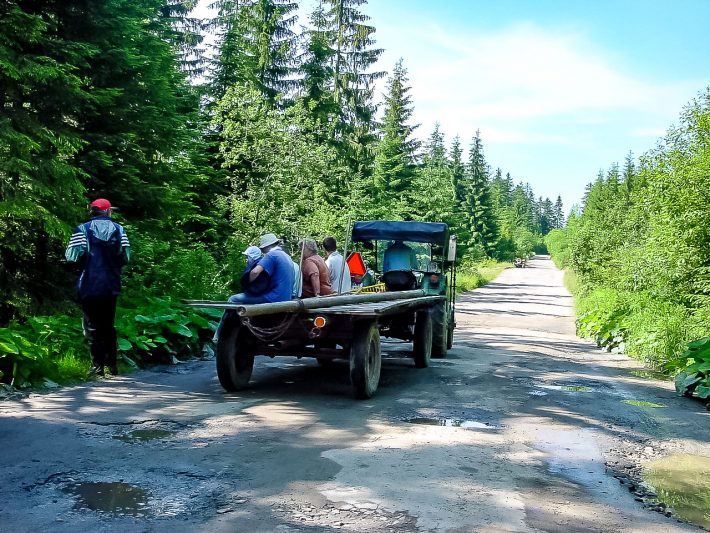
What's worse is when your shrooming partners are finding "prawdziwki" and you aren't. Of course, I'm a shrooming novice, and I guess I don't know how or where to look.
Transubstantiation—a doctrine I’m only now beginning to understand. A frightening doctrine in the twenty-first century. A doctrine based on an antiquated idea that has been shown, centuries ago, to be false. Transubstantiation is simply the Catholic doctrine that explains how the bread and wine, which after consecration are supposedly Jesus’ body and blood, still look suspiciously like bread and wine. Their substance has changed, retaining only their accidental appearance. And that, my friends, is Aristotelian “science” which has been shown to be false. It still permeates our thinking, though, as Pinker shows in The Blank Slate. Here is a whole doctrine based on—I don’t even know.
This helps explain for me how cupping glasses—something I need to write about for my site—can still be used here. It’s a country that abounds in antiquated thinking.
Obviously, I’m still reading Letters Between a Catholic and an Evangelical. It seems to be that the basic problem, the source of disagreement between Catholics and Protestants (and Protestants and Protestants) is the Bible itself, but that is never a considered possibility. The Bible in one place says one thing, and in another, something entirely different. What believers are forced to do is write books like The Hard Sayings of Jesus and WCG’s whole “difficult scriptures” idea to try to make obvious inconsistencies (which would be labeled as such were they found in any other book) appear as “seeming inconsistencies” or “difficult passages.”
Take for example the whole works versus grace thing:
On the other hand, we find Jesus (who should have known what is required for salvation if anyone in the world ever did) and James saying something quite different.
It also explains why there’s such (as I called it in my “Why I’m not a Christian” piece) a literal/figurative potluck.
I’m reading a book D sent me called Letters Between a Catholic and an Evangelical. It’s interesting, but the two guys seem to be talking at each other at times.
Much of it seems to reduce down to a question of whether or not to interpret a passage literally. When Jesus says, “Call no man ‘Father,’” McCarthy, the evangelical, wants to take that at face value (i.e., literally) and Waiss, the priest, offers possible explanations (99). Hyperbole, he says, citing Jesus’ eye-plucking-out comment. Another possible interpretation deals with whom we regard as the source of our faith. But why the Catholic Church doesn’t apply the same rigorous interpretation as it does to John 6 is a notable inconsistency.
This cuts both ways—McCarthy wants to interpret this literally, but not John 6; Waiss wants to interpret this figuratively (even as hyperbole) but not John 6. Literal and figurative—take your pick.
Regarding this broader question of interpretation, Wais argues,
We carry all sorts of historical, cultural baggage that affects our interpretation. Tradition allows us to transcend our particular cultural and historical situation to understand God’s Word in the context in which it was written and first interpreted (65).
Fine and good. But Catholic, capital “T” Tradition doesn’t stop in the first century when the apostles and disciples lived. So he’s right when he says that trust in Tradition is a question of faith. He argues it’s a question of faith in the Holy Spirit; I think McCarthy more correctly argues it’s a faith in fellow man.
Earlier, McCarthy states that the burden of proof is on Waiss:
Now, in a court of law, the burden of proof lies with the one who asserts a particular point, not the one who denies it. It appears, then, that it is you who must prove the claim for Tradition, rather than I who mush show that Scripture is the sole rule of faith, as you have insisted in your letters (44).
Is McCarthy blind here?! Doesn’t he realize that he’s “assert[ing] a particular position?!” Further, given the fact that the Catholic Church existed long before the Protestant movement, it seems that the burden of proof lies on the Protestant side.
Discussing the hierarchy of the Catholic Church, McCarthy makes a terrible logical blunder, which Waiss makes little use of: the argument from silence. McCarthy says that because “Pope” doesn’t appear in the Bible, it’s not Christian. Three words: Trinity, Christmas, and Easter.
Concerning Tradition, McCarthy writes,
What then prevents the gradual introduction of new doctrines? Could not a pious comment by a Pope in one century—say about Mary of the power of the papacy—spread and become widely known in the next century, a generally held belief in the third, and a dogma in the fourth or fifth? With no written record of what is contained in Tradition, who’s to say what’s in and what’s not (69)?
He goes on to point out that this is exactly what happened with the Catholic doctrines of the Immaculate Conception (proclaimed by Pius IV in 1859) and the Assumption of Mary (Pius XII, 1950). He ends this asking, “Today an international campaign is being waged to petition the Pope to proclaim as dogma that Mary is the Co-Redeemer of the human race. Whether it is successful or not, I still must ask: What’s next” (69)?
There seem to be indeed no check on the Pope in that regard. Of course, Popes have only formally invoked Papal Infallibility a couple of times (or maybe even once) to date. But what’s to stop them from making, say, Paul a Co-Redeemer? Or Peter?
Protestants like to quote 2 Timothy 3.15-17 as proof of sola scriptura, and McCarthy doesn’t let us down:
and how from childhood you have known the sacred writings that are able to instruct you for salvation through faith in Christ Jesus. All scripture is inspired by God and is useful for teaching, for reproof, for correction, and for training in righteousness, so that everyone who belongs to God may be proficient, equipped for every good work.
Something I never realized until now, though, concerns the question of what these “scared writings” might be. Why, none other than the Old Testament. The New Testament didn’t exist yet, obviously enough. So sola scriptura should be more like one of the early heresies: sola Old Testament.
Having been raised a Protestant and now marrying a Catholic, I've been thinking about the nothing of "sola scriptura."
The facts about sola scriptura as I see them:
Does this justify the Roman Catholic position on tradition? Certainly not. But it does make headway in showing the Protestant notion of sola scriptura is not Biblically based, nor logical.
Sola scriptura is even more troubling when we think about all the extra-Biblical beliefs and practices that Protestants engage in:
The Trinity is a special case, because Protestants argue that the Bible does teach that there is a Trinity, it just doesn’t use that term. But Armstrongism, Mormonism, and the Jehovah’s Witnesses show that such a conclusion doesn’t necessarily have to follow — not to mention all the early heresies.
Poland is a Catholic country — in spades. Some ninety-seven percent of the population claims Roman Catholicism as their religion, though estimates of practicing Catholics is around seventy percent.
Of this seventy percent, I'm not sure how much of it is from habit and from true faith. I've had many a discussion about this with friends here about it. It calls to mind a college professor who'd "accepted Christ" at age five, which seems more from environment than from inner conviction. Regardless, the vast majority of Poles go through the motions, anyway. And certainly, many of them are devout and sincere.
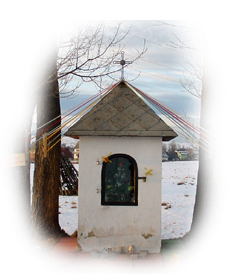 There are quite a few who go to daily mass. It's mainly elderly women, judging from the small stream of people I see leaving the church. This raises a question: how does one draw the line between sincerity and habit? And what if it seems only to be habit despite the individual's protests that it's not? Pious until proven habitual? Or maybe I'm begging the question of them being mutually exclusive.
This Catholic piety spills over into every facet of life here, something striking to someone coming from a relatively irreligious country like the States. Separation of church and state — a completely foreign concept here.
One of the many results of this piety is the proliferation of chapels —roadside chapels, yard chapels, even gable chapels.
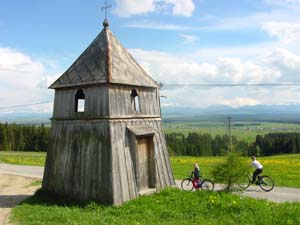
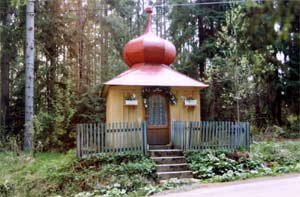
Roadside chapel just outside of KiczoryRoadside chapels are everywhere in Poland. They're by highways (or the Polish approximation of "highways") and roads you think are probably traveled once a year.
And they're all different: from small, simple, covered crucifixes to elaborate buildings.
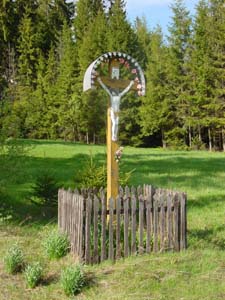
I've rarely seen people there praying, but it does happen occasionally. It seems to be most common around high holidays in the spring and summer when the weather is conducive to spending all that time outside praying. And in many ways, it's quite admirable, that kind of religious dedication.
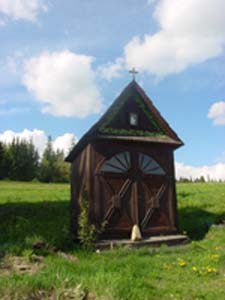
Some Protestants might suggest that building chapels like this is not necessary, that no building contains God.
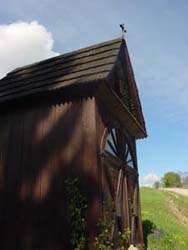
Theological differences aside, it's still a pleasant idea for me, even as a non-believer.
So we survived this Catholic church’s inability to treat its believers like responsible adults—i.e., we survived the pre-wedding, weekend-long marriage class. I would say “seminar,” but “seminar” implies more interaction than actually took place. The first half of the first day especially was nothing more than a long lecture.
Kinga and I decided that the people who really need such a thing don’t benefit at all from it, because they don’t really pay attention to it; and the people who don’t need it obviously don’t benefit from it all that much. The price was not worth the benefit in our case, I would say. It didn’t really cover anything Kinga and I hadn’t heard/thought/realized before.
What was especially frustrating was the repetition of the Catholic birth control talk. It began with an attempt at justifying it logically (and of course theologically, and even thought “logical” is in the word “theological,” it often isn’t). The presenter hung up a poster of Van Gogh’s Sunflowers and asked us to imagine we’d painted it. In comes a friend who rips the painting and she had us brainstorm what we would feel toward that friend: anger, surprise, hatred, desire for revenge, etc. were the words that came to people’s minds. She then pointed out that we weren’t physically harmed by our “friend’s” action, but that our creation was. “Ah,” I began thinking, “That’s how they’re going to try to justify the church’s absurd position on birth control.” And sure enough, she pointed out that we’re God’s creation, and that according to the Genesis account (which apparently we’re to interpret literally), we were created with four critical aspects/commands. One of them was our fertility and the command “be fruitful.” So the reasoning went, that when we’re tampering with our fertility, we’re tampering with God’s creation, and so on and so on.
She then went on to frame it as a question of faith, and I believe that was a great mistake. “Checkmate,” I thought, recalling my upbringing. In short, I wanted to talk to her about this and say the things I’m about to write, but I didn’t. If it’s a question of faith in God’s almighty power, then going to the doctor is just as much a questioning of that faith as using birth control. It’s one and the same. Catholics pray to God for healing—and then use medicine. If it’s an act of anti-faith (for lack of a better term) to use birth control, it’s just as much to use birth control.
Another one of the critical aspects of the Genesis account that they brought out was the control over creation that God supposedly gave Adam and Eve. So we’re supposed to “panować” all of creation except our fertility…
The church’s position is an antiquated position based on a time when infant mortality was much higher than now, and global overpopulation was an unthinkable concept. “Be fruitful” makes a lot of sense when perhaps half of the children you bring into the world live to be adults. In today’s society, it just makes no sense whatsoever. So the church is left scrambling to explain a first century (and earlier) tradition in a twenty-first century reality.
Interesting that the woman presenting said that the church’s position was not a question of the church wanting to have as many Catholics as possible—having babies for the church, in other words. And yet, just the day before, the priest said just that. That children were a blessing, and that by having many of them (he suggested three!) we would help our “fatherland” and the church.
The whole weekend wasn’t a waste. There were some interesting moments, but it could have been done in an afternoon as opposed to two full days. And the fact that it was required was ridiculous. Of course those conducting it had nothing to do with that, as they pointed out at the beginning when they said that no one would be excuse for any reason, we had to sit there throughout the whole thing. And then actually said bottom line themselves: “Ci który mają świadecwy mają władca.” “Those who have the certificates have the power.” It was meant as a joke, but I didn’t find it terribly amusing.
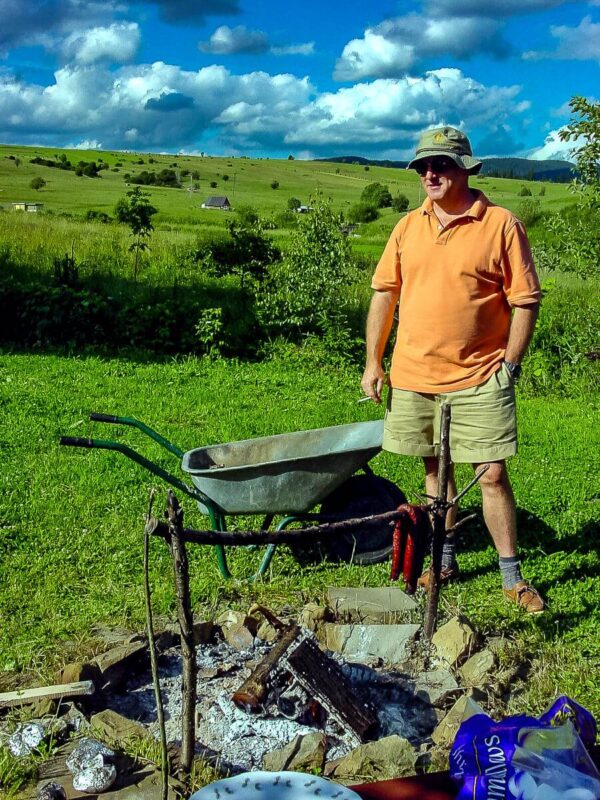
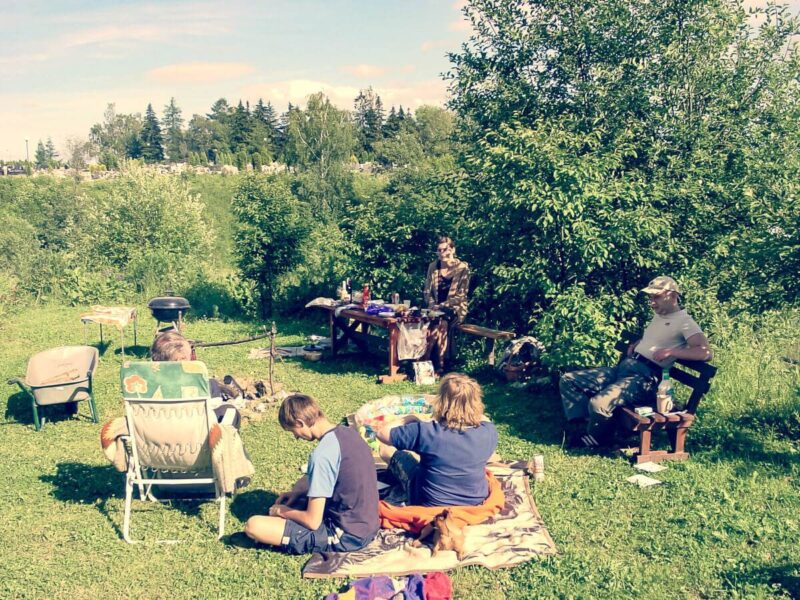

Part of the tradition of the Polish wedding is the delivery of the invitations. In short, if you can drive there in a reasonable amount of time, you’re expected to hand-deliver the invitations. That means a lot of driving before the wedding.
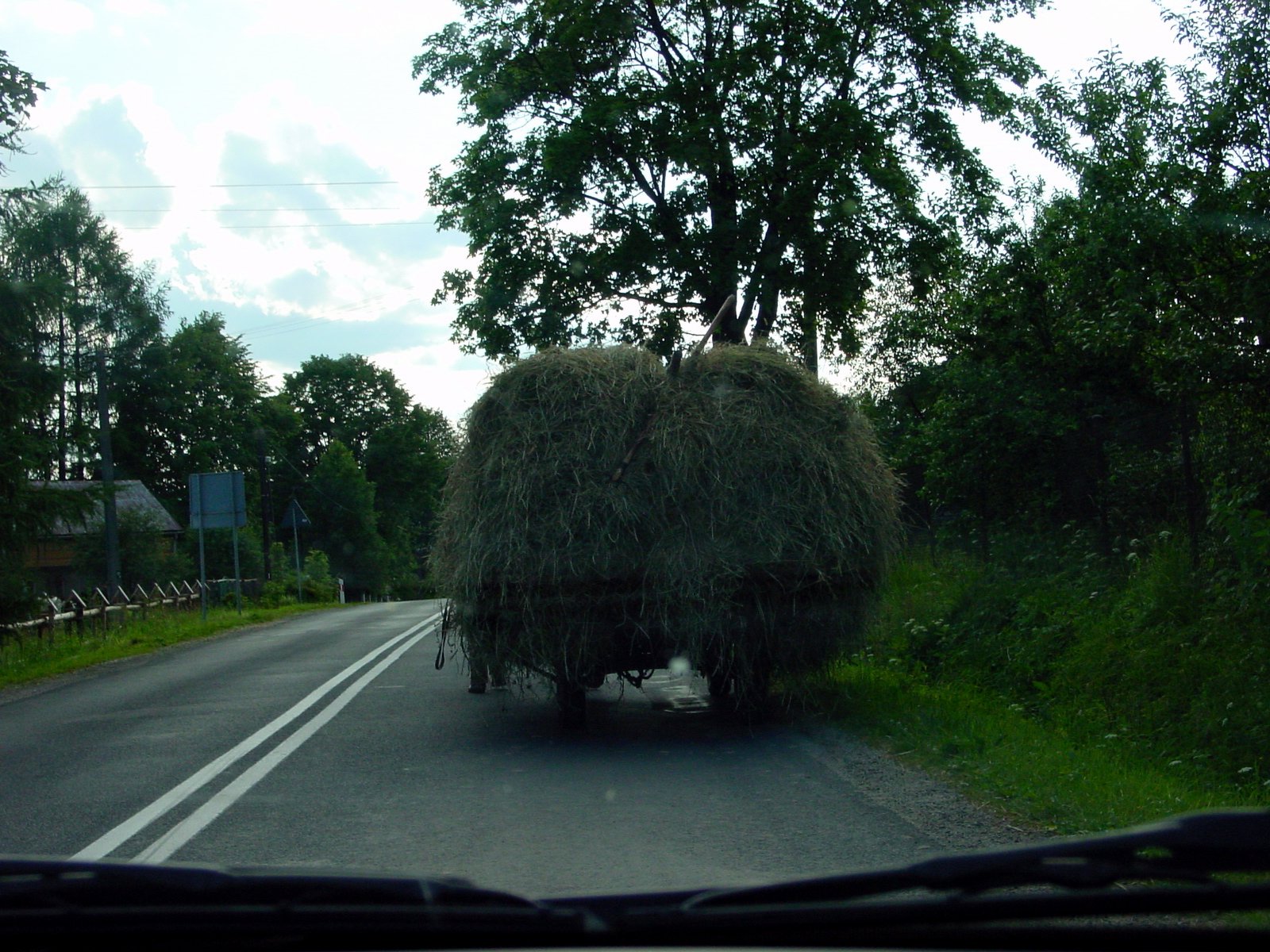
In places you might not usually drive.

With views typical of the region.