xcg
A Long Letter
@ 11:51 And here's where the email gets to be tough to hear. And I hope it deeply sobers every person in the room. “I had four members in a PM tell me just last week how confused they are about prophecy. I directly asked brethren if they were keeping up and understanding what is being taught in the Series. Their frank responses are sometimes sobering. Many brethren are excited about the Series. But I would not be surprised if at least 10 to 20 percent of brethren in my area are confused to the point where they do not even listen to the Series anymore.They just blow it off.” Astounding. And then he talks about a recent trip to a place that he visited, and that confirmed it.
@ 13:26 I very much appreciate this letter. “The reasons they are confused may be many, but I think there are three common issues. Number One: They don't have literature and reference points they access to review, which outline the basic elements of prophecy. Think of all the charts and booklets we had to explain the Big T.” You know, the Millennium and the Seven Seals we thought preceded it. “And when I was a new member, I thought it was rather complex. Many changes in our understanding is Number Two. This caused many to stop taking notes to prevent the current understanding to get ingrained into their thinking because it will change again.”So they just stop taking notes.
@ 14:14 “Some have even said that it helped them.” Not taking notes anymore. Depends on how you mean that. They could listen better, or they could just tune it out better. I don't know, maybe both. "The effect is that when an easy part or basic truth is explained, unrelated to prophecy, they don't take notes, causing the understanding to slip easier. New brethren have zero background and have to,” so this is Number Three. “You have to sorta just figure out how to learn on the fly unless someone takes several hours to bring them up to speed. And in this context, I think sometimes the sermons come so thick and fast that it sometimes just goes over the head of not only new brethren, but also some existing members.”
@ 15:21 “Now, I referred all brethren to the ‘How God's Kingdom Will Come—Not What You Think!’ World to Come video to help them solidify the different comings of Christ. I have and will refer them to your recent sermon if they've not studied it yet. If you know of other material we can refer them to, please let me know. I've mentioned this to the Headquarters Ministry in the past, but I find brethren who struggle with the Series difficult to pastor. Several refuse to talk about the Series and will even walk away from a conversation or fellowship containing it.” Astonishing. But there are such people.
@ 16:25 “I started to mention the issues in pastorate reports from more than two years ago, and sometimes I feel like it's getting worse. Sometimes not.”
@ 16:35 “We all have found some elements of the Series hard to follow, too. But I never want to give brethren the impression that I am in any way undermining the Series or our father in the gospel. Yet at the same time, I fully appreciate the obligation I have towards the sheep God has put in my care. I just try my best to communicate what I see on the ground back to Headquarters. It's been a challenging task to keep many of the sheep glued to it and excited. It remains awkward to balance. If Friday comes and goes,” Well, it did, fortunately. And it went. It came and went, and I get to give this sermon. “I look forward to exploring (rather urgently) ways to help those who are not actively following the Series anymore. Any ideas will be welcomed. Recently, I mentioned to the Headquarters Ministry how I may want to give a sermon on the Series one day. Maybe two parts just to help their understanding of basic elements. The three iterations, the Seventh and Eighth Head, timing of resurrections, et cetera. You already covered several parts of it. Thanks again.” And how I love reading the last part of that. That's a proactive pastor.
The Liberation of the Worldwide Church of God: A Review
Many observers who have been watching the changes within the Worldwide Church of God (WCG) in the last fifteen years have probably wondered about the dynamics within the church’s administration that might have lead to such a change. This is especially true since the truly major doctrinal changes, culminating with the acceptance of the Trinity and rejection of Sabbatarian doctrine in the mid–1990’s. An insider’s story would go a long way in explaining how the changes came about and be of interest and use to members and nonmembers alike.
When Joseph Tkach Jr.’s Transformed By Truth was released, it became immediately clear that this was not the “insider’s story” many people would have liked. Panned by most as shallow propaganda, Transformed fell out of print and has yet to be reprinted.
Michael Feazell’s The Liberation of the Worldwide Church of God generated controversy even before it was released. Many perceived the initial cover art as a condemnation of Herbert Armstrong, indicating that he was suffering eternal damnation for his heresy. Perhaps some Evangelicals might have hoped this was indicative of a coming out-right denunciation of Armstrong. Such was not the case, however. And while the book does offer some much-needed information about the changes within the Worldwide Church of God, it falls short of hard, critical analysis.
Governmental Structure, Christian Duty, and the Pace of Change
There is a certain lack of organization in the book, which initially was a cause of irritation. However, the ironic thing is that without this poor organization, an important facet of Liberation might have slipped by unnoticed.
On several occasions (see pages 45, 114, 119), Feazell makes the point that without the Armstrongian, authoritarian governmental model, the sweeping changes that occurred would never have been possible. I thought about this for a while and realized it was probably true, but it still left me uneasy. It wasn’t until a couple of days later that all the pieces of the puzzle (to use an apt Armstrong analogy, which bordered on cliché) fell into place.
One piece of the puzzle was Feazell’s claim that the Worldwide Church of God’s greatest sin was its exclusivist stance towards other Christians.
The sin of the Worldwide Church of God lay not only with its doctrinal error, but even more seriously with its arrogant, self-righteous, in-your-face declaration that it had the corner on the doctrinal market (169)
It did not follow Jesus’ commands to “have love, one for another.” “There are worse things than poor theology” (166), and this, Feazell reasons, is one of them.
Another piece was Feazell’s refusal to condemn Armstrong as a heretic.1 Feazell writes that God’s grace is sufficient enough to cover even bad theology. “How wrong did Herbert Armstrong have to be to be considered unworthy of God’s forgiving grace?” asks Feazell (101). He continues, “Don’t we all, doctrinally ‘pure’ and doctrinally odd alike, stand together at the foot of the cross, together in utter hopelessness and infinite need of God’s amazing grace?” (102). Feazell’s argument is that condemning Armstrong is drawing
boundaries around the potential of the grace of God to reach even into the area of doctrinal error. Yes, Herbert Armstrong taught error. But does not the grace of God extend even to doctrinal error? I have to believe it does (103).
In other words, Feazell is proposing that despite leading thousands astray, Armstrong is still in the “eternal embrace of the Lord” (149). Indeed, Feazell seems to indicate that condemning Armstrong constitutes another form of heresy: “Heresy comes in many forms, and surely one form is to place humanly devised limitations on the power and grace of God” (103). This is because “the blood of Jesus Christ is powerful enough even to wash his children clean from doctrinal error” (169).
The final piece appears when considering what Feazell writes about the unrelenting velocity of the changes in the WCG. He admits that things could have been slower in certain areas (namely, worship style), but regarding Armstrong’s heresies, “our backs were to the wall,” he writes. “When it comes to false doctrine, a church doesn’t have the luxury of pacing the change” (120). 2
When it came to doctrinal changes, however, we found ourselves having to weight faithfulness to God and commitment to truth against sound principles of managing change. On the one hand, change was coming too fast to be assimilated. On the other hand, how could we just sit on the truth? How could we deliberately allow our church to continue to believe and teach error and heresy? The responsibility to proceed with doctrinal changes once we became convicted of them was greater than the responsibility to go slowly (110).
Curiously, after spending several pages justifying Armstrong on the basis that God’s grace can overcome bad theology, and several more pages explaining that the WCG’s main problem was not its bad theology but its judgmental attitude, theology suddenly seems awfully important. Important enough to put their “backs to the wall” as if they’re standing in front of some denominational firing squad.
What Feazell is saying reduces down to this: Christ’s main command to his church was to love each other. Because of its judgmental attitude and exclusivist theology, the WCG did not fulfill this primary command, and as such, the WCG’s bad theology was actually periphery — not it’s main sin. Indeed, this command to love other Christians is one reason why we cannot condemn Mr. Armstrong. Additionally, such condemnation would be putting a limit on God’s grace, which surly covers bad theology. Still, we had to make all the changes with blinding rapidity and in complete confidentiality because to do otherwise would be another “affront to the gospel” (132).
All these things just doesn’t add up. If there are worse things than bad theology, why the desperate mid-90’s race to change this theology? If not having love one for fellow human beings is worse than bad theology, why rip out from under thousands their primary grounding?
All of this came to my attention when I began noticing that, due to the poor organization,3 Feazell pointed out several times that the authoritarian government structure that helped give the WCG its sectarian status was what enabled these drastic theological changes to be effected. However true that might be, it doesn’t necessarily follow that having such power to make these changes gives one the right to make them, especially in the clandestine fashion that they did. While he doesn’t use the same vocabulary, Feazell argues that it was their “Christian responsibility” to make these changes, much as the WCG argued that it was its responsibility to keep Mystery of the Ages out of circulation by suing the Philadelphia Church of God. Such a claim would simply be a hollow contradiction of what he says in Liberation is the responsibility of a Christian: to love others. Yet it is not surprising that these changes were effected as they were given Feazell’s view that the WCG constituted a “rather immature group” (123).
The Identity Issue and the Question of Audience
The question of identity is another recurring theme in the book. Many of the best passages of the book deal with the question of identity, and Feazell makes some of his best points regarding it. He writes that for the Worldwide Church of God, the question of identity was of utmost importance, whether it was the Biblical identity of United States and Britain or the identity of WCG members as the called out ones taking part in a great, global media enterprise. Feazell argues, though, that the only identity that truly matters is the identity of Christ, and that various groups’ identities are of secondary importance.
All the same, corporate identity of the WCG is very important for Feazell and the other administrators. The identity they’re all trying to cultivate is one of a moderately conservative evangelical denomination. As such, it’s not surprising how many times he tosses around phrases that sound like they come from a Max Lucado book. Examples include:
- “Praise God for his grace!” (130).
- “The gospel broke into our hearts like a clear, fresh, bubbling mountain brook after an exhausting, seemingly endless climb over burning rocks and parched soil on a blistering day” (139).
- Worship should be “a genuine rehearsal of the gospel story” (80).
One might legitimately ask, “What does a ‘genuine rehearsal of the gospel story’ look like?” Feazell doesn’t proffer and answer, perhaps assuming that at least a significant portion of his target, evangelical audience will know what this vague, feel-good phrase could possibly mean.
It is not the only example of fuzzy, self-affirming evangelical haziness. A few pages later, Feazell includes this description of the gospel, which deserves to be quoted at length:
According to Frederick Buechner, the key to effective preaching is honesty. And as Buechner asserts, the incarnation is the epitome of honesty. That is because Jesus Christ — God with us, God in the flesh — ever faithful, meets us precisely where we are — in a particular place in a particular time in the particular reality of our broken and wretched humanity. He offers himself as the perfect means to our healing and restoration, and he perfectly establishes in himself our eternal significance and future.
We are made in such a way that this astounding truth reaches our hearts through the stimulation of our imagination — not through the logical “proofs” and stacks of facts we like to amass before we are prepared to believe anything that threatens to significantly change the way we live. and Buechner is surely right about the sheer wildness of this story. It is an extravagant tale — at once shocking, disturbing, comforting, and thrilling. It is a paradox of unbounded power and senseless self-sacrifice, a song of indescribably love in the face of brutal disaster. It is the turning and twisting story of the crucible of our confusing lives into which God himself has entered to bring meaning to the absurd.
Always surprising, always unexpected, always turning the endlessly resurfacing tragedy to hope, always piercing turmoil with peace, always wringing joy out of pain, this gospel is the reality from which all forms of the human story flow. In the gospel everything changes, yet everything continues as it was before. In the gospel of Jesus Christ the impossible is possible though it cannot be done, and the darkness is lit with invisible light. As Fredrick Buechner so richly puts it, this gospel is “the tale that is too good not to be true” (85, 86).
Once again, it is legitimate to ask what exactly all that means. In some ways, it seems empty — simply poetic description of the gospel, meant to resonant with evangelical Christians. Not only that, but one can question what the point is of the last two paragraphs is, except to show his Protestant audience that the WCG has indeed changed. Referring to the “sheer wildness” of the gospel and describing it with phrases like “a song of indescribably love in the face of brutal disaster,” “the endlessly resurfacing tragedy to hope,” and “the reality from which all forms of the human story flow” firmly places Feazell in the evangelical community, at least in appearance.
Condemning Armstrong
Feazell and the Worldwide Church of God leadership are in an interesting position. They have to condemn the heresies of Herbert Armstrong. However, the primary heresy, according to Feazell, is that Armstrong relegated all of Christendom to satanic deception and heresy. In a sense, then, it is the ultimate finger-pointing game.
Feazell must walk a fine line: on the one hand he has to condemn Armstrong’s theology; on the other, he has to show that that theology has changed and is no longer exclusivist (which was, in Feazell’s assessment, the primary sin of the WCG), condemning all of Christianity to being the “Whore of Babylon.” As such, Feazell in his book begins by condemning Armstrong’s theology, switches to a brief rebuke of those who condemn Armstrong’s person, and ends again condemning Armstrong’s theology. In other words, he swings back and forth between condemning Armstrong and condemning those who condemn Armstrong.
Recalling that Armstrong’s main problem was his exclusivist views, Feazell writes, “I pray we never descend again to thinking ourselves the legitimate arbiters of truth versus error” (100). Yet just two pages earlier, he writes, “I will go so far as to say that Sabbatarianism prevents anyone who believes in it from coming fully to the freedom of the gospel” (98). Isn’t that, to some degree, arbitrating truth and error? The “true” gospel is not a Sabbatarian gospel, he seems to be saying. Earlier still he conjectured that as long as people “continue to believe that Armstrong was what he claimed to be, they cannot fully enjoy the richness, rest, and joy of salvation that is theirs through confidence in Jesus” (97). One cannot have the true gospel in one’s heart and be an “Armstrongite.” Indeed, Armstrongism (or Armstrong himself — it’s not clear exactly which Feazell is referring to, and I suspect that is not an accidental ambiguity) was a “Barrier to Christ” (96). Further, when several ministers proposed a middle-ground compromise that would allow some churches to follow Armstrong’s Old Covenant teachings and others to follow Tkach’s New Covenant changes, it was “rejected as an affront to the gospel” (132). In other words, it was wrong.
The tensions within the WCG administration thus come to full view. In order to embrace traditional Christianity, the administration must continue to commit Armstrong’s “biggest sin” and arbitrate between right and wrong. The primary difference now, though, is that the WCG’s sense of orthodoxy is the polar opposite of what it was under Armstrong.
“If you can’t say anything good . . .”
Despite the problems, Liberation does offer some new views and surprisingly astute analysis. The stress on identity, while problematic as discussed earlier, does show how critical the question of identity was in the Worldwide Church of God.4 It is a fairly well established sociological fact that groups with a worldview that deviates from that of society as a whole will expend a great deal of effort constructing, defending (i.e., apologetics), and protecting that worldview and the accompanying identity. Feazell’s recognition of the importance of identity in a cognitively deviant group is good to see.
Perhaps the best point Feazell makes is regarding the formation of the church and members’ role in it.
Begun not as a church but a media ministry, the church just “happened” in the wake of Armstrong’s mass media proclamation. Until the day he died, Armstrong saw the role of the church as simply to stand behind him in prayer and financial support in his mission of preaching the gospel to the world.
This also touches on the issue of identity, for now members must identify themselves as “members of a local church [and not] a group of special people called to support a powerful, globe-girdling media ministry” (109). Further, it follows such a vision will impact worship in the WCG.
Once again, worship is relegated to the role of a tool to uphold Herbert Armstrong as God’s appointed end-time apostle and Armstrong’s church as the one and only true church, the body to which one must belong in order to be saved (85).
It also seems to have influenced how the WCG proselytized: “Rather than evangelize unbelievers, the Worldwide Church of God targeted the Christian community” (153). Most importantly, it follows that since members were called to support Armstrong they were not called for individual salvation.
There was a surprising amount of forthrightness, though not as much as many WCG critics would have liked. The admission of lack of WCG vision, for example, is surprisingly forthright (145), and as mentioned before, the analysis of this fact is quite enlightening. Further, the admission of potential bankruptcy is surprising (130).
Yet despite these surprises, the book has little going for it. As I pointed out, it is certainly revealing, showing a certain level of contradiction in the messages and behavior of denominational headquarters. However, I doubt such “revelation” is what Feazell was planning.
Notes
1 Some exiters and critics of the Worldwide Church of God claim this is further proof that the WCG is still essentially a cult, but that doesn’t necessarily follow.
2 It’s interesting that he writes that the administration could and “should have gone much more slowly with changes in worship style” (120). I don’t recall such changes causing the monumental problems in people’s lives that the changes regarding the Sabbath and God’s nature did. I never heard a comment like, “Oh my! We don’t have to do three hymns, followed by the opening prayer and sermonette, with another hymn before announcements. We have freedom in how Sabbath services are organized! This is chaos! And we all know who the author of confusion is!”
3 A prime example of the poor organization is the scattered discussion of the Sabbath. Feazell discusses it at length page 98, delving into the well-worn, evangelical cliché that Jesus is the Christian’s real Sabbath. Yet he discussed it from Armstrong point of view on page 77 to 84. In between is a bit about Armstrong’s false prophecies, and a section dealing with the simple fact that Armstrong was “not what he claimed to be” (97). It would have made more sense to consolidate all the discussion of the Sabbath into one chapter.
4 According to my reading notes, the idea of identity is mentioned at least ten times, on the following pages: 69, 71, 83, 94, 107, 124, 125, 137, 142, and 144.
Lot 403
More Pack Nonsense
You'd think a man would eventually learn. After setting the date for Jesus's return at least five times that I know of, David Pack has set yet another date just days after his latest failure. Jesus was supposed to come back a little over a week ago, on 26 September. This last Saturday, Pack explained he'd learned a lot of new things in the previous week. God had blinded him before; now he can see.
If you listen to him talk about the prophetic world he's created for himself and his followers, it's easy to see how far from reality the man has strayed.
The 1,335 days, the ten-day period, the fifteen-day kingdom -- all his followers know exactly what he's talking about (well, perhaps not exactly as those who have recently left point out that Pack has been changing these doctrines on a whim over the last few years) but no one else knows. It might as well be gibberish. It might as well sound like this:
But like all good cult leaders, he's not afraid ultimately to tell his followers where their place is:
"Shut up and learn." That's their job.
More Predictions
Dave Pack is at it again. He's predicting Jesus's return within the next nineteen hours:
In case that's not clear, that's tomorrow:
We can forgive him for not having figured it out sooner -- after all, no one else has figured this out:
He's figured out lots of other things, so we should be grateful for that.
He'd predicted this earlier, and it didn't come to pass, but in the end, he was just a day off. A day and nine years:
Still, it's a relief to know the return of Jesus is happening tomorrow.
At least, that's what he said on 17 September...
Mention

Off the Rails
I've been listening to some of Herbert Armstrong's sermons the last couple of days, and it's been a fascinatingly awful experience. I knew what was coming: I grew up listening to this shit, but I still had forgotten about just how awful he was. Just how misogynistic he was. Just how much he liked to yell during sermons to impress upon congregants just how serious his words (and thus God's words) were.
I made a mental note about a couple of the passages because they just stood out so drastically. In this one, for example, he goes from talking about the fall of Lucifer and his resulting transformation into Satan to the evils of women wearing makeup -- without any kind of transition at all. None.
By the end of the sermon, he turns his attention to men and the inappropriate clothing some of them are wearing to church -- shirts with no jacket!
What's most interesting is he suggests that not everyone has to be dressed up just wearing the best clothes they've got without even thinking that perhaps the men who aren't wearing suits are doing just that -- wearing the best they've got. And then, of course, there's the misogynistic double standard: women aren't to worry about their appearance but men had better be dressed smart!

As I've listened to these three or four sermons (how many more will I put myself through?!), I've come to re-learn the man's cadences: I can predict with dreadful accuracy when he's about to ramp up, go off the rails, and start yelling.
First Day of Break

Today was my first full day off. What did I get scratched off that list? Something I'd forgotten even to add to the list in the first place. It's something I started last summer. Or was it the summer before that? I could check, but what's the point -- the point is that it wasn't completely finished, that French drain project. I'd intended to hook the whole system up to three of the five downspouts on the back of the house.

Since we've hired someone to enclose the area under our deck with lattice, and he was scheduled to start today, I knew I had to finish hooking everything up this morning.

While I worked, I conducted informal research on a project I've had lingering in the back of my mind for years now, something I've wanted to write but just never had the distance required to write about it. Now that both my parents have passed, I've started drafting ideas for an extended piece on my religious upbringing. A memoir? Who knows what it will be. But I've started exploring that world again, downloading old sermons from the 70s and 80s from an internet archive of impressive scope, a site that has made available all the literature (books, "booklets," magazines, sermons, television broadcasts) of the Worldwide Church of God, the organization in which I grew up.
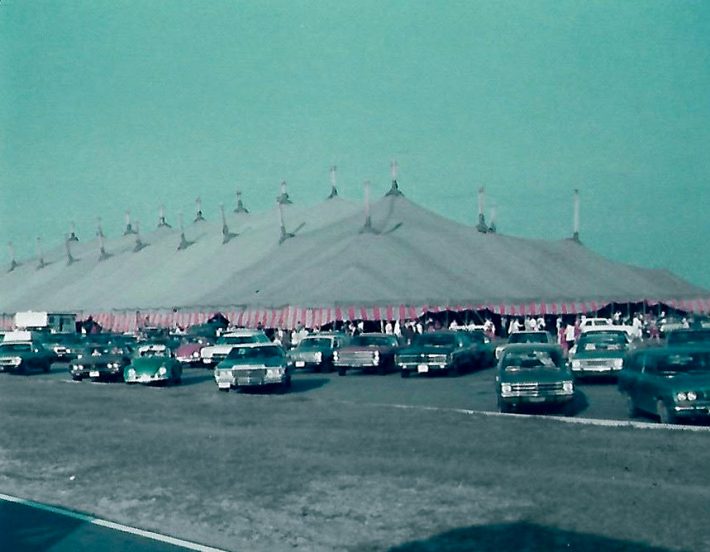
I grew up having expectations for my teen years and early adulthood that were so different that my peers' expectations that they're almost laughable now.
I've written about similar matters here, but mainly I've explored the groups that exist that profess, to varying degrees, the same theology of the WCG. Now, I'll write about my own experiences growing up in such an environment.
The Last Great Day
They woke up this morning with a sense of excitement and dread, thrilled with their sense of foreboding and relief. Today, Jesus was returning. No one knew the hour, that is certain, but it would certainly happen today.
Unless it didn’t. It wasn’t the first time their leader had predicted Jesus’s return. It wasn’t even the second time he’d foretold the day. It wasn’t the third or fourth time. Many members of the group had lost track of how many times their leader had made this exact prediction with the same fervent confidence. Just a year before, their leader had suggested that during this same fall festival Jesus would return.
“You won’t be returning to your houses!” He’d confidently assured everyone. He’d suggested that members might be talking to the resurrected Abraham — the Abraham of the Bible — within days. Even the original leader of their group, Herbert Armstrong, would have risen from the dead within that week and members would be able to “ask him yourselves” about various prophetic timing he seemed to get a little wrong.
So when they wake this morning and recalled their leader’s words from earlier in the week-long festival they were celebrating when he’d assured them Jesus would come back by Tuesday, they were hopeful that he might finally be right and worried that once again the prescribed day would come and go just like every other day before it.
Why do these people, members of the Restored Church of God under the autocratic leadership of Dave Pack, stick around and continue to support Pack’s delusions? The man sees himself as the most hated man on Earth. He has said about his importance in coming events that, from the perspective of the powers of evil seeking to wreck God’s plan, “I must be stopped at all costs!” Why do they continue to support him when year after year he has made the same false prophecy about the return of Jesus? It’s simple: the sunken cost fallacy. They’ve invested so much time and money into the prospect already that they cannot bring themselves to cut free. After all, there’s still the hope that he is God’s only apostle and his exclusive spokesman on Earth. If they leave now and then Jesus returns, they’ve forfeited their crown, literally: they believe they will become gods, part of the so-called “God family” that Pack and other heretics teach is the explanation of the passage in Genesis, “Let US make man in OUR image.” Abandoning the plan now means giving up god-hood if Pack ever does get it right. And since they thought for so long that eventually, he would get it right, they can’t bring themselves to admit that while he might be wrong now, he might eventually be right.
And yet they’ve heard it all before. They likely view their doubts as temptations of the devil, an attempt to get them to give up their crown -- the ultimate victory for the devil.
In the midst of all this, I look at this little group that splintered away from the group I grew up in -- I used to believe many of the absurd things the Restored Church of God teaches -- and think about those members who are watching these last hours of the promised day slip away, and I feel for them.