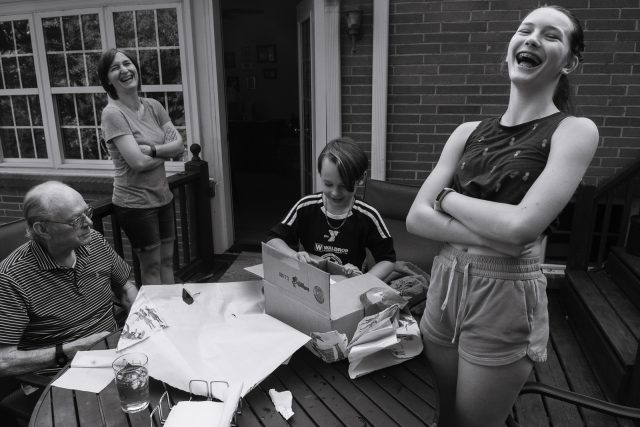
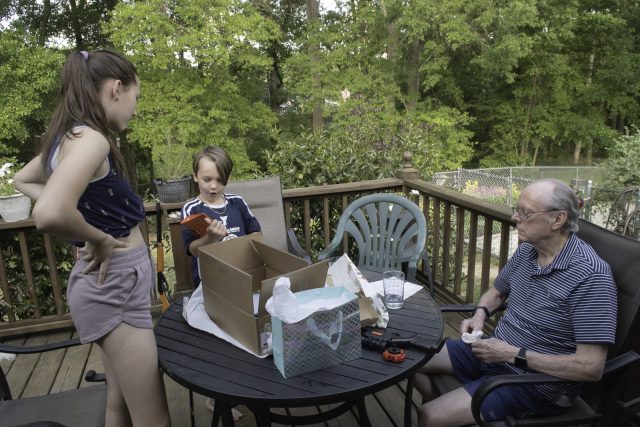
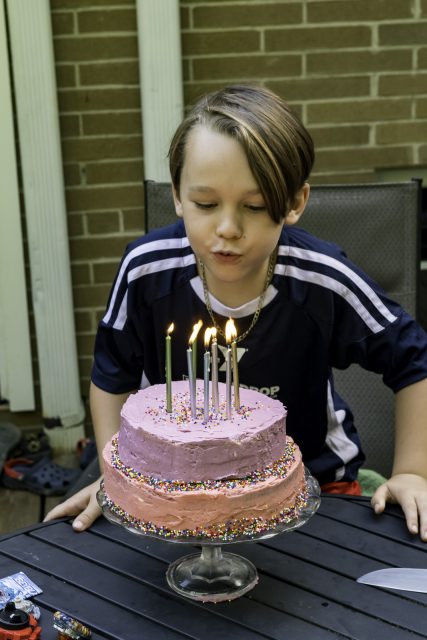
matching tracksuits

fun in threes, sometimes fours

the girl

Day 55: The Swing, the Dog House, and the Bench

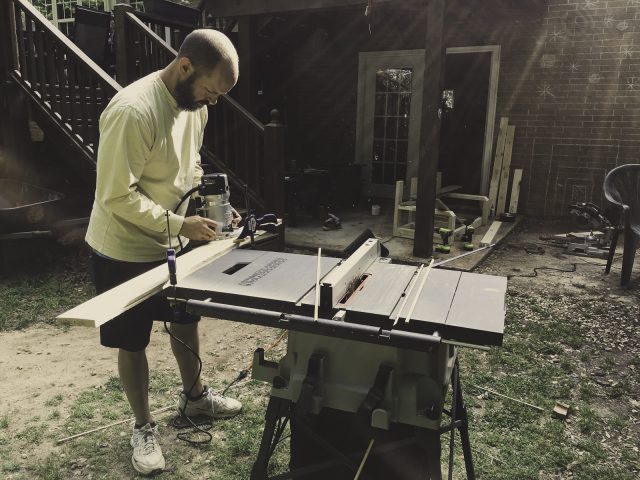
I don't know how it inevitably happens, but projects with me just seem to swell completely out of proportion from my original estimates. Sometimes it's simply that my estimates are wrong. No, that's most of the time. I tend to underestimate the time required because I tend to overestimate my skills. Today, though, my estimation of the time required to make K's Mother's Day present was just about dead on. True, it took me longer in the end, but that's because I decided to pull out the router and round over every edge. Why? Because I have a router and quite honestly don't have that many opportunities to use it.

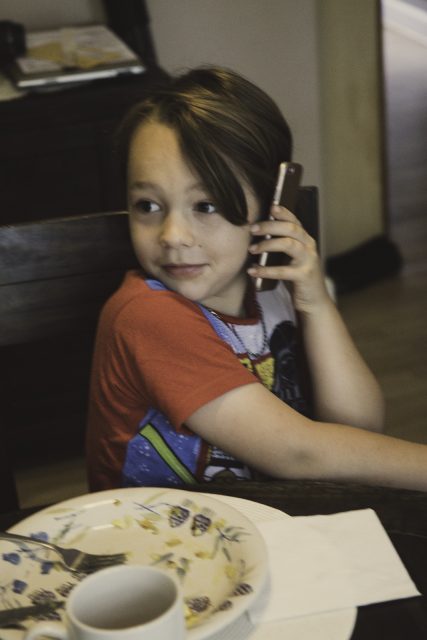
From K's iPhone

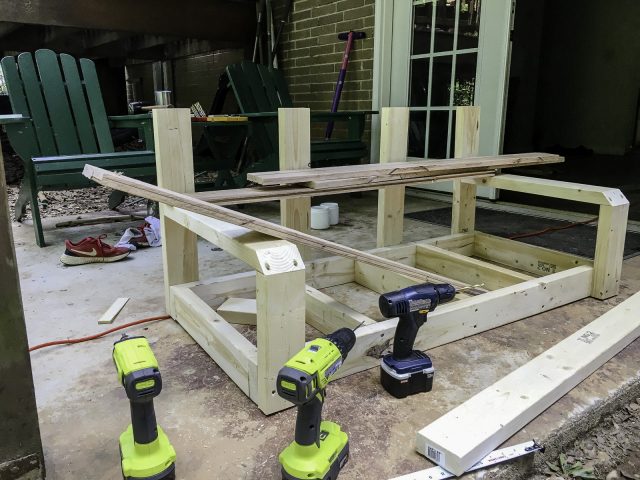
I also decided as I was working to countersink all the screws and go back with wood filler and hide them all. That added a bit of additional time. But the raw building itself took just about as long as I anticipated.

What got me off track was not the time it took to make the bench but rather the time it took to gather the needed materials. The wood was the real trick.

I went to Lowe's expecting to be back fairly quickly. All I needed was a bit of additional chain for the swing, a few hooks to connect the swing to the chain, and some 2x4s for the framing of the swing. The chain took quite some time -- probably more than twenty minutes -- because I pressed the "Press here for assistance" button and no one came for what seemed like an eternity.

From K's iPhone

Finally, I was ready to pick up the lumber and haul it back to the in-store sawing station to have them cut the 96" studs down to 48" pieces that would fit in K's Rogue. The first trick was to find a lumber cart. I finally gave up looking for one, went to the cashier, paid for the hardware, took it out to the car, and returned with a lumber cart from the parking lot. I loaded my six 2x4s and headed to the cut station. Where I found a sign that read, "Saw not functioning."

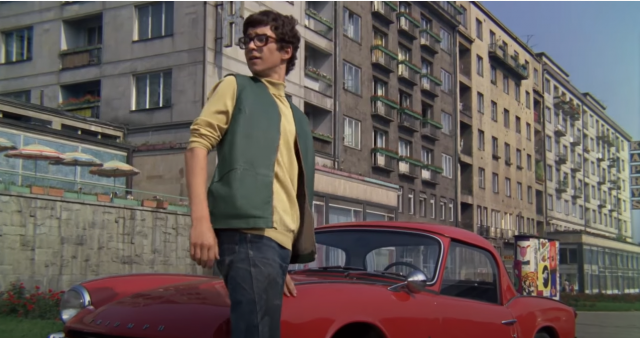
I felt like I was in the film Nie Lubię Poniedzialku except that I was in Greenville not Warsaw and it was Saturday not Sunday.

I just left the cart there with the lumber on it. It was a somewhat crummy thing to do -- I could have at least taken the lumber back.

From K's iPhone

After dropping off the hardware at the house (because it was on the way), I headed to Home Depot. The saw there was completely functional. The studs I picked out, though, were not 96" but only 93". So when I told the shop assistant to cut them at 48", adding "I just need them in half-size pieces," he did just that: he put one end of the board on 48" and cut. And the resulting pieces were of a significantly different length. That's when I measured and saw they weren't 96". I could have checked. I didn't. I just sighed.

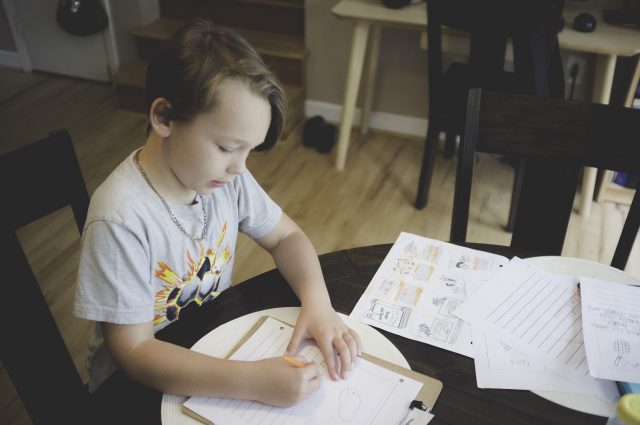
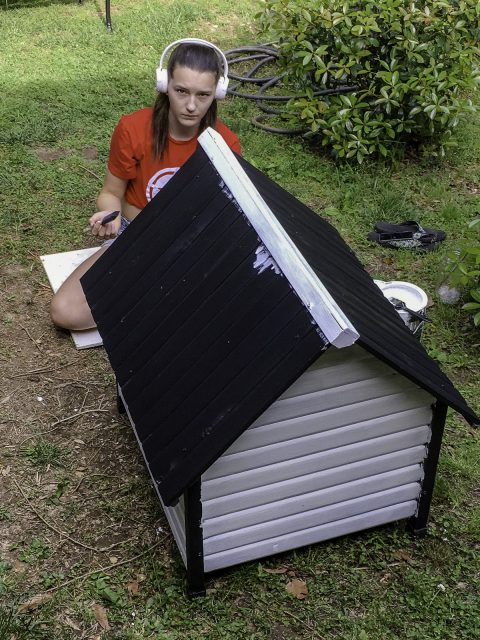
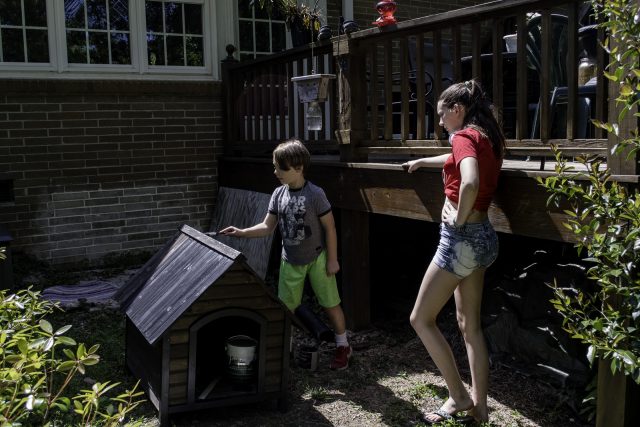
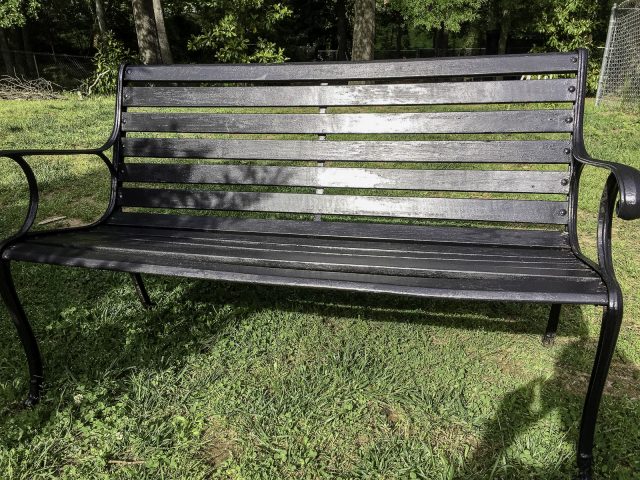
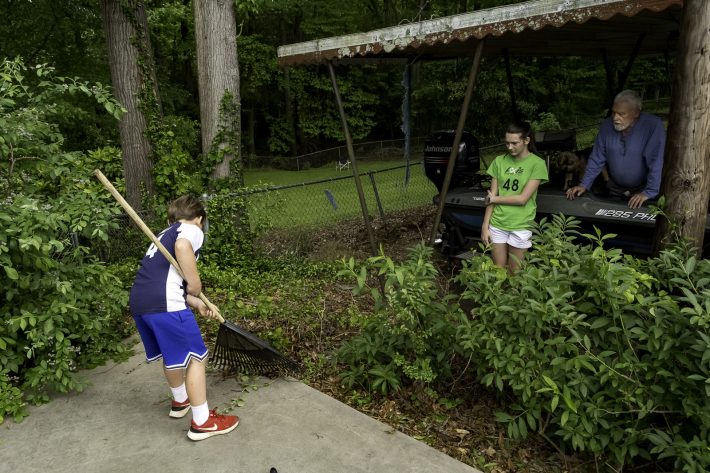
While all of this was going on, the Boy alternated between helping me and helping the Girl, who was painting the dog house and the bench.

From K's iPhone

In the evening, we watched Nie Lubię Poniedzialku. We've been trying to expose the kids to some of the classics, and we decided it was time for Poniedzialku. I love that film. It's probably my second-favorite Polish film, right behind Miś. The story, such as it is, is charming: we all laugh at the horrid Monday everyone is having even though none of their trials rise above irritation. There's no shadow of any real tragedy -- just the annoyance of plans going awry.

What I really love about the film, though, is the views of the Warsaw of the early 1970s. Just a quarter of a century after the Second World War, much of the city is still under construction, and what has been completed has the look of 60s communist architecture that was still prevalent in Warsaw when I arrived in 1996.

https://www.youtube.com/watch?v=1M2386VX0Po

Papa decided he'd watch the film with us. "There are no subtitles," we warned him, but he wasn't fazed. We explained critical dialogue, but most of it really didn't require a whole lot of explaining.

The Boy disagreed. "I don't get any of the funny parts, even when you explain them," he fussed.

Perhaps he'll find the next one we've planned a little more enjoyable: the classic Sami Swoi. We found it on Netflix DVDs, which means it will have subtitles. "Kargul, podejdź no do płota!"

Day 53: Changes

Schedule

A couple of weeks ago, I got an email from my principal. It read, in part,

We are working on the schedule for next year, and I wanted to run something by you. In an effort to simplify people’s assignments and avoid teachers having 3 preps, we are looking at the possibility of you teaching all of the English 1 sections. [...] My one hesitation is that 4 sections of E1H is a lot for one person. A lot to grade and be responsible for.

English I Honors is indeed a handful. Each class is about 30 students usually, and whereas 60-65% of students in English 8 turn in a given assignment, it's something like 90% in English I. Many English 8 students often have issues with time management and apathy, so it's rare for a student in those classes to turn in all assignments in a given quarter. English I is exactly the opposite thought: it's rare to have more than two or three students in a given class not turn in a given assignment.

Another element adding to the E1 workload is the simple fact that, compared to English 8, it's two classes combined into one: reading and writing are separated into two classes for English 8, and I have always taught the reading/literature portion. English I isn't, so I have to teach both, which means a lot of writing to assess.

So I was hesitant to accept such an offer. At the same time the idea of working with students who have almost no serious behavior problems, who are all working hard most of the time, who all see the value of education, is pretty hard to resist.

My other concern was regarding the fact that having all the English 1 classes would mean Mrs. H, the other English I teacher, would have none. I knew how she enjoyed teaching that class, and if the tables were turned, I would not want to give up English 1 even for the tempting offer of having only one prep. I expressed my concerns to the principal, and he, in turn, discussed those concerns with Mrs. H. It turned out that for her, the thought of having only one prep was indeed enticing enough to give up English I. In fact, she was somewhat worried about the workload that I would be facing, and she emailed me about those concerns. Receiving this email and having assurances from my principal that Mrs. H would not feel as if I were somehow taking these classes away from her (because that's how I felt: if I to take these classes, that means she loses them, and I can always say no), I agreed to take the 4 English I classes.

Yesterday the official master schedule for the 2020-2021 school year was released.

And there I am back-to-back-to-back-to-back English 1 classes.

I'm happy about this for a number of reasons, not the least of which that I will have very few behavior issues to deal with. It's also a great joy to work with students of actually do want to learn and you actually do put forth their best effort on a consistent basis.

On the other hand, working with a class that includes a significant number of at-risk students has its own rewards. I often feel I have the opportunity to teach them even more important skills like anger management, delayed gratification, empathy, impulse control, and appropriate self-efficacy.

The change will be significant. The increased workload will be noticeable. The rewards? Well, it is indeed a trade-off.

The Fort

L decided today that she wanted to get involved in the fort.

"You guys did the hardest part," she said, "But still -- I want to help."

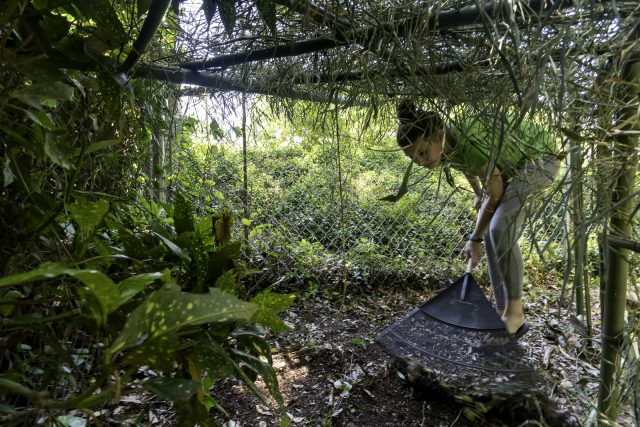
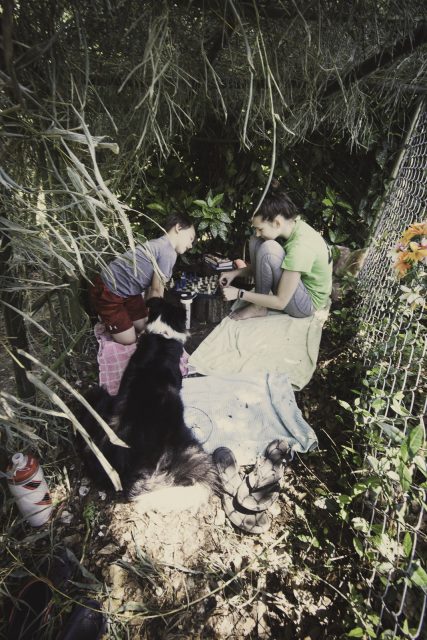
She brought an interior design eye to the project, bringing ground covering (old towels), decorations (old silk flowers), entertainment (books, a chess board, and more), and snacks.

Day 51: Seeing Anew

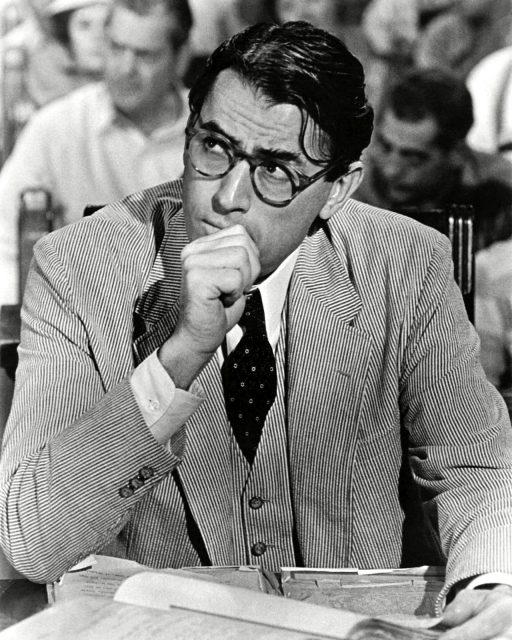
Atticus Finch -- what a hero. What a fantastic lawyer. That's what we all walk away thinking the first time we read To Kill a Mockingbird. We read his cross-examination of Bob and Mayella Ewell and think, "He did a really good job establishing Tom's innocence," and can't understand how Tom could be found guilty-- though we can understand it because it's Depression-era Alabama.

The state has not produced one iota of medical evidence to the effect that the crime Tom Robinson is charged with ever took place. It has relied instead upon the testimony of two witnesses whose evidence has not only been called into serious question on cross-examination, but has been flatly contradicted by the defendant.

Nailed it -- keep hammering on the fact that no doctor was called, Atticus.

She was white, and she tempted a Negro. She did something that in our society is unspeakable: she kissed a black man. Not an old Uncle, but a strong young Negro man. No code mattered to her before she broke it, but it came crashing down on her afterwards.

Her father saw it, and the defendant has testified as to his remarks. What did her father do? We don’t know, but there is circumstantial evidence to indicate that Mayella Ewell was beaten savagely by someone who led almost exclusively with his left. We do know in part what Mr. Ewell did: he did what any God-fearing, persevering, respectable white man would do under the circumstances—he swore out a warrant, no doubt signing it with his left hand, and Tom Robinson now sits before you, having taken the oath with the only good hand he possesses—his right hand.

There it is -- that brilliant evidence that someone lefthanded inflicted the bruises on the right side of Mayella's face. Tom's left arm was mangled in a cotton gin when he was young -- he couldn't have done it. Case closed.

And then that impassioned closing:

Thomas Jefferson once said that all men are created equal, a phrase that the Yankees and the distaff side of the Executive branch in Washington are fond of hurling at us. There is a tendency in this year of grace, 1935, for certain people to use this phrase out of context, to satisfy all conditions. The most ridiculous example I can think of is that the people who run public education promote the stupid and idle along with the industrious—because all men are created equal, educators will gravely tell you, the children left behind suffer terrible feelings of inferiority. We know all men are not created equal in the sense some people would have us believe—some people are smarter than others, some people have more opportunity because they’re born with it, some men make more money than others, some ladies make better cakes than others—some people are born gifted beyond the normal scope of most men.

But there is one way in this country in which all men are created equal—there is one human institution that makes a pauper the equal of a Rockefeller, the stupid man the equal of an Einstein, and the ignorant man the equal of any college president. That institution, gentlemen, is a court. It can be the Supreme Court of the United States or the humblest J.P. court in the land, or this honorable court which you serve. Our courts have their faults, as does any human institution, but in this country our courts are the great levelers, and in our courts all men are created equal.

I’m no idealist to believe firmly in the integrity of our courts and in the jury system—that is no ideal to me, it is a living, working reality. Gentlemen, a court is no better than each man of you sitting before me on this jury. A court is only as sound as its jury, and a jury is only as sound as the men who make it up. I am confident that you gentlemen will review without passion the evidence you have heard, come to a decision, and restore this defendant to his family. In the name of God, do your duty.

What a perfect defense! What insight! What an amazing job defending a man in a hopeless situation!

That's what we think when we're not lawyers, though. But what about a trial lawyer who's had twenty years' experience in the courtroom? Someone who's represented defendants against charges of rape and murder?

During the 2018/2019 school year

Every year, as the kids finish up Mockingbird, I have Jim Bannister, a local defense attorney, come in and walk the kids through the details of the trial and evidence. He's been doing this presentation for some years, ever since a friend's daughter read the book. The friend asked him what he thought of Atticus's defense and, not having read the book since middle school, Bannister reread the chapters dealing with the trial.

"I would have handled things a little differently," he remarked. "To be fair," he's always added when talking to the kids, "Atticus seems to be a tax and/or estate lawyer, so he was not in his area of specialization at all." Still, he helps the kids see the mountains of evidence that Atticus could have brought into the trial that doesn't even get a mention.

The most damning evidence does appear in the book, but Atticus doesn't push it hard enough: no doctor was ever called.  This means there's no evidence that the crime even took place. But there's so much more than that.

What about clothing the accused and supposed victim were wearing? How could Tom, who's left arm is all but useless, hold down Mayella as she claimed, take off his clothes, take off her clothes, and rape her while using only one arm? It doesn't make sense -- it's physically impossible.
What about defensive wounds on Tom? Mayella said she fought him "tooth and nail." There should have been scratches all over Tom's face.

What about the window through which Bob says he saw the rape in progress? Earlier in the book, the Ewell house is described and we discover that there's cheesecloth over the windows instead of glass panes. How clean was that cheesecloth? How much could Bob actually see?

And if his daughter was being raped and all that stood between him and the rapist was a bit of cheesecloth over a window no more than three feet above the ground, why didn't he dive through the window and attack Tom? Instead, he claims he witnesses the rape in the front room and runs around the entire shotgun house and enters through the back door.

All these were failures on the part of Heck Tate, the sheriff, who did absolutely no investigation at all. "I would tear him apart on the stand," Bannister laughs.

For me, though, the most jaw-dropping piece of evidence was a little gem hidden in Tom's account of the event.

"Mr. Finch, I was wonderin’ why it was so quiet like, an‘ it come to me that there weren’t a chile on the place, not a one of ’em, and I said Miss Mayella, where the chillun?”

Tom’s black velvet skin had begun to shine, and he ran his hand over his face.

“I say where the chillun?” he continued, “an‘ she says—she was laughin’, sort of—she says they all gone to town to get ice creams. She says, ‘took me a slap year to save seb’m nickels, but I done it. They all gone to town.’”

Tom’s discomfort was not from the humidity. “What did you say then, Tom?” asked Atticus.

“I said somethin‘ like, why Miss Mayella, that’s right smart o’you to treat ’em. An‘ she said, ’You think so?‘ I don’t think she understood what I was thinkin’—I meant it was smart of her to save like that, an‘ nice of her to treat em.”

Why in the world didn't Atticus call to the stand that ice cream salesman?! Everybody in the town knows the Ewells; everyone knows how poor they are. To see all seven of them come traipsing up with nickels in hand to buy ice cream would have been a once-in-a-lifetime, always-remember-it moment.

So he comes every year to lead students through these pieces of evidence, suggesting at the outset that they pretend like he's the lead attorney and they are his paralegals, investigators, and co-attorneys. "Let's see if we can't put together a better defense for Tom Robinson."

Except he couldn't come this year for all the obvious reasons. Yet when I asked him if he'd be willing to give it a shot on Google Meet, he didn't hesitate: "What dates are we looking at?"

And so he sat in his study and led several of my students through a discussion via Google Meet, and my eighth-grade vice principal (well, she will be next year after our current, much-loved vice principal retires) popped in eagerly when I told her what we were planning.

Despite the frustration of the lockdown, it was a good day to be a teacher.

The Day's Adventures

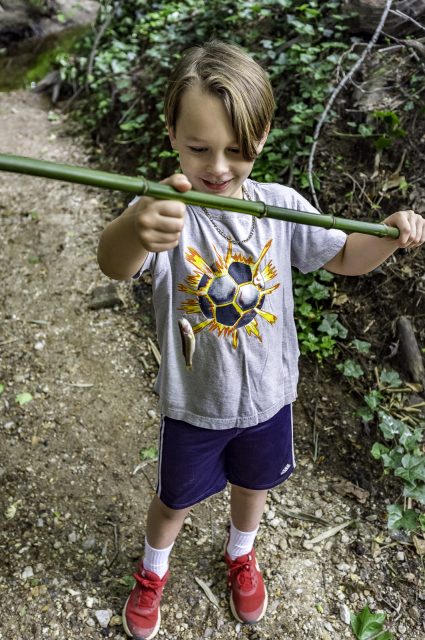
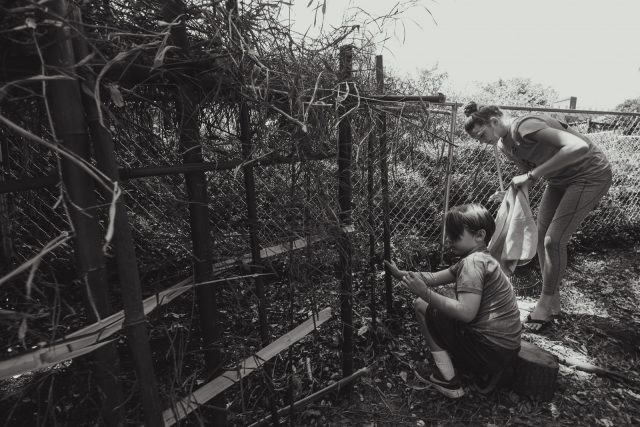
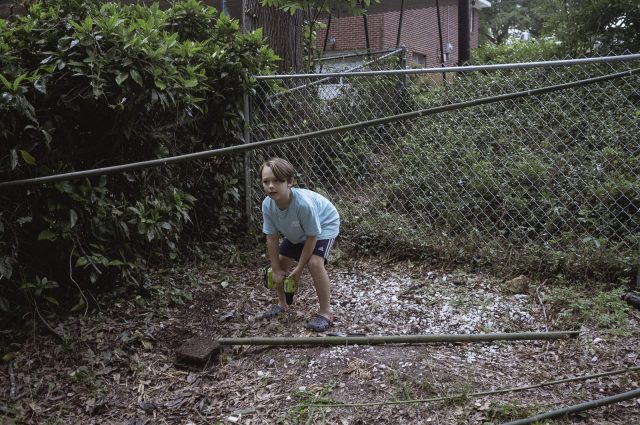
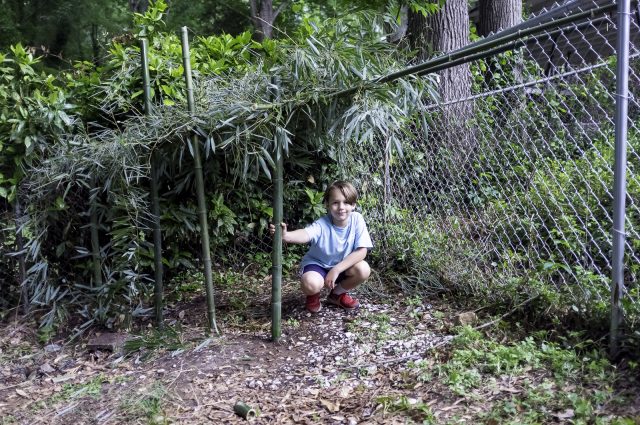
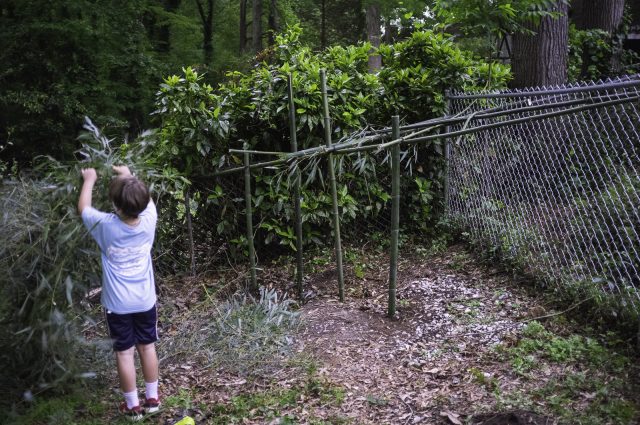
The Boy has wanted to build a bamboo structure of some sort for some time now. He had in his mind a large and grand structure, perhaps with a swimming pool beside it and a diving platform coming out of the second story.

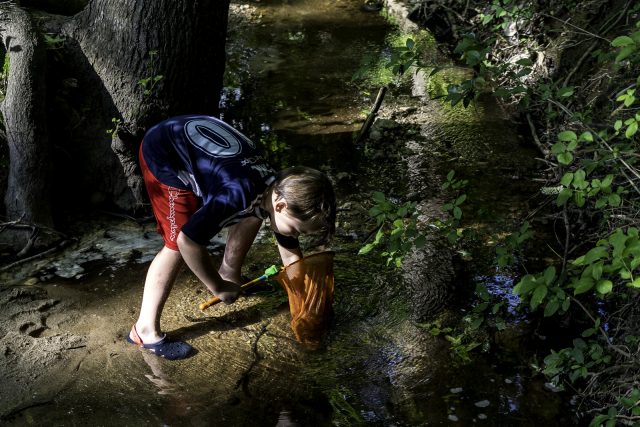
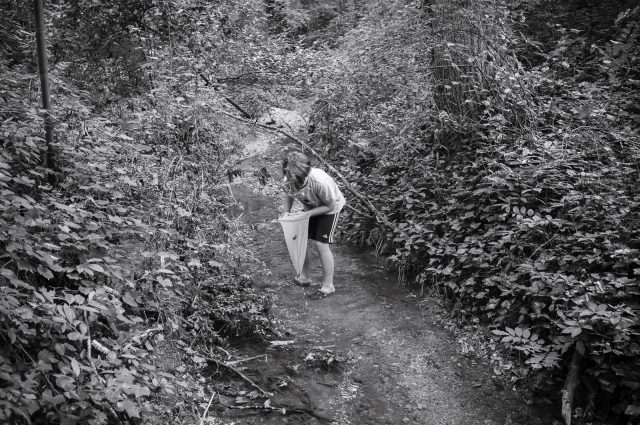
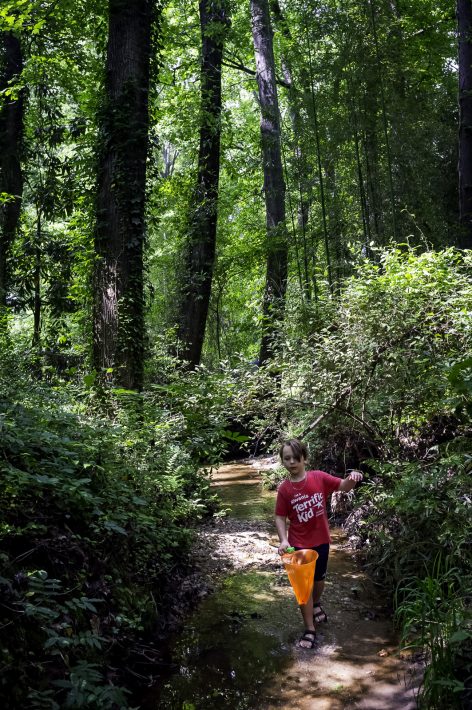
Heading down to play in the creek after "school"

Today, I suggested a little more modest structure: "We could simply use the corner of our fence and Mr. F's fence and build it there.

Looking for minnows

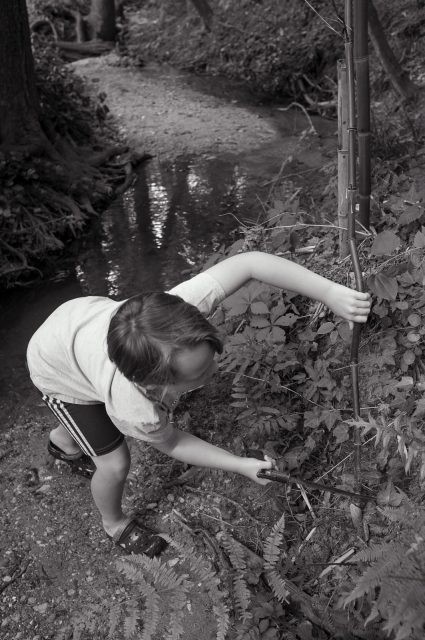
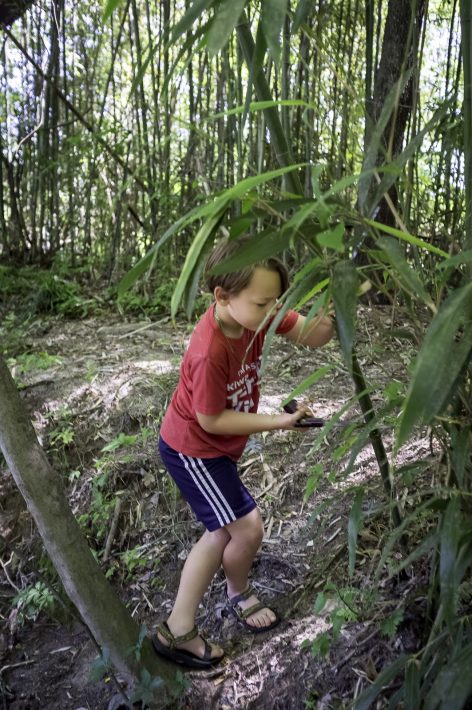
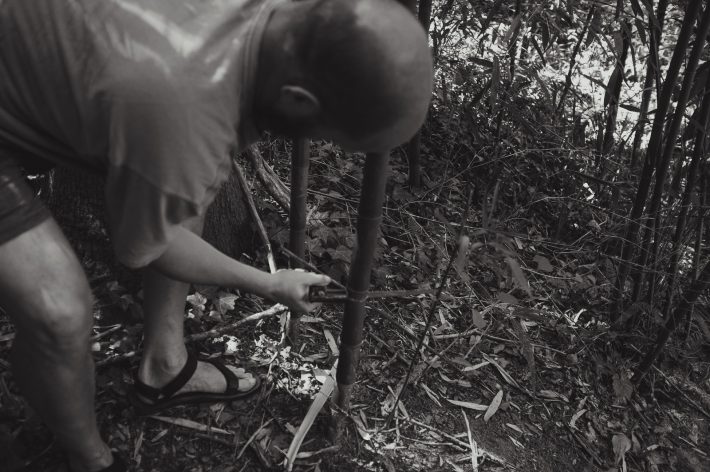
And so we went out into the stand of bamboo growing in Mr. F's back yard (more or less -- not really sure of property lines there) and took a few canes.

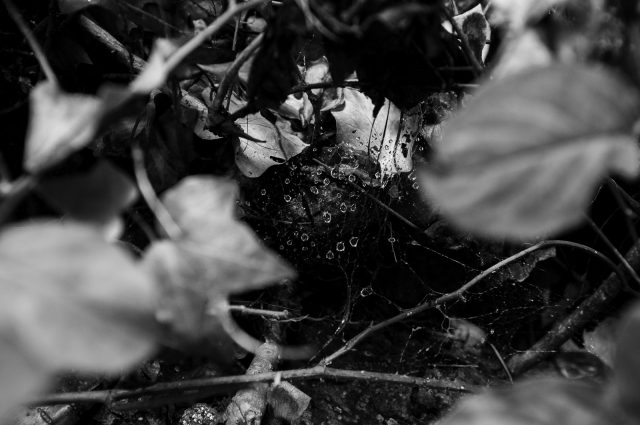
Dew-laden web, photo by the Girl

We stripped off the small branches on which grow the leaves, cut them to length,

dug a few holes, and we had our basic frame. A little more work and we had a functional structure.

A good day to be a dad.

Day 50: Death In the Creek?

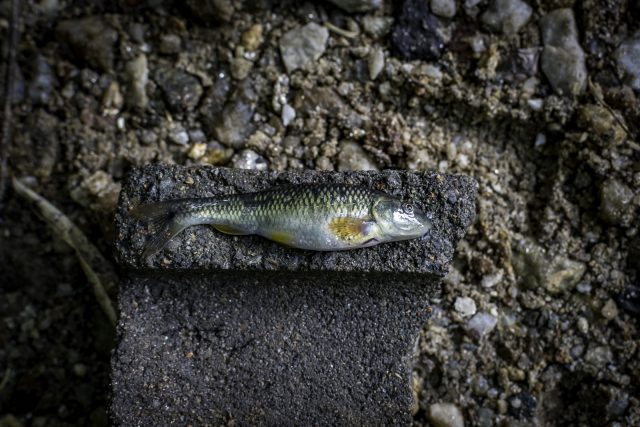
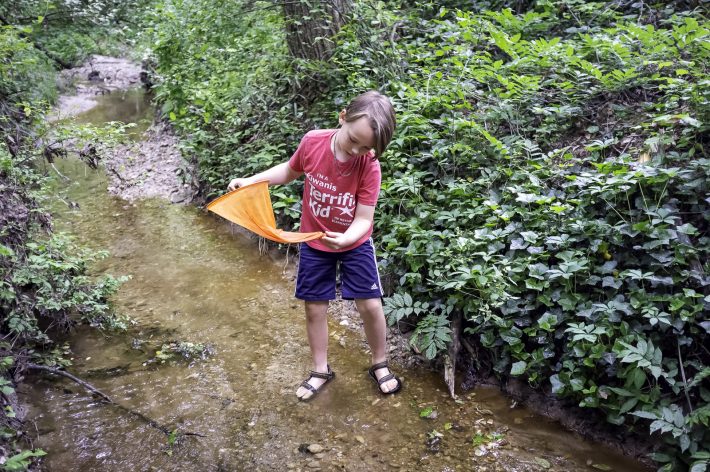
During the warmer months, the creek that runs through the backyards of our street becomes a frequent destination for us. Of late, this has been because of the minnows that flourish in the small stream.

I find myself wondering how in the world the little fish survive. What do they eat? According to one site, "Bluntnose minnows eat algae, aquatic insect larvae, diatoms, and small crustaceans called entomostracans." I don't know if these are bluntnose minnows, but that was the first thing Google turned up when I asked, "what do minnows in streams eat." That makes sense.

Their presence also solves another mystery: what do the snapping turtles in the creek eat? That and frogs, I guess.

We were in the creek three times today. The first was in the morning, a session that included a bit of minnow netting and some bamboo harvesting.

The Boy has been watching videos on YouTube showing young men in some south Asian country (Malaysia? Indonesia?) who dig vast underground spaces or build impressive bamboo houses using only the most primitive of tools and resources. He has decided that he wants to do the same. This morning, then, we cut down a couple of bamboo canes for this project. The Boy wanted to get more, but I put him off, hoping his obsession with this project would wane a bit when he realized it's impossibility for a seven-year-old boy. Still, I want to encourage him to try, hence today's harvest.

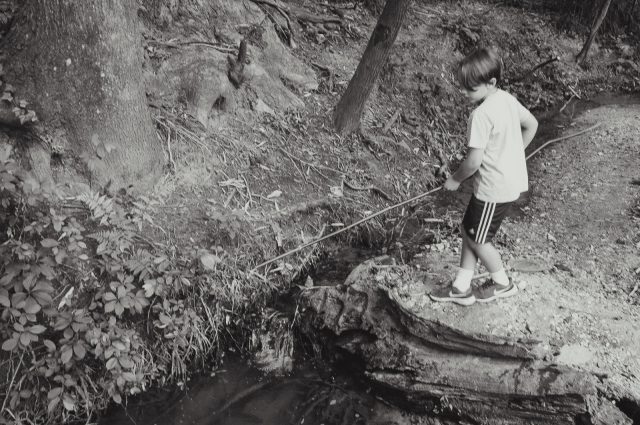
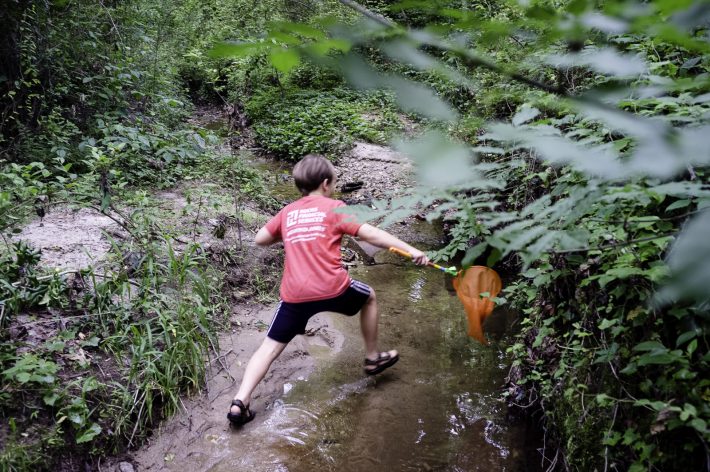
After we took down the canes, it was time for a little minnowing. The Boy as a curious and amusing approach that seems counterintuitive but works: he sneaks up to where the minnows are gathering, then leaps into the water, thrusting the net in before him and waving it about violently in the water.

It seems like it would never work, but it does.

Occasionally, the minnows have caused a bit of consternation in the house. The first minnows he caught spent the night in a Mason jar on the kitchen counter. When K went down in the morning, one of the two minnows was floating on the surface of the water. Not wanting to risk the other's life, K took the jar and sprinted down to the creek to release the survivor.

This prompted a new rule: minnows can be held in captivity until bedtime. When the Boy comes up for his bedtime ritual, the minnows need to be back in their own habitat. That worked for a couple of days until yesterday, when one of the minnows leaped out of the jar as it sat on the deck, flopped about on the deck board, then slipped in between two boards to its death in the leaves and chaos that exists under our deck.

"Minnow murderer!" the Girl exclaimed.

So now the jar stays in the house and minnows are released only moments after they're caught.

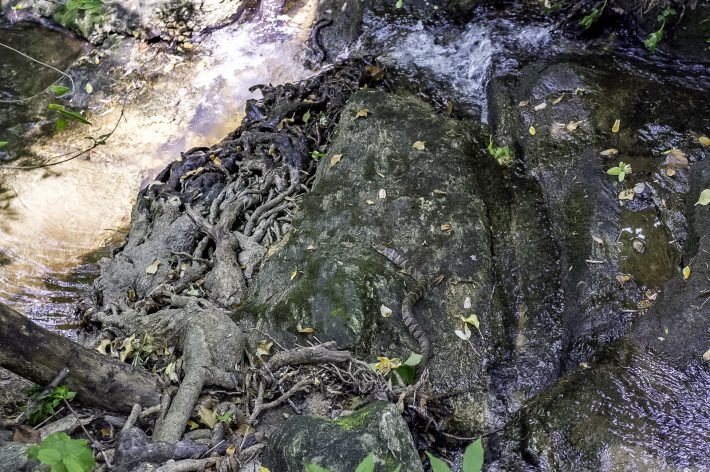
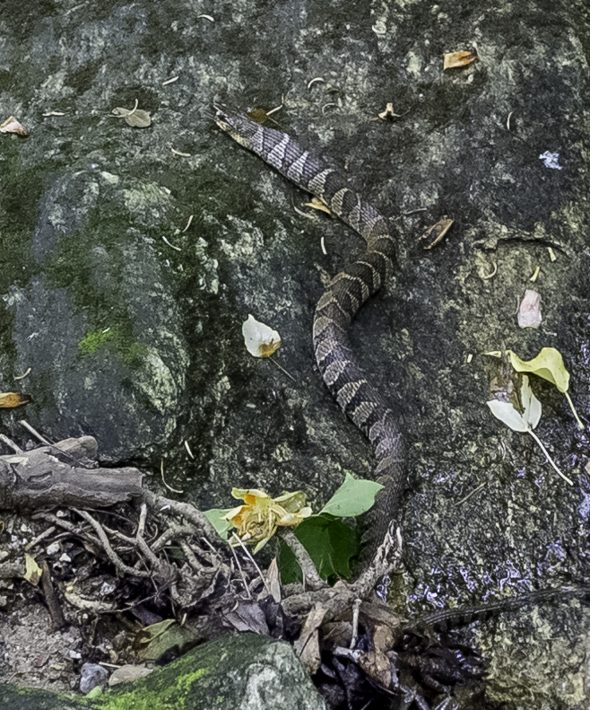
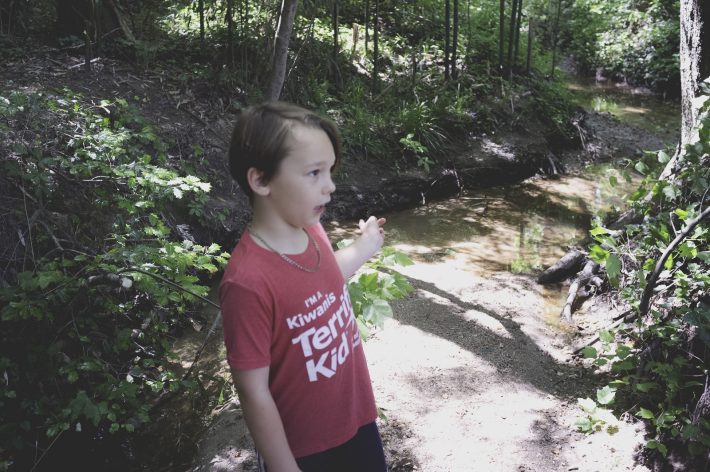
Today, though, we discovered much more than minnows. During our afternoon session, we decided to head to the waterfall that's just upstream. This means a short jaunt through the woods, approaching the stream from above. E started out toward the rocks and then suddenly started yelling.

"Daddy! Daddy! Come quick! It's a snake! A snake! And it's eating!" There was excitement and fear in his voice: he loves snakes, but he's terrified of the thought of encountering a venomous one. He seems to think they're conscious of their deadly venom and somewhat maleficent to boot. "What if they just chase me down and attack me?"

I try to reassure him when he says things like that, and today was no different: "Buddy, to him, you're a huge, terrifying monster!"

"But how? They're packed with venom."

"They don't know that."

"They don't?!" The Boy was having trouble comprehending that. How can a snake be so deadly and yet not realize its power?

I'm no snake expert to say the least, but I was fairly sure it wasn't a venomous snake. The eyes, the shape of the head, its markings. But what about those markings? They're awfully close to a cottonmouth's markings except the dark triangles rest fat side on the belly of the snake -- the whole pattern of this snake inverted.

Still, no need to take chances. We left the snake to its dinner and headed home.

I did a little research when we got home and came to the tentative conclusion that it might be a plain-bellied water snake, which is not venomous. Still, it got me thinking: what if it had been a cottonmouth and the Boy was bitten? Cottonmouths don't have venom that kills humans, but it can make one very sick. But what about a little boy? We've tromped about those rocks where the snake was eating dinner countless times.

Explaining

It was another one of those realizations that threats lurk around us constantly and we're mostly unaware of them. Our current global reality is a reminder that we are far from the top dogs on the planet in a number of ways, and yet we're the only species that could burn the whole thing to a radioactive cinder.

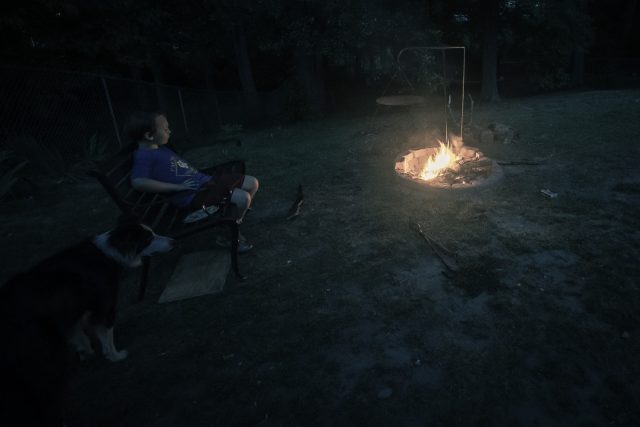
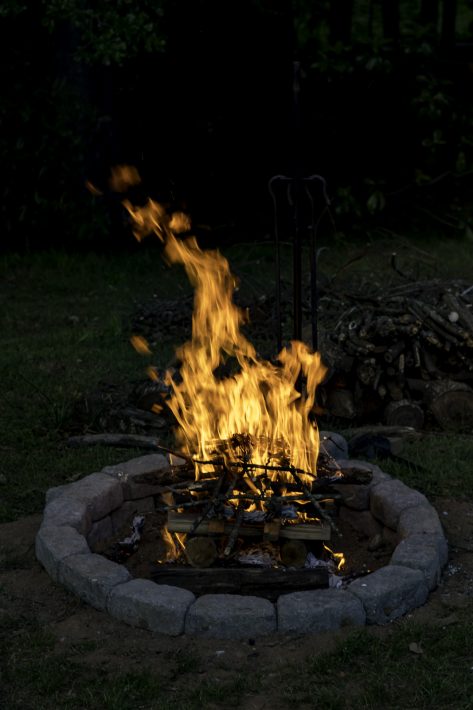
While I was cooking dinner over an open flame in our new fire pit, I listened to The Scarlet Letter again, and once again, an echo of the day:

Much of the marble coldness of Hester's impression was to be attributed to the circumstance, that her life had turned, in a great measure, from passion and feeling, to thought. Standing alone in the world,—alone, as to any dependence on society, and with little Pearl to be guided and protected,—alone, and hopeless of retrieving her position, even had she not scorned to consider it desirable,—she cast away the fragments of a broken chain. The world's law was no law for her mind. It was an age in which the human intellect, newly emancipated, had taken a more active and a wider range than for many centuries before. Men of the sword had overthrown nobles and kings. Men bolder than these had overthrown and rearranged—not actually, but within the sphere of theory, which was their most real abode—the whole system of ancient prejudice, wherewith was linked much of ancient principle. Hester Prynne imbibed this spirit. She assumed a freedom of speculation, then common enough on the other side of the Atlantic, but which our forefathers, had they known it, would have held to be a deadlier crime than that stigmatized by the scarlet letter. In her lonesome cottage, by the sea-shore, thoughts visited her, such as dared to enter no other dwelling in New England; shadowy guests, that would have been as perilous as demons to their entertainer, could they have been seen so much as knocking at her door.

Two hundred years had passed from the events of the book to the narration of the book, and in the meantime, the country had grown a little less Puritanical and a little more tolerant. Hawthorne seems to see some hope in this. Perhaps we all should

Day 49: Honking Adventure

Today was a somewhat low-key day. We went for a walk or two; we did a little work around the house; K led an in-house Mass substitute for the kids. But overall, it was a very lazy day.

In the morning, I took E on a walk with the dog. Well, I was planning on going alone, but he tagged along anyway. I was glad to have him.

"I want to hear the car honking!" he proclaimed, so we went back to the neighborhood where I'd heard it last week.

"Why do they do that?" he asked.

Why indeed. What's the point of all those "amens" and "hallelujahs"? I think it has to do with social bonding. It's like Catholics kneeling and standing and praying together, like Miloszcz said. I wanted to say, "It makes them feel good," but I didn't. And it probably isn't all that simple, either.

Clover's new ball

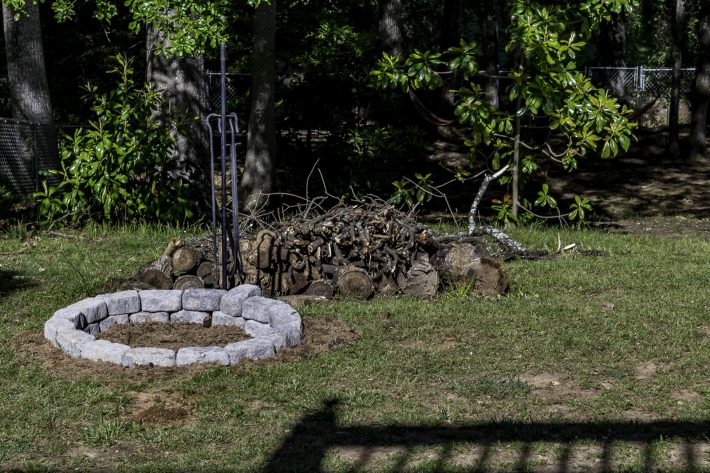
After the walk, I took care of a couple of little tasks left over from yesterday. I use construction adhesive to connect the landscaping timbers on which I mounted the composter to solid concrete blocks to give it a bit more weight. I wanted to make sure that, if when another flood washes through the backyard, the composter will stay put. (I also set it behind two trees, which will help break the flow of the water.) I used the rest of the adhesives on the fire pit, gluing pairs of bricks together to make it a little more solid but not completely permanent. (To be sure, I have no idea how long the adhesive can handle the heat in the fire pit before failing, so it might have been a waste of time. Still, I didn't have anything else to do with the remaining adhesive.

There was witchcraft in little Pearl's eyes, and her face, as she glanced upward at the minister, wore that naughty smile which made its expression frequently so elvish. She withdrew her hand from Mr. Dimmesdale's, and pointed across the street. But he clasped both his hands over his breast, and cast his eyes towards the zenith.

He looks up toward the heavens, and we know what will happen: he will see something; he will hear something; he will have some revelation. What's startling is the narrator's take on this:

Nothing was more common, in those days, than to interpret all meteoric appearances, and other natural phenomena, that occurred with less regularity than the rise and set of sun and moon, as so many revelations from a supernatural source. Thus, a blazing spear, a sword of flame, a bow, or a sheaf of arrows, seen in the midnight sky, prefigured Indian warfare. Pestilence was known to have been foreboded by a shower of crimson light. We doubt whether any marked event, for good or evil, ever befell New England, from its settlement down to Revolutionary times, of which the inhabitants had not been previously warned by some spectacle of this nature.

From a modern perspective, what's most interesting is the little side comment in the opening lines: "in those days." Were the people of Hawthorne's day any different? Are we any different? After all, it was the appearance of the Hale-Bopp comet that led 39 people to take their own lives.

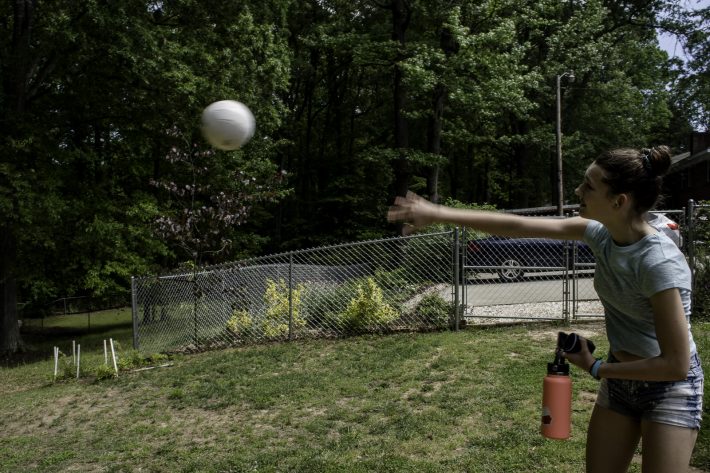
Which is a volleyball, much to L's delight

It's really one of the many God-of-the-gaps situations: we don't understand this, therefore God. At some point, earthquakes or comets were the antecedents, the "this" which we don't understand. Science comes along, explains it, closes one gap, and believers searching for evidence of God's existence move on to other gaps. The complexity of DNA and the seeming impossibility of cosmology are the biggest gaps now, and they will not likely be closed for some time. Will science ever unravel those mysteries? I don't know. I'm not worried about it. As someone put it, I would rather have questions I can't answer than answers I can't question.

Not seldom, it had been seen by multitudes. Oftener, however, its credibility rested on the faith of some lonely eye-witness, who beheld the wonder through the colored, magnifying, and distorting medium of his imagination, and shaped it more distinctly in his after-thought. It was, indeed, a majestic idea, that the destiny of nations should be revealed, in these awful hieroglyphics, on the cope of heaven. A scroll so wide might not be deemed too expansive for Providence to write a people's doom upon. The belief was a favorite one with our forefathers, as betokening that their infant commonwealth was under a celestial guardianship of peculiar intimacy and strictness.

This problem is at the heart of all religious revelation: Joseph Smith discovered the plates that he translated into the Book of Mormon all by himself; Muhammed received his revelation alone, in a cave; Moses saw the burning bush all by himself; Mary was all by herself when the angel appeared. These revelations that started large religions later developed ways to deal with the problem that Hawthorne mentions (there were individuals who signed affidavits that they had seen Smith's golden plates in person, for example). The smaller revelations, which lead to smaller followings, don't: David Koresh alone heard God's voice. At that point, short of working miracles, how do such people convince followers?

But what shall we say, when an individual discovers a revelation addressed to himself alone, on the same vast sheet of record! In such a case, it could only be the symptom of a highly disordered mental state, when a man, rendered morbidly self-contemplative by long, intense, and secret pain, had extended his egotism over the whole expanse of nature, until the firmament itself should appear no more than a fitting page for his soul's history and fate!

Some people go further than this: David Pack, leader of a little sect of a few hundred to a couple of thousand followers, literally sees himself prophesied in the Bible. As such, he says things like "I have to be the most hated man on the planet," which he claims in one of his sermons.

We impute it, therefore, solely to the disease in his own eye and heart, that the minister, looking upward to the zenith, beheld there the appearance of an immense letter,—the letter A,—marked out in lines of dull red light. Not but the meteor may have shown itself at that point, burning duskily through a veil of cloud; but with no such shape as his guilty imagination gave it; or, at least, with so little definiteness, that another's guilt might have seen another symbol in it.

So it's remarkable to me that Nathaniel Hawthrone, writing The Scarlet Letter 170 years ago, created such commentary. And I wonder what he would have to say about contemporary Evangelical worship, with its rock-concert feels and amen-ing. And what he would have thought about nearly-sequestered worshippers replacing it with claxons.

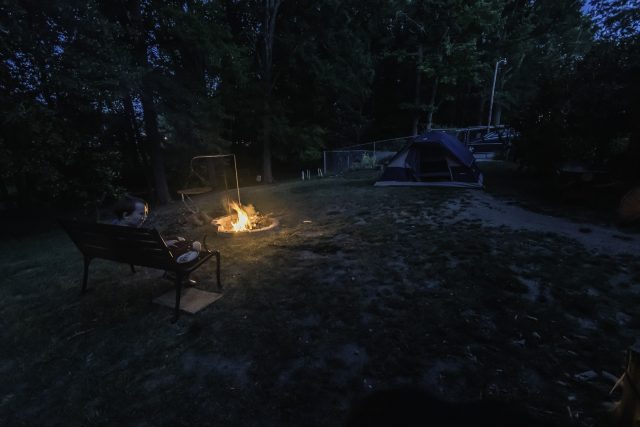
First fire in new firepit

Day 48: Scarlet Projects

This morning I had a little epiphany that I should have had months ago: "I'll bet there are lots of audiobooks on Spotify." I know -- an obvious thought I should have had long ago, but I am sometimes a little slow on the up-take. I did a quick search and discovered that almost any classic one could imagine is there. Shouldn't have been a surprise.

A month or so ago, I'd pulled from the bookshelf a novel I've been wanting on and off to re-read since college, The Scarlet Letter. I hadn't really liked it a lot then, and I liked it even less in high school, but I reasoned that, being twenty-five years older than when I'd last read it, I might see something more in it.

For one thing, it's been a different read because I finally made it through the opening section, "The Custom House." When we read it in college, we were supposed to read that seemingly disconnected introduction but I didn't. Today, I listened to it while I worked on our broken smoke, cleaning off the base blocks before screwing down the barrel that serves as the body of the smoker and then covering all the base in concrete. The job took about an hour and a half because I spent some time trying to pry off the leaking quick-connector on the hose before mixing the concrete, to no avail; the intro itself took considerably longer to complete.

And what of "The Custom House"? It's a fictionalized attempt at making the story seem authentic by making it something of a found-footage type novel (mixing media there, I know). Was that novel (no pun in intended)? I really don't know.

When the novel began, I was back in familiar territory. I'd initially forgotten about that opening, with the rose outside the jail door, but once that portion began, it was like hearing a long-forgotten-but-once-loved song again after twenty years:

[O]n one side of the portal, and rooted almost at the threshold, was a wild rose-bush, covered, in this month of June, with its delicate gems, which might be imagined to offer their fragrance and fragile beauty to the prisoner as he went in, and to the condemned criminal as he came forth to his doom, in token that the deep heart of Nature could pity and be kind to him.

This rose-bush, by a strange chance, has been kept alive in history; but whether it had merely survived out of the stern old wilderness, so long after the fall of the gigantic pines and oaks that originally overshadowed it,—or whether, as there is fair authority for believing, it had sprung up under the footsteps of the sainted Ann Hutchinson, as she entered the prison-door,—we shall not take upon us to determine. Finding it so directly on the threshold of our narrative, which is now about to[53] issue from that inauspicious portal, we could hardly do otherwise than pluck one of its flowers, and present it to the reader. It may serve, let us hope, to symbolize some sweet moral blossom, that may be found along the track, or relieve the darkening close of a tale of human frailty and sorrow.

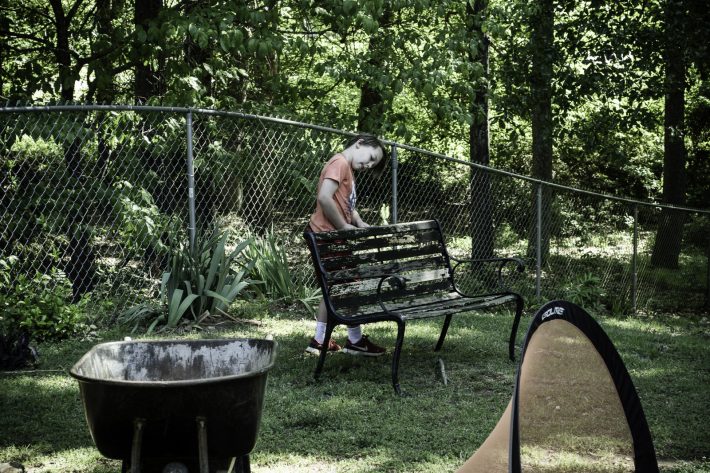
While I was working on the smoker, the Boy was working to remove the last bit of flaking paint from the bench we brought from Nana's and Papa's to use by our firepit.

I went inside to get the drill and impact driver and by the time I came back out, he'd disappeared.

"It's too hard!" he exclaimed. I think he understood that I expected him to get all the paint off.

By the time I was ready to work on the next project of the day, the novel was introducing its heroine, Hester Prynne.

The young woman was tall, with a figure of perfect elegance on a large scale. She had dark and abundant hair, so glossy that it threw off the sunshine with a gleam, and a face which, besides being beautiful from regularity of feature and richness of complexion, had the impressiveness belonging to a marked brow and deep black eyes. She was lady-like, too, after the manner of the feminine gentility of those days; characterized by a certain state and dignity, rather than by the delicate, evanescent, and indescribable grace, which is now recognized as its indication. And never had Hester Prynne appeared more lady-like, in the antique interpretation of the term, than as she issued from the prison. Those who had before known her, and had expected to behold her dimmed and obscured by a disastrous cloud, were astonished, and even startled, to perceive how her beauty shone out, and made a halo of the misfortune and ignominy in which she was enveloped. It may be true, that, to a sensitive observer, there was something exquisitely painful in it. Her attire, which, indeed, she had wrought for the occasion, in prison, and had modelled much after her own fancy, seemed to express the attitude of her spirit, the desperate recklessness of her mood, by its wild and picturesque peculiarity. But the point which drew all eyes, and, as it were, transfigured the wearer,—so that both men and women, who had been familiarly acquainted with Hester Prynne, were now impressed as if they beheld her for the first time,—was that Scarlet Letter, so fantastically embroidered and illuminated upon her bosom. It had the effect of a spell, taking her out of the ordinary relations with humanity, and enclosing her in a sphere by herself.

The scarlet letter is a double symbol: it is a symbol to the characters in the novel of Hester's sin and depravity as well as a symbol for Hester herself of her resistance. For readers, it's both these things, but it also represents the hypocrisy of Puritans, among other things.

At this point, I'm about halfway through the novel, though completely through the day's projects (as is L). More thoughts coming later, I'm sure.

Day 46: Snakes, Dogs, and Balls

Some years ago, there was a little flu epidemic here in the upstate. I'd forgotten all about it until I read the entry from the "Time Machine" widget at the bottom of the page.

I wrote,

Students come running into the classroom, desperate not to touch anything but the bottles of hand sanitizer that they’re most eagerly sharing amongst themselves. They sit down and put their hands in the air as if they’re being held up at gun point. They open doors with their feet and they laughingly refuse to touch the copies of Much Ado About Nothing we’ve been using in class.

A quick look around the room confirms my suspicions: I won’t be able to accomplish anything without dealing with this first.

That was 11 years ago now, and it seems so insignificant compared to what we're living now. Our flu outbreak affected a small part of the state; this viral reality is affecting the entire world. Magnify something and its significance seems often to increase exponentially like the curve of new cases in many places. That curve seems to have reached its summit in some areas. Everyone seems eager for that to be the reality, though. Do we have the maturity and self-control needed to keep the curve from turning back upwards again? I don't know.

Looking for the snake E and our neighbor saw

I know the kids have simply settled into the new rhythm and joke about it. The Girl is having an easier time than the Boy in some ways because she's in more constant contact with her friends through Facetime -- they sometimes just leave it on while they're doing other things, as if to have a companion near.

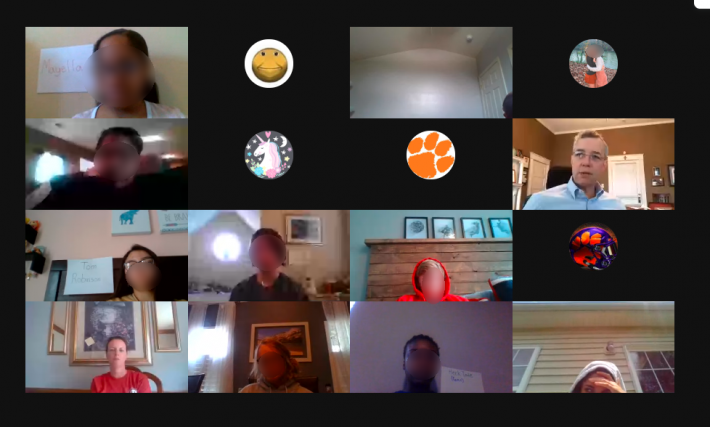
The Boy gets to see his friends daily with their whole-class Google Meet. (An aside: It's amazing the difference between elementary students and middle school students when it comes to these online meetings. When E's class meets, almost everyone is there; when my classes meet, almost no one is there. I suppose there's more parental involvement in the younger children's lives.) Still, that's hardly a substitute for their usual day together, which includes a bit of down-time to talk and of course recess.

Another entry from the nostalgia widget:

I wrote,

My reaction over the years has changed. In the past, I was just trying to survive at this point in the year. Perhaps that was because of a lack of clear and clear-headed goals for students; maybe that was a result of my inexperience and ineffectiveness; possibly that was because I had some exceptionally challenging students. Or perhaps it was all that and more. At any rate, I find myself eager, after a short break, to begin again. A sufficient “short break” in this case would be about three weeks or so, but I’m fortunate that we get about four times that.

That short break I was referring to was a hypothetical three-week summer break before getting back to school. I was suggesting that perhaps the whole summer is necessary. Indeed, it's a luxury. But now -- we'll have a break from mid-March until mid-August, and even then, I doubt we'll get back to normal.

In the end, "normal" will have to shift. Our state superintendent is already talking about possibly going to school in shifts to maintain an appropriate distance. I'm assuming that would mean dividing the eighth-grade student body in half: group A goes Monday and Wednesday and group B goes Tuesday and Thursday. Friday? Who knows. Who knows anything at this point. It's odd that the longer this stretches out, the more the uncertainty in some sense.

Day 44: Chess and the Mess

“Daddy, let’s play chess!” Normally, I wouldn’t say no to this. I enjoy sharing chess with the kids, so when the Girl suggested we play this afternoon, I was more than willing. She went out on the deck, where Papa was taking his afternoon fresh air, and began setting up the board. And then I had the idea.

“Why don’t you ask Papa if he‘d like to play?” I suggested.

Papa used to be obsessed with chess. He taught me how to move the pieces and then nothing more. This was because, by the time I came along, he’d given up chess. It was taking over his life, he said. He was lying in bed thinking of lost games. I know that feeling. So I wasn’t sure if he would play a game with her. But of course, I knew he would — he’s not going to turn down his granddaughter.

It was an up and down game. I sat by them, reading Paul Auster’s The Locked Room, looking over every now and then to see how things were going. Papa was up; L was up; Papa was up; L was up. It was a very uneven game until the end, when L just fell apart.

During all this, E was Facetiming his best friend from school. They were talking about Pokemon, baseball cards, favorite cartoons — second-grader stuff. He’d suggested it to his friend while the whole class was having a Google Meet in the morning.

“E, do you have a question?”

“Yes! I want to ask N when he can Facetime because it’s been ridiculously long since the last time.” And so we set it up for this afternoon.

Once he came outside and saw the chess game, though, he wanted to play Papa.

Things didn’t go much better for him — Papa went undefeated today. Which was good for Papa.

In the evening, L decided she wanted to bake cookies and try a formula for homemade Playdough. One might think this is something that would thrill parents, but K and I have learned: the Girl is not the best cleaner. She talks fast, walks fast, and cleans fast, which means she cleans poorly. It’s a thirteen-year-old thing, I’m certain. Tonight was no different. So I called her back down to the kitchen and pointed out the little things she’d missed.

She fussed; she argued; she pouted. But in the end, she did it.

Day 43: Cooperation

School in the morning. 

Pierogi in the afternoon.

Games in the evening.

Day 42: The Sermon and the Wall

The Sermon

I went out for a walk this morning. It was sunny and warm, and everyone else was busy doing something, so I couldn't resist. Listening to The Brothers Karamazov as I walked, I heard an amplified voice over the reader's voice. Sometimes, when the conditions are just right, we hear the announcer at the local high school's football games. Of course, there are no such games now, and there wouldn't be any on a Sunday anyway. I paused the recording, stopped walking, and listened carefully. It took a moment, but I realized that it was a preacher delivering a Sunday morning message to the faithful as they sat in their cars. Drive-in church service.

As I walked a little further, I heard a little later furious honking coming from that direction, as if twenty or thirty cars were all randomly honking their horns. I took the earbuds out again and listened for some time.

Through the trees, I heard, "But we don't have to fear death! Christ Jesus has conquered death!" Fairly typical evangelical formulation. "Isn't that wonderful?" And then the horns began again, and I realized what was going on.

"They're honking their amens," I muttered to myself.

The Wall

The kids have taken the back corner of the house as their practice area: the Boy kicks his soccer ball against the wall; the Girl uses it for volleyball. They decided to use chalk to make some targets to practice accuracy.

The Girl had it all planned out. Colors, target shapes, everything. And then the Boy "messed it all up," using colors at random for no other reason than wanting to use that particular color. And so they cleaned it and began again.