Matching Tracksuits

fun in fours

society and culture

Maps

Via Kerim at Keywords, who found it at Strange Maps.

GDP Map

It is a bit misleading, though, as Strange Maps explains:

The creator of this map has had the interesting idea to break down that gigantic US GDP into the GDPs of individual states, and compare those to other countries� GDP. What follows, is this slightly misleading map � misleading, because the economies both of the US states and of the countries they are compared with are not weighted for their respective populations.

Pakistan, for example, has a GDP that�s slightly higher than Israel�s � but Pakistan has a population of about 170 million, while Israel is only 7 million people strong. The US states those economies are compared with (Arkansas and Oregon, respectively) are much closer to each other in population: 2,7 million and 3,4 million.

All the same, fascinating.

I went to Strange Maps myself (obviously) and found a map much more interesting, in my view: the Inglehart-Welzel Cultural Map of the World.

Cultural Map

How to read the map?

On this map, East and West Germany are next to each other, as one would expect. But Romania�s closest neighbour is Armenia? And Poland and India are side by side? Well, this is not a straightforward geographical map, but a cultural one. It plots out how countries relate to each other on a double axis of values (ranging from �traditional� to �secular-rational� on the vertical and from �survival� to �self-expression� on the horizontal scale). This makes for some strange bedfellows � for example: South Africa, Peru and the Philippines occupy almost the same position, although they�re on three different continents.

If I were a social studies teacher…

Reading in America

Almost all of the kids in the program in which I teach have one thing in common: a hatred of reading. If I have them read a couple of paragraphs (say, 200 words total), they immediately begin complaining about how long that is.

"Man, that's too long!" is a common refrain in the classroom.

When I have them read something to me aloud, it becomes clear fairly quickly why they're not fans of reading: they're not very good at it. They stumble on very basic words, and don't recognize words they themselves use every day. And like most activities, the only way to improve reading is to practice -- to do it. But many of the kids in the program come from demographics -- low education and low income -- in which reading is not particularly popular, probably for the very same reason.

And so for them, the dilemma of the 21st century is intensified: how do we teachers, in a world of video games, YouTube, and music videos successfully encourage reading?
Foreign Missionaries

It seems that Europe is now importing what it exported, namely Christianity. But this is often a different kind of Christianity:

The “Amens!” flew like popcorn in hot oil as 120 Christian worshipers clapped and danced and praised Jesus as if He’d just walked into the room. In a country where about 2 percent of the population attend church regularly and many churches draw barely enough worshipers to fill a single pew, the Sunday morning service at this old mission hall was one rocking celebration.

In the middle of all the keyboards, drums and hallelujahs, Stendor Johansen, a blond Danish sea captain built like a 180-pound ice cube, sang along and danced, as he said, like a Dane — without moving. (washingtonpost.com)

A more emotional religion than the methodical Lutheranism Denmark would have exported, to be sure.

Yet what’s most interesting about the article is not the fact that missionaries are going to Europe. That’s old news — I often saw Evangelical missionaries in Poland trying to convert Poles from Catholicism to Christianity. (Yes, I know — but that’s how they see it.) The interesting thing is where the missionaries are coming from.

The International Christian Community (ICC) is one of about 150 churches in Denmark that are run by foreigners, many from Africa, Asia and Latin America, part of a growing trend of preachers from developing nations coming to Western Europe to set up new churches or to try to reinvigorate old ones.

World Christianity today is in an odd stage of development. Evangelicalism, that distinctly American version of Christianity, has been on fire throughout the world. America has been sending out Evangelical missionaries, especially to countries that have large Catholic populations, and now, it seems, these missionaries are going to Europe — full circle.

I wonder if they’re bringing disease back with them, though…

Ty Pan Du Sie Tu Vous

When learning Polish, for some reason I had the hardest time initially using the formal voice of address. English-only speakers might not know what I'm talking about, even though the formal/intimate distinction existed in English for hundreds of years.

In French, it's a question of "Vous" and "tu." "Vous" would be "you all" -- second person plural -- and is used in all formal occasions; "tu" is informal, and used with intimate friends or family. In German, it's "sie" and "du".

This is why Martin Burber's wonderful book Ich und Du is translated I and Thou and not I and You.

In English, it used to be "you" and "thou," with "thou" being the more intimate. Because most of us are exposed to "thou" exclusively through liturgical language, we get the sense that it's incredibly formal. In fact, it's the opposite.

Po Polsku

In Polish, there are two options. The first is the common use of "Pan" or "Pani" -- literally, "lord/master" or "lady/mistress."

The older, now-obsolete form is to use "Wy" -- "you all." It's still used in the mountainous southern region, and K in fact speaks to her grandmothers this way. "Co robicie ostatnio?" "What have you been doing lately?"

Out of this came an amusing verb: dwoic. While this is related to the word "dwa" (two), it's not, strictly speaking, "double" (which is "podwoic"). Instead, a better explanation would be "to use the second person plural." In that case, one might ask another, "why are you [dwoic] me?" meaning, "Why are you using the formal voice with me?"

The second method, and the one used now, is to use "Pan" and "Pani." To be polite, a shop attendant, for example, doesn't ask, "Do you need help?" Literally, he asks, "Does the lady need help?"

The problem for me was not so much remembering the odd construction but learning when to make the switch from "Pan" or "Pani" to "you." I called people "you" when I should have used "Pan/Pani" more times than I care to recall. And there really are no guidelines -- it depends, somewhat, on the person.

Linguistics of Diplomacy

I got to thinking about all of this due to an article by Charles Bremner. It begins,

Here is one of those stories that are difficult to convey to people who speak only English. President Sarkozy's government has annoyed the "progressive" sections of the teaching establishment with an order that school pupils must address their teachers with the formal vous rather than the familiar second person singular tu. Teachers are advised to use the respectful vous to Lyc�e teenagers in their classes.

While I could never imagine students in Poland referring to teachers in the second person, I could also never imagine teachers using the formal third person with teachers.

The piece goes on to discuss how world leaders refer to each other -- tu/du or vous/sie?

Angela Merkel dropped German formality enough to call him "Lieber (Dear) Nicolas" but stuck to the formal "sie" not the familiar "du". Sarkozy's matey reply jarred on old-fashioned ears. "Ch�re Angela... J'ai confiance en toi." (In older English I trust thee not you). Lib�ration joked that Franco-German harmony was still lacking. "They are going to have to start by agreeing whether they use tu or vous," it said. (Charles Bremner piece)

While the article doesn't mention George Bush, it seems safe to assume that, like Gordon Brown, his dependence on interpretors will solve the tu/Vous problem. But considering the little back rub he once gave Merkel, it's fairly reasonable to assume that Bush would opt for "tu" over "Vous."

Young Earth

The Creation Museum recently opened in Kentucky.

DefCon provided an informative guide about the errors of young earth creationism. Entitled “Top 10 Reasons Why the Universe, the Sun, the Earth, and Life Are Not 6,000 Years Old,” it’s available at the DefCon web site.

We’re Holocaust deniers, each and every one

Holocaust denial is rampant in the Arab world. One doesn’t have to look too far to find it.

While looking for Holocaust images on Google, I found a discussion thread called “Myth of Holocaust Will Not Survive, French Historian” at IslamOnline.net.

French historian and professor of Sorbonne University Robert Faurisson said that the ‘myth of Holocaust’ fabricated by the Zionists would not survive.

Addressing the International Confernce on ‘World Vision on Holocaust’, Faurisson said that the gas chambers allegedly used by Hitler to massacre the Jews did never exist.

It didn’t take much to find it — I wasn’t even looking for it.

But who would have thought that we, American taxpayers, are actually supporting Arab/Islamic Holocaust denial?

Testifying under oath recently, Secretary of State Condoleezza Rice misled Congress in her strong defense of Al-Hurra, the taxpayer financed Arab TV network. It was unwitting, though. She herself was misled.

During the March 21 House Foreign Operations Appropriations subcommittee hearing, Rep. Mark Kirk (R., Ill.) pressed Ms. Rice on the wisdom of providing a platform to Islamic terrorists, citing Hezbollah leader Sheikh Hassan Nasrallah’s Dec. 7 speech, which Al-Hurra aired live. The broadcast speech “went on for 30 minutes,” she responded, “followed by commentary, much of which was critical of Nasrallah.”

In fact, Mr. Nasrallah’s speech was carried in its entirety, roughly an hour and eight minutes. The commentary that followed–a 13-minute phone interview with Wael Abou Faour, a member of Lebanon’s governing coalition–was indeed critical of Mr. Nasrallah. He accused the Hezbollah leader of not being anti-U.S. and anti-Israel enough. While Mr. Nasrallah had claimed Lebanon’s governing coalition was aligned with the U.S. and had backed Israel during the war last summer, Mr. Abou Faour said that Hezbollah was actually closer to the U.S and added that any Lebanese faction that assisted “the Israeli enemy” should not be allowed to engage in political discussion because “the only place they should be [is] in prison.” […]

Under Mr. Register, Al-Hurra covered the Holocaust denial conference in Tehran last December. But in a stark break from Mr. Harb’s era, Iranian President Mahmoud Ahmadinejad and the attendees at his conference were treated with unmistakable deference.

Al-Hurra’s Dec. 12 report on the gathering included David Duke’s praise for Mr. Ahmadinejad, and it took at face value the organizers’ demand for Israel “to provide proof and evidence that certifies the occurrence” of the Holocaust. An official running the event was afforded the opportunity to show the open-mindedness of Holocaust deniers: “If we actually conclude with our experts through this meeting that the Holocaust is a real incident we will at that time admit its presence.” (Transcript provided by a fluent Arabic-speaking U.S. government employee.)

So we’re paying for a station that provides a platform for anti-Semitic rantings. What about the reporters themselves? Surely they are more objective.

The Al-Hurra reporter stationed in Tehran referred to those who believe Hitler killed six million Jews as “Holocaust supporters.” He took a swipe at the handful of conference attendees who didn’t deny the Holocaust, by noting that they “didn’t enforce their statements with scientific evidence.” In closing the piece, he referred to Israel as “the Jewish state on Palestinian lands.” (Wall Street Journal)

At least something, though, is providing a little bit of bi-partisanship on Capital Hill…

My New Hero

How easily are people manipulated? How quickly can someone change a complete stranger's will? Just how fragile are we, mentally speaking? A few videos from skeptic Derren Brown shows just how easily someone with skills can manipulate people.

But by far, the best (a tie):

Chinese Math

America, in general, is lagging far behind a lot of the world regarding education, and this is particularly true with science and math.

Who’s ahead of us? It might be easier to ask who isn’t ahead of us.

Not surprisingly, the Chinese, in their quest for world domination (Mwa-ha-ha!), not only have cheap labor on their side; they also have a higher level of mathematics achievement, I’d venture.

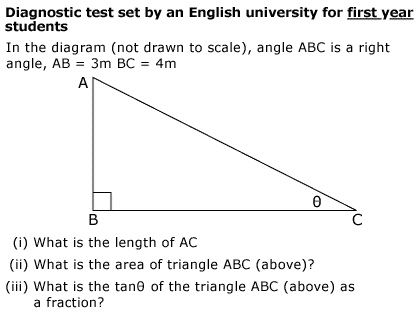
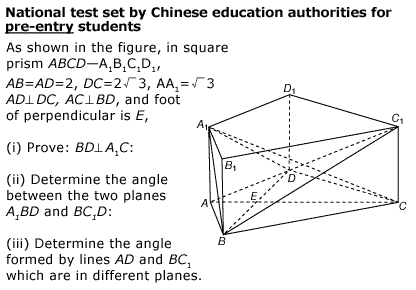
The BBC recently put up two questions from two tests: one, a test intended for first-year university students in English schools; the other, a question from a Chinese pre-entrance exam.

Here’s the English problem:

English Math

That’s pretty simple. Even I, having used no geometry for close to twenty years now, can do that with no problems.

Here’s the Chinese problem:

Chinese Math

From BBC.co.uk

“Background Check? We don’t need no stinkin’ background check”

Cho Seung-hui went through the mandatory background check before buying the guns he used in his rampage. No criminal record, no problem.

Yet...

  • He'd been admitted to a mental health care unit within the last eighteen months.
  • Teachers and students alike commented on his disturbing behavior.
  • Complaints had been made about his behavior.
  • A professor had raised concerns about the content of his writing.

But what kind of a background check could have discovered all this?

If if someone has recently received significant mental health care in the same state he's trying to buy a gun, it's conceivable that that information could be available. But since there's no national database of such information, all one would have to do is cross the state line.

Do we want a national database to record that kind of information? I don't think I do.

Do we want to have background checks that include interviews with former educators? Is that even feasible?

Just what kind of background check can stop someone like this from getting a gun? The only solutions I can think of involve national databases and inquiries into very personal information.