Matching Tracksuits

fun in fours

site

English Camp

Camp

From 22 June to 19 July, I was at a summer English camp in Augustów, a small town in the northeastern lake district of Poland. I was there for two sessions — a rewarding experience, but not having had any break between the conclusion of the regular school year and the start of camp, it was also an exhausting experience.

My duties were simple: conduct English lessons/sessions in the morning (some of which were much more successful than others . . .) and accompany the kids during their afternoon and evening activities. Said activities included softball, kayaking, sailing, waterskiing, frisbee golf, horseshoes, Scrabble (in English, of course).

Sunsets

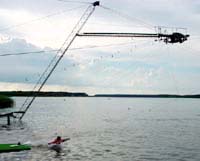
Water Skiing

Some got up on two Some got up on one
Some fell after a few moments Some fell a bit earlier

The concept was simple: why not use snow skiing as a model for water skiing? It would eliminate the necessity for need for a boat, thus allowing more people the pleasure of waterskiing in a shorter time.

A German thought of it, I believe.

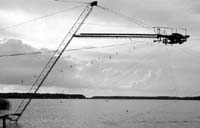
So, engineers put four towers in a rectangular shape, ran a tow-cable through it and use that to jerk people off a dock and haul them round the lake. The result is above.

Now, it’s not an entirely bad idea. Just, for someone used to skiing behind a boat, it’s a little weird. I passed on trying. Most didn’t.

For most, I believe, the most stressful was the preparation — the waiting simply to be jerked forcefully and sometimes unexpectedly into the water.

Some got up . . . some didn’t.

Baseball (well, okay, softball)

Ewelina gets a hit Red team fielding

One of the highlights for most kids at the camp was baseball. Sort of. To make it easier and safer, we in fact played softball, but the difference for most of them would have been minimal.

One thing I learned anew is how many many rules there are that just seem commonsensical to us. For example, not having two people on base at the same time — a frequent occurrence on second base.

Paintball

Though paintball was not one of the “offical” camp activities, some of the folks from the second camp got together and spent an evening hurling plastic, paint-filled balls at each other while running blindly through the woods, desparately trying to see through the well-worn, virtually opaque protective masks. what else would you expect?

Polish paintballs: a guy shows up in a forest driving a Maluch (Fiat 126p) filled with paintball equipment…

surrender bystanders in the field plans

The Wounds including one from a paintball that somehow got around/under the protective mask)

Polish Strings

I recently bought guitar strings. "Recently" is of course a relative word, in this case meaning a month ago.

"You bought guiatr strings a month ago and you're complaining about them? They're ancient! Get new ones!" You who play guitar might be thinking along those lines.

Easier said than done, for like many things here in Poland, they're atrociously expensive. Good strings (i.e., something like D'Adario) cost more than forty zloty. As I've explained earlier, that would be the same as paying forty bucks in the States for a set of guitar strings!

Needless to say, I've taken to buying Polish-made strings because they're cheaper — in theory. But as the Polish saying goes, "What's cheap is expensive." Or as we might say, "You get what you pay for."

I did buy D'Adario strings once here — they lasted probably three months. Yes, that's a ridiculously long time for strings, but how often would you change them if they cost forty bucks? Anyway, they sounded dead as a brick by that time, but they were still intact. None of them had broken, or even frazzled.
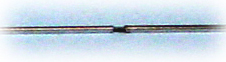
The Polish strings I bought lasted about three weeks before the D string started to fray. A close-up reveals that it might last a few days more until it completely unravels and morphs into another E string.

Then I'll trek back to Nowy Targ, buy a new set of strings, and kick myself for not buying decent ones in the first place.

EU Vote

There is a referendum on the seventh and eight of June for Poles to decide if they want their country to become a member. Hungary and Slovakia recently voted in the affirmative, as did Lithuania some time ago, I believe.

In order for the referendum to be valid, there has to be at least a 50% voter turnout. Some of those opposed are not even going to vote "No" for fear of raising the voter frequency. (If the turnout is less than 50%, then the Sejm (parliament) decides. "At least we'll know by name who's responsible then," said one opponent.)

There seems to be a chronic shortage of concrete information about the effects of joining the EU. The pro-EU placards posted everywhere have pictures of individuals with something vague like, "I'm voting 'Yes' because I want to have a better future," written in a stylish, script-like font. Marketing. There are concrete advantages, to be sure: EU subsidies for farmers, the ability to work abroad legally (though after a waiting period for most EU countries), and so on. Other than that . . .

Opponents, on the other hand, distribute photocopied fliers with dire warnings about how the EU standards for television will allow godless, sexually perverted programs to flood Poland and create hedonistic egoists out of the younger generation. More marketing, without the big złoty backing.

Where do I stand on the issue? I think it would be foolish for Poland to remain out of the EU — Polska is no Switzerland, after all. The short-term disadvantages (namely, more expensive food and such) will eventually disappear. That's the hope. As an American living here, though, membership won't have the same advantages, I guess.

And of course, there's always the concern that I'll be living in the territory of the Beast Power of the Book of Revelation, which will rise up any day now and kick America's immoral . . . or wait, is that the UN? I can never keep those fundamentalist prophecies straight . . .

The Matura

PrzemekFew things seem to cause as much angst in a Polish teenager’s life like the matura: a series of compulsory written and oral exit exams. Required of all students are two exams from Polish: a written and a spoken test. Students must pass the written before they are allowed to take the oral exam.The written matura consists of four essay questions read aloud at precisely 9:00 a.m. on the same day in high schools throughout Poland.Matura 2003This year the questions included the interpretation of a Wis?awa Szymborska poem, and a question, “Od Adam i Ewy…” (From Adam and Eve), about the loss of one’s home and one’s place in society as illustrated through literature. Another question began, “If you want to know a person, look at his shadow…”




The second day brings the chosen exams, with most people picking history, with math coming a close second. (Ironically enough, most of the students who chose math were girls — probably something like 80%.) This year there were about six people taking the matura in geography and one girl chose biology. No one chose English, and for good reason: it’s adifficult exam, concentrating mainly on the irregularities and exceptions of English grammar.

Once the students’ pain is over, it’s time for the teachers to get their dose: grading all those exams according to strict criteria.

Then comes the spoken exams — when my pain begins.

The spoken English matura consists of three parts.

  1. There’s a text students must read and be prepared to discuss. Topics include smoking, living in the city, my dream holiday — nothing too taxing, in other words. Usually the exam begins here, with the examiners asking one or two questions about the details of the text and then inviting the victim to “share his/her thoughts” about the topic. Free talking, in other words. This is where the truly good students show they’re truly good, and the less-than-great students struggle.
  2. There are eight grammar questions. They cover everything from tenses to specific grammatical constructions.
  3. There five situations. The situations themselves are described in Polish, but of course students are required to respond in English.

Students are given the situations and text beforehand; the grammar they see for the first time when they sit down for the exam, though they know possible topics.


Grammar

‘Samuel didn’t come here last night’. She said __________. Reported speech — gossiping, in other words. The key is in changing tenses and selected words. The correct answer: She said that Samuel hadn’t come/gone there the night before.
If I were the President of the country, I __________ . Conditional, namely the second conditional. Impossible condition (If + past simple), imaginary result (would + verb). If I were president of the country, I would give all teachers a substantial raise.
They enjoy (go) __________ on exotic holiday, but they wouldn’t like (live) __________ outside the USA. Verb patters — or when to use “to” and when to use “-ing.” It’s basically a question of memorization. They enjoy going on holiday, but wouldn’t like to live outside the USA.
Robert (read) __________ a book about English grammar when David (leave) __________ last night. Verb tenses. Since Polish has three verb tenses and English, twelve, it makes senses that students have a bit of trouble keeping all of them straight. Robert was reading a book about English grammar when David left last night.

Situations

Buy a one-way train ticket from Warsaw to Pairs. How would you ask about a return ticket? The situations are fairly straightforward, and even a little boring. Usually one of them is fairly involved, requiring interaction with one of the examiners, but the rest are often a matter of one or two sentences.
You returned very late from a friend’s house. Apologize to your parents and explain that the bus driver had to repair the bus.

“[Not] Knockin’ on Heaven’s Door”

"Knock" in Polish is "pukać," but you'd never know that the word even exists in the language, for many Poles (around here at least) have a habit of literally walking into your house unannounced. Or they knock once and walk in without waiting.

It can lead to some particularly embarrassing situations, as you might imagine: walking in when someone's taking a nap, for example.

And it's not just friends and acquaintances that do this. The first time I was here, a lady going door-to-door selling apples tried to walk in after a single, quiet knock. Fortunately, my door was locked (a habit I quickly acquired), for I was just changing clothes.

And then for some friends, it was difficult to explain why I always knock.

Smalec

A friend once described mayonnaise as "whipped fat." That name somehow seems more appropriate for a particular, traditional Polish highlander dish called "smalec," with the "c" pronounced "ts." It is, in a word, lard. Seasoned lard, with big chucks of boczek in it (which is basically smoked fat-back — yum). The funny thing about it is that they add something to the lard so it's not so solid (not like the solid white blob I bought to make tortillas with the other week), and then whip it. Yes, I've literally eaten whipped fat, smeared it fresh-baked bread.

It took a moment before I could actually bring myself to eat it, though. I sat there, looking at the piece of bread with the glistening concoction smeared all over it, the blobs of smoked fat sitting like burnt raisins in the whipped fat that looked more like dirty whipped cream, wondering if I could go through with it. Obviously I did, else I wouldn't be rambling about it.

And — surprise — it was tasty. Tasty in a cholesterolly, carnivorous kind of way, but tasty all the same.

Kinga informed me that she's had much better, and that I shouldn't judge all whipped fat on that one experience, but I think I will anyway.

Tired of worrying fat content, always thinking about calories-from-fat percentages and cholesterol levels? Try smalec. No need to worry about fat content here — it's a nice, round 100%.

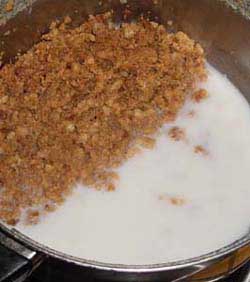
But how to make it? Simple. Put some lard and boczekinto a pot and let it simmer all day.

Next, pour the mixture through a sieve and place the now-soft chunks of fat in a ceramic container, careful not to drain entirely the now-clarified fat from the now-soft fat.

Smile as you think of the glistening mixture sliding through your body.

If your curious what the insides of your veins will look like shortly, leave the remaining mixture to cool.

Next day, dig in. Your neighborhood cardiologist will thank you for the business.

So apparently, I was wrong. It's not whipped fat. It's just boiled fat.

It's amazing there are any Poles who, eating like this, live past the age of, say, fourteen.

Universally Empty Rhetoric

In what is shaping up to be an east-versus-west, worldwide conflict, it is not surprising that both sides have been spewing its share of rhetoricand propaganda. It is also not surprising how similar the propaganda has been. A point-by-point comparison of Bush’s post-attack speech and bin Laden’s post-attack statement (though, being filmed during the day, it was clearly made before the nighttime raids) reveals that both men are saying essentially the same thing. In what follows, I have simply cut and pasted comments from each individual’s speech, usually with no altercation. Where I have made changes, I have done so only for contextual clarity, with inclusions indicated with brackets and omissions with ellipses. In addition, I have not indicated the individual sources. For most examples it will be obvious, but for some, its eerily similar.

To begin with, both sides see themselves as the liberatorand defender of freedom while calling the enemy an oppressor:

  • The winds of change have come to eradicate oppression from the island of Muhammad, peace be upon him.
  • We defend not only our precious freedoms, but also the freedom of people everywhere to live and raise their children free from fear.

Each side accuses the other of killing innocents:

  • If any government sponsors the outlaws and killers of innocence, they have become outlaws and murderers themselves.
  • They supported the butcher over the victim, the oppressor over the innocent child.

Each side has given its demands unequivocally:

  • I gave Taliban leaders a series of clear and specific demands.
  • we [must] live [security] in Palestine, and . . . all the infidel armies [must] leave the land of Muhammad

In the case of non-compliance, each side has explained the consequences:

  • neither America nor the people who live in it will dream of security . . .
  • And they will take that lonely path at their own peril.
  • And now, the Taliban will pay a price.

“Terrorism” is the key term in describing each others’ actions:

  • This military action is a part of our campaign against terrorism
  • They have come out in force with their men . . . to suppress people in the name of terrorism.

Each man sees the situation as the definitive “us-them” battle, with no middle ground:

  • Every nation has a choice to make. In this conflict, there is no neutral ground.
  • These events have divided the whole world into two sides. The side of believers and the side of infidels, may God keep you away from them.

Each leader has made a call for support from his people, no matter what the price:

  • Every Muslim has to rush to make his religion victorious.
  • [We] patience in all the sacrifices that may come.

(Recall that the Taliban leader recently pledge to sacrifice 2 million lives to defend Afghani freedom.)

And, as is the case in every war, each side has made an appeal to God and believes that God is on its side:

  • God is great, may pride be with Islam. May peace and God’s mercy be upon you.
  • May God continue to bless America.

With two equally stubborn, stupid individuals at the forefront of this conflict, there can be little doubt that a horrific conclusion lies somewhere in the future.

On September Eleventh

The attacks on New York and Washington have called into question many things that until now had been taken for granted, such as the safety of life in the United States and the level of hatred some feel towards America. Now that some time has passed, even more urgent questioning is taking place.

The initial shock seems to have worn off and everyone is left asking who did it, why, and what should be the proper response, without the roar of emotions everyone felt in the initial days after the attacks. Immediately after the attack, the initial answers to those questions were more the consequences of emotion, anger, and pain than the result careful thought. Hopefully, most people now realize that it is indeed time for careful thought and not emotive reactions. To that end, I offer my own answers to those three questions that seem to be plaguing everyone.

The first question everyone thought was probably something along the lines of "Who would do such a thing?!" In the days immediately following the attacks, the then-unknown perpetrators were completely vilified. The general consensus seemed to be that they were not human beings in any real sense of the word. They were monsters. Bush continually called them "evil" and the rest of the administration referred to the in similar terms. Those who did not go so far as to say they were the epitome of evil at the very least thought they were very sick individuals, people in dire need of mental help. Sick and demented, in other words.

Yet they were human beings. Indeed, they were "normal people" in many ways. They all undoubtedly had hopes, worries, and fears; they all probably loved their mothers with great devotion; they laughed occasionally (as evidenced by the suicide note found in one attacker's luggage); they felt weak and frail (again, as shown in the suicide letter). They were like me in many ways, I'm sure.

How they differed, though, is in the grounding of their worldview. The ultimate reality for them was Allah. Reading the things left behind by the attackers, one cannot possibly deny that for them, Allah's will was everything. They were devout and strict - so much so that they were willing to give their lives to fulfill what they felt was Allah's will. I of course cannot answer whether or not it was Allah's will, nor can anyone else. I can say that I certainly hope that the most powerful being in the world wouldn't require or even condone such actions, but that is a question beyond my finite abilities to answer. The point, though, is that they felt it was Allah's will; they felt they were doing their religious duty; they thought they were pleasing God. It seems that most followers of the three monotheistic religions should give at least a grudging respect to these men's devotion. The outcome was tragic, but single-mindedness with which they pursued their goal is strangely admirable. If we were to try to eradicate world hunger with the kind of devotion they had, everyone would be well fed by week's end. [1]

Even before most people began asking, "Who would do such a thing?" the Bush administration had already decided Osama bin Laden was responsible. At first his name was mentioned couched in words that seemed to soften the fact that he was immediately assumed guilty. Bush and others didn't want to be seen as acting in violation of that most-American judicial assumption of innocence before being proved guilty. Soon, however, the niceties were dropped and it was generally assumed that bin Laden was responsible. All eyes then shifted to Afghanistan where the Taliban was hosting him and his organization, and this led to the crisis that seems only to be increasing.

It is here that the Bush administration seems to be failing most miserably. Bush has demanded, "Hand over bin Laden." The Taliban, in response, has made a very reasonable demand: provide evidence that bin Laden is responsible. Yet the Bush administration seems completely unwilling to do such a thing. "No!" it seems to cry, "Our demands are not negotiable! Hand him over or be destroyed!"

It's more than a little disturbing that Bush in fact was demanding bin Laden's extradition before the BBC was reporting that the FBI had announced that it finally had proof of the attackers' ties to bin Laden's organization. Guilt was assumed from the beginning, and that assumption (however logical it might be) has informed all of Bush's actions.

Yet is the United States asking for something it would be willing to do? What if another country were to demand the extradition of some American on charges of terrorism, but refused to provide any evidence? It is doubtful that the US would be willing to hand over the accused. Yet that is exactly what it is demanding of the Taliban. What if, further, this country seeking to try an American gave the American leadership an ultimatum: hand over the accused or face attack? How would America respond? Probably in a manner similar to the Taliban: "Any attack will be seen as an act of war and we will respond accordingly."

One might respond to this line of reasoning that the two situations are completely dissimilar. "Bin Laden has been accused of a most heinous crime, of killing thousands of innocent people, of committing an unbelievable injustice - in short, of being a terrorist. America would never protect anyone accused of doing such a thing!" So some might argue, but the argument brings to the table one of the most critical points of this whole crisis, and that is the definition of terrorism itself. America seeks to try bin Laden on charges of terrorism, as America and the rest of the Western world defines "terrorism." But is it not inconceivable that certain acts America has committed or financed could be defined as terrorism?

What about its support of oppressive regimes such as Pinochet in Chile and Marcos in the Philippines? What about the enforcement of embargoes against countries that result in millions of people being pushed to the brink of starvation while leaving the people the U.S. is trying to punish completely untouched? What about its unquestioning support of Israel (which has included providing weapons, training, and information) in the Middle East conflict? What about the simple fact that America is the only nation in the world to use a nuclear device in a non-testing situation? What about its carpet bombing in Dresden and Cambodia knowingly resulted in the deaths of thousands of civilians? What about the help America provided oppressive regimes to overwhelm democratically elected governments simply because the former espoused capitalism and the latter communism (I'm thinking here of Central and South America)?

These are just the potential "sins of commission." One could also argue that America has committed several sins of omission. This is particularly true when one thinks about American intervention in Kuwait in the early 1990's. George Bush (and others after him) explained the action as one of humanitarianism - saving the Kuwaitis from the horrors the Iraqis were committing. While this may very well be true, it doesn't hold well when one considers all the other atrocities that America has set back and allowed to happen: in Rwanda, Cambodia, and Bosnia, for example, there was attempted genocide. For several years now the Taliban has been committing the most atrocious human rights violations. During the Second World War, America knew of the Nazi's genocidal actions and did nothing about it (i.e., destroying the death camps). America sat back and watched while Pol Pot and Idi Amin destroyed their own countries, killing thousands. The point is this: if the American intervention in Kuwait was a truly humanitarian effort, then America should have also stepped in and tried to stop all these other horrors. But Kuwait has something that Cambodia, Europe, and central Africa don't have: oil.

So whether by omission or commission, America has done plenty of things that others could easily regard as unjust, or even "terrorist." American relations with Iraq and Iran provide a good example of something that someone might label as "terrorist." For a while it suited America's interests to support Saddam in his war with Iran, and all the while he massacred Kurds in his own country. His regime did to the Kurds what they later did to the Kuwaitis. Why didn't America do something about Saddam then? Because he was useful. He severed as a distraction for Iran. When Iran was busy fighting Iraq, it couldn't devote as many resources to sponsoring terrorism against the West. Problem solved. And in the meantime, thousands and thousands of innocent people were killed in a senseless war America helped sponsor. Now America has switched positions - Iran seems to be a little more moderate, so we can now play them against Iraq. One can say, "Well that's because Iran is now a more humanitarian, less repressive regime, and we're rewarding their changes with a new openness toward them." That might be so, but that's not the point - the point is that throughout all this, Iraq has been an oppressive, murderous regime, and America only did something about it when the threat spread beyond its borders. America created Saddam Hussein, and when he was no longer convenient, America destroyed him.

The reason I've been putting the words "terrorist" and terrorism" in quotes is because it is, after all, a relative term. One man's terrorism is another's patriotism. This leads to the second question people have been asking - "Why?" Though no direct information is available, it seems reasonable to assume that these individuals who attacked New York and Washington did so because something America did provoked them. This is not to say that America got what it deserved, and that this justifies or excuses the attacks. I'm simply saying that people do not commit acts of this horrific magnitude without extreme provocation (at least provocation in their eyes). In attacking the Pentagon and World Trade Center, these men felt they were righting a wrong, that their act was an attempt to bring about justice. In other words, these men acted in response to a perceived injustice, something they might also have labeled "terrorism." Whether or not America meant to, it has done something that has angered many people in the world enough that they are willing to sacrifice everything to enact some kind of "justice."[2]

This is where things start getting really interesting, though; where our common humanity comes into sharpest focus. The same kind of rage that Americansfelt immediately after the bombing (and many still feel, certainly) must surely be similar to what drove these men to do this. No one in the American mainstream media (from the limited bit I get) seems to be admitting let alone discussing this. Some senator said, "We've got to be somewhat irrational in our response. Blow their capital from under them." Yet however "just" that might seem to Americans, Afghanis would feel the same pain and resentment toward America that some Americans now feel toward them. As Salon magazine put it, "You might as well hand out box-cutters and directions to Kennedy Airport to every kid in Afghanistan unto the third generation."

Our common humanity is evidenced in other ways as well:

  1. Both people feel that a great injustice has been done to them. This drove certain individuals to commit one of the most horrific acts in history. Who knows what that itself will cause America to do in retaliation. But it will retaliate, and that leads to the second point:
  2. Both groups feel that their retaliatory action will rectify the situation. The men who killed all those people in the States didn't do it because they thought they were being evil; they did it because they thought they were acting justly. We can of course question their sense of justice, but the fact remains: they most likely felt that this act would tilt the scales of justice in their favor. America feels that its retaliation will accomplish the same thing.
  3. The injustice they feel has inspired many of them to volunteer their services in operations that might result in their own death in order to get justice. European news agencies showed footage of bin Laden's minions training, and no reasonable person would deny that these men are willing to give their life for their beliefs. At the same time, the American public seems okay with the idea of casualties in its search for justice. Additionally, there have been reports of common soldiers expressing an eager willingness to take part in missions that might result in casualties.
  4. Both groups see themselves as virtuous and the other as the epitome of evil. Of course the US has been branded the Great Satan by the Islamic world for ages. Now Bush is continually referring to those people who planned and committed this act, as well as those who harbor them (read: the Taliban) as "evil."
  5. There is a certain fanaticism among both people. When Bush visited the disaster area in New York soon after the attack, he was talking to all the rescue workers through a megaphone. At one point they spontaneously began chanting, "U.S.A.!!! U.S.A.!!! U.S.A.!!!" pumping their fists, with a look of just indignation on their faces. Change the language to Arabic and put a beard on Bush and it would look eerily similar to what we see in the Middle East from time to time.
  6. Both groups see the loss of a certain number of innocent lives as an acceptable price to pay to reach their objectives. Senator Zell Miller said the U.S. should "bomb the hell out of Afghanistan." This would probably result in significant civilian losses, but this is apparently not a concern for Miller. Loss of civilian life is not an issue, obviously, for those who carried out the attacks. And of course both groups would define "innocent" differently, and I highly doubt that Miller would call the Afghani citizens who died as "innocent," because, after all, they support bin Laden. Those who killed the people in the States would probably not call their victims innocent, because, after all, they support Israel's anti-Arab war and so on.
  7. Neither group will ever say, "We deserve that act of retaliation because our own last attack was so awful. The scales of justice are now even and we, as an evil state, have been justly punished." In other words, a military attack will just bring about another terrorist attack.

This brings us to the final question: what should America do? The temptation at first was for me to frame that question as "what should America do in retaliation," but that begs the very question I'm raising: should America retaliate? It is at times like this that at least a tinge of nationalism touches most people and even the most liberal critic in America probably, for at least a moment, would have answered unhesitatingly affirmatively. But one thing is certain: unless America can somehow convince the world that bin Laden is responsible for the attack and it is an unjust act that deserves punishment, whatever America does will only provoke another attack.

One thing America should certainly do but seems unwilling to do is provide evidence to the world at large that indicts bin Laden in this attack. Yet the objective itself of Operation Infinite Justice (as the Bush administration is calling it) — capture and try bin Laden in a court of law - ensures that America will not provide such evidence (and this in turn will create more motivation for terrorism). [3] In the effort to capture bin Laden, America will commit acts a, b, and c. These three acts will be justified, no matter what they are, simply by saying that they were done in the pursuit of justice. Even if act b is the accidental killing of 500 civilians, it will still be "covered" by the "pursuit of justice" clause. One act (of omission, certainly) may well be the starvation of thousands of civilians. Another might be the re-creation of a power vacuum like the one that, upon Soviet retreat, led to years of civil war. This would be the same as destroying the country, and Bush has already told us what the results of that would be — leave it alone, because we're "not into country-building."

Now my main point is this: these three acts are defined as ultimately just because they lead to the capture of bin Laden. But what if someone decides these very three acts are "acts of "terrorism?" What if only 5,000 Afghanis die of starvation because of this war (a number that seems ridiculously low in early October) and the leadership of Afghanistan wants to try George Bush on charges of terrorism? What will America do? Laugh, basically.

What if any country demanded an American citizen for trial but provided no evidence? America too would be unwilling to give up the accused person.

This is the main reason why Bush is unwilling to capitulate to the Taliban's very reasonable demand: give us evidence. To this point, as far as I can tell from the news, the United States has refused. It has said, "Our demand is non-negotiable." What if any country demanded an American citizen for trial but provided no evidence? America too would be unwilling to give up the accused person.

And this leads to exactly why the U.S. will never provide the evidence. If it does so, and the later some country does the same to the US, it will be obliged to turn over the accused. In other words, it has to play fair. It has to realize that it's not always right, that its citizens and even government do things that other find reprehensible. And of course America has committed acts that others define as terrorism, but I highly doubt it will be willing to turn over anyone for trial in another country as it's asking the Taliban to do. Especially without evidence.

It's precisely this selfish, biased behavior that leads others to hate America. America, like any other country, has always acted in its best interests. Even the greatest acts of generosity America has committed have been inspired out of national interest. The rebuilding of Europe after World War Two, for example, was not an act of charity. It was a way to make sure that another regime with visions of global (or at least European) domination didn't arise from the rubble just as the Nazis had arisen from the ashes of World War One. No one individual or nation does a single thing from purely selfless motives. Even the greatest martyr gets some sort of personal satisfaction out of her death.

It seems clear, then, that the answer is not simply retaliation. You don't calm an angry dog by kicking the shit out of it every time it bears its teeth. If America (and the Western world as a whole) truly wants to stop these types of things from happening, it has to take into account what causes the conditions that make people feel this way.

The answer to the question "what to do" lies in the very facet of human nature that led these men to attack Washington and New York and may well lead America to attack Afghanistan, and that is human's tendency toward dualistic worldviews. And with dualism, it's really a matter of perspective. Some see all of America's actions as just; others see all their nation's actions as just. There are few people in the world who say, "We as a people and a nation are bad — inherently evil, in fact — and we just want to wreck havoc on the world." Everyone sees themselves as the good-guy. But everyone can't be the good-guy all the time. There have to be bad-guys, and I think most Americans are unwilling to admit that their country has ever been a bad-guy. Much like Islamic extremists are unwilling to admit that their country has ever been a bad-guy. "We're backed by God's justice." "We're backed by Allah's justice." Both statements can't be right.

This dualistic view that so many people seem to have — on both sides of any given political coin — will do nothing but encourage and fuel such actions as we saw on 11 September. Americans have to be willing to look at themselves and say, "What could we have done that could have possibly resulted in someone feeling such fury towards us?" In other words, they have to walk a mile in others' cliché moccasins. Are those on the other side going to do the same? I don't know. Maybe they would continue to be close-minded, but their close-mindedness would never justify our own.

If America provides an equal response, that's exactly what it will get — more of the same. People who share the same views and opinions as those who committed the attacks will see America's action as something that needs to be avenged, and will strike again. America will hit them again and say, "Justice has been done." They'll feel injustice has been done, and hit America back. Sort of like how practical jokes seem to spiral out of control. In this case, though, the consequences (for both sides) are a little more dire than short-sheeted beds.

Flaki

It looked like perfectly harmless soup. I could see a bit of carrot and potato, and a sip of the broth revealed a nice, rich flavor. Then I saw it: A bit of bumpy white mystery that was vaguely meat-like. I moved it around a little with my spoon and thought to myself, "Oh, please don't let this be flaki." I took a bite. It was rubbery and had a very pungent flavor. I swallowed and it was at that point that my host brother asked, "You know what that is?" Before I could say, "Wait--don't tell me. I don't want to know," he informed me, "Flaki!" He smaked his lips and rubbed his belly. "Ummmm," he said with a sly smile. "Go ahead," he prodded, "It's great!" I tried to eat more, but I simply couldn't. After all, how much intestine soup could you handle? Yep, flaki is basically soup made from cow guts. While the broth can be tasty, the meat itself isn't, and the while it cooks it positively stinks.

This was only one of my culinary adventures during the 1996 Christmas holidays. I returned to Radom to spend Christmas with my host family and I was introduced to the wonders of the Christmas feast. On Christmas Eve there is a huge meal with anywhere from nine to fifteen dishes, none of which have meat (unless you count fish, which the Poles don't). There were a couple of geletin dishes with bits of veggies and fish suspended in a suspect looking gel and sledz (herring).

The highlight of the dinner is the carp. Traditionally it is kept alive in the bathtub until the day of Christmas Eve when the grandfather bludgeons the poor thing to death and then it becomes the central entree of the Christmas Eve banquet. I'd never eaten carp, and if you haven't, I wouldn't advise it. Fishermen throw it back for a reason! It is basically a bone with some skin and a little meat trapped in between. Breaded and fried, the carp I had was rather difficult to finish. When I finished the pile of bones was somehow bigger than the actual piece of fish was.

Christmas day is a day of meat. While none of the Christmas Eve dishes had meat, almost every single Christmas day dish had meat. This was when the flaki made its appearance. I was somewhat surprised to find that the desert had no meat in it. I thought, "Why not a mincemeat pie? Perhaps some chicken ice cream? Or even a pork cake?" but I kept it to myself.

As a general rule, though, Polish fare is quite good. It's a bit on the starchy side, but tasty. Potatoes are served with almost every meal to which I've been privy, cabbage appears on the table frequently, and pork is the meat of choice. Beets are rather common (in soup--barszcz--and as a side dish), and every meal is washed down with warm kompot which is an incredibly sweet drink made from various fruit (apple and pear seem to be the most common in Lipnica). Occasionally chicken will show up (though most often in soup) and I've even had rabbit on once. While I ate, Elmer Fudd kept singing, "Kill da wabbit, kill da wabbit . . ." and I felt a little guilty, but I have to admit that wabbit is wader wonderful. No wonder Elmer's so intent on bagging Bugs.

Crucifix

There are crucifixes in each and every classroom at my school.  Separation of church and state is not a goal of the Polish democracy.  So every day I teach with a little statue of a man nailed to a tree hanging right above my head.  “It gives some people comfort,” says Danuta, my counterpart English teacher.  I suppose that’s possible.

Early in the first semester the director told me to come down to the new English classroom to tell him where I wanted the bulletin boards.  (The boards were actually sheets of styrofoam attached to the wall.  Economical.)  He drilled the holes, put up the styrofoam, then drilled the hole for the crucifix.  I wondered how he would respond if I said, “I don’t want that in my classroom.”  No doubt he would be confused, and maybe (probably?) a bit upset with my irreverence.  Of course I said nothing.  “When in Poland . . . ”

It’s got me to thinking about the whole religious symbolism in Christianity.  The cross is a sacred symbol because it represents Christ’s death to millions of Christians around the world.  It is a simple character, almost reminiscent of minimalism in its barest form.  Most people wear crosses because it is an outward expression of their inner convictions.  Yet I wonder: If Jesus had slipped in the shower and bonked his head, would we be wearing Soap-On-A-Rope?  Would giant bath-size Dial bars replace steeples at churches?  Would we make bathing motions every time we enter a church?  It would shed new light on what Pilate said: “Okay, I wash my hands of the whole issue!”

Anyone seen Monty Python’s Life of Brian?  Remember the scene where they’re trying to decide what symbol they’ll use to indicate that they are followers of Brian?  “The shoe!  The shoe!”  I suppose that scene prefigures my own speculations.  Yet both point out how virtually arbitrary religious symbols are.  If Christ were to be put to death today, I suppose twenty-first century Christians would use the electric chair or a hangman’s noose as the primary symbol.

The crucifixes are just one indication of how strong Catholicism is in Poland.  For many, to be Polish is to be Catholic.  They are virtually synonymous.  In fact, next to every crucifix is a relief in plastic of the national symbol of Poland.  Religion and nationalism, hand in hand, as they so often are.