Matching Tracksuits

fun in fours

site

Dziennik

Each class has one. All teachers are responsible for keeping it up to date. Students have a right to look at it at just about any time. And the Ministry of Education can cause a lot of headaches if it doesn’t like what it sees in it.

So what is this mysterious thing called a dziennik?

I’m tempted to say it’s a direct consequence of The Fall, God’s punishment for all evil on earth, or other such silliness, but I’ll simply say that it’s one of the most annoying things about teaching in Poland.

“Dziennik” is Polish for “journal,” and The Dziennik (imagine a Charlton Heston-esque booming voice saying that) is the grade book for each class. It is the record of the entire class for the entire year, and keeping it up to date is the biggest headache I know of. All grades for all classes (biology, English, physics) are in this marvel of modern stupidity as well as the personal information of each student, and in addition, attendance is marked in one portion.

The most irritating and annoying part of it is the slots for lesson topics. For each lesson, I must write the topic in a special little slot. Now this doesn’t seem like much, but it can be an incredible pain in the ass. Teachers take the dziennik to class, and it is always bouncing through the school–one never really knows where it is. So you forget to write your topics one day.

Then that one day becomes two. Then three. Four. A week.

Then comes the fun.

The Polish equivalent of the homeroom teacher comes and points out all the slots where you forgot to write the topic, and you’re supposed to get out your notebook, look up that day, and write the appropriate topic.

Of course I write all my topics in English, so the obvious struck me long ago: “Only [Basia] (the other English teacher) knows enough English to understand what I’m writing in here. I can write anything I want.” So that’s what I started doing.

After that, topics included, “General Chaos and an Attempt to Keep Them Interested Forty-Five Minutes” and “Stuff.” Song lyrics can provide good topics: “Looking for someone, I guess . . .” or “Looking Over that Silly Four-Leaf Clove.” I suppose it’s immature, but we’re all allowed to be childish every now and then, right?

Mind, I didn’t do this regularly–just when I’d forgotten to write the topic or (more likely) the dziennik wasn’t available at the time.

Some years ago, when I did this more often, the other English teacher finally saw me doing it, and she asked me to stop. “I’ll be the one who gets in trouble,” she protested. At that time I didnโ€™t speak much Polish, really, and she was the go-between.

Reasonably enough, she didnโ€™t want to get yelled at.

I toned it down a bit, something like “Present Continuous in Questions and Cow Tipping.”–a combination of the two.

In theory, she explained, someone from the Ministry of Education might know enough English to understand what I wrote, and then the stuff would hit the fan.

I thought to myself, “If the Ministry of Education doesn’t have anything better to do than to sit and read every single topic in some little village’s school’s dziennik, then I think whoever was reading it might appreciate the humor.” But I said nothing. And wrote for my topic that day, “Telephone Vocabulary and Other Silliness.”

EFL Materials

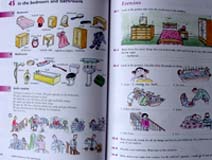
Ever wonder what an EFL (English as a Foreign Language) textbook looks like? I certainly did as I was preparing to come to Poland for the first time back in 1996. After all, how often do you get to see a textbook teaching something you already know fluently? Naturally, after four and a half years' experience, I've seen and used more textbooks than I care to remember. I thought I'd share a little about the books I've been using.
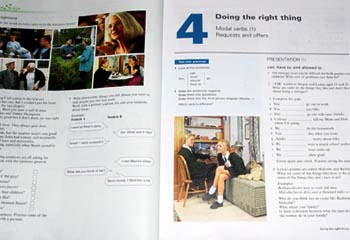
Most units tend to be thematic. For example, for practicing modal verbs such as "should," "must," and "have to" (among others), this particular book (and many others) use the idea of advice and "Doing the right thing."

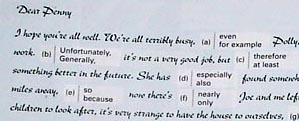
There are certain groups of easily-confused words, and some activities are aimed at improving students' ability to choose the correct word from a similar pair. This particular book is written specifically for Polish students, and so that influenced the word choice (in other words, they might not seem like similar words in English, but they are in Polish translation, so . . .).

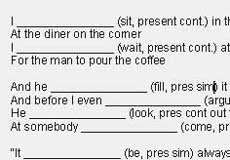
There are three tenses in Polish; there are twelve in English. When to use which tense can be somewhat confusing for students. Even remembering how to make them all can be difficult, so sometimes we have "easy" lessons that just make students think about how to make the tenses. (This particular exercise uses Suzanne Vega's "Tom's Diner," a rather popular song in Poland, making this one of the most popular lessons I've ever taught.)

Obviously, the most basic element needed to be able to use a foreign language is an adequate vocabulary.

Teaching English in Poland presented some special challenges. For instance, articles: when to use "a," when to use "an," and when to use "the." Polish doesn't have articles, so the sentence "Id? do sklepu" could be translated "I'm going to a shop" or "I'm going to the shop." Teaching students when to use which was initially very difficult.

The most difficult part, though, would be orthography: getting kids to remember that the dark part of a 24-hour period is "night" and a medieval soldier is a "knight" and they're both pronounced the same.

Mushrooms

As a child, I hated mushrooms โ€” or what I took to be mushrooms: slimy little buds that came from cans. Admittedly, I'd never tried them. Eventually, I did, and I came to like what I'd mistakenly taken as "mushrooms."

I also recall being in the woods and wondering why we didn't just pick the mushrooms that were all around us. Someone explained that they were poisonous, and my mother later clarified that "We only eat mushrooms we buy in stores."

That limits things somewhat: champignons, portabella, and shitake are the only non-canned mushrooms I recall seeing in stores in the States. Of course, I never really went out looking for other types, so I'm sure I'm misrepresenting mushroom's availability.

Then I came to Poland, and all my conceptions about mushrooms changed. Mushrooms became not something you bought in stores, but something you went out in the woods to find.

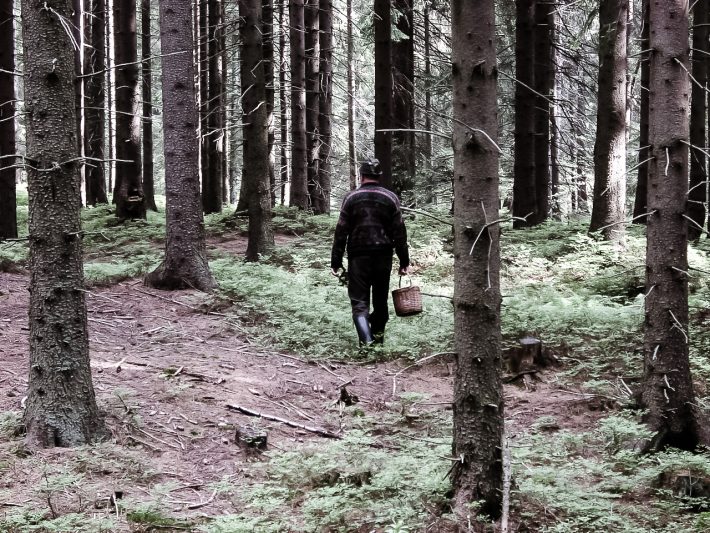
"Mushrooming," for lack of a better term, is a popular hobby in rural Poland, and not only, for often people come from the cities for the express purpose of "mushrooming." It's a simple concept, really: take a basket into the woods and wander around looking for mushrooms.

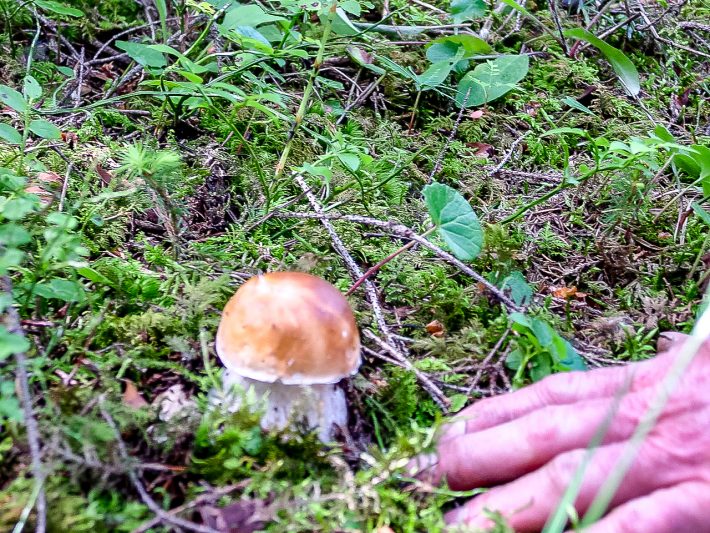
Of course, not just any mushroom will do. Some, as a shroomer put it, are "edible only once." Others don't taste so good. What everyone dreams of is finding "prawdziwki." I've no idea what kind of mushroom that would be (the mushrooms in the first image are "prawdziwki" โ€” anyone know what they're called in English?), but the word "prawdziwki" would be literally translated "little real ones."

The first step is to find them. Most often they're at the base of trees, or near them, partially covered, growing in damp ground.

A friend told a story of someone who, while out hunting mushrooms, unexpectedly came upon a deer with a broken leg, it's antlers caught in the undergrowth. The gentleman managed to kill the deer with the small paring-knife he'd brought along for cutting mushrooms. Then he went back into the village, borrowed someone's van, drove out into the woods, and loaded the deer up, only to find that the animal was much larger than he'd imagined and the antlers were still on the ground. So he tied the antlers up to the roof of the van, drove it home, and had venison for a week.

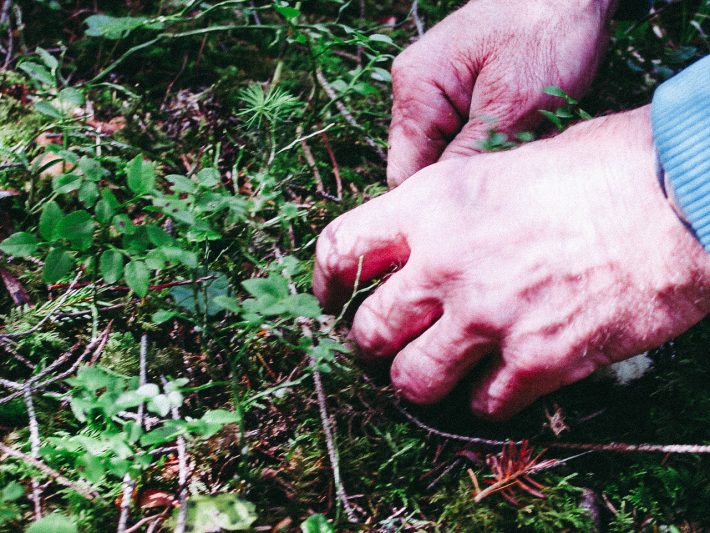
Once you find them, it's not a question of jerking them out of the ground. Instead, you have to cut them carefully at the base.

In some ways, it's a pleasant enough activity even if you don't find any mushrooms. Fresh air, sunshine, singing birds โ€” a pipeful of tobacco in my case. It's not a bad way to spend a morning.

But the longer you look without finding anything, two conflicting thoughts start rising. First of all: "I've been out here for ninety minutes already and I haven't found anything edible. This is a waste of my time now." Second: "I've been out here for ninety minutes and I haven't found anything edible. I can't possibly go home empty-handed, so I'll look longer."

What's worse is when your shrooming partners are finding "prawdziwki" and you aren't. Of course, I'm a shrooming novice, and I guess I don't know how or where to look.

Sola Scriptura

Having been raised a Protestant and now marrying a Catholic, I've been thinking about the nothing of "sola scriptura."

The facts about sola scriptura as I see them:

  1. The Gospels were probably written by and large after Paulโ€™s epistles. Paul no where makes mention of the Gospels. Therefore, any of Paulโ€™s passages that are taken as proof of sola scriptura cannot be referring to the Gospels.
  2. Paulโ€™s letters were not collected into anything canonical during his lifetime, nor were the other epistles. They were circulated from church to church. Therefore, any of Paulโ€™s passages that are used to prove sola scriptura also cannot be referring to any of the pastoral epistles.
  3. The Gospels are purportedly reporting what Jesus said โ€” in theory (and in faith), they report what happened before either Paulโ€™s epistles or the Gospels were written. Therefore, anything in the Gospels taken as proof of sola scriptura cannot be applied to the New Testament.
  4. The recognition for the need of an authorized list of New Testament books (i.e., canonization) did not emerge until the middle of the second century. The Old Testament canon, however, was handed down from Judaism. That, combined with the above points, means any reference in the New Testament to โ€œScriptureโ€ is a reference to the Old Testament.
  5. Because of lack of canonized testimony about Jesus, early Christians based their faith primarily on oral traditions and the Old Testament.

Does this justify the Roman Catholic position on tradition? Certainly not. But it does make headway in showing the Protestant notion of sola scriptura is not Biblically based, nor logical.
Sola scriptura is even more troubling when we think about all the extra-Biblical beliefs and practices that Protestants engage in:

  1. Christmas
  2. Easter
  3. Sunday worship
  4. The Trinity
  5. Prohibition of polygamy
  6. The use of the cross as a Christian symbol
  7. Rejection of the Jewish festivals

The Trinity is a special case, because Protestants argue that the Bible does teach that there is a Trinity, it just doesnโ€™t use that term. But Armstrongism, Mormonism, and the Jehovahโ€™s Witnesses show that such a conclusion doesnโ€™t necessarily have to follow โ€” not to mention all the early heresies.

Chapels

Poland is a Catholic country โ€” in spades. Some ninety-seven percent of the population claims Roman Catholicism as their religion, though estimates of practicing Catholics is around seventy percent.

Of this seventy percent, I'm not sure how much of it is from habit and from true faith. I've had many a discussion about this with friends here about it. It calls to mind a college professor who'd "accepted Christ" at age five, which seems more from environment than from inner conviction. Regardless, the vast majority of Poles go through the motions, anyway. And certainly, many of them are devout and sincere.

There are quite a few who go to daily mass. It's mainly elderly women, judging from the small stream of people I see leaving the church. This raises a question: how does one draw the line between sincerity and habit? And what if it seems only to be habit despite the individual's protests that it's not? Pious until proven habitual? Or maybe I'm begging the question of them being mutually exclusive.
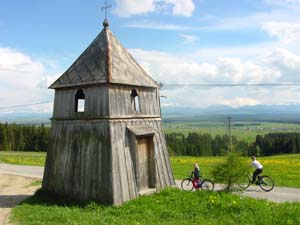
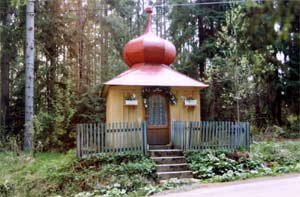
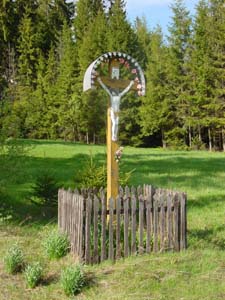
This Catholic piety spills over into every facet of life here, something striking to someone coming from a relatively irreligious country like the States. Separation of church and state โ€” a completely foreign concept here.

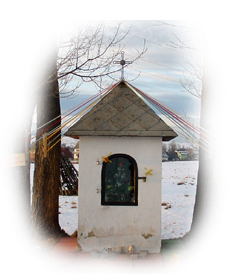
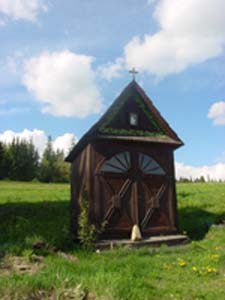
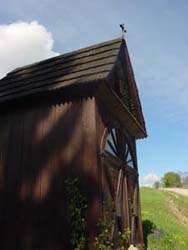
One of the many results of this piety is the proliferation of chapels โ€”roadside chapels, yard chapels, even gable chapels.

Roadside Chapels

Belltower in Jablonka

Roadside chapel just outside of KiczoryRoadside chapels are everywhere in Poland. They're by highways (or the Polish approximation of "highways") and roads you think are probably traveled once a year.

And they're all different: from small, simple, covered crucifixes to elaborate buildings.

I've rarely seen people there praying, but it does happen occasionally. It seems to be most common around high holidays in the spring and summer when the weather is conducive to spending all that time outside praying. And in many ways, it's quite admirable, that kind of religious dedication.

Some Protestants might suggest that building chapels like this is not necessary, that no building contains God.

Theological differences aside, it's still a pleasant idea for me, even as a non-believer.

Libation

There are several drinks one associates with Poland. Surprisingly, tea is one of them. I say "suprisingly" because tea is too English to fit into Polish society, but fit it does.

But who wants to read about tea?

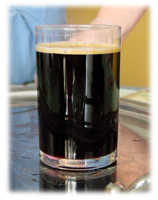
Coffee is another story altogether. In Poland they drink their coffee Turkish style. They simply put coffee grounds in a cup and add water.  No filter, so there's a sludge (not to be confused with sledz) in the bottom of the cup. My friend's uncle does strange things with his coffee grounds: He eats them.  He puts eight or nine teaspoons of sugar in his coffee (or rather, he pours a little water of his sugar and coffee ground mixture), then eats the stuff at the bottom of the glass.

"Glass?  Don't you mean, 'cup?'" you might be asking yourselves. No, I mean glass. Most often coffee is served in a glass, much like we would drink soda from in the States. In other words, there's no handle. I think it is actually rather dangerous, because it's very easy to burn my tender hands holding a glassful of hot coffee. But most Poles just grab the glass, and don't wince at all.

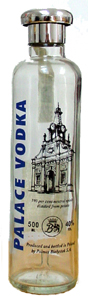
Vodka

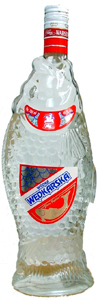
I'm not sure I'd ever drunk vodka straight before I came to Poland. Since coming to Poland, I've drunk a fair amount of it (comparatively speaking), but I still don't like it.

Vodka accounts for many of the little surprises I've noticed around here โ€” missing fingers, for instance. Many men in Lipnica have part or all of one or more fingers missing. I knew fairly early on that this would be a result of carelessness in one of the many sawmills in the village, but I thought, "Come on, simple carelessness doesn't account for it." Then I saw a man covered with wood chips and sawdust come into a shop and buy a half-liter of vodka.

As far as straight drinking goes, though, Poles, while they out-drink Americans to a lip-numbing degree, are teetotalers in comparison to Russians. I once saw a documentery in Poland, called Z?ota Ryba ("The Golden Fish"), about vodka in Russia. It showed a home distillary that produced 140 proof (i.e., 70% alcohol) vodka that even Grandma was tossing back by the full glass (Not a shot glass, mind you, but the size Poles use for coffee and tea.), without a chaser.

Poles make their own vodka too โ€” to a degree. It's a tradition to use pure spirits to make wedding vodka. (Kinga's father and I made it for ours.)

Still, buying spirits and dilluting them is one thing; making your own spirits is quite another.

The Linguistics of Vodka

Vodka in Polish is "wรณdka." A perfectly normal word, but its derivation is strange.

First, a bit about diminutives. A grammatical "diminutive," for those who don't know what it is and don't want to look it up, is used to denote the smallness of or fondness towards a particular thing.

In English, we don't really have them. We might preface some noun with "little" (as in, that's a nice little dog), or even use "little" in conjunction with "cute" or "sweet."

In Polish, though, you actually change the word, usually adding "ek," "ka," or "ko" to masculine, feminine, and neuter nouns respectively. In the example above, a Pole might say "piesek" as the diminutive form of "pies."

Poles have diminutive forms of first names as well. You seldom call a friend named Piotr by that name, but instead use "Piotrek," or if you're his mother, "Piotru?." It's similar to the change from "Thomas" to "Tommy," I suppose.

Now, back to "wรณdka." If you notice, it ends in "ka," meaning it is, in fact, the diminutive of some feminine noun. What word could that be? Why, it's none other than "woda," or "water."

Beer

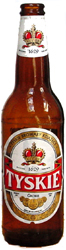
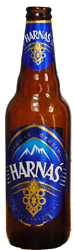
I'll never forget the first time I saw it: standing in a shop at seven in the morning, waiting to buy something for breakfast, I watch a man come in, buy a beer, down it in one long gulp (for lack of a better word), put the bottle on the counter and walk out. Seven in the morning.

It's safe to say that beer is viewed somewhat differently in Poland than in the States. In fact, when someone in Poland says, "I haven't drunk in two days!" I take that to exclude beer. "I haven't drunk vodka in two days," is what he probably means.

Polish

Polish is, beyond a doubt, the most difficult language I've ever attempted to learn. In a way, that's not saying much: I "studied" Spanish in high school and French in college; living in Boston, I began learning a little Russian until the novelty wore off; in Poland, I decided to learn some Greek. But Polish puts them all to shame.

Polish is difficult and strange โ€” even Poles will admit that. The pronunciation is tongue-warping and the grammar is unbelievable.

I recall an instance when four teachers โ€” three German teachers and an English teacher โ€” were writing an official letter of thanks and spent a good three to five minutes discussing how a particular word should be declined (i.e., which ending should be used). One of them looked at me and said, "You see, Gary, you're not the only one who has problems with this hopeless language." In fact, I've often seen teachers who are preparing some formal paper or task asking the Polish teachers whether something should be this way or that in a given case.

What follows is a basic outline of why Polish is so difficult.

Declension

In English, word order is an essential grammatical element. We know in the sentence "The dog bit John" that the dog did the biting, and not John, from the position of "The dog" in the sentence.

Polish, however, is an inflected language and that means that word order has no effect on the meaning of the sentence. In Polish, you could just as easily order the words, "John bit the dog" without any change in meaning. For that matter, "Bit John the dog" and "The dog John bit" are possible as well.

So how are they differentiated? By their ending. In Polish (in all highly inflected languages) you indicate a word as a direct object, an indirect object, a subject, or whatever by adding a suffix according to a given pattern.

An example may help. Imagine in English that subjects ended in "-doj" and direct objects ended in "-aldi." Our sentence would then look like this: "The dogdoj bit Johnaldi." In that case, "Bit Johnaldi the dogdoj" would have the same meaning, as would the following:

  • "Johnaldi bit the dogdoj."
  • "Johnaldi the dogdoj bit."
  • "The dogdoj Johnaldi bit."
The genitive case singular ending of "non-alive" nouns, either -u or -a, is decided by the morphology of the noun, not by its meaning.
Polish: An Essential Grammar by Dana Bielec, page 109
.

English does indeed have a bit of declension. Some examples:

  • "-ed" to a verb to make it past tense
  • "-s" to make a noun plural
  • "-ing" to make a verb a gerund (i.e., "Swimming is a healthy activity.")
  • "-er" and "-est" in the comparative and superlative forms
  • "-'s" to denote possession (i.e., "Samantha's mother left for Switzerland.")

By and large, though, English is not an inflected language. "The dog bit John" and "John bit the dog" are very different sentences as a result.

An inflected language uses cases to differentiate functions and forms. Greek has four cases. German, I believe, has five.

Polish has seven:

Case

Use

Nominative caseThe subject of a sentence
Accusative caseThe direct object of a positive sentence
Genitive caseTo denote possession (i.e., "That's George's bag.")
The direct object of a positive sentence for some verbs
The direct object of a negative sentence
For quantities of five and above (more later)
Locative caseTo specify location after certain prepositions
Instrumental caseTo denote the method or tool used to do something
Dative caseThe indirect object of a sentence
Vocative caseUsed in addressing people (i.e., Did you take it, George?)

These changes even occur to names, providing a clear example of the complexities of Polish grammar.

Case

Example

 
Nominative caseTo jest Bill Clinton.This is Bill Clinton.
Accusative caseLubi? Billa Clintona.I like Bill Clinton.
Genitive caseSzukam Billa Clintona.I'm looking for Bill Clinton.
Locative caseMy?l? o Billu Clintonie.I'm thinking about Bill Clinton.
Instrumental caseRozmawiam z Billem Clintonem.I'm talking with Bill Clinton.
Dative caseDa?em Billowi Clintonowi.I gave Bill Clinton... (s'thing).
Vocative caseWzi??e?, Billu?Did you take it, Bill?

Because of declension, the word order doesn't make any difference. For example, if you want to stress that you gave it to Bill as opposed to George, you could say, with the proper vocal inflection to stress it, "Billowi da?em."

-a is a feminine ending, so such nouns[, which are masculine nouns but in fact have feminine endings,] are declined as feminine in the singular but as masculine in the plural.
Polish: An Essential Grammar by Dana Bielec, page 85

But learning Polish grammar is not simply a matter of remembering some endings, for all nouns in Polish have a gender (as in German, French, Spanish, etc.), so you have to learn a hell of a lot of endings.

  • Three genders
  • Seven cases
  • Singular and plural

So when you utter a Polish noun, there are forty-two possible endings, depending on whether it's singular or plural, masculine, feminine or neuter, and whichever case is necessary.

And the exceptions, for some forms are exactly the same except in given cases.

  • The accusitive plural and the nominative plural of neuter nouns are identical, but feminine and masculine nouns are different.
  • The female genetive and locative cases are the same for singular nouns but not for plural nouns.

Aside from that nonsense, there are various considerations for exceptions. Is it a masculine alive noun? Does it end in "a"?

The genitive case [. . .] is used [. . .] For the accusitive case in (a) masculine singular/plural nouns denoting men and (b) singular nouns denoting living creatures [and] for the direct object of a negative verb[, as well as] after the number five and upwards.
Polish: An Essential Grammar by Dana Bielec, page 106

Genitive Case

My favorite case (I never thought I'd say that) is the genitive case โ€” it shows just how absolutely, astoundingly, and weirdly arbitrary Polish grammar is.

To being with, the genitive case is used for the direct object in negative sentences (as opposed to the standard accusitive). In other words, if you say, "I don't like cabbage," the form of "cabbage" would be different than in the positive sentence, "I like cabbage."

Lubi?kapust?.I like cabbage.
Nie lubi?kapusty.I don't like cabbage.

It is also used for quantities of five and above. That means there are two plural forms. If you say "I ate two dinner rolls," you use one form; if you say "I ate five dinner rolls" you use a different form. In English, it would be like saying, "Martin has four brothers." "No, he has five brotherid." The "dinner roll" example in Polish looks like this:

Zjad?em jedna bu?keI ate one dinner roll.
Zjad?em cztery bu?ki.I ate four dinner rolls.
Zjad?em pi?c bu?ek.I ate five dinner rolls.

But that's not all. Once you get to twenty, it's only for numbers that contain the actual with the word "five," "six," "seven," etc. that use the genitive case. Returning to the dinner roll example, we see how the plural form switches back and forth:

Quantity

Form

1 - 4bu?ki
5 - 20bu?ek
21 - 24bu?ki
25 - 30bu?ek
31 - 34bu?ki
35 - 40bu?ek

Given all there is to think about, it's no surprise that I once compared my speaking Polish to clear-cutting a forest, or strip mining.

Verbs

All Polish verbs come in pairs: an imperfective and a perfective form. The imperfective form is for actions not completed or for regularly occurring actions; the perfective form is for completed actions and one-time actions.

It's like an attempt to make up for Polish's lack of tenses, for Polish only has present, past, and future tenses. (English has twelve tenses, mind-blowing for beginners in Poland.) For instance, using the imperfective form in the past tense is equivalent to using past continuous in English: I was doing something (i.e., an interrupted, incomplete action).

The forms themselves can get crazy. The future tense of the imperfective form is created with the future form of "be" (i.e., "I will be" in English) with the past form of the imperfective form of the main verb itself. In other words, you literally say, "I will be went" in Polish, which is why that particular, odd construction appears often with Polish learns of English.

The perfective/imperfective pairing is all fine and good, but what it means from a practical point of view is that learners of Polish have to learn twoPolish verbs for every one English verb. Often they're quite similar. "Do" for example is "robi?" in the imperfective form and "zrobi?" in the perfective form. But some of them are completely different:

 ImperfectivePerfective
to find outdowiadywa? si?dowiedzie? si?
to leave on footwychodzi?wyj??
to takebra?wzi??
to watchogl?da?obejrze?
(How the hell do I pronounce all that?)

Polish verbs, like verbs in French, German, Spanish, Italian, etc., change their form according to the person. English does too, but only in present simple: "I go" but "He goes." In Polish, they all change. For present tense there are twenty different verb ending patterns, though they are, by and large, similar. For example, almost all first person singular ("I") verbs in Polish end in "-?" or "-am." Almost all third person plural forms ("they") end in "-?" with some of the adding a "j" before it (i.e., "-j?").

The past tense is another story altogether, for its forms are gender sensitive. For example, the first person singular form for a man takes the ending "-?em" and the first person singular form for a woman takes the ending "-?am." The stem for this comes from the third person singular present tense form. It would be like taking "goes" in English and adding "-ed" for a man and "-eda" for a woman. Sam would say "I goesed" whereas Samantha would say "I goeseda."

Occasionally the stem even changes between masculine and feminine forms. Stem for "go" in the past for a male is "szed" whereas for a woman it is simply "sz."

The full pattern is:

Past Tense Conjugation of "i??" ("go")*

 SingularPlural
MasculineFeminineMasculineFeminine
First personszed?emsz?amszli?mysz?y?my
Second personszed?e?sz?a?szedli?ciesz?y?cie
Third personszed?sz?aszedlisz?y
 * Literally "i??" is "to go once, by foot."

In the plural forms, the feminine conjugation is used only when there areabsolutely no males in the group. One male, and you have to use the masculine form โ€” a reflection of Polish society's highly patriarichal standard.

Oddites of Polish Vocabulary

  • The words for "sky" and "blue" are related. Nothing particularly odd about that until you take into account that "heaven" and "sky" are the same words in Polish: niebo. This means that in church, when the priest makes reference to "our heavenly father," he's also saying, "our blue father."
  • The words for "lock," "zipper," and "castle" are all the same:zamek.
  • "Wรณdka" (pronounced "vood-ka" โ€” "vodka," obviously) is related to the word "woda" ("water") and could be translated "water-let" (as in piglet). (Read more)
  • There are at least six words that can be translated "go." The difference lies in three factors:
    • is it a habitual journey or a one-time affair;
    • is it by foot or by vehicle;
    • is it a completed action or not?
  • The word for "door" ("dzwi," pronounced "jrvee") exists only in the plural form, like "trousers" or "scissors" in English (which, too, exists only plural in Polish). Other only-plural examples include the Polish words for:
    • birthday,
    • ice cream,
    • holiday,
    • back (i.e., part of the body), and
    • rake.
  • The words for "pigeon" and "dove" are the same, resulting in students coming up with an interesting construction: Pigeons of Peace.

The Other Hand

One great thing about Polish is it's phonetic. There are some similar-sounding letters (for example "รณ" and "u," or "?" and "si"), but by and large, you don't find the nonsense you find in English, where "g" pronounced like "j" one time, and like "g" another.

Similarities

For a language that likes to cluster a lot of consonants around a single vowel, Polish has a lot of word pairs in which the meaning is quite different (even completely opposite), but the orthographic difference is a single vowel, often simply the addition of "y":

PolishPronunciationMeaning
przesz?o??pshesz-woshchpast
przysz?o??pshisz-woshchfuture
   
wej?cievay-shchebuilding entrance
wyj?cievi-shchhebuilding exit
   
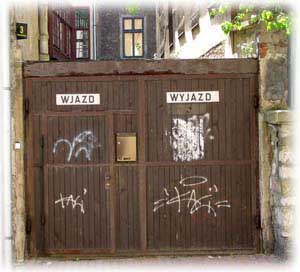
wjazdvyazdvehicular entrance
wyjazdvy-jazdvehicular exit
   
wyk?advi-kwadlecture
wk?advkwadrefill
   

The most troublesome is przesz?o?? // przysz?o?? โ€” when explaining grammar in Polish to first year students, one slip of the tongue and suddenly you have some momentarily confused students. "But I thought this was a pasttense, not a future tense!"

Of course if you're driving, wyjazd/wjazd might be disastrously confusing . . .


All quotes are from Polish: An Essential Grammar by Dana Bielec, as well as details about declension. (You don't think I could have written all stuff off the top of my head, do you?! I can't remember all the details, and that's why I speak Polish like an idiot.)

Information about verbs comes from Prawie Wszystko o Czsowinku (Almost Everything About Polish Verbs) by Dorota Drewnowska and Ma?gorzata Kujawske, as do the declension examples with Bill Clinton.

Both are excellent resources.

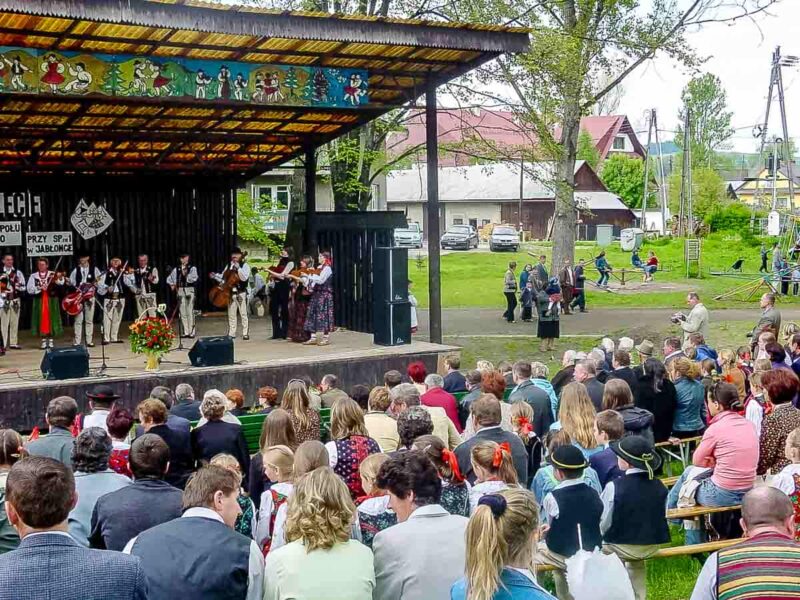
Orawian Dancing

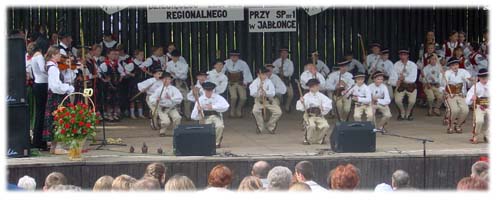
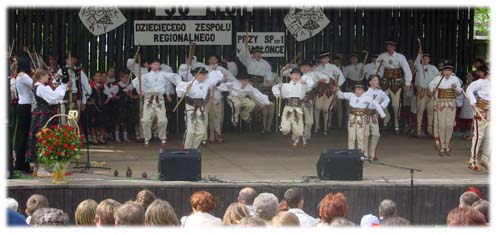
Highlander music is an acquired taste, which I personally haven't completely acquired.

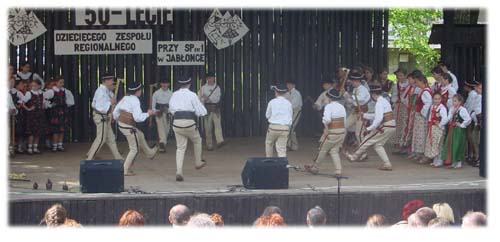
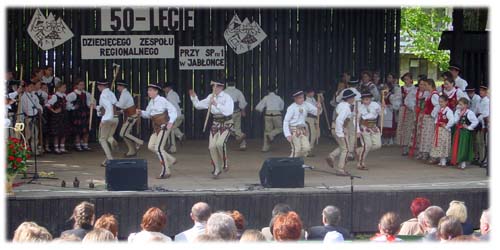
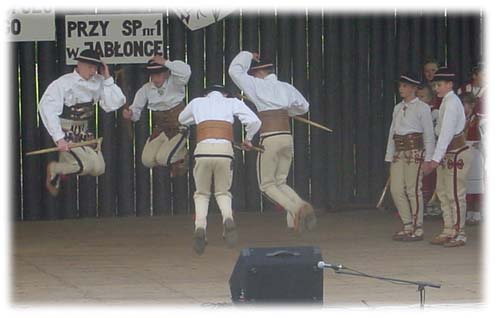
Highlander dancing, though, is a different story. Both graceful and almost violently energetic, it seems to require knees of steel and lungs to match.

Pictured here is the men's dance called "Zbรณjnicki" (pronounced "zbouy-nits-key"). If men were birds, this dance would be struting their plummage. In other words, it's to show their strength, agility, and endurance to potential mates.

Cost of Surviving

I recently bit the cliche bullet and bought a cell phone. It was a question of necessity โ€” having no phone in my apartment, I really had no choice if I wanted any contact at all with the outside world.

A summary of the plans I was offered:

Plan"Free" minutes"Free" SMS'sPrice
Plus 20101030.50 zล‚
Plus 40202042.70 zล‚
Plus 60303054.90 zล‚
Plus 100505079.30 zล‚
Plus 200100100128.10 zล‚
Plus 400200200225.70 zล‚

So I was wrong โ€” it wasn't ten zล‚oty for ten minutes. If only. (Prices include the value added tax.)

Take a look at that first plan: that's 3.05 zล‚oty per minute! And you get a whopping ten of them for that price. Super! "Buy this cell phone plan and you get one free conversation a month!"

Who in the States would pay $3.05 per minute for a cell phone!?! Who in France would pay โ‚ฌ3.05 per minute for a cell phone? What would the public reaction be to such a wonderful, generous offer?

Sitting there across the desk from the squeaky-clean young salesman who looked to be all of twenty-one, I just started laughing and said, "I'm sorry, but these 'offers' are simply absurd. They're jokes."

The reason he gave was simple: of every zล‚Plus GSM (the cell phone company in question) gets, they have to pay TKP, the only phone company in Poland (read: monopoly) either 60 or 80 groszy (I can't remember which, though I'm fairly sure it was "only" 60.) Even though Plus GSM is an independently owned company. What do we call that, boys and girls? Mafia? Extortion?

Of course the government is trying to do all it can to stop this, especially considering the fact that TKP is state-owned. They're doing all they can to divest the state of ownership. And stop fleecing the Polish public? Yeah, whatever.

Still, I'm not sure I buy young Mr. Squeaky's argument. So they have to give 60% of their income to TKP โ€” so what? Cell phone systems don't have lines they have to maintain. They don't have big switching buildings. And Plus GSM doesn't really have a lot of offices. It's 60 grosz per dollar, not per minute (as it was explained to me), so that has no effect on the price per minute, simply on the company's net earnings. Giving 60% of their profits to the government is a sorry excuse for not offering a better plan.

All of this simply makes me realize anew how much better some things are in the States. Regardless of how they got better (a fraction of the world's population taking the lion's share of the resources โ€” true of the West in general, I realize), the fact is, Americans economically have it better than most people even in Western Europe.

When I originally wrote this, gas cost about 3.50 zล‚oty a liter. Upon entry into the EU, it jumped, within a matter of two or three weeks, to 3.90 a liter.

An excellent example of this is gas. I've no idea what the price of gas is in the States these days, but I'd hazard a guess that even if it's "ridiculously expensive," it's not even close to $2.00 a gallon. Here, gas costs about 3.90 zล‚oty a liter. That would be almost 12 zล‚oty a gallon. Remember โ€” an average monthly salary in Poland is about 1,500 zล‚oty. Converting the sum directly to dollars (i.e., $1,500), that's a lower-middle class income, which means the buying power of a zล‚oty for me here in Poland would be the same as the buying power of a dollar in the States. All that being said, imagine if the price of gas jumped up to an equivalent level? What would happen? What would be the general public reaction to having to pay over $100 (at $12 a gallon) to fill up your car?

Compact discs provide another excellent example. To determine the price of a CD in Poland, take the price in America, find out the dollar/zล‚oty exchange rate, and convert the price to z?oty. Simple. In other words, CDs here cost about 60.00 zล‚oty. How many CDs would you own if each one cost $60?

Entry into the EU has indeed caused the prices to go up, but it is taking a bit longer than expected.

Entry into the European Union in about seven months is supposed to make prices go up even further. A pack of cigarettes now costs about 5.00 zล‚ (depending on the brand โ€” that's an estimated average) and rumor has it that the price will double come May.

This has me particularly worried because, though I only rarely smoke a cigarette while having a beer, I do enjoy a pipe. My favorite pipe tobacco, Dunhill's "My Mixture 965," already costs a fortune: 33 zล‚oty for 50 grams. If that doubles too, then I might find myself out of a hobby. (And all the better for it, I'm sure some might say.)

Cheating in Poland

Though I was previously warned about it in Peace Corps teacher training sessions (and it was probably even mentioned in “cross cultural” sessions), I was shocked at the level of cheating among students in Polish schools. Simply put, ninety-nine percent of students here will cheat in any and all perceived opportunities. They will whisper to each other; they will attempt to peak in their books; they will write on desks before a test; they will hide cheat-sheets in more places than you can possibly imagine; they will write on their hands, arms, and legs; they will copy their homework from each other โ€” and that’s just the stuff I’ve caught them doing.

It is, though, a cultural difference. They don’t even see it as cheating, but more as “helping.” Intellectual honesty is, in my experience here, hard to come by. Cheating begins in elementary school and continues through university and into the workplace.

Two examples show the tolerance Poles seem to have for cheating:

  • A friend was working on a development project in the north of Poland some years ago. Individual cities wishing to participate in the project had to submit budget proposals. One town copied another’s proposal.
  • A high-ranking minister (I believe in the Ministry of Education, if memory serves) admitted to having plagiarized his doctoral dissertation some years earlier. It was deemed “excessive” punishment to revoke his doctoral degree, though I can’t remember what ultimate punishment was.

It’s no wonder, then, that students cheat. It seems to be in the blood.But how do they do it?

To begin with, they talk. Literally, if I turn my back for one moment a murmur spreads across the classroom. But I usually watch them like a cliche hawk (no reading books whihle they’re taking a test here . . .), so they have to resort to written methods.

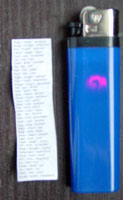
The most common method (aside from writing on hands) is to make cheat sheets what are then hidden in shirt sleeves, taped to the knee (if it’s a girl wearing a skirt), taped to the inside of clothing, or numerous other places.
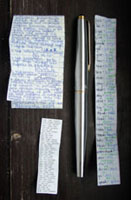
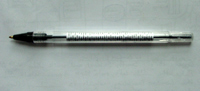
Another place students like to use these little “aids” is in conjunction with a pen. A little unbelievable, but here’s the proof:


There’s two methods: the cruder form is simply to take the small, virtually illegible sheet on the outside of a pen. The more sophisticated way is to put it inside a pen with a clear casing.

Whenever I happen to find these, I keep them โ€” so there’s at least a minimal consequence to cheating: loss of a z?oty.

Despite my best efforts, I can’t seem to stop this. I might have better luck trying to get my friends to give up smoking and drinking. It doesn’t matter than I have a zero-toleration policy, that I remind students of beforeevery test or quiz. Students know that there’s no questions asked, no arguing tolerated, and begging is ignored โ€” they cheat in any form and I fail them for the assignment.

And still they cheat.

Usually I’m remorseless about failing them. After all, I’ve warned them repeatedly. But sometimes a usually hard-working, generally honest student (in other words, someone I really like) cheats. And that’s when it’s difficult to fail them. But I do, explaining my desire not to show favoritism and be fair at all costs.