Matching Tracksuits

fun in fours

religion

Any posts about religion are my views alone and do not represent any attempt to de-convert anyone.

Two Problems

I've been working on my own "Why I Am Not a Christian" a la Bertrand Russell's piece of the same name. There seem to be two logical problems Christianity encounters from the very beginning before taking anything else into account.


The two main issues I have with the Christian worldview are the problem of suffering and the nature of Christian salvation. The best way to highlight these problems is to reframe them in strictly human terms to see how much sense it would make for humans to do what the Christian god supposedly does.

The problem of suffering is simple: if there is a loving god who is omnipotent, it would want its creatures to live free of meaningless suffering. There is meaningless suffering in the world. Therefore, this god is either not loving, not omnipotent, or doesn't exist. Christians will likely quibble over the definition of "meaningless suffering," pointing out that that it is a value judgment and that we are in no way to determine if a given example of suffering is meaningless or not (that's their god's decision). Here it becomes useful to put it in concrete human terms: put simply, if I had the power to stop a child from being raped, I would. No questions, no hesitation: I would just stop it from happening if I could. If I had the power to stop a child from starving to death, I would. If I had the power to stop a child from being beaten, I would. The god of Christianity doesn't stop these things from happening. In fact, the supposed representatives of this god are all too often the ones inflicting this suffering on children.

The common apologetic response here is to suggest that the Chrisitan god's ways are not our ways, that we cannot know what good can come from this suffering. That might be so, but that supposed good that can somehow justify the evil and make it in fact a good -- that is merely speculation. What is not speculation is the suffering itself.

In response to this, apologists in turn bring up free will. Their god gave us free will, and we can use it, or we can abuse it. Their god lets us do whichever we wish because to do otherwise would be to limit our free will.

Another example shows the absurdity of this thinking. Imagine you walk in on your twelve-year-old son beating your three-year-old daughter to death with a length of two-by-four. Would you stop it? Of course, you would. But imagine you decide that to do so would be to violate your twelve-year-old's free will, so you let it happen. The authorities find out and charge you. At your trial, you make the defense that, because we all have free will, you are not ultimately responsible and that you were merely allowing your son to exercise his free will. Would the jury accept that defense? If the roles were reversed, and you were on that jury, would you accept that defense?

Thus, reframing the problem of suffering in strictly human terms leads to a strange outcome: we realize that we hold ourselves to a higher moral standard than we hold our idea of a god. We allow a god to get by with things we would find abhorrent in our own behavior by suggesting that we're just not smart enough to see the good that raping a three-year-old can bring.

At this point, the Christian apologist will likely suggest that this is all a moot point anyway because all this is due to the Fall, and then suggest Jesus's sacrifice solves this problem (i.e., the Fall). We might point out that the evil still exists but at least Christians have a way to explain where it comes from: we're flawed in our very nature due to the Fall. Jesus solves all this, the apologists assure us.

What happens when we examine that solution in human terms? Imagine my wife and I have a rule in my home: no one is to spill food while at the dinner table. The penalty for spilling food is three cuts on the forearm with a sharp knife. One night, predictably, my young son spills food. I take his arm and tell him that because of the rules, I have to make three cuts on his arm. However, because I love him so much, I'm going to take that punishment for him. I hand the knife to my wife, and she makes three deep cuts in my forearm. I look at my son lovingly and say, with tears in my eyes, "Do you see, son, how much I love you? I took this punishment for you. This should fill you with an incredible love for me!"

You, as an outside observer, would think all of this is quite absurd. You might question why I had such a strict punishment for such a relatively insignificant "crime." You would likely suggest that it was inevitable that my child would spill some food and ask why I had that rule in the first place. And finally, you would probably think the whole blood-letting for forgiveness was ridiculous: "Why not just forgive the kid if that rule has to be in place?" you'd ask before pointing out yet again that I was the one who created the law in the first place and that it was completely unnecessary to begin with. As for my suggesting that my son should love me all the more because I took his punishment, you'd likely think that it was a highly traumatizing event for my son.

Yet this is just what Christians think Jesus does for them: he takes a punishment that they deserve and in doing so, earns our undying love. However, Jesus is, according to the doctrine of the trinity, God, so this god set the rules himself as well as the punishment. He could have just forgiven us, but for some reason, he's insistent on a blood sacrifice to make up for sins that we didn't even necessarily commit, so Jesus steps in to fulfill that obligation.

At this point, Christians explain that their god would like to forgive us but because of his perfectly righteous nature, he can't. This is some bizarre argument: the nature of this god apparently restricts this god.

Cat Fight

Greg Locke has gone after fellow Evangelical Christian Kenneth Copeland, daring Copeland to sue him and suggesting he’s actually a “ninth-degree Mason.” As an outsider, I find this insider friction fascinating. Locke’s insult is that as a member of a Masonic lodge (and I don’t even know if that’s true), Copeland is actuallyย not a Christian and is instead worshiping Satan.

When you don’t believe in either of the characters, it’s like watching people get into a fight over which is better, Star Wars or Star Trek.

It will be interesting to see how this one plays out.

Thoughts on Hell

Iโ€™ve been in a Twitter conversation with a Christian fundamentalist about hell. What has come to light once again is the Christian double standard regarding hell and Godโ€™s omnipotence. This Christian and many like him suggested God doesnโ€™t send anyone to hell. People choose to go to hell. They choose with their sins, they choose with their blasphemy, and they choose with their rejection of God. And most disturbingly, some will even admit that according to Christian doctrine and the idea of original sin, even newborn babies are deserving of this punishment because of the stain of original sin.

Yeah who determine the parameters that resulted in such consequences? Who determined that transgressions against gods will result in separation from God? God of course. God said all the rules and all the consequences, so why are you might want to try to suggest to ease your conscience that God doesnโ€™t send anyone to hell, he set up all the framers to make that a certainty in some situations.

This Christian continued his argument by explaining that God didnโ€™t Mikaรซl for humans but rather for the devil. Here once again we run into a problem when we accept the idea of God's supposed omnipotence and omniscience. He exists outside time, Christians explain, so he knows all things at all times. That means that when he created hell for the devil, he knew man would eventually end up there as well. But the Christian view creates a surprised God who thinks, "Crap -- that went off the rails quickly! I'd better do something!" My interlocutor explained it thusly:

Can you decide anything yourself? Free will. Man had free will & chose evil. He didnt have to, was warned not to but did anyway. Free will. Then God Himself made the way back. Man sends himself to hell. Your choice.

My response was along the lines above:

God made the consequences of disobedience hell. He could have made the consequences anything. He chose infinite punishment for a finite transgressionโ€”or, thanks to original sin, the transgression of a distant relative of eating a piece of fruit. Perverse.

But he'll likely continue to insist that I just don't understand God's grace, that I don't understand the finer points of the theological argument, that I just don't understand.

And that's another problem: why would a benevolent god make things so difficult to understand, so easy to misunderstand, when eternal punishment is on the line?!

Four Blood Moons

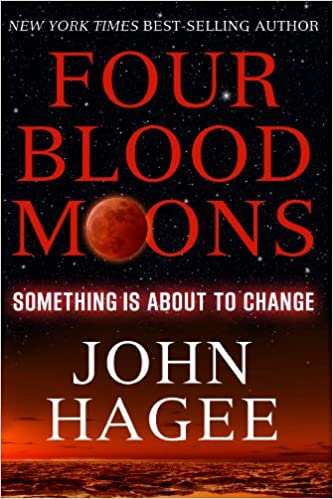
I don’t know why I read things like this. I knew when I reserved it at the library that I was just getting this nearly-decade-old book by fundamentalist nutjob pastor John Hagee to see just how ridiculous it is — to mock it, in other words. Yet since I’m reading a book of primary documents (letters, reports, etc.) from the perpetrators of the Holocaust, I felt I needed some light reading.
The back cover blurb itself was enough to entice me:

It is rare that Scripture, science, and history align with each other, yet the last three series of Four Blood Moons have done exactly that. Are these the โ€œsignsโ€ that God refers to in His Word? If they are, what do they mean? What is their prophetic significance?

In this riveting book, New York Times best-selling author, Pastor John Hagee, explores the supernatural connection of certain celestial events to biblical prophecyโ€”and to the future of Godโ€™s chosen people and to the nations of the world.

Just as in biblical times, God is controlling the sun, the moon, and the stars to send our generation a signal that something big is about to happen. The question is: Are we watching and listening to His message?

It’s rare that Scripture and science align? It’s never happened. Ever. Scripture and history? A handful of times. All three together? Never. Double-never.

But I was intrigued: it sounded from the blurb that Hagee was going to try to get some prophetic meaning out of the positioning of the sun, moon, and stars. That sounds like astrology — one must say that in a rumbling, threatening voice for the full effect. Fundamentalist Christians avoid astrology or anything that looks like it at all costs. So how can a good, Rapture-believing, tee-totaling, fundamentalist, Scripture-literalist have anything to do with astrology?

First, we might want to define astrology. Sure, we allย know what it is, but let’s get a good definition on the table. Let’s Google it and take the first definition: “the study of the movements and relative positions of celestial bodies interpreted as having an influence on human affairs and the natural world.”

Just for kicks, let’s see what astronomy’s definition is, using the same method: “the branch of science which deals with celestial objects, space, and the physical universe as a whole.”

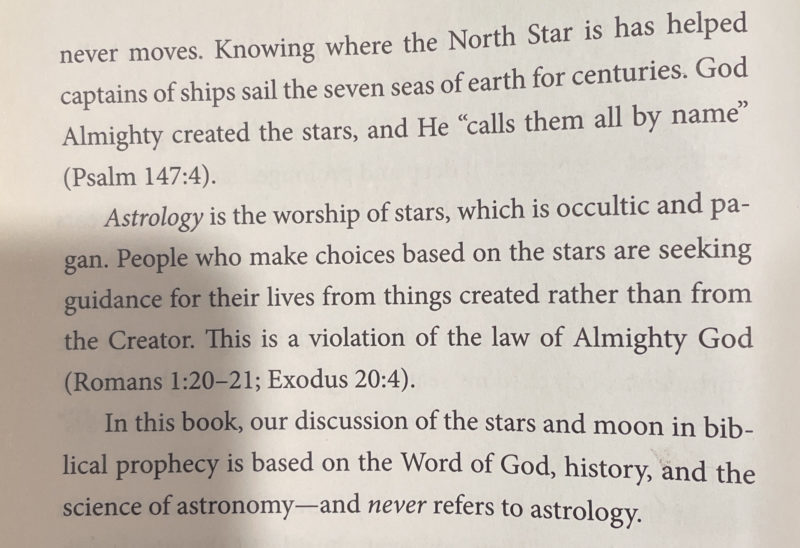
How does Hagee define these?

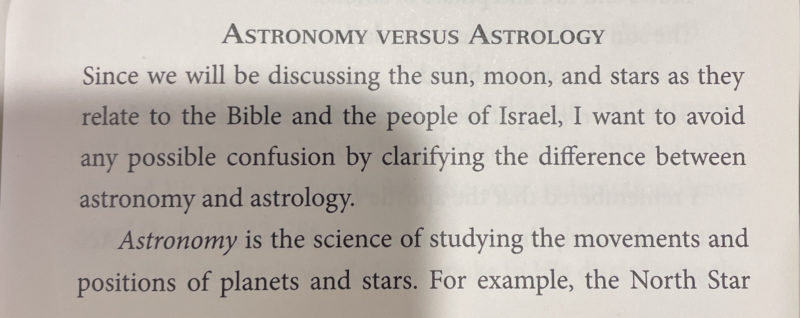
  • Astronomy is the science of studying the movements and positions of planets and stars.”
  • Astrology is the worship of stars, which is occultic and pagan.”

He literally gives the definition of “astrology” for “astronomy.” Don’t believe me (because I’d be skeptical of such idiocy myself)? Here are the shots from the book:

This means one of two things:

  1. He’s completely ignorant about what astronomy actually is, and no one around him corrected him either from deference to his position as “God’s anointed” of their own ignorance.
  2. He knows what astronomy is and is counting on his readersย not knowing how duplicitous he’s being.

Neither option is good.

Holy Saturday 2022

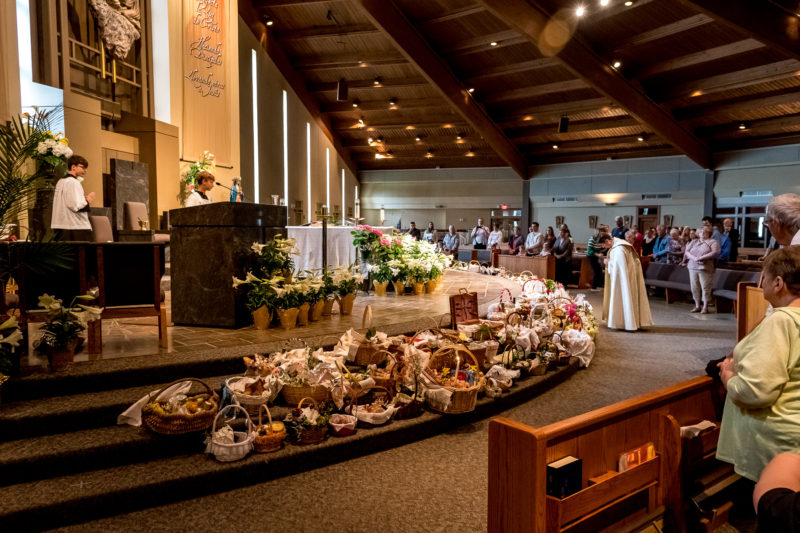
Today is the day in the Catholic liturgical year when Jesus is supposed to be in the tomb. Crucified yesterday afternoon, he was laid to rest according to the gospels in a tomb provided by Joseph of Arimathea. It is this tomb that various people will find empty tomorrow morning according to tradition in the gospels.

Who exactly find the tomb empty depends on which gospel you read. Critics point this out as one of many discrepancies which undermines the supposed factual accuracy of the gospels. Believers have various apologetics to explain away these differences. Thatโ€™s a different issue for a different post. Besides thatโ€™s not until tomorrow. Today is Holy Saturday: Iโ€™m more interested in whatโ€™s going on today according to the gospels.

One piece of “evidence” that apologists like to put forth is the empty tomb, but first, we have to get Jesus in the tomb. What is the evidence we have that he was even buried? Only the Bible biblical narrative.

We do know from other contemporary sources, however, that most victims of crucifixion were not given a proper burial. This was part of the punishment. Your rotting corpse served as a deterrent for others. Furthermore, once burial took place, it was most often accomplish by tossing the remains not eaten by the birds into mass common graves. So we have two major problems with the account in the gospels: first, criminals’ bodies are traditionally left on the crucifixion steak to serve as a deterrent; second, once the remains were buried, they were placed in a common grave. The only evidence that we have Jesus was buried, comes from gospels written 50 to 70 years after he died. Thatโ€™s not terribly convincing evidence, and I would bet that most Christians if this claim were made by another religion where is similar objections.

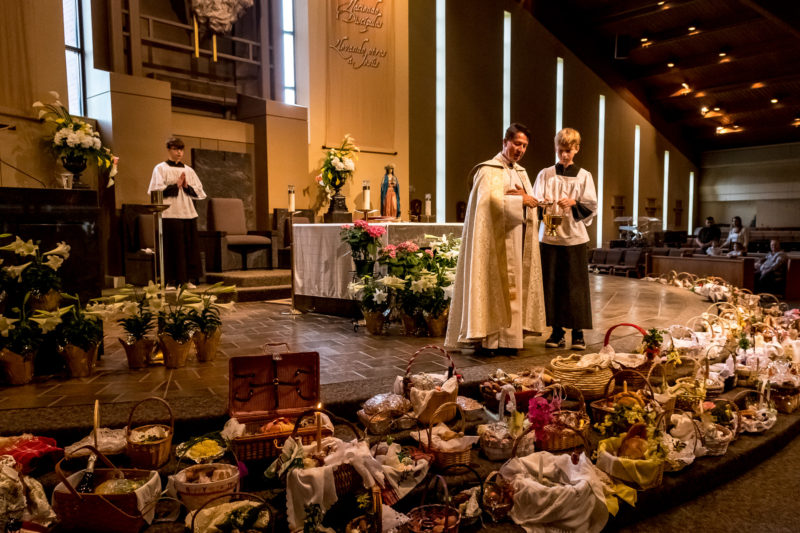
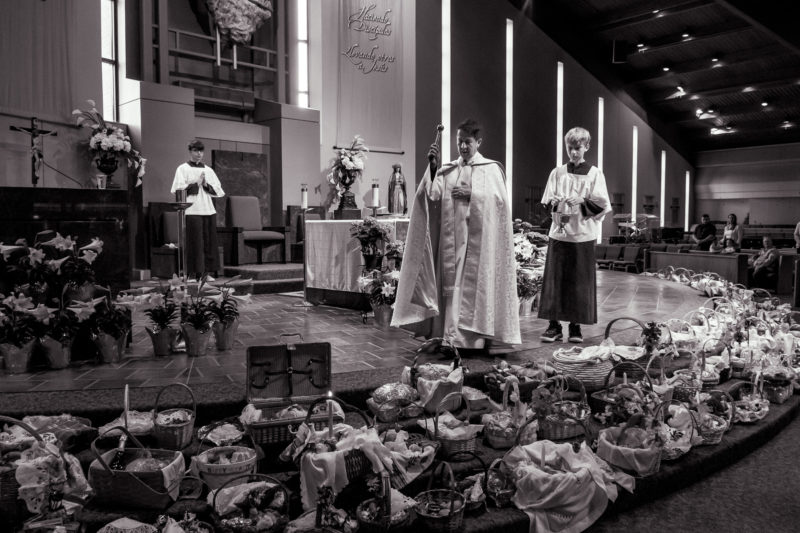
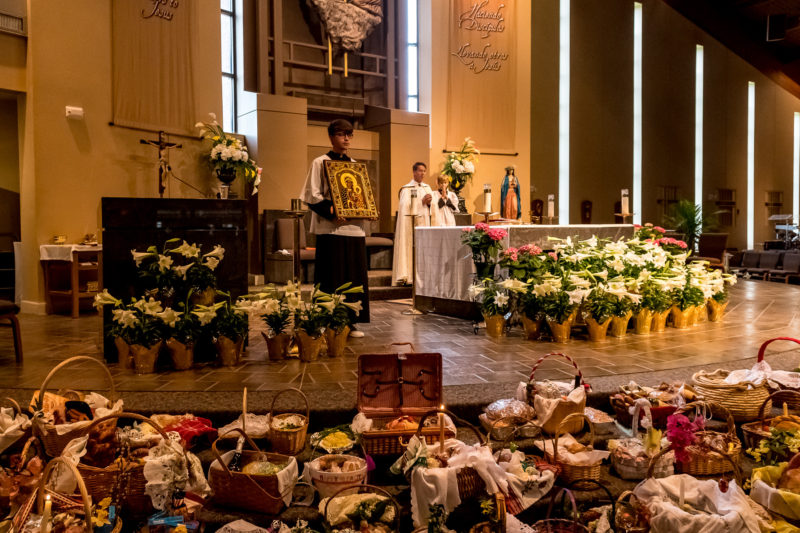
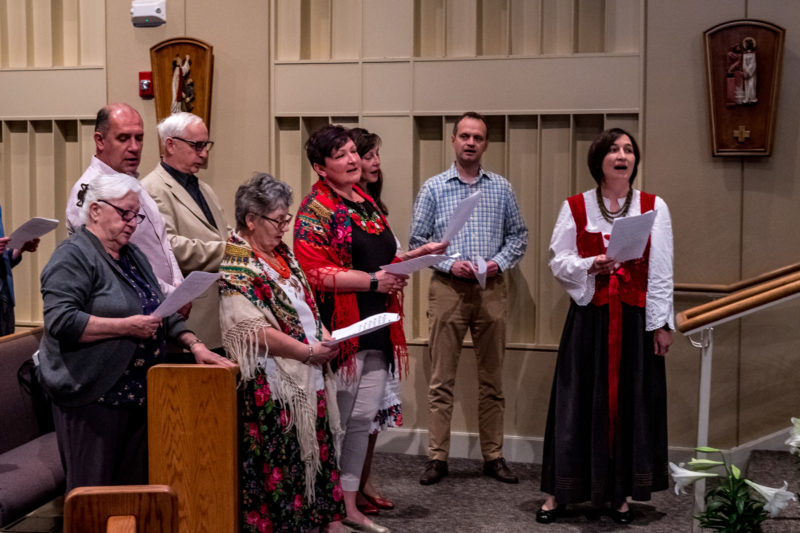
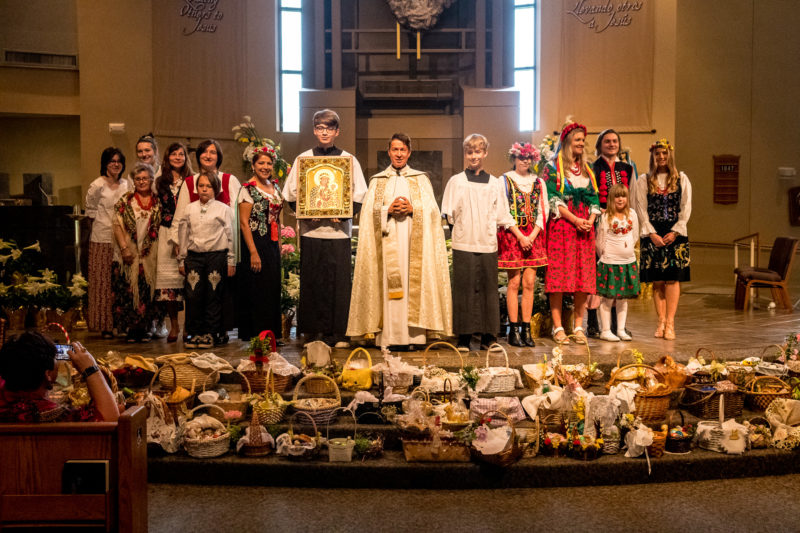
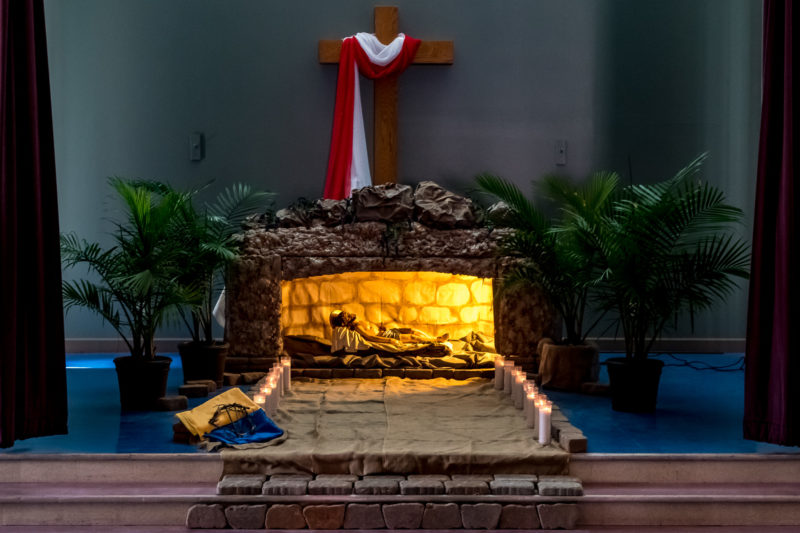
However, most Christians accept this as a simple fact it is beyond dispute, and from this narrative, Catholic secondary traditions have sprung up. Polish Catholics traditionally build a grave in their church and some sort of Jesus figure is placed in it, symbolizing Jesus and Joseph of Arimatheaโ€˜s grave tomb. Local Poles brought that tradition to our area, and the parish pastor has fallen in love with the tradition. So every year, the Polish community creates a tomb for Jesus just like they would do in Poland, and the faithful come and keep vigil with him throughout Friday night and Saturday. Of course, everyone knows that this is simply symbolic representation of Jesus in the tomb, but the fervor with which some people sit and pray in front of this tomb suggests that somehow that symbol has become for them very real. It is as if they are sitting by the actual tomb, which of course likely didnโ€™t even exist. How is this possible?

I think thereโ€™s a certain predisposition among Catholics to turn the symbolic into the real, to suggest with a line between the symbol and the thing somehow blurs, somehow disappears completely. They do this every week with the bread and the wine. Catholic teaching is that this bread and this wine, after some words uttered by the priest, are no longer bread and no longer wine. It looks like bread and wine; it taste like bread and wine; scientific analysis would show that on a molecular level, itโ€™s still bread and wine. None of these things matter. What matters is that the church has taught for ages that somehow despite all appearances to the contrary, this is now the physical body and blood of Jesus. When someone can make that kind of Leap, all other boundaries between symbol and symbolized unnecessarily begin to slip.

All of this is undergirded by the nearly universal notion that our world is it duality. There is a physical; there is a spiritual. Things can exist that donโ€™t seem to exist, that leave no physical trace, they have no physical characteristics, they have nothing. Humans, according to Catholic teaching, are not just physical beings: at our core, we are a soul. This duality then spills into other things, so that we can suggest it bread and wine have a physical existence, but they have some other kind of existence. This is what changes Catholic say.

Of course, this other “existence,” which they call substance, cannot be shown to exist in any scientific manner. It is a philosophical construct. Once a group of people starts to imbue philosophical constructs with actual existence, then literally things that exist only in the head can be said to exist in reality, and in a certain sense, they do exist in reality, for our conscious experience of the world is the only experience of it we have. But they donโ€™t have an external reality, they donโ€™t have a reality that is not dependent on our contemplation of said philosophical construct.

Freedom doesnโ€™t exist outside our notion of what freedom is. Justice does not exist outside of our notion of what justice is. And our notions of freedom and justice and every other philosophical construct vary widely from cultural culture, from time to time, from person to person. And so their existence is completely relative and completely dependent on human thought.

Once someone is comfortable with a squishy boundary between these two things, though, all sorts of ideas that they might otherwise think are silly can become the most profound, the holiest ideas that they hold. And so we end up with over one billion people in the world kneeling before a piece of bread and a bit of wine with the same reverence as if they were kneeling actually before the most powerful being in the universe. We have people shedding tears in front of a tomb that they themselves made that the houses a carving of a crucified man whose existence or might not be questionable but his characteristics, actions, words, and deeds have scant if any real likelihood of being accurately recorded in the one historical record we have of them. Which is to say, because we donโ€™t actually have Jesus here physically with us itโ€™s all in our heads.

Passover

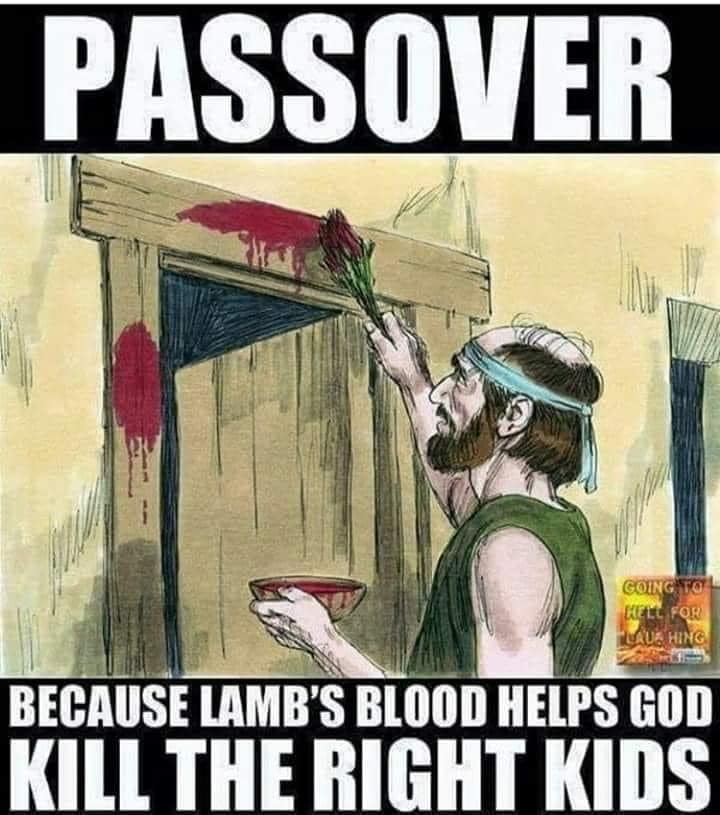
The story of Passover always confused me. The Israelite god is going to destroy all the firstborn of Egypt in order to convince Pharaoh to let the slaves go (after, according to the passage, this same god โ€œhardened Pharaohโ€™s heartโ€ against the idea of releasing his slaves). He commands the Israelites to smear blood above their door in order to receive protection and save their own firstborn. Why in the world did an all-powerful, all-knowing god need the Israelites to smear blood on their door lintel in order to indicate to this god that the occupants were, in fact, Israelites? This so anthropomorphizes this god as to make it laughable. It leaves readers imagining this god moving physically from house to house, door to door, checking to see if thereโ€™s blood, then acting accordingly. Now, granted, I believe the text refers to an angel doing the actual killing, but spirit is spirit, right (in whatever sense โ€œdisembodied mind that has the ability to affect the physical worldโ€ might mean)?

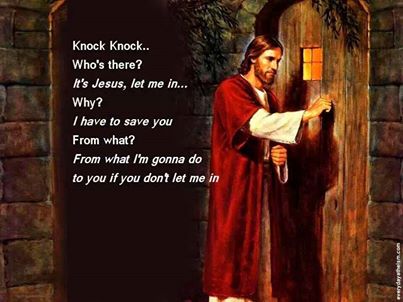
Yet there’s a more brutal way of expressing this confusion:


Image

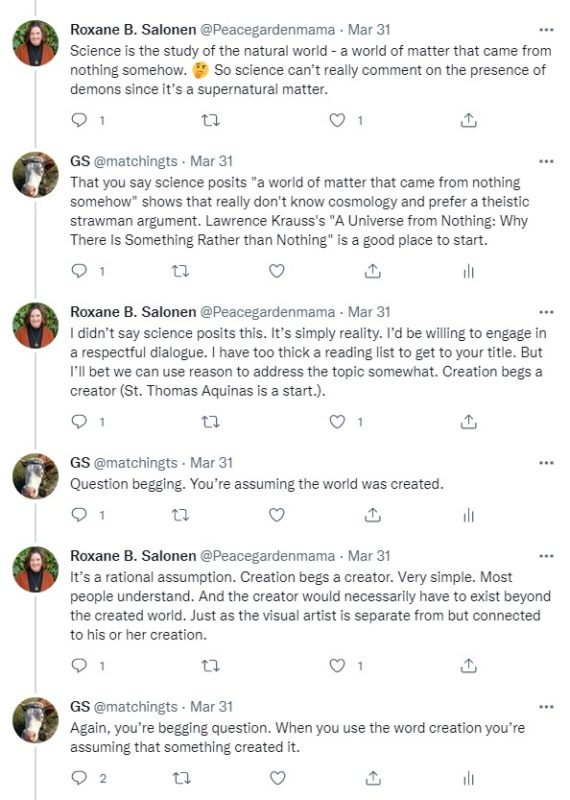
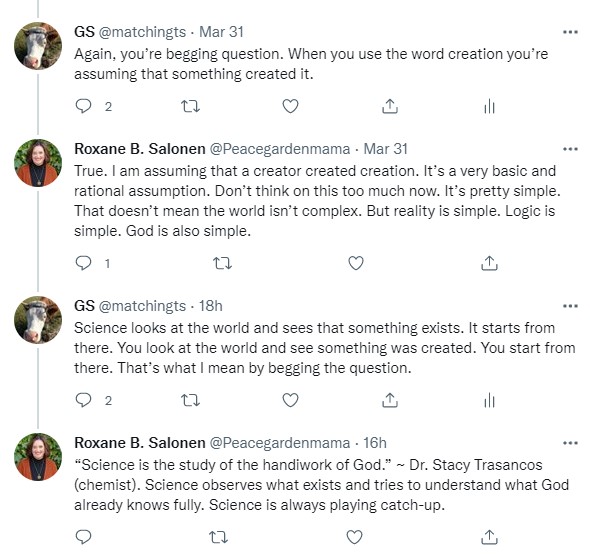
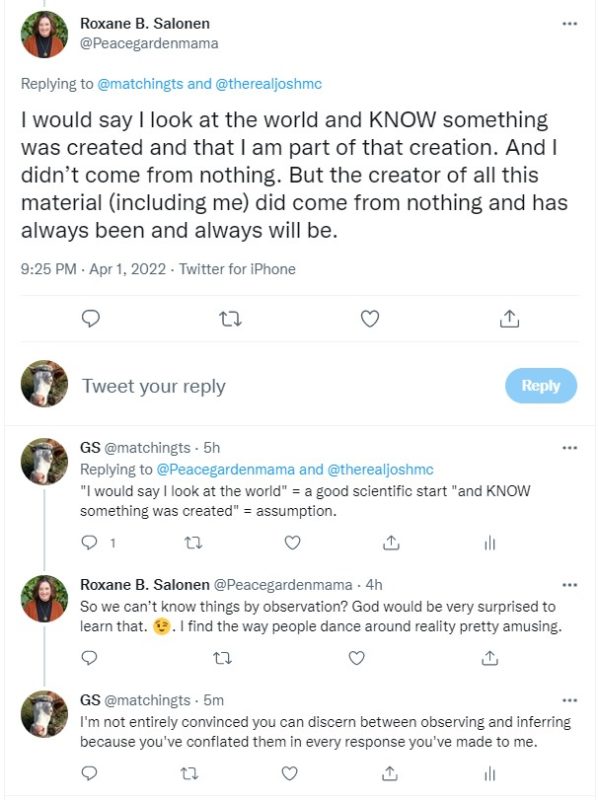
Observing and Inferring

Hard Sayings: First Impressions

I’m currently reading Trent Horn’sย Hard Sayings: A Catholic Approach to Answering Bible Difficulties and at about halfway through, I’ve definitely formed some definite opinions about the book. Most strikingly, I’ve come to realize it’s mistitled. Instead of Hard Sayings: A Catholic Approach to Answering Bible Difficulties, it should be titled The Passage Makes Sense if We Assumeโ€ฆ : A Catholic Approach to Answering Bible Difficulties. That phrase — “The passage makes sense if we assumeโ€ฆ” — is a quote from the book, and it’s indicative of the whole argument. In fact, Horn doesn’t just suggest that we have to assume to Bible is correct to really understand how it’s correct, he says it outright:

[I]t is the critic’s burden to prove that there is a contradiction in the Bible because he is the one accusing the text of being contradictory. All the believer has to do is offer one or more reasonable explanations of how the passages could be reconciled, thereby showing that the critic’s evidence is not conclusive (152).

This is ridiculous: there is nothing to prove with the contradictions. They’re sitting on the page, obvious as the sun in the sky. This passage says X; that passage says not X. There — it contradicts itself. It’s the believer’s burden to explain how it onlyย appears to be a contradiction.

But Horn’s approach makes it possible for him to weave his conditional explanations of problems with the Bible and feel that they suffice. And does this book ever have a ton of conditionals. Within X pages, we read that “Mark may have referred to him…”, that the “name Jethro appears to be a title on par with ‘your excellency,'” that it “could be that the Midianites…”, that “[o]ne way to resolve this contradiction … is to propose,” that “both are probably referring…”, and that “It could be the case.” Let’s make a list of those statements:

  • may have
  • appears to be
  • could be
  • to propose
  • probably referring
  • could be the case

This is an argument of possibilities, all of which are extra-Biblical and simply endeavor to save the Bible for people who want it saved. These explanations are just ways of explaining away obvious problems, and these types of “arguments” will only appeal to those who have already accepted the conclusion. In other words, another possible subtitle could be “Begging the Question.”

Revealing

On one of the Bible-in-a-Year groups that I still follow appeared the following comment:

I’ve been behind…well I actually started on day 5. So I’ve been at least 4 days behind. Today, I got caught up to day 44 and haven’t stop thinking of day 42. I have a lot of friends who are in a same sex marriage, and I just couldn’t accept the thought that my friends who love eachother so much, are sinful. I found this group to see what others thought on the subject; or really what the church’s view really was. I just can’t help but think that God truly loves us no matter who we love. No one chooses to be in a same sex marriage to go against the grain, but with the intention of love! I was really bothered by others not thinking otherwise. I mean, who are we tell other people what God will punish or not?

It’s so unusual to find members of these groups expressing their doubts and disagreements like this. Most of the groups are simply fawning over how great Jesus is, how great the Bible is, how great God is (I know — God and Jesus are supposed to be the same person, but no Christian reallyย thinks of them as the same being in any practical way). To see someone else (someone other than me, that is) saying, “Hold on a tick — this just doesn’t seem to make sense” is fabulous. I had to show some solidarity:

Never will understand this — why is the Abrahamic God so concerned about what consenting adults do to the point that in both the OT and the Koran, believers are commanded to kill homosexuals? One of the biggest things that has pushed me toward exiting the church.

It got a couple of responses, but nothing major. One lady explained it thusly:

You know how in the OT, the objects in the Temple are holy, simply because they were consecrated to God for a specific use? So are a man and a woman holy and their relationship is holy.

When we take something SO Incredibly Holy and use it for our own selfish purposes, it causes SO MUCH Pain to God. We don’t feel our own pain, because it is in our souls, and it is hidden underneath the sweetness of our sinfulness. BTW – it isn’t just a homosexual relationship that is unholy – a heterosexual one can be just as unholy. But a homosexual relationship is sinful inside and out. It is such a deep, deep, deep devaluing of the person of the opposite sex, who has been rejected in favor of a person of the same sex.

First of all, in what sense does could an omnipotent, omniscient, eternal being feel pain? One only has to think about it for half a second to realize the absurdity of it. But this idea of causing the Christian god pain is one of the fundamental ways Christianity encourages feelings of guilt. “Jesus didย so muchย for you, and you’re justย rejecting him?!” First of all, what exactly did Jesus do? He died for a weekend. Second, why did he have to die, according to Christian theology? To pay for our sins. But who defined those sins and defined the consequences for violating those laws? He did. It reminds me of a favorite meme:

Second, the idea of it being “such a deep, deep, deep devaluing of the person of the opposite sex, who has been rejected in favor of a person of the same sex” illustrates how deep this person’s misunderstanding of human sexuality.

Circles and Spirals

I’m reading Trent Horn’s Hard Sayings: A Catholic Approach to Answering Bible Difficulties.ย He speaks of Karl Keating’s argument for scriptural inspiration, saying “when taken as just a reliable human document, the Bible shows that Christ not only rose from the dead, but that he established a Church built on the apostles.” These apostles “were then able to authoritatively declare the Bible to be the word of God.” So the Bible proves the church and the church proves the veracity of the Bible. That’s called circular reasoning, isn’t it? Horn doesn’t think so.

This is not a circular argument, in which an inspired Bible is used to prove the Church’s authority and the Church’s authority is used to prove that the Bible is inspired. Instead, as Keating says, it is a “spiral argument,” in which the Bible is assumed to be a merely human document that records the creation of a divinely instituted Church. This Church then had the authority to pronounce which human writings also had God as their author.

The level of cognitive dissonance in this statement is absolutely astounding. He can assert that calling it a “spiral argument” somehow removes the circularity of the argument, but in essence, he is still using the Bible to prove the Church to prove the Bible. No Christian ever regards the Bible as “a merely human document.” People regard the Bible as authoritative because they see it as divinely authored. I get that this is a distinctly Catholic explanation of things, but no Catholic ever sees the Bible this way, either. It is, defacto, divinely inspired in their eyes. The so-called divine nature of the Catholic church is in no way illustrated in the pages of the Bible, and we still have the basic problem of Biblical error: how are we to know that that particular portion of the Bible detailing the founding of the church is accurate? In short, we don’t. We have to take that on faith. And who is the one explaining all of this? The Church. So the Church says the Bible is just a humanly written document that proves the Church is divinely inspired, which then proves the Bible is not just a humanly-written document.

It’s almost as convoluted as God impregnating Mary to give birth to God to die to appease God’s anger, which is the story of Christianity in its most simplistic form.