Matching Tracksuits

fun in fours

religion

Any posts about religion are my views alone and do not represent any attempt to de-convert anyone.

Exchange

But God is NOT a commanding officer, now is He??

Of course, he is.

Who made him commanding office? One of higher authority had to do so. So who was it?

Don't be silly with semantics. You know what I meant.

As you do mine. God IS and IS in command. So why do you rebel against your commander? And don't pull this crap that He's not YOUR commander.

But he's not. Sorry -- had to pull it.

What any rebel should say. Any treasonous rebel. Any delusional, treasonous rebel.

I'll bet you just can't wait to be in heaven watching me writhe in hell, right?

But what about YOU??? Evidently you wrote and then deleted. Afraid of your own lie? Yeah it's hard work figuring new ways to ignore truth. Why are you avoiding the issue?

I originally said that there's no hate like Christian love. You're a great example of that. Then I thought you'd probably say something like, "I look forward to watching you roast," or some such nonsense. I'm not afraid of anything; I'm not ignoring the truth; I'm not avoiding any issues. I just don't believe. But I'm not dripping with only slightly concealed hatred like you are.

Why is it "hatred" to say you are a rebel against God? Or why is EVERYTHING that is a contrary view labeled "hatred" by you people?? It's like the only verb you know.

So many Christians can't see themselves as others see them. It's a form of hatred because it's a judgment made on a personal standard that insinuates that joy I suggested you feel when you contemplate me in hell. It suggests that you will stand in judgment alongside your god and say with mock sadness, "Lord, you know best, but of course, I can't say anything about this miserable wretch other than to say he's rebelled against you -- which of course you already know, Lord," all the while anticipating getting watch me get my dues. "I told you so!" you can say. So on second thought, perhaps it's not hatred as much as childishness.

And how others see is always right and correct, huh? So we must cater to what YOU think? How bout non-Christians can't see themselves the way God sees them? And once again, the unbeliever makes a shambles of Christian doctrine while congratulating himself in his mockery. Dude…we were ALL rebels. We say nothing about you that we couldn't say of ourselves.

"How bout non Christians can't see themselves the way God sees them?" -- See? You're speaking for your god, standing by his side and passing judgment, eager to see your so-called enemy cast into the flames. As for "And once again, the unbeliever makes a shambles of Christian doctrine while congratulating himself in his mockery." -- I don't even see where that came from. I watched a couple of your videoes, so I know you have a real persecution complex like so many Christians, and you'll read into things persecution that's not even there, but I wasn't even talking about any Christian doctrine. I was talking about your attitude. This whole thing started with me making an off-hand comment about the Christian god being a sort of commander-in-chief (You know, like "Onward Christian Soldiers"?), and you've blown this up into -- I don't even know what. I'm just shaking my head in disbelief: I don't get you or your attitude. I never said anything derogatory about Christians or Christian beliefs. I just made a silly comment. Calm down, man. This has gotten way out of hand: you're frothing at the mouth.

No I'm nailing you to the wall for bring so flippant. You make it sound like you're not even referring to Christianity. Liar. Persecution complex? Not here, bud. You don't know what that is anymore more than you understand rebellion.

I read that imagining John Wayne was saying it. Very effective.

Please identify this "hate". You make reference to it but do not state what you consider hateful.

I did. A few comments ago. (That comment didn’t sound so great in a John Wayne voice. I was hoping for more “nail you to the wall” kind of bravado.)

Genocide

The commands to genocide in the Old Testament are particularly troubling for most people except for the most basic, literal-thinking fundamentalist (Protestant or Catholic). For them is simple: God said it, so it's morally right. Most other Christians take a little more nuanced approach -- at least the ones who know about the passages and want to deal with them honestly.

Capturing Christianity -- a YouTube apologetics channel -- invited Dr. Randal Rauser, who describes himself as "progressively evangelical, generously orthodox, rigorously analytic, [and] revolutionary Christian thinking," to discuss the troubling passages. He wrote Jesus Loves Canaanites, a book that deals with the various Christian attempts to explain these passages. I listened to the interview on my run this evening, and two things stood out.

How do we make sense of the fact that God is supposed to be love and yet he commands all these awful things? Surely this creates some cognitive dissonance that Christians want to deal with. How do we deal with it?

Rauser explains that, in dealing with these passages, Christians need to "develop different reading strategies to minimize the cognitive dissonance that is created when we read these passages." Earlier he mentions a new convert who discovered these passages and found them troubling, and Rauser suggests that new converts who haven't been "inculcated" with these reading habits might find these passages to be stumbling blocks to their faith. It's interesting that he uses the word "inculcated" because the definition Oxford is "instill (an attitude, idea, or habit) by persistent instruction." Persistent instruction -- drilling this into one's head. So in order to deal with these issues, one has to have drilled into one's head certain reading habits. What are these habits?

One of them is to ask if a given interpretation develops a love of God and man. If it doesn't, it's not the intended interpretation. But this puts the cart before the horse: one should not have to read the Bible with an ideal interpretive framework in place that automatically defaults to erring on the side of the Bible. That's not critical study; that's mindless acceptance.

Another reading technique is to apply what we know about God and ask if a certain interpretation reflects that.

He uses the extreme example of Dena Schlosser, who in 2004 used a knife to amputate the arms of her eleven-month-old baby because it was a sacrifice God had asked her to make. Rauser insists that

the vast majority of people today, we don't even give it a moment's consideration that God possibly willed such a thing to happen because we believe it is fundamentally inconsistent with who God is. And we would say, maybe she was influenced by a demonic entity or she is mentally ill, schizophrenic or something else, but what we don't think seriously is that God maybe or possibly commanded that.

Yet I don't see why we can't imagine God commanding that: he did command Abraham to do just the same thing. If we're going to accept that Abraham was justified in what he did, we have to at least consider that Schlosser was justified in what she did. After all, who are we to say that God wasn't talking to her?

But of course, we will say that because it's the only thing we can say. To suggest that God might be getting back into the business of having people slaughter each other at his bidding opens up such potential chaos and terror that it's unimaginable.

A favorite question of skeptics when the story of Abraham and Isaac comes up is to ask the Christian, "What would you do if God commanded you to kill your child?" Most Christians will hem and haw and suggest that they'd have themselves checked into a hospital to check for mental illness and yet at the same time deny that possibility for Abraham.

I commend Rauser for dealing with the issue, but like Trent Horn, he seems just to be offering possible ways out that allow a Christian some breathing room from the crowding cognitive dissonance that rattles thinking Christians' faith.

Strawman

This whole discussion starts with a sort of ad hominem attack on Harris, suggesting his view is "naive" and (later) silly. That's amusing since all Harris was doing was paraphrasing the basic core of the Biblical account of the ascension and second coming. There's a literal up motion and a down motion: Up toward the sky for the ascension, down toward earth for the second coming. All this "vast" and "rich" and "nuanced" theory that Davis presents is simply modern apologists' attempts at recasting these events in a way that doesn't so clearly contradict science. The fact is simple: for most of Christian history, a literal upward motion to heaven above us and vice versa was the only understanding. If you're criticizing Harris's view, you are in fact criticizing the Biblical account. All the theories Davis presents are simply speculative apology that has absolutely no support in the Biblical text.

Sapiens Thoughts

I've been reading Yuval Harari's Sapiens, and two early passages have led me to see religion in a whole new way. Unfortunately, neither epiphany is ultimately flattering for religion, but at least one thought from the book got me thinking that religion was a useful tool in our development.

The first realization comes from the argument religionists make about the existence of morality being ultimately due to the existence of a law-giver that created a conscience in us all that is somewhat similar. Murder, theft, and lying seem to be universally bad -- how could this be unless some god "wrote that on our heart" to use a Christian apologist metaphor. Harari points out, however, that because we Homo sapiens walk upright, our hips have to be narrower, which led to an evolutionary preference to earlier birth. But human babies need much more care and development time than babies of other species, and this necessitated help from others. This need, in turn, led to evolutionary selection for people more likely to cooperate and live together peacefully. And this would eventually result in a moral system that prized compassion and cooperation -- without the need for a god.

The second realization came from Harari's contention that Homo sapiens development into a species that can coexist in large groups, much larger than our closest evolutionary relative, the chimp, has to do with our ability to use language to describe things that aren't actually there. To create fiction, in other words. He writes, "Large numbers of strangers can cooperate successfully by believing in common myths." He continues,

Two Catholics who have never met can nevertheless go together on crusade or pool funds to build a hospital because they both believe that God was incarnated in human flesh and allowed Himself to be crucified to redeem our sins. States are rooted in common national myths. Two Serbs who have never met might risk their lives to save one another because both believe in the existence of the Serbian nation, the Serbian homeland and the Serbian flag.

This common myth enables large-scale cooperation that doesn't appear in the societies of other apes.

The problem, though, is that we are at a point in our development in which the competing myths can go to war with each other with catastrophic effects for the entire plant...

Friday Night Football

When I was in high school, Friday night football was, during the beginning of the year, the highlight of the week. Everyone would arrive early to stake out their seats and make sure all the lowly freshmen got the worst seats. Friends saved seats for each other, and had cell phones existed then, they likely would have been texting each other, asking where they were, demanding that they hurry.

All the students went to cheer on the team, to hang out, to escape parents, to escape the everyday. The cheerleaders led everyone with raucous, taunting chants, and the marching band took the spotlight during halftime. The football players looked, and probably felt, a bit like stars.

My next-door neighbor played on the football team, and though we were not close, I'd wish him luck with the game if I saw him that day. The neighbor across the street also played, but even though I was closer to him than my next-door neighbor during our childhood, by the time we reached high school, we rarely talked.

Win or lose, spirits were always high. While everyone wanted the home team to win, it wasn't just about the game's outcome. It was about the friendship and closeness that everyone experienced.

At least I'm assuming it was, for I never went to a Friday night high school football game as a kid. Not once. It was in part because of a lack of desire, I suppose: football was never really something I loved except for a short couple of years when I was in second and third grade. (Or was it first and second grade? Or third and fourth grade? Hard to remember.) The main reason I never went was because it was off limits: growing up in a sabbatarian sect, we observed Friday night sundown to Saturday night sundown as the Sabbath, and all worldly cares and events went by the wayside. A Friday night football game was most certainly out of the question.

I never really wanted to go, but I wouldn't have been able to even if I did want it.

Or I tell myself that. Could my inability to go, my knowledge long before I could develop a desire to go that I would never be allowed to go, my certainty that there was something deeply and spiritually wrong with going to watch a football game on Friday night -- could that have tempered my desire before it ever developed?

I tell myself that I would not have felt comfortable there even if I did go because most of that crowd -- the in-crowd, the popular crowd -- felt uncomfortable. But why? If I'm honest it's because I was always distancing myself to begin with: I knew I could never really do any of the things they did on the weekend even if I was invited, even if they begged me because they thought I was the most amazing person to be around, even if I were king of homecoming (which I could have never been because, well, it's probably obvious). I'd never been terribly close to any of them outside of school (and perhaps playing in the neighborhood after school) during elementary school, and that moved with me into junior high where it settled into a sort of permanent quasi-outsider sense that I carried with me into college.

So at tonight's high football game -- the first I, at nearly fifty years old, had ever been to in my life -- I found myself wondering how different my light might have been if I had not grown up in what can only charitably be called a sect. I'm not bitter about my childhood; I don't regret that life; I appreciate what I got in return for Friday night and Saturday events.

But I still can't help but wonder...

A Short Response

I've been listening to a discussion between Alex O'Connor, an atheist, and Trent Horn, a Catholic. At one point, an audience member asks Horn a simple question: what level of evil would have to exist in the world for you to think that perhaps it's an unjustifiable level of evil that thus counts as evidence against the existence of a god. His answer was revealing, so I made a one-minute response video.

Here's the whole discussion:

Belief Revisited

It's a quote I've used twice here:

[Belief] may be the battle of your life, but emotionally and intellectually, it could also be the most exhilarating one you’ve ever engaged in. Whether you experience God’s reality or are just intellectually intrigued by the idea, God can be a very real force in peoples’ lives – spiritual, emotional, supportive – that almost no other system can offer. But you must gird yourself for a fight and know that you’re going to have to try to reconcile very difficult things. Or at least hold them in suspension and bounce them back and forth and get tired. There’s no quick fix, but we have the benefit of drawing on thousands of years of religious thinking. You can’t learn it over a weekend. It’s an engagement for the rest of your life.

Burton Visotzky

I originally included it while discussing Winifred Galligher's Working on God, in which it's originally quoted.

I also reposted the quote on its own a few years later, undoubtedly just to have an easy way out of keeping up some artificial posting streak:

In some ways, I think I admired that quote, but now, I view it so very differently.

Visotzky writes that believers are "going to have to try to reconcile very difficult things. Or at least hold them in suspension and bounce them back and forth and get tired." I originally read this very ambiguously, not really thinking about what exactly one must reconcile. As I've returned to my skeptical positions of the past after a sojourn in faith, I see it simply: you're going to have to reconcile contradictions or ignore them. Contradictions between faith claims and scientific claims. Contradictions between various faiths' claims. Contradictions between claims of omnipotence and omnibenevolence and the evil we see around us. Contradictions within traditions' holy books. You might "get tired," he suggests. I think that's what happened to me: I got tired of the continual cognitive disonance.

Far from being a wise quote, I see this now as the dysfunctional heart of faith itself: it's seeing one thing that has an abundance of evidence and believing another that has little to no real evidence.

Perspective

Connected to Christ

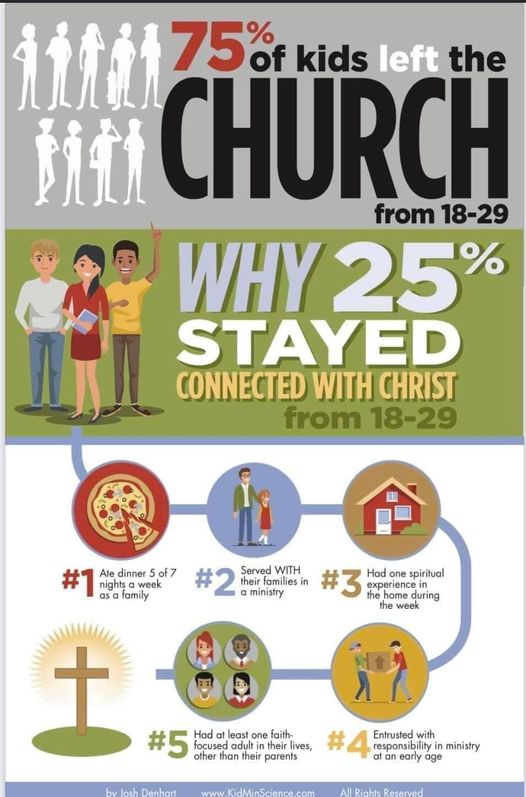
There's an infographic I've seen several times on several social media platforms. It's meant to encourage Christian parents to take concrete steps to make sure that their children stay Christian.

The fact that such an infographic exists let alone that it has gone somewhat viral speaks to the crisis in which contemporary Christianity finds itself. The "Nones" are the fastest-growing demographic in the States. This has a lot to do with the explosion of social media in the last decade. Skeptics have made good use of these media and present opposing viewpoints that churches were otherwise historically able to keep somewhat hidden from young people. No more -- now skeptics are explaining why Christian theology makes little to no sense and young people are listening. Additionally, Christianity's historic position on gay rights and its relative opposition to science (the Catholic Church's weak protests notwithstanding) leave young believers out of step with church teachings.

If they're connected with Christ, why are there so many people involved in this? If Jesus is real and the connection is real, why does it need to be so supported socially? Each one of these is a social connection. Each one is an example of what sociologists call plausibility structures. The more people someone has around them supporting their beliefs, the more likely they are to hold those beliefs.

If we look at the wording of each one, we see that it's obvious how this is using social psychology and sociology to enforce belief systems.

  1. Ate dinner with family
    This is critical for the initial creation of plausibility structures. Doing it five to seven times a week gives it the repetition necessary for it to remain relevant. This will be key for young children.
  2. Served with family in ministry
    Again, doing the same thing together with the same underlying motivation will increase the likelihood that an individual accepts as valid that motivation.
  3. Had one spiritual experience per week in the home
    This one is a little vague: what is that one experience? How do we determine that it is spiritual? Most likely this will occur through the instruction of the parents. This will enforce what children learn in church: that warm feeling you get sometimes when listening to "praise and worship" music or reading the Bible is the Holy Spirit at work. The experience itself cannot be questioned; the cause of it can. This makes sure that that cause always leads back to a deity.
  4. Entrusted with ministry responsibility at an early age
    This begins the transfer from trusting others' interpretation of your inner experiences (i.e., labeling them as coming from a god) to making it your own. In treating you like an adult, you become an adult, and when this is tied to "ministry," that ministry becomes part of your adult identity.
  5. Had one non-familial faith-based adult in life
    Again, this is adding plausibility to the belief structure. Step one (dinner as a family) will work with children; this step will be key for teens, who don't necessarily want to listen exclusively to the family because it's part of growing up. A close relationship with a non-familial adult will help the transfer process from "their worldview" to "my worldview."

I, of course, rose to the bait when this appeared on a friend's feed:

If Jesus is real and the connection is real, why does it need so much social support? These are all examples of what sociologists of religion call plausibility structures: the more people you have around you believing the same thing and suggesting, directly and indirectly, that such belief is plausible and logical, the more likely an individual is to accept that belief as such.

The individual who posted this meme responded:

[H]ow long can one coal burn (even with regular blowing) apart from the rest of the fire? We aren’t closed systems…the World, the Flesh, & the Devil are actively pulling us away from God. Driftwood doesn’t move upstream…it must be acted upon.

It's interesting that this response doesn't deny the fact that these are, in essence, plausibility structures. Instead, the response only highlights it. Sociologist Peter Berger suggests that the only way to maintain a given belief in the face of competing beliefs is to surround yourself with like-minded people. He calls this a "cognitive ghetto." The response posits that just such mental sequestration is necessary to keep out the three enemies:

  1. The World
  2. The Flesh
  3. The Devil

Of course, in such a Christian's worldview, these three can all be subsumed under the last one: the devil. But attributing one's loss of faith when confronted with conflicting viewpoints to the devil does little: it's an untested and unfalsifiable hypothesis without evidence, and as such, it can be dismissed without evidence.

Another person asked,

[D]on’t all relationships require some sort of support to survive? The very word relationship indicates two or more things, factors or people.

I replied:

I just don't understand why a relationship with a supposedly omnipotent being needs support. It seems to me that the omnipotent being could make it so obvious to the believer that it would be folly to reject it. As it is, in my experience with a believer, I only had my own inner experiences and other people's assurances that those experiences were of God.

My interlocutor did not respond.

Who Commanded What

I really don't know why I do it. I follow some of these Catholic groups online for no good reason, I think. Am I there just to pick a fight? I guess.

Today, this one popped up as a joke.

Everyone was laughing about it, so I guess humor is the new way of dealing with the awful things God commands in Leviticus. Of course, I replied: "But both come from God. Both are commands from God. That's the problem."

A user named Joseph responded, "no there is no problem. None of the levitical laws are valid anymore. Thus any command from Chirst is superior."

People just don't get it, though. Jesus might have done away with these laws, but because of the trinity doctrine, it was Jesus who created the commands in the first place. I responded to Joseph:

But the fact that they were commanded in the first place -- that's the problem I'm referring to. That God commanded his people to stone to death incorrigible children, stone homosexuals, stone people for breaking the sabbath -- THAT is the problem. Whether or not he did away with those laws is not as troubling as the fact that he made them in the first place.

At this point, Jesse jumped in to help:

[I]f you listened to the first couple of episodes, Fr. Mike clarified it. Some laws were "allowed", just as what Jesus said about the law on divorce. Also that some must be understood that they were given to a savage, nomadic, tent-living, and with frequent streaks of going astray kind of people who lived thousands of years ago.

I've heard this so many times I'm sick of it. No one sees the problem that the same god who gave us the kinder, gentler Jesus also gave us these commands in Leviticus! In fact, because of the trinity, it's the same being! I tried to explain this:

No, that doesn't fly. God didn't allow those laws. He didn't see them stoning people and say, "Well, I'll let you do that for a while." It was God who COMMANDED the stoning. Why does no one get that distinction?

There were a few more responses -- I replied to them all. And then everyone just stopped responding to me. Questions are unwelcome, I guess, and even more so follow-up questions.