Why Question?

religion
Any posts about religion are my views alone and do not represent any attempt to de-convert anyone.

While jogging this evening, I listened to a video by Prophet of Zod called "Do We Get Offended Because Christians Believe in Truth?" The entire video is below:
It's a critique of another video, this one by Impact 360 Institute, a Christian apologetics organization. The original video is here:
It's a ridiculous caricature of how non-believers view Christians, suggesting that non-Christians feel threatened and offended because Christians believe the things they believe, and these caricature atheists suggest in the name of tolerance that shouldn't be tolerated. It's as mind-numbingly stupid as it sounds.
However, there was a link to a set of questions designed to determine if one is tolerant or not. Intrigued, I went ahead and provided my email address (Gmail will sort out any of the spam the organization sends me as a result) and went through the questions.
The first question is a slow pitch that is based on the premises of the video: atheists are supposedly intolerant in the name of tolerance, and this first question is directed to that assumption. I don't know of anyone who would agree with this.
There is a fairly robust effort, it seems, to shut out voices that college students seem to disagree with, but it seems to be from the students themselves and not from the institute. The passive construction of the statement ("students should be protected") only suggests that it's the college itself that's doing the protecting. From what I've seen, it's the students who raise a stink. Sometimes, granted, the college caves, but often they don't.
Notice the wording: it's saying that people should be able to promote it. Christians will say they have no issues with people advocating it. When it comes to implementing it, though, they will, as we have seen time and time again, vociferously disagree and fight it in the courts. Which leads to the next statement:
This is such a loaded, biased question that it's difficult to know where to start. First, we have the idea that the photographer "should be forced," which makes it seem like a draconian, totalitarian state that's behind it without coming out and saying it. It does this through the use of the passive voice. No one is suggesting that a photographer be forced to do this. If the photographer doesn't want to do it, she doesn't do it. It does mean, however, that can no longer be a photograph because they are denying their services in a discriminatory fashion. Some will say this is the same as forcing, but people have to do things in their jobs all the time that they don't really want to do. It's not, I suspect, that they don't want to "celebrate and memorialize" a same-sex wedding; they're homophobic and don't want to witness this wedding. Fine -- don't. But you can't withhold services because of that. We can frame this racially and see how bigoted it is: "A wedding photographer should be forced to use her artistic talents to celebrate and memorialize a [mixed-race] wedding even though it violates her conscience and deeply held religious beliefs." Suddenly, it looks different -- except that it doesn't.
There's also the word "celebrate." The wedding photographer is not a guest. She's not celebrating anything. She's recording the event. That's it. By doing so, she's not approving or disapproving of it -- she's taking pictures. If she's not willing to provide her services to anyone who wants to pay for them, she needs to find another line of work.
This is meant to help the individual (most likely a Christian since it is an apologetics site) feel good about their religious views: "We're not interested in forcing our religion on others!" Except if you're trying to outlaw (to use the previous example) same-sex marriage, you are attempting to force that particular tenant of your religion on everyone. You're compelling everyone to follow that particular part of your religion.
Talk about stacking the deck: their view is "based on science." "We're just basing our views on science -- how can you argue with that?" Unless we bring up all the science they don't like -- evolutionary theory and global warming come to mind.
Now we're back to same-sex marriage -- isn't that what it's always about? Obviously, parents have the right to teach this, but implicit in this is the notion that they want to be able to support draconian laws to stop same-sex marriage. And that's fine, I suppose: it wouldn't be freedom if you couldn't be free to be a bigot. (Yes, I am aware of the loaded language I just used.)
By the same token, they have to accept that some of us are fine with same-sex marriage and think it might even be -- gasp! -- a question of equal rights.
What an out-of-left-field question! I really have nothing to say about it.
Christians themselves don't seem okay with this. "Why are you trying to push your atheism on us?!" they decry when all atheists have been doing is pushing back on centuries of the majority trying to stop them from "respectfully challenge[ing] the truth of another person's sincerely held beliefs."
That depends, doesn't it? What about snake handers? They claim that three verses in the Bible allow, even call for, the handling of snakes as evidence of faith:
Yet several states have legislation on the books that forbids this. Isn't that a restriction of their right "to worship God according to their conscience or to express freely and publicly their deeply held religious convictions"?
I answered as one might expect a left-leaning moderate atheist to answer. The response:
Congratulations, you are a truly tolerant person! In a culture that operates with a confused view of tolerance that thinks "real tolerance means agreeing that everyone’s moral, religious, or social viewpoints are equally valid and true," you have rightly rejected this false tolerance because it's unlivable. True tolerance respectfully allows others the right to be wrong because we disagree with them. The good news is you have strong beliefs about the way things should be. Continue to courageously and respectfully make your case and let the best ideas win. Is it messy? Yes. But true tolerance is the only way we will discover the truth about questions that matter.
Yet I'm sure in discussion, the makers of this "quiz" would determine that I am, in fact, not tolerant.
I was having an exchange on Twitter (I would say "conversation," but that would be a terribly inflated label given the medium) about my disbelief. "Do you know why the Bible says you don’t believe?" my interlocutor asked.
I was confident I'd hear Romans 1:20: "For since the creation of the world God’s invisible qualities—his eternal power and divine nature—have been clearly seen, being understood from what has been made, so that people are without excuse." It's a favorite among apologists, so I was ready to hear my questioner suggest that I really had no excuse, that I did believe but was just hiding the fact -- probably because I "just want to sin." These moves are as standard as any established chess opening.
Taking that all into consideration, I responded, "I have a hard heart. I refuse to see despite the evidence all around me. Lay the verse from Romans on me, baby! I'm ready!"
Instead, the fellow replied with a verse I'd never really noticed: “He has blinded their eyes and he hardened their heart, so that they would not see with their eyes and perceive with their heart, and be converted and I heal them” (John 12:40).
How could I have not noticed this verse before? This passage presents a positively damning view of this god, and I pointed this out: "He then is responsible. Your god created me, blinded me, then damned me for being blind. Do you guys not see how sick this is? Do you guys not understand it's perverse thinking like this that prompts so many to question their faith?"
I was expecting an explanation for how this can make the New Testament god appear to be heartless and even capriciously cruel, that preventing someone from believing and then punishing him for that disbelief is in fact some unfathomable mystery that ultimately will work to this god's "greater glory" (what an immature, insecure being this god of Christianity is, always demanding praise and worship and smiting those who don't fall in line -- sounds a bit like North Korea). Instead, I got another verse:
But their minds were blinded. For until this day the same veil remains unlifted in the reading of the Old Testament, because the [veil] is taken away in Christ.
2 Corinthians 3:14 (New King James Version)
That "Old Testament" bit sounded a bit strange, so I looked it up to find other translations:
I suspect this translation to "Old Testament" instead of "old covenant" is to create a sense of continuity between the New Testament and what it views itself as replacing in some sense -- a propaganda move, in other words.
Still, I resisted the urge to comment on that (and thus radically derail the topic under discussion) and stuck to the point: "So your god blinds me and then punishes me for being blind. How can you not see how perverse that is?"
He, however, had no qualms about radically changing the topic, which I see as another typical apologetic move. Instead of dealing with what I said, he replied, "I see someone who fights tooth and nail against God. What makes you more deserving? You are already under the judgement [sic] of God."
"It’s like you willfully misconstrue my objection," I concluded.
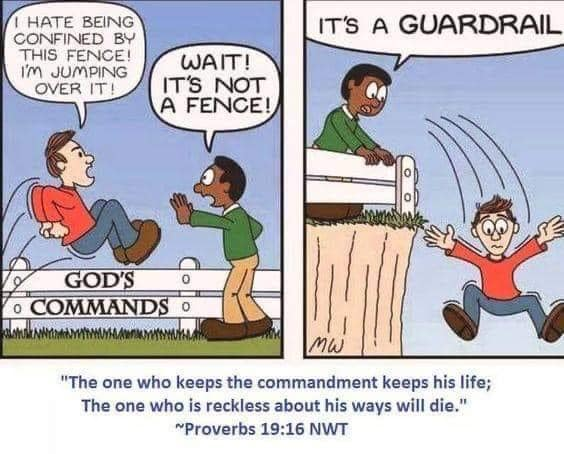
"God just puts these laws in place for our protection!" seems to be a common apologetic response to criticism of the laws of the Bible and the sense of absurdity some of them engender. There's even a cartoon about it.

This is such a silly cartoon -- it shows the absurdity of the argument better than apologists recognize. Most basically, the things that this god's law supposedly protects us from were created by that god himself! He made all the universe, according to apologists. He created all the laws of physics. He created all the contingencies and consequences. In other words, to relate it back to the cartoon, he created the fence ("guardrail") and the cliff. And he put the guardrail right at the edge of the cliff.
To turn it back to Christianity itself, this god created the laws and the consequences for breaking them (i.e., eternal damnation). If it were any other way, he would be dealing with something he didn't create.
This also plays into the idea of Jesus's salvific sacrifice. He's saving us from the consequences of breaking some god's laws. The trouble is, according to the doctrine of the trinity, he is that god! He's saving us from himself.
No matter how many times I point this out to believers, they just don't see it. They bring up free will and all that: "God created us with free will, and we can abuse it and reject God."
"Yes, but this god put in place the laws and their consequences. He's the one sending you to hell and then saving you from it," I reply.
"Yes, but he loves us so much that he sacrificed himself for us, to pay our debt."
"Our debt to him!" I want to scream.
If I am beating a child and then stop beating that child, I haven't saved him any more than the mafia, when receiving payment, is not saving you from anyone other than themselves.
How do they not see this?
Got into a discussion on Twitter with a Christian about morality. I made the point that Christianity invents the idea of sin (the transgression of a diety's law) and then sells the solution (Jesus). My interlocutor quickly moved to the "you have no grounds for morality if you don't believe in a god" argument. I said,
I know what you're getting at. I've seen it all before. It's a tiresome road to travel down. Your god commands the stoning of incorrigible children (Deut 21:18-21), so I don't think believers in the Bible can take the moral high ground as you're trying to do.
The interlocutor replied,
What you just cited was never Carried out. Even the Talmud says this. This was stated by Moses to put fear into GROWN children to obey the commandments to love their mother and father.
To which I responded,
Carried out or not, it was commanded. By your god, no less. You can't deny that. The fact that it wasn't carried out goes against your assertion that morality comes from your god. If it wasn't carried out, it means people realized it's a sick command.
To which she replied,
How could my God command it if he doesn’t exist?
I answered,
Just because I say "Juliet made a bad decision" doesn't mean I have to believe she existed. I'm working within the framework of your holy book. It's that simple.
What I learned from this exchange is the slithery, slimy nature of religious discussions. One topic slides off to another and to still another. Exhausting.
Any time the sky began growing dark with threatening clouds, Babcia would always shuffle to the kitchen, light a votive candle, and place it in a plate of water.
The motivation behind the small plate of water was obvious: it was protection against an unintentional fire. The bottom of the candle could get quite hot, after all -- an entirely reasonable precaution.
The candle itself, though, was to ward off the approaching storm. I'm assuming prayers accompanied the candle, but they must have been silent because the only thing I ever heard Babcia say was, "I must light a candle to keep the storm away."

If the storm never appeared or the clouds dissipated completely, I'm sure this felt like confirmation of the ritual's effectiveness. But it didn't always work. What then?
Looking back on it, this is the same approach Christians take to prayer in general. When a believer prays for something and God appears to have answered the prayer, then it's confirmation of prayer's effectiveness. But what happens when God doesn't seem to have answered the prayer? Most Christians simply move the goalposts.
Let's say a young child runs out into the road after an errant ball toss and gets struck by a car. The child's family rushes out to the child lying on the street, praying all the way. If the child gets up, the prayers were answered: God saved the child from all harm. If the child gets taken to the hospital but survived, the prayers were answered: God saved the child from serious harm. If the child ends up paralyzed because of the accident, the prayers were answered: God spared the child's life. If the child ends up dying, the prayers were answered: God has taken the child into eternal bliss.
This type of thinking persists in the conservative Christian community, and it begins to affect how they view other things. Just look at the followers of the MAGA movement, in particular Mike Lindell and his pronouncements that soon his lawyers will present information that will change everything about the 2020 election. He gives a date by which everything will change; that date comes; nothing changes; he grows silent; after a while, he gives a new date, and the cycle repeats. He's been doing it for nearly two years now, and those who follow him and believe him give him a pass each and every time.
What can we make of this mentality? If nothing counts against a claim, then it's not rational in any sense. Unfalsifiable claims are meaningless, and because they're unfalsifiable, nothing counts against them. But in the case of prayer and the My Pillow guy, they have been falsified, time and time again, and yet believers hold fast. The belief itself, the faith itself, is more important, it seems, than truth.
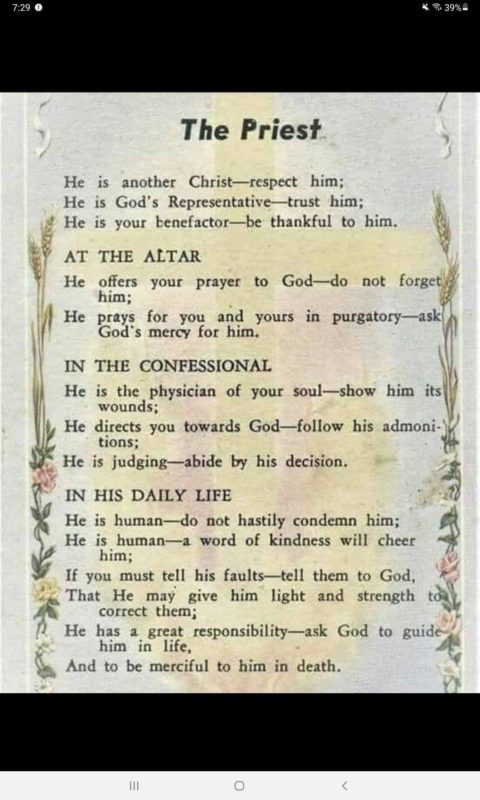
Priests in the Catholic church have always been afforded special status. Priests in Poland have almost god-like status. Why is this? A post on a Catholic social media stream might offer some insight:

If he is "another Christ" and "God's Representative," how could his status increase except by being declared an actual god?
It was a little after six when I realized I hadn't gone to vote. I'd been putting it off all day, spending the day working on our yearbook for 2022, taking the kids on a bookstore outing, and learning that the $3,000 we spent to fix our outdoor HVAC unit was completely wasted. So, a mixed bag.
The line for voting stretched into the parking lot, but it was moving fast. Even if it wasn't, I was going to stick it out: "Vote like democracy depends on it" has been an idea consistently popping up on social media, and I'm likely to agree. The radical GOP (which stands for Gaslight Obstruct and Project) seems determined to destroy our democratic institutions, and their traitorous support of a man who tried to overturn a fair election has made me say numerous times, "I'd vote for Satan himself before I'd vote Republican." Besides, the Republican party of the past is just that: they are, by and large, a bunch of conspiracy theory anti-democracy grifters who take their supporters to be naive children who don't remember what they said five minutes ago.
As I entered the voting booth, I clicked on the option to vote for the entire Democratic ticket, then clicked through the options to check each selection. It was only then that I realized how many races were one-person (usually one-man) races, with only a Republican running. In all of those races, I cast no vote, though I thought about writing in myself.
What an amusing situation that creates, though: so many Bible-belt Christians here are so anti-communist that they see communism where it doesn't even exist. They equate anything left-leaning with socialism, which they in turn equate with the very worst version of it (i.e., the Soviet Union). However, elections in the USSR looked more like elections in South Carolina than Republicans here would probably like: one option, and one alone.
If the modern GOP had its way, that's exactly what they'd enforce.
Apologist Allen Parr posted a video in which he made the following bold claim:
Have you ever wondered whether the resurrection of Jesus really happened? I get it. I mean, how can we know FOR SURE that the resurrection of Jesus was an actual event in human history? Or have we been believing some myth or fable that has been passed down about the resurrection of Jesus for nearly 2000 years? In this video I give you 5 undeniable proofs of Jesus' resurrection.
Video Description
Undeniable?! That's a strong term. Let me see what I can do with them.
Parr suggests that "[i]n order to prevent Jesus' body from being stolen, the Romans took three precautions (Mt. 27:64-66)," which he lists a guard, a stone, and a seal.
According to Parr, the Romans "posted a squad of 10-30 soldiers to protect and guard the tomb where Jesus' body was laid." This suggests that the Romans were worried that someone would steal the body. This seems like a legitimate precaution to prevent theft of the body. In addition, the Romans "placed a stone weighing close to 3,500 pounds in front of the tomb preventing people from coming in or out." Again, a wise precaution if they're worried about grave robbing. Finally, the Romans "placed a Roman seal across the stone that, if tampered with, was punishable by death." This is all very logical.
There's only one small problem with all this: it depends solely on one source, the Bible. This is a problem not because we have reason to doubt that Romans would not have set guards; it's problematic because we have reason to doubt that they would have disposed of Jesus's body in any other way than was customary: a mass grave.
This is a favorite among apologists: Parr asks, "WHY WOULD THEY RISK THEIR LIVES FOR SOMETHING THEY KNEW WAS A LIE?" (The all-caps screaming was from him not me.) Parr's reasoning goes like this: "Before Jesus' crucifixion, the disciples were fearful and ran for their lives (Mt. 14:50). After the resurrection, they became fearless, willing to get beaten, burned, beheaded, sawed in two, stoned and crucified!"
Yet it doesn't follow that the only other option to "Jesus was really resurrected" is "The early Christians knowingly promoted the like that Jesus was resurrected." In other words, this argument rests on a false dichotomy.
Furthermore, there's very little evidence that anyone died because they were Christians who refused to renounce their faith. Certainly, Nero persecuted the Christians, but this was because they were a convenient group to scapegoat. It's not at all clear that Christians could have saved their lives by renouncing their faith. Furthermore, the persecution of the Christians was, at least to some degree, an exaggeration developed later in Christian history to back up the notion Jesus taught that people would be "persecuted in [his] name."
Parr here makes two simple points. First, he says, "The Bible teaches that Jesus spent 40 additional days on earth after His resurrection making convincing proofs that He was alive (Acts 1:3)." Again, the only source for this is the Bible, which is not exactly an unbiased source of unquestionable authorship. Much of the New Testament was written two or more decades after the events it supposedly narrates, and the gospel authors are completely anonymous.
Parr's second point is that in addition "to appearing multiple times to His disciples, Paul recounts when Jesus appeared to over 500 people at one time who were still alive to give testimony at the time of Paul's writing (1 Cor. 15:6)." This is a second- or third-hand account at best and even if they do exist, these 500 are completely anonymous.
Parr argues that if "the Bible was the only book that recorded the resurrection, people might criticize us for using circular reasoning." He insists that "it is well documented in SECULAR history books," then lists two: Josephus, The Words of Flavius Josephus and Thomas Arnold's History of Rome. These are problematic for several reasons, including the most basic being that Josephus didn't write anything called The Words of Flavius Josephus. He wrote The Jewish War and Antiquities of the Jews, and these works appear in The Works of Flavius Josephus. It might just be a typo, but it certainly wears at the credibility. But what does Josephus actually say about Jesus?
About this time lived Jesus, a wise man, if indeed one ought to call him a man. For he was the achiever of extraordinary deeds and was a teacher of those who accept the truth gladly. He won over many Jews and many of the Greeks. He was the Messiah. When he was indicted by the principal men among us and Pilate condemned him to be crucified, those who had come to love him originally did not cease to do so; for he appeared to them on the third day restored to life, as the prophets of the Deity had foretold these and countless other marvelous things about him, and the tribe of the Christians, so named after him, has not disappeared to this day.
Yet the bit about "He was the Messiah" is clearly a Christian addition as Josephus was a Jew and would not have accepted Jesus as the Messiah.
There is a second mention of Jesus in Josephus, but it is weaker than the first:
Having such a character [“rash and daring” in the context], Ananus thought that with Festus dead and Albinus still on the way, he would have the proper opportunity. Convening the judges of the Sanhedrin, he brought before them the brother of Jesus who was called the Christ, whose name was James, and certain others. He accused them of having transgressed the law and delivered them up to be stoned.
It's not even about Jesus but about his brother, James. What's important to note, though, is that neither of Josephus's passages deals with Jesus's supposed resurrection. We might use them to confirm that Jesus existed but nothing more.
As far as Thomas Arnold's History of Rome goes, I'm not even sure why Parr would suggest that this is pertinent in any way since it was published in 1838, a full 18 centuries (or if we're going to put it in the context of the Old Testament, 180 decades) after Jesus's death. That Parr includes this is simply laughable.
After this, though, Par includes a list of "ATHEISTS WHO BECAME CHRISTIANS"
I have no idea why he included this -- it has nothing to do with secular historians confirming Jesus's resurrection.
Parr's final argument is the weakest: the body never turned up. He argues, "If Jesus never rose from the dead, then the Romans could have produced the body, thus destroying Christianity forever." But this assumes that the first-century Romans cared enough about Christianity or viewed it as any threat to do something like this. Remember: this is just after the supposed resurrection. How many Christians were there? How much of a threat did the Romans think they posed? Apocalyptic sects were all over the place: why would they have cared about this particular one?
Parr concludes, "But…the body was never found in the tomb because Jesus rose from the dead!" Or maybe because it was tossed in a mass grave like all other crucifixion victims' bodies.
Parr writes in his "Key Takeaway" that the "reality of the resurrection will not only give you more confidence about what you believe, but also give you the knowledge and ammunition you need to silence those who are skeptical about the Christian faith." If this is the best he's got, I'd advise his followers not use these arguments on any vaguely-informed skeptic.
Dave Pack is at it again. He's predicting Jesus's return within the next nineteen hours:
In case that's not clear, that's tomorrow:
We can forgive him for not having figured it out sooner -- after all, no one else has figured this out:
He's figured out lots of other things, so we should be grateful for that.
He'd predicted this earlier, and it didn't come to pass, but in the end, he was just a day off. A day and nine years:
Still, it's a relief to know the return of Jesus is happening tomorrow.
At least, that's what he said on 17 September...